AI in Telemedicine Market Overview:
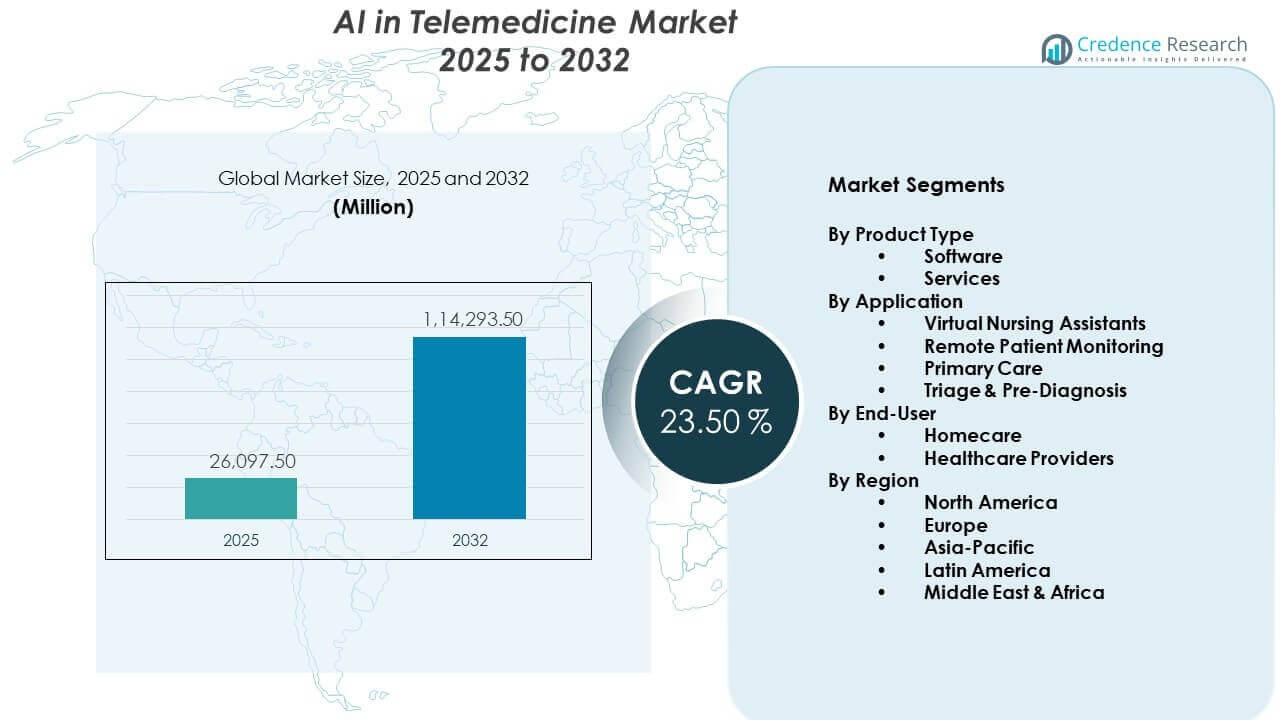
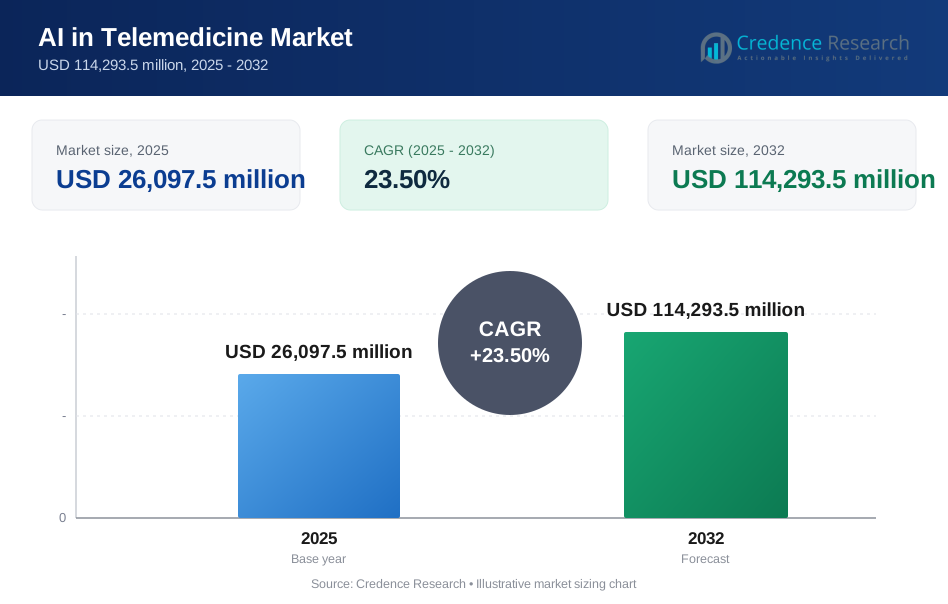
The AI in Telemedicine Market is projected to grow from USD 26,097.5 million in 2025 to an estimated USD 114,293.5 million by 2032, with a compound annual growth rate (CAGR) of 23.50% from 2025 to 2032.
| RT ATTRIBUTE | DETAILS |
|---|---|
| Historical Period | 2020-2023 |
| Base Year | 2024 |
| Forecast Period | 2025-2032 |
| AI in Telemedicine Market Size 2025 | USD 26,097.5 million |
| AI in Telemedicine Market, CAGR | 23.50% |
| AI in Telemedicine Market Size 2032 | USD 114,293.5 million |
AI in Telemedicine Market Insights:
- North America leads with 50% share due to advanced digital infrastructure and strong tech investments, Europe holds 25% supported by public health digitization, and Asia-Pacific accounts for 15% backed by expanding telehealth adoption.
- Asia-Pacific is the fastest-growing region with 15% share, fueled by smartphone penetration, government-led digital health programs, and rising demand for remote care in populous countries like India and China.
- By Product Type, Software dominates with nearly 65% share owing to high demand for AI platforms, analytics tools, and clinical automation systems, while Services contribute around 35% through deployment and support solutions.
- By Application, Remote Patient Monitoring holds approximately 40% share due to chronic disease management needs, while Primary Care and Triage & Pre-Diagnosis together account for nearly 35% driven by AI-enabled virtual consultations.
AI in Telemedicine Market Drivers:
Rising Demand for Remote Healthcare Access in Underserved and Rural Regions
The growing need for accessible healthcare is pushing governments and private providers to invest in AI-powered telemedicine platforms. Populations in rural and underserved areas lack physical access to advanced hospitals and specialists. AI enables remote screening, diagnosis, and monitoring by supporting virtual consultations with intelligent decision systems. It helps fill gaps where healthcare infrastructure is limited. AI-powered triage tools assess symptoms and prioritize care without human intervention. These systems improve response times and reduce unnecessary hospital visits. The AI in Telemedicine Market benefits as more countries deploy such technologies to bridge access gaps. This trend aligns with public health goals focused on equity.
- For instance, Apollo TeleHealth has extended its network to over 20,000 villages across India and implemented a Clinical Intelligence Engine (CIE) that covers over 95% of commonly seen cases in primary care. While the system provides a top-3 differential diagnosis accuracy of over 80%, it is designed to assist doctors in achieving higher clinical outcomes across rural and urban populations.
Growing Burden on Healthcare Systems Due to Aging Population and Chronic Illnesses
A rise in the global aging population and chronic disease burden increases pressure on health systems. Conditions like diabetes, heart disease, and COPD require continuous care and monitoring. AI-enabled platforms automate routine checkups, flag abnormalities, and offer real-time feedback. These systems support clinicians with predictive analytics and help patients stay engaged in self-care. Hospitals use AI for early detection, reducing emergency visits and inpatient stays. Telemedicine with AI also helps manage medication adherence and monitor vital signs remotely. The AI in Telemedicine Market gains momentum by reducing workloads on overburdened hospitals. Payers and providers see long-term cost benefits in these solutions.
- For instance, Teladoc Health demonstrated that its AI-driven predictive modeling within the Livongo chronic care platform delivers personalized "nudges" that resulted in an additional 0.4% mean reduction in HbA1c levels (decreasing from 8.2% to 7.8%) for diabetic participants over a 9-month period, as reported at the American Diabetes Association’s 84th Scientific Sessions.
Supportive Government Policies and Regulatory Shifts to Encourage AI Health Adoption
Several countries have relaxed telehealth regulations and boosted AI health funding since the COVID-19 pandemic. Governments now support AI-driven care models through grants and digital health roadmaps. Regulatory bodies are also updating frameworks to guide safe use of AI in clinical workflows. These actions encourage innovation while protecting patient safety. Interoperability and data-sharing rules help AI models access larger datasets and improve accuracy. Emerging markets are creating public-private partnerships to expand telemedicine infrastructure. Policymakers recognize AI’s role in healthcare modernization. The AI in Telemedicine Market benefits from this alignment with health system reform and national digital strategies.
Integration of AI with IoT and Wearables to Enable Proactive Virtual Care Models
The use of wearables and smart medical devices is increasing across fitness, chronic care, and remote monitoring. AI analyzes this continuous data stream to detect anomalies, provide alerts, and predict complications. This allows clinicians to intervene early and reduce emergency incidents. Telemedicine platforms now integrate with such devices to offer end-to-end virtual care. AI also personalizes feedback to improve patient engagement and outcomes. Insurers support these models due to their cost-saving and preventive nature. The AI in Telemedicine Market sees adoption across lifestyle management, elderly care, and remote diagnostics. It signals a shift from reactive to proactive healthcare.
AI in Telemedicine Market Trends:
Emergence of AI Chatbots and Virtual Health Assistants in Primary and Mental Healthcare
AI chatbots and virtual assistants are gaining popularity in managing non-urgent consultations. They handle symptom checks, appointment scheduling, and health education. Mental health apps use AI chatbots for behavioral therapy, stress management, and mood tracking. These tools are accessible 24/7 and reduce the burden on healthcare staff. AI can analyze text or voice patterns to detect mental distress or physical discomfort. Such platforms are scalable and cost-effective, reaching more patients without increasing clinical manpower. The AI in Telemedicine Market is expanding into preventive and behavioral care through these digital frontlines. This trend reflects consumer demand for privacy, speed, and personalization.
- For instance, Ada Health reported that its AI-based symptom assessment tool has completed over 32 million health assessments, with a peer-reviewed study showing its suggest-of-diagnosis accuracy reached 54.2% for complex cases, outperforming human general practitioners in specific digital triage scenarios.
Increased Use of Predictive Analytics for Population Health Management and Risk Stratification
Healthcare systems are investing in predictive models to identify at-risk populations and optimize resources. AI uses EHRs, lab data, and real-time inputs to forecast disease progression. It supports telemedicine platforms in creating personalized care plans and timely interventions. Providers use predictive analytics to reduce readmissions and improve outcomes. Risk stratification helps prioritize patients for virtual follow-up or outreach. Health insurers and governments also rely on these insights to design value-based care programs. The AI in Telemedicine Market incorporates these tools to shift toward data-driven care. It strengthens healthcare planning and operational efficiency.
- For instance, Cleveland Clinic integrated an AI-based predictive analytics tool from Bayesian Health that was clinically validated using data from over 760,000 patient encounters. While Cleveland Clinic achieved a total 35% reduction in risk-adjusted sepsis mortality between 2022 and 2025 through comprehensive clinical initiatives, the specific AI platform used is associated with an 18% relative reduction in sepsis-related mortality in peer-reviewed studies.
Rise of Multilingual AI Models to Expand Access Across Diverse Populations
Language barriers are a critical hurdle in global telemedicine expansion. AI-based translation models now support real-time multilingual consultations. These models interpret patient inputs and generate context-aware clinical responses. It allows healthcare providers to serve linguistically diverse populations without additional staffing. Regional platforms in Asia, Africa, and Latin America are adopting this capability to scale faster. Speech-to-text and NLP tools also improve documentation and compliance. The AI in Telemedicine Market gains wider reach by addressing language inclusivity. This trend helps bridge communication gaps and fosters equitable care delivery.
Integration of Computer Vision and AI Imaging for Virtual Diagnostics in Dermatology and Ophthalmology
AI-based computer vision is advancing tele-diagnostics in fields like dermatology, radiology, and ophthalmology. Patients can upload images or use smartphone cameras for remote assessment. AI models analyze skin lesions, eye conditions, and other visible symptoms with high accuracy. These tools reduce delays in specialist access and support early detection. Platforms now integrate AI imaging with video consultations for streamlined workflows. This enables diagnosis in regions with limited specialist availability. The AI in Telemedicine Market benefits from faster, image-based screening tools. It is becoming a key enabler for decentralized, image-driven remote care.
AI in Telemedicine Market Challenges Analysis:
Data Privacy, Security Risks, and Ethical Concerns in AI-Driven Virtual Care Platforms
One of the biggest concerns in the AI in Telemedicine Market is safeguarding patient data. Telemedicine platforms collect sensitive personal and health information across various touchpoints. AI systems require large datasets for training and performance optimization, which raises questions around consent and data sharing. Cyberattacks targeting health systems are also increasing, putting patient privacy at risk. Regulators are enforcing stricter data protection norms, such as HIPAA and GDPR. Ethical concerns around AI decision-making, transparency, and potential biases further complicate implementation. Many providers hesitate to adopt AI without clear audit trails and governance. These challenges slow down deployment despite technical feasibility.
Lack of Clinical Validation, Interoperability, and AI Talent Limits Wider Adoption
Despite rapid progress, many AI tools lack peer-reviewed clinical validation. Providers demand evidence of safety and efficacy before adoption. Interoperability with existing EHR systems and medical devices remains limited in some regions. Fragmented data environments hinder seamless AI integration. There's also a shortage of AI talent in healthcare IT teams, especially in developing markets. Training medical staff to work alongside AI tools remains a hurdle. The AI in Telemedicine Market struggles with aligning tech developers, hospitals, and regulators on common standards. Until these gaps close, scaling AI solutions will remain restricted.
AI in Telemedicine Market Opportunities:
Expanding Role of AI in Home-Based and Geriatric Care Delivery Across Aging Economies
As more countries face an aging population, there's a clear opportunity for AI to support home-based care. Fall detection, medication reminders, and remote monitoring become vital in elderly care. AI-driven virtual assistants and smart sensors improve safety and autonomy at home. The AI in Telemedicine Market can serve this growing segment by tailoring solutions to age-specific needs. Insurers and governments show interest in funding these tools to reduce nursing home costs.
AI-Driven Telehealth Models for Emerging Markets with Limited Healthcare Access
Emerging economies present strong growth potential due to healthcare infrastructure gaps. AI tools enable low-cost teleconsultation, triage, and disease monitoring. Language localization, smartphone penetration, and cloud access improve viability. The AI in Telemedicine Market can scale faster in these regions with fewer legacy system constraints. Local tech startups and global health agencies are accelerating adoption through pilot programs.
AI in Telemedicine Market Segmentation Analysis:
By Product Type
Software dominates the AI in Telemedicine Market due to its scalability and integration across digital platforms. AI algorithms power diagnostics, triage systems, chatbots, and workflow automation. Services are gaining traction as providers seek managed AI solutions for remote care. Cloud-based models support flexibility and remote updates. Custom software platforms tailored to specific specialties further drive growth. Service vendors also offer AI implementation, maintenance, and training support. The demand for full-stack AI solutions supports growth across both software and services.
- For instance, Hims & Hers Health launched MedMatch, a proprietary AI-powered system that analyzes over 50 million data points from patient interactions to help providers personalize treatment plans, a strategy that has helped approximately 55% of its 2.5 million subscribers transition to personalized solutions.
By Application
Remote Patient Monitoring holds the largest share as chronic disease management and post-acute care shift to virtual formats. AI-enabled tools analyze real-time data and flag anomalies. Virtual Nursing Assistants automate symptom checks, appointment scheduling, and follow-ups. Primary Care applications gain relevance through AI-powered virtual consultations and basic diagnostics. Triage and Pre-Diagnosis tools help reduce emergency load and streamline care prioritization. The AI in Telemedicine Market sees higher adoption across these use cases where automation reduces manual burden and improves access.
- For instance, Biofourmis received FDA 510(k) clearance for its Biovitals™ Analytics Engine, which leverages AI to derive more than 20 physiological signals (such as heart rate and respiration rate) from medical-grade sensors to predict heart failure decompensation 12 days in advance of a potential hospitalization event.
By End-User
Healthcare Providers lead adoption as hospitals and clinics integrate AI to manage patient volumes and reduce costs. AI tools support staff shortages and enhance clinical accuracy. Homecare is expanding rapidly, especially for elderly care and chronic conditions. AI helps families monitor health, predict complications, and engage in preventive care. Growing interest in independent living solutions strengthens AI deployment in homecare settings. It enables 24/7 support without physical intervention. These shifts indicate strong dual growth across institutional and home-based virtual care channels.
Segmentation:
By Product Type
- Software
- Services
By Application
- Virtual Nursing Assistants
- Remote Patient Monitoring
- Primary Care
- Triage & Pre-Diagnosis
By End-User
- Homecare
- Healthcare Providers
By Region
- North America
- U.S.
- Canada
- Mexico
- Europe
- Germany
- France
- U.K.
- Italy
- Spain
- Rest of Europe
- Asia Pacific
- China
- Japan
- India
- South Korea
- South-east Asia
- Rest of Asia Pacific
- Latin America
- Brazil
- Argentina
- Rest of Latin America
- Middle East & Africa
- GCC Countries
- South Africa
- Rest of the Middle East and Africa
Regional Analysis:
North America Leads with Strong Technology Ecosystem and High Adoption Rate
North America holds the largest share in the AI in Telemedicine Market, accounting for 50% of the global revenue. The region benefits from advanced digital health infrastructure, high healthcare spending, and widespread adoption of AI across clinical settings. Major players like IBM, Microsoft, and Teladoc Health are headquartered in the U.S., which supports innovation and early adoption. Government initiatives, favorable reimbursement policies, and large-scale deployments of telemedicine platforms drive demand. The U.S. shows strong traction in AI-enabled remote patient monitoring, triage tools, and virtual assistants. Canada also contributes with investments in digital health frameworks, especially in remote care for rural populations. The region continues to dominate due to technological maturity and robust regulatory frameworks.
Europe Demonstrates Steady Growth Through Policy Reforms and Cross-Border Health Initiatives
Europe represents the second-largest share in the market with 25% contribution. Countries like Germany, the UK, and France are leading in AI integration within public health systems. EU-level digital health programs and cross-border data-sharing frameworks help scale AI-powered telehealth solutions. Providers in Europe focus on chronic disease management and mental health support through AI-based virtual consultations. Aging populations in Western Europe increase demand for home-based AI care models. The region sees continuous development in language-localized AI tools to support its diverse population. The AI in Telemedicine Market gains from Europe's push toward cost-efficient, inclusive, and digitally connected care delivery.
Asia-Pacific Emerges as Fastest-Growing Region Fueled by Digital Health Expansion
Asia-Pacific holds around 15% share and is the fastest-growing region due to strong mobile penetration, rising health-tech investments, and government support. China, India, Japan, and South Korea are leading adopters of AI in telemedicine. Population size, rural healthcare gaps, and a younger tech-savvy demographic create fertile ground for AI-enabled virtual care. Local tech startups and multinational firms are launching scalable platforms in regional languages. Governments are promoting digital health records and AI-assisted primary care to increase healthcare access. The AI in Telemedicine Market in Asia-Pacific expands quickly as providers address infrastructure challenges with low-cost, AI-driven virtual care delivery.
Key Player Analysis:
- IBM Corporation
- Medtronic PLC
- GE Healthcare
- Koninklijke Philips N.V.
- Teladoc Health, Inc.
- Microsoft Corporation
- Google LLC
- NVIDIA Corporation
- Oracle
- Siemens Healthineers AG
Competitive Analysis:
The AI in Telemedicine Market features strong competition led by technology giants and specialized telehealth providers. Companies like IBM, Microsoft, Google, and NVIDIA offer AI platforms that integrate with telemedicine tools, while healthcare-focused firms such as Teladoc Health, GE Healthcare, and Philips deploy AI in clinical applications. These players compete on algorithm accuracy, scalability, language capabilities, and cloud infrastructure. It continues to attract investments as firms enhance diagnostic support, virtual assistants, and remote patient monitoring. Partnerships with hospitals and payers strengthen market presence. Vendors focus on real-time analytics, compliance with health data regulations, and user-friendly interfaces to stay competitive.
Recent Developments:
- In January 2026, Medtronic expanded its AI portfolio beyond its established GI Genius module by announcing new partnerships for AI-driven stroke diagnostics and heart monitoring. This builds on the 2025 momentum where the company integrated NVIDIA's Holoscan and IGX edge AI hardware into its devices, enabling real-time, AI-enhanced diagnostic images for physicians during remote consultations and surgical procedures.
- In March 2025, GE Healthcare announced it would continue its aggressive M&A strategy through 2026, following the successful integration of MIM Software and Intelligent Ultrasound’s clinical AI business. The company also signed a major $1 billion, seven-year agreement with Sutter Health in January 2025 to deploy integrated AI-driven solutions across their network, significantly enhancing remote patient monitoring and diagnostic precision.
Report Coverage:
The research report offers an in-depth analysis based on Product Type, Application, End-User, and Region. It details leading market players, providing an overview of their business, product offerings, investments, revenue streams, and key applications. Additionally, the report includes insights into the competitive environment, SWOT analysis, current market trends, as well as the primary drivers and constraints. Furthermore, it discusses various factors that have driven market expansion in recent years. The report also explores market dynamics, regulatory scenarios, and technological advancements that are shaping the industry. It assesses the impact of external factors and global economic changes on market growth. Lastly, it provides strategic recommendations for new entrants and established companies to navigate the complexities of the market.
Future Outlook:
- AI-powered remote patient monitoring will become central to chronic care management. It will help reduce readmissions by predicting complications and alerting doctors in real time.
- Virtual nursing assistants will ease clinical workloads by handling routine tasks like symptom checks, reminders, and follow-ups. Their EHR integration and multilingual features will support broad usage.
- Aging populations will drive demand for AI-based homecare solutions with fall alerts, personalized insights, and safety monitoring, supporting independent living.
- North America will remain the leading region due to strong digital infrastructure, tech investments, and supportive regulations. Hospital-insurer partnerships will accelerate AI adoption.
- Asia-Pacific will grow fastest, driven by smartphone use, public health tech rollouts, and scalable platforms in countries like India and China.
- Cloud-based AI models will gain momentum for their affordability, flexibility, and remote deployment capabilities across health networks.
- Culturally adaptive, multilingual AI systems will expand telemedicine access and address communication gaps in global healthcare delivery.
- Partnerships between tech firms and providers will grow, focusing on improving AI accuracy, interface design, and clinical integration.
- Governments will introduce clearer policies to guide safe, ethical, and transparent AI use in patient-facing applications.
- AI tools for triage and diagnostics will streamline virtual consultations and ease emergency care burdens.
Request a Free Sample
Fill in your details and we'll send you a free sample report.
- Sample data tables & charts
- Research methodology
Need a Custom Version of This Report?
Tailor the scope, geography, or segments to your exact requirements.
- Custom geography or segment scope
- Direct access to our analyst team
Frequently Asked Questions
What is the current market size for AI in Telemedicine Market, and what is its projected size in 2032?
At what Compound Annual Growth Rate is the AI in Telemedicine Market projected to grow between 2025 and 2032?
Which AI in Telemedicine Market segment held the largest share in 2025?
What are the primary factors fueling the growth of the AI in Telemedicine Market?
Who are the leading companies in the AI in Telemedicine Market?
Which region commanded the largest share of the AI in Telemedicine Market in 2025?
Table of Content
Chapter 1 Market Segmentation
- 1.1 Segmentation Framework
- 1.1.1 Product and Service Classification
- 1.1.2 Application and End-Use Classification
- 1.1.3 Technology and Solution Classification
- 1.1.4 Customer and Distribution Channel Classification
- 1.1.5 Geographic Segmentation
- 1.1.6 Market Segment Definitions and Boundaries
Chapter 2 Introduction
- 2.1 Report Objectives and Scope
- 2.2 Product Definition and Industry Terminology
- 2.3 Market Inclusions and Exclusions
- 2.4 Research Process
- 2.4.1 Primary Research and Expert Interviews
- 2.4.2 Secondary Research and Source Review
- 2.4.3 Top-Down and Bottom-Up Estimation
- 2.4.4 Data Triangulation and Verification
- 2.5 Market Size Measurement Basis
- 2.5.1 2025: USD 26,097.5 million → 2032: USD 114,293.5 million
- 2.6 Historical and Forecast Reference Periods
- 2.6.1 Base Year: 2025
- 2.6.2 Forecast Period: 2025-2032
- 2.7 Research Assumptions and Limitations
Chapter 3 Executive Summary
- 3.1 Market Snapshot and Key Findings
- 3.2 Base-Year Market Size, 2025
- 3.3 Forecast Market Size, 2032
- 3.4 Revenue and Volume Growth Outlook
- 3.5 Key Demand and Supply Indicators
- 3.6 Leading Market Segments
- 3.7 Fastest-Growing Market Opportunities
- 3.8 Regional Performance Highlights
- 3.9 Technology and Industry Transformation
- 3.10 Competitive Landscape Summary
- 3.11 Analyst View and Strategic Implications
Chapter 4 Global AI in Telemedicine Market Trends and Developments
- 4.1 Historical Industry Development
- 4.2 Recent Market Trends and Developments
- 4.3 Demand and Customer Behavior Trends
- 4.4 Technology and Product Innovation
- 4.5 Artificial Intelligence, Automation and Digitalization
- 4.6 Local Manufacturing and Supply Chain Realignment
- 4.7 Industry Partnerships, Mergers and Acquisitions
- 4.8 Sustainability and Circular Economy Developments
- 4.9 Government and Private Sector Investment Trends
- 4.10 Emerging Business Models and Commercialization
- 4.11 Industry Developments and Announcements
Chapter 5 Global AI in Telemedicine Market Production, Supply and Demand Analysis
- 5.1 Demand Trend and Consumption Analysis
- 5.2 Demand Forecast, 2025-2032
- 5.3 Production and Output Trend
- 5.4 Production and Output Forecast, 2025-2032
- 5.5 Installed Capacity and Capacity Utilization
- 5.6 Company-Wise Production Plants and Statistics
- 5.6.1 Installed Production Capacity
- 5.6.2 Actual Production
- 5.6.3 Planned Capacity and Expansion Targets
- 5.7 Supply Chain Structure and Procurement Trends
- 5.8 Supply-Demand Gap and Bottlenecks
- 5.9 Import Dependence and Sourcing Structure
- 5.10 Contract Manufacturing and Outsourcing
- 5.11 Regional Supply and Demand Concentration
Chapter 6 Global AI in Telemedicine Market Pricing Analysis
- 6.1 Pricing Structure and Measurement
- 6.2 Historical Pricing Trends
- 6.3 Pricing Outlook, 2025-2032
- 6.4 Average Selling Price and Unit Economics
- 6.5 Pricing by Product and Market Segment
- 6.6 Geographic Pricing Differences
- 6.7 Key Input, Energy, Labor and Logistics Costs
- 6.8 Contract Pricing and Purchasing Models
- 6.9 Pricing Sensitivity and Competitive Positioning
- 6.10 Price, Margin and Profitability Implications
Chapter 7 Global AI in Telemedicine Market Dynamics
- 7.1 Market Growth Drivers
- 7.1.1 Demand-Side Drivers
- 7.1.2 Technology and Innovation Drivers
- 7.1.3 Infrastructure and Investment Drivers
- 7.1.4 Regulatory and Policy Drivers
- 7.2 Market Restraints
- 7.2.1 Cost and Affordability Constraints
- 7.2.2 Technology and Adoption Barriers
- 7.2.3 Supply Chain and Operational Constraints
- 7.3 Market Challenges
- 7.3.1 Competitive Pressure and Margin Erosion
- 7.3.2 Skills, Infrastructure and Implementation Gaps
- 7.4 Emerging Market Opportunities
- 7.5 Market Dynamics Impact and Time-Horizon Assessment
Chapter 8 Global AI in Telemedicine Value Chain Analysis
- 8.1 Industry Value Chain Overview
- 8.2 Upstream Suppliers and Critical Inputs
- 8.3 Technology and Component Providers
- 8.4 Manufacturing or Service Delivery
- 8.5 Distribution, Channel Partners and Integrators
- 8.6 Downstream Applications and End Users
- 8.7 Value Addition and Profit Pools
- 8.8 Vertical Integration and Outsourcing
- 8.9 Supplier Concentration and Risk
- 8.10 Supply Chain Localization and Resilience
Chapter 9 Global AI in Telemedicine Market Regulations and Policies
- 9.1 Relevant Laws, Standards and Compliance Frameworks
- 9.2 Product, Service, Safety and Quality Requirements
- 9.3 Government Policies, Incentives and Subsidies
- 9.4 Imports, Exports and Trade Barriers
- 9.5 Public Procurement and Local Content Requirements
- 9.6 Environmental and Sustainability Compliance
- 9.7 Upcoming Policy Changes and Market Implications
Chapter 10 Global AI in Telemedicine Market Hotspots and Opportunities
- 10.1 Market Opportunity Mapping and Growth Hotspots
- 10.2 High-Growth Applications and Customer Groups
- 10.3 Underserved Markets and White-Space Opportunities
- 10.4 Emerging Technology and Product Opportunities
- 10.5 New Capacity and Investment Hotspots
- 10.6 Market Entry and Expansion Opportunities
- 10.7 Distribution and Partnership Opportunities
- 10.8 Near-Term and Long-Term Commercial Potential
- 10.9 Opportunity Attractiveness and Execution Risks
Chapter 11 Global AI in Telemedicine Market Outlook, 2025-2032
- 11.1 Market Size and Analysis
- 11.1.1 Revenue (Market Measurement: 2025: USD 26,097.5 million → 2032: USD 114,293.5 million)
- 11.1.2 Market Volume and Quantity Sold
- 11.1.3 Historical Market Size
- 11.1.4 Base-Year Market Size, 2025
- 11.2 Market Forecast, 2025-2032
- 11.2.1 Revenue Forecast to 2032
- 11.2.2 Volume Forecast to 2032
- 11.2.3 CAGR and Year-on-Year Growth
- 11.2.4 Incremental Revenue Opportunity
- 11.3 Forecast Assumptions and Scenario Analysis
- 11.3.1 Base-Case Forecast
- 11.3.2 Optimistic and Conservative Scenarios
- 11.3.3 Technology, Pricing and Policy Sensitivities
- 11.4 Market Attractiveness and Growth Outlook
Chapter 12 Global AI in Telemedicine Market Segmentation and Outlook
- 12.1 Segmentation Summary and Market Shares, 2025
- 12.2 Largest and Fastest-Growing Segments
- 12.3 Segment Growth Comparison
- 12.4 Segment Attractiveness and Priority Matrix
Chapter 13 Global AI in Telemedicine Geographic Market Outlook, 2025-2032
- 13.1 Regional Market Size and Share, 2025
- 13.2 Regional Market Forecast, 2025-2032
- 13.3 Regional Pricing, Production and Demand Differences
- 13.4 North America
- 13.4.1 United States
- 13.4.2 Canada
- 13.4.3 Mexico
- 13.5 Europe
- 13.5.1 Germany
- 13.5.2 France
- 13.5.3 Italy
- 13.5.4 United Kingdom
- 13.5.5 Spain
- 13.5.6 Poland
- 13.5.7 Russia
- 13.5.8 Netherlands
- 13.5.9 Belgium
- 13.5.10 Sweden
- 13.5.11 Denmark
- 13.5.12 Norway
- 13.5.13 Rest of Europe
- 13.6 Asia Pacific
- 13.6.1 China
- 13.6.2 India
- 13.6.3 Japan
- 13.6.4 South Korea
- 13.6.5 Thailand
- 13.6.6 Indonesia
- 13.6.7 Vietnam
- 13.6.8 Malaysia
- 13.6.9 Australia
- 13.6.10 Rest of Asia Pacific
- 13.7 Latin America
- 13.7.1 Brazil
- 13.7.2 Argentina
- 13.7.3 Colombia
- 13.7.4 Chile
- 13.7.5 Rest of Latin America
- 13.8 Middle East
- 13.8.1 Saudi Arabia
- 13.8.2 United Arab Emirates
- 13.8.3 Turkey
- 13.8.4 Israel
- 13.8.5 Iran
- 13.8.6 Rest of the Middle East
- 13.9 Africa
- 13.9.1 South Africa
- 13.9.2 Egypt
- 13.9.3 Nigeria
- 13.9.4 Morocco
- 13.9.5 Rest of Africa
- 13.10 Regional Investment, Policy and Supply Chain Differences
- 13.11 Regional Competitive Landscape
- 13.12 Geographic Growth Hotspots
Chapter 14 Global AI in Telemedicine Technology, Innovation and Sustainability Outlook
- 14.1 Technology Landscape and Maturity
- 14.2 Product, Process and Service Innovation
- 14.3 AI, Automation and Digital Tools in the Industry
- 14.4 Technology Adoption and Performance Benchmarking
- 14.5 Innovation Pipeline and R&D Investment
- 14.6 Patent and Intellectual Property Trends
- 14.7 Energy Efficiency and Resource Management
- 14.8 Sustainability, Recycling and Circularity
- 14.9 Technology Roadmap, 2025-2032
- 14.10 Risks of Obsolescence and Technology Substitution
Chapter 15 Global AI in Telemedicine Market Key Strategic Imperatives
- 15.1 Growth and Market Entry Priorities
- 15.2 High-Return Products and Segments
- 15.3 Pricing, Profitability and Cost Optimization
- 15.4 Technology Investment and Product Differentiation
- 15.5 Supply Chain Localization and Resilience
- 15.6 Distribution and Customer Acquisition
- 15.7 Partnership, Acquisition and Capacity Strategy
- 15.8 Regional Expansion Priorities
- 15.9 Short-, Medium- and Long-Term Actions
Chapter 16 Competition Outlook
- 16.1 Industry Competition Characteristics
- 16.2 Market Structure and Concentration
- 16.3 Market Share and Competitive Positioning, 2025
- 16.4 Company-Wise Revenue and Product Benchmarking
- 16.5 Production and Service Capacity Benchmarking
- 16.6 Technology, Pricing and Differentiation
- 16.7 Regional Footprint and Distribution Strength
- 16.8 Mergers, Acquisitions and Strategic Alliances
- 16.9 New Entrants and Competitive Threats
- 16.10 Porter's Five Forces and Industry Attractiveness
- 16.11 Competitive Outlook, 2025-2032
Chapter 17 Company Profiles
- 17.1 Company Coverage and Selection Criteria
- 17.2 Leading Market Participants – Standard Profile Structure
- 17.2.1 Business Description
- 17.2.2 Company Ownership and Geographic Presence
- 17.2.3 Product and Service Portfolio
- 17.2.4 Manufacturing and Operating Footprint
- 17.2.5 Production Capacity and Expansion Plans
- 17.2.6 Financial Performance and Investment
- 17.2.7 Market Share and Competitive Position
- 17.2.8 Technology and Innovation Capabilities
- 17.2.9 Strategic Alliances or Partnerships
- 17.2.10 Recent Developments
- 17.2.11 Growth Strategy and Outlook
- 17.3 Other Relevant Market Participants
Note: Every listed company is profiled on the structure shown under the first company. The company list is preliminary and may change based on research findings, market developments, data availability and client requirements.
Chapter 18 Disclaimer
- 18.1 Research and Forecast Disclaimer
- 18.2 Data Source and Estimation Limitations
Note: The depth of individual sections depends on data availability for this market. Volume, capacity, trade and other unit-based metrics are included where applicable.