
Market Overview
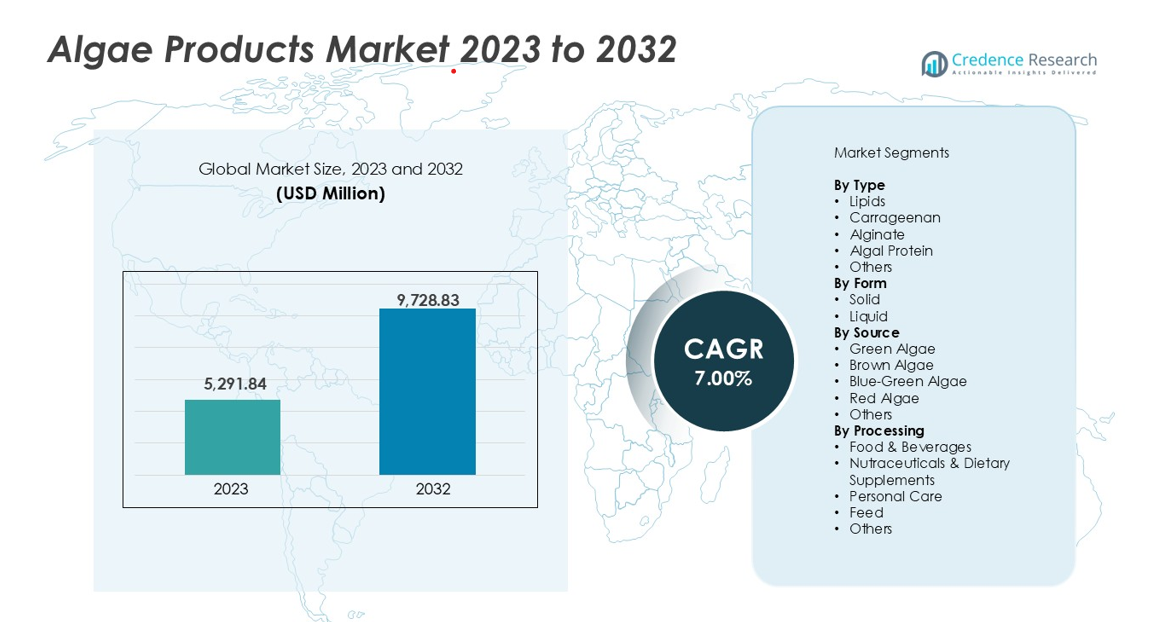
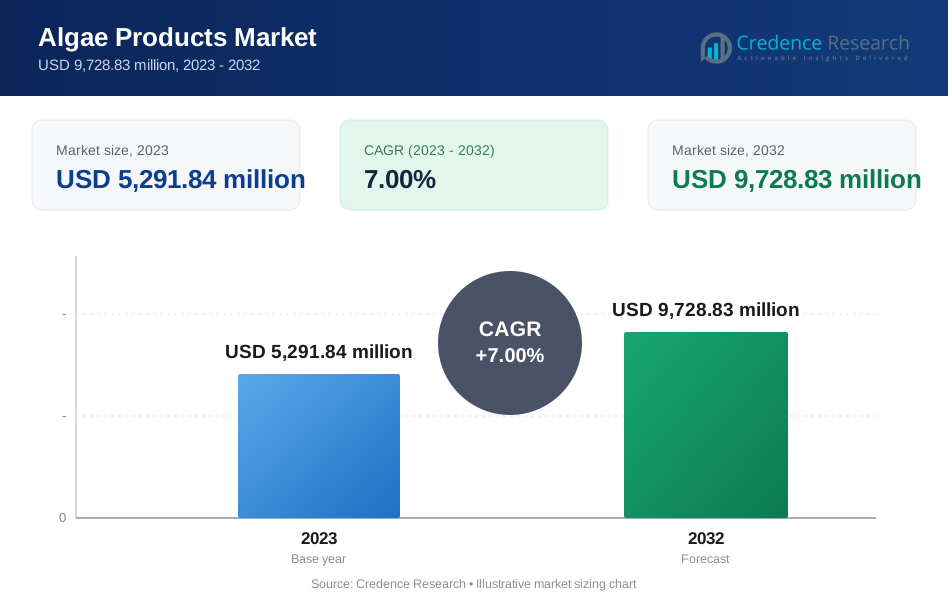
The Algae Products Market size was valued at USD 5,291.84 million in 2024 and is anticipated to reach USD 9,728.83 million by 2032, at a CAGR of 7.00% during the forecast period.
| REPORT ATTRIBUTE | DETAILS |
|---|---|
| Historical Period | 2020-2023 |
| Base Year | 2024 |
| Forecast Period | 2025-2032 |
| Algae Products Market Size 2024 | USD 5,291.84 million |
| Algae Products Market, CAGR | 7.00% |
| Algae Products Market Size 2032 | USD 9,728.83 million |
The algae products market is led by major players such as DSM, BASF, Cargill, Corbion, Euglena Co., Cyanotech Corporation, Kerry, Algae Systems LLC, and BIOPROCESS ALGAE, LLC. These companies focus on expanding algae-based applications across food, nutraceutical, cosmetic, and biofuel sectors through advanced cultivation and extraction technologies. DSM and BASF lead in high-value algae-derived ingredients for nutrition and personal care, while Cargill and Corbion emphasize large-scale sustainable production. Regionally, North America holds the largest market share at 33%, supported by strong R&D investments and consumer demand for plant-based products. Asia-Pacific follows with a 30% share, driven by industrial-scale algae cultivation and expanding applications in food and pharmaceuticals.
Market Insights
- The algae products market was valued at USD 5,291.84 million in 2024 and is projected to reach USD 9,728.83 million by 2032, growing at a CAGR of 7.00%.
- Rising demand for plant-based ingredients, biofuels, and functional food additives is fueling market expansion across global industries.
- Emerging trends include the use of algae in nutraceuticals, cosmetics, and sustainable bioplastics, supported by innovations in cultivation and extraction technologies.
- The market is moderately consolidated, with DSM, BASF, Cargill, Corbion, and Euglena Co. leading through strategic collaborations and product diversification.
- North America dominates with a 33% share, followed by Asia-Pacific at 30% and Europe at 28%; by type, lipids hold the largest segment share at 36%, driven by their application in nutritional and bioenergy sectors.
Market Segmentation Analysis:
By Type
The lipids segment dominated the algae products market in 2024, capturing around 36% of the total share. Lipids derived from microalgae are widely used in nutraceuticals, cosmetics, and biofuel applications due to their high omega-3 fatty acid content. The growing demand for sustainable DHA and EPA sources in dietary supplements and infant nutrition is driving segment growth. Companies are investing in large-scale algae cultivation and extraction technologies to improve lipid yields, reinforcing this segment’s leadership across both food and energy industries.
- For instance, Corbion's AlgaPrime DHA facility in Brazil has been expanding its production of algae-based omega-3 oil for aquafeed. In 2023, sales from the plant exceeded €100 million, and a 2024 expansion project is expected to increase sales to €200 million by 2028.
By Form
The solid form segment held the largest market share of nearly 58% in 2024, driven by its extended shelf life, ease of handling, and suitability for food, pharmaceutical, and cosmetic applications. Dried and powdered algae are widely used as ingredients in protein supplements and animal feed. This format supports convenient packaging and transportation, making it cost-effective for bulk supply. Increasing industrial-scale demand for powdered spirulina and chlorella further strengthens the solid form’s dominance over liquid-based algae extracts.
- For instance, Cyanotech Corporation's Kona facility in Hawaii produces significant quantities of spirulina powder, supplying global nutraceutical and feed markets. In Spain, AlgaEnergy operates a large-scale industrial plant for manufacturing dried microalgae, though its capacity is closer to 100 tons per year.
By Source
Brown algae led the market in 2024, accounting for approximately 40% of total revenue. Its dominance stems from its high content of alginate, fucoidan, and laminarin, which are key components in food additives, pharmaceuticals, and cosmetics. The rising demand for natural hydrocolloids and antioxidants in health products supports steady growth. Leading producers are expanding brown algae harvesting operations in coastal regions of Asia-Pacific and Europe to meet increasing global demand for sustainable, marine-derived bioactive compounds.
Key Growth Drivers
Rising Demand for Natural and Plant-Based Ingredients
The global shift toward sustainable and plant-derived ingredients is a major driver of the algae products market. Consumers increasingly prefer algae-based proteins, lipids, and polysaccharides as alternatives to animal-derived and synthetic ingredients. Algae offer rich nutritional content, including omega-3 fatty acids, antioxidants, and vitamins, making them ideal for food, cosmetics, and nutraceutical applications. Food manufacturers and supplement brands are expanding algae inclusion in their formulations to meet clean-label and vegan demands. Companies like Corbion and DSM are investing in large-scale microalgae fermentation facilities, further boosting supply and market adoption across the food and wellness sectors.
- For instance, Corbion's AlgaPrime DHA plant in Brazil delivers a significantly higher volume of algae-derived omega-3 oil than the "400 metric tons" stated. One source notes that in 2021, the company passed the production milestone of 1 million metric tons of fish feed based on AlgaPrime DHA. In 2024, an update from Corbion's partner, BioMar, indicated that approximately 600,000 metric tons of feed containing the microalgae had been produced and sold.
Expanding Application in Biofuel and Bioplastics Production
Algae’s role as a renewable raw material for biofuels and bioplastics is rapidly strengthening its market potential. Governments worldwide are funding algae-based energy projects to reduce carbon emissions and dependence on fossil fuels. Microalgae can produce lipids for biodiesel and carbohydrates for bioethanol, offering a sustainable energy source. Additionally, algae-derived biopolymers are gaining traction in packaging and industrial materials, addressing global plastic pollution concerns. Collaborations between bioenergy startups and large chemical companies are accelerating technological innovations, improving yield efficiency and scalability. These developments position algae as a vital resource for circular economy solutions.
- For instance, Algenol Biotech’s pilot facility in Florida achieved production rates of over 8,000 gallons of ethanol per acre annually using cyanobacteria-based systems, while Solazyme (now part of Corbion) developed algae oils with a 60% lipid yield for renewable diesel and jet fuel manufacturing.
Technological Advancements in Algae Cultivation and Extraction
Ongoing technological improvements in algae farming, harvesting, and extraction are enhancing production efficiency and cost-effectiveness. Advanced photobioreactors, closed-loop systems, and genetic engineering techniques are improving biomass productivity and nutrient content. Automation and AI-based monitoring systems enable precise control of growth parameters, reducing energy consumption and operational costs. Extraction technologies such as supercritical CO₂ and ultrasound-assisted methods are helping obtain high-purity bioactive compounds. These innovations are supporting wider industrial use in pharmaceuticals, cosmetics, and food processing, making algae production more scalable and commercially viable across multiple industries.
Key Trends & Opportunities
Rising Investment in Nutraceutical and Functional Food Applications
Algae-based products are witnessing growing demand in the nutraceutical and functional food industries due to their dense nutrient profile and health benefits. Chlorella and spirulina are gaining popularity as protein supplements and immunity-boosting ingredients. Major brands are introducing fortified beverages, snacks, and capsules incorporating microalgae extracts. The expanding market for personalized nutrition and preventive healthcare further amplifies growth opportunities. Partnerships between biotech firms and food manufacturers are driving the development of novel formulations, while increasing retail availability through e-commerce channels enhances consumer accessibility and awareness.
- For instance, DIC Corporation's Earthrise facility in California produces 550 metric tons of spirulina powder annually for dietary supplements. As for Roquette, while its Algility range included microalgae ingredients, more recent company information highlights that its chlorella-based flours and powders typically contain 45 grams of protein per 100 grams.
Expansion of Algae Cultivation for Carbon Capture and Sustainability
The increasing focus on carbon-neutral production is opening new opportunities for algae-based carbon capture systems. Algae efficiently absorb CO₂ during photosynthesis, offering an eco-friendly method to mitigate emissions from industrial sources. Several companies are integrating algae cultivation with wastewater treatment and carbon recycling facilities to create sustainable production cycles. Governments and environmental agencies are supporting algae biofixation projects as part of climate change mitigation strategies. These initiatives not only reduce greenhouse gas emissions but also generate valuable by-products like biofertilizers and animal feed, strengthening the market’s sustainability profile.
Key Challenges
High Production and Processing Costs
Despite strong market potential, high production costs remain a major barrier to large-scale algae commercialization. Cultivation requires controlled environmental conditions, advanced photobioreactors, and costly nutrient inputs, which increase capital expenditure. Energy-intensive drying and extraction processes further raise operational costs, limiting competitiveness with conventional plant or synthetic sources. Limited automation and economies of scale restrict affordability for smaller manufacturers. To overcome these challenges, companies are investing in low-cost feedstocks, wastewater-based cultivation, and integrated biorefinery models aimed at maximizing value recovery from every biomass fraction.
Regulatory and Standardization Barriers
The lack of uniform global regulations and product standards for algae-derived materials poses significant challenges. Varying approval timelines for food, pharmaceutical, and cosmetic applications across regions delay product launches and market expansion. Inconsistent labeling requirements and quality certification criteria hinder international trade. Moreover, the absence of standardized testing for purity, safety, and bioactivity affects consumer confidence and investor interest. Industry stakeholders are collaborating with regulatory bodies such as EFSA and FDA to establish clear frameworks for algae products. Streamlined approvals and harmonized standards will be crucial for ensuring long-term market growth.
Regional Analysis
North America
North America dominated the algae products market in 2024, accounting for around 33% of the total share. The region’s growth is driven by strong demand for algae-based nutraceuticals, cosmetics, and biofuels. The U.S. leads due to high consumer awareness regarding plant-based nutrition and active R&D investments in algae cultivation. Companies such as Corbion and Cyanotech are expanding production capacities and developing advanced extraction technologies. Government support for sustainable bioenergy and dietary supplements continues to boost market adoption, strengthening North America’s leadership in the global algae products industry.
Europe
Europe captured nearly 28% of the algae products market in 2024, supported by stringent sustainability regulations and the rising adoption of natural ingredients in food and pharmaceuticals. France, Germany, and the Netherlands are major contributors, driven by innovation in algae-based bioplastics and cosmetics. The European Union’s funding for renewable raw materials and carbon-neutral production enhances regional competitiveness. Growing consumer preference for vegan protein and bioactive compounds derived from algae further supports expansion, positioning Europe as a key hub for environmentally sustainable algae production and value-added applications.
Asia-Pacific
Asia-Pacific held a market share of about 30% in 2024 and is projected to grow rapidly through 2032. China, Japan, South Korea, and India are leading producers and consumers of algae-based food, feed, and industrial materials. Abundant coastal resources and favorable government initiatives toward marine biotechnology support regional supply growth. Expanding demand for spirulina and chlorella in dietary supplements and aquaculture feed drives strong commercial uptake. The increasing focus on sustainable food ingredients and renewable biomass solutions reinforces Asia-Pacific’s emerging dominance in global algae product manufacturing.
Latin America
Latin America accounted for nearly 6% of the algae products market in 2024, supported by the growing use of algae in animal feed and fertilizers. Countries such as Brazil and Chile are leveraging their extensive coastlines to develop commercial-scale algae farms. Local governments are promoting biotechnology projects focused on algae-based energy and food applications. Rising awareness of sustainable agriculture and alternative protein sources contributes to steady market growth. Partnerships between regional producers and global nutraceutical companies are enhancing production capabilities and expanding export potential.
Middle East & Africa
The Middle East & Africa region captured around 3% of the global algae products market in 2024, with gradual growth expected through 2032. Regional development is driven by increasing applications in aquaculture, food supplements, and wastewater treatment. Countries like South Africa and the United Arab Emirates are investing in pilot-scale algae cultivation projects to support biofuel and feed production. Limited freshwater resources are encouraging the use of algae-based biomass in arid zones. Growing awareness of sustainable production and regional investment initiatives are gradually expanding the market footprint.Top of FormBottom of Form
Market Segmentations:
By Type
- Lipids
- Carrageenan
- Alginate
- Algal Protein
- Others
By Form
- Solid
- Liquid
By Source
- Green Algae
- Brown Algae
- Blue-Green Algae
- Red Algae
- Others
By Processing
- Food & Beverages
- Nutraceuticals & Dietary Supplements
- Personal Care
- Feed
- Others
By Geography
- North America
- U.S.
- Canada
- Europe
- Germany
- France
- U.K.
- Italy
- Spain
- Rest of Europe
- Asia Pacific
- China
- Japan
- India
- South Korea
- South-east Asia
- Rest of Asia Pacific
- Latin America
- Brazil
- Mexico
- Rest of Latin America
- Middle East & Africa
- GCC Countries
- South Africa
- Rest of the Middle East and Africa
Competitive Landscape
The competitive landscape of the algae products market is moderately consolidated, with key players focusing on technological innovation, capacity expansion, and strategic collaborations to strengthen market presence. Leading companies such as DSM, BASF, Corbion, and Cargill dominate through extensive product portfolios spanning food ingredients, biofuels, and nutraceuticals. Firms like Euglena Co. and Cyanotech Corporation emphasize product differentiation through high-quality microalgae cultivation and value-added dietary supplements. Algae Systems LLC and BIOPROCESS ALGAE, LLC. are advancing large-scale cultivation technologies for bioenergy and bioplastics. Strategic mergers and joint ventures are expanding global production networks, particularly across Asia-Pacific and North America. Continuous R&D investment in strain improvement, sustainable extraction, and carbon-neutral production remains a core competitive factor shaping the industry’s long-term growth trajectory.
Key Player Analysis
- Algae Systems LLC
- Euglena Co.
- Cyanotech Corporation
- Cargill
- DSM
- Kerry
- Corbion
- BIOPROCESS ALGAE, LLC.
- BASF
Recent Developments
- In October 2024, dsm-firmenich launched Life’sDHA B54-0100, their most potent algal DHA oil to date. This new product delivers 545 mg of DHA and 80 mg of EPA per gram, enabling the development of smaller, more cost-effective capsules with higher DHA concentrations. The company also announced plans to launch two new EPA-rich products in 2025 under the “life’s” portfolio.
- In July 2024, Euglena Co., Ltd. collaborated with ORYZAE Co., Ltd. to launch “ORYZAE GRANOLA Euglena,” a sugar-free granola incorporating Euglena’s nutrient-rich superfood “Ishigaki Island Euglena”. This product combines ORYZAE’s rice koji-based sweetener with Euglena’s microalgae, offering a nutritious and sustainable food option.
- In May 2024, Cyanotech launched Hawaiian Spirulina gummies, expanding their product line to complement their existing Astaxanthin gummy product. This launch was part of their strategy to diversify their microalgae-based dietary supplement offerings.
Report Coverage
The research report offers an in-depth analysis based on Type, Form, Source, Processing and Geography. It details leading market players, providing an overview of their business, product offerings, investments, revenue streams, and key applications. Additionally, the report includes insights into the competitive environment, SWOT analysis, current market trends, as well as the primary drivers and constraints. Furthermore, it discusses various factors that have driven market expansion in recent years. The report also explores market dynamics, regulatory scenarios, and technological advancements that are shaping the industry. It assesses the impact of external factors and global economic changes on market growth. Lastly, it provides strategic recommendations for new entrants and established companies to navigate the complexities of the market.
Future Outlook
- The algae products market is projected to maintain steady growth supported by rising global sustainability goals.
- Increasing use of algae-derived lipids, proteins, and pigments in food and pharma will drive adoption.
- Expanding biofuel production using algae feedstock will strengthen industrial demand worldwide.
- Technological innovations in photobioreactors and strain optimization will enhance production efficiency.
- Strategic alliances among DSM, BASF, and Corbion will shape the competitive landscape.
- Growing consumer preference for vegan and natural ingredients will sustain market momentum.
- High production costs and scalability challenges may limit smaller manufacturers.
- Asia-Pacific will emerge as the fastest-growing region, while North America remains dominant.
- Supportive policies for carbon capture and renewable energy will boost algae cultivation projects.
- Diversification into new applications such as bioplastics and animal nutrition will expand long-term market opportunities.
Request a Free Sample
Fill in your details and we'll send you a free sample report.
- Sample data tables & charts
- Research methodology
Need a Custom Version of This Report?
Tailor the scope, geography, or segments to your exact requirements.
- Custom geography or segment scope
- Direct access to our analyst team
Frequently Asked Questions
What is the market size of the algae products market in 2023 and 2032, and what is the projected CAGR?
What are the primary drivers of growth in the algae products market?
Which regions lead the algae products market, and why?
Why are algae products considered environmentally beneficial?
What are the key applications of algae products?
Who are some major players in the algae products market?
Table of Content
Chapter 1. Report Introduction
- 1.1 Report Description & Purpose
- 1.1.1 Report Title & Market Definition
- 1.1.2 Unique Selling Propositions (USP) & Key Differentiators
- 1.1.3 Value Proposition for Stakeholders
- 1.2 Research Objectives
- 1.2.1 Market Sizing Objectives (Volume & Revenue)
- 1.2.2 Segmentation Objectives
- 1.2.3 Competitive Intelligence Objectives
- 1.2.4 Forecast & Scenario Objectives
- 1.3 Report Scope
- 1.3.1 Algae Products Scope – Types & Subtypes Covered
- 1.3.2 Geographic Scope – Regions & Countries Covered
- 1.3.3 Historical Period, Base Year & Forecast Period (2023; forecast to 2032)
- 1.3.4 Inclusions & Exclusions
- 1.4 HS Code & Classification Framework
- 1.5 Currency, Units & Pricing Basis
- 1.6 Target Stakeholders
- 1.7 Limitations & Assumptions
Chapter 2. Executive Summary
- 2.1 Global Algae Products Market Snapshot
- 2.1.1 Market Size – Historical (2023) & Forecast (2023-2032) (2023: USD 5,291.84 million → 2032: USD 9,728.83 million)
- 2.1.2 Volume & Revenue – Global Totals
- 2.1.3 Key Market Highlights – Top Five Facts
- 2.2 Algae Products Market Segmentation Snapshot
- 2.2.1 Market Split by Region – 2023 vs. 2032
- 2.3 Competitive Snapshot
- 2.3.1 Top 10 Players by Revenue Share – 2023
- 2.3.2 Top 10 Players by Volume Share – 2023
- 2.3.3 Recent Strategic Developments (18-Month Summary)
- 2.4 Key Investment Highlights & Strategic Conclusions
Chapter 3. Algae Products Market Dynamics & Industry Analysis
- 3.1 Market Overview & Context
- 3.1.1 Algae Products Market Position in the Broader Automotive Value Chain
- 3.1.2 OEM vs. Replacement Market Dynamics
- 3.1.3 Market Maturity & Development Stage by Region
- 3.2 Algae Products Market Drivers
- 3.3 Algae Products Market Restraints & Challenges
- 3.4 Algae Products Market Opportunities
- 3.5 Porter's Five Forces Analysis
- 3.5.1 Threat of New Entrants
- 3.5.2 Bargaining Power of Suppliers
- 3.5.3 Bargaining Power of Buyers
- 3.5.4 Threat of Substitutes
- 3.5.5 Competitive Rivalry – Intensity Assessment
- 3.6 Algae Products Value Chain Analysis
- 3.6.1 Upstream – Raw Material/Input Suppliers
- 3.6.1.1 Raw Material/Input 1
- 3.6.1.2 Raw Material/Input 2
- 3.6.1.3 Raw Material/Input 3
- 3.6.2 Midstream – Production/Manufacturing/Service Delivery
- 3.6.2.1 Production/Process Overview
- 3.6.2.2 Key Facility Locations & Capacity by Manufacturer
- 3.6.3 Downstream – Distribution & End Consumer
- 3.6.3.1 Primary Channel – B2B/OEM
- 3.6.3.2 Secondary Channels – Dealer, Retail, Online, Direct
- 3.6.4 Value Chain Profitability Analysis
- 3.6.1 Upstream – Raw Material/Input Suppliers
- 3.7 PESTEL Analysis
- 3.7.1 Political Factors
- 3.7.2 Economic Factors
- 3.7.3 Social Factors
- 3.7.4 Technological Factors
- 3.7.5 Environmental Factors
- 3.7.6 Legal Factors
- 3.8 Algae Products Supply Chain Analysis
- 3.8.1 Raw Material/Input Supply Risk Assessment
- 3.8.2 Manufacturing Concentration Risk (Geographic Exposure)
- 3.8.3 Trade Disruption Impact Analysis
- 3.9 Regulatory & Policy Landscape
Note: The regulatory and policy landscape section covers regulations based on their applicability to the market, Algae Products category, geography, and scope of the study. Only regulatory frameworks with a material impact on operations, compliance, trade, sustainability, or market access are analyzed in detail.
Chapter 4. Key Investment Pockets & Opportunity Analysis
- 4.1 Algae Products Market Attractiveness Analysis
- 4.1.1 By Region – Investment Attractiveness Matrix (Volume × CAGR)
- 4.2 Absolute Revenue Growth Opportunity
- 4.2.1 By Region – Absolute USD Growth Through 2032
- 4.3 Incremental Volume Opportunity
- 4.3.1 By Region – Incremental Volume Through 2032
- 4.3.2 Segment – Incremental Volume
- 4.4 Emerging Submarket Opportunity Deep Dive (Subject to Applicability)
- 4.5 Emerging Market Opportunity Scorecards
- 4.5.1 United States
- 4.5.2 Europe
- 4.5.3 Asia
- 4.5.4 Middle East & Africa
Note: Emerging Market Opportunity Scorecards will be included based on relevance and strategic importance. Regions listed are indicative and may vary depending on data availability and market dynamics.
Chapter 5. Algae Products Import-Export Analysis & Trade Flows
- 5.1 Global Trade Overview
- 5.1.1 Global Export Value by Country (2023)
- 5.1.2 Global Export Volume by Country (2023)
- 5.1.3 Global Import Value by Country (2023)
- 5.1.4 Global Import Volume by Country (2023)
- 5.1.5 Net Trade Balance by Country (2023)
- 5.2 Export Analysis – Segment
- 5.2.1 Type 1 (HS Code)
- 5.2.2 Type 2 (HS Code)
- 5.2.3 Type 3 (HS Code)
- 5.2.4 Type 4 (HS Code)
- 5.2.5 Type 5 (HS Code)
- 5.3 Import Analysis – Segment
- 5.3.1 Type 1 (HS Code)
- 5.3.2 Type 2 (HS Code)
- 5.3.3 Type 3 (HS Code)
- 5.3.4 Type 4 (HS Code)
- 5.3.5 Type 5 (HS Code)
- 5.4 Average Unit Trade Prices
- 5.4.1 Average Export Price – Segment & Country
- 5.4.2 Average Import Price – Segment & Source Country
- 5.4.3 Price Trends (2023)
- 5.5 Key Trade Route Analysis
- 5.5.1 Trade Route 1
- 5.5.2 Trade Route 2
- 5.5.3 Trade Route 3
- 5.5.4 Trade Route 4
- 5.5.5 Trade Route 5
- 5.6 Trade Policy Impact Assessment
- 5.6.1 US Anti-Dumping & Section 301 Tariffs
- 5.6.2 EU Customs Union Impact
- 5.6.3 Major Free Trade Agreements
- 5.6.4 USMCA Rules of Origin
Note: Trade policy analysis will be included only where relevant to the Algae Products market.
Chapter 6. Competitive Landscape & Company Benchmarking
- 6.1 Algae Products Market Concentration & Structure
- 6.1.1 Herfindahl-Hirschman Index (HHI) – vs. 2023
- 6.1.2 Tier 1, Tier 2 & Tier 3 Market Structure
- 6.1.3 Global, Regional & Local Player Dynamics
- 6.2 Algae Products Market Share Analysis – 2023
- 6.2.1 Global Revenue Share by Company
- 6.2.2 Global Volume Share by Company
- 6.2.3 Regional Revenue Share
- 6.2.4 Market Share Evolution ( vs. 2023)
- 6.2.5 OEM Segment Share by Company
- 6.2.6 Replacement Segment Share by Company
- 6.3 Production/Delivery Capacity & Facility Analysis
- 6.3.1 Global Installed Capacity
- 6.3.2 Capacity Utilization Rates
- 6.3.3 Production/Output Volume
- 6.3.4 Facility Locations & Capacity Map
- 6.3.5 Planned Capacity Additions
- 6.4 Algae Products Competitive Benchmarking Matrix
- 6.4.1 Revenue, Volume, CAGR & Profitability Comparison
- 6.4.2 Channel Revenue Mix
- 6.4.3 Geographic Revenue Exposure
- 6.4.4 R&D Intensity
- 6.4.5 Sustainability Maturity
- 6.5 Strategic Developments in Algae Products (Last 24 Months)
- 6.5.1 Mergers, Acquisitions & Divestments
- 6.5.2 New Algae Products Launches
- 6.5.3 Facility Expansions
- 6.5.4 Strategic Alliances, Joint Ventures & Partnerships
- 6.5.5 Distribution Expansion & Market Entry
- 6.5.6 Sustainability & ESG Initiatives
- 6.6 Competitive Strategy Mapping
- 6.6.1 Leader, Challenger, Follower & Niche Classification
- 6.6.2 Pricing Strategy Comparison
- 6.6.3 Channel Strategy Matrix
Note: Strategic developments are included based on their materiality and the availability of reliable information.
Chapter 7. Global Algae Products Market – By Distribution Channel
- 7.1 Segment Overview
- 7.1.1 Volume & Revenue Split by Channel (2023 & 2032)
- 7.1.2 Channel Mix Evolution (2023-2032)
Chapter 8. Regional Market Analysis – Global Overview
- 8.1 Global Regional Overview
- 8.1.1 Regional Volume Share
- 8.1.2 Regional Revenue Share
- 8.1.3 Regional Volume by Region
- 8.1.4 Regional Revenue by Region
- 8.1.5 Regional Forecast Through 2032
- 8.2 Cross-Regional Segment Analysis
- 8.2.1 By Distribution Channel
- 8.2.2 By Brand/Price Tier
Chapter 9. North America Algae Products Market
- 9.1 United States
- 9.2 Canada
- 9.3 Mexico
Chapter 10. Europe Algae Products Market
- 10.1 Germany
- 10.2 France
- 10.3 Italy
- 10.4 United Kingdom
- 10.5 Spain
- 10.6 Poland
- 10.7 Russia
- 10.8 Netherlands
- 10.9 Belgium
- 10.10 Sweden
- 10.11 Denmark
- 10.12 Norway
- 10.13 Rest of Europe
Chapter 11. Asia Pacific Algae Products Market
- 11.1 China
- 11.2 India
- 11.3 Japan
- 11.4 South Korea
- 11.5 Thailand
- 11.6 Indonesia
- 11.7 Vietnam
- 11.8 Malaysia
- 11.9 Australia
- 11.10 Rest of Asia Pacific
Chapter 12. Latin America Algae Products Market
- 12.1 Brazil
- 12.2 Argentina
- 12.3 Colombia
- 12.4 Chile
- 12.5 Rest of Latin America
Chapter 13. Middle East Algae Products Market
- 13.1 Saudi Arabia
- 13.2 United Arab Emirates
- 13.3 Turkey
- 13.4 Israel
- 13.5 Iran
- 13.6 Rest of the Middle East
Chapter 14. Africa Algae Products Market
- 14.1 South Africa
- 14.2 Egypt
- 14.3 Nigeria
- 14.4 Morocco
- 14.5 Rest of Africa
Chapter 15. Algae Products Company Profiles
- 15.1 [Company 01]
- 15.1.1 Company Overview
- 15.1.2 Key Management Personnel
- 15.1.3 Products & Services Portfolio
- 15.1.4 Financial Performance
- 15.1.5 Key Market Focus & Geographic Presence
- 15.1.6 Recent Developments & Strategic Initiatives
Note: The company profile list is preliminary and may change based on research findings, market developments, data availability, and client requirements.
Chapter 16. Appendices
- Appendix A – List of Abbreviations & Acronyms
- Appendix B – Industry Classification Code Reference – Full Series
- Appendix C – Production & Capacity Data Tables
- Appendix D – End-Use & Demand Base Tables
- Appendix E – Consumption & Replacement Rate Assumptions
- Appendix F – ASP Reference Tables
- Appendix G – Manufacturing & Facility Database
- Appendix H – Import-Export Data Tables
- Appendix I – Regulatory Summary Tables
- Appendix J – Primary Research Participant List (Anonymized)
- Appendix K – Primary Research Questionnaire Framework
- Appendix L – Data Sources & Bibliography
- Appendix M – Market Size Divergence & Source Comparison
Chapter 17. Research Methodology
- 17.1 Research Framework & Philosophy
- 17.2 Secondary Research – Sources, Hierarchy & Data Extraction
- 17.3 Data Modeling – Bottom-Up & Top-Down Market Sizing
- 17.4 Primary Research – Stakeholder Framework, LOI & Sample Sizes
- 17.5 Forecast Methodology – Regression, Scenario & Sensitivity Analysis
- 17.6 Quality Control – Four-Layer Validation Framework
- 17.7 Limitations & Standard Assumptions
- 17.8 Disclaimer
