Anesthesia Devices Market Overview:
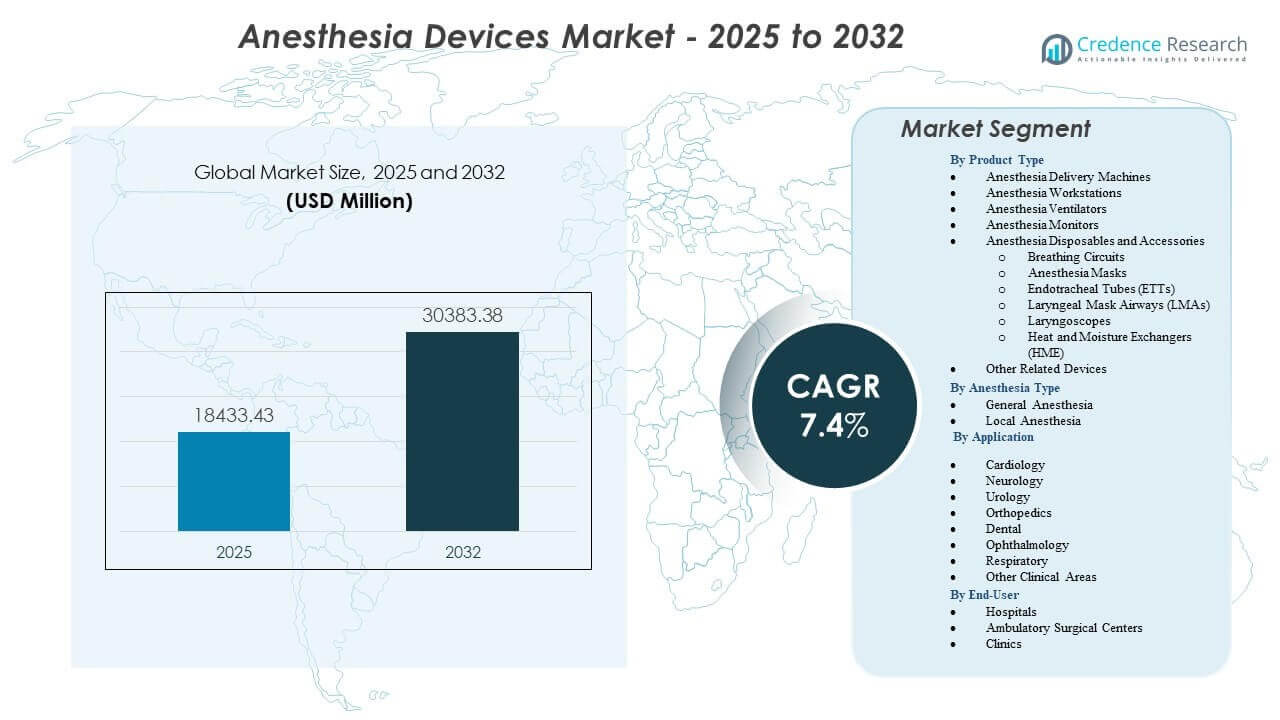
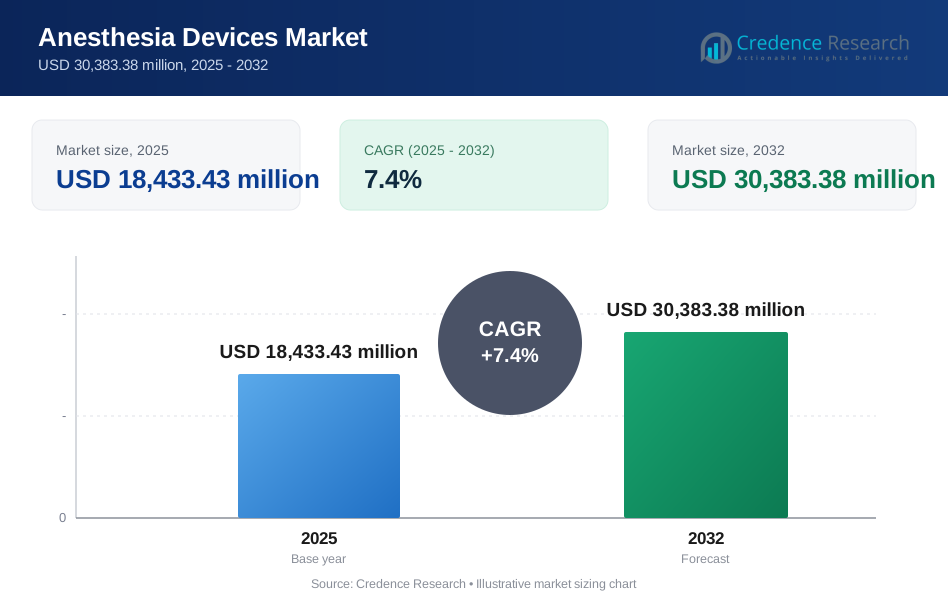
The Anesthesia Devices Market is projected to grow from USD 18,433.43 million in 2025 to an estimated USD 30,383.38 million by 2032, with a compound annual growth rate (CAGR) of 7.4% from 2025 to 2032.
| REPORT ATTRIBUTE | DETAILS |
|---|---|
| Historical Period | 2020-2023 |
| Base Year | 2024 |
| Forecast Period | 2025-2032 |
| Anesthesia Devices Market Size 2025 | USD 18,433.43 million |
| Anesthesia Devices Market, CAGR | 7.4% |
| Anesthesia Devices Market Size 2032 | USD 30,383.38 million |
Growth is driven by the rising need for advanced workstations, integrated monitoring capabilities, and high-performance ventilation systems that support safer and more predictable anesthesia care. Healthcare providers prioritize solutions that improve patient stability, streamline workflows, and minimize the risk of intraoperative complications. Adoption increases with the expansion of minimally invasive surgeries and the growing preference for automated, digitally connected systems that offer real-time analytics. The market continues gaining momentum as facilities modernize perioperative care environments and invest in devices that enable consistency, safety, and efficiency.
North America leads due to strong clinical infrastructure, high surgical demand, and rapid adoption of smart, integrated anesthesia platforms. Europe follows with established regulatory standards and sustained investment in patient safety technologies that encourage continuous equipment upgrades. Asia-Pacific emerges as the fastest-growing region due to expanding hospital networks, increased access to specialized surgeries, and rising training capacity for anesthesia teams. Latin America and the Middle East show steady progress driven by OR modernization and private-sector healthcare expansion. It supports broader access to advanced anesthesia care in both developed and emerging markets.
Anesthesia Devices Market Insights:
- The Anesthesia Devices Market is projected to grow from USD 18,433.43 million in 2025 to USD 30,383.38 million by 2032, reflecting a 7.4% CAGR during the forecast period.
- Rising demand for advanced workstations, precise ventilation systems, and integrated monitoring tools drives strong adoption across high-volume surgical environments.
- Limited budgets, complex maintenance needs, and skill gaps in developing regions restrict faster penetration of next-generation anesthesia technologies.
- North America leads the market due to rapid uptake of digital anesthesia platforms and strong perioperative infrastructure.
- Asia-Pacific expands at the fastest pace, supported by growing hospital capacity, increased surgical demand, and rising investments in OR modernization.
Anesthesia Devices Market Drivers
Growing Need For Advanced Perioperative Care Across Surgical Settings
Global surgical demand rises in complex specialties, and this trend strengthens the role of the Anesthesia Devices Market. Hospitals upgrade operating rooms to support real-time monitoring and precision delivery. Clinicians prefer systems that reduce complications and support safer induction. New devices help teams maintain steady control during long procedures. Many providers invest in enhanced workstations to improve workflow. Aging populations increase procedure volumes across regions. Chronic disease growth supports higher surgical loads. It encourages steady adoption of devices that enhance safety and efficiency.
- For instance, Getinge’s Flow-e anesthesia workstation is built for high-acuity surgical environments and features a precision piston ventilator with a documented tidal volume range starting at 20 mL, supporting both neonatal and adult patients. The Flow Family specifications confirm advanced ventilation modes and integrated safety functions designed to maintain stable performance across complex surgical workflows.
Rapid Shift Toward Integrated, Automated, And Digitally Enabled Anesthesia Systems
Healthcare systems prioritize automation to reduce human error and support consistent anesthesia depth. The Anesthesia Devices Market benefits from rising interest in smart ventilators and closed-loop control features. Hospitals adopt integrated systems that link monitoring, diagnostics, and record-keeping. Digitized platforms simplify decision-making for clinicians. Automated alerts support safer patient transitions. Software-driven modules help staff manage high-risk cases. It enables teams to reduce variability in care. Digital adoption pushes demand for interoperable, upgradeable devices.
- For instance, GE HealthCare’s Carestation 750 features an automated pre-use machine checkout designed to streamline OR preparation, with results displayed through its Carestation-specific user interface. The workstation integrates advanced ventilation tools, including real-time monitoring of lung mechanics such as airway pressure and compliance, which are documented capabilities within GE’s anesthesia platform specifications.
Rising Use Of Portable And Compact Devices Across Emergency And Remote Care
Portable systems gain traction due to their flexible use in ambulatory centers and transport units. The Anesthesia Devices Market experiences greater attention from providers that operate in resource-limited spaces. Compact devices support rapid deployment during emergency procedures. Field hospitals use them for faster patient stabilization. Many systems offer battery support that improves care delivery in remote areas. Advances in lightweight designs reduce training requirements. Clinicians prefer simple interfaces that shorten setup time. It helps healthcare teams expand anesthesia access where capacity is limited.
Growing Focus On Patient Safety, Outcome Optimization, And Standardized Anesthesia Protocols
Hospitals apply stronger rules for patient safety, which drives upgrades in anesthesia systems. The Anesthesia Devices Market grows with rising need for accurate dosing and controlled ventilation. Safety guidelines push facilities to adopt modern alarms and advanced monitoring. Features that support airway security gain priority in critical care. Teams adopt standardized anesthesia pathways to reduce risks. New systems support these pathways with precise control tools. Real-time analytics strengthen clinical decisions during induction and recovery. It supports better outcomes across diverse patient groups.
Anesthesia Devices Market Trends
Expansion Of AI-Driven Decision Support And Predictive Monitoring In Anesthesia Practice
AI-enabled modules improve clinical planning and strengthen anesthesia depth control. The Anesthesia Devices Market reflects strong uptake of predictive monitoring tools. These tools help teams track patient risk factors before procedure onset. Machine-guided alerts support faster responses. Hospitals integrate AI to improve sedation stability. Predictive ventilation patterns increase safety during high-risk cases. Teams value insights that reduce adverse events. It pushes hospitals to adopt next-generation smart anesthesia workstations.
Higher Demand For Low-Flow Anesthesia And Sustainability-Focused Device Innovation
Sustainability goals shift attention to low-flow anesthesia systems. The Anesthesia Devices Market experiences stronger demand for devices that reduce gas waste. Hospitals adopt systems that support reduced environmental impact. New features control flow rates with greater accuracy. Clinicians pursue lower emissions without affecting clinical safety. Manufacturers design circuits that cut consumption of anesthetic agents. These upgrades lower long-term operating costs. It supports global moves toward greener surgical environments.
Growth Of Ambulatory Surgical Centers And Their Preference For Cost-Efficient Devices
Ambulatory sites expand due to rising preference for shorter procedures. The Anesthesia Devices Market benefits from demand for reliable and compact systems. Many centers select devices with faster startup cycles. Simple interfaces help reduce operating complexity. Short procedures require precise control and quick recovery support. Manufacturers design systems tailored for outpatient workflows. High portability supports flexible room use. It aligns with the shift toward outpatient surgical care.
- For instance, Mindray’s A-Series anesthesia workstations, including the A4, feature an automated system check at startup and a compact design intended to streamline operating room workflows. These units are engineered to support fast turnover in high-volume surgical environments, with user interfaces and ventilation modes documented in Mindray’s official product specifications.
Increased Adoption Of Hybrid Operating Rooms And Multi-Functional Anesthesia Platforms
Hybrid ORs combine imaging and surgical capabilities in one room, which raises need for adaptable anesthesia systems. The Anesthesia Devices Market responds with platforms that support varied surgical modes. Multi-functional devices enable smoother coordination in complex cases. Integrated displays help teams manage several parameters at once. Systems include flexible ventilation modes for diverse procedures. Hospitals request plug-and-play designs that speed room turnover. These features support high surgical output. It strengthens long-term demand for advanced OR-ready anesthesia workstations.
- For instance, the Dräger Atlan A300/A350 series is designed for demanding environments such as Hybrid ORs and features a high-precision piston ventilator with a documented minimum tidal volume of 20 mL. The system supports a wide range of patient categories, from neonates to adults, with official specifications detailing advanced ventilation modes and integrated safety functions.
Market Challenges Analysis
High Operational Cost, Complex Maintenance Needs, And Limited Access In Resource-Restricted Regions
Many facilities struggle with purchase and maintenance costs, and the Anesthesia Devices Market faces pressure from budget constraints. Devices require regular calibration that raises service expense. Smaller hospitals delay upgrades due to limited technical staff. Supply chain gaps reduce access to spare parts. Training requirements slow adoption in developing regions. Older machines remain in use despite safety gaps. Providers manage risk by limiting use of advanced features. It restricts widespread technology penetration in low-income markets.
Regulatory Complexity, Interoperability Gaps, And Risks Linked To Device Failures
Manufacturers navigate strict approval pathways, and the Anesthesia Devices Market must comply with evolving global rules. Many systems lack smooth integration with hospital IT platforms. Interoperability flaws increase manual work for clinicians. Device errors pose safety concerns that require continuous oversight. Cyber vulnerabilities increase with connected systems. Hospitals invest in safeguards, which slow procurement. Frequent updates create operational disruptions. It reinforces the need for stronger compliance strategies.
Anesthesia Devices Market Opportunities
Rising Demand For Digital Health Integration And Smart Anesthesia Delivery Ecosystems
Hospitals seek stronger decision support, and the Anesthesia Devices Market gains opportunity to expand connected solutions. Integrated analytics platforms support personalized care. Real-time data flows help clinicians predict instability earlier. Smart delivery modules enable precise drug control. Tele-connected systems help monitor remote surgical units. Software upgrades extend device life cycles. Many providers invest in digital OR ecosystems. It enables new growth for vendors offering scalable platforms.
Expansion Potential In Emerging Markets With Improving Surgical Infrastructure
Developing regions build advanced surgical centers, and the Anesthesia Devices Market holds strong potential in these areas. Governments invest in operating room modernization. New hospitals demand compact and cost-efficient units. Local manufacturing partnerships reduce import barriers. Training programs increase staff capability and raise adoption. Rising medical tourism strengthens need for upgraded surgical technology. Growing private sector hospitals seek premium devices. It supports long-term expansion across emerging economies.
Market Segmentation Analysis:
By Product Type
The Anesthesia Devices Market grows with rising adoption of advanced delivery machines, workstations, ventilators, and monitoring systems. Hospitals prefer integrated platforms that support precise control and real-time analytics. Demand increases for ventilators that manage varied patient conditions. Disposables gain strong traction due to safety rules and infection-control needs. Masks, breathing circuits, LMAs, ETTs, HMEs, and laryngoscopes support routine procedures across care settings. These items enable efficient airway management during surgeries. Other related devices strengthen workflow in operating rooms. It supports continuous upgrades across product categories.
By Anesthesia Type
General anesthesia dominates due to its extensive use in complex surgeries across specialties. The Anesthesia Devices Market benefits from high demand for controlled ventilation and continuous monitoring. Providers select systems that support stable sedation during long procedures. Local anesthesia rises in smaller interventions that require minimal recovery time. Clinics expand its use for outpatient workflows. Devices that support rapid setup gain higher preference. Growth in minimally invasive procedures increases uptake of local anesthesia tools. It broadens product use across varied care environments.
By Application
Clinical use spreads across cardiology, neurology, orthopedics, respiratory care, dental, ophthalmology, and urology. The Anesthesia Devices Market supports diverse surgical pathways that depend on safe airway control and sedation stability. High-risk specialties demand advanced monitoring and ventilator precision. Dental and ophthalmic procedures use compact units for shorter cycles. Respiratory cases require greater airflow management. Neurology and cardiology teams rely on precise dosing control. Other clinical areas adopt flexible systems for varied patient needs. It strengthens device utilization across specialty care.
- For instance, the Philips IntelliVue MX series monitors offer integrated anesthetic gas measurement (AGM) modules, documented in Philips’ device specifications.
By End-User
Hospitals hold the largest share due to high surgical volumes and need for integrated workstations. The Anesthesia Devices Market benefits from continuous OR modernization in large facilities. Ambulatory surgical centers expand demand for portable and fast-setup systems. Clinics adopt compact devices that support routine procedures. Outpatient care models increase need for flexible ventilation and monitoring solutions. Providers focus on systems that reduce error and support faster turnover. Each end-user segment drives unique product requirements. It sustains broad adoption across healthcare environments.
- For instance, Penlon’s Prima 450 is marketed for clinic-based anesthesia delivery and is part of the UK MHRA-registered product portfolio.
Anesthesia Devices Market Segmentation:
By Product Type
- Anesthesia Delivery Machines
- Anesthesia Workstations
- Anesthesia Ventilators
- Anesthesia Monitors
- Anesthesia Disposables and Accessories
- Breathing Circuits
- Anesthesia Masks
- Endotracheal Tubes (ETTs)
- Laryngeal Mask Airways (LMAs)
- Laryngoscopes
- Heat and Moisture Exchangers (HME)
- Other Related Devices
By Anesthesia Type
- General Anesthesia
- Local Anesthesia
By Application
- Cardiology
- Neurology
- Urology
- Orthopedics
- Dental
- Ophthalmology
- Respiratory
- Other Clinical Areas
By End-User
- Hospitals
- Ambulatory Surgical Centers
- Clinics
By Region
- North America
- U.S.
- Canada
- Mexico
- Europe
- Germany
- France
- U.K.
- Italy
- Spain
- Rest of Europe
- Asia Pacific
- China
- Japan
- India
- South Korea
- South-east Asia
- Rest of Asia Pacific
- Latin America
- Brazil
- Argentina
- Rest of Latin America
- Middle East & Africa
- GCC Countries
- South Africa
- Rest of the Middle East and Africa
Regional Analysis:
North America holds the largest share of the Anesthesia Devices Market, accounting for around 35%, driven by strong healthcare infrastructure and high surgical procedure volumes. Hospitals in the region adopt advanced workstations and smart ventilators more quickly due to strict safety rules. Investments in operating room modernization strengthen technology upgrades. New digital systems gain rapid acceptance across major centers. Manufacturers expand service networks to support uptime. It continues to benefit from strong reimbursement structures that favor modern anesthesia platforms.
Europe represents about 30% of the global market and maintains steady growth due to robust clinical standards and expanded focus on patient safety. Hospitals upgrade anesthesia systems to align with evolving regulatory requirements. Multi-specialty centers use integrated monitoring tools to support complex surgeries. Adoption increases in countries that invest in digital OR transformation. Sustainability goals drive interest in low-flow anesthesia technology. It gains steady momentum from continuous investments in perioperative care modernization.
Asia Pacific captures nearly 25% of the market and grows at the fastest pace due to rising surgical volumes and rapid hospital expansion. Demand increases in China, India, Japan, and Southeast Asia as populations age and chronic diseases rise. Private hospitals invest in modern anesthesia workstations to support specialized procedures. Training programs expand access to advanced airway tools. Local manufacturing activity improves product availability. It benefits from growing investments in medical tourism and operating room upgrades across emerging economies.
The Rest of the World region holds around 10%, supported by gradual improvements in healthcare access and infrastructure growth. Adoption increases in Latin America, the Middle East, and parts of Africa as facilities add new surgical departments. Providers focus on cost-efficient devices that deliver reliable performance. Modernization efforts accelerate in large urban hospitals. Clinical teams adopt compact systems for flexible use. It gains traction with steady expansion in specialty care capacity.
Key Player Analysis:
- GE Healthcare
- Drägerwerk AG & Co. KGaA
- Mindray Bio-Medical Electronics Co., Ltd.
- Medtronic plc
- Koninklijke Philips N.V.
- Braun Melsungen AG
- Smiths Medical (ICU Medical)
- Fisher & Paykel Healthcare
- Teleflex Incorporated
- Ambu A/S
- Getinge AB
- Penlon Ltd.
- BPL Medical Technologies
- Beijing Aeonmed Co., Ltd.
- Spacelabs Healthcare
Competitive Analysis:
The Anesthesia Devices Market remains highly competitive, with global manufacturers investing in technology upgrades to strengthen product differentiation. Leading companies enhance system intelligence, ventilation modes, and monitoring accuracy to support safer anesthesia delivery. Many vendors expand software capabilities to improve workflow, automate alerts, and support electronic record integration. Competitors strengthen portfolios through advanced workstations that combine delivery, monitoring, and analytics. Mid-tier players focus on cost-efficient devices that meet the needs of emerging markets. Disposable product makers grow their presence through infection-control solutions and airway management tools. It continues to evolve through strategic partnerships, after-sales service expansion, and local manufacturing initiatives that improve accessibility and reduce procurement barriers for healthcare providers.
Recent Developments:
- In January 2026, GE HealthCare collaborated with NXP Semiconductors on edge AI solutions for acute care settings, including voice-activated anesthesia delivery systems and real-time neonatal monitoring demonstrated at CES 2026, leveraging secure edge processors to enable low-latency AI in operating rooms.
- In October 2025 , GE Healthcare launched the Carestation 850 anesthesia delivery system at ANESTHESIOLOGY 2025, featuring ergonomic design, customizable apps, advanced vaporization technology, sustainability tools, and an intuitive user interface to improve precision and efficiency for patients ranging from neonates to adults.
- In November 2024, Mindray Medical introduced upgrades to its A7 and A5 anesthesia systems, featuring precise agent delivery, enhanced safety checks, and smart alarm systems to improve clinical efficiency and patient outcomes.
Report Coverage:
The research report offers an in-depth analysis based on Product Type, Anesthesia Type, Application, End-User and Region. It details leading market players, providing an overview of their business, product offerings, investments, revenue streams, and key applications. Additionally, the report includes insights into the competitive environment, SWOT analysis, current market trends, as well as the primary drivers and constraints. Furthermore, it discusses various factors that have driven market expansion in recent years. The report also explores market dynamics, regulatory scenarios, and technological advancements that are shaping the industry. It assesses the impact of external factors and global economic changes on market growth. Lastly, it provides strategic recommendations for new entrants and established companies to navigate the complexities of the market.
Future Outlook:
- Rising adoption of integrated anesthesia workstations will strengthen digital OR ecosystems across the Anesthesia Devices Market.
- AI-supported monitoring tools will expand clinical decision support and reduce perioperative risks.
- Low-flow anesthesia systems will gain traction due to growing focus on sustainability and reduced agent consumption.
- Portable and compact units will see higher demand across ambulatory and emergency care settings.
- Smart ventilators will evolve with advanced modes to support complex and high-risk procedures.
- Hospitals will prioritize interoperable platforms that link delivery, monitoring, and analytics.
- Disposable airway management products will experience steady growth driven by infection-control standards.
- Hybrid OR expansion will boost demand for multifunctional anesthesia platforms.
- Emerging markets will increase procurement of modern workstations as surgical infrastructure improves.
- Service-driven business models will expand as providers seek long-term maintenance and software support.
Request a Free Sample
Fill in your details and we'll send you a free sample report.
- Sample data tables & charts
- Research methodology
Need a Custom Version of This Report?
Tailor the scope, geography, or segments to your exact requirements.
- Custom geography or segment scope
- Direct access to our analyst team
Frequently Asked Questions
What is the current market size for the Anesthesia Devices Market, and what is its projected size in 2032?
At what Compound Annual Growth Rate is the Anesthesia Devices Market projected to grow between 2025 and 2032?
Which Anesthesia Devices Market segment held the largest share in 2025?
What are the primary factors fueling the growth of the Anesthesia Devices Market?
Who are the leading companies in the Anesthesia Devices Market?
Which region commanded the largest share of the Anesthesia Devices Market in 2025?
Table of Content
Chapter 1 Market Segmentation
- 1.1 Segmentation Framework
- 1.1.1 Product and Service Classification
- 1.1.2 Application and End-Use Classification
- 1.1.3 Technology and Solution Classification
- 1.1.4 Customer and Distribution Channel Classification
- 1.1.5 Geographic Segmentation
- 1.1.6 Market Segment Definitions and Boundaries
Chapter 2 Introduction
- 2.1 Report Objectives and Scope
- 2.2 Product Definition and Industry Terminology
- 2.3 Market Inclusions and Exclusions
- 2.4 Research Process
- 2.4.1 Primary Research and Expert Interviews
- 2.4.2 Secondary Research and Source Review
- 2.4.3 Top-Down and Bottom-Up Estimation
- 2.4.4 Data Triangulation and Verification
- 2.5 Market Size Measurement Basis
- 2.5.1 2025: USD 18,433.43 million → 2032: USD 30,383.38 million
- 2.6 Historical and Forecast Reference Periods
- 2.6.1 Base Year: 2025
- 2.6.2 Forecast Period: 2025-2032
- 2.7 Research Assumptions and Limitations
Chapter 3 Executive Summary
- 3.1 Market Snapshot and Key Findings
- 3.2 Base-Year Market Size, 2025
- 3.3 Forecast Market Size, 2032
- 3.4 Revenue and Volume Growth Outlook
- 3.5 Key Demand and Supply Indicators
- 3.6 Leading Market Segments
- 3.7 Fastest-Growing Market Opportunities
- 3.8 Regional Performance Highlights
- 3.9 Technology and Industry Transformation
- 3.10 Competitive Landscape Summary
- 3.11 Analyst View and Strategic Implications
Chapter 4 Global Anesthesia Devices Market Trends and Developments
- 4.1 Historical Industry Development
- 4.2 Recent Market Trends and Developments
- 4.3 Demand and Customer Behavior Trends
- 4.4 Technology and Product Innovation
- 4.5 Artificial Intelligence, Automation and Digitalization
- 4.6 Local Manufacturing and Supply Chain Realignment
- 4.7 Industry Partnerships, Mergers and Acquisitions
- 4.8 Sustainability and Circular Economy Developments
- 4.9 Government and Private Sector Investment Trends
- 4.10 Emerging Business Models and Commercialization
- 4.11 Industry Developments and Announcements
Chapter 5 Global Anesthesia Devices Market Production, Supply and Demand Analysis
- 5.1 Demand Trend and Consumption Analysis
- 5.2 Demand Forecast, 2025-2032
- 5.3 Production and Output Trend
- 5.4 Production and Output Forecast, 2025-2032
- 5.5 Installed Capacity and Capacity Utilization
- 5.6 Company-Wise Production Plants and Statistics
- 5.6.1 Installed Production Capacity
- 5.6.2 Actual Production
- 5.6.3 Planned Capacity and Expansion Targets
- 5.7 Supply Chain Structure and Procurement Trends
- 5.8 Supply-Demand Gap and Bottlenecks
- 5.9 Import Dependence and Sourcing Structure
- 5.10 Contract Manufacturing and Outsourcing
- 5.11 Regional Supply and Demand Concentration
Chapter 6 Global Anesthesia Devices Market Pricing Analysis
- 6.1 Pricing Structure and Measurement
- 6.2 Historical Pricing Trends
- 6.3 Pricing Outlook, 2025-2032
- 6.4 Average Selling Price and Unit Economics
- 6.5 Pricing by Product and Market Segment
- 6.6 Geographic Pricing Differences
- 6.7 Key Input, Energy, Labor and Logistics Costs
- 6.8 Contract Pricing and Purchasing Models
- 6.9 Pricing Sensitivity and Competitive Positioning
- 6.10 Price, Margin and Profitability Implications
Chapter 7 Global Anesthesia Devices Market Dynamics
- 7.1 Market Growth Drivers
- 7.1.1 Demand-Side Drivers
- 7.1.2 Technology and Innovation Drivers
- 7.1.3 Infrastructure and Investment Drivers
- 7.1.4 Regulatory and Policy Drivers
- 7.2 Market Restraints
- 7.2.1 Cost and Affordability Constraints
- 7.2.2 Technology and Adoption Barriers
- 7.2.3 Supply Chain and Operational Constraints
- 7.3 Market Challenges
- 7.3.1 Competitive Pressure and Margin Erosion
- 7.3.2 Skills, Infrastructure and Implementation Gaps
- 7.4 Emerging Market Opportunities
- 7.5 Market Dynamics Impact and Time-Horizon Assessment
Chapter 8 Global Anesthesia Devices Value Chain Analysis
- 8.1 Industry Value Chain Overview
- 8.2 Upstream Suppliers and Critical Inputs
- 8.3 Technology and Component Providers
- 8.4 Manufacturing or Service Delivery
- 8.5 Distribution, Channel Partners and Integrators
- 8.6 Downstream Applications and End Users
- 8.7 Value Addition and Profit Pools
- 8.8 Vertical Integration and Outsourcing
- 8.9 Supplier Concentration and Risk
- 8.10 Supply Chain Localization and Resilience
Chapter 9 Global Anesthesia Devices Market Regulations and Policies
- 9.1 Relevant Laws, Standards and Compliance Frameworks
- 9.2 Product, Service, Safety and Quality Requirements
- 9.3 Government Policies, Incentives and Subsidies
- 9.4 Imports, Exports and Trade Barriers
- 9.5 Public Procurement and Local Content Requirements
- 9.6 Environmental and Sustainability Compliance
- 9.7 Upcoming Policy Changes and Market Implications
Chapter 10 Global Anesthesia Devices Market Hotspots and Opportunities
- 10.1 Market Opportunity Mapping and Growth Hotspots
- 10.2 High-Growth Applications and Customer Groups
- 10.3 Underserved Markets and White-Space Opportunities
- 10.4 Emerging Technology and Product Opportunities
- 10.5 New Capacity and Investment Hotspots
- 10.6 Market Entry and Expansion Opportunities
- 10.7 Distribution and Partnership Opportunities
- 10.8 Near-Term and Long-Term Commercial Potential
- 10.9 Opportunity Attractiveness and Execution Risks
Chapter 11 Global Anesthesia Devices Market Outlook, 2025-2032
- 11.1 Market Size and Analysis
- 11.1.1 Revenue (Market Measurement: 2025: USD 18,433.43 million → 2032: USD 30,383.38 million)
- 11.1.2 Market Volume and Quantity Sold
- 11.1.3 Historical Market Size
- 11.1.4 Base-Year Market Size, 2025
- 11.2 Market Forecast, 2025-2032
- 11.2.1 Revenue Forecast to 2032
- 11.2.2 Volume Forecast to 2032
- 11.2.3 CAGR and Year-on-Year Growth
- 11.2.4 Incremental Revenue Opportunity
- 11.3 Forecast Assumptions and Scenario Analysis
- 11.3.1 Base-Case Forecast
- 11.3.2 Optimistic and Conservative Scenarios
- 11.3.3 Technology, Pricing and Policy Sensitivities
- 11.4 Market Attractiveness and Growth Outlook
Chapter 12 Global Anesthesia Devices Market Segmentation and Outlook
- 12.1 Segmentation Summary and Market Shares, 2025
- 12.2 Largest and Fastest-Growing Segments
- 12.3 Segment Growth Comparison
- 12.4 Segment Attractiveness and Priority Matrix
Chapter 13 Global Anesthesia Devices Geographic Market Outlook, 2025-2032
- 13.1 Regional Market Size and Share, 2025
- 13.2 Regional Market Forecast, 2025-2032
- 13.3 Regional Pricing, Production and Demand Differences
- 13.4 North America
- 13.4.1 United States
- 13.4.2 Canada
- 13.4.3 Mexico
- 13.5 Europe
- 13.5.1 Germany
- 13.5.2 France
- 13.5.3 Italy
- 13.5.4 United Kingdom
- 13.5.5 Spain
- 13.5.6 Poland
- 13.5.7 Russia
- 13.5.8 Netherlands
- 13.5.9 Belgium
- 13.5.10 Sweden
- 13.5.11 Denmark
- 13.5.12 Norway
- 13.5.13 Rest of Europe
- 13.6 Asia Pacific
- 13.6.1 China
- 13.6.2 India
- 13.6.3 Japan
- 13.6.4 South Korea
- 13.6.5 Thailand
- 13.6.6 Indonesia
- 13.6.7 Vietnam
- 13.6.8 Malaysia
- 13.6.9 Australia
- 13.6.10 Rest of Asia Pacific
- 13.7 Latin America
- 13.7.1 Brazil
- 13.7.2 Argentina
- 13.7.3 Colombia
- 13.7.4 Chile
- 13.7.5 Rest of Latin America
- 13.8 Middle East
- 13.8.1 Saudi Arabia
- 13.8.2 United Arab Emirates
- 13.8.3 Turkey
- 13.8.4 Israel
- 13.8.5 Iran
- 13.8.6 Rest of the Middle East
- 13.9 Africa
- 13.9.1 South Africa
- 13.9.2 Egypt
- 13.9.3 Nigeria
- 13.9.4 Morocco
- 13.9.5 Rest of Africa
- 13.10 Regional Investment, Policy and Supply Chain Differences
- 13.11 Regional Competitive Landscape
- 13.12 Geographic Growth Hotspots
Chapter 14 Global Anesthesia Devices Technology, Innovation and Sustainability Outlook
- 14.1 Technology Landscape and Maturity
- 14.2 Product, Process and Service Innovation
- 14.3 AI, Automation and Digital Tools in the Industry
- 14.4 Technology Adoption and Performance Benchmarking
- 14.5 Innovation Pipeline and R&D Investment
- 14.6 Patent and Intellectual Property Trends
- 14.7 Energy Efficiency and Resource Management
- 14.8 Sustainability, Recycling and Circularity
- 14.9 Technology Roadmap, 2025-2032
- 14.10 Risks of Obsolescence and Technology Substitution
Chapter 15 Global Anesthesia Devices Market Key Strategic Imperatives
- 15.1 Growth and Market Entry Priorities
- 15.2 High-Return Products and Segments
- 15.3 Pricing, Profitability and Cost Optimization
- 15.4 Technology Investment and Product Differentiation
- 15.5 Supply Chain Localization and Resilience
- 15.6 Distribution and Customer Acquisition
- 15.7 Partnership, Acquisition and Capacity Strategy
- 15.8 Regional Expansion Priorities
- 15.9 Short-, Medium- and Long-Term Actions
Chapter 16 Competition Outlook
- 16.1 Industry Competition Characteristics
- 16.2 Market Structure and Concentration
- 16.3 Market Share and Competitive Positioning, 2025
- 16.4 Company-Wise Revenue and Product Benchmarking
- 16.5 Production and Service Capacity Benchmarking
- 16.6 Technology, Pricing and Differentiation
- 16.7 Regional Footprint and Distribution Strength
- 16.8 Mergers, Acquisitions and Strategic Alliances
- 16.9 New Entrants and Competitive Threats
- 16.10 Porter's Five Forces and Industry Attractiveness
- 16.11 Competitive Outlook, 2025-2032
Chapter 17 Company Profiles
- 17.1 Company Coverage and Selection Criteria
- 17.2 Leading Market Participants – Standard Profile Structure
- 17.2.1 Business Description
- 17.2.2 Company Ownership and Geographic Presence
- 17.2.3 Product and Service Portfolio
- 17.2.4 Manufacturing and Operating Footprint
- 17.2.5 Production Capacity and Expansion Plans
- 17.2.6 Financial Performance and Investment
- 17.2.7 Market Share and Competitive Position
- 17.2.8 Technology and Innovation Capabilities
- 17.2.9 Strategic Alliances or Partnerships
- 17.2.10 Recent Developments
- 17.2.11 Growth Strategy and Outlook
- 17.3 Other Relevant Market Participants
Note: Every listed company is profiled on the structure shown under the first company. The company list is preliminary and may change based on research findings, market developments, data availability and client requirements.
Chapter 18 Disclaimer
- 18.1 Research and Forecast Disclaimer
- 18.2 Data Source and Estimation Limitations
Note: The depth of individual sections depends on data availability for this market. Volume, capacity, trade and other unit-based metrics are included where applicable.