Anesthesia drugs follow surgical volume more than price
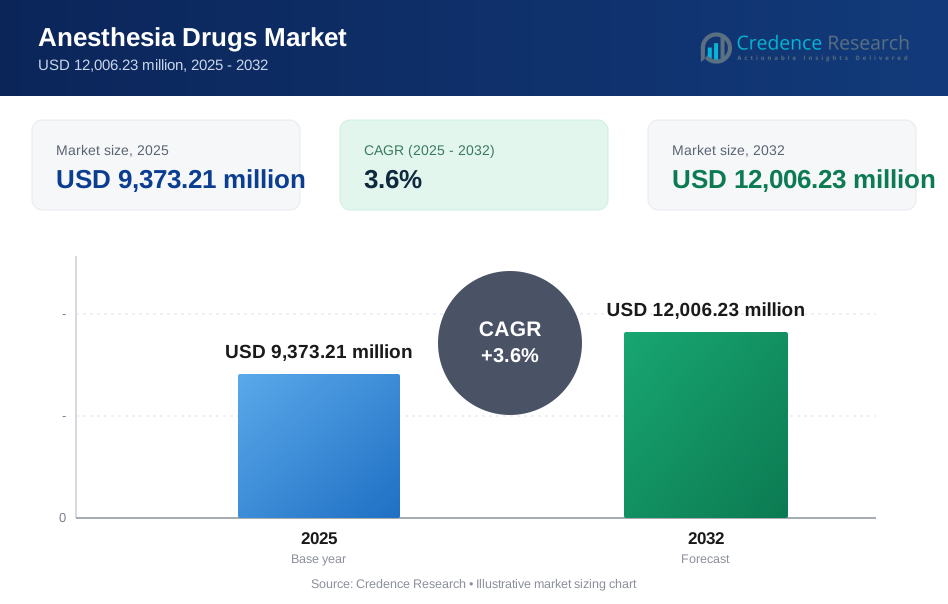
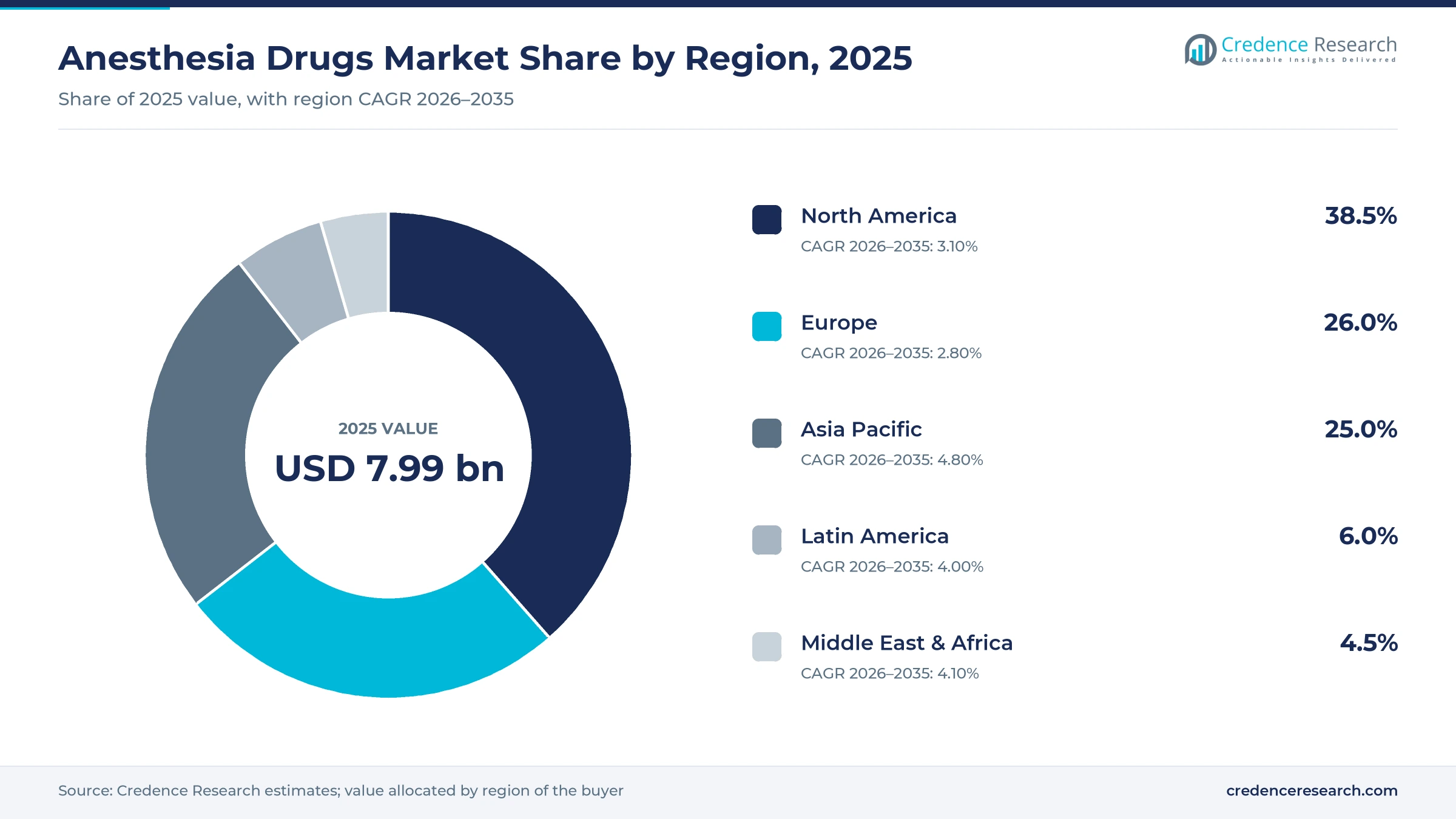
The global anesthesia drugs market was valued at USD 7.99 billion in 2025 and is projected to increase from USD 8.28 billion in 2026 to USD 11.35 billion by 2035, registering a CAGR of 3.57% during 2026–2035. Demand rises with the number of operations, procedural sedation cases and cesarean deliveries performed each year, because almost every procedure uses at least one hypnotic, sedative, short-acting opioid or local agent. North America held the largest regional share, 38.5% in 2025, on high procedure volumes and branded extended-release local products. Asia Pacific is the fastest-growing region at 4.80% a year as China and India add surgical beds and train more anesthesiologists. Most volume is generic and bought through hospital tenders, so revenue tracks procedure counts more closely than list prices. The main regulatory change is in Europe, where an EU rule on fluorinated gases has prohibited routine use of desflurane since January 2026 unless a clinician records a medical need.
What does the anesthesia drugs market include and exclude?
The market counts manufacturer revenue from drugs used to induce, maintain and support general anesthesia, sedation and local or regional anesthesia. It covers intravenous hypnotics such as propofol, inhaled agents such as sevoflurane and desflurane, sedatives such as dexmedetomidine and midazolam, short-acting opioids such as remifentanil, and local agents including bupivacaine, ropivacaine, lidocaine and chloroprocaine. Hospitals, ambulatory surgical centers, dental offices and endoscopy units buy these products mostly through group purchasing contracts and national tenders.
The scope excludes anesthesia machines, vaporizers, infusion pumps, monitors and airway devices, which are sold as capital equipment rather than as drugs. It also excludes neuromuscular blockers, reversal agents such as sugammadex and veterinary anesthetics, because their buyers, prices and demand cycles differ from the core human anesthetic and sedative portfolio.
Anesthesia Drugs Market Insights
- The anesthesia drugs market grows from USD 7.99 billion in 2025 to USD 11.35 billion by 2035, a 3.57% CAGR over 2026–2035 driven by procedure volume rather than price.
- North America held 38.5% of global anesthesia drug value in 2025, supported by high surgical volumes and branded extended-release local anesthetics.
- Local anesthesia drugs led drug classes with 24.0% of 2025 value, because nerve blocks, infiltration and dental injections are used in nearly every care setting.
- An EU fluorinated gas rule has prohibited routine desflurane use since January 2026, pushing European hospitals toward sevoflurane and total intravenous anesthesia.
- Fresenius Kabi, Hikma, Baxter and B. Braun compete on dependable injectable supply, while Haisco's cipepofol approval in 2026 brings Chinese originator competition to the U.S.
Local agents lead while dexmedetomidine grows fastest
Why do local anesthesia drugs hold the largest share?
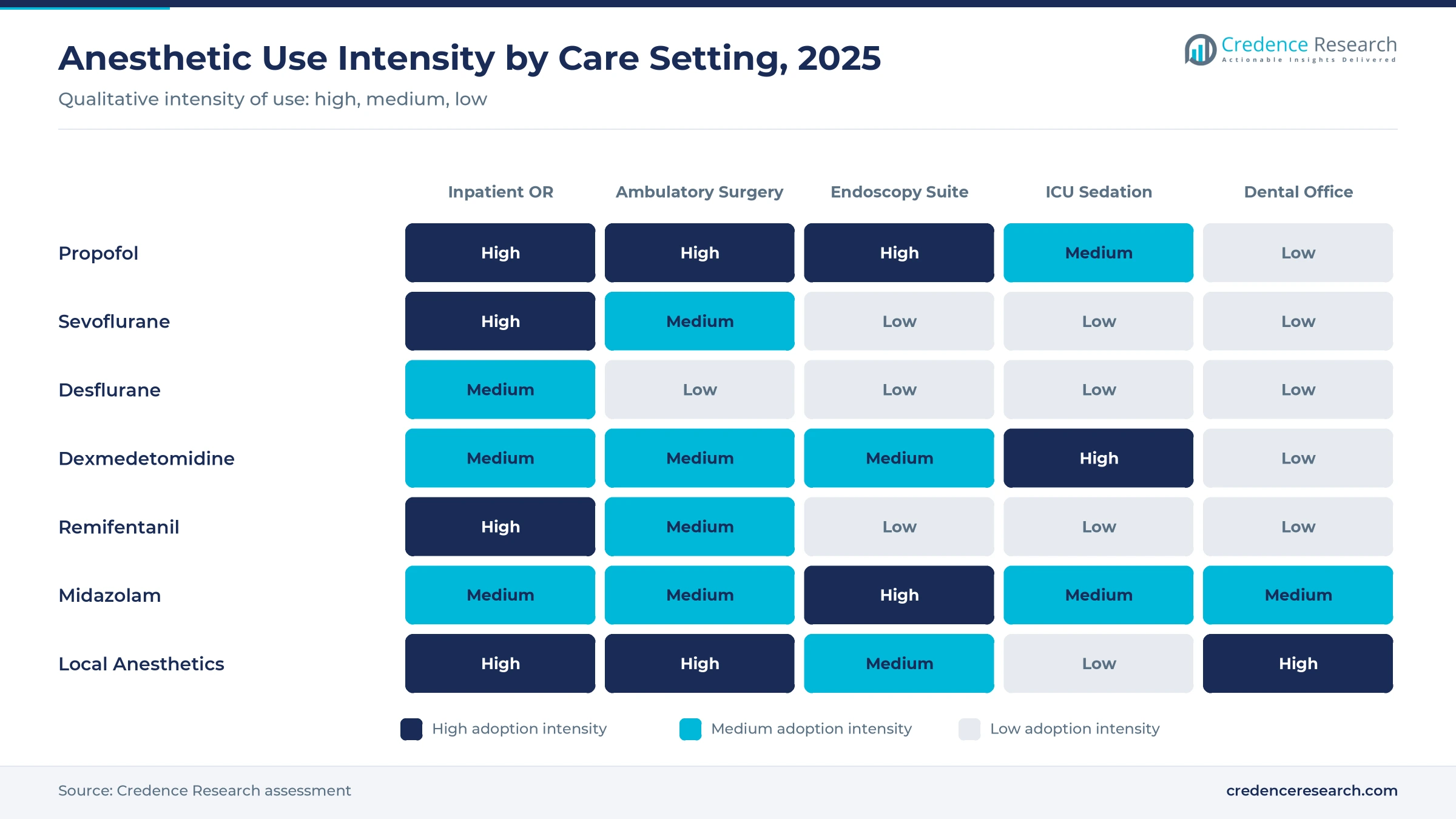
Based on drug class, the market is categorized into propofol, sevoflurane, desflurane, dexmedetomidine, remifentanil, midazolam, local anesthesia drugs and others. Local Anesthesia Drugs led with a 24.0% share of 2025 value, as bupivacaine, ropivacaine, lidocaine and chloroprocaine are used in nerve blocks, spinal anesthesia, wound infiltration and dental anesthetics cartridges. Dexmedetomidine grows fastest at 4.97% a year through 2035, because intensive care units and procedural suites use it for light sedation that preserves spontaneous breathing.
Which route of administration carries the most value?
Based on route of administration, the market is categorized into intravenous, inhalation, local and regional injection, and oral products. Intravenous products led with a 48.0% share of 2025 value, because propofol, dexmedetomidine, remifentanil and midazolam are given through IV lines in almost every operating room. Local and Regional Injection grows fastest at 3.93% a year, as ultrasound-guided nerve blocks replace part of systemic opioid use after joint, shoulder and cesarean surgery.
Which procedures use the most anesthetic value?
Based on application, the market is categorized into general surgery, plastic and reconstructive surgery, cosmetic and aesthetic procedures, dental procedures, obstetric and gynecologic surgery, and others. General Surgery led with a 38.0% share of 2025 value, because abdominal, hernia, gallbladder and bowel operations form the largest block of cases that need full general anesthesia. Cosmetic and Aesthetic Procedures grow fastest at 5.16% a year, as office-based body contouring, breast and facial procedures expand with sedation and tumescent local anesthesia.
How fast is anesthetic use moving to outpatient centers?
Based on end user, the market is categorized into hospitals, ambulatory surgical centers, diagnostic centers, home care and others. Hospitals led with a 68.0% share of 2025 value, because inpatient surgery, trauma care, obstetrics and intensive care sedation remain hospital work. Ambulatory Surgical Centers grow fastest at 4.81% a year, as payers move joint replacement, cataract, endoscopy and spine cases to lower-cost outpatient settings that favor short-acting agents and nerve blocks.
| Segment Group | Leading Sub-segment | Share, 2025 | Fastest-growing Sub-segment | CAGR, 2026–2035 |
|---|---|---|---|---|
| By Drug Class | Local Anesthesia Drugs | 24.0% | Dexmedetomidine | 4.97% |
| By Route of Administration | Intravenous | 48.0% | Local and Regional Injection | 3.93% |
| By Application | General Surgery | 38.0% | Cosmetic and Aesthetic Procedures | 5.16% |
| By End User | Hospitals | 68.0% | Ambulatory Surgical Centers | 4.81% |
Request a Free Sample
Fill in your details and we'll send you a free sample report.
- Sample data tables & charts
- Research methodology
Surgery volume, outpatient shifts and opioid-sparing care
How does rising surgical volume lift anesthetic demand?
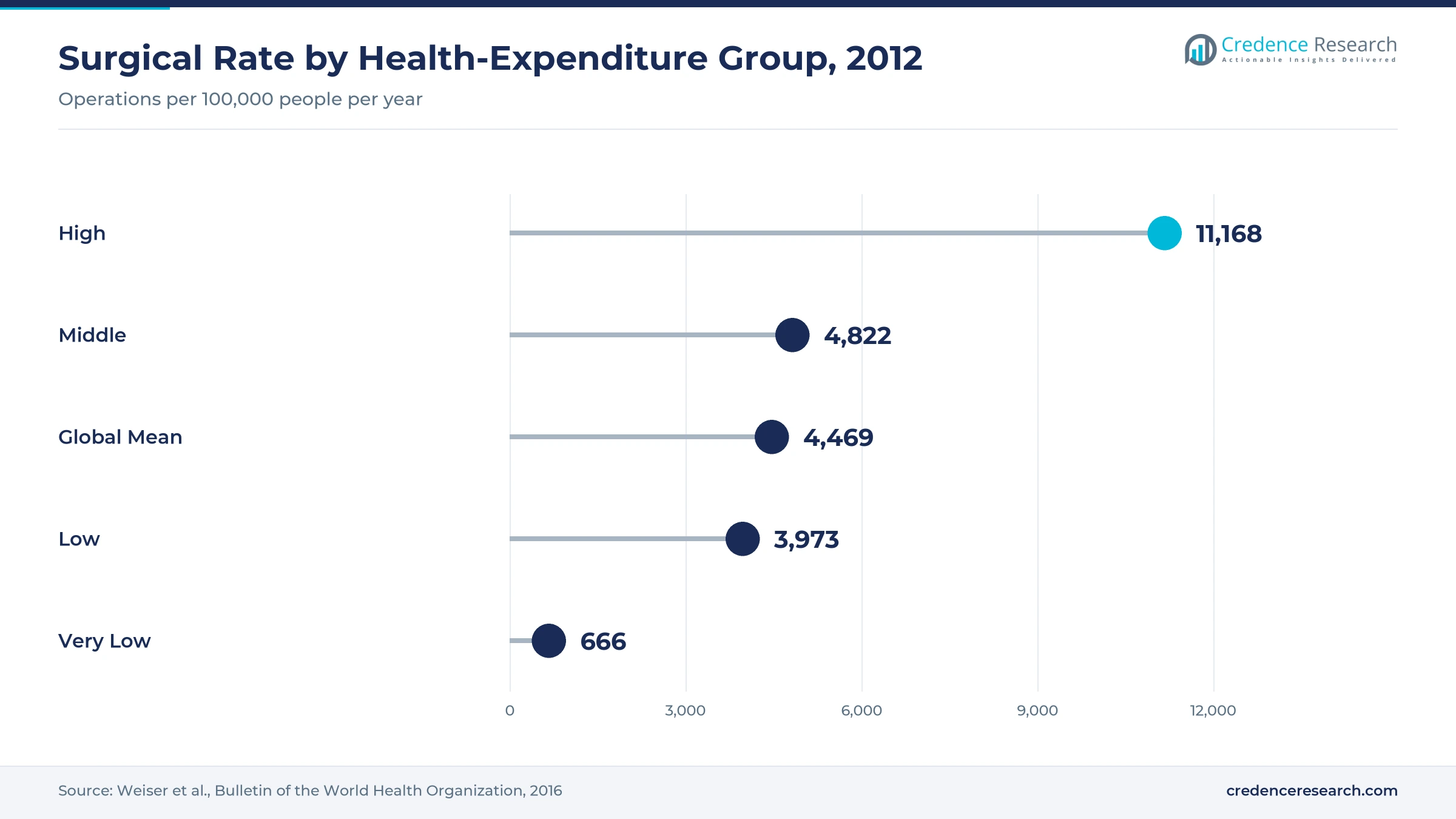
Every operation needs at least one anesthetic or sedative, so drug demand follows surgical volume closely. A study in the WHO Bulletin estimated that 312.9 million operations took place worldwide in 2012, within a 95% confidence range of 266.2 million to 359.5 million and a mean of 4,469 operations per 100,000 people. Rates were far higher in high-spending health systems, at 11,168 per 100,000 people, than in very-low-spending countries, at 666. As a result, aging populations and joint replacements in wealthy markets, with new operating rooms in emerging markets, keep raising anesthetic use through 2035.
Why are outpatient shifts changing drug choice?
Payers in the U.S. and Europe keep moving hip, knee, spine and endoscopy cases into ambulatory surgical centers, where patients must wake quickly and go home the same day. This favors short-acting agents such as propofol, remifentanil and sevoflurane, along with regional blocks and non-opioid pain treatment that reduce nausea after discharge. Ambulatory centers therefore buy a different mix than inpatient wards, with more prefilled syringes and fewer long-acting sedatives. In turn, the shift adds volume for generic suppliers that can guarantee ready-to-use formats at contract prices.
How do opioid-sparing protocols raise local anesthetic use?
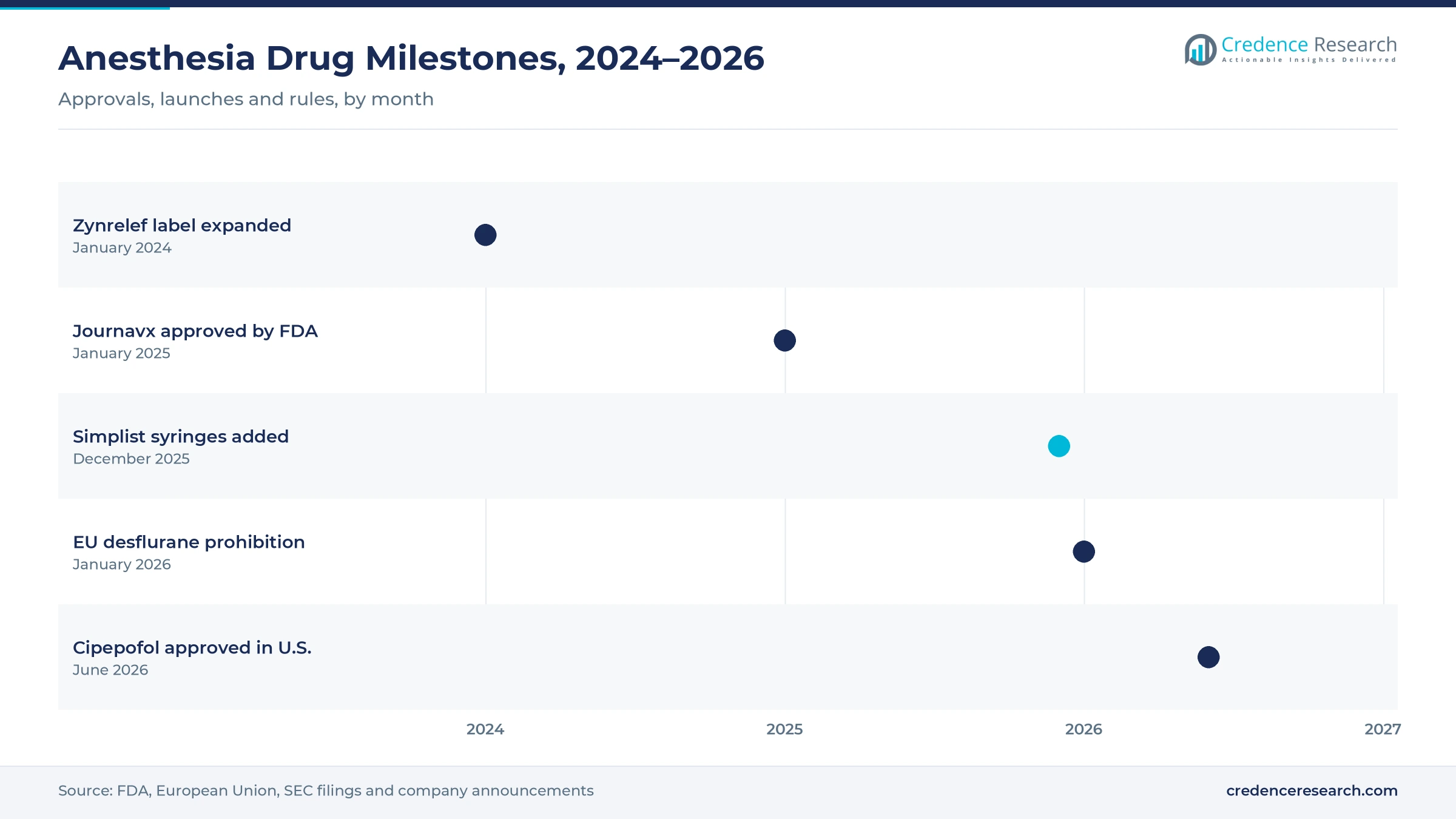
Enhanced recovery protocols aim to cut opioid prescriptions after surgery, and local anesthetics carry much of that load. In January 2024, Heron Therapeutics announced that the FDA had approved an expanded indication for Zynrelef, its extended-release bupivacaine and meloxicam product. The broader label covers an estimated 13 million procedures a year, 86% more than the earlier indication, after trials in spine surgery, cesarean section and shoulder replacement. As a result, hospitals that adopt such protocols use more long-acting local agents per case, which supports demand for the largest drug class.
Why do emerging markets add new anesthetic demand?
Large gaps in surgical access remain, and closing them adds demand for basic anesthetics in lower-income countries. In the same WHO Bulletin estimate, very-low and low-spending countries performed only 6.3% and 23.1% of global operations, although they were home to 36.8% and 34.2% of the world population. China, India, Indonesia and Brazil are building surgical capacity and training anesthesia staff, which raises use of low-cost generic propofol, ketamine, lidocaine and bupivacaine. Because local producers supply much of this volume, prices stay low, yet units grow faster than in mature health systems.
Greener vapors, ready-to-use syringes and new sedatives
Why are hospitals shifting away from desflurane?
Inhaled anesthetics are potent greenhouse gases, and desflurane has by far the strongest warming effect among the common agents. The EU's Regulation (EU) 2024/573 on fluorinated greenhouse gases prohibits use of desflurane as an inhalation anesthetic from Jan. 1, 2026, unless its use is required on medical grounds. Anesthesiology colleges in the U.K. and Ireland had already backed decommissioning desflurane in public hospitals before the rule took effect. As a result, European demand is shifting toward sevoflurane, low-flow techniques and total intravenous anesthesia with propofol and remifentanil.
How are ready-to-use syringes changing operating room supply?
Hospitals want fewer drawing-up steps to cut medication errors and waste in operating rooms. In December 2025, Fresenius Kabi introduced succinylcholine and ephedrine in its Simplist prefilled syringe line, with succinylcholine in 100 mg per 5 mL and 200 mg per 10 mL syringes and ephedrine in 25 mg per 5 mL and 50 mg per 10 mL syringes. Prefilled formats carry higher unit prices than vials, which raises value per case. In turn, suppliers with sterile syringe filling capacity gain an edge in group purchasing contracts across the U.S. and Europe.
Where is the opening for newer sedatives?
Newer sedatives that wake patients faster or cause less injection pain create a premium tier in a market dominated by generics. Haisco Pharmaceutical announced in June 2026 that the FDA had approved cipepofol injection, sold as Cypsedo, for induction of general anesthesia in adults, the first China-developed intravenous anesthetic cleared in the U.S. Remimazolam, developed by PAION and sold as Byfavo, offers an ultra-short-acting benzodiazepine option for procedural sedation in several markets. These emerging agents give suppliers a chance to win endoscopy and ambulatory contracts on recovery speed rather than price.
Can non-opioid analgesia open new perioperative revenue?
On Jan. 30, 2025, the FDA approved Journavx (suzetrigine) 50 milligram tablets, a first-in-class non-opioid analgesic for moderate to severe acute pain in adults. Approvals of this kind encourage surgeons and anesthesiologists to combine regional blocks, local infiltration and non-opioid tablets in multimodal plans. For local anesthetic makers, the opportunity lies in longer-acting formulations and procedure kits that fit these plans in ambulatory centers. Interest in such multimodal bundles is increasing fastest in orthopedic, spine and cesarean surgery, where long-acting nerve blocks are already common.
Shortages, price erosion and staff gaps limit value
How do sterile injectable shortages disrupt anesthesia care?
Many anesthetics are old, low-priced sterile injectables made at a handful of plants, so one quality failure can empty shelves nationwide. In October 2026, the FDA drug shortage database listed bupivacaine, lidocaine and midazolam injections as currently in shortage, forcing hospitals to ration vials and switch agents. Shortages raise costs for hospitals that must buy from secondary distributors and retrain staff on substitute products. Because margins are thin, few generic makers invest in backup sterile capacity, which keeps this supply risk in place through the forecast period.
Why does generic price erosion cap value growth?
Most anesthetic volume is off patent, and hospital group purchasing organizations and national tenders award contracts largely on price. In China, national volume-based procurement rounds have covered many common injectables, and European tenders also reward the lowest bid, so value grows more slowly than the number of cases. As a result, the market's 3.57% CAGR over 2026–2035 sits below procedure growth in many emerging countries. Suppliers respond with prefilled syringes, premixed bags and long-acting formulations that carry better margins and longer contract terms.
How do workforce gaps limit anesthesia capacity?
Anesthetic use depends on trained anesthesiologists and nurse anesthetists, and many health systems lack enough of them. Low-income countries have far fewer anesthesia providers per 100,000 people than high-income countries, which caps how many operations can be done safely. Even in the U.S. and Europe, staff shortages delay elective surgery lists and push hospitals toward simpler techniques. This constraint limits volume growth in exactly the regions where unmet surgical need is largest, slowing the conversion of clinical need into drug sales.
What pressure do climate goals and safety warnings add?
Climate goals put pressure on inhaled agents beyond desflurane, because sevoflurane and nitrous oxide also count toward hospital carbon footprints. Many European health systems now measure anesthetic gas emissions, and vapor capture systems add equipment and handling costs where they are installed. Safety pressure adds to this risk, since sedatives and opioids used together in anesthesia carry warnings on breathing suppression. As a result, suppliers of inhaled agents face slower growth in Europe, while intravenous and regional techniques gain ground in new protocols.
North America leads as Asia Pacific adds surgical capacity
| Region | Value, 2025 (USD billion) | Share, 2025 | CAGR, 2026–2035 |
|---|---|---|---|
| North America | 3.08 | 38.5% | 3.10% |
| Europe | 2.08 | 26.0% | 2.80% |
| Asia Pacific | 2.00 | 25.0% | 4.80% |
| Latin America | 0.48 | 6.0% | 4.00% |
| Middle East & Africa | 0.36 | 4.5% | 4.10% |
North America leads on procedure volume and branded local agents
North America held a 38.5% share of 2025 value and grows at 3.10% a year through 2035. The U.S. performs the largest number of inpatient and outpatient operations, and branded extended-release local products such as liposomal bupivacaine and Zynrelef add value per case. Ambulatory surgical centers continue to take orthopedic, spine and gastrointestinal cases from hospitals, which raises use of short-acting agents. However, shortages of sterile injectables and tight group purchasing contracts keep generic prices low, so value growth trails procedure counts.
Europe moves from desflurane toward intravenous techniques
Europe held a 26.0% share of 2025 value and grows at 2.80% a year, the slowest rate among the five regions. The EU restriction on routine desflurane use removes a premium inhaled product, while hospitals in Germany, France, Italy and the Nordic countries expand total intravenous anesthesia and low-flow sevoflurane techniques. National tenders award most generic contracts on price, which limits value growth across the region. An older population still supports steady volumes of hip, knee, cataract and cancer operations through the forecast period.
Asia Pacific adds the most new operating capacity
Asia Pacific held a 25.0% share of 2025 value and is the fastest-growing region at 4.80% a year. China and India are adding hospital beds, surgical specialists and day-surgery units, and Japan's aging population keeps demand for orthopedic and cancer operations high. Domestic originators such as Jiangsu Hengrui, with remimazolam and Haisco, with cipepofol, compete with imported brands at lower prices. As a result, unit growth in the region is strong, while value growth is held back by price controls and procurement rounds.
Latin America grows with public hospital investment
Latin America held a 6.0% share of 2025 value and grows at 4.00% a year through 2035. Brazil and Mexico account for most regional demand, with public hospitals buying generic propofol, lidocaine and bupivacaine through national tenders. Private hospital groups are adding cosmetic and bariatric surgery capacity, which supports sedation and local anesthetic use. Currency swings and import dependence remain risks for multinational suppliers operating in the region.
Middle East and Africa start from a low base
The Middle East & Africa held a 4.5% share of 2025 value and grows at 4.10% a year. Gulf states such as Saudi Arabia and the United Arab Emirates are building hospitals and specialty surgical centers, which raises demand for modern intravenous and inhaled agents. In much of sub-Saharan Africa, shortages of anesthesia providers and basic drugs still limit surgical access for large populations. Hikma, with plants in the Middle East, and multinational generic makers supply much of the region's injectable volume.
Label expansions, an EU gas rule and a Chinese IV agent
| Development | Status and market relevance |
|---|---|
| In January 2024, Heron Therapeutics announced FDA approval of an expanded Zynrelef indication covering more soft tissue and orthopedic procedures. | Approved. Widens use of extended-release bupivacaine in opioid-sparing surgery protocols. |
| In January 2025, the FDA approved Vertex Pharmaceuticals' Journavx (suzetrigine), expanding non-opioid options for acute pain. | Approved. Supports multimodal plans that pair nerve blocks with non-opioid tablets. |
| In December 2025, Fresenius Kabi introduced succinylcholine and ephedrine in Simplist prefilled syringes for operating rooms. | Launched. Extends the ready-to-administer format across anesthesia carts. |
| In January 2026, the EU prohibition on routine use of desflurane as an inhalation anesthetic took effect under Regulation (EU) 2024/573. | In force. Moves European volume toward sevoflurane and intravenous techniques. |
| In June 2026, Haisco Pharmaceutical announced U.S. FDA approval of cipepofol injection (Cypsedo) for induction of general anesthesia in adults. | Approved. The first China-developed intravenous anesthetic cleared in the U.S. |
Soft-drug sedatives, prefilled syringes and nerve blocks
- Soft-drug sedatives such as remimazolam and cipepofol are designed for fast, predictable wake-up after endoscopy and short procedures.
- Prefilled syringes deliver vasopressors, muscle relaxants and other operating room drugs ready to administer, cutting drawing-up errors and waste.
- Extended-release local formulations such as liposomal bupivacaine and bupivacaine with meloxicam extend pain control for days after surgery and reduce opioid needs.
- Low-flow delivery and vapor capture reduce the amount of sevoflurane released per case and collect waste gas for destruction or recycling.
- Target-controlled infusion pumps dose propofol and remifentanil by predicted blood concentration, supporting total intravenous anesthesia as desflurane use declines.
Need a Custom Version of This Report?
Tailor the scope, geography, or segments to your exact requirements.
- Custom geography or segment scope
- Direct access to our analyst team
Generic injectable makers compete on supply reliability
Competition splits between generic sterile injectable makers and a smaller group of companies with branded or differentiated products. Large volumes of propofol, midazolam, lidocaine, bupivacaine and ropivacaine are sold by Fresenius Kabi, Hikma, Baxter and B. Braun through group purchasing contracts and national tenders, where price, supply record and packaging format decide awards. Baxter and AbbVie hold long-standing positions in inhaled agents, and Maruishi Pharmaceutical developed sevoflurane in Japan. Aspen Pharmacare owns established brands such as Diprivan, Xylocaine, Naropin and Marcaine outside the U.S., acquired from AstraZeneca in 2016. Sandoz and Dr. Reddy's add generic competition in selected molecules and countries. Newer agents come from smaller originators and Chinese companies, including PAION's remimazolam and Haisco's cipepofol. Because hospitals value uninterrupted supply over small price gaps, makers with redundant sterile plants and prefilled formats win contracts during shortages.
Companies profiled and their roles in this market
| Company | Type | Role in the market |
|---|---|---|
| Fresenius SE & Co. KGaA | Generic and branded injectables | Diprivan propofol in the U.S. and Simplist prefilled syringes |
| Baxter International Inc. | Inhaled and injectable anesthetics | Suprane desflurane, sevoflurane and generic injectables |
| AbbVie Inc. | Inhaled anesthetics | Ultane sevoflurane |
| Aspen Pharmacare Holdings Ltd. | Branded anesthetics | Diprivan, Xylocaine, Naropin and Marcaine outside the U.S. |
| B. Braun Melsungen AG | Infusion and injectables | Propofol emulsions and local anesthetics for hospitals |
| Hikma Pharmaceuticals plc | Generic injectables | Bupivacaine, ropivacaine and dexmedetomidine in the U.S. |
| Sandoz AG | Generics | Generic injectables in selected markets |
| Dr. Reddy's Laboratories | Generics | Generic injectables in selected markets |
| Abbott Laboratories | Branded generics | Established pharmaceuticals in emerging markets |
| Jiangsu Hengrui Pharma | Originator, China | Remimazolam for sedation in China |
| Maruishi Pharmaceutical Co. Ltd. | Originator, Japan | Developer of sevoflurane |
| PAION AG | Originator | Remimazolam (Byfavo) licensing |
Supply security matters more than new molecules
Credence Research's view is that supply security, not new molecules, decides who gains share in anesthesia drugs through 2035. Most procedures still use decades-old agents, and hospitals reward suppliers that keep delivering during shortages. Prefilled syringes, premixed bags and long-acting local formulations are the main routes to higher value per case. Newer sedatives such as cipepofol and remimazolam will win endoscopy and ambulatory niches, but price-led tenders limit their spread in public hospitals. Europe's exit from routine desflurane use is a one-time shift that favors sevoflurane and intravenous suppliers over the decade.
How the 2025 baseline and forecast were built
The report uses 2025 as the base year and forecasts market value to 2035, with growth rates stated for 2026–2035. Market values come from the Credence Research market model, which combines procedure volumes, typical drug use per procedure type and average selling prices by region. Splits by drug class, route, application, end user and region are Credence Research estimates. Sources used include regulator approvals and rules from the FDA and the European Union, company press releases and filings, and a peer-reviewed estimate of global surgical volume published in the Bulletin of the World Health Organization. No primary interviews or surveys were used to build the estimates in this report.
Volume-led growth with a steady move to outpatient care
By 2035, the market reaches USD 11.35 billion, with growth coming from volume rather than price. Procedure counts rise with aging populations in North America, Europe and Japan and with new surgical capacity in China, India and Southeast Asia. Ambulatory centers take a larger share of cases, which favors short-acting intravenous agents, nerve blocks and prefilled formats. Inhaled agents lose some ground in Europe after the desflurane restriction, while sevoflurane keeps its role in pediatric induction. New sedatives from Chinese originators reach more markets, adding competition for propofol in endoscopy and short procedures across the decade.
Frequently Asked Questions
How big is the anesthesia drugs market?
Which drug class leads the anesthesia drugs market?
Which drug class grows fastest?
Which region holds the largest share?
How does the EU desflurane rule affect demand?
What drives demand for anesthesia drugs?
Who are the leading companies?
What are the main challenges?
Table of Content
Chapter 1 Market Segmentation
- 1.1 Segmentation Framework
- 1.1.1 Product and Service Classification
- 1.1.2 Application and End-Use Classification
- 1.1.3 Technology and Solution Classification
- 1.1.4 Customer and Distribution Channel Classification
- 1.1.5 Geographic Segmentation
- 1.1.6 Market Segment Definitions and Boundaries
- 1.2 By Drug Class
- 1.2.1 Local Anesthesia Drugs
- 1.2.2 Propofol
- 1.2.3 Sevoflurane
- 1.2.4 Dexmedetomidine
- 1.2.5 Remifentanil
- 1.2.6 Midazolam
- 1.2.7 Desflurane
- 1.2.8 Others
- 1.3 By Route of Administration
- 1.3.1 Intravenous
- 1.3.2 Local and Regional Injection
- 1.3.3 Inhalation
- 1.3.4 Oral
- 1.4 By Application
- 1.4.1 General Surgery
- 1.4.2 Obstetric and Gynecologic Surgery
- 1.4.3 Dental Procedures
- 1.4.4 Plastic and Reconstructive Surgery
- 1.4.5 Cosmetic and Aesthetic Procedures
- 1.4.6 Others
- 1.5 By End User
- 1.5.1 Hospitals
- 1.5.2 Ambulatory Surgical Centers
- 1.5.3 Diagnostic Centers
- 1.5.4 Home Care
- 1.5.5 Others
Chapter 2 Introduction
- 2.1 Report Objectives and Scope
- 2.2 Product Definition and Industry Terminology
- 2.3 Market Inclusions and Exclusions
- 2.4 Research Process
- 2.4.1 Primary Research and Expert Interviews
- 2.4.2 Secondary Research and Source Review
- 2.4.3 Top-Down and Bottom-Up Estimation
- 2.4.4 Data Triangulation and Verification
- 2.5 Market Size Measurement Basis
- 2.5.1 2025: USD 7.99 billion → 2035: USD 11.35 billion
- 2.6 Historical and Forecast Reference Periods
- 2.6.1 Historical Period: 2018-2025
- 2.6.2 Base Year: 2025
- 2.6.3 Forecast Period: 2025-2035
- 2.7 Research Assumptions and Limitations
Chapter 3 Executive Summary
- 3.1 Market Snapshot and Key Findings
- 3.2 Base-Year Market Size, 2025
- 3.3 Forecast Market Size, 2035
- 3.4 Revenue and Volume Growth Outlook
- 3.5 Key Demand and Supply Indicators
- 3.6 Leading Market Segments
- 3.7 Fastest-Growing Market Opportunities
- 3.8 Regional Performance Highlights
- 3.9 Technology and Industry Transformation
- 3.10 Competitive Landscape Summary
- 3.11 Analyst View and Strategic Implications
Chapter 4 Global Anesthesia Drugs Market Trends and Developments
- 4.1 Historical Industry Development, 2018-2025
- 4.2 Recent Market Trends and Developments
- 4.3 Demand and Customer Behavior Trends
- 4.4 Technology and Product Innovation
- 4.5 Artificial Intelligence, Automation and Digitalization
- 4.6 Local Manufacturing and Supply Chain Realignment
- 4.7 Industry Partnerships, Mergers and Acquisitions
- 4.8 Sustainability and Circular Economy Developments
- 4.9 Government and Private Sector Investment Trends
- 4.10 Emerging Business Models and Commercialization
- 4.11 Industry Developments and Announcements
Chapter 5 Global Anesthesia Drugs Market Production, Supply and Demand Analysis
- 5.1 Demand Trend and Consumption Analysis, 2018-2025
- 5.2 Demand Forecast, 2025-2035
- 5.3 Production and Output Trend, 2018-2025
- 5.4 Production and Output Forecast, 2025-2035
- 5.5 Installed Capacity and Capacity Utilization
- 5.6 Company-Wise Production Plants and Statistics
- 5.6.1 Installed Production Capacity
- 5.6.2 Actual Production
- 5.6.3 Planned Capacity and Expansion Targets
- 5.7 Supply Chain Structure and Procurement Trends
- 5.8 Supply-Demand Gap and Bottlenecks
- 5.9 Import Dependence and Sourcing Structure
- 5.10 Contract Manufacturing and Outsourcing
- 5.11 Regional Supply and Demand Concentration
Chapter 6 Global Anesthesia Drugs Market Pricing Analysis
- 6.1 Pricing Structure and Measurement
- 6.2 Historical Pricing Trends, 2018-2025
- 6.3 Pricing Outlook, 2025-2035
- 6.4 Average Selling Price and Unit Economics
- 6.5 Pricing by Product and Market Segment
- 6.6 Geographic Pricing Differences
- 6.7 Key Input, Energy, Labor and Logistics Costs
- 6.8 Contract Pricing and Purchasing Models
- 6.9 Pricing Sensitivity and Competitive Positioning
- 6.10 Price, Margin and Profitability Implications
Chapter 7 Global Anesthesia Drugs Market Dynamics
- 7.1 Market Growth Drivers
- 7.1.1 Demand-Side Drivers
- 7.1.2 Technology and Innovation Drivers
- 7.1.3 Infrastructure and Investment Drivers
- 7.1.4 Regulatory and Policy Drivers
- 7.2 Market Restraints
- 7.2.1 Cost and Affordability Constraints
- 7.2.2 Technology and Adoption Barriers
- 7.2.3 Supply Chain and Operational Constraints
- 7.3 Market Challenges
- 7.3.1 Competitive Pressure and Margin Erosion
- 7.3.2 Skills, Infrastructure and Implementation Gaps
- 7.4 Emerging Market Opportunities
- 7.5 Market Dynamics Impact and Time-Horizon Assessment
Chapter 8 Global Anesthesia Drugs Value Chain Analysis
- 8.1 Industry Value Chain Overview
- 8.2 Upstream Suppliers and Critical Inputs
- 8.3 Technology and Component Providers
- 8.4 Manufacturing or Service Delivery
- 8.5 Distribution, Channel Partners and Integrators
- 8.6 Downstream Applications and End Users
- 8.7 Value Addition and Profit Pools
- 8.8 Vertical Integration and Outsourcing
- 8.9 Supplier Concentration and Risk
- 8.10 Supply Chain Localization and Resilience
Chapter 9 Global Anesthesia Drugs Market Regulations and Policies
- 9.1 Relevant Laws, Standards and Compliance Frameworks
- 9.2 Product, Service, Safety and Quality Requirements
- 9.3 Government Policies, Incentives and Subsidies
- 9.4 Imports, Exports and Trade Barriers
- 9.5 Public Procurement and Local Content Requirements
- 9.6 Environmental and Sustainability Compliance
- 9.7 Upcoming Policy Changes and Market Implications
Chapter 10 Global Anesthesia Drugs Market Hotspots and Opportunities
- 10.1 Market Opportunity Mapping and Growth Hotspots
- 10.2 High-Growth Applications and Customer Groups
- 10.3 Underserved Markets and White-Space Opportunities
- 10.4 Emerging Technology and Product Opportunities
- 10.5 New Capacity and Investment Hotspots
- 10.6 Market Entry and Expansion Opportunities
- 10.7 Distribution and Partnership Opportunities
- 10.8 Near-Term and Long-Term Commercial Potential
- 10.9 Opportunity Attractiveness and Execution Risks
Chapter 11 Global Anesthesia Drugs Market Outlook, 2025-2035
- 11.1 Market Size and Analysis
- 11.1.1 Revenue (Market Measurement: 2025: USD 7.99 billion → 2035: USD 11.35 billion)
- 11.1.2 Market Volume and Quantity Sold
- 11.1.3 Historical Market Size, 2018-2025
- 11.1.4 Base-Year Market Size, 2025
- 11.2 Market Forecast, 2025-2035
- 11.2.1 Revenue Forecast to 2035
- 11.2.2 Volume Forecast to 2035
- 11.2.3 CAGR and Year-on-Year Growth
- 11.2.4 Incremental Revenue Opportunity
- 11.3 Forecast Assumptions and Scenario Analysis
- 11.3.1 Base-Case Forecast
- 11.3.2 Optimistic and Conservative Scenarios
- 11.3.3 Technology, Pricing and Policy Sensitivities
- 11.4 Market Attractiveness and Growth Outlook
Chapter 12 Global Anesthesia Drugs Market Segmentation and Outlook
- 12.1 Segmentation Summary and Market Shares, 2025
- 12.2 Largest and Fastest-Growing Segments
- 12.3 By Drug Class - Market Size and Forecast, 2025-2035
- 12.3.1 Segment Definition and Scope
- 12.3.2 Historical Market Size, 2018-2025
- 12.3.3 Revenue Forecast, 2025-2035
- 12.3.4 Volume Forecast, 2025-2035
- 12.3.5 Base-Year Market Share, 2025
- 12.3.6 Segment CAGR and Growth Drivers
- 12.3.7 Subsegment Market Size and Forecast
- 12.3.7.1 Local Anesthesia Drugs
- 12.3.7.2 Propofol
- 12.3.7.3 Sevoflurane
- 12.3.7.4 Dexmedetomidine
- 12.3.7.5 Remifentanil
- 12.3.7.6 Midazolam
- 12.3.7.7 Desflurane
- 12.3.7.8 Others
- 12.3.8 Subsegment Pricing and Adoption Trends
- 12.3.9 Leading Suppliers and Competition
- 12.3.10 Regional Demand and Opportunities
- 12.4 By Route of Administration - Market Size and Forecast, 2025-2035
- 12.4.1 Segment Definition and Scope
- 12.4.2 Historical Market Size, 2018-2025
- 12.4.3 Revenue Forecast, 2025-2035
- 12.4.4 Volume Forecast, 2025-2035
- 12.4.5 Base-Year Market Share, 2025
- 12.4.6 Segment CAGR and Growth Drivers
- 12.4.7 Subsegment Market Size and Forecast
- 12.4.7.1 Intravenous
- 12.4.7.2 Local and Regional Injection
- 12.4.7.3 Inhalation
- 12.4.7.4 Oral
- 12.4.8 Subsegment Pricing and Adoption Trends
- 12.4.9 Leading Suppliers and Competition
- 12.4.10 Regional Demand and Opportunities
- 12.5 By Application - Market Size and Forecast, 2025-2035
- 12.5.1 Segment Definition and Scope
- 12.5.2 Historical Market Size, 2018-2025
- 12.5.3 Revenue Forecast, 2025-2035
- 12.5.4 Volume Forecast, 2025-2035
- 12.5.5 Base-Year Market Share, 2025
- 12.5.6 Segment CAGR and Growth Drivers
- 12.5.7 Subsegment Market Size and Forecast
- 12.5.7.1 General Surgery
- 12.5.7.2 Obstetric and Gynecologic Surgery
- 12.5.7.3 Dental Procedures
- 12.5.7.4 Plastic and Reconstructive Surgery
- 12.5.7.5 Cosmetic and Aesthetic Procedures
- 12.5.7.6 Others
- 12.5.8 Subsegment Pricing and Adoption Trends
- 12.5.9 Leading Suppliers and Competition
- 12.5.10 Regional Demand and Opportunities
- 12.6 By End User - Market Size and Forecast, 2025-2035
- 12.6.1 Segment Definition and Scope
- 12.6.2 Historical Market Size, 2018-2025
- 12.6.3 Revenue Forecast, 2025-2035
- 12.6.4 Volume Forecast, 2025-2035
- 12.6.5 Base-Year Market Share, 2025
- 12.6.6 Segment CAGR and Growth Drivers
- 12.6.7 Subsegment Market Size and Forecast
- 12.6.7.1 Hospitals
- 12.6.7.2 Ambulatory Surgical Centers
- 12.6.7.3 Diagnostic Centers
- 12.6.7.4 Home Care
- 12.6.7.5 Others
- 12.6.8 Subsegment Pricing and Adoption Trends
- 12.6.9 Leading Suppliers and Competition
- 12.6.10 Regional Demand and Opportunities
- 12.7 Segment Growth Comparison
- 12.8 Segment Attractiveness and Priority Matrix
Chapter 13 Global Anesthesia Drugs End-Use and Application Market Outlook
- 13.1 End-Use Industry and Customer Demand Structure
- 13.2 Leading Applications and Customer Groups
- 13.3 End-Use Market Size, Share and Forecast
- 13.4 Major End-Use Industry Deep Dives
- 13.4.1 Customer Requirements and Use Cases
- 13.4.2 Demand and Replacement Cycles
- 13.4.3 Technical and Regulatory Considerations
- 13.4.4 Purchasing and Procurement Models
- 13.4.5 Leading Vendors and Distribution Channels
- 13.4.6 Forecast and Commercial Opportunities
- 13.5 Emerging Applications and Cross-Segment Demand
- 13.6 End-Use Industry Investment Priorities
Chapter 14 Global Anesthesia Drugs Geographic Market Outlook, 2025-2035
- 14.1 Regional Market Size and Share, 2025
- 14.2 Regional Market Forecast, 2025-2035
- 14.3 Regional Pricing, Production and Demand Differences
- 14.4 North America
- 14.4.1 United States
- 14.4.2 Canada
- 14.4.3 Mexico
- 14.5 Europe
- 14.5.1 Germany
- 14.5.2 France
- 14.5.3 Italy
- 14.5.4 United Kingdom
- 14.5.5 Spain
- 14.5.6 Poland
- 14.5.7 Russia
- 14.5.8 Netherlands
- 14.5.9 Belgium
- 14.5.10 Sweden
- 14.5.11 Denmark
- 14.5.12 Norway
- 14.5.13 Rest of Europe
- 14.6 Asia Pacific
- 14.6.1 China
- 14.6.2 India
- 14.6.3 Japan
- 14.6.4 South Korea
- 14.6.5 Thailand
- 14.6.6 Indonesia
- 14.6.7 Vietnam
- 14.6.8 Malaysia
- 14.6.9 Australia
- 14.6.10 Rest of Asia Pacific
- 14.7 Latin America
- 14.7.1 Brazil
- 14.7.2 Argentina
- 14.7.3 Colombia
- 14.7.4 Chile
- 14.7.5 Rest of Latin America
- 14.8 Middle East
- 14.8.1 Saudi Arabia
- 14.8.2 United Arab Emirates
- 14.8.3 Turkey
- 14.8.4 Israel
- 14.8.5 Iran
- 14.8.6 Rest of the Middle East
- 14.9 Africa
- 14.9.1 South Africa
- 14.9.2 Egypt
- 14.9.3 Nigeria
- 14.9.4 Morocco
- 14.9.5 Rest of Africa
- 14.10 Regional Investment, Policy and Supply Chain Differences
- 14.11 Regional Competitive Landscape
- 14.12 Geographic Growth Hotspots
Chapter 15 Global Anesthesia Drugs Technology, Innovation and Sustainability Outlook
- 15.1 Technology Landscape and Maturity
- 15.2 Product, Process and Service Innovation
- 15.3 AI, Automation and Digital Tools in the Industry
- 15.4 Technology Adoption and Performance Benchmarking
- 15.5 Innovation Pipeline and R&D Investment
- 15.6 Patent and Intellectual Property Trends
- 15.7 Energy Efficiency and Resource Management
- 15.8 Sustainability, Recycling and Circularity
- 15.9 Technology Roadmap, 2025-2035
- 15.10 Risks of Obsolescence and Technology Substitution
Chapter 16 Global Anesthesia Drugs Market Key Strategic Imperatives
- 16.1 Growth and Market Entry Priorities
- 16.2 High-Return Products and Segments
- 16.3 Pricing, Profitability and Cost Optimization
- 16.4 Technology Investment and Product Differentiation
- 16.5 Supply Chain Localization and Resilience
- 16.6 Distribution and Customer Acquisition
- 16.7 Partnership, Acquisition and Capacity Strategy
- 16.8 Regional Expansion Priorities
- 16.9 Short-, Medium- and Long-Term Actions
Chapter 17 Competition Outlook
- 17.1 Industry Competition Characteristics
- 17.2 Market Structure and Concentration
- 17.3 Market Share and Competitive Positioning, 2025
- 17.4 Company-Wise Revenue and Product Benchmarking
- 17.5 Production and Service Capacity Benchmarking
- 17.6 Technology, Pricing and Differentiation
- 17.7 Regional Footprint and Distribution Strength
- 17.8 Mergers, Acquisitions and Strategic Alliances
- 17.9 New Entrants and Competitive Threats
- 17.10 Porter's Five Forces and Industry Attractiveness
- 17.11 Competitive Outlook, 2025-2035
Chapter 18 Company Profiles
- 18.1 Company Coverage and Selection Criteria
- 18.2 Abbott Laboratories
- 18.2.1 Business Description
- 18.2.2 Company Ownership and Geographic Presence
- 18.2.3 Product and Service Portfolio
- 18.2.4 Manufacturing and Operating Footprint
- 18.2.5 Production Capacity and Expansion Plans
- 18.2.6 Financial Performance and Investment
- 18.2.7 Market Share and Competitive Position
- 18.2.8 Technology and Innovation Capabilities
- 18.2.9 Strategic Alliances or Partnerships
- 18.2.10 Recent Developments
- 18.2.11 Growth Strategy and Outlook
- 18.3 AbbVie Inc.
- 18.4 Aspen Pharmacare Holdings Ltd.
- 18.5 B. Braun Melsungen AG
- 18.6 Baxter International Inc.
- 18.7 Dr. Reddy's Laboratories
- 18.8 Fresenius SE & Co. KGaA
- 18.9 Hikma Pharmaceuticals plc
- 18.10 Jiangsu Hengrui Pharma
- 18.11 Maruishi Pharmaceutical Co. Ltd.
- 18.12 Sandoz AG
- 18.13 PAION AG
- 18.14 Other Relevant Market Participants
Note: Every listed company is profiled on the structure shown under the first company. The company list is preliminary and may change based on research findings, market developments, data availability and client requirements.
Chapter 19 Disclaimer
- 19.1 Research and Forecast Disclaimer
- 19.2 Data Source and Estimation Limitations
Note: The depth of individual sections depends on data availability for this market. Volume, capacity, trade and other unit-based metrics are included where applicable.