
Market Overview:
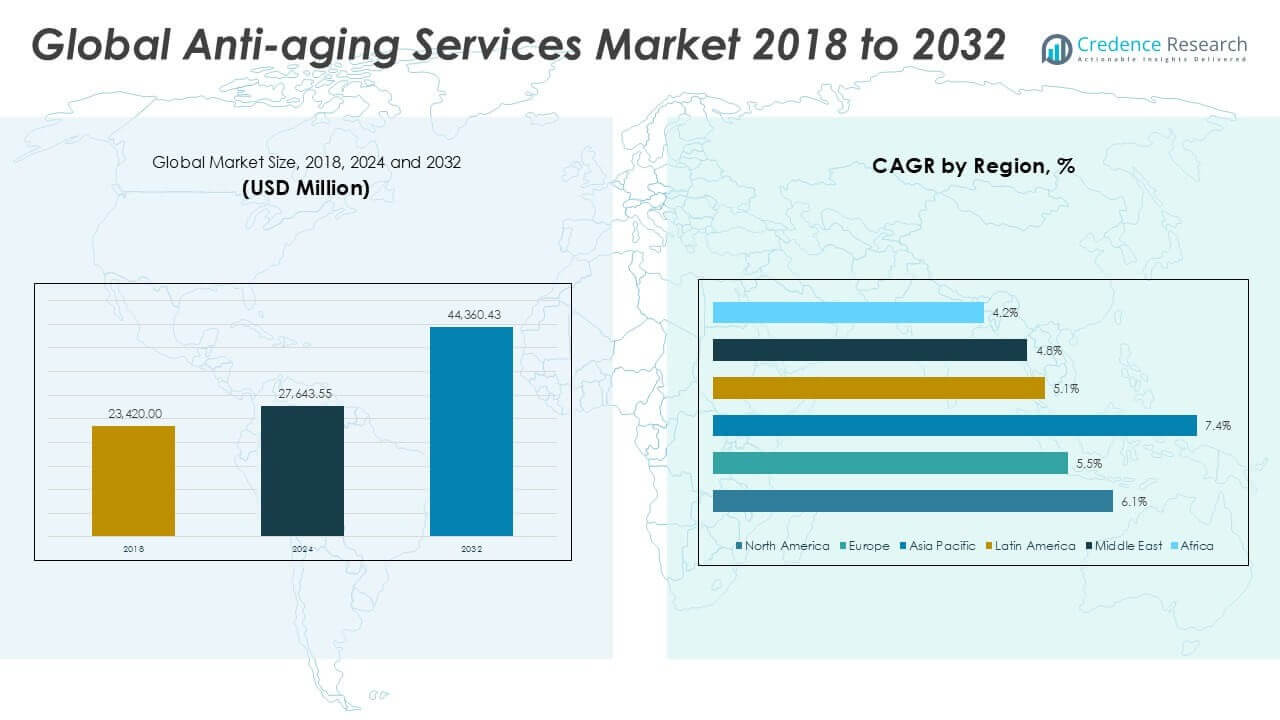
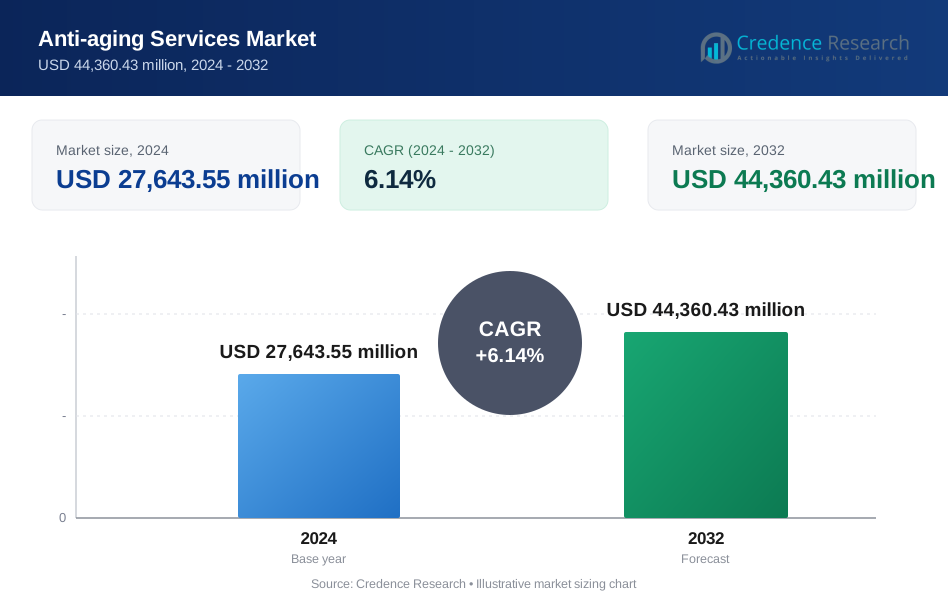
The Anti-aging Services market size was valued at USD 23,420.00 million in 2018, reached USD 27,643.55 million in 2024, and is anticipated to reach USD 44,360.43 million by 2032, at a CAGR of 6.14% during the forecast period.
| REPORT ATTRIBUTE | DETAILS |
|---|---|
| Historical Period | 2020-2023 |
| Base Year | 2024 |
| Forecast Period | 2025-2032 |
| Anti-aging Services Market Size 2024 | USD 27,643.55 million |
| Anti-aging Services Market, CAGR | 6.14% |
| Anti-aging Services Market Size 2032 | USD 44,360.43 million |
The Anti-aging Services market is driven by key players such as Allergan, Inc., Beiersdorf AG, Cynosure, Lumenis, Solta Medical, Inc., Procter & Gamble, and Estee Lauder, Inc., who actively focus on product innovation, service expansion, and strategic collaborations to strengthen their market presence. These companies leverage advanced technologies and targeted marketing to meet the rising demand for minimally invasive aesthetic procedures. North America leads the global Anti-aging Services market, accounting for approximately 34.1% of the total market share in 2024. The region’s dominance is supported by high consumer spending, advanced healthcare infrastructure, and strong awareness of cosmetic treatments. Asia Pacific follows as the fastest-growing region, driven by increasing beauty consciousness, rising disposable incomes, and rapid urbanization. Together, these regions shape the competitive dynamics and growth trajectory of the global Anti-aging Services market.
Market Insights
- The Anti-aging Services market was valued at USD 23,420.00 million in 2018, reached USD 27,643.55 million in 2024, and is projected to reach USD 44,360.43 million by 2032, growing at a CAGR of 6.14%.
- Growing demand for minimally invasive procedures, increasing aging population, and rising consumer awareness are key drivers boosting the market growth across all regions.
- The market is witnessing trends like early adoption of preventative treatments among Generation Y and increasing influence of social media and celebrity endorsements on aesthetic preferences.
- North America holds the largest regional share at 34.1% in 2024, followed by Europe with 27.7%, and Asia Pacific as the fastest-growing region; Botox is the leading service type in the global market.
- High costs of advanced treatments, regulatory challenges, and limited access in developing regions are key restraints affecting the market expansion.
Market Segmentation Analysis:
By Type:
Botox emerged as the dominant sub-segment in the Anti-aging Services market, accounting for a significant market share in 2024. The growing demand for minimally invasive procedures, faster recovery times, and effective wrinkle reduction drives the strong uptake of Botox treatments. Additionally, increasing social acceptance, expanding age demographics seeking cosmetic enhancement, and rising disposable incomes further support this growth. The popularity of Botox surpasses other types such as microdermabrasion, liposuction, and chemical peels due to its convenience, safety profile, and shorter procedure duration, making it a preferred choice among both practitioners and consumers.
- For instance, AbbVie’s Botox recorded over 4.6 million procedures in the United States alone in 2022, according to the American Society of Plastic Surgeons (ASPS), making it the most frequently performed minimally invasive cosmetic procedure in that year.
By Demographics
The Baby Boomers segment holds the largest market share in the Anti-aging Services market, primarily due to the increasing focus on maintaining a youthful appearance among aging individuals. This demographic actively seeks anti-aging treatments like Botox, dermal fillers, and chemical peels to combat visible signs of aging. Growing life expectancy, higher disposable income, and a strong desire for aesthetic maintenance contribute to the dominance of this segment. The demand from Baby Boomers significantly outpaces Generation X and Generation Y, as this age group increasingly invests in both surgical and non-surgical procedures to enhance their appearance.
- For instance, according to the ASPS, individuals aged 55 and older underwent approximately 6.2 million cosmetic procedures in 2020 in the U.S., with Botox accounting for more than 3 million of these treatments in this age group.
Market Overview
Rising Demand for Minimally Invasive Procedures
The growing preference for minimally invasive and non-invasive cosmetic procedures significantly drives the Anti-aging Services market. Treatments such as Botox, dermal fillers, and microdermabrasion offer effective results with shorter recovery periods and reduced risk compared to surgical options. This shift is further supported by advancements in technology that enhance safety and precision. Increasing consumer awareness about these procedures, combined with greater social acceptance and affordability, continues to fuel demand across diverse age groups, particularly among middle-aged and younger populations seeking early aesthetic interventions.
- For instance, in 2022, Allergan’s Juvéderm dermal filler was used in over 3.4 million procedures globally, as reported by the International Society of Aesthetic Plastic Surgery (ISAPS), reflecting the growing demand for non-invasive volume restoration treatments.
Expanding Aging Population Base
The global rise in the aging population, particularly among Baby Boomers, is a major contributor to market growth. As life expectancy increases, more individuals are actively pursuing anti-aging solutions to maintain a youthful appearance and improve self-confidence. This demographic group, with higher disposable incomes and willingness to invest in personal aesthetics, drives sustained demand for both surgical and non-surgical anti-aging services. Their growing focus on wellness, active lifestyles, and appearance enhancement ensures long-term growth opportunities for service providers and industry stakeholders.
- For instance, data from the U.S. Census Bureau shows that by 2020, more than 96 million Americans were aged 55 or older, a key target group for anti-aging services, with a substantial proportion opting for non-surgical procedures like Botox and laser skin treatments.
Increasing Influence of Social Media and Celebrity Culture
Social media platforms and celebrity endorsements play a pivotal role in shaping beauty standards and consumer behavior in the Anti-aging Services market. Continuous exposure to idealized beauty images motivates individuals to seek cosmetic enhancements to align with these trends. Influencers and public figures regularly showcase their aesthetic procedures, making anti-aging treatments more mainstream and socially acceptable. This influence has significantly widened the consumer base, especially among Generation X and Millennials, who are increasingly adopting preventative and corrective anti-aging solutions at a younger age.
Key Trends & Opportunities
Technological Advancements in Anti-aging Treatments
Rapid technological progress in anti-aging treatments presents significant market opportunities. Innovations such as laser therapies, advanced dermal fillers, and ultrasound-based skin tightening have improved treatment outcomes, patient safety, and procedural efficiency. These advancements not only enhance the appeal of minimally invasive options but also attract a broader customer base seeking effective, low-risk solutions. Continuous research and development in the cosmetic industry are expected to introduce more sophisticated and accessible anti-aging technologies, offering providers opportunities to diversify their service offerings and improve customer satisfaction.
- For instance, Cynosure’s PicoSure laser technology delivers ultra-short 755 nm wavelength pulses at picosecond intervals, significantly reducing skin rejuvenation treatment sessions from five sessions to as few as three, as clinically documented.
Growing Popularity of Preventative Anti-aging Services
Preventative anti-aging services are gaining traction, particularly among younger demographics like Generation Y. Consumers are increasingly adopting early interventions, such as microdermabrasion, chemical peels, and low-dose Botox, to delay visible signs of aging. This trend is driven by rising awareness, better access to information, and the influence of social media. Preventative approaches not only create repeat customers but also expand the market's reach to younger age groups. Service providers focusing on early-stage treatments can capitalize on this growing preference to build long-term client relationships.
- For instance, according to the ASPS, over 811,000 Botox procedures were performed on patients aged 20-29 in the U.S. in 2022, reflecting the growing demand for preventative anti-aging services among Millennials and Generation Z.
Key Challenges
High Cost of Advanced Anti-aging Treatments
The substantial costs associated with advanced anti-aging treatments remain a significant barrier for many consumers, especially in emerging economies. Procedures like Botox, laser resurfacing, and body contouring involve considerable expenses, often not covered by insurance as they are considered elective. This cost factor limits the accessibility of anti-aging services to higher-income groups, restricting market penetration among price-sensitive consumers. Affordability remains a critical challenge that may slow market expansion unless more cost-effective solutions or flexible payment options become widely available.
Regulatory and Safety Concerns
Stringent regulatory requirements and safety concerns pose key challenges to the Anti-aging Services market. As demand rises, the risk of unlicensed practitioners and substandard products entering the market also increases, potentially endangering patient safety. Regulatory authorities maintain strict guidelines for product approval and professional certifications, which can slow the introduction of new treatments and limit market growth. Ensuring consistent quality, practitioner competence, and patient safety is essential to sustaining consumer trust and driving the market forward.
Limited Awareness in Developing Regions
Despite strong growth in developed countries, limited consumer awareness and access to anti-aging services in developing regions present a challenge. Factors such as lower disposable incomes, cultural stigmas, and limited availability of certified service providers hinder market penetration in these areas. Additionally, a lack of targeted marketing and education restricts the adoption of preventative treatments. Expanding awareness through localized campaigns, educational initiatives, and affordable service models will be necessary to tap into the untapped potential of these emerging markets.
Regional Analysis
North America
North America held the largest share of the Anti-aging Services market in 2024, accounting for approximately 34.1% of the global market. The regional market was valued at USD 8,079.90 million in 2018 and is expected to reach USD 15,087.06 million by 2032, growing at a CAGR of 6.1%. The high adoption of advanced aesthetic procedures, favorable reimbursement scenarios, and the strong presence of key market players contribute to North America's dominance. Increasing consumer awareness, high disposable incomes, and a strong focus on personal appearance further fuel the demand for anti-aging services in this region.
Europe
Europe accounted for around 27.7% of the Anti-aging Services market share in 2024, with the market growing from USD 6,721.54 million in 2018 to a projected USD 11,655.82 million by 2032, registering a CAGR of 5.5%. The region benefits from increasing demand for non-invasive treatments, a rising aging population, and a well-established healthcare infrastructure. Consumers in countries like Germany, France, and the UK actively seek cosmetic procedures, contributing to consistent market growth. The growing popularity of preventative treatments among younger demographics and expanding medical tourism further support the European market's expansion.
Asia Pacific
The Asia Pacific region is the fastest-growing market, holding approximately 25.4% of the global market share in 2024. The market was valued at USD 5,691.06 million in 2018 and is anticipated to reach USD 12,434.27 million by 2032, progressing at a robust CAGR of 7.4%. Rapid economic growth, increasing urbanization, rising disposable incomes, and growing beauty consciousness are key factors driving demand in this region. Countries such as China, Japan, and South Korea lead the market due to their advanced cosmetic industries and increasing consumer inclination towards aesthetic enhancement procedures.
Latin America
Latin America captured approximately 5.8% of the global Anti-aging Services market share in 2024. The market grew from USD 1,379.44 million in 2018 and is projected to reach USD 2,385.26 million by 2032, registering a CAGR of 5.1%. The region shows steady growth due to rising awareness of cosmetic procedures and increasing demand for affordable non-invasive treatments. Brazil and Mexico are key contributors, supported by an expanding medical tourism sector. Growing social acceptance of aesthetic enhancements and improving access to advanced healthcare facilities are also driving market expansion in Latin America.
Middle East
The Middle East accounted for approximately 3.6% of the Anti-aging Services market share in 2024. The market was valued at USD 911.04 million in 2018 and is expected to reach USD 1,464.14 million by 2032, growing at a CAGR of 4.8%. Increasing demand for aesthetic procedures, growing disposable incomes, and rising beauty consciousness among both men and women support regional growth. Countries like the UAE and Saudi Arabia are major markets, where rising medical tourism and growing interest in Western beauty trends contribute to the expanding adoption of anti-aging services.
Africa
Africa held approximately 3.4% of the global Anti-aging Services market share in 2024. The market grew from USD 637.02 million in 2018 and is anticipated to reach USD 1,333.88 million by 2032, at a CAGR of 4.2%. Growth in the region is driven by increasing urbanization, rising healthcare access, and gradual shifts in consumer perception towards aesthetic services. Although limited compared to more developed regions, increasing disposable incomes and greater awareness of anti-aging solutions are beginning to shape the market landscape in Africa, presenting future opportunities for service providers to expand their footprint.
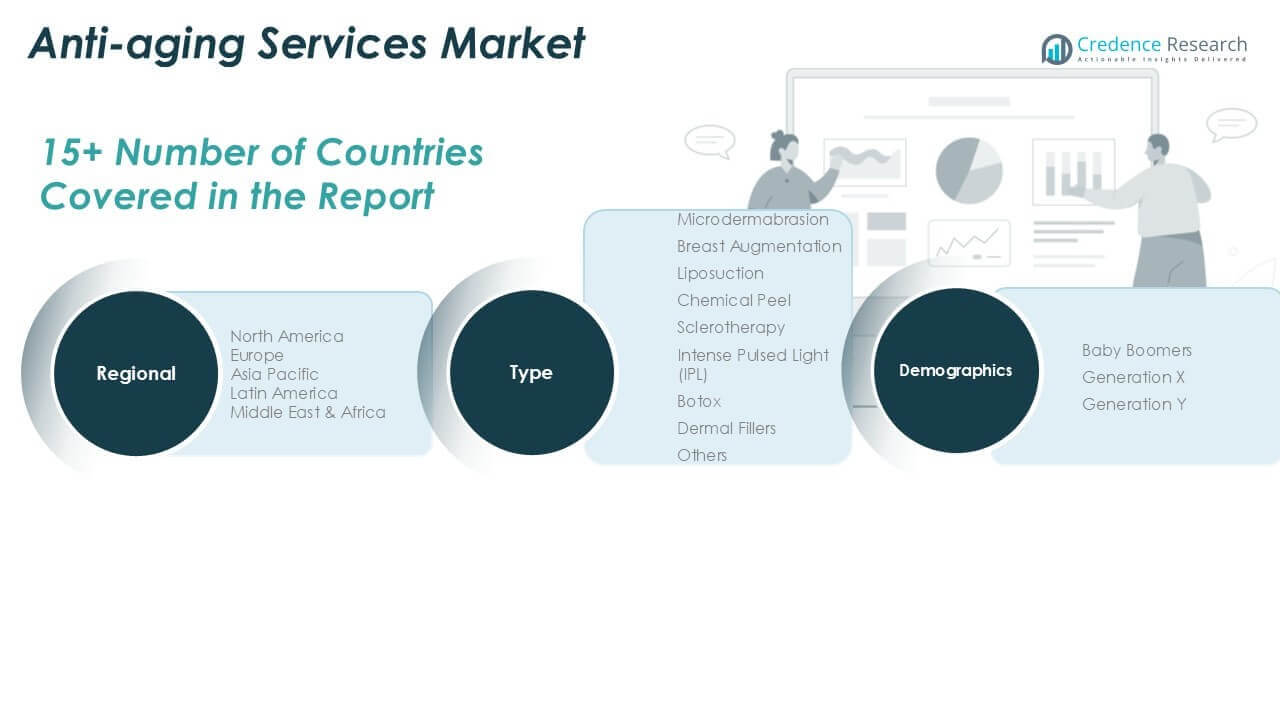
Market Segmentations:
By Type:
- Microdermabrasion
- Breast Augmentation
- Liposuction
- Chemical Peel
- Sclerotherapy
- Intense Pulsed Light (IPL)
- Botox
- Dermal Fillers
- Others
By Demographics:
- Baby Boomers
- Generation X
- Generation Y
By Geography:
- North America
- U.S.
- Canada
- Mexico
- Europe
- Germany
- France
- U.K.
- Italy
- Spain
- Rest of Europe
- Asia Pacific
- China
- Japan
- India
- South Korea
- South-east Asia
- Rest of Asia Pacific
- Latin America
- Brazil
- Argentina
- Rest of Latin America
- Middle East & Africa
- GCC Countries
- South Africa
- Rest of the Middle East and Africa
Competitive Landscape
The Anti-aging Services market is characterized by intense competition, with several established players focusing on expanding their service portfolios and geographical reach to maintain market leadership. Key companies such as Allergan, Inc., Beiersdorf AG, Cynosure, Lumenis, Solta Medical, Inc., Procter & Gamble, and Estee Lauder, Inc. consistently invest in research and development to introduce advanced, minimally invasive treatments that align with evolving consumer preferences. Strategic collaborations, mergers, and acquisitions are common as companies aim to enhance their technological capabilities and strengthen their market positions. Additionally, players are leveraging social media, celebrity endorsements, and targeted marketing strategies to build brand visibility and attract younger demographics. The market also sees growing competition from regional providers offering cost-effective services, which increases pricing pressure and drives innovation. Overall, the competitive landscape remains dynamic, with continuous advancements in technology, product diversification, and service quality serving as key differentiators among leading market participants.
Key Player Analysis
- Allergan, Inc.
- Beiersdorf AG
- Cynosure
- Lumenis
- Solta Medical, Inc.
- Procter & Gamble
- Estee Lauder, Inc.
Recent Developments
- In January 2025, StimCell Energetics entered into a marketing agreement with Think Ink Marketing to enhance public awareness of its anti-aging and wellness products.
- In January 2025, Researchers at Texas A&M College of Veterinary Medicine and Biomedical Sciences has received USD 7 million from the National Institutes of Health (NIH) to enhance a clinical trial examining rapamycin's potential to extend the lives of companion dogs as part of The Dog Aging Projec.
- In December 2024, LVMH Recherche partnered with Integrated Biosciences to develop anti-aging beauty products.
- In October 2022, the Anti-aging company Sofwave launched anti-aging technology, Synchronous Ultrasound Parallel Beam- based on ultrasound rays and approved by FDA for firming facial and neck skin and for lifting the eyebrows and chin. This was launched at the International Congress on Medical Aesthetics and Anti-aging in Tel Aviv.
- In October 2022, LR Health and Beauty launched ZEITGARD PRO cosmetic device for home use with interchangeable beauty tools. Each tool provides a different function including anti-aging.
Market Concentration & Characteristics
The Anti-aging Services Market shows moderate concentration, with several key players holding significant but not dominant shares. It remains highly competitive, driven by continuous advancements in non-invasive treatments and shifting consumer preferences toward aesthetic enhancement. The market benefits from strong consumer demand across diverse demographics, including Baby Boomers, Generation X, and an increasing number of younger individuals pursuing preventative care. It features rapid innovation cycles, with service providers introducing new technologies to meet evolving expectations for safety, convenience, and effectiveness. Price sensitivity varies across regions, with premium services dominating in developed countries and cost-effective solutions gaining traction in emerging markets. It is heavily influenced by social trends, celebrity endorsements, and growing social media exposure, which shape consumer choices and raise awareness. Regulatory frameworks maintain high standards for safety and practitioner certification, creating barriers to entry for unlicenseroviders. Strong marketing strategies and brand reputation often determine customer loyalty, while patient outcomes and minimally invasive procedures drive repeat service uptake. It requires constant investment in technology and customer engagement to remain competitive.
Report Coverage
The research report offers an in-depth analysis based on Type, Demographics and Geography. It details leading market players, providing an overview of their business, product offerings, investments, revenue streams, and key applications. Additionally, the report includes insights into the competitive environment, SWOT analysis, current market trends, as well as the primary drivers and constraints. Furthermore, it discusses various factors that have driven market expansion in recent years. The report also explores market dynamics, regulatory scenarios, and technological advancements that are shaping the industry. It assesses the impact of external factors and global economic changes on market growth. Lastly, it provides strategic recommendations for new entrants and established companies to navigate the complexities of the market.
Future Outlook
- The demand for minimally invasive anti-aging procedures is expected to grow steadily due to their safety, effectiveness, and shorter recovery times.
- Preventative anti-aging treatments are likely to gain more popularity among younger consumers seeking early intervention.
- Technological advancements in laser therapy, skin tightening, and injectable treatments will continue to shape the market.
- Social media influence and celebrity endorsements will drive greater consumer interest in aesthetic procedures.
- The aging global population will consistently fuel the need for anti-aging services to maintain youthful appearances.
- North America and Asia Pacific are projected to remain the key growth regions, supported by high consumer spending and increasing awareness.
- Regulatory bodies will continue to enforce strict safety standards, encouraging the growth of licensed and certified service providers.
- Rising disposable incomes in developing countries will create new opportunities for market expansion.
- Companies will focus on developing more affordable and accessible treatments to capture price-sensitive consumers.
- Strong competition will push service providers to offer personalized and innovative anti-aging solutions to retain customer loyalty.
Request a Free Sample
Fill in your details and we'll send you a free sample report.
- Sample data tables & charts
- Research methodology
Need a Custom Version of This Report?
Tailor the scope, geography, or segments to your exact requirements.
- Custom geography or segment scope
- Direct access to our analyst team
Frequently Asked Questions
What is the current size of the Anti-aging Services Market?
What are the key segments within the Anti-aging Services Market?
What are some challenges faced by the Anti-aging Services Market?
Who are the major players in the Anti-aging Services Market?
Table of Content
Chapter 1. Report Introduction
- 1.1 Report Description & Purpose
- 1.1.1 Report Title & Market Definition
- 1.1.2 Unique Selling Propositions (USP) & Key Differentiators
- 1.1.3 Value Proposition for Stakeholders
- 1.2 Research Objectives
- 1.2.1 Market Sizing Objectives (Volume & Revenue)
- 1.2.2 Segmentation Objectives
- 1.2.3 Competitive Intelligence Objectives
- 1.2.4 Forecast & Scenario Objectives
- 1.3 Report Scope
- 1.3.1 Anti-aging Services Scope – Types & Subtypes Covered
- 1.3.2 Geographic Scope – Regions & Countries Covered
- 1.3.3 Historical Period, Base Year & Forecast Period (2024; forecast to 2032)
- 1.3.4 Inclusions & Exclusions
- 1.4 HS Code & Classification Framework
- 1.5 Currency, Units & Pricing Basis
- 1.6 Target Stakeholders
- 1.7 Limitations & Assumptions
Chapter 2. Executive Summary
- 2.1 Global Anti-aging Services Market Snapshot
- 2.1.1 Market Size – Historical (2024) & Forecast (2024-2032) (2024: USD 27,643.55 million → 2032: USD 44,360.43 million)
- 2.1.2 Volume & Revenue – Global Totals
- 2.1.3 Key Market Highlights – Top Five Facts
- 2.2 Anti-aging Services Market Segmentation Snapshot
- 2.2.1 Market Split by Region – 2024 vs. 2032
- 2.3 Competitive Snapshot
- 2.3.1 Top 10 Players by Revenue Share – 2024
- 2.3.2 Top 10 Players by Volume Share – 2024
- 2.3.3 Recent Strategic Developments (18-Month Summary)
- 2.4 Key Investment Highlights & Strategic Conclusions
Chapter 3. Anti-aging Services Market Dynamics & Industry Analysis
- 3.1 Market Overview & Context
- 3.1.1 Anti-aging Services Market Position in the Broader Automotive Value Chain
- 3.1.2 OEM vs. Replacement Market Dynamics
- 3.1.3 Market Maturity & Development Stage by Region
- 3.2 Anti-aging Services Market Drivers
- 3.3 Anti-aging Services Market Restraints & Challenges
- 3.4 Anti-aging Services Market Opportunities
- 3.5 Porter's Five Forces Analysis
- 3.5.1 Threat of New Entrants
- 3.5.2 Bargaining Power of Suppliers
- 3.5.3 Bargaining Power of Buyers
- 3.5.4 Threat of Substitutes
- 3.5.5 Competitive Rivalry – Intensity Assessment
- 3.6 Anti-aging Services Value Chain Analysis
- 3.6.1 Upstream – Raw Material/Input Suppliers
- 3.6.1.1 Raw Material/Input 1
- 3.6.1.2 Raw Material/Input 2
- 3.6.1.3 Raw Material/Input 3
- 3.6.2 Midstream – Production/Manufacturing/Service Delivery
- 3.6.2.1 Production/Process Overview
- 3.6.2.2 Key Facility Locations & Capacity by Manufacturer
- 3.6.3 Downstream – Distribution & End Consumer
- 3.6.3.1 Primary Channel – B2B/OEM
- 3.6.3.2 Secondary Channels – Dealer, Retail, Online, Direct
- 3.6.4 Value Chain Profitability Analysis
- 3.6.1 Upstream – Raw Material/Input Suppliers
- 3.7 PESTEL Analysis
- 3.7.1 Political Factors
- 3.7.2 Economic Factors
- 3.7.3 Social Factors
- 3.7.4 Technological Factors
- 3.7.5 Environmental Factors
- 3.7.6 Legal Factors
- 3.8 Anti-aging Services Supply Chain Analysis
- 3.8.1 Raw Material/Input Supply Risk Assessment
- 3.8.2 Manufacturing Concentration Risk (Geographic Exposure)
- 3.8.3 Trade Disruption Impact Analysis
- 3.9 Regulatory & Policy Landscape
Note: The regulatory and policy landscape section covers regulations based on their applicability to the market, Anti-aging Services category, geography, and scope of the study. Only regulatory frameworks with a material impact on operations, compliance, trade, sustainability, or market access are analyzed in detail.
Chapter 4. Key Investment Pockets & Opportunity Analysis
- 4.1 Anti-aging Services Market Attractiveness Analysis
- 4.1.1 By Region – Investment Attractiveness Matrix (Volume × CAGR)
- 4.2 Absolute Revenue Growth Opportunity
- 4.2.1 By Region – Absolute USD Growth Through 2032
- 4.3 Incremental Volume Opportunity
- 4.3.1 By Region – Incremental Volume Through 2032
- 4.3.2 Segment – Incremental Volume
- 4.4 Emerging Submarket Opportunity Deep Dive (Subject to Applicability)
- 4.5 Emerging Market Opportunity Scorecards
- 4.5.1 United States
- 4.5.2 Europe
- 4.5.3 Asia
- 4.5.4 Middle East & Africa
Note: Emerging Market Opportunity Scorecards will be included based on relevance and strategic importance. Regions listed are indicative and may vary depending on data availability and market dynamics.
Chapter 5. Anti-aging Services Import-Export Analysis & Trade Flows
- 5.1 Global Trade Overview
- 5.1.1 Global Export Value by Country (2024)
- 5.1.2 Global Export Volume by Country (2024)
- 5.1.3 Global Import Value by Country (2024)
- 5.1.4 Global Import Volume by Country (2024)
- 5.1.5 Net Trade Balance by Country (2024)
- 5.2 Export Analysis – Segment
- 5.2.1 Type 1 (HS Code)
- 5.2.2 Type 2 (HS Code)
- 5.2.3 Type 3 (HS Code)
- 5.2.4 Type 4 (HS Code)
- 5.2.5 Type 5 (HS Code)
- 5.3 Import Analysis – Segment
- 5.3.1 Type 1 (HS Code)
- 5.3.2 Type 2 (HS Code)
- 5.3.3 Type 3 (HS Code)
- 5.3.4 Type 4 (HS Code)
- 5.3.5 Type 5 (HS Code)
- 5.4 Average Unit Trade Prices
- 5.4.1 Average Export Price – Segment & Country
- 5.4.2 Average Import Price – Segment & Source Country
- 5.4.3 Price Trends (2024)
- 5.5 Key Trade Route Analysis
- 5.5.1 Trade Route 1
- 5.5.2 Trade Route 2
- 5.5.3 Trade Route 3
- 5.5.4 Trade Route 4
- 5.5.5 Trade Route 5
- 5.6 Trade Policy Impact Assessment
- 5.6.1 US Anti-Dumping & Section 301 Tariffs
- 5.6.2 EU Customs Union Impact
- 5.6.3 Major Free Trade Agreements
- 5.6.4 USMCA Rules of Origin
Note: Trade policy analysis will be included only where relevant to the Anti-aging Services market.
Chapter 6. Competitive Landscape & Company Benchmarking
- 6.1 Anti-aging Services Market Concentration & Structure
- 6.1.1 Herfindahl-Hirschman Index (HHI) – vs. 2024
- 6.1.2 Tier 1, Tier 2 & Tier 3 Market Structure
- 6.1.3 Global, Regional & Local Player Dynamics
- 6.2 Anti-aging Services Market Share Analysis – 2024
- 6.2.1 Global Revenue Share by Company
- 6.2.2 Global Volume Share by Company
- 6.2.3 Regional Revenue Share
- 6.2.4 Market Share Evolution ( vs. 2024)
- 6.2.5 OEM Segment Share by Company
- 6.2.6 Replacement Segment Share by Company
- 6.3 Production/Delivery Capacity & Facility Analysis
- 6.3.1 Global Installed Capacity
- 6.3.2 Capacity Utilization Rates
- 6.3.3 Production/Output Volume
- 6.3.4 Facility Locations & Capacity Map
- 6.3.5 Planned Capacity Additions
- 6.4 Anti-aging Services Competitive Benchmarking Matrix
- 6.4.1 Revenue, Volume, CAGR & Profitability Comparison
- 6.4.2 Channel Revenue Mix
- 6.4.3 Geographic Revenue Exposure
- 6.4.4 R&D Intensity
- 6.4.5 Sustainability Maturity
- 6.5 Strategic Developments in Anti-aging Services (Last 24 Months)
- 6.5.1 Mergers, Acquisitions & Divestments
- 6.5.2 New Anti-aging Services Launches
- 6.5.3 Facility Expansions
- 6.5.4 Strategic Alliances, Joint Ventures & Partnerships
- 6.5.5 Distribution Expansion & Market Entry
- 6.5.6 Sustainability & ESG Initiatives
- 6.6 Competitive Strategy Mapping
- 6.6.1 Leader, Challenger, Follower & Niche Classification
- 6.6.2 Pricing Strategy Comparison
- 6.6.3 Channel Strategy Matrix
Note: Strategic developments are included based on their materiality and the availability of reliable information.
Chapter 7. Global Anti-aging Services Market – By Distribution Channel
- 7.1 Segment Overview
- 7.1.1 Volume & Revenue Split by Channel (2024 & 2032)
- 7.1.2 Channel Mix Evolution (2024-2032)
Chapter 8. Regional Market Analysis – Global Overview
- 8.1 Global Regional Overview
- 8.1.1 Regional Volume Share
- 8.1.2 Regional Revenue Share
- 8.1.3 Regional Volume by Region
- 8.1.4 Regional Revenue by Region
- 8.1.5 Regional Forecast Through 2032
- 8.2 Cross-Regional Segment Analysis
- 8.2.1 By Distribution Channel
- 8.2.2 By Brand/Price Tier
Chapter 9. North America Anti-aging Services Market
- 9.1 United States
- 9.2 Canada
- 9.3 Mexico
Chapter 10. Europe Anti-aging Services Market
- 10.1 Germany
- 10.2 France
- 10.3 Italy
- 10.4 United Kingdom
- 10.5 Spain
- 10.6 Poland
- 10.7 Russia
- 10.8 Netherlands
- 10.9 Belgium
- 10.10 Sweden
- 10.11 Denmark
- 10.12 Norway
- 10.13 Rest of Europe
Chapter 11. Asia Pacific Anti-aging Services Market
- 11.1 China
- 11.2 India
- 11.3 Japan
- 11.4 South Korea
- 11.5 Thailand
- 11.6 Indonesia
- 11.7 Vietnam
- 11.8 Malaysia
- 11.9 Australia
- 11.10 Rest of Asia Pacific
Chapter 12. Latin America Anti-aging Services Market
- 12.1 Brazil
- 12.2 Argentina
- 12.3 Colombia
- 12.4 Chile
- 12.5 Rest of Latin America
Chapter 13. Middle East Anti-aging Services Market
- 13.1 Saudi Arabia
- 13.2 United Arab Emirates
- 13.3 Turkey
- 13.4 Israel
- 13.5 Iran
- 13.6 Rest of the Middle East
Chapter 14. Africa Anti-aging Services Market
- 14.1 South Africa
- 14.2 Egypt
- 14.3 Nigeria
- 14.4 Morocco
- 14.5 Rest of Africa
Chapter 15. Anti-aging Services Company Profiles
- 15.1 [Company 01]
- 15.1.1 Company Overview
- 15.1.2 Key Management Personnel
- 15.1.3 Products & Services Portfolio
- 15.1.4 Financial Performance
- 15.1.5 Key Market Focus & Geographic Presence
- 15.1.6 Recent Developments & Strategic Initiatives
Note: The company profile list is preliminary and may change based on research findings, market developments, data availability, and client requirements.
Chapter 16. Appendices
- Appendix A – List of Abbreviations & Acronyms
- Appendix B – Industry Classification Code Reference – Full Series
- Appendix C – Production & Capacity Data Tables
- Appendix D – End-Use & Demand Base Tables
- Appendix E – Consumption & Replacement Rate Assumptions
- Appendix F – ASP Reference Tables
- Appendix G – Manufacturing & Facility Database
- Appendix H – Import-Export Data Tables
- Appendix I – Regulatory Summary Tables
- Appendix J – Primary Research Participant List (Anonymized)
- Appendix K – Primary Research Questionnaire Framework
- Appendix L – Data Sources & Bibliography
- Appendix M – Market Size Divergence & Source Comparison
Chapter 17. Research Methodology
- 17.1 Research Framework & Philosophy
- 17.2 Secondary Research – Sources, Hierarchy & Data Extraction
- 17.3 Data Modeling – Bottom-Up & Top-Down Market Sizing
- 17.4 Primary Research – Stakeholder Framework, LOI & Sample Sizes
- 17.5 Forecast Methodology – Regression, Scenario & Sensitivity Analysis
- 17.6 Quality Control – Four-Layer Validation Framework
- 17.7 Limitations & Standard Assumptions
- 17.8 Disclaimer
