
Automotive Logistics Market Overview:
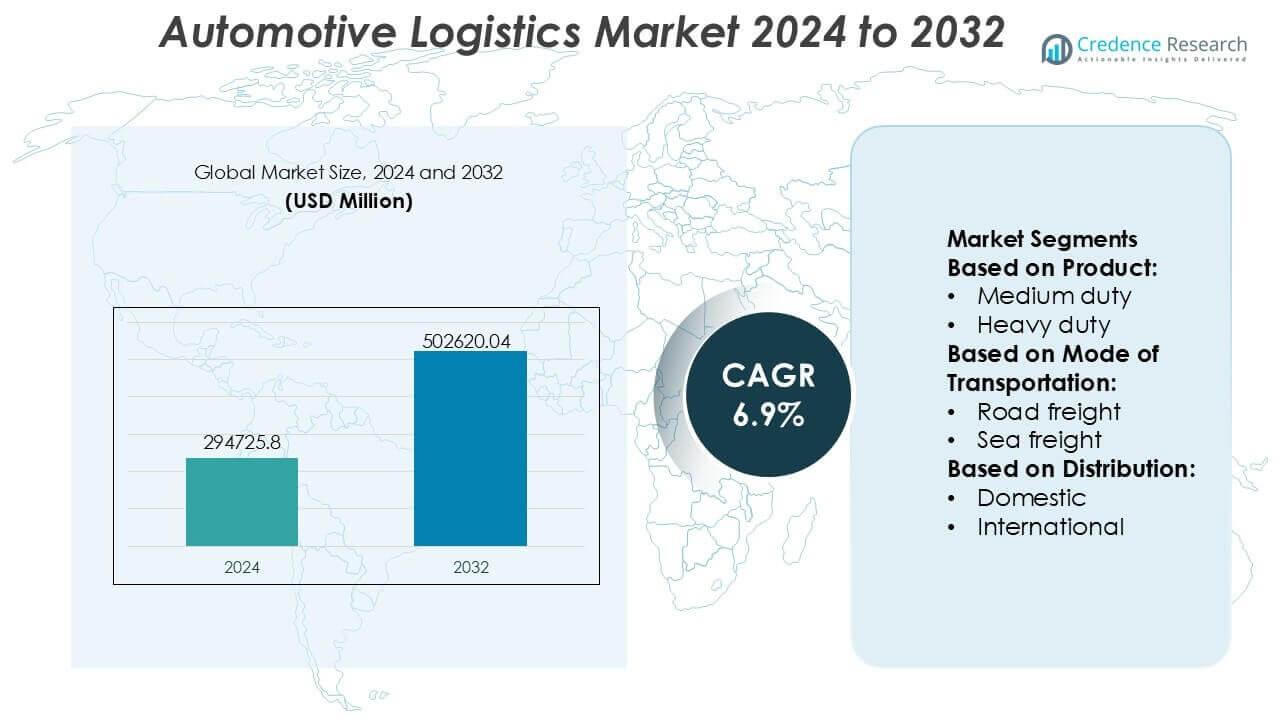
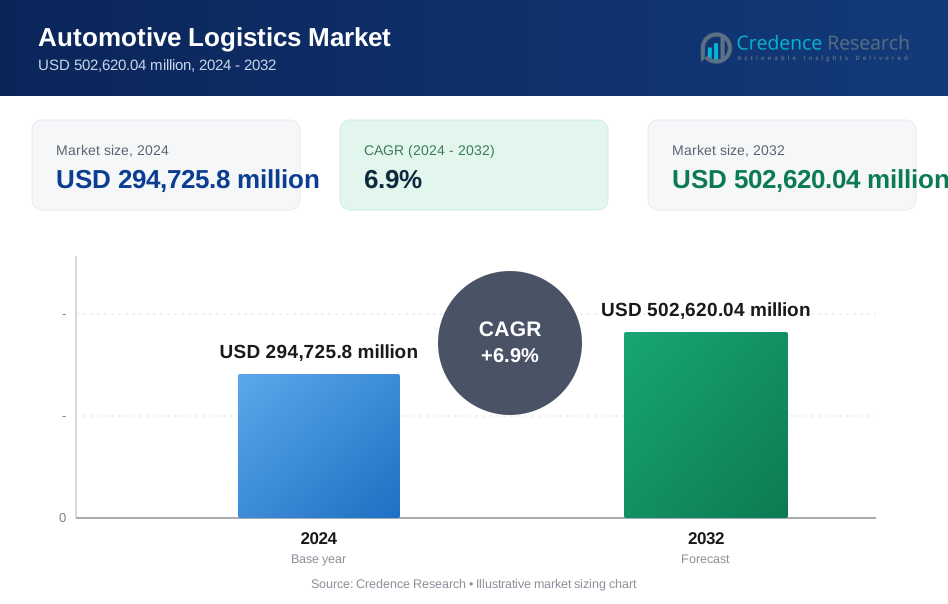
Automotive Logistics Market size was valued USD 294725.8 million in 2024 and is anticipated to reach USD 502620.04 million by 2032, at a CAGR of 6.9% during the forecast period.
| REPORT ATTRIBUTE | DETAILS |
|---|---|
| Historical Period | 2020-2023 |
| Base Year | 2024 |
| Forecast Period | 2025-2032 |
| Automotive Logistics Market Size 2024 | USD 294725.8 million |
| Automotive Logistics Market, CAGR | 6.9% |
| Automotive Logistics Market Size 2032 | USD 502620.04 million |
Automotive Logistics Market Insights
- Market growth is primarily driven by increasing automotive manufacturing volumes, expansion of electric vehicle supply chains, and rising demand for integrated inbound, outbound, and aftermarket logistics solutions.
- Digitalization, multimodal transport optimization, and sustainability-focused logistics models represent key market trends, with finished vehicle logistics emerging as the dominant segment holding around 56% share due to high outbound distribution volumes.
- The competitive landscape remains consolidated, with leading logistics providers focusing on scale, global network coverage, OEM partnerships, and technology-enabled visibility to manage complex automotive supply chains efficiently.
- Regionally, Asia-Pacific leads with an exact 34% market share, driven by large-scale vehicle production, strong domestic demand, and export-oriented manufacturing hubs across China, Japan, India, and South Korea.
Automotive Logistics Market Segmentation Analysis:
By Product
By product, finished vehicles dominate the automotive logistics market, accounting for approximately 56% market share, driven by high outbound volumes from OEM plants to dealer networks and ports. Within this segment, passenger cars lead due to their larger production scale, faster inventory turnover, and extensive dealer distribution footprints. SUVs and hatchbacks contribute significantly as OEMs diversify model portfolios, while commercial vehicles follow, supported by fleet renewals and infrastructure spending. Automotive parts and components logistics remains critical but secondary, benefiting from just-in-time manufacturing, aftermarket demand, and the rising complexity of powertrain, electronics, and chassis systems.
- For instance, CEVA Logistics manages finished-vehicle distribution for major OEMs across more than 120 vehicle logistics compounds worldwide, operating a vast fleet of car carriers including 7,000-CEU dual-fuel car carrier vessels and multi-level trucks.
By Mode of Transportation
By mode of transportation, road freight holds the dominant position with nearly 47% market share, supported by its flexibility, dense road networks, and suitability for short- to medium-haul vehicle and component movement. Road transport remains essential for plant-to-dealer deliveries and first- and last-mile connectivity. Sea freight follows as a key mode for international vehicle exports and bulk component shipments, driven by globalization of automotive production. Rail freight gains traction for long-distance inland movement due to cost efficiency and lower emissions, while air freight remains niche, used mainly for high-value or time-critical components.
- For instance, DP World (formerly Imperial) operates a dedicated automotive road fleet exceeding 2,300 vehicles across southern Africa, including purpose-built car carriers with payload capacities reaching 36 tonnes.
By Distribution
By distribution, domestic logistics leads the market with an estimated 61% market share, reflecting high intra-country vehicle movements between manufacturing plants, distribution centers, and dealerships. Strong domestic sales volumes, regional production hubs, and synchronized dealer replenishment cycles support this dominance. International logistics plays a strategic but smaller role, driven by cross-border trade of finished vehicles and specialized components. Growth in international distribution is supported by export-oriented OEM strategies, free trade agreements, and the expansion of global production footprints, although it remains more complex due to customs, regulatory, and port-handling requirements.
Key Growth Drivers
Rising Vehicle Production and Model Proliferation
Growing global vehicle production volumes remain a primary driver of the automotive logistics market, supported by expanding OEM manufacturing footprints and increasing model proliferation. Automakers now operate multiple platforms and variants across passenger and commercial vehicles, increasing the frequency and complexity of inbound and outbound logistics flows. Higher production volumes intensify demand for finished vehicle transport, parts sequencing, and just-in-time delivery services. In parallel, shorter model life cycles and frequent facelifts require more agile logistics networks capable of rapid reconfiguration without disrupting supply continuity.
- For instance, Kintetsu World Express, Inc. supports automotive customers through more than 200 logistics facilities in 46 countries, operating over 1,000 consolidated air and ocean departures per week; its proprietary KWE Global Visibility System processes millions of shipment milestones annually, providing event updates at shipment-level granularity.
Expansion of Electric Vehicles and Advanced Powertrains
The rapid expansion of electric vehicles significantly accelerates automotive logistics demand by reshaping supply chains. EV production requires specialized handling of batteries, power electronics, and high-value components, increasing the need for temperature-controlled storage, hazardous goods compliance, and dedicated transport solutions. Logistics providers are investing in battery warehousing, reverse logistics, and end-of-life recycling flows. As OEMs localize EV production while sourcing critical components globally, logistics complexity rises, creating sustained demand for integrated multimodal, cross-border, and digitally managed logistics services.
- For instance, DSV has established dedicated lithium-ion battery logistics capabilities across Europe, Asia, and North America, operating warehouses certified to handle UN 3480 and UN 3481 batteries with fire-suppression systems rated above 120 minutes and temperature monitoring sensors recording data at 5-minute intervals; according to DSV’s automotive and sustainability documentation.
Growth of Global Trade and OEM Export Strategies
Automakers’ growing focus on exports and regional production hubs continues to drive automotive logistics growth. OEMs increasingly manufacture vehicles in cost-competitive regions and ship finished vehicles to multiple international markets, boosting demand for port handling, ocean freight, and customs-compliant logistics services. At the same time, tier-1 and tier-2 suppliers support OEMs through cross-border component flows aligned with synchronized production schedules. This globalization of automotive supply chains elevates the importance of reliable international logistics partners with strong regulatory and trade-management capabilities.
Key Trends & Opportunities
Digitalization and Smart Logistics Platforms
Digital transformation is reshaping automotive logistics through real-time tracking, predictive analytics, and automated planning tools. Logistics providers are adopting transport management systems, IoT-enabled vehicle tracking, and AI-driven demand forecasting to improve visibility and reduce delays. These technologies support proactive disruption management and better asset utilization. As OEMs demand higher transparency and performance reporting, digital logistics platforms present strong opportunities for service differentiation, long-term contracts, and deeper integration into automaker supply chain ecosystems.
- For instance, BLG LOGISTICS GROUP AG & Co. KG operates its proprietary AutoTerminal Operating System (ATOS) across multiple European automotive terminals, digitally managing more than 5 million vehicle movements per year; BLG’s IoT-based tracking solutions generate timestamped status updates at each handling step, while its Bremen-based automotive terminals use automated gate systems capable of processing over 1,200 trucks per day, as documented in BLG’s annual report and digital logistics disclosures.
Sustainability and Low-Emission Transport Solutions
Sustainability is emerging as a major opportunity in automotive logistics as OEMs commit to carbon-reduction targets across their supply chains. Logistics providers are expanding the use of rail and sea freight, optimizing load consolidation, and introducing alternative-fuel trucks to reduce emissions. Green logistics solutions increasingly influence supplier selection decisions, particularly in Europe and North America. Companies that can offer measurable emission reductions, energy-efficient warehousing, and circular logistics models gain a competitive advantage in long-term automotive contracts.
- For instance, Expeditors International of Washington, Inc. utilizes its proprietary Carbon Visibility platform to calculate shipment-level CO₂e emissions using over 60 mode-specific data variables.
Outsourcing and Integrated Logistics Services
OEMs are increasingly outsourcing complex logistics activities to focus on core manufacturing and product development. This trend creates opportunities for third-party logistics providers to offer integrated services covering inbound parts logistics, plant sequencing, finished vehicle distribution, and aftermarket logistics. End-to-end service models improve cost control and operational efficiency for automakers while increasing contract size and duration for logistics providers. The shift toward strategic partnerships strengthens long-term market growth and revenue stability.
Key Challenges
Supply Chain Disruptions and Capacity Constraints
Automotive logistics faces persistent challenges from supply chain disruptions, including port congestion, labor shortages, and transportation capacity constraints. Unexpected disruptions can delay vehicle deliveries, interrupt production schedules, and increase operating costs. High dependence on synchronized logistics makes the automotive sector particularly vulnerable to delays. Logistics providers must maintain buffer capacity and contingency planning, which raises costs and pressures margins while complicating service-level commitments to OEMs.
Cost Volatility and Regulatory Complexity
Rising fuel prices, fluctuating freight rates, and increasing regulatory requirements pose significant challenges for automotive logistics providers. Compliance with safety, emissions, and cross-border trade regulations adds administrative complexity and operational costs. Additionally, varying customs procedures and documentation requirements across regions slow international vehicle and component flows. Managing cost volatility while maintaining service reliability requires continuous process optimization, contract renegotiation, and investment in compliance expertise, limiting short-term profitability for logistics operators.
Regional Analysis
North America
North America accounts for approximately 32% of the automotive logistics market, driven by high vehicle ownership rates, strong aftermarket demand, and advanced logistics infrastructure. The region benefits from well-developed road and rail networks that support efficient domestic vehicle and component movement across the U.S., Canada, and Mexico. Cross-border automotive trade under integrated manufacturing frameworks sustains demand for inbound and outbound logistics services. Growth is further supported by electric vehicle investments, large-scale assembly plants, and increasing use of digital logistics platforms to enhance visibility, compliance, and delivery reliability across complex supply chains.
Europe
Europe holds an estimated 28% market share, supported by a dense concentration of automotive OEMs, tier suppliers, and export-oriented production hubs. The region’s logistics market is shaped by strong reliance on rail and sea freight for cross-border and intermodal transport, reflecting sustainability priorities and cost efficiency. High vehicle exports from Germany, France, and Eastern Europe drive finished vehicle logistics, while stringent environmental regulations encourage low-emission transport solutions. Advanced port infrastructure and integrated customs systems further strengthen Europe’s role as a major automotive logistics center.
Asia-Pacific
Asia-Pacific dominates the automotive logistics market with around 34% market share, led by high vehicle production volumes in China, Japan, India, and South Korea. The region benefits from large-scale manufacturing clusters, expanding domestic consumption, and strong export activity. Road freight remains critical for domestic distribution, while sea freight supports global vehicle and component exports. Rapid industrialization, growing middle-class demand, and increasing electric vehicle production significantly boost logistics requirements. Investments in port capacity, logistics parks, and digital supply chain solutions further reinforce Asia-Pacific’s leadership position.
Latin America
Latin America represents roughly 4% market share, supported by automotive manufacturing activities in Brazil, Mexico, and Argentina. The region’s logistics market is driven by both domestic distribution and exports to North America and Europe. Road transport dominates due to limited rail connectivity, while port-based logistics remains essential for international trade. Growth is influenced by gradual production recovery, regional trade agreements, and increasing localization of component manufacturing. However, infrastructure gaps and regulatory complexity continue to shape logistics strategies and cost structures across the region.
Middle East & Africa
The Middle East & Africa accounts for about 2% market share, reflecting lower vehicle production volumes but growing vehicle imports and aftermarket demand. The region’s logistics activity is concentrated around key ports and trade corridors that support vehicle imports and re-exports. Gulf countries benefit from advanced port infrastructure and free trade zones, while Africa shows emerging growth potential driven by urbanization and rising vehicle parc. Despite logistical challenges, investments in transport infrastructure and regional trade integration support steady long-term market development.
Automotive Logistics Market Segmentations:
By Product:
- Medium duty
- Heavy duty
By Mode of Transportation:
- Road freight
- Sea freight
By Distribution:
- Domestic
- International
By Geography
- North America
- U.S.
- Canada
- Mexico
- Europe
- Germany
- France
- U.K.
- Italy
- Spain
- Rest of Europe
- Asia Pacific
- China
- Japan
- India
- South Korea
- South-east Asia
- Rest of Asia Pacific
- Latin America
- Brazil
- Argentina
- Rest of Latin America
- Middle East & Africa
- GCC Countries
- South Africa
- Rest of the Middle East and Africa
Competitive Landscape
The competitive landscape of the automotive logistics market players such as CEVA Logistics, Imperial, Kintetsu World Express, Inc., DSV, BLG LOGISTICS GROUP AG & Co. KG, Expeditors International of Washington, Inc., LOGISTEED, CMA CGM Group, Hellmann Worldwide Logistics SE & Co. KG, DHL. The automotive logistics market features a highly competitive environment shaped by global service providers and specialized regional operators competing on efficiency, scale, and service integration. Companies focus on delivering comprehensive solutions that span inbound component logistics, just-in-time plant supply, finished vehicle distribution, and aftermarket support. Competitive differentiation is increasingly driven by multimodal transport capabilities, strong port and inland infrastructure access, and advanced digital platforms that enhance real-time visibility and operational control. Sustainability has become a critical competitive factor, with providers adopting low-emission transport, rail and sea optimization, and energy-efficient warehousing. Long-term OEM partnerships, operational reliability, and the ability to manage complex cross-border automotive supply chains remain central to maintaining market leadership.
Key Player Analysis
- CEVA Logistics
- Imperial
- Kintetsu World Express, Inc.
- DSV
- BLG LOGISTICS GROUP AG & Co. KG
- Expeditors International of Washington, Inc.
- LOGISTEED
- CMA CGM Group
- Hellmann Worldwide Logistics SE & Co. KG
- DHL
Recent Developments
- In April 2025, Swan Defence and Heavy Industries (SDHI) launched India's first integrated F.A.S.T. (Fabrication, Assembly, Storage, and Transportation) logistics ecosystem at its Pipavav shipyard in April 2025 with Wheel & Time Shipping Transport Logistics, offering a turnkey solution for heavy engineering projects to streamline timelines, reduce handoffs, and cut project risks by integrating fabrication, heavy lifting, and global logistics on-site.
- In September 2024, DSV signed an agreement to acquire one of the global logistics and supply chain industry participants, DB SCHENKER. The acquisition is expected to strengthen DSV's presence worldwide while adding valuable reinforcement to its networks, competitive advantages, expertise, and more.
- In July 2024, DHL Group signed a strategic partnership agreement with Envision Group, a green technology provider. The deal aims to develop logistic solutions with comprehensive cooperation and accelerate progress towards improved sustainability targets.
Report Coverage
The research report offers an in-depth analysis based on Product, Mode of Transportation, Distribution and Geography. It details leading market players, providing an overview of their business, product offerings, investments, revenue streams, and key applications. Additionally, the report includes insights into the competitive environment, SWOT analysis, current market trends, as well as the primary drivers and constraints. Furthermore, it discusses various factors that have driven market expansion in recent years. The report also explores market dynamics, regulatory scenarios, and technological advancements that are shaping the industry. It assesses the impact of external factors and global economic changes on market growth. Lastly, it provides strategic recommendations for new entrants and established companies to navigate the complexities of the market.
Future Outlook
- Automotive logistics networks will become more digitally integrated, enabling real-time visibility, predictive planning, and faster disruption response.
- Electric vehicle growth will increase demand for specialized battery handling, reverse logistics, and recycling-oriented supply chain models.
- OEMs will continue to consolidate logistics partners to achieve greater cost control, transparency, and operational efficiency.
- Multimodal transport adoption will expand as manufacturers optimize road, rail, and sea freight to balance cost and sustainability.
- Sustainability requirements will accelerate the use of low-emission vehicles, rail freight, and carbon-optimized routing strategies.
- Localization of manufacturing will reshape regional logistics flows while maintaining strong cross-border component movement.
- Finished vehicle logistics will require more flexible capacity management to support fluctuating production volumes and model diversity.
- Advanced warehouse automation will improve parts sequencing accuracy and reduce handling time within automotive supply chains.
- Geopolitical and regulatory complexity will drive greater investment in compliance management and trade optimization capabilities.
- Long-term growth will favor logistics providers offering end-to-end, technology-enabled, and resilient automotive supply chain solutions.
Request a Free Sample
Fill in your details and we'll send you a free sample report.
- Sample data tables & charts
- Research methodology
Need a Custom Version of This Report?
Tailor the scope, geography, or segments to your exact requirements.
- Custom geography or segment scope
- Direct access to our analyst team
Frequently Asked Questions
What is the current market size for the Automotive Logistics Market, and what is its projected size in 2032?
At what Compound Annual Growth Rate is the Automotive Logistics Market projected to grow between 2024 and 2032?
Which Automotive Logistics Market segment held the largest share in 2024?
What are the primary factors fueling the growth of the Automotive Logistics Market?
Who are the leading companies in the Automotive Logistics Market?
Which region commanded the largest share of the Automotive Logistics Market in 2024?
Table of Content
Chapter 1. Report Introduction
- 1.1 Report Description & Purpose
- 1.1.1 Report Title & Market Definition
- 1.1.2 Unique Selling Propositions (USP) & Key Differentiators
- 1.1.3 Value Proposition for Stakeholders
- 1.2 Research Objectives
- 1.2.1 Market Sizing Objectives (Volume & Revenue)
- 1.2.2 Segmentation Objectives
- 1.2.3 Competitive Intelligence Objectives
- 1.2.4 Forecast & Scenario Objectives
- 1.3 Report Scope
- 1.3.1 Automotive Logistics Scope – Types & Subtypes Covered
- 1.3.2 Geographic Scope – Regions & Countries Covered
- 1.3.3 Historical Period, Base Year & Forecast Period (2024; forecast to 2032)
- 1.3.4 Inclusions & Exclusions
- 1.4 HS Code & Classification Framework
- 1.5 Currency, Units & Pricing Basis
- 1.6 Target Stakeholders
- 1.7 Limitations & Assumptions
Chapter 2. Executive Summary
- 2.1 Global Automotive Logistics Market Snapshot
- 2.1.1 Market Size – Historical (2024) & Forecast (2024-2032) (2024: USD 294,725.8 million → 2032: USD 502,620.04 million)
- 2.1.2 Volume & Revenue – Global Totals
- 2.1.3 Key Market Highlights – Top Five Facts
- 2.2 Automotive Logistics Market Segmentation Snapshot
- 2.2.1 Market Split by Region – 2024 vs. 2032
- 2.3 Competitive Snapshot
- 2.3.1 Top 10 Players by Revenue Share – 2024
- 2.3.2 Top 10 Players by Volume Share – 2024
- 2.3.3 Recent Strategic Developments (18-Month Summary)
- 2.4 Key Investment Highlights & Strategic Conclusions
Chapter 3. Automotive Logistics Market Dynamics & Industry Analysis
- 3.1 Market Overview & Context
- 3.1.1 Automotive Logistics Market Position in the Broader Automotive Value Chain
- 3.1.2 OEM vs. Replacement Market Dynamics
- 3.1.3 Market Maturity & Development Stage by Region
- 3.2 Automotive Logistics Market Drivers
- 3.3 Automotive Logistics Market Restraints & Challenges
- 3.4 Automotive Logistics Market Opportunities
- 3.5 Porter's Five Forces Analysis
- 3.5.1 Threat of New Entrants
- 3.5.2 Bargaining Power of Suppliers
- 3.5.3 Bargaining Power of Buyers
- 3.5.4 Threat of Substitutes
- 3.5.5 Competitive Rivalry – Intensity Assessment
- 3.6 Automotive Logistics Value Chain Analysis
- 3.6.1 Upstream – Raw Material/Input Suppliers
- 3.6.1.1 Raw Material/Input 1
- 3.6.1.2 Raw Material/Input 2
- 3.6.1.3 Raw Material/Input 3
- 3.6.2 Midstream – Production/Manufacturing/Service Delivery
- 3.6.2.1 Production/Process Overview
- 3.6.2.2 Key Facility Locations & Capacity by Manufacturer
- 3.6.3 Downstream – Distribution & End Consumer
- 3.6.3.1 Primary Channel – B2B/OEM
- 3.6.3.2 Secondary Channels – Dealer, Retail, Online, Direct
- 3.6.4 Value Chain Profitability Analysis
- 3.6.1 Upstream – Raw Material/Input Suppliers
- 3.7 PESTEL Analysis
- 3.7.1 Political Factors
- 3.7.2 Economic Factors
- 3.7.3 Social Factors
- 3.7.4 Technological Factors
- 3.7.5 Environmental Factors
- 3.7.6 Legal Factors
- 3.8 Automotive Logistics Supply Chain Analysis
- 3.8.1 Raw Material/Input Supply Risk Assessment
- 3.8.2 Manufacturing Concentration Risk (Geographic Exposure)
- 3.8.3 Trade Disruption Impact Analysis
- 3.9 Regulatory & Policy Landscape
Note: The regulatory and policy landscape section covers regulations based on their applicability to the market, Automotive Logistics category, geography, and scope of the study. Only regulatory frameworks with a material impact on operations, compliance, trade, sustainability, or market access are analyzed in detail.
Chapter 4. Key Investment Pockets & Opportunity Analysis
- 4.1 Automotive Logistics Market Attractiveness Analysis
- 4.1.1 By Region – Investment Attractiveness Matrix (Volume × CAGR)
- 4.2 Absolute Revenue Growth Opportunity
- 4.2.1 By Region – Absolute USD Growth Through 2032
- 4.3 Incremental Volume Opportunity
- 4.3.1 By Region – Incremental Volume Through 2032
- 4.3.2 Segment – Incremental Volume
- 4.4 Emerging Submarket Opportunity Deep Dive (Subject to Applicability)
- 4.5 Emerging Market Opportunity Scorecards
- 4.5.1 United States
- 4.5.2 Europe
- 4.5.3 Asia
- 4.5.4 Middle East & Africa
Note: Emerging Market Opportunity Scorecards will be included based on relevance and strategic importance. Regions listed are indicative and may vary depending on data availability and market dynamics.
Chapter 5. Automotive Logistics Import-Export Analysis & Trade Flows
- 5.1 Global Trade Overview
- 5.1.1 Global Export Value by Country (2024)
- 5.1.2 Global Export Volume by Country (2024)
- 5.1.3 Global Import Value by Country (2024)
- 5.1.4 Global Import Volume by Country (2024)
- 5.1.5 Net Trade Balance by Country (2024)
- 5.2 Export Analysis – Segment
- 5.2.1 Type 1 (HS Code)
- 5.2.2 Type 2 (HS Code)
- 5.2.3 Type 3 (HS Code)
- 5.2.4 Type 4 (HS Code)
- 5.2.5 Type 5 (HS Code)
- 5.3 Import Analysis – Segment
- 5.3.1 Type 1 (HS Code)
- 5.3.2 Type 2 (HS Code)
- 5.3.3 Type 3 (HS Code)
- 5.3.4 Type 4 (HS Code)
- 5.3.5 Type 5 (HS Code)
- 5.4 Average Unit Trade Prices
- 5.4.1 Average Export Price – Segment & Country
- 5.4.2 Average Import Price – Segment & Source Country
- 5.4.3 Price Trends (2024)
- 5.5 Key Trade Route Analysis
- 5.5.1 Trade Route 1
- 5.5.2 Trade Route 2
- 5.5.3 Trade Route 3
- 5.5.4 Trade Route 4
- 5.5.5 Trade Route 5
- 5.6 Trade Policy Impact Assessment
- 5.6.1 US Anti-Dumping & Section 301 Tariffs
- 5.6.2 EU Customs Union Impact
- 5.6.3 Major Free Trade Agreements
- 5.6.4 USMCA Rules of Origin
Note: Trade policy analysis will be included only where relevant to the Automotive Logistics market.
Chapter 6. Competitive Landscape & Company Benchmarking
- 6.1 Automotive Logistics Market Concentration & Structure
- 6.1.1 Herfindahl-Hirschman Index (HHI) – vs. 2024
- 6.1.2 Tier 1, Tier 2 & Tier 3 Market Structure
- 6.1.3 Global, Regional & Local Player Dynamics
- 6.2 Automotive Logistics Market Share Analysis – 2024
- 6.2.1 Global Revenue Share by Company
- 6.2.2 Global Volume Share by Company
- 6.2.3 Regional Revenue Share
- 6.2.4 Market Share Evolution ( vs. 2024)
- 6.2.5 OEM Segment Share by Company
- 6.2.6 Replacement Segment Share by Company
- 6.3 Production/Delivery Capacity & Facility Analysis
- 6.3.1 Global Installed Capacity
- 6.3.2 Capacity Utilization Rates
- 6.3.3 Production/Output Volume
- 6.3.4 Facility Locations & Capacity Map
- 6.3.5 Planned Capacity Additions
- 6.4 Automotive Logistics Competitive Benchmarking Matrix
- 6.4.1 Revenue, Volume, CAGR & Profitability Comparison
- 6.4.2 Channel Revenue Mix
- 6.4.3 Geographic Revenue Exposure
- 6.4.4 R&D Intensity
- 6.4.5 Sustainability Maturity
- 6.5 Strategic Developments in Automotive Logistics (Last 24 Months)
- 6.5.1 Mergers, Acquisitions & Divestments
- 6.5.2 New Automotive Logistics Launches
- 6.5.3 Facility Expansions
- 6.5.4 Strategic Alliances, Joint Ventures & Partnerships
- 6.5.5 Distribution Expansion & Market Entry
- 6.5.6 Sustainability & ESG Initiatives
- 6.6 Competitive Strategy Mapping
- 6.6.1 Leader, Challenger, Follower & Niche Classification
- 6.6.2 Pricing Strategy Comparison
- 6.6.3 Channel Strategy Matrix
Note: Strategic developments are included based on their materiality and the availability of reliable information.
Chapter 7. Global Automotive Logistics Market – By Distribution Channel
- 7.1 Segment Overview
- 7.1.1 Volume & Revenue Split by Channel (2024 & 2032)
- 7.1.2 Channel Mix Evolution (2024-2032)
Chapter 8. Regional Market Analysis – Global Overview
- 8.1 Global Regional Overview
- 8.1.1 Regional Volume Share
- 8.1.2 Regional Revenue Share
- 8.1.3 Regional Volume by Region
- 8.1.4 Regional Revenue by Region
- 8.1.5 Regional Forecast Through 2032
- 8.2 Cross-Regional Segment Analysis
- 8.2.1 By Distribution Channel
- 8.2.2 By Brand/Price Tier
Chapter 9. North America Automotive Logistics Market
- 9.1 United States
- 9.2 Canada
- 9.3 Mexico
Chapter 10. Europe Automotive Logistics Market
- 10.1 Germany
- 10.2 France
- 10.3 Italy
- 10.4 United Kingdom
- 10.5 Spain
- 10.6 Poland
- 10.7 Russia
- 10.8 Netherlands
- 10.9 Belgium
- 10.10 Sweden
- 10.11 Denmark
- 10.12 Norway
- 10.13 Rest of Europe
Chapter 11. Asia Pacific Automotive Logistics Market
- 11.1 China
- 11.2 India
- 11.3 Japan
- 11.4 South Korea
- 11.5 Thailand
- 11.6 Indonesia
- 11.7 Vietnam
- 11.8 Malaysia
- 11.9 Australia
- 11.10 Rest of Asia Pacific
Chapter 12. Latin America Automotive Logistics Market
- 12.1 Brazil
- 12.2 Argentina
- 12.3 Colombia
- 12.4 Chile
- 12.5 Rest of Latin America
Chapter 13. Middle East Automotive Logistics Market
- 13.1 Saudi Arabia
- 13.2 United Arab Emirates
- 13.3 Turkey
- 13.4 Israel
- 13.5 Iran
- 13.6 Rest of the Middle East
Chapter 14. Africa Automotive Logistics Market
- 14.1 South Africa
- 14.2 Egypt
- 14.3 Nigeria
- 14.4 Morocco
- 14.5 Rest of Africa
Chapter 15. Automotive Logistics Company Profiles
- 15.1 [Company 01]
- 15.1.1 Company Overview
- 15.1.2 Key Management Personnel
- 15.1.3 Products & Services Portfolio
- 15.1.4 Financial Performance
- 15.1.5 Key Market Focus & Geographic Presence
- 15.1.6 Recent Developments & Strategic Initiatives
Note: The company profile list is preliminary and may change based on research findings, market developments, data availability, and client requirements.
Chapter 16. Appendices
- Appendix A – List of Abbreviations & Acronyms
- Appendix B – Industry Classification Code Reference – Full Series
- Appendix C – Production & Capacity Data Tables
- Appendix D – End-Use & Demand Base Tables
- Appendix E – Consumption & Replacement Rate Assumptions
- Appendix F – ASP Reference Tables
- Appendix G – Manufacturing & Facility Database
- Appendix H – Import-Export Data Tables
- Appendix I – Regulatory Summary Tables
- Appendix J – Primary Research Participant List (Anonymized)
- Appendix K – Primary Research Questionnaire Framework
- Appendix L – Data Sources & Bibliography
- Appendix M – Market Size Divergence & Source Comparison
Chapter 17. Research Methodology
- 17.1 Research Framework & Philosophy
- 17.2 Secondary Research – Sources, Hierarchy & Data Extraction
- 17.3 Data Modeling – Bottom-Up & Top-Down Market Sizing
- 17.4 Primary Research – Stakeholder Framework, LOI & Sample Sizes
- 17.5 Forecast Methodology – Regression, Scenario & Sensitivity Analysis
- 17.6 Quality Control – Four-Layer Validation Framework
- 17.7 Limitations & Standard Assumptions
- 17.8 Disclaimer
