
Market Overview:
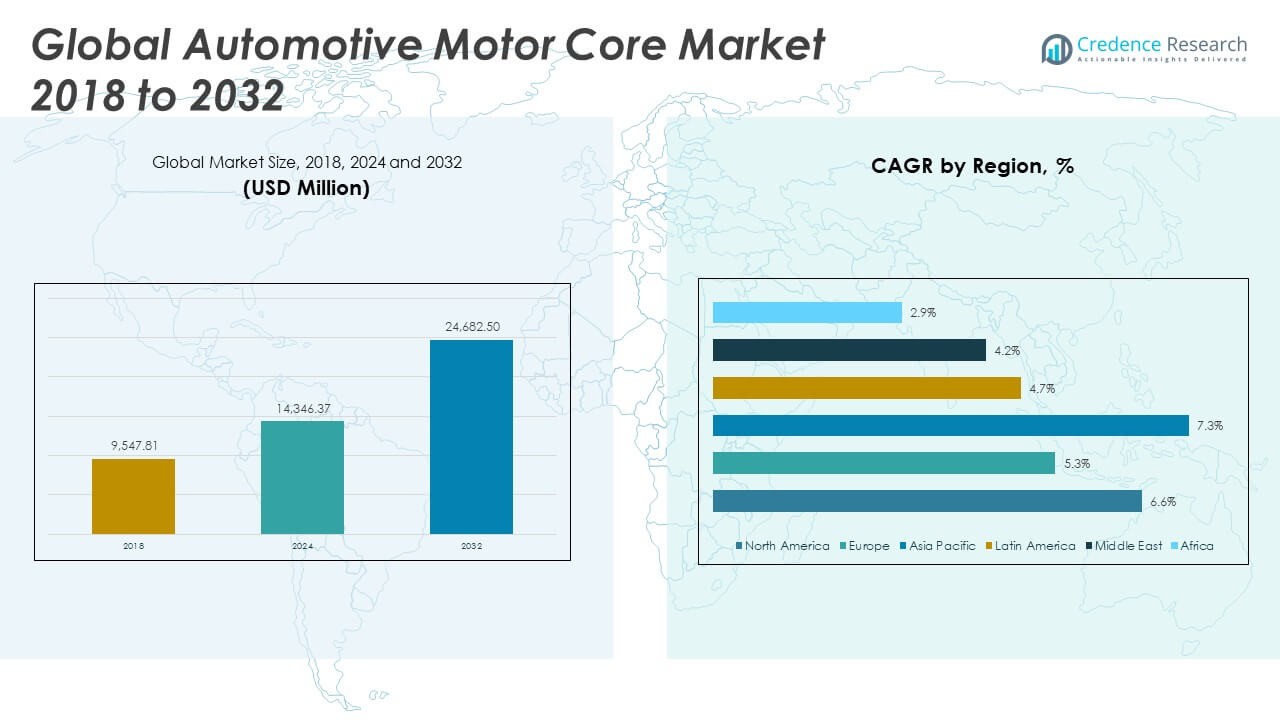
The Global Automotive Motor Core Market size was valued at USD 9,547.81 million in 2018 to USD 14,346.37 million in 2024 and is anticipated to reach USD 24,682.50 million by 2032, at a CAGR of 6.53% during the forecast period.
| REPORT ATTRIBUTE | DETAILS |
|---|---|
| Historical Period | 2020-2023 |
| Base Year | 2024 |
| Forecast Period | 2025-2032 |
| Automotive Motor Core Market Size 2024 | USD 14,346.37 Million |
| Automotive Motor Core Market , CAGR | 6.53% |
| Automotive Motor Core Market Size 2032 | USD 24,682.50 Million |
Market drivers include higher EV and hybrid adoption, ongoing improvements in magnetic materials, and strong demand for lightweight laminated structures. Automakers place greater focus on optimized flux performance to support high-speed traction motors. Suppliers upgrade stamping, stacking and bonding processes to enhance structural strength and thermal stability. It gains momentum from growing interest in integrated drive units that require compact, precision-engineered core assemblies. Increasing regulatory pressure on emission reduction also fuels broader market expansion. Continuous R&D improves motor durability and supports long-term platform development across major OEM groups.
Regional dynamics show Asia Pacific leading due to high-volume EV production and well-established motor manufacturing ecosystems. Europe follows with strong commitments to electrified mobility and advanced engineering capabilities. North America strengthens its presence through growing EV assembly capacity and increased investment in localized motor production. Emerging regions in Latin America, the Middle East and Africa advance gradually, driven by early-stage electrification programs and improving industrial infrastructure. Each region contributes to expanding global demand through unique mobility transitions and production strategies.
Market Insights:
- The Global Automotive Motor Core Market grew from USD 9,547.81 million in 2018 to USD 14,346.37 million in 2024 and is projected to reach USD 24,682.50 million by 2032, expanding at a 6.53% CAGR driven by rising EV adoption and high-efficiency motor demand.
- Asia Pacific (45.24%), North America (28.96%), and Europe (17.61%) held the top regional shares in 2024, driven by strong EV production bases, advanced component manufacturing, and strict efficiency regulations.
- Asia Pacific, the fastest-growing region with a 7.3% CAGR, benefits from large-scale EV manufacturing, strong supplier ecosystems, and expanding domestic demand for electric mobility.
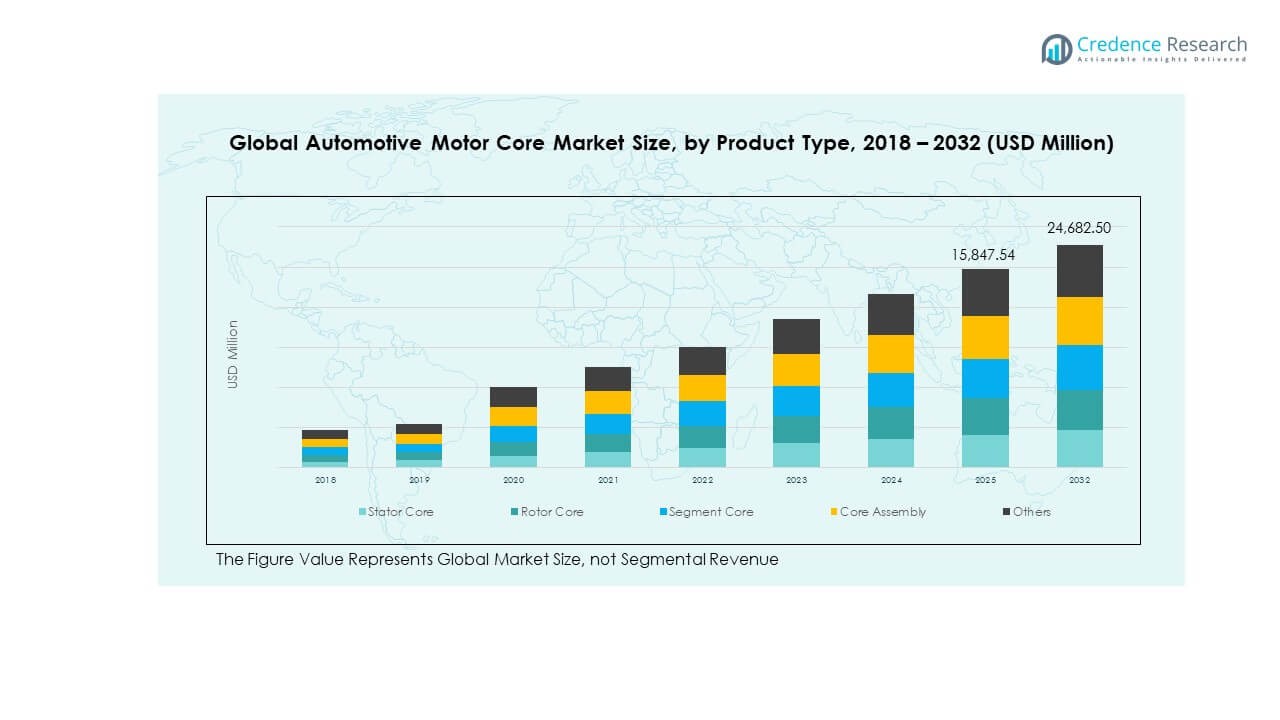
- Stator cores accounted for the largest share, representing roughly 34–36% of total market demand, reflecting their critical role in magnetic efficiency and torque generation.
- Rotor cores followed with an estimated 24–26% share, supported by their importance in high-density EV motors and growing adoption across integrated drive units.
Market Drivers
Rising Adoption of Electric and Hybrid Vehicles
The Global Automotive Motor Core Market expands due to strong EV and hybrid demand. Automakers deploy advanced motor cores to support higher torque output. Governments enforce strict emission rules that encourage electrified fleets. Suppliers focus on improving magnetic efficiency to reduce power loss. High-voltage architectures require durable laminated cores. It supports smoother acceleration and extended driving range. Long-term EV investments strengthen supply chain capabilities. Consumer preference for clean mobility further accelerates adoption.
- For instance, the Tesla Model 3 Performance uses dual permanent magnet motors that produce a combined torque output of 660 Nm, enabling 0–100 km/h acceleration in 3.3 seconds. These motors use advanced laminated steel cores to support high torque density and maintain effective thermal control during peak load conditions.
Growth in High-Efficiency Motor Technologies
High-efficiency motor platforms fuel market growth across global OEMs. Engineers design compact cores that improve power density. Thermal stability gains support continuous performance in harsh conditions. It enables better heat control during extended cycles. Automakers seek materials that support stable magnetic flux. Laminated structures reduce vibration and noise during operation. Production improvements raise uniformity across large volumes. Regulatory pressure drives interest in optimized motor efficiency.
Expansion of E-Axle and Integrated Drive Units
Automotive programs shift toward e-axles and integrated drive units. These systems rely on precision motor cores for compact layouts. It helps reduce drivetrain weight and complexity. Automakers prefer integrated systems for higher output consistency. Suppliers develop advanced materials for rigid and stable structures. Demand grows for cores that support multi-motor systems. Production lines introduce automated inspection to enhance accuracy. Global mobility brands incorporate integrated units across EV models.
- For instance, ZF’s AxTrax 2 single electric axle integrates a high-efficiency hairpin electric motor delivering 210 kW continuous power and up to 26,000 Nm wheel torque, supported by an 800 V SiC inverter and a compact multi-speed transmission. The integrated design reduces drivetrain mass and improves packaging efficiency for commercial EV platforms.
Rising Focus on Lightweight and Compact Designs
Lightweight motor core structures gain traction in EV architectures. Compact cores improve space use within electric drivetrains. It supports better cabin layout and battery packaging. OEMs push for high-strength electrical steel with low losses. Suppliers upgrade cutting and lamination technologies. Weight reduction enhances range performance in EV segments. Vehicle platforms adopt thin-gauge lamination to reduce mass. Manufacturers pursue modular core designs for global rollout.
Market Trends
Shift Toward Advanced Soft Magnetic Materials
The Global Automotive Motor Core Market observes strong interest in new magnetic materials. Soft magnetic composites support higher frequency operation. It improves torque density and overall power delivery. Engineers explore materials that limit heat buildup. Core developers aim for smoother magnetic transitions. Demand increases for materials supporting renewable-powered vehicles. Suppliers test new alloys for improved durability. Market players invest in research to reduce energy loss.
- For instance, Hitachi Metals developed amorphous magnetic materials for motor cores that enabled a four- to five-fold reduction in core loss compared to conventional magnetic steel sheet teeth, as demonstrated in publicly released Hitachi technical data.
Automation and Precision Manufacturing Techniques
Manufacturers expand automated production for consistent core quality. Automated stacking raises precision in laminated structures. It lowers defect rates during bulk manufacturing. Robotics improve uniformity in cutting and shaping tasks. Optical systems support real-time inspection control. Production lines integrate IoT tools for predictive maintenance. Uniform processes strengthen final motor performance. Advanced equipment reduces operational downtime for suppliers.
Integration of Motor Cores in Multi-Drive Platforms
Multi-drive platforms drive new design standards across OEMs. Vehicle architectures adopt dual and tri-motor layouts. It increases demand for compact and efficient motor cores. Engineers develop cores tailored for independent wheel motors. High-output EVs rely on customized laminations for stability. Performance EV brands integrate specialized cores for torque control. Core flexibility supports advanced traction systems. Manufacturers respond with scalable core architecture.
Rise of High-Speed Traction Motor Development
High-speed traction motors reshape future EV propulsion. These motors require precision-crafted cores for safe operation. It supports smoother behavior at elevated RPM levels. OEMs design new cooling methods to stabilize high-speed systems. Motor cores must tolerate higher stress without deformation. Suppliers refine stack geometry for stronger structure. Performance vehicle developers adopt thinner laminations. Market players enhance bonding processes to manage vibration.
- For instance, the newly developed eAxle adopted for Toyota's bZ4X integrates an advanced inverter and cooling method, with reports confirming high-speed motor operation and output density optimization, officially disclosed by Toyota and its suppliers in technical press materials.
Market Challenges Analysis
Complexity in Material Sourcing and Cost Volatility
The Global Automotive Motor Core Market faces stress from volatile material pricing. Electrical steel supply fluctuates in several manufacturing regions. It raises procurement pressure on motor suppliers. OEMs struggle to secure stable contracts for premium steel. Quality variance across batches increases testing needs. Global trade policies influence import rules and cost structures. Production plants must adjust to shifting supply timelines. Cost uncertainty affects long-term planning for core production.
Manufacturing Precision Requirements and Technical Limitations
High-precision lamination remains a key challenge across suppliers. Minor errors in stacking influence magnetic efficiency. It demands strict process control to avoid performance loss. Production faults increase scrap rates in busy plants. High-speed motors require tighter tolerances across all layers. Heat distortion risks rise during rapid manufacturing cycles. Engineers struggle to maintain accuracy at large scale. OEMs enforce stricter quality rules that push production limits.
Market Opportunities
Expansion of EV Infrastructure and New Energy Vehicles
The Global Automotive Motor Core Market benefits from strong EV infrastructure growth. Charging expansion supports faster vehicle adoption in major nations. It raises demand for efficient motors in new energy fleets. Governments push for wider electrification across public transport. Suppliers explore high-power core designs for heavy EVs. New mobility platforms widen the scope for advanced cores. Smart city programs further improve market potential. Clean transport shifts open new production avenues.
Advancement in Magnetic Alloys and Next-Generation Designs
Motor core developers gain opportunities through advanced alloy research. New materials reduce heat loss and enhance flux stability. It strengthens performance across compact EV motors. Suppliers introduce optimized patterns for high-speed models. Scalability supports integration into future EV platforms. OEMs explore modular formats for flexible vehicle design. Material innovation expands industry competitiveness. Emerging core geometries improve long-term system value.
Market Segmentation Analysis:
By Product Type
The Global Automotive Motor Core Market shows strong traction across key product categories, with stator cores and rotor cores holding the highest demand due to their essential role in motor efficiency and torque output. Segment cores gain adoption in compact EV platforms that require flexible geometry. Core assemblies support integrated drive units where OEMs seek reduced weight and higher structural strength. It maintains niche demand within the “others” category for customized lamination stacks designed for high-performance propulsion systems across premium electric models.
By Application
Permanent magnet motors lead application demand due to their high efficiency and strong power density, supporting mainstream EV adoption. Induction motors retain relevance in cost-optimized vehicle programs that prioritize durability. Switched reluctance motors gain interest for their simplified structure and robust thermal behavior in next-generation platforms. Brushless DC motors find wider use in two-wheelers and compact electric mobility. It holds stable demand for “others,” which include motors used in auxiliary automotive systems and emerging propulsion formats.
- For instance, Nidec’s E-Axle traction motor system entered mass production in 2019 and surpassed 300,000 units by March 2021, reaching 700,000 units by April 2023. The permanent magnet motors used in these systems deliver high power density and verified efficiency, confirming large-scale adoption across global EV platforms and linking directly to expanding demand in the Global Automotive Motor Core Market.
By End-user
Electric passenger vehicles dominate consumption as global manufacturers expand EV portfolios. Hybrid vehicles contribute steady growth where dual-motor configurations require high-precision cores. Commercial vehicles adopt durable assemblies to support heavy-duty cycles and extended operational hours. Two-wheelers show rapid penetration in dense urban markets that prioritize electric mobility. It supports broader adoption across the “others” category, which includes specialty vehicles, micro-mobility fleets, and low-speed electric platforms.
- For instance, BYD’s Xi’an EV manufacturing base expanded in 2022 with annual chip and motor-core production capacity supporting more than 500,000 electric vehicles, as confirmed in industry assessments and company disclosures. Dana TM4 supplies electric propulsion and motor core systems that meet OEM qualification standards, with its advanced traction motors now deployed across major commercial EV fleets worldwide.
By Material Type
Silicon steel remains the leading material due to its balanced magnetic performance and cost efficiency. Amorphous steel gains interest for systems that target ultra-low core losses. Nickel alloys support motors that operate under high thermal stress and demand consistent flux stability. Soft magnetic composites provide design flexibility for compact and high-speed motors. It sustains additional demand across the “others” category, which covers emerging engineered materials used in advanced EV prototypes.
By Manufacturing Process
Stamping holds the largest share due to its suitability for high-volume lamination production with tight tolerances. Stacking remains essential for building uniform magnetic structures across motor categories. Welding strengthens assemblies where structural stability is critical during high-load operation. Bonding improves insulation and reduces noise in advanced motors designed for premium EVs. Die casting supports specialized shapes in integrated drive units. It helps manufacturers streamline production while improving consistency across global automotive programs.
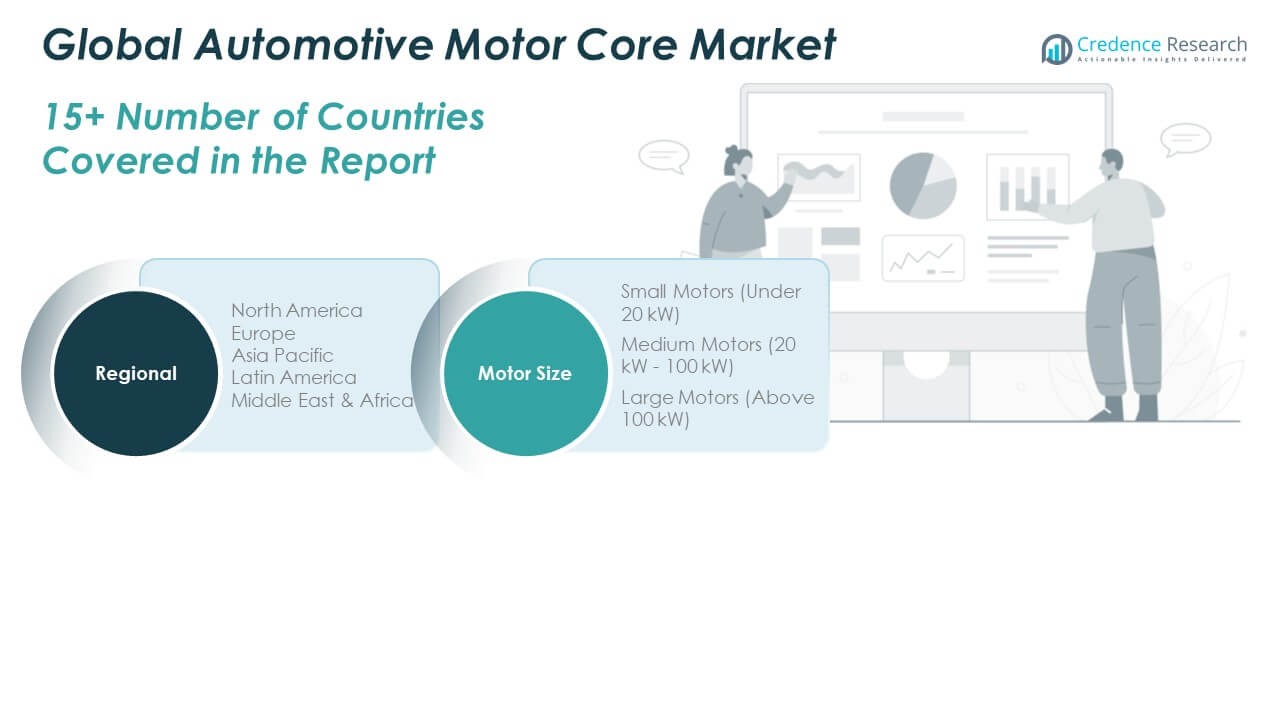
By Motor Size
Small motors under 20 kW support two-wheelers, compact EVs and auxiliary automotive systems where efficiency and light weight matter. Medium motors between 20 kW and 100 kW hold the largest demand due to their widespread use in electric passenger vehicles and hybrid platforms. Large motors above 100 kW serve performance EVs and commercial vehicles that require high torque output and stronger magnetic structures. The Global Automotive Motor Core Market benefits from rising adoption across all three motor classes. It gains steady traction as OEMs diversify propulsion strategies to match vehicle size and power needs. Suppliers refine lamination thickness and material composition to meet the demands of higher-capacity motors. Medium and large formats push advanced thermal control features into core design. Growth across this segment reflects expanding EV portfolios in global markets.
Segmentation:
By Product Type
- Stator Core
- Rotor Core
- Segment Core
- Core Assembly
- Others
By Application
- Permanent Magnet Motors
- Induction Motors
- Switched Reluctance Motors
- Brushless DC Motors
- Others
By End-user
- Electric Passenger Vehicles
- Hybrid Vehicles
- Commercial Vehicles
- Two-Wheelers
- Others
By Material Type
- Silicon Steel
- Amorphous Steel
- Nickel Alloys
- Soft Magnetic Composite
- Others
By Manufacturing Process
- Welding
- Stamping
- Bonding
- Stacking
- Die Casting
By Motor Size
- Small Motors (Under 20 kW)
- Medium Motors (20 kW - 100 kW)
- Large Motors (Above 100 kW)
By Regional
- North America
- Europe
- Asia Pacific
- Latin America
- Middle East & Africa
Regional Analysis:
North America
The North America Global Automotive Motor Core Market size was valued at USD 2,808.01 million in 2018 to USD 4,154.21 million in 2024 and is anticipated to reach USD 7,176.81 million by 2032, at a CAGR of 6.6% during the forecast period. (Market Share 2024: 28.96%) North America shows steady demand due to strong EV adoption across the U.S. and Canada. The region benefits from deep automotive supply chains and active investment in electrified platforms. The Global Automotive Motor Core Market gains traction here due to high-volume EV production commitments by regional OEMs. It supports growth through rising demand for high-efficiency motor architectures across passenger and commercial segments. Suppliers expand automated production lines to meet precision requirements. Regulatory pressure on emissions strengthens interest in electric mobility. The region’s mature research ecosystem accelerates material innovation in silicon steel and composites. Expansion of new battery and motor manufacturing plants lifts long-term demand.
Europe
The Europe Global Automotive Motor Core Market size was valued at USD 1,779.19 million in 2018 to USD 2,526.65 million in 2024 and is anticipated to reach USD 3,952.10 million by 2032, at a CAGR of 5.3% during the forecast period. (Market Share 2024: 17.61%) Europe remains a leading market driven by strict emission policies and strong EV incentives. Automakers in Germany, France and the U.K. push advanced motor technologies that require high-precision cores. The Global Automotive Motor Core Market grows through premium EV production that depends on lightweight motor structures. It gains support from strong engineering and metallurgy capabilities across the region. Suppliers adopt advanced stamping and bonding techniques to meet efficiency goals. High-speed traction motors used by performance EV brands strengthen material demand. Europe’s focus on sustainability encourages the use of low-loss laminations. Investments in integrated drive units reinforce long-term regional expansion.
Asia Pacific
The Asia Pacific Global Automotive Motor Core Market size was valued at USD 4,165.08 million in 2018 to USD 6,489.86 million in 2024 and is anticipated to reach USD 11,847.83 million by 2032, at a CAGR of 7.3% during the forecast period. (Market Share 2024: 45.24%) Asia Pacific dominates due to large-scale EV manufacturing hubs across China, Japan and South Korea. High production volumes create strong demand for stator and rotor cores. The Global Automotive Motor Core Market strengthens its base here due to competitive material sourcing and advanced industrial capacity. It benefits from rapid electrification in passenger and two-wheeler markets. Regional suppliers invest heavily in automation to support precise lamination output. Expanding battery and motor plants create integrated supply chains. Governments support electrified transport through targeted policy frameworks. Growing exports from Asia Pacific further reinforce regional leadership.
Latin America
The Latin America Global Automotive Motor Core Market size was valued at USD 411.73 million in 2018 to USD 610.23 million in 2024 and is anticipated to reach USD 917.59 million by 2032, at a CAGR of 4.7% during the forecast period. (Market Share 2024: 4.25%) Latin America shows gradual adoption supported by rising interest in hybrid and electric mobility. Brazil and Mexico lead regional activity with expanding automotive production bases. The Global Automotive Motor Core Market gains from growing EV pilot programs and industrial upgrades. It builds traction as suppliers upgrade stamping and stacking capabilities in local plants. Governments introduce early-stage electrification policies that support long-term uptake. Limited material supply chains create challenges but also open investment opportunities. Commercial vehicle electrification grows in fleet-heavy markets. Regional assembly hubs create demand for cost-efficient motor core components.
Middle East
The Middle East Global Automotive Motor Core Market size was valued at USD 260.03 million in 2018 to USD 356.19 million in 2024 and is anticipated to reach USD 514.09 million by 2032, at a CAGR of 4.2% during the forecast period. (Market Share 2024: 2.48%) The Middle East market progresses through early EV adoption supported by national diversification initiatives. Gulf countries invest in local EV assembly and charging infrastructure. The Global Automotive Motor Core Market benefits from selective premium vehicle imports that require high-quality motor components. It grows as governments promote clean transport in urban centers. Suppliers explore partnerships to localize motor component production. The region adopts advanced materials for high-temperature performance due to harsh climatic conditions. Luxury EV segments drive early demand for precision motor cores. Gradual expansion of public transport electrification raises long-term prospects.
Africa
The Africa Global Automotive Motor Core Market size was valued at USD 123.77 million in 2018 to USD 209.23 million in 2024 and is anticipated to reach USD 274.08 million by 2032, at a CAGR of 2.9% during the forecast period. (Market Share 2024: 1.46%) Africa remains at an early stage of electrification, with slow but rising interest in EVs and hybrids. South Africa leads demand due to its established automotive manufacturing base. The Global Automotive Motor Core Market grows steadily as local companies explore new mobility solutions. It benefits from improving transport modernization policies in selected countries. Limited infrastructure slows rapid expansion, yet opportunities increase in fleet electrification projects. Suppliers evaluate localized assembly for cost-effective motor components. Growing urbanization creates long-term mobility needs. Pilot EV programs in public transport systems support early market formation.
Key Player Analysis:
- Siemens AG
- Robert Bosch GmbH
- Mitsubishi Electric Corporation
- Nidec Corporation
- ABB Ltd.
- Hitachi Automotive Systems, Ltd.
- Johnson Electric Holdings Limited
- Toshiba Corporation
- Denso Corporation
- Continental AG
- Valeo SA
- Magna International Inc.
- Mitsui High-tec, Inc.
- NHK Spring Co., Ltd.
- Shinko Electric Industries Co., Ltd.
- Brose Fahrzeugteile GmbH & Co. KG
- Mahle GmbH
- Yaskawa Electric Corporation
- Wolong Electric Group Co., Ltd.
Competitive Analysis:
The Global Automotive Motor Core Market features strong competition among global motor manufacturers, material suppliers, and component specialists that focus on precision-engineered core production. Leading companies invest in advanced stamping, bonding and stacking technologies to enhance magnetic efficiency and support high-density EV motors. It strengthens competition through continuous upgrades in silicon steel, amorphous alloys and soft magnetic composites. Major players expand their portfolios toward lightweight cores used in integrated drive units and high-speed traction motors. Strategic partnerships between OEMs and core manufacturers improve production alignment and shorten development cycles. Regional suppliers enhance capacity to meet rising EV demand in Asia Pacific and North America. Companies emphasize automation and quality control to maintain consistency in large-scale lamination output. Ongoing R&D efforts drive improvements in thermal stability, vibration control and motor performance, shaping long-term competitive positioning.
Recent Developments:
- In November 2025, Mitsubishi Electric Corporation reached an agreement to transfer its three-phase and IPM motor business to a wholly owned subsidiary of EBARA Corporation. This transfer includes production facilities in Japan and Thailand, as well as design and development expertise, and aims to fuel EBARA’s growth in energy-efficient industrial solutions.
- In November 2025, Mitsubishi Electric announced the transfer of its three-phase motor business to EBARA Corporation. Through this transaction, EBARA will acquire production facilities in Japan and Thailand dedicated to motor manufacturing. The transfer underscores both companies’ strategies to leverage manufacturing assets and expand their respective automotive and industrial electric motor portfolios.
- In May 2025, Mitsubishi Electric announced a strategic partnership with Tramec, a European gearbox manufacturer, to co-develop complete gearmotor drive systems based on Mitsubishi’s high-efficiency EM-A motors. The cooperation enables both companies to broaden product offerings and target the growing demand for energy-efficient drivetrains in automotive and industrial markets.
Report Coverage:
The research report offers an in-depth analysis based on Product Type, Application, End-user, Material Type and Manufacturing Process. It details leading market players, providing an overview of their business, product offerings, investments, revenue streams, and key applications. Additionally, the report includes insights into the competitive environment, SWOT analysis, current market trends, as well as the primary drivers and constraints. Furthermore, it discusses various factors that have driven market expansion in recent years. The report also explores market dynamics, regulatory scenarios, and technological advancements that are shaping the industry. It assesses the impact of external factors and global economic changes on market growth. Lastly, it provides strategic recommendations for new entrants and established companies to navigate the complexities of the market.
Future Outlook:
- Electrification will drive stronger demand for high-efficiency motor cores across global platforms.
- Lightweight laminations will gain priority to support compact EV architectures and integrated drive units.
- Automation will expand in stamping and stacking lines to enhance precision and cycle consistency.
- New magnetic materials will enter production to reduce core losses and improve torque density.
- High-speed motors will push suppliers to refine bonding and insulation technologies.
- Modular motor core designs will enable flexible adoption across multiple vehicle classes.
- Regional manufacturing networks will expand to reduce supply bottlenecks and improve delivery speed.
- Two-wheeler and light-mobility electrification will create new demand in emerging economies.
- Strong OEM–supplier collaboration will accelerate development of advanced traction motor systems.
- Strategic investments in R&D will shape next-generation designs with improved thermal stability and efficiency.

Request a Free Sample
Fill in your details and we'll send you a free sample report.
- Sample data tables & charts
- Research methodology
Need a Custom Version of This Report?
Tailor the scope, geography, or segments to your exact requirements.
- Custom geography or segment scope
- Direct access to our analyst team
Frequently Asked Questions
What is the current market size for the Global Automotive Motor Core Market, and what is its projected size in 2032?
At what Compound Annual Growth Rate is the Global Automotive Motor Core Market projected to grow between 2024 and 2032?
Which Global Automotive Motor Core Market segment held the largest share in 2024?
What are the primary factors fueling the growth of the Global Automotive Motor Core Market?
Who are the leading companies in the Global Automotive Motor Core Market?
Which region commanded the largest share of the Global Automotive Motor Core Market in 2024?
Table of Content
Chapter 1. Report Introduction
- 1.1 Report Description & Purpose
- 1.1.1 Report Title & Market Definition
- 1.1.2 Unique Selling Propositions (USP) & Key Differentiators
- 1.1.3 Value Proposition for Stakeholders
- 1.2 Research Objectives
- 1.2.1 Market Sizing Objectives (Volume & Revenue) (Volume Where Applicable)
- 1.2.2 Segmentation Objectives
- 1.2.3 Competitive Intelligence Objectives
- 1.2.4 Forecast & Scenario Objectives
- 1.3 Report Scope
- 1.3.1 Automotive Motor Core Scope – Segments & Subsegments Covered
- 1.3.2 Geographic Scope – Regions & Countries Covered
- 1.3.3 Historical Period, Base Year & Forecast Period (2024; forecast to 2032)
- 1.3.4 Inclusions & Exclusions
- 1.4 Industry Classification & Applicable Codes
- 1.5 Currency, Measurement Units & Valuation Basis
- 1.6 Target Stakeholders
- 1.7 Limitations & Assumptions
Chapter 2. Executive Summary
- 2.1 Global Automotive Motor Core Market Snapshot
- 2.1.1 Market Size – Historical (2024) & Forecast (2024-2032) (2024: USD 14,346.37 million → 2032: USD 24,682.50 million)
- 2.1.2 Volume & Revenue – Global Totals (Volume Where Applicable)
- 2.1.3 Key Market Highlights – Top Five Facts
- 2.2 Automotive Motor Core Market Segmentation Snapshot
- 2.2.1 Market Split by Region – 2024 vs. 2032
- 2.3 Competitive Snapshot
- 2.3.1 Top 10 Players by Revenue Share – 2024
- 2.3.2 Top 10 Players by Volume Share – 2024 (Volume Where Applicable)
- 2.3.3 Recent Strategic Developments (18-Month Summary)
- 2.4 Key Investment Highlights & Strategic Conclusions
Chapter 3. Automotive Motor Core Market Dynamics & Industry Analysis
- 3.1 Market Overview & Context
- 3.1.1 Automotive Motor Core Market Position in the Broader Industry Value Chain
- 3.1.2 Demand Structure & Purchasing Dynamics
- 3.1.3 Market Maturity & Development Stage by Region
- 3.2 Automotive Motor Core Market Drivers
- 3.3 Automotive Motor Core Market Restraints & Challenges
- 3.4 Automotive Motor Core Market Opportunities
- 3.5 Porter's Five Forces Analysis
- 3.5.1 Threat of New Entrants
- 3.5.2 Bargaining Power of Suppliers
- 3.5.3 Bargaining Power of Buyers
- 3.5.4 Threat of Substitutes
- 3.5.5 Competitive Rivalry – Intensity Assessment
- 3.6 Automotive Motor Core Value Chain Analysis
- 3.6.1 Upstream – Key Inputs, Resources & Suppliers
- 3.6.1.1 Key Input/Resource 1
- 3.6.1.2 Key Input/Resource 2
- 3.6.1.3 Key Input/Resource 3
- 3.6.2 Midstream – Core Operations & Value Creation
- 3.6.2.1 Operating Model & Process Overview
- 3.6.2.2 Key Operating Locations & Capabilities by Company
- 3.6.3 Downstream – Market Channels & End Users
- 3.6.3.1 Direct Sales & Customer Engagement Channels
- 3.6.3.2 Indirect Sales, Intermediaries & Partner Channels
- 3.6.4 Value Chain Profitability Analysis
- 3.6.1 Upstream – Key Inputs, Resources & Suppliers
- 3.7 PESTEL Analysis
- 3.7.1 Political Factors
- 3.7.2 Economic Factors
- 3.7.3 Social Factors
- 3.7.4 Technological Factors
- 3.7.5 Environmental Factors
- 3.7.6 Legal Factors
- 3.8 Automotive Motor Core Supply Chain Analysis
- 3.8.1 Critical Input & Resource Availability Risk Assessment
- 3.8.2 Supplier & Operational Concentration Risk (Geographic Exposure)
- 3.8.3 Supply & Service Disruption Impact Analysis
- 3.9 Regulatory & Policy Landscape
Note: The regulatory and policy landscape section covers regulations based on their applicability to the market, Automotive Motor Core category, geography, and scope of the study. Only regulatory frameworks with a material impact on operations, compliance, trade, sustainability, or market access are analyzed in detail.
Chapter 4. Key Investment Pockets & Opportunity Analysis
- 4.1 Automotive Motor Core Market Attractiveness Analysis
- 4.1.1 By Region – Investment Attractiveness Matrix (Market Size × CAGR)
- 4.2 Absolute Revenue Growth Opportunity
- 4.2.1 By Region – Absolute Revenue Growth Through 2032
- 4.3 Incremental Demand Opportunity
- 4.3.1 By Region – Incremental Demand Through 2032
- 4.3.2 Segment – Incremental Demand
- 4.4 Emerging Submarket Opportunity Deep Dive (Subject to Applicability)
- 4.5 Priority Market Opportunity Scorecards
- 4.5.1 United States
- 4.5.2 Europe
- 4.5.3 Asia
- 4.5.4 Middle East & Africa
Note: Priority market opportunity scorecards reflect the geographic scope and strategic relevance of the study. Listed markets are indicative and may be adapted to the industry.
Chapter 5. Automotive Motor Core Cross-Border Trade & Market Access Analysis
- 5.1 International Trade & Cross-Border Activity Overview
- 5.1.1 Global Export Value by Country (2024)
- 5.1.2 Global Export Volume by Country (2024) (Volume Where Applicable)
- 5.1.3 Global Import Value by Country (2024)
- 5.1.4 Global Import Volume by Country (2024) (Volume Where Applicable)
- 5.1.5 Net Trade Balance by Country (2024)
- 5.2 Export Analysis – Segment
- 5.2.1 Category 1 (Applicable Classification Code)
- 5.2.2 Category 2 (Applicable Classification Code)
- 5.2.3 Category 3 (Applicable Classification Code)
- 5.2.4 Category 4 (Applicable Classification Code)
- 5.2.5 Category 5 (Applicable Classification Code)
- 5.3 Import Analysis – Segment
- 5.3.1 Category 1 (Applicable Classification Code)
- 5.3.2 Category 2 (Applicable Classification Code)
- 5.3.3 Category 3 (Applicable Classification Code)
- 5.3.4 Category 4 (Applicable Classification Code)
- 5.3.5 Category 5 (Applicable Classification Code)
- 5.4 Cross-Border Pricing & Transaction Benchmarks
- 5.4.1 Export Pricing – Segment & Country
- 5.4.2 Import Pricing – Segment & Source Country
- 5.4.3 Price Trends (2024)
- 5.5 Key Cross-Border Trade & Delivery Routes
- 5.5.1 Cross-Border Trade/Delivery Route 1
- 5.5.2 Cross-Border Trade/Delivery Route 2
- 5.5.3 Cross-Border Trade/Delivery Route 3
- 5.5.4 Cross-Border Trade/Delivery Route 4
- 5.5.5 Cross-Border Trade/Delivery Route 5
- 5.6 Trade Policy & Market Access Impact Assessment
- 5.6.1 Tariff & Non-Tariff Barriers
- 5.6.2 Regional Trade & Economic Integration Frameworks
- 5.6.3 Bilateral & Multilateral Trade Agreements
- 5.6.4 Cross-Border Operating, Licensing & Localization Requirements
Note: This chapter applies where cross-border trade or delivery is relevant to Automotive Motor Core. Goods, services, and digital offerings are assessed using applicable classifications and transaction measures. Import-export volumes, trade balances, and route analyses are included only where meaningful to the market.
Chapter 6. Competitive Landscape & Company Benchmarking
- 6.1 Automotive Motor Core Market Concentration & Structure
- 6.1.1 Herfindahl-Hirschman Index (HHI) – the historical period vs. 2024
- 6.1.2 Leading, Mid-Sized & Emerging Player Structure
- 6.1.3 Global, Regional & Local Player Dynamics
- 6.2 Automotive Motor Core Market Share Analysis – 2024
- 6.2.1 Global Revenue Share by Company
- 6.2.2 Global Volume Share by Company (Volume Where Applicable)
- 6.2.3 Regional Revenue Share
- 6.2.4 Market Share Evolution (the historical period vs. 2024)
- 6.2.5 Company Market Share by Key Segment
- 6.2.6 Company Market Share by Customer Group
- 6.3 Operating Scale, Capacity & Infrastructure Analysis
- 6.3.1 Global Operating Scale & Supply Capacity
- 6.3.2 Resource Utilization & Operating Efficiency
- 6.3.3 Output, Service Delivery & Activity Metrics
- 6.3.4 Operating Footprint & Infrastructure Map
- 6.3.5 Planned Operational & Capacity Expansion
- 6.4 Automotive Motor Core Competitive Benchmarking Matrix
- 6.4.1 Revenue, Growth, Profitability & Operating Metric Comparison
- 6.4.2 Channel Revenue Mix
- 6.4.3 Geographic Revenue Exposure
- 6.4.4 R&D Intensity
- 6.4.5 Sustainability Maturity
- 6.5 Strategic Developments in Automotive Motor Core (Last 24 Months)
- 6.5.1 Mergers, Acquisitions & Divestments
- 6.5.2 New Products, Services & Solutions in Automotive Motor Core
- 6.5.3 Operational & Infrastructure Expansions
- 6.5.4 Strategic Alliances, Joint Ventures & Partnerships
- 6.5.5 Distribution Expansion & Market Entry
- 6.5.6 Sustainability & ESG Initiatives
- 6.6 Competitive Strategy Mapping
- 6.6.1 Leader, Challenger, Follower & Niche Classification
- 6.6.2 Pricing Strategy Comparison
- 6.6.3 Channel Strategy Matrix
Note: Strategic developments are included based on their materiality and the availability of reliable information.
Chapter 7. Global Automotive Motor Core Market – By Sales & Delivery Channel
- 7.1 Segment Overview
- 7.1.1 Volume & Revenue Split by Channel (2024 & 2032) (Volume Where Applicable)
- 7.1.2 Channel Mix Evolution (2024-2032)
Chapter 8. Regional Market Analysis – Global Overview
- 8.1 Global Regional Overview
- 8.1.1 Regional Volume Share (Volume Where Applicable)
- 8.1.2 Regional Revenue Share
- 8.1.3 Regional Volume by Region (Volume Where Applicable)
- 8.1.4 Regional Revenue by Region
- 8.1.5 Regional Forecast Through 2032
- 8.2 Cross-Regional Segment Analysis
- 8.2.1 By Sales & Delivery Channel
- 8.2.2 By Competitive Positioning & Price Tier
Chapter 9. North America Automotive Motor Core Market
- 9.1 United States
- 9.2 Canada
- 9.3 Mexico
Chapter 10. Europe Automotive Motor Core Market
- 10.1 Germany
- 10.2 France
- 10.3 Italy
- 10.4 United Kingdom
- 10.5 Spain
- 10.6 Poland
- 10.7 Russia
- 10.8 Netherlands
- 10.9 Belgium
- 10.10 Sweden
- 10.11 Denmark
- 10.12 Norway
- 10.13 Rest of Europe
Chapter 11. Asia Pacific Automotive Motor Core Market
- 11.1 China
- 11.2 India
- 11.3 Japan
- 11.4 South Korea
- 11.5 Thailand
- 11.6 Indonesia
- 11.7 Vietnam
- 11.8 Malaysia
- 11.9 Australia
- 11.10 Rest of Asia Pacific
Chapter 12. Latin America Automotive Motor Core Market
- 12.1 Brazil
- 12.2 Argentina
- 12.3 Colombia
- 12.4 Chile
- 12.5 Rest of Latin America
Chapter 13. Middle East Automotive Motor Core Market
- 13.1 Saudi Arabia
- 13.2 United Arab Emirates
- 13.3 Turkey
- 13.4 Israel
- 13.5 Iran
- 13.6 Rest of the Middle East
Chapter 14. Africa Automotive Motor Core Market
- 14.1 South Africa
- 14.2 Egypt
- 14.3 Nigeria
- 14.4 Morocco
- 14.5 Rest of Africa
Chapter 15. Automotive Motor Core Company Profiles
- 15.1 [Company 01]
- 15.1.1 Company Overview
- 15.1.2 Key Management Personnel
- 15.1.3 Products & Services Portfolio
- 15.1.4 Financial Performance
- 15.1.5 Key Market Focus & Geographic Presence
- 15.1.6 Recent Developments & Strategic Initiatives
Note: The company profile list is preliminary and may change based on research findings, market developments, data availability, and client requirements.
Chapter 16. Appendices
- Appendix A – List of Abbreviations & Acronyms
- Appendix B – Industry Classification Code Reference – Full Series
- Appendix C – Supply, Output & Operating Capacity Data Tables
- Appendix D – End-Use & Demand Base Tables
- Appendix E – Demand, Adoption & Usage Assumptions
- Appendix F – Pricing & Revenue Metric Reference Tables
- Appendix G – Company Operations & Infrastructure Database
- Appendix H – Cross-Border Trade & Activity Data Tables (Where Applicable)
- Appendix I – Regulatory Summary Tables
- Appendix J – Primary Research Participant List (Anonymized)
- Appendix K – Primary Research Questionnaire Framework
- Appendix L – Data Sources & Bibliography
- Appendix M – Market Size Divergence & Source Comparison
Chapter 17. Research Methodology
- 17.1 Research Framework & Philosophy
- 17.2 Secondary Research – Sources, Hierarchy & Data Extraction
- 17.3 Data Modeling – Bottom-Up & Top-Down Market Sizing
- 17.4 Primary Research – Stakeholder Framework, LOI & Sample Sizes
- 17.5 Forecast Methodology – Regression, Scenario & Sensitivity Analysis
- 17.6 Quality Control – Four-Layer Validation Framework
- 17.7 Limitations & Standard Assumptions
- 17.8 Disclaimer
