
Behavioral Health EHR Market
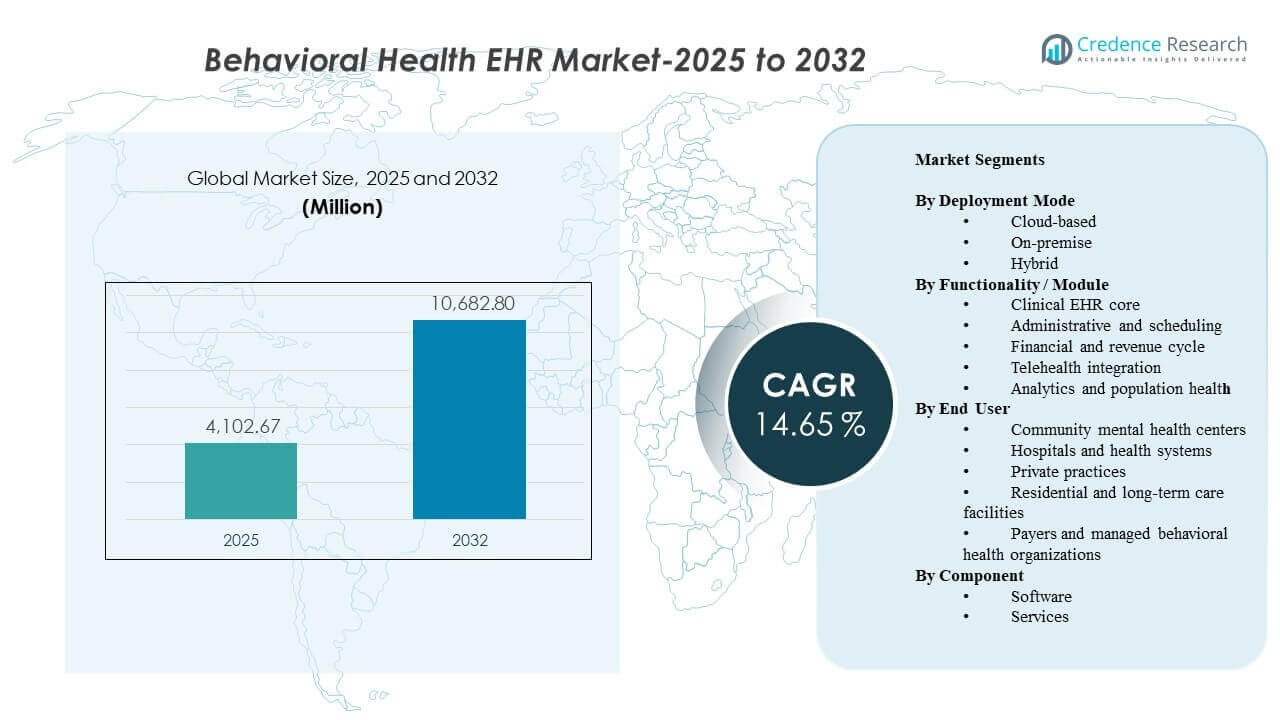
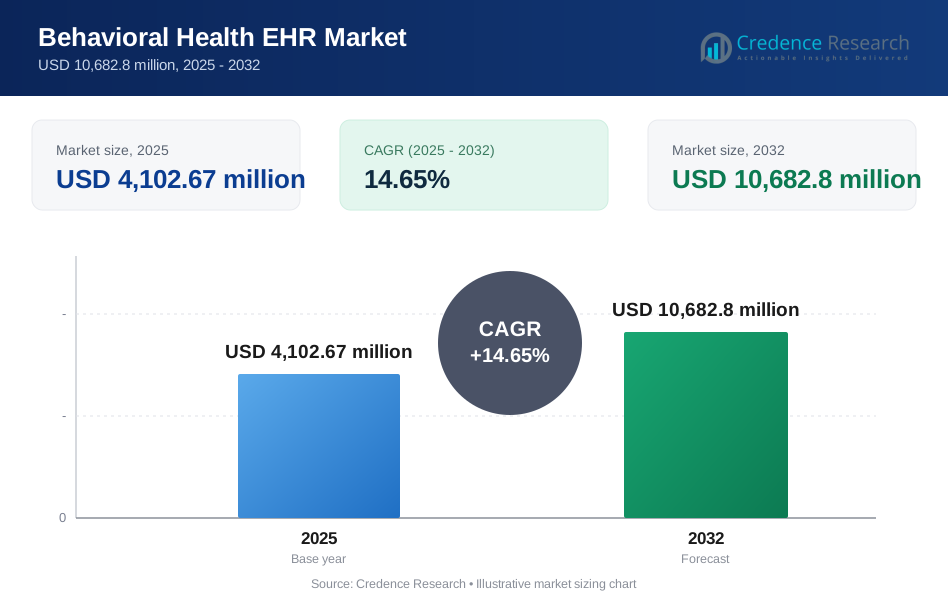
The global Behavioral Health EHR Market size was estimated at USD 4,102.67 million in 2025 and is expected to reach USD 10,682.8 million by 2032, growing at a CAGR of 14.65% from 2025 to 2032. Demand is being propelled by the shift toward measurement-based care and tighter requirements for structured documentation, outcomes reporting, and coordinated workflows across multiple care settings. Behavioral Health EHR Market adoption is also supported by expanding virtual-care delivery, which increases the value of integrated clinical, scheduling, and billing workflows across distributed provider networks.
| REPORT ATTRIBUTE | DETAILS |
|---|---|
| Historical Period | 2020-2024 |
| Base Year | 2025 |
| Forecast Period | 2026-2032 |
| Behavioral Health EHR Market Size 2025 | USD 4,102.67 million |
| Behavioral Health EHR Market, CAGR | 14.65% |
| Behavioral Health EHR Market Size 2032 | USD 10,682.8 million |
Key Market Trends & Insights
- Behavioral Health EHR Market is projected to expand at a CAGR of 14.65% during 2025–2032, reaching USD 10,682.8 million by 2032 from USD 4,102.67 million in 2025.
- Cloud-based deployment led Behavioral Health EHR Market by deployment mode with 58.19% share in 2025, reflecting the continued shift toward hosted delivery models.
- Clinical EHR core led Behavioral Health EHR Market by functionality/module with 41.41% share in 2025, supported by demand for standardized clinical documentation and care-plan continuity.
- Hospitals and health systems held the largest Behavioral Health EHR Market end-user share at 36.30% in 2025, driven by enterprise standardization and integrated care models.
- North America represented the leading regional revenue share in Behavioral Health EHR Market at 45.83% in 2025, supported by mature health IT infrastructure and higher adoption intensity.
Segment Analysis
Behavioral Health EHR Market demand is increasingly shaped by buyers prioritizing end-to-end workflow continuity across intake, clinical documentation, scheduling, and billing functions. Behavioral Health EHR Market procurement decisions commonly emphasize usability, interoperability, and the ability to support high-volume documentation requirements without increasing clinician administrative burden. Behavioral Health EHR Market platform differentiation is strengthening around integrated telehealth, automated documentation support, and configurable templates that align with behavioral workflows across diverse care models.
Behavioral Health EHR Market segmentation also reflects a clear shift toward integrated module stacks rather than standalone recordkeeping, especially where provider networks operate across multiple sites and payer reporting requirements are expanding. Behavioral Health EHR Market services demand remains structural because implementations often require training, customization, data migration, and continuous optimization to sustain adoption across multidisciplinary teams. Behavioral Health EHR Market adoption momentum is most visible where organizations are consolidating systems, standardizing documentation, and improving outcome measurement to support care quality and reimbursement alignment.
By Deployment Mode Insights
Cloud-based accounted for the largest share of 58.19% in 2025. Behavioral Health EHR Market cloud adoption is supported by lower infrastructure burden, faster rollout across multi-site networks, and streamlined updates for compliance and billing rules. Behavioral Health EHR Market buyers increasingly value remote accessibility and centralized administration to support hybrid and distributed care delivery. Behavioral Health EHR Market cloud deployments also enable faster integration of telehealth, analytics, and workflow automation capabilities that improve operational throughput.
By Functionality / Module Insights
Clinical EHR core accounted for the largest share of 41.41% in 2025. Behavioral Health EHR Market clinical cores remain foundational because standardized documentation, assessments, care plans, and progress tracking sit at the center of day-to-day clinical workflows. Behavioral Health EHR Market demand also remains anchored in maintaining longitudinal records that support continuity across visits and care teams. Behavioral Health EHR Market module adoption is reinforced by the need to align clinical documentation with billing, reporting, and outcomes tracking expectations.
By End User Insights
Hospitals and health systems accounted for the largest share of 36.30% in 2025. Behavioral Health EHR Market adoption in hospitals and health systems is driven by enterprise-scale standardization, integrated behavioral and medical care pathways, and higher capability requirements for interoperability. Behavioral Health EHR Market procurement in this segment typically prioritizes platform stability, security governance, and service coverage for large deployments. Behavioral Health EHR Market growth is also supported by system-wide efforts to unify behavioral documentation and reporting across outpatient, inpatient, and community-linked programs.
By Component Insights
Software accounted for the largest share of 68.60% in 2025. Behavioral Health EHR Market software spending is anchored in core platform subscriptions, module licensing, and workflow features that support daily documentation and administrative operations. Behavioral Health EHR Market software value is increasingly tied to integrated telehealth, configurable templates, and analytics capabilities that reduce operational friction. Behavioral Health EHR Market services continue to grow in parallel because implementation, training, and optimization remain critical to achieving durable adoption and measurable workflow improvement.
Behavioral Health EHR Market Drivers
Expansion of coordinated behavioral care models
Behavioral Health EHR Market growth is supported by care models that require coordination across clinicians, settings, and referral networks. Behavioral Health EHR Market platforms are increasingly used to standardize documentation and enable structured information exchange across multi-disciplinary teams. Behavioral Health EHR Market adoption improves when organizations require consistent care plans, outcome tracking, and closed-loop referral workflows. Behavioral Health EHR Market demand rises further as organizations standardize workflows across multiple sites and service lines.
- For instance, Netsmart states that its network connects more than 35,000 clients, and its Referral Manager helped Spectrum Health Systems reduce referral processing time to just over 2 minutes per case while managing more than 1,200 referrals in 60 days.
Increased need for structured documentation and outcomes reporting
Behavioral Health EHR Market adoption is reinforced by the need for consistent clinical documentation and measurement-based care workflows. Behavioral Health EHR Market platforms help providers maintain standardized assessments and progress tracking that support care quality monitoring. Behavioral Health EHR Market value increases when systems enable reporting that aligns with payer and program requirements. Behavioral Health EHR Market buyers also prioritize tools that reduce time spent on repetitive documentation tasks.
- For instance, Eleos reports that its documentation technology can populate 80% of progress note content in minutes, and Coleman Health Services reduced documentation and submission time by 70% after implementation.
Acceleration of virtual and hybrid care delivery
Behavioral Health EHR Market growth is driven by continued normalization of telehealth and hybrid delivery across many behavioral service lines. Behavioral Health EHR Market demand increases when telehealth workflows are integrated directly with clinical documentation, scheduling, and billing. Behavioral Health EHR Market systems that reduce context switching across multiple tools improve staff efficiency and patient experience. Behavioral Health EHR Market adoption also strengthens in organizations that need secure remote access and consistent documentation practices across locations.
Operational efficiency and revenue-cycle optimization needs
Behavioral Health EHR Market demand rises as providers focus on improving throughput and reducing administrative bottlenecks. Behavioral Health EHR Market platforms that support integrated scheduling, eligibility workflows, documentation support, and billing processes reduce friction across intake-to-claim pathways. Behavioral Health EHR Market buyers prioritize configuration flexibility to align templates and billing rules with behavioral-specific requirements. Behavioral Health EHR Market services growth is further supported by the need for training, customization, and continuous optimization to sustain performance improvements.
Behavioral Health EHR Market Challenges
Behavioral Health EHR Market faces implementation complexity driven by workflow variability across provider types, treatment modalities, and documentation practices. Behavioral Health EHR Market deployments often require change management, training, and template configuration to achieve consistent clinician adoption. Behavioral Health EHR Market organizations can struggle with data migration, integration with legacy systems, and the effort needed to standardize forms and assessments. Behavioral Health EHR Market outcomes can be constrained when staffing shortages reduce capacity for onboarding, optimization, and governance.
Behavioral Health EHR Market also faces persistent interoperability and usability challenges that can limit realized value in day-to-day operations. Behavioral Health EHR Market users may encounter friction when systems require extensive manual documentation, fragmented workflows, or limited integration across clinical and administrative modules. Behavioral Health EHR Market providers may delay replacement decisions when switching costs are high and historical data continuity is critical. Behavioral Health EHR Market vendors must balance specialization for behavioral workflows with broader interoperability expectations across healthcare ecosystems.
- For instance, Qualifacts’ 2025 integration with Greenspace Health added more than 500 validated assessments to its EHR environment and automated synchronization of assessment schedules and progress tracking, helping reduce manual workflow friction.
Behavioral Health EHR Market Trends and Opportunities
Behavioral Health EHR Market is seeing increased product focus on workflow automation and intelligence features that reduce documentation burden and improve clinician efficiency. Behavioral Health EHR Market opportunities expand when platforms embed structured assessments, configurable templates, and integrated communication workflows that support care coordination. Behavioral Health EHR Market buyers are also seeking platforms that enable consistent reporting and measurement-based care tracking across service lines. Behavioral Health EHR Market differentiation increasingly depends on practical usability improvements that shorten visit workflows and reduce administrative time.
Behavioral Health EHR Market opportunities are also expanding through broader module integration across telehealth, scheduling, and revenue-cycle workflows. Behavioral Health EHR Market value increases when organizations can unify intake, treatment documentation, follow-ups, and billing within a single platform. Behavioral Health EHR Market adoption potential is strong in segments with lower digitization maturity and in networks pursuing system consolidation and standardization. Behavioral Health EHR Market vendors that support multi-site scalability and rapid configuration can capture opportunities in expanding provider ecosystems.
- For instance, Valant reported that Mount Diablo Unified School District Counseling Services saved upwards of 80 staff hours per month and about 15 hours per month per clinician after moving documentation, billing, and reporting into one behavioral-health-specific EHR, and the same platform reduced productivity-report generation to about one hour per clinician per month, saving 63 work hours through a single automation process.
Regional Insights
North America
Behavioral Health EHR Market in North America accounted for 45.83% share in 2025, supported by mature health IT infrastructure and strong adoption intensity across large provider networks. Behavioral Health EHR Market demand is reinforced by integrated care models and the need for standardized behavioral documentation across settings. Behavioral Health EHR Market buyers commonly prioritize interoperability, security governance, and enterprise rollout support. Behavioral Health EHR Market growth is also supported by continued expansion of telehealth and outcome tracking requirements.
Europe
Behavioral Health EHR Market in Europe accounted for 20.67% share in 2025, supported by structured care pathways and strong attention to privacy and governance expectations. Behavioral Health EHR Market purchasing decisions in Europe often emphasize clinical reliability, workflow standardization, and integration into routine outpatient operations. Behavioral Health EHR Market adoption continues as providers modernize documentation and reporting workflows to improve continuity of care. Behavioral Health EHR Market growth is supported by broader digitization programs and modernization of clinical information systems.
Asia Pacific
Behavioral Health EHR Market in Asia Pacific accounted for 21.12% share in 2025, supported by expanding care access, digitization initiatives, and growing demand for scalable behavioral services. Behavioral Health EHR Market adoption rises as provider networks expand and as organizations seek more standardized documentation and administrative efficiency. Behavioral Health EHR Market opportunities increase where cloud delivery improves accessibility and reduces infrastructure barriers. Behavioral Health EHR Market growth is strengthened by rising adoption of virtual care models in major markets.
Latin America
Behavioral Health EHR Market in Latin America accounted for 6.54% share in 2025, supported by gradual modernization and increasing interest in cloud-first deployments. Behavioral Health EHR Market buyers often prioritize affordability, ease of implementation, and deployment models that reduce operational overhead. Behavioral Health EHR Market adoption varies across countries due to differences in funding structures and digitization maturity. Behavioral Health EHR Market growth improves as providers seek unified scheduling, documentation, and billing workflows.
Middle East & Africa
Behavioral Health EHR Market in the Middle East & Africa accounted for 5.84% share in 2025, reflecting uneven adoption across markets with differing digital infrastructure and healthcare spending levels. Behavioral Health EHR Market momentum is stronger in higher-investment systems that prioritize modernization and multi-site service expansion. Behavioral Health EHR Market demand is supported by the need to improve access, documentation quality, and care coordination across distributed facilities. Behavioral Health EHR Market adoption remains opportunity-led where cloud delivery can reduce infrastructure and deployment constraints.
Competitive Landscape
Behavioral Health EHR Market competition is shaped by depth of behavioral workflow specialization, breadth of module integration, and the ability to support scaled deployments across multiple care settings. Behavioral Health EHR Market vendors compete on usability, configuration flexibility, interoperability, and service delivery capabilities that reduce implementation friction. Behavioral Health EHR Market differentiation is increasingly tied to integrated telehealth workflows, analytics for outcome tracking, and automation features that reduce documentation load. Behavioral Health EHR Market enterprise wins are often secured through platform stability, multi-site governance controls, and proven implementation playbooks.
Netsmart Technologies is positioned in Behavioral Health EHR Market through specialization in behavioral and post-acute workflows, with an emphasis on integrated clinical, administrative, and interoperability capabilities. Behavioral Health EHR Market customers often value the ability to configure templates and workflows aligned to behavioral-specific documentation and coordinated care models. Behavioral Health EHR Market deployments supported by Netsmart Technologies typically prioritize operational scalability across distributed settings and program types. Behavioral Health EHR Market differentiation for Netsmart Technologies is supported by sustained focus on integrated modules and workflow efficiency enhancements.
The industry research and growth report includes detailed analyses of the competitive landscape of the market and information about key companies, including:
- Netsmart Technologies
- Oracle Health (Cerner)
- Epic Systems Corporation
- Qualifacts
- NextGen Healthcare
- Valant
- AdvancedMD
Qualitative and quantitative analysis of companies has been conducted to help clients understand the wider business environment as well as the strengths and weaknesses of key industry players. Data is qualitatively analyzed to categorize companies as pure play, category-focused, industry-focused, and diversified; it is quantitatively analyzed to categorize companies as dominant, leading, strong, tentative, and weak.
Recent Developments
- In March 2025, OPEN MINDS expanded its partnership with Core Solutions to advance EHR and AI innovation in behavioral health, with the collaboration focused on interoperability, operational efficiency, client-centered care, and practical AI use across behavioral health and human services organizations.
- In October 2025, Sunwave Health and Lightning Step Technologies announced a merger, supported by a strategic growth investment from BVP Forge, to create a unified technology platform purpose-built for behavioral health providers; Lightning Step said the combination would strengthen innovation and deliver a more comprehensive all-in-one ecosystem for the sector.
- In January 2026, Sheridan Capital Partners completed its investment in ICANotes, a purpose-built behavioral health EHR and practice management platform, with ICANotes stating that the partnership would help it scale its core PM and EHR solutions while expanding platform capabilities for clinician customers.
- In January 2026, Findhelp announced a partnership with SimplePractice to expand access to behavioral health care nationwide by integrating real-time provider search and scheduling into Findhelp’s platform, while leveraging SimplePractice’s behavioral health practice management and EHR capabilities for independent practitioners.
Report Scope
| Report Attribute | Details |
| Market size value in 2025 | USD 4102.67 million |
| Revenue forecast in 2032 | USD 10682.8 million |
| Growth rate (CAGR) | 14.65% (2025–2032) |
| Base year | 2025 |
| Forecast period | 2026-2032 |
| Quantitative units | USD million |
| Segments covered | Deployment Mode Outlook: Cloud-based, On-premise, Hybrid; Functionality / Module Outlook: Clinical EHR core, Administrative and scheduling, Financial and revenue cycle, Telehealth integration, Analytics and population health; End User Outlook: Community mental health centers, Hospitals and health systems, Private practices, Residential and long-term care facilities, Payers and managed behavioral health organizations; Component Outlook: Software, Services |
| Regional scope | North America, Europe, Asia Pacific, Latin America, Middle East & Africa |
| Key companies profiled | Netsmart Technologies, Oracle Health (Cerner), Epic Systems Corporation, Qualifacts, NextGen Healthcare, Valant, AdvancedMD companies |
| No.of Pages | 336 |
By Segmentation
By Deployment Mode
- Cloud-based
- On-premise
- Hybrid
By Functionality / Module
- Clinical EHR core
- Administrative and scheduling
- Financial and revenue cycle
- Telehealth integration
- Analytics and population health
By End User
- Community mental health centers
- Hospitals and health systems
- Private practices
- Residential and long-term care facilities
- Payers and managed behavioral health organizations
By Component
- Software
- Services
By Region
- North America
- U.S.
- Canada
- Mexico
- Europe
- Germany
- France
- U.K.
- Italy
- Spain
- Rest of Europe
- Asia Pacific
- China
- Japan
- India
- South Korea
- South-east Asia
- Rest of Asia Pacific
- Latin America
- Brazil
- Argentina
- Rest of Latin America
- Middle East & Africa
- GCC Countries
- South Africa
- Rest of the Middle East and Africa
Request a Free Sample
Fill in your details and we'll send you a free sample report.
- Sample data tables & charts
- Research methodology
Need a Custom Version of This Report?
Tailor the scope, geography, or segments to your exact requirements.
- Custom geography or segment scope
- Direct access to our analyst team
Frequently Asked Questions
What is the market size of the Behavioral Health EHR Market in 2025 and what is the forecast for 2032?
What is the CAGR of the Behavioral Health EHR Market during 2025–2032?
Which segment is the largest in the Behavioral Health EHR Market?
What factors are driving growth in the Behavioral Health EHR Market?
Who are the leading companies in the Behavioral Health EHR Market?
Which region leads the Behavioral Health EHR Market?
Table of Content
Chapter 1. Report Introduction
- 1.1 Report Description & Purpose
- 1.1.1 Report Title & Market Definition
- 1.1.2 Unique Selling Propositions (USP) & Key Differentiators
- 1.1.3 Value Proposition for Stakeholders
- 1.2 Research Objectives
- 1.2.1 Market Sizing Objectives (Volume & Revenue)
- 1.2.2 Segmentation Objectives
- 1.2.3 Competitive Intelligence Objectives
- 1.2.4 Forecast & Scenario Objectives
- 1.3 Report Scope
- 1.3.1 Behavioral Health EHR Scope – Types & Subtypes Covered
- 1.3.2 Geographic Scope – Regions & Countries Covered
- 1.3.3 Historical Period, Base Year & Forecast Period (2025; forecast to 2032)
- 1.3.4 Inclusions & Exclusions
- 1.4 HS Code & Classification Framework
- 1.5 Currency, Units & Pricing Basis
- 1.6 Target Stakeholders
- 1.7 Limitations & Assumptions
Chapter 2. Executive Summary
- 2.1 Global Behavioral Health EHR Market Snapshot
- 2.1.1 Market Size – Historical (2025) & Forecast (2025-2032) (2025: USD 4,102.67 million → 2032: USD 10,682.8 million)
- 2.1.2 Volume & Revenue – Global Totals
- 2.1.3 Key Market Highlights – Top Five Facts
- 2.2 Behavioral Health EHR Market Segmentation Snapshot
- 2.2.1 Market Split by Region – 2025 vs. 2032
- 2.3 Competitive Snapshot
- 2.3.1 Top 10 Players by Revenue Share – 2025
- 2.3.2 Top 10 Players by Volume Share – 2025
- 2.3.3 Recent Strategic Developments (18-Month Summary)
- 2.4 Key Investment Highlights & Strategic Conclusions
Chapter 3. Behavioral Health EHR Market Dynamics & Industry Analysis
- 3.1 Market Overview & Context
- 3.1.1 Behavioral Health EHR Market Position in the Broader Automotive Value Chain
- 3.1.2 OEM vs. Replacement Market Dynamics
- 3.1.3 Market Maturity & Development Stage by Region
- 3.2 Behavioral Health EHR Market Drivers
- 3.3 Behavioral Health EHR Market Restraints & Challenges
- 3.4 Behavioral Health EHR Market Opportunities
- 3.5 Porter's Five Forces Analysis
- 3.5.1 Threat of New Entrants
- 3.5.2 Bargaining Power of Suppliers
- 3.5.3 Bargaining Power of Buyers
- 3.5.4 Threat of Substitutes
- 3.5.5 Competitive Rivalry – Intensity Assessment
- 3.6 Behavioral Health EHR Value Chain Analysis
- 3.6.1 Upstream – Raw Material/Input Suppliers
- 3.6.1.1 Raw Material/Input 1
- 3.6.1.2 Raw Material/Input 2
- 3.6.1.3 Raw Material/Input 3
- 3.6.2 Midstream – Production/Manufacturing/Service Delivery
- 3.6.2.1 Production/Process Overview
- 3.6.2.2 Key Facility Locations & Capacity by Manufacturer
- 3.6.3 Downstream – Distribution & End Consumer
- 3.6.3.1 Primary Channel – B2B/OEM
- 3.6.3.2 Secondary Channels – Dealer, Retail, Online, Direct
- 3.6.4 Value Chain Profitability Analysis
- 3.6.1 Upstream – Raw Material/Input Suppliers
- 3.7 PESTEL Analysis
- 3.7.1 Political Factors
- 3.7.2 Economic Factors
- 3.7.3 Social Factors
- 3.7.4 Technological Factors
- 3.7.5 Environmental Factors
- 3.7.6 Legal Factors
- 3.8 Behavioral Health EHR Supply Chain Analysis
- 3.8.1 Raw Material/Input Supply Risk Assessment
- 3.8.2 Manufacturing Concentration Risk (Geographic Exposure)
- 3.8.3 Trade Disruption Impact Analysis
- 3.9 Regulatory & Policy Landscape
Note: The regulatory and policy landscape section covers regulations based on their applicability to the market, Behavioral Health EHR category, geography, and scope of the study. Only regulatory frameworks with a material impact on operations, compliance, trade, sustainability, or market access are analyzed in detail.
Chapter 4. Key Investment Pockets & Opportunity Analysis
- 4.1 Behavioral Health EHR Market Attractiveness Analysis
- 4.1.1 By Region – Investment Attractiveness Matrix (Volume × CAGR)
- 4.2 Absolute Revenue Growth Opportunity
- 4.2.1 By Region – Absolute USD Growth Through 2032
- 4.3 Incremental Volume Opportunity
- 4.3.1 By Region – Incremental Volume Through 2032
- 4.3.2 Segment – Incremental Volume
- 4.4 Emerging Submarket Opportunity Deep Dive (Subject to Applicability)
- 4.5 Emerging Market Opportunity Scorecards
- 4.5.1 United States
- 4.5.2 Europe
- 4.5.3 Asia
- 4.5.4 Middle East & Africa
Note: Emerging Market Opportunity Scorecards will be included based on relevance and strategic importance. Regions listed are indicative and may vary depending on data availability and market dynamics.
Chapter 5. Behavioral Health EHR Import-Export Analysis & Trade Flows
- 5.1 Global Trade Overview
- 5.1.1 Global Export Value by Country (2025)
- 5.1.2 Global Export Volume by Country (2025)
- 5.1.3 Global Import Value by Country (2025)
- 5.1.4 Global Import Volume by Country (2025)
- 5.1.5 Net Trade Balance by Country (2025)
- 5.2 Export Analysis – Segment
- 5.2.1 Type 1 (HS Code)
- 5.2.2 Type 2 (HS Code)
- 5.2.3 Type 3 (HS Code)
- 5.2.4 Type 4 (HS Code)
- 5.2.5 Type 5 (HS Code)
- 5.3 Import Analysis – Segment
- 5.3.1 Type 1 (HS Code)
- 5.3.2 Type 2 (HS Code)
- 5.3.3 Type 3 (HS Code)
- 5.3.4 Type 4 (HS Code)
- 5.3.5 Type 5 (HS Code)
- 5.4 Average Unit Trade Prices
- 5.4.1 Average Export Price – Segment & Country
- 5.4.2 Average Import Price – Segment & Source Country
- 5.4.3 Price Trends (2025)
- 5.5 Key Trade Route Analysis
- 5.5.1 Trade Route 1
- 5.5.2 Trade Route 2
- 5.5.3 Trade Route 3
- 5.5.4 Trade Route 4
- 5.5.5 Trade Route 5
- 5.6 Trade Policy Impact Assessment
- 5.6.1 US Anti-Dumping & Section 301 Tariffs
- 5.6.2 EU Customs Union Impact
- 5.6.3 Major Free Trade Agreements
- 5.6.4 USMCA Rules of Origin
Note: Trade policy analysis will be included only where relevant to the Behavioral Health EHR market.
Chapter 6. Competitive Landscape & Company Benchmarking
- 6.1 Behavioral Health EHR Market Concentration & Structure
- 6.1.1 Herfindahl-Hirschman Index (HHI) – vs. 2025
- 6.1.2 Tier 1, Tier 2 & Tier 3 Market Structure
- 6.1.3 Global, Regional & Local Player Dynamics
- 6.2 Behavioral Health EHR Market Share Analysis – 2025
- 6.2.1 Global Revenue Share by Company
- 6.2.2 Global Volume Share by Company
- 6.2.3 Regional Revenue Share
- 6.2.4 Market Share Evolution ( vs. 2025)
- 6.2.5 OEM Segment Share by Company
- 6.2.6 Replacement Segment Share by Company
- 6.3 Production/Delivery Capacity & Facility Analysis
- 6.3.1 Global Installed Capacity
- 6.3.2 Capacity Utilization Rates
- 6.3.3 Production/Output Volume
- 6.3.4 Facility Locations & Capacity Map
- 6.3.5 Planned Capacity Additions
- 6.4 Behavioral Health EHR Competitive Benchmarking Matrix
- 6.4.1 Revenue, Volume, CAGR & Profitability Comparison
- 6.4.2 Channel Revenue Mix
- 6.4.3 Geographic Revenue Exposure
- 6.4.4 R&D Intensity
- 6.4.5 Sustainability Maturity
- 6.5 Strategic Developments in Behavioral Health EHR (Last 24 Months)
- 6.5.1 Mergers, Acquisitions & Divestments
- 6.5.2 New Behavioral Health EHR Launches
- 6.5.3 Facility Expansions
- 6.5.4 Strategic Alliances, Joint Ventures & Partnerships
- 6.5.5 Distribution Expansion & Market Entry
- 6.5.6 Sustainability & ESG Initiatives
- 6.6 Competitive Strategy Mapping
- 6.6.1 Leader, Challenger, Follower & Niche Classification
- 6.6.2 Pricing Strategy Comparison
- 6.6.3 Channel Strategy Matrix
Note: Strategic developments are included based on their materiality and the availability of reliable information.
Chapter 7. Global Behavioral Health EHR Market – By Distribution Channel
- 7.1 Segment Overview
- 7.1.1 Volume & Revenue Split by Channel (2025 & 2032)
- 7.1.2 Channel Mix Evolution (2025-2032)
Chapter 8. Regional Market Analysis – Global Overview
- 8.1 Global Regional Overview
- 8.1.1 Regional Volume Share
- 8.1.2 Regional Revenue Share
- 8.1.3 Regional Volume by Region
- 8.1.4 Regional Revenue by Region
- 8.1.5 Regional Forecast Through 2032
- 8.2 Cross-Regional Segment Analysis
- 8.2.1 By Distribution Channel
- 8.2.2 By Brand/Price Tier
Chapter 9. North America Behavioral Health EHR Market
- 9.1 United States
- 9.2 Canada
- 9.3 Mexico
Chapter 10. Europe Behavioral Health EHR Market
- 10.1 Germany
- 10.2 France
- 10.3 Italy
- 10.4 United Kingdom
- 10.5 Spain
- 10.6 Poland
- 10.7 Russia
- 10.8 Netherlands
- 10.9 Belgium
- 10.10 Sweden
- 10.11 Denmark
- 10.12 Norway
- 10.13 Rest of Europe
Chapter 11. Asia Pacific Behavioral Health EHR Market
- 11.1 China
- 11.2 India
- 11.3 Japan
- 11.4 South Korea
- 11.5 Thailand
- 11.6 Indonesia
- 11.7 Vietnam
- 11.8 Malaysia
- 11.9 Australia
- 11.10 Rest of Asia Pacific
Chapter 12. Latin America Behavioral Health EHR Market
- 12.1 Brazil
- 12.2 Argentina
- 12.3 Colombia
- 12.4 Chile
- 12.5 Rest of Latin America
Chapter 13. Middle East Behavioral Health EHR Market
- 13.1 Saudi Arabia
- 13.2 United Arab Emirates
- 13.3 Turkey
- 13.4 Israel
- 13.5 Iran
- 13.6 Rest of the Middle East
Chapter 14. Africa Behavioral Health EHR Market
- 14.1 South Africa
- 14.2 Egypt
- 14.3 Nigeria
- 14.4 Morocco
- 14.5 Rest of Africa
Chapter 15. Behavioral Health EHR Company Profiles
- 15.1 [Company 01]
- 15.1.1 Company Overview
- 15.1.2 Key Management Personnel
- 15.1.3 Products & Services Portfolio
- 15.1.4 Financial Performance
- 15.1.5 Key Market Focus & Geographic Presence
- 15.1.6 Recent Developments & Strategic Initiatives
Note: The company profile list is preliminary and may change based on research findings, market developments, data availability, and client requirements.
Chapter 16. Appendices
- Appendix A – List of Abbreviations & Acronyms
- Appendix B – Industry Classification Code Reference – Full Series
- Appendix C – Production & Capacity Data Tables
- Appendix D – End-Use & Demand Base Tables
- Appendix E – Consumption & Replacement Rate Assumptions
- Appendix F – ASP Reference Tables
- Appendix G – Manufacturing & Facility Database
- Appendix H – Import-Export Data Tables
- Appendix I – Regulatory Summary Tables
- Appendix J – Primary Research Participant List (Anonymized)
- Appendix K – Primary Research Questionnaire Framework
- Appendix L – Data Sources & Bibliography
- Appendix M – Market Size Divergence & Source Comparison
Chapter 17. Research Methodology
- 17.1 Research Framework & Philosophy
- 17.2 Secondary Research – Sources, Hierarchy & Data Extraction
- 17.3 Data Modeling – Bottom-Up & Top-Down Market Sizing
- 17.4 Primary Research – Stakeholder Framework, LOI & Sample Sizes
- 17.5 Forecast Methodology – Regression, Scenario & Sensitivity Analysis
- 17.6 Quality Control – Four-Layer Validation Framework
- 17.7 Limitations & Standard Assumptions
- 17.8 Disclaimer
