
| REPORT ATTRIBUTE | DETAILS |
|---|---|
| Historical Period | 2019-2022 |
| Base Year | 2023 |
| Forecast Period | 2024-2032 |
| Border Security Technologies Market Size 2024 | USD 48,025 million |
| Border Security Technologies Market, CAGR | 35.8% |
| Border Security Technologies Market Size 2032 | USD 555,476.29 million |
Market Overview
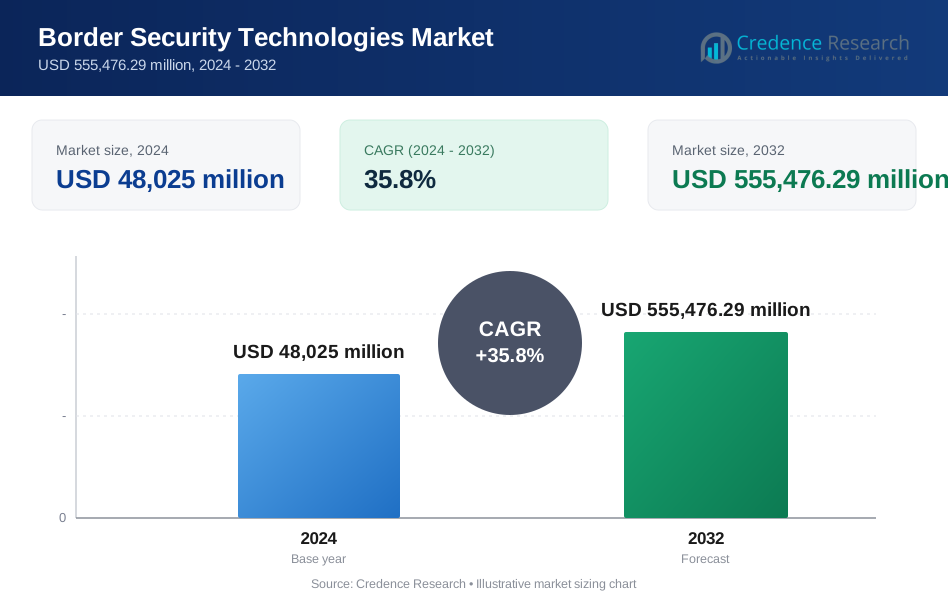
The Border Security Technologies Market is projected to grow from USD 48,025 million in 2024 to an estimated USD 555,476.29 million by 2032, at an impressive compound annual growth rate (CAGR) of 35.8%.
The Border Security Technologies market is driven by increasing geopolitical tensions, rising cross-border threats, and a growing emphasis on national security. Governments worldwide are investing heavily in advanced surveillance systems, such as drones, radar systems, and AI-powered analytics, to enhance border control and detect illegal activities. The integration of biometric technologies, such as facial recognition and fingerprint scanning, is gaining traction to streamline identity verification processes. Additionally, the surge in global trade and travel necessitates efficient border management solutions, further fueling market growth. The adoption of smart technologies, including IoT-enabled sensors and autonomous systems, is transforming traditional border security approaches by enabling real-time monitoring and predictive analytics. Moreover, public-private partnerships and increased defense budgets are fostering the development of innovative security solutions. As regulatory frameworks evolve, demand for sustainable and interoperable technologies is also rising, making the market a crucial player in global security infrastructure.
North America leads the Border Security Technologies market, driven by substantial investments in advanced surveillance systems, biometrics, and AI-powered technologies, with the U.S. holding a dominant share due to its extensive border infrastructure upgrades. The Asia-Pacific region is the fastest-growing market, fueled by increasing geopolitical tensions and the adoption of modernized border management solutions in countries like China and India. Europe also plays a significant role, with rising investments in smart technologies for border surveillance, especially in regions managing migration challenges. Key players shaping the market include Northrop Grumman Systems Corporation, Airbus SAS, Lockheed Martin Corporation, General Dynamics Corporation, and Thales, among others. These companies focus on innovative solutions, such as drones, automated systems, and advanced command centers, to address evolving global border security needs.
Market Drivers:
Rising Geopolitical Tensions and Cross-Border Threats:
Increasing geopolitical tensions and heightened cross-border threats are driving the adoption of advanced border security technologies. Nations face challenges such as illegal immigration, smuggling, and terrorism, necessitating robust measures to secure their borders. For instance, the FICCI-PwC report on Smart Border Management: An Indian Perspective highlights the importance of deploying surveillance systems, including drones, radar systems, and thermal cameras, to enhance situational awareness and improve response times. This growing need for security and protection is a key driver of market growth globally.
Advancements in Biometric and AI Technologies:
Technological innovations, particularly in biometrics and artificial intelligence, are significantly impacting the border security technologies market. For instance, companies like IBM are integrating biometric solutions, such as facial recognition, iris scanning, and fingerprint authentication, into border control systems to streamline identity verification and improve efficiency. AI-powered analytics enhance threat detection and predictive capabilities, enabling proactive security measures. These advancements not only strengthen border surveillance but also ensure seamless and secure travel for passengers.
Growing Trade and Travel Volume:
The increasing volume of international trade and travel is propelling the demand for efficient border management solutions. With global supply chains expanding and tourism rebounding post-pandemic, countries are focusing on upgrading their border infrastructure to handle higher volumes effectively. For instance, the Government of India's Border Management-I Division is adopting smart technologies, such as IoT-enabled sensors and automated checkpoints, to facilitate faster cargo and passenger processing. These solutions reduce bottlenecks while maintaining stringent security standards, fostering market growth.
Rising Defense Budgets and Public-Private Partnerships:
Growing defense budgets and collaborations between governments and private sector players are driving innovation in border security technologies. Investments in R&D for cutting-edge solutions, for instance, the U.S. Department of Defense's Border Security Technology Consortium (BSTC), are increasing. Public-private partnerships facilitate the development and deployment of cost-effective, scalable technologies tailored to specific security needs. These strategic collaborations are enabling the creation of advanced, integrated systems that enhance national security and operational efficiency.
Market Trends
Integration of Artificial Intelligence and Machine Learning:
Artificial intelligence (AI) and machine learning (ML) are revolutionizing border security technologies by enabling advanced threat detection and predictive analysis. For instance, U.S. Customs and Border Protection (CBP) uses AI to screen cargo at ports of entry, validate identities through the CBP One app, and enhance threat awareness at the border. AI models automatically identify objects in streaming video and imagery, improving real-time threat detection.
Expansion of Biometric Authentication Systems:
Biometric authentication is becoming a cornerstone of modern border security systems. Solutions such as facial recognition, iris scanning, and fingerprint identification are now integrated into border control checkpoints to expedite identity verification and enhance security. For instance, the UK Home Office has introduced a policy paper emphasizing the use of biometric eGates to enable entirely contactless travel for British citizens and trusted overseas partners. This initiative aims to streamline border control processes and enhance user experience.
Adoption of Autonomous and Unmanned Systems:
Unmanned aerial vehicles (UAVs), ground vehicles, and autonomous systems are witnessing increased adoption in border security. These technologies are utilized for surveillance, reconnaissance, and patrolling, especially in remote and challenging terrains. For instance, the European Union Member States have deployed AI-powered mobile autonomous surveillance systems to enhance border security. These systems, equipped with high-resolution cameras and sensors, provide real-time intelligence and reduce risks to personnel. Autonomous systems are also used to monitor maritime boundaries and ensure the safety of coastlines, showcasing their versatility across various applications.
Focus on Cybersecurity in Border Management:
As border security systems become more digitized and interconnected, cybersecurity has emerged as a critical focus area. Governments and organizations are investing in robust cybersecurity solutions to protect sensitive data and ensure the integrity of surveillance networks. For instance, the European Border and Coast Guard Agency (Frontex) has been empowered with a stronger mandate and increased resources to coordinate external border control efforts. Multi-layered security protocols and blockchain technology are being explored to protect sensitive data and ensure the integrity of surveillance networks.
Market Challenges Analysis:
High Implementation Costs and Budget Constraints:
One of the primary challenges in the Border Security Technologies market is the high cost of implementing advanced security systems. Cutting-edge solutions such as AI-powered surveillance, biometric authentication, and autonomous systems require substantial investments in hardware, software, and infrastructure. Many countries, particularly those in developing regions, face budgetary constraints that limit their ability to adopt these technologies. Additionally, limited access to skilled labor for operating and maintaining these systems further complicates their implementation. The expenses associated with maintenance, training personnel, and upgrading existing systems further compound the financial burden. For smaller nations or those with limited resources, prioritizing border security amid other pressing socioeconomic needs becomes a significant challenge, hindering widespread adoption. These high costs and resource limitations create disparities in the deployment of border security technologies, leaving some regions vulnerable to evolving threats.
Interoperability Issues and Privacy Concerns:
The lack of interoperability among different border security systems poses a considerable challenge to efficient operations. Border agencies often rely on a mix of legacy and modern systems, which may not integrate seamlessly, leading to inefficiencies in data sharing and real-time decision-making. This fragmentation of technologies results in delays and reduced effectiveness in responding to security threats. Furthermore, international borders often involve collaboration between multiple countries, each with its own set of technologies, policies, and protocols. Achieving seamless cross-border coordination and data exchange is complex and time-consuming, requiring significant diplomatic and technical effort. Additionally, the widespread use of biometric data and AI raises concerns over privacy and data security. Citizens and advocacy groups are increasingly voicing apprehensions about potential misuse of personal information, leading to resistance and calls for stricter regulations. Balancing these concerns with the need for robust security measures requires transparency, regulatory compliance, and the adoption of secure and privacy-respecting technologies. Addressing these challenges is critical to building trust and ensuring the successful deployment of border security systems.
Market Segmentation Analysis:
By Domain
The Border Security Technologies market is segmented by domain into ground, air, and maritime operations. Ground-based systems hold the largest share due to their critical role in securing land borders and checkpoints, utilizing technologies like surveillance towers, ground sensors, and perimeter fencing. Air-based systems, including drones and aircraft equipped with advanced radar and imaging, are witnessing rapid adoption to monitor large and remote areas effectively. Maritime solutions, such as automated patrol vessels and underwater surveillance, are gaining prominence as nations focus on protecting coastlines and combating illegal activities like smuggling and human trafficking via sea routes.
By System
By system, the market includes surveillance systems, command and control systems, communication networks, biometric solutions, and detection systems. Surveillance systems lead the segment, driven by the increasing need for real-time monitoring through advanced radars, cameras, and UAVs. Command and control systems facilitate integrated operations and efficient decision-making. Biometric technologies, such as facial recognition and fingerprint scanning, are revolutionizing border control by enhancing identity verification and minimizing security breaches. Detection systems, including chemical, radiological, and explosives detectors, play a vital role in preventing the illegal transport of hazardous materials. These systems collectively cater to the rising demand for robust and scalable border security technologies.
Segments:
Based on Domain
- Land
- Maritime
- Airborne
Based on System
- Surveillance Systems
- Detection Systems
- Communication Systems
- Border Security Systems
- Laser Systems
- Unmanned Systems
- Perimeter Intrusion Detection Systems
- Cybersecurity Systems
Based on Installation
- New Installations
- Upgradation
Based on Vertical
- Military
- Homeland Security
Based on the Geography:
- North America
- U.S.
- Canada
- Mexico
- Europe
- Germany
- France
- U.K.
- Italy
- Spain
- Rest of Europe
- Asia Pacific
- China
- Japan
- India
- South Korea
- South-east Asia
- Rest of Asia Pacific
- Latin America
- Brazil
- Argentina
- Rest of Latin America
- Middle East & Africa
- GCC Countries
- South Africa
- Rest of the Middle East and Africa
Regional Analysis:
North America
North America dominates the Border Security Technologies market, accounting for over 40% of the global market share in 2023. The region's leadership is driven by significant investments in advanced border security solutions, particularly in the United States. The U.S. government allocates substantial budgets for upgrading its border infrastructure with cutting-edge technologies such as drones, AI-powered surveillance systems, and biometric authentication. The U.S.-Mexico border, one of the most critical and heavily monitored borders globally, continues to benefit from these advancements, ensuring enhanced threat detection, operational efficiency, and streamlined processing at checkpoints. Initiatives like the deployment of automated surveillance towers and smart fencing demonstrate the country’s commitment to maintaining security while addressing humanitarian concerns and privacy regulations. Additionally, Canada is adopting innovative solutions such as automated border control systems, maritime surveillance, and integrated command centers to safeguard its extensive coastline and ensure smooth trade flow. The strong presence of leading defense contractors, robust public-private collaborations, and a well-established innovation ecosystem further strengthens the regional market. These partnerships have fostered the development of scalable, efficient, and secure solutions tailored to evolving threats, reinforcing North America's position as a global leader in border security technologies.
Asia-Pacific
Asia-Pacific is the fastest-growing region in the Border Security Technologies market, holding 30% of the global share in 2023. The region's rapid growth is fueled by increasing geopolitical tensions, cross-border conflicts, and rising concerns over illegal immigration, smuggling, and piracy. Countries such as China and India are making significant investments in advanced technologies, including AI-powered surveillance systems, biometrics, and unmanned aerial vehicles, to secure their extensive land and maritime borders. China’s Belt and Road Initiative has heightened its focus on border security to protect critical infrastructure and trade routes, while India is actively modernizing its border management systems to address threats along its borders with Pakistan and China. Southeast Asian nations, such as Indonesia and the Philippines, are adopting smart maritime technologies to counteract illegal fishing and piracy in their waters, showcasing the region’s growing sophistication in border security. Regional governments are increasingly collaborating with international technology providers to accelerate the deployment of innovative solutions, while rising defense budgets provide further impetus. These comprehensive initiatives are transforming the Asia-Pacific region into a pivotal market for border security technologies, ensuring enhanced security, economic stability, and strategic resilience amid growing regional challenges.
Europe
Europe follows with a market share of about 30%. The region faces challenges related to illegal immigration, terrorism, and cross-border crimes, prompting substantial government spending on state-of-the-art security solutions. European countries are increasingly adopting integrated security technologies to enhance border control and cooperation among member states. The European Union's commitment to improving border security has further accelerated the adoption of advanced surveillance systems and infrastructure upgrades.
Key Player Analysis:
- Lockheed Martin Corporation
- Elbit Systems Ltd.
- RTX Corporation
- Thales
- Teledyne FLIR LLC
- General Dynamics Corporation
- Northrop Grumman Systems Corporation
- RAFAEL Advanced Defense Systems Ltd.
- Airbus SAS
- BAE Systems
Competitive Analysis:
The Border Security Technologies market is highly competitive, with major players such as Northrop Grumman Systems Corporation, Airbus SAS, Lockheed Martin Corporation, General Dynamics Corporation, BAE Systems, Thales, RTX Corporation, Elbit Systems Ltd., RAFAEL Advanced Defense Systems Ltd., and Teledyne FLIR LLC driving innovation and market growth. These companies focus on developing advanced technologies, including AI-powered surveillance systems, unmanned aerial vehicles, biometric authentication, and integrated command and control systems, to meet the growing demand for comprehensive border security solutions. For instance, Northrop Grumman Systems Corporation has developed advanced AI-powered surveillance systems that are widely used in border security. Strategic initiatives such as mergers, acquisitions, and collaborations enable these firms to expand their global footprint and enhance their product offerings. Additionally, investments in R&D and partnerships with government agencies ensure a steady pipeline of innovative and scalable solutions, maintaining a competitive edge. The market’s dynamic nature and technological advancements push players to consistently evolve to address emerging security challenges effectively.
Recent Developments:
- In August 2024, Canadian border authorities introduced a new app designed to assist in tracking individuals who have been ordered to leave the country. The Canada Border Services Agency (CBSA) will use facial biometrics to verify identities and employ the app to monitor their locations. The app, called ReportIn, is intended to enable foreign nationals and permanent residents who are subject to immigration enforcement conditions to report their status without needing to visit a CBSA office in person.
- In April 2024, ideaForge Technology Ltd., a prominent player in drone technology and manufacturing, unveiled new cutting-edge solutions aimed at strengthening its position in the U.S. market. These advanced solutions for Border Protection and Public Safety highlight the company's dedication to tackling key challenges faced by border patrol agencies and law enforcement through technological innovation.
- In November 2023, Northrop Grumman Systems Corp secured a USD 543 million contract modification to expand the production and delivery of MQ-4C Triton Unmanned Aircraft Systems for the U.S. Navy and Australia. This includes three Triton aircraft for the U.S. Navy, one for Australia, and a dedicated operational hub, along with support services, technical expertise, and administrative data.
- In November 2023, the Lithuanian State Border Guard Service finalized a contract for three five-bladed H145 multi-mission helicopters at the European Rotors trade show. These helicopters will support missions such as border patrol, firefighting, organ transport, and the deployment of Lithuanian Special Forces, enhancing Airbus Helicopters’ presence in the segment.
- In November 2023, Centaurium UAS partnered with Thales to receive two Thales UAS100 drone systems and ground control stations. The drones, set for testing in spring 2024 and commercial operations by 2025, are designed for diverse missions, including border surveillance, fire detection, infrastructure risk monitoring, and search-and-rescue, while adhering to aviation regulations.
- In November 2023, QinetiQ was awarded a USD 170 million contract by the U.S. Department of Homeland Security (DHS) Customs and Border Protection (CBP) to provide operations and maintenance services for the Air and Marine Tethered Aerostat Radar System (TARS).
- In June 2023, ASISGUARD, a Turkish defense firm, secured a USD 36.5 million contract to deploy an integrated border protection solution in Nigeria. The project includes AI-equipped Songar drones for target identification and neutralization, demonstrating Nigeria's commitment to enhancing border safety.
- In March 2023, Accenture Federal Services received a USD 380 million contract to modernize IT infrastructure for the U.S. Customs and Border Protection (CBP). The agreement focuses on providing advanced technology support to secure national borders while ensuring the seamless movement of people and goods.
- In February 2023, the U.K. Home Office partnered with BAE Systems Digital Intelligence in a three-year, USD 41.42 million agreement to develop real-time data analysis technology for border security. The initiative aims to manage the data associated with 300 million passenger journeys and 385 million tons of cargo entering the U.K. annually.
Market Concentration & Characteristics:
The Border Security Technologies market is moderately concentrated, with leading players such as Northrop Grumman Systems Corporation, Lockheed Martin Corporation, Airbus SAS, and Thales holding a significant share. These companies dominate due to their advanced portfolios of surveillance systems, biometric technologies, and AI-powered solutions. The market is characterized by high entry barriers, including substantial R&D costs, complex regulatory compliance, and the need for sophisticated technology integration, which limits competition from smaller players. Additionally, the market exhibits a high degree of specialization, with firms focusing on specific domains such as ground, air, or maritime security. Collaboration between governments and private firms is a defining feature, driving the development of innovative and scalable solutions to address evolving threats. The growing adoption of automation, IoT, and AI technologies further highlights the market's dynamic nature and the ongoing focus on modernization and efficiency in border management.
Report Coverage:
The research report offers an in-depth analysis based on Domain, System, Installation, Vertical and Geography. It details leading market players, providing an overview of their business, product offerings, investments, revenue streams, and key applications. Additionally, the report includes insights into the competitive environment, SWOT analysis, current market trends, as well as the primary drivers and constraints. Furthermore, it discusses various factors that have driven market expansion in recent years. The report also explores market dynamics, regulatory scenarios, and technological advancements that are shaping the industry. It assesses the impact of external factors and global economic changes on market growth. Lastly, it provides strategic recommendations for new entrants and established companies to navigate the complexities of the market.
Future Outlook:
- The Border Security Technologies market is expected to witness robust growth driven by rising geopolitical tensions and increasing cross-border threats.
- Advanced surveillance systems, including AI-powered drones and smart sensors, will see widespread adoption for real-time threat detection.
- The integration of biometric solutions such as facial recognition and iris scanning will streamline identity verification processes globally.
- Governments will increasingly prioritize automated and autonomous technologies to enhance border security efficiency.
- The Asia-Pacific region will emerge as the fastest-growing market, fueled by rising defense budgets and modernization initiatives.
- Collaboration between private technology firms and governments will drive the development of innovative and cost-effective security solutions.
- Cybersecurity will play a crucial role in securing interconnected border management systems against digital threats.
- Investments in IoT-enabled border infrastructure will enhance operational efficiency and cross-border coordination.
- Climate change and environmental factors will prompt the adoption of adaptable and mobile border security solutions.
- Regulatory frameworks will evolve to address privacy concerns while supporting the deployment of advanced technologies.
Request a Free Sample
Fill in your details and we'll send you a free sample report.
- Sample data tables & charts
- Research methodology
Market Dynamics
Rising Geopolitical Tensions and Cross-Border Threats
Escalating geopolitical disputes and increasing incidents of illegal immigration, smuggling, and terrorism are prompting governments to invest in advanced border security technologies to safeguard national boundaries and maintain public safety.
Advancements in Biometric and AI Technologies
Innovations in biometrics and artificial intelligence are enabling more accurate identity verification and real-time threat detection, making border control processes faster, more secure, and less prone to human error.
Growing Trade and Travel Volume
The surge in international trade and travel is driving demand for efficient border management solutions that can process higher volumes of people and goods while maintaining stringent security standards.
Rising Defense Budgets and Public-Private Partnerships
Increased government spending on defense and collaborative initiatives with private technology firms are accelerating the development and deployment of cutting-edge, scalable border security solutions tailored to evolving threats.
Integration of Autonomous and IoT-Enabled Systems
The adoption of unmanned aerial vehicles, autonomous ground systems, and IoT-enabled sensors is transforming traditional border security by enabling continuous, real-time monitoring and predictive analytics across vast and challenging terrains.
Need a Custom Version of This Report?
Tailor the scope, geography, or segments to your exact requirements.
- Custom geography or segment scope
- Direct access to our analyst team
Frequently Asked Questions
What is the current size of the Border Security Technologies market?
What factors are driving the growth of the Border Security Technologies market?
What are the key segments within the Border Security Technologies market?
What are some challenges faced by the Border Security Technologies market?
Who are the major players in the Border Security Technologies market?
Table of Content
Chapter 1 Market Segmentation
- 1.1 Segmentation Framework
- 1.1.1 Product and Service Classification
- 1.1.2 Application and End-Use Classification
- 1.1.3 Technology and Solution Classification
- 1.1.4 Customer and Distribution Channel Classification
- 1.1.5 Geographic Segmentation
- 1.1.6 Market Segment Definitions and Boundaries
- 1.2 By Domain
- 1.2.1 Land
- 1.2.2 Maritime
- 1.2.3 Airborne
- 1.3 By System
- 1.3.1 Surveillance Systems
- 1.3.2 Detection Systems
- 1.3.3 Communication Systems
- 1.3.4 Unmanned Systems
- 1.3.5 Cybersecurity Systems
- 1.4 By Vertical
- 1.4.1 Military
- 1.4.2 Homeland Security
- 1.5 By Installation
- 1.5.1 New Installations
- 1.5.2 Upgradation
Chapter 2 Introduction
- 2.1 Report Objectives and Scope
- 2.2 Product Definition and Industry Terminology
- 2.3 Market Inclusions and Exclusions
- 2.4 Research Process
- 2.4.1 Primary Research and Expert Interviews
- 2.4.2 Secondary Research and Source Review
- 2.4.3 Top-Down and Bottom-Up Estimation
- 2.4.4 Data Triangulation and Verification
- 2.5 Market Size Measurement Basis
- 2.5.1 2024: USD 48,025 million → 2032: USD 555,476.29 million
- 2.6 Historical and Forecast Reference Periods
- 2.6.1 Base Year: 2024
- 2.6.2 Forecast Period: 2024-2032
- 2.7 Research Assumptions and Limitations
Chapter 3 Executive Summary
- 3.1 Market Snapshot and Key Findings
- 3.2 Base-Year Market Size, 2024
- 3.3 Forecast Market Size, 2032
- 3.4 Revenue and Volume Growth Outlook
- 3.5 Key Demand and Supply Indicators
- 3.6 Leading Market Segments
- 3.7 Fastest-Growing Market Opportunities
- 3.8 Regional Performance Highlights
- 3.9 Technology and Industry Transformation
- 3.10 Competitive Landscape Summary
- 3.11 Analyst View and Strategic Implications
Chapter 4 Global Border Security Technologies Market Trends and Developments
- 4.1 Historical Industry Development
- 4.2 Recent Market Trends and Developments
- 4.3 Demand and Customer Behavior Trends
- 4.4 Technology and Product Innovation
- 4.5 Artificial Intelligence, Automation and Digitalization
- 4.6 Local Manufacturing and Supply Chain Realignment
- 4.7 Industry Partnerships, Mergers and Acquisitions
- 4.8 Sustainability and Circular Economy Developments
- 4.9 Government and Private Sector Investment Trends
- 4.10 Emerging Business Models and Commercialization
- 4.11 Industry Developments and Announcements
Chapter 5 Global Border Security Technologies Market Production, Supply and Demand Analysis
- 5.1 Demand Trend and Consumption Analysis
- 5.2 Demand Forecast, 2024-2032
- 5.3 Production and Output Trend
- 5.4 Production and Output Forecast, 2024-2032
- 5.5 Installed Capacity and Capacity Utilization
- 5.6 Company-Wise Production Plants and Statistics
- 5.6.1 Installed Production Capacity
- 5.6.2 Actual Production
- 5.6.3 Planned Capacity and Expansion Targets
- 5.7 Supply Chain Structure and Procurement Trends
- 5.8 Supply-Demand Gap and Bottlenecks
- 5.9 Import Dependence and Sourcing Structure
- 5.10 Contract Manufacturing and Outsourcing
- 5.11 Regional Supply and Demand Concentration
Chapter 6 Global Border Security Technologies Market Pricing Analysis
- 6.1 Pricing Structure and Measurement
- 6.2 Historical Pricing Trends
- 6.3 Pricing Outlook, 2024-2032
- 6.4 Average Selling Price and Unit Economics
- 6.5 Pricing by Product and Market Segment
- 6.6 Geographic Pricing Differences
- 6.7 Key Input, Energy, Labor and Logistics Costs
- 6.8 Contract Pricing and Purchasing Models
- 6.9 Pricing Sensitivity and Competitive Positioning
- 6.10 Price, Margin and Profitability Implications
Chapter 7 Global Border Security Technologies Market Dynamics
- 7.1 Market Growth Drivers
- 7.1.1 Demand-Side Drivers
- 7.1.2 Technology and Innovation Drivers
- 7.1.3 Infrastructure and Investment Drivers
- 7.1.4 Regulatory and Policy Drivers
- 7.2 Market Restraints
- 7.2.1 Cost and Affordability Constraints
- 7.2.2 Technology and Adoption Barriers
- 7.2.3 Supply Chain and Operational Constraints
- 7.3 Market Challenges
- 7.3.1 Competitive Pressure and Margin Erosion
- 7.3.2 Skills, Infrastructure and Implementation Gaps
- 7.4 Emerging Market Opportunities
- 7.5 Market Dynamics Impact and Time-Horizon Assessment
Chapter 8 Global Border Security Technologies Value Chain Analysis
- 8.1 Industry Value Chain Overview
- 8.2 Upstream Suppliers and Critical Inputs
- 8.3 Technology and Component Providers
- 8.4 Manufacturing or Service Delivery
- 8.5 Distribution, Channel Partners and Integrators
- 8.6 Downstream Applications and End Users
- 8.7 Value Addition and Profit Pools
- 8.8 Vertical Integration and Outsourcing
- 8.9 Supplier Concentration and Risk
- 8.10 Supply Chain Localization and Resilience
Chapter 9 Global Border Security Technologies Market Regulations and Policies
- 9.1 Relevant Laws, Standards and Compliance Frameworks
- 9.2 Product, Service, Safety and Quality Requirements
- 9.3 Government Policies, Incentives and Subsidies
- 9.4 Imports, Exports and Trade Barriers
- 9.5 Public Procurement and Local Content Requirements
- 9.6 Environmental and Sustainability Compliance
- 9.7 Upcoming Policy Changes and Market Implications
Chapter 10 Global Border Security Technologies Market Hotspots and Opportunities
- 10.1 Market Opportunity Mapping and Growth Hotspots
- 10.2 High-Growth Applications and Customer Groups
- 10.3 Underserved Markets and White-Space Opportunities
- 10.4 Emerging Technology and Product Opportunities
- 10.5 New Capacity and Investment Hotspots
- 10.6 Market Entry and Expansion Opportunities
- 10.7 Distribution and Partnership Opportunities
- 10.8 Near-Term and Long-Term Commercial Potential
- 10.9 Opportunity Attractiveness and Execution Risks
Chapter 11 Global Border Security Technologies Market Outlook, 2024-2032
- 11.1 Market Size and Analysis
- 11.1.1 Revenue (Market Measurement: 2024: USD 48,025 million → 2032: USD 555,476.29 million)
- 11.1.2 Market Volume and Quantity Sold
- 11.1.3 Historical Market Size
- 11.1.4 Base-Year Market Size, 2024
- 11.2 Market Forecast, 2024-2032
- 11.2.1 Revenue Forecast to 2032
- 11.2.2 Volume Forecast to 2032
- 11.2.3 CAGR and Year-on-Year Growth
- 11.2.4 Incremental Revenue Opportunity
- 11.3 Forecast Assumptions and Scenario Analysis
- 11.3.1 Base-Case Forecast
- 11.3.2 Optimistic and Conservative Scenarios
- 11.3.3 Technology, Pricing and Policy Sensitivities
- 11.4 Market Attractiveness and Growth Outlook
Chapter 12 Global Border Security Technologies Market Segmentation and Outlook
- 12.1 Segmentation Summary and Market Shares, 2024
- 12.2 Largest and Fastest-Growing Segments
- 12.3 By Domain - Market Size and Forecast, 2024-2032
- 12.3.1 Segment Definition and Scope
- 12.3.2 Historical Market Size
- 12.3.3 Revenue Forecast, 2024-2032
- 12.3.4 Volume Forecast, 2024-2032
- 12.3.5 Base-Year Market Share, 2024
- 12.3.6 Segment CAGR and Growth Drivers
- 12.3.7 Subsegment Market Size and Forecast
- 12.3.7.1 Land
- 12.3.7.2 Maritime
- 12.3.7.3 Airborne
- 12.3.8 Subsegment Pricing and Adoption Trends
- 12.3.9 Leading Suppliers and Competition
- 12.3.10 Regional Demand and Opportunities
- 12.4 By System - Market Size and Forecast, 2024-2032
- 12.4.1 Segment Definition and Scope
- 12.4.2 Historical Market Size
- 12.4.3 Revenue Forecast, 2024-2032
- 12.4.4 Volume Forecast, 2024-2032
- 12.4.5 Base-Year Market Share, 2024
- 12.4.6 Segment CAGR and Growth Drivers
- 12.4.7 Subsegment Market Size and Forecast
- 12.4.7.1 Surveillance Systems
- 12.4.7.2 Detection Systems
- 12.4.7.3 Communication Systems
- 12.4.7.4 Unmanned Systems
- 12.4.7.5 Cybersecurity Systems
- 12.4.8 Subsegment Pricing and Adoption Trends
- 12.4.9 Leading Suppliers and Competition
- 12.4.10 Regional Demand and Opportunities
- 12.5 By Vertical - Market Size and Forecast, 2024-2032
- 12.5.1 Segment Definition and Scope
- 12.5.2 Historical Market Size
- 12.5.3 Revenue Forecast, 2024-2032
- 12.5.4 Volume Forecast, 2024-2032
- 12.5.5 Base-Year Market Share, 2024
- 12.5.6 Segment CAGR and Growth Drivers
- 12.5.7 Subsegment Market Size and Forecast
- 12.5.7.1 Military
- 12.5.7.2 Homeland Security
- 12.5.8 Subsegment Pricing and Adoption Trends
- 12.5.9 Leading Suppliers and Competition
- 12.5.10 Regional Demand and Opportunities
- 12.6 By Installation - Market Size and Forecast, 2024-2032
- 12.6.1 Segment Definition and Scope
- 12.6.2 Historical Market Size
- 12.6.3 Revenue Forecast, 2024-2032
- 12.6.4 Volume Forecast, 2024-2032
- 12.6.5 Base-Year Market Share, 2024
- 12.6.6 Segment CAGR and Growth Drivers
- 12.6.7 Subsegment Market Size and Forecast
- 12.6.7.1 New Installations
- 12.6.7.2 Upgradation
- 12.6.8 Subsegment Pricing and Adoption Trends
- 12.6.9 Leading Suppliers and Competition
- 12.6.10 Regional Demand and Opportunities
- 12.7 Segment Growth Comparison
- 12.8 Segment Attractiveness and Priority Matrix
Chapter 13 Global Border Security Technologies End-Use and Application Market Outlook
- 13.1 End-Use Industry and Customer Demand Structure
- 13.2 Leading Applications and Customer Groups
- 13.3 End-Use Market Size, Share and Forecast
- 13.4 Major End-Use Industry Deep Dives
- 13.4.1 Customer Requirements and Use Cases
- 13.4.2 Demand and Replacement Cycles
- 13.4.3 Technical and Regulatory Considerations
- 13.4.4 Purchasing and Procurement Models
- 13.4.5 Leading Vendors and Distribution Channels
- 13.4.6 Forecast and Commercial Opportunities
- 13.5 Emerging Applications and Cross-Segment Demand
- 13.6 End-Use Industry Investment Priorities
Chapter 14 Global Border Security Technologies Geographic Market Outlook, 2024-2032
- 14.1 Regional Market Size and Share, 2024
- 14.2 Regional Market Forecast, 2024-2032
- 14.3 Regional Pricing, Production and Demand Differences
- 14.4 North America
- 14.4.1 United States
- 14.4.2 Canada
- 14.4.3 Mexico
- 14.5 Europe
- 14.5.1 Germany
- 14.5.2 France
- 14.5.3 Italy
- 14.5.4 United Kingdom
- 14.5.5 Spain
- 14.5.6 Poland
- 14.5.7 Russia
- 14.5.8 Netherlands
- 14.5.9 Belgium
- 14.5.10 Sweden
- 14.5.11 Denmark
- 14.5.12 Norway
- 14.5.13 Rest of Europe
- 14.6 Asia Pacific
- 14.6.1 China
- 14.6.2 India
- 14.6.3 Japan
- 14.6.4 South Korea
- 14.6.5 Thailand
- 14.6.6 Indonesia
- 14.6.7 Vietnam
- 14.6.8 Malaysia
- 14.6.9 Australia
- 14.6.10 Rest of Asia Pacific
- 14.7 Latin America
- 14.7.1 Brazil
- 14.7.2 Argentina
- 14.7.3 Colombia
- 14.7.4 Chile
- 14.7.5 Rest of Latin America
- 14.8 Middle East
- 14.8.1 Saudi Arabia
- 14.8.2 United Arab Emirates
- 14.8.3 Turkey
- 14.8.4 Israel
- 14.8.5 Iran
- 14.8.6 Rest of the Middle East
- 14.9 Africa
- 14.9.1 South Africa
- 14.9.2 Egypt
- 14.9.3 Nigeria
- 14.9.4 Morocco
- 14.9.5 Rest of Africa
- 14.10 Regional Investment, Policy and Supply Chain Differences
- 14.11 Regional Competitive Landscape
- 14.12 Geographic Growth Hotspots
Chapter 15 Global Border Security Technologies Technology, Innovation and Sustainability Outlook
- 15.1 Technology Landscape and Maturity
- 15.2 Product, Process and Service Innovation
- 15.3 AI, Automation and Digital Tools in the Industry
- 15.4 Technology Adoption and Performance Benchmarking
- 15.5 Innovation Pipeline and R&D Investment
- 15.6 Patent and Intellectual Property Trends
- 15.7 Energy Efficiency and Resource Management
- 15.8 Sustainability, Recycling and Circularity
- 15.9 Technology Roadmap, 2024-2032
- 15.10 Risks of Obsolescence and Technology Substitution
Chapter 16 Global Border Security Technologies Market Key Strategic Imperatives
- 16.1 Growth and Market Entry Priorities
- 16.2 High-Return Products and Segments
- 16.3 Pricing, Profitability and Cost Optimization
- 16.4 Technology Investment and Product Differentiation
- 16.5 Supply Chain Localization and Resilience
- 16.6 Distribution and Customer Acquisition
- 16.7 Partnership, Acquisition and Capacity Strategy
- 16.8 Regional Expansion Priorities
- 16.9 Short-, Medium- and Long-Term Actions
Chapter 17 Competition Outlook
- 17.1 Industry Competition Characteristics
- 17.2 Market Structure and Concentration
- 17.3 Market Share and Competitive Positioning, 2024
- 17.4 Company-Wise Revenue and Product Benchmarking
- 17.5 Production and Service Capacity Benchmarking
- 17.6 Technology, Pricing and Differentiation
- 17.7 Regional Footprint and Distribution Strength
- 17.8 Mergers, Acquisitions and Strategic Alliances
- 17.9 New Entrants and Competitive Threats
- 17.10 Porter's Five Forces and Industry Attractiveness
- 17.11 Competitive Outlook, 2024-2032
Chapter 18 Company Profiles
- 18.1 Company Coverage and Selection Criteria
- 18.2 Northrop Grumman Systems Corporation
- 18.2.1 Business Description
- 18.2.2 Company Ownership and Geographic Presence
- 18.2.3 Product and Service Portfolio
- 18.2.4 Manufacturing and Operating Footprint
- 18.2.5 Production Capacity and Expansion Plans
- 18.2.6 Financial Performance and Investment
- 18.2.7 Market Share and Competitive Position
- 18.2.8 Technology and Innovation Capabilities
- 18.2.9 Strategic Alliances or Partnerships
- 18.2.10 Recent Developments
- 18.2.11 Growth Strategy and Outlook
- 18.3 Airbus SAS
- 18.4 Lockheed Martin Corporation
- 18.5 General Dynamics Corporation
- 18.6 Thales
- 18.7 BAE Systems
- 18.8 Elbit Systems Ltd.
- 18.9 RTX Corporation
- 18.10 Teledyne FLIR LLC
- 18.11 RAFAEL Advanced Defense Systems Ltd.
- 18.12 Other Relevant Market Participants
Note: Every listed company is profiled on the structure shown under the first company. The company list is preliminary and may change based on research findings, market developments, data availability and client requirements.
Chapter 19 Disclaimer
- 19.1 Research and Forecast Disclaimer
- 19.2 Data Source and Estimation Limitations
Note: The depth of individual sections depends on data availability for this market. Volume, capacity, trade and other unit-based metrics are included where applicable.

