| REPORT ATTRIBUTE | DETAILS |
|---|---|
| Historical Period | 2020-2023 |
| Base Year | 2024 |
| Forecast Period | 2025-2032 |
| Cake Mixes Market Size 2024 | USD 1,599 million |
| Cake Mixes Market, CAGR | 3% |
| Cake Mixes Market Size 2032 | USD 2,025.57 million |
Market Overview
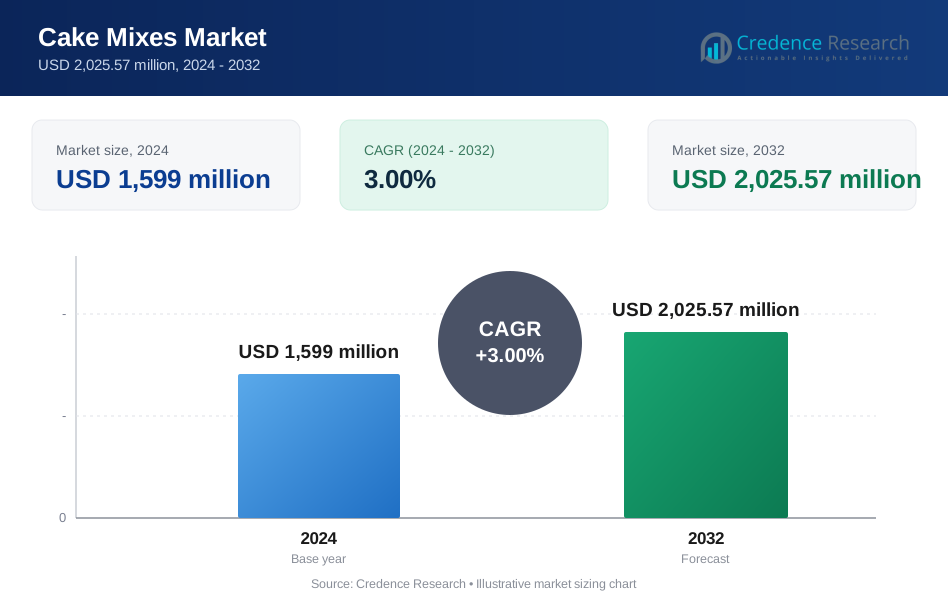
The global cake mixes market is projected to grow from USD 1,599 million in 2024 to USD 2,025.57 million by 2032, at a compound annual growth rate (CAGR) of 3%.
The cake mixes market is driven by the growing demand for convenient baking solutions, especially among consumers with busy lifestyles seeking time-saving options. The rising popularity of home baking, fueled by social media trends and the increasing inclination toward celebrating special occasions at home, has significantly boosted market growth. Additionally, the growing awareness of gluten-free, organic, and healthier alternatives is encouraging manufacturers to innovate and offer diverse product ranges to cater to health-conscious consumers. The introduction of premium and gourmet cake mixes with high-quality ingredients has also gained traction, appealing to those looking for indulgent yet convenient baking experiences. Moreover, advancements in packaging and longer shelf life are contributing to the increasing adoption of cake mixes in households. These factors, coupled with rising disposable incomes and expanding urbanization, are expected to further propel the market over the coming years.
The cake mixes market is geographically diverse, with North America leading in market share, accounting for 35% in 2024, driven by strong demand for convenient and health-conscious products. Europe follows, holding around 25%, with a focus on organic and premium options in countries like the UK, Germany, and France. The Asia-Pacific region, with a 20% share, is experiencing rapid growth due to increasing disposable incomes and urbanization in markets like China, India, and Japan. Latin America holds 12% of the market, supported by rising middle-class consumers, particularly in Brazil and Mexico. The Middle East and Africa account for 8%, with growth driven by urbanization and increased interest in home baking. Key players in the global market include General Mills, Archer Daniels Midland, and Associated British Foods, among others.
Market Insights
- The global cake mixes market is projected to grow from USD 1,599 million in 2024 to USD 2,025.57 million by 2032, at a CAGR of 3%.
- Growing demand for convenient baking solutions, particularly among busy consumers, is driving market growth.
- The rising popularity of home baking, influenced by social media trends and home celebrations, has significantly boosted the demand for cake mixes.
- Increasing consumer awareness of gluten-free, organic, and healthier alternatives is prompting manufacturers to offer more diverse product ranges.
- Premium and gourmet cake mixes with high-quality ingredients are gaining traction among consumers seeking indulgent yet convenient baking experiences.
- Advancements in packaging and extended shelf life are contributing to the wider adoption of cake mixes in households.
- Rising disposable incomes, expanding urbanization, and geographic diversity, with North America holding the largest market share at 35%, continue to propel market growth globally.
Market Drivers
Growing Demand for Convenience Foods
One of the key drivers of the cake mixes market is the increasing demand for convenient food options, particularly among consumers with hectic schedules. Cake mixes provide a quick and simple solution for those looking to bake at home without the need for advanced baking skills or extensive preparation. For instance, Pillsbury Baking launched a Creamy Cake Mix Line with Moist Supreme Creamy Almond and Vanilla Cake Mix flavors. The ease of use and time-saving attributes of cake mixes make them appealing to a wide range of consumers, from busy professionals to novice bakers. This growing demand for convenience foods is expected to drive consistent growth in the cake mixes market.
Rising Popularity of Home Baking
Home baking has become a widespread trend, particularly in recent years, as consumers seek to recreate bakery-quality products in the comfort of their own homes. The rise of social media platforms has also contributed to the popularity of home baking, with consumers sharing their creations and experimenting with new recipes. For instance, Mass retailers like Walmart, Target, and Amazon are increasing their stock of baking paper to meet the rising trend of home cooking. Cake mixes offer an accessible entry point into the world of baking, allowing consumers to enjoy the process without the complexity of starting from scratch. This trend is a significant driver of the cake mixes market.
Shift Toward Healthier Options
As health awareness continues to grow, consumers are increasingly seeking healthier alternatives in their baking products. This has led to a rise in demand for cake mixes that cater to dietary preferences, such as gluten-free, organic, and low-sugar options. Manufacturers are responding to this trend by innovating their product offerings to include healthier alternatives without compromising on taste or quality. The shift toward health-conscious baking solutions is a critical driver in the cake mixes market.
Premium and Gourmet Product Innovation
The demand for premium and gourmet cake mixes is also influencing the market. Consumers are showing interest in high-quality, indulgent baking experiences, with premium ingredients such as artisanal flours, natural flavorings, and organic ingredients. This trend toward premiumization is encouraging manufacturers to develop new, gourmet cake mixes that appeal to more discerning consumers. Additionally, eco-conscious consumers are seeking sustainable packaging and ethically sourced ingredients, pushing companies to prioritize both product quality and environmental responsibility, which further enhances the appeal of these premium offerings in the market.
Market Trends
Expansion of Health-Conscious Products
A significant trend in the cake mixes market is the increasing focus on health-conscious products. With consumers becoming more aware of their dietary needs, there is a growing demand for gluten-free, organic, and low-calorie cake mixes. Many manufacturers are responding to this shift by expanding their product portfolios to cater to those seeking healthier baking options. For instance, Bob's Red Mill offers gluten-free cake mixes, catering to consumers with gluten sensitivities and those seeking alternative baking options. This trend is expected to continue as more consumers prioritize health and wellness in their food choices.
Premiumization and Gourmet Offerings
Another prominent trend is the rise of premium and gourmet cake mixes. Consumers are increasingly looking for high-quality baking experiences that go beyond the standard offerings. Cake mixes made with artisanal ingredients, natural flavors, and organic products are gaining popularity, particularly among home bakers who want to recreate bakery-quality goods. This premiumization trend has led manufacturers to innovate and introduce gourmet options that provide both indulgence and convenience.
Customization and DIY Baking Kits
The trend toward customization in the baking industry is gaining momentum, with more consumers seeking personalized baking experiences. DIY baking kits that allow consumers to add their own creative touch to cakes are becoming more popular. These kits often come with customizable options such as toppings, fillings, and flavor enhancements, giving consumers the flexibility to create unique and personalized baked goods. This trend is driving interest in cake mixes that offer a balance of convenience and creativity.
Sustainability and Eco-Friendly Packaging
Sustainability is a growing concern among consumers, and the cake mixes market is responding by adopting eco-friendly packaging solutions. Manufacturers are increasingly focusing on reducing plastic use and implementing recyclable or biodegradable materials in their packaging. For instance, Puratos, a global provider of bakery, patisserie, and chocolate ingredients, is committed to switching to more sustainable packaging solutions, with the goal of 100% recycle-ready packaging. This trend aligns with consumers' growing preference for environmentally responsible products, further influencing purchasing decisions in the cake mixes market.
Market Challenges Analysis
Intense Competition and Price Sensitivity
One of the major challenges facing the cake mixes market is the high level of competition among manufacturers. With a growing number of brands entering the market, the competition has intensified, leading to price wars and an emphasis on cost-effective production. Established players are constantly pressured to innovate and maintain their market share while also offering products at competitive prices. This situation creates challenges for both new entrants and existing companies, as they need to find a balance between product quality and cost efficiency. Price sensitivity among consumers further adds to the challenge, as many customers seek affordable baking solutions, especially in price-conscious markets. For instance, Bob’s Red Mill has introduced a cake mix that contains a gluten-free flour blend and high-quality cocoa powder. It offers 150 calories and contains 1% fat, 7% dietary fiber, and 2g of protein per serving. Companies must strategically navigate this competitive environment by focusing on product differentiation, innovation, and marketing to stay relevant. Furthermore, the emergence of private-label brands offered by large retailers has added another layer of competition, intensifying the pressure on manufacturers to consistently deliver value while maintaining profit margins.
Rising Costs of Ingredients and Supply Chain Disruptions
Another significant challenge in the cake mixes market is the rising cost of raw ingredients, including flour, sugar, and natural flavorings. The increasing demand for premium and health-conscious ingredients such as organic products, gluten-free alternatives, and natural sweeteners further escalates production costs for manufacturers. As companies strive to meet consumer preferences for high-quality, healthier options, they must also contend with fluctuating ingredient prices, which can impact profitability. Moreover, global supply chain disruptions, exacerbated by factors such as the COVID-19 pandemic and geopolitical tensions, have further strained the market. Delays in the supply of ingredients, packaging materials, and transportation have contributed to increased operational costs and production delays, posing additional hurdles for manufacturers. These challenges require companies to adopt more efficient supply chain strategies and explore alternatives to mitigate rising costs and ensure consistent product availability. Additionally, manufacturers are now focusing on local sourcing and exploring sustainable alternatives to traditional ingredients, which can also help mitigate supply chain risks in the long term.
Market Opportunities
The cake mixes market presents significant growth opportunities, driven by the increasing demand for health-conscious and specialty products. As consumers become more aware of dietary needs and preferences, there is a growing opportunity for manufacturers to innovate and introduce cake mixes catering to specific dietary requirements, such as gluten-free, sugar-free, and organic options. The health and wellness trend is expected to continue gaining momentum, with consumers seeking out products that offer both convenience and nutritional benefits. Manufacturers that focus on developing high-quality, healthy alternatives without compromising on taste or texture can tap into this expanding market segment. Additionally, the growing popularity of plant-based ingredients provides further opportunities for brands to develop vegan or dairy-free cake mixes, appealing to a broader audience.
Another promising opportunity lies in the premium and gourmet segment. As consumers seek more indulgent experiences, there is potential for manufacturers to introduce premium cake mixes featuring high-quality ingredients like artisanal flours, natural sweeteners, and exotic flavors. The demand for premium, bakery-style products that offer convenience but also deliver a gourmet experience continues to rise, especially among home bakers and those looking to elevate their celebrations. Moreover, the increasing trend of at-home baking kits and personalized baking experiences offers brands the opportunity to create customizable cake mix products that allow consumers to add their own creative touches. By capitalizing on these emerging trends, companies in the cake mixes market can expand their reach and drive growth.
Market Segmentation Analysis:
By Type
The cake mixes market is segmented by type, with key categories including traditional cake mixes, gluten-free options, organic mixes, and premium or gourmet varieties. Traditional cake mixes continue to dominate the market due to their affordability and convenience, while gluten-free and organic options are gaining traction as health-conscious consumers seek dietary-specific products.
By Flavor
Flavor remains a crucial segment, with popular varieties such as vanilla, chocolate, and red velvet leading the market. However, there is a growing demand for unique and exotic flavors like lemon, caramel, and spice blends. Innovation in flavor profiles allows manufacturers to appeal to diverse consumer preferences and expand their market share.
By Distribution Channel
Distribution channels for cake mixes include supermarkets and hypermarkets, specialty stores, online retailers, and convenience stores. Supermarkets remain the primary channel due to their wide availability and consumer accessibility, but the online segment is growing rapidly as e-commerce continues to expand, offering convenience and a broader selection for consumers.
Segments:
Based on Type:
- Layer Cake
- Angel Food Cake
- Flourless or Low- Flour Cake
- Mug Cake
- Others
Based on Flavor:
- Vanilla
- Chocolate
- Fruits & Nuts
- Others
Based on Distribution Channel:
- Online
- Offline
Based on the Geography:
- North America
- U.S.
- Canada
- Mexico
- Europe
- Germany
- France
- U.K.
- Italy
- Spain
- Rest of Europe
- Asia Pacific
- China
- Japan
- India
- South Korea
- South-east Asia
- Rest of Asia Pacific
- Latin America
- Brazil
- Argentina
- Rest of Latin America
- Middle East & Africa
- GCC Countries
- South Africa
- Rest of the Middle East and Africa
Regional Analysis
North America
North America holds a significant share of the global cake mixes market, accounting for 35% of the total market in 2024. The region's strong preference for convenient and ready-to-use food products is a key factor driving market growth. The U.S. leads this segment, supported by the popularity of home baking, especially during festive seasons. Additionally, the growing demand for health-conscious and gluten-free cake mixes has encouraged manufacturers to introduce innovative products that cater to changing consumer preferences. Canada also plays a role in this market, with rising trends in organic and premium cake mixes. The region’s mature market and consumers' willingness to spend on premium, indulgent baking products are expected to sustain growth.
Europe
Europe is another major region in the cake mixes market, contributing 25% of the global market share in 2024. The region is characterized by a diverse and evolving baking culture, with both traditional and modern trends driving consumer demand. Countries such as the UK, Germany, and France are key players, with increasing demand for organic, vegan, and gluten-free cake mixes. The growing awareness of healthier baking alternatives, alongside the popularity of home-baking, is driving market expansion in Europe. Moreover, the region’s emphasis on premium products, with consumers willing to invest in gourmet cake mixes featuring high-quality ingredients, is contributing to the rise in sales. Manufacturers are also leveraging Europe’s rich culinary traditions by offering a wide range of flavors to cater to local tastes.
Asia-Pacific
The Asia-Pacific region is emerging as a high-growth market, with a market share of 20% in 2024. Rapid urbanization, increasing disposable incomes, and the growing popularity of Western-style baked goods are key factors fueling the demand for cake mixes in countries like China, India, and Japan. The rise in home-baking trends, especially post-pandemic, has further driven the adoption of convenient baking solutions like cake mixes. In addition, the younger population’s increasing interest in experimenting with baking and celebrating various occasions at home has accelerated market growth. The growing awareness of healthy alternatives, such as gluten-free and low-sugar options, also presents significant opportunities for manufacturers in the region.
Latin America
Latin America accounted for 12% of the global cake mixes market share in 2024. The region is witnessing steady growth, driven by the increasing popularity of ready-to-use baking products, especially in countries like Brazil, Mexico, and Argentina. The rising middle class and a growing inclination toward convenience products are key factors supporting market expansion. While traditional flavors such as vanilla and chocolate remain popular, there is increasing interest in healthier and premium options, such as organic and gluten-free cake mixes.
Middle East and Africa
The Middle East and Africa region held 8% of the market share in 2024. The demand for cake mixes in this region is largely driven by the expanding urban population and rising disposable incomes. The growing popularity of Western-style cakes and baked goods, along with an increasing interest in home baking, is driving market growth.
Key Player Analysis
- Pinnacle Food LLC
- The Hain Celestial Group, Inc.
- General Mills, Inc.
- Kerry Group Plc
- Cargill, Inc.
- Chelsea Milling Co.
- Associated British Foods Plc
- The Krusteaz Company
- Archer Daniels Midland Company
- Ingredion, Inc.
Competitive Analysis
The cake mixes market is highly competitive, with key players such as General Mills, Inc., Archer Daniels Midland Company, Associated British Foods Plc, Ingredion, Inc., Cargill, Inc., Pinnacle Food LLC, The Hain Celestial Group, Inc., Kerry Group Plc, The Krusteaz Company, and Chelsea Milling Co. dominating the industry. These companies leverage their established brand presence, extensive product portfolios, and strong distribution networks to maintain a competitive edge. Leading players focus on product innovation, introducing health-conscious, gluten-free, and organic cake mixes to cater to shifting consumer preferences. Additionally, premium and gourmet product lines are becoming a major focus for brands looking to capture the growing demand for indulgent, high-quality baking products. The competition is further intensified by the rise of private-label brands and smaller, specialized manufacturers entering the market, driving established players to continuously differentiate their offerings through marketing, product development, and expansion into new geographic regions.
Recent Developments
- In November 2023, General Mills, Inc. initiated the construction of a USD12 million baking plant in Nashik, Maharashtra. This facility will be dedicated to producing Pillsbury baking mixes for the Indian market and is expected to become operational by August 2024. It will be General Mills' second Pillsbury plant in India, doubling its production capacity. Anand Khurana, Country Director for General Mills India, noted the rapid growth of India's bakery industry, with cake cutting becoming integral to various celebrations beyond birthdays.
- In April 2023, Continental Mills, Inc. expanded its Krusteaz product line by introducing four new baking and waffle mixes, including Gluten-Free Vanilla Muffin Mix, Vanilla Pound Cake Mix, Churro Belgian Waffle Mix, and Gluten-Free Meyer Lemon Bar Mix.
- In February 2024, Ann Clark, a leading manufacturer of baking supplies, launched a new range of gourmet cake mixes and frosting kits. These high-quality mixes, made with ingredients such as malted barley flour and Dutch-process cocoa, deliver bakery-level results with ease, requiring only vegetable oil, eggs, and milk. CEO Ben Clark highlighted their commitment to offering gourmet cake mixes that balance convenience and exceptional taste.
- In 2024, Pillsbury Baking introduced two new product lines. The Creamy Cake Mix Line includes two flavors: Moist Supreme Creamy Almond Cake Mix and Moist Supreme Creamy Vanilla Cake Mix. These indulgent options are perfect for special occasions or everyday treats.
- In 2024, Dawn Foods, a global bakery manufacturer and distributor, launched two new products: the Dawn Yogurt Cake Mix and the Dawn Exceptional Yuzu Compound. These launches are part of their Total Cake Solutions concept, which provides bakers with innovative recipes, cake consumption insights, and strategies for increasing sales.
- In 2023, Renewal Mill introduced a new gluten-free vanilla cake mix in partnership with Perfect Day. They are using Perfect Day’s "Protein Pre-Blend Bakery Egg Replacer," a plant-based whey protein that mimics the functionality of eggs in baking.
Market Concentration & Characteristics
The cake mixes market is moderately concentrated, with a few key players dominating a significant portion of the global market. Companies like General Mills, Archer Daniels Midland, and Associated British Foods hold a strong market presence due to their established brands, extensive product portfolios, and wide distribution networks. These players benefit from economies of scale, allowing them to maintain competitive pricing and invest in innovation. However, the market is also characterized by the presence of smaller regional and private-label brands, which are gaining traction by offering niche, specialized products, such as gluten-free, organic, and premium cake mixes. The market's competitive landscape is influenced by continuous innovation, as manufacturers strive to differentiate themselves by catering to changing consumer preferences for healthier, convenient, and premium baking options. Despite growing competition, established companies continue to focus on product diversification and marketing strategies to retain market share and adapt to evolving trends.
Report Coverage
The research report offers an in-depth analysis based on Type, Flavour, Distribution Channel and Geography. It details leading market players, providing an overview of their business, product offerings, investments, revenue streams, and key applications. Additionally, the report includes insights into the competitive environment, SWOT analysis, current market trends, as well as the primary drivers and constraints. Furthermore, it discusses various factors that have driven market expansion in recent years. The report also explores market dynamics, regulatory scenarios, and technological advancements that are shaping the industry. It assesses the impact of external factors and global economic changes on market growth. Lastly, it provides strategic recommendations for new entrants and established companies to navigate the complexities of the market.
Future Outlook
- The cake mixes market is expected to witness steady growth driven by the increasing demand for convenient baking solutions.
- Consumer preference for healthier options, including gluten-free, organic, and low-sugar cake mixes, will continue to rise.
- Premium and gourmet cake mixes with high-quality ingredients will gain more popularity among discerning consumers.
- Innovation in product offerings and new flavors will be a key strategy for manufacturers to attract a wider consumer base.
- Growing urbanization and higher disposable incomes in emerging markets will drive demand for cake mixes.
- The increasing influence of social media trends will further fuel the home baking movement.
- Longer shelf life and improved packaging solutions will enhance product appeal and convenience for consumers.
- Private-label brands will increasingly challenge established players by offering cost-effective and specialized products.
- Expansion into online retail channels will play a crucial role in reaching tech-savvy and home-bound consumers.
- Sustainable ingredient sourcing and eco-friendly packaging are likely to become more important for brands in the market.
Request a Free Sample
Fill in your details and we'll send you a free sample report.
- Sample data tables & charts
- Research methodology
Market Dynamics
Growing Demand for Convenience Foods
Consumers with busy lifestyles are increasingly seeking quick and easy baking solutions, making cake mixes an attractive option due to their simplicity and time-saving benefits. This trend is expanding the consumer base for cake mixes, from novice bakers to professionals looking for efficiency.
Rising Popularity of Home Baking
The surge in home baking, fueled by social media trends and the desire to celebrate special occasions at home, has significantly increased the demand for cake mixes. Consumers are drawn to the ability to create bakery-quality cakes at home with minimal effort.
Shift Toward Healthier Options
Increasing health awareness is driving demand for gluten-free, organic, and low-sugar cake mixes. Manufacturers are innovating to offer healthier alternatives, attracting health-conscious consumers and expanding the market beyond traditional offerings.
Premium and Gourmet Product Innovation
There is a growing appetite for premium and gourmet cake mixes featuring high-quality, artisanal ingredients. This premiumization trend appeals to consumers seeking indulgent yet convenient baking experiences, encouraging manufacturers to diversify their product lines.
Advancements in Packaging and Shelf Life
Improvements in packaging technology and extended shelf life are making cake mixes more appealing and accessible to a wider audience. These advancements enhance product convenience and reduce waste, supporting broader market adoption.
Need a Custom Version of This Report?
Tailor the scope, geography, or segments to your exact requirements.
- Custom geography or segment scope
- Direct access to our analyst team
Frequently Asked Questions
What is the current size of the Cake Mixes Market?
What factors are driving the growth of the Cake Mixes Market?
What are some challenges faced by the Cake Mixes Market?
Who are the major players in the Cake Mixes Market?
Table of Content
Chapter 1 Market Segmentation
- 1.1 Segmentation Framework
- 1.1.1 Product and Service Classification
- 1.1.2 Application and End-Use Classification
- 1.1.3 Technology and Solution Classification
- 1.1.4 Customer and Distribution Channel Classification
- 1.1.5 Geographic Segmentation
- 1.1.6 Market Segment Definitions and Boundaries
- 1.2 By Type
- 1.2.1 Layer Cake
- 1.2.2 Angel Food Cake
- 1.2.3 Flourless or Low-Flour Cake
- 1.2.4 Mug Cake
- 1.2.5 Others
- 1.3 By Flavor
- 1.3.1 Vanilla
- 1.3.2 Chocolate
- 1.3.3 Fruits & Nuts
- 1.3.4 Others
Chapter 2 Introduction
- 2.1 Report Objectives and Scope
- 2.2 Product Definition and Industry Terminology
- 2.3 Market Inclusions and Exclusions
- 2.4 Research Process
- 2.4.1 Primary Research and Expert Interviews
- 2.4.2 Secondary Research and Source Review
- 2.4.3 Top-Down and Bottom-Up Estimation
- 2.4.4 Data Triangulation and Verification
- 2.5 Market Size Measurement Basis
- 2.5.1 2024: USD 1,599 million → 2032: USD 2,025.57 million
- 2.6 Historical and Forecast Reference Periods
- 2.6.1 Base Year: 2024
- 2.6.2 Forecast Period: 2024-2032
- 2.7 Research Assumptions and Limitations
Chapter 3 Executive Summary
- 3.1 Market Snapshot and Key Findings
- 3.2 Base-Year Market Size, 2024
- 3.3 Forecast Market Size, 2032
- 3.4 Revenue and Volume Growth Outlook
- 3.5 Key Demand and Supply Indicators
- 3.6 Leading Market Segments
- 3.7 Fastest-Growing Market Opportunities
- 3.8 Regional Performance Highlights
- 3.9 Technology and Industry Transformation
- 3.10 Competitive Landscape Summary
- 3.11 Analyst View and Strategic Implications
Chapter 4 Global Cake Mixes Market Trends and Developments
- 4.1 Historical Industry Development
- 4.2 Recent Market Trends and Developments
- 4.3 Demand and Customer Behavior Trends
- 4.4 Technology and Product Innovation
- 4.5 Artificial Intelligence, Automation and Digitalization
- 4.6 Local Manufacturing and Supply Chain Realignment
- 4.7 Industry Partnerships, Mergers and Acquisitions
- 4.8 Sustainability and Circular Economy Developments
- 4.9 Government and Private Sector Investment Trends
- 4.10 Emerging Business Models and Commercialization
- 4.11 Industry Developments and Announcements
Chapter 5 Global Cake Mixes Market Production, Supply and Demand Analysis
- 5.1 Demand Trend and Consumption Analysis
- 5.2 Demand Forecast, 2024-2032
- 5.3 Production and Output Trend
- 5.4 Production and Output Forecast, 2024-2032
- 5.5 Installed Capacity and Capacity Utilization
- 5.6 Company-Wise Production Plants and Statistics
- 5.6.1 Installed Production Capacity
- 5.6.2 Actual Production
- 5.6.3 Planned Capacity and Expansion Targets
- 5.7 Supply Chain Structure and Procurement Trends
- 5.8 Supply-Demand Gap and Bottlenecks
- 5.9 Import Dependence and Sourcing Structure
- 5.10 Contract Manufacturing and Outsourcing
- 5.11 Regional Supply and Demand Concentration
Chapter 6 Global Cake Mixes Market Pricing Analysis
- 6.1 Pricing Structure and Measurement
- 6.2 Historical Pricing Trends
- 6.3 Pricing Outlook, 2024-2032
- 6.4 Average Selling Price and Unit Economics
- 6.5 Pricing by Product and Market Segment
- 6.6 Geographic Pricing Differences
- 6.7 Key Input, Energy, Labor and Logistics Costs
- 6.8 Contract Pricing and Purchasing Models
- 6.9 Pricing Sensitivity and Competitive Positioning
- 6.10 Price, Margin and Profitability Implications
Chapter 7 Global Cake Mixes Market Dynamics
- 7.1 Market Growth Drivers
- 7.1.1 Demand-Side Drivers
- 7.1.2 Technology and Innovation Drivers
- 7.1.3 Infrastructure and Investment Drivers
- 7.1.4 Regulatory and Policy Drivers
- 7.2 Market Restraints
- 7.2.1 Cost and Affordability Constraints
- 7.2.2 Technology and Adoption Barriers
- 7.2.3 Supply Chain and Operational Constraints
- 7.3 Market Challenges
- 7.3.1 Competitive Pressure and Margin Erosion
- 7.3.2 Skills, Infrastructure and Implementation Gaps
- 7.4 Emerging Market Opportunities
- 7.5 Market Dynamics Impact and Time-Horizon Assessment
Chapter 8 Global Cake Mixes Value Chain Analysis
- 8.1 Industry Value Chain Overview
- 8.2 Upstream Suppliers and Critical Inputs
- 8.3 Technology and Component Providers
- 8.4 Manufacturing or Service Delivery
- 8.5 Distribution, Channel Partners and Integrators
- 8.6 Downstream Applications and End Users
- 8.7 Value Addition and Profit Pools
- 8.8 Vertical Integration and Outsourcing
- 8.9 Supplier Concentration and Risk
- 8.10 Supply Chain Localization and Resilience
Chapter 9 Global Cake Mixes Market Regulations and Policies
- 9.1 Relevant Laws, Standards and Compliance Frameworks
- 9.2 Product, Service, Safety and Quality Requirements
- 9.3 Government Policies, Incentives and Subsidies
- 9.4 Imports, Exports and Trade Barriers
- 9.5 Public Procurement and Local Content Requirements
- 9.6 Environmental and Sustainability Compliance
- 9.7 Upcoming Policy Changes and Market Implications
Chapter 10 Global Cake Mixes Market Hotspots and Opportunities
- 10.1 Market Opportunity Mapping and Growth Hotspots
- 10.2 High-Growth Applications and Customer Groups
- 10.3 Underserved Markets and White-Space Opportunities
- 10.4 Emerging Technology and Product Opportunities
- 10.5 New Capacity and Investment Hotspots
- 10.6 Market Entry and Expansion Opportunities
- 10.7 Distribution and Partnership Opportunities
- 10.8 Near-Term and Long-Term Commercial Potential
- 10.9 Opportunity Attractiveness and Execution Risks
Chapter 11 Global Cake Mixes Market Outlook, 2024-2032
- 11.1 Market Size and Analysis
- 11.1.1 Revenue (Market Measurement: 2024: USD 1,599 million → 2032: USD 2,025.57 million)
- 11.1.2 Market Volume and Quantity Sold
- 11.1.3 Historical Market Size
- 11.1.4 Base-Year Market Size, 2024
- 11.2 Market Forecast, 2024-2032
- 11.2.1 Revenue Forecast to 2032
- 11.2.2 Volume Forecast to 2032
- 11.2.3 CAGR and Year-on-Year Growth
- 11.2.4 Incremental Revenue Opportunity
- 11.3 Forecast Assumptions and Scenario Analysis
- 11.3.1 Base-Case Forecast
- 11.3.2 Optimistic and Conservative Scenarios
- 11.3.3 Technology, Pricing and Policy Sensitivities
- 11.4 Market Attractiveness and Growth Outlook
Chapter 12 Global Cake Mixes Market Segmentation and Outlook
- 12.1 Segmentation Summary and Market Shares, 2024
- 12.2 Largest and Fastest-Growing Segments
- 12.3 By Type - Market Size and Forecast, 2024-2032
- 12.3.1 Segment Definition and Scope
- 12.3.2 Historical Market Size
- 12.3.3 Revenue Forecast, 2024-2032
- 12.3.4 Volume Forecast, 2024-2032
- 12.3.5 Base-Year Market Share, 2024
- 12.3.6 Segment CAGR and Growth Drivers
- 12.3.7 Subsegment Market Size and Forecast
- 12.3.7.1 Layer Cake
- 12.3.7.2 Angel Food Cake
- 12.3.7.3 Flourless or Low-Flour Cake
- 12.3.7.4 Mug Cake
- 12.3.7.5 Others
- 12.3.8 Subsegment Pricing and Adoption Trends
- 12.3.9 Leading Suppliers and Competition
- 12.3.10 Regional Demand and Opportunities
- 12.4 By Flavor - Market Size and Forecast, 2024-2032
- 12.4.1 Segment Definition and Scope
- 12.4.2 Historical Market Size
- 12.4.3 Revenue Forecast, 2024-2032
- 12.4.4 Volume Forecast, 2024-2032
- 12.4.5 Base-Year Market Share, 2024
- 12.4.6 Segment CAGR and Growth Drivers
- 12.4.7 Subsegment Market Size and Forecast
- 12.4.7.1 Vanilla
- 12.4.7.2 Chocolate
- 12.4.7.3 Fruits & Nuts
- 12.4.7.4 Others
- 12.4.8 Subsegment Pricing and Adoption Trends
- 12.4.9 Leading Suppliers and Competition
- 12.4.10 Regional Demand and Opportunities
- 12.5 Segment Growth Comparison
- 12.6 Segment Attractiveness and Priority Matrix
Chapter 13 Global Cake Mixes Geographic Market Outlook, 2024-2032
- 13.1 Regional Market Size and Share, 2024
- 13.2 Regional Market Forecast, 2024-2032
- 13.3 Regional Pricing, Production and Demand Differences
- 13.4 North America
- 13.4.1 United States
- 13.4.2 Canada
- 13.4.3 Mexico
- 13.5 Europe
- 13.5.1 Germany
- 13.5.2 France
- 13.5.3 Italy
- 13.5.4 United Kingdom
- 13.5.5 Spain
- 13.5.6 Poland
- 13.5.7 Russia
- 13.5.8 Netherlands
- 13.5.9 Belgium
- 13.5.10 Sweden
- 13.5.11 Denmark
- 13.5.12 Norway
- 13.5.13 Rest of Europe
- 13.6 Asia Pacific
- 13.6.1 China
- 13.6.2 India
- 13.6.3 Japan
- 13.6.4 South Korea
- 13.6.5 Thailand
- 13.6.6 Indonesia
- 13.6.7 Vietnam
- 13.6.8 Malaysia
- 13.6.9 Australia
- 13.6.10 Rest of Asia Pacific
- 13.7 Latin America
- 13.7.1 Brazil
- 13.7.2 Argentina
- 13.7.3 Colombia
- 13.7.4 Chile
- 13.7.5 Rest of Latin America
- 13.8 Middle East
- 13.8.1 Saudi Arabia
- 13.8.2 United Arab Emirates
- 13.8.3 Turkey
- 13.8.4 Israel
- 13.8.5 Iran
- 13.8.6 Rest of the Middle East
- 13.9 Africa
- 13.9.1 South Africa
- 13.9.2 Egypt
- 13.9.3 Nigeria
- 13.9.4 Morocco
- 13.9.5 Rest of Africa
- 13.10 Regional Investment, Policy and Supply Chain Differences
- 13.11 Regional Competitive Landscape
- 13.12 Geographic Growth Hotspots
Chapter 14 Global Cake Mixes Technology, Innovation and Sustainability Outlook
- 14.1 Technology Landscape and Maturity
- 14.2 Product, Process and Service Innovation
- 14.3 AI, Automation and Digital Tools in the Industry
- 14.4 Technology Adoption and Performance Benchmarking
- 14.5 Innovation Pipeline and R&D Investment
- 14.6 Patent and Intellectual Property Trends
- 14.7 Energy Efficiency and Resource Management
- 14.8 Sustainability, Recycling and Circularity
- 14.9 Technology Roadmap, 2024-2032
- 14.10 Risks of Obsolescence and Technology Substitution
Chapter 15 Global Cake Mixes Market Key Strategic Imperatives
- 15.1 Growth and Market Entry Priorities
- 15.2 High-Return Products and Segments
- 15.3 Pricing, Profitability and Cost Optimization
- 15.4 Technology Investment and Product Differentiation
- 15.5 Supply Chain Localization and Resilience
- 15.6 Distribution and Customer Acquisition
- 15.7 Partnership, Acquisition and Capacity Strategy
- 15.8 Regional Expansion Priorities
- 15.9 Short-, Medium- and Long-Term Actions
Chapter 16 Competition Outlook
- 16.1 Industry Competition Characteristics
- 16.2 Market Structure and Concentration
- 16.3 Market Share and Competitive Positioning, 2024
- 16.4 Company-Wise Revenue and Product Benchmarking
- 16.5 Production and Service Capacity Benchmarking
- 16.6 Technology, Pricing and Differentiation
- 16.7 Regional Footprint and Distribution Strength
- 16.8 Mergers, Acquisitions and Strategic Alliances
- 16.9 New Entrants and Competitive Threats
- 16.10 Porter's Five Forces and Industry Attractiveness
- 16.11 Competitive Outlook, 2024-2032
Chapter 17 Company Profiles
- 17.1 Company Coverage and Selection Criteria
- 17.2 General Mills, Inc.
- 17.2.1 Business Description
- 17.2.2 Company Ownership and Geographic Presence
- 17.2.3 Product and Service Portfolio
- 17.2.4 Manufacturing and Operating Footprint
- 17.2.5 Production Capacity and Expansion Plans
- 17.2.6 Financial Performance and Investment
- 17.2.7 Market Share and Competitive Position
- 17.2.8 Technology and Innovation Capabilities
- 17.2.9 Strategic Alliances or Partnerships
- 17.2.10 Recent Developments
- 17.2.11 Growth Strategy and Outlook
- 17.3 Archer Daniels Midland Company
- 17.4 Associated British Foods Plc
- 17.5 Ingredion, Inc.
- 17.6 Cargill, Inc.
- 17.7 Pinnacle Food LLC
- 17.8 The Hain Celestial Group, Inc.
- 17.9 Kerry Group Plc
- 17.10 The Krusteaz Company
- 17.11 Chelsea Milling Co.
- 17.12 Other Relevant Market Participants
Note: Every listed company is profiled on the structure shown under the first company. The company list is preliminary and may change based on research findings, market developments, data availability and client requirements.
Chapter 18 Disclaimer
- 18.1 Research and Forecast Disclaimer
- 18.2 Data Source and Estimation Limitations
Note: The depth of individual sections depends on data availability for this market. Volume, capacity, trade and other unit-based metrics are included where applicable.