
| REPORT ATTRIBUTE | DETAILS |
|---|---|
| Historical Period | 2020-2023 |
| Base Year | 2024 |
| Forecast Period | 2025-2032 |
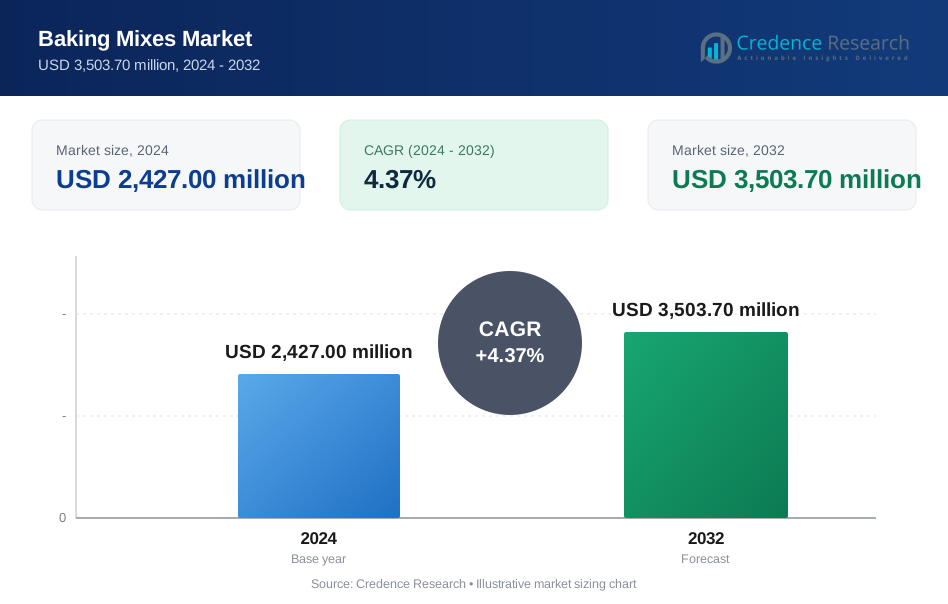
| Baking Mixes Market Size 2024 | USD 2,427.00 million |
| Baking Mixes Market, CAGR | 4.37% |
| Baking Mixes Market Size 2032 | USD 3,503.70 million |
Market Overview
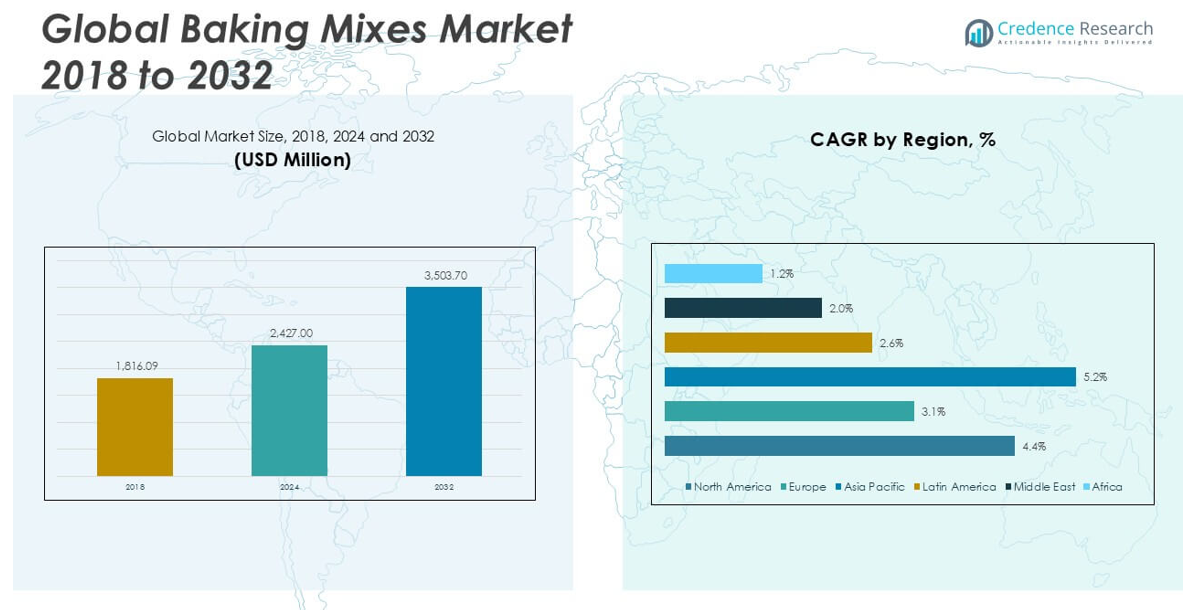
The Baking Mixes market size was valued at USD 1,816.09 million in 2018, increased to USD 2,427.00 million in 2024, and is anticipated to reach USD 3,503.70 million by 2032, at a CAGR of 4.37% during the forecast period.
The Baking Mixes market is led by key players such as Nestlé, Associated British Foods plc, Lesaffre, and AAK AB, which dominate through extensive product portfolios, strong brand equity, and global distribution networks. These companies focus on innovation, offering health-oriented, clean-label, and convenience-driven baking solutions to meet evolving consumer demands. Regional players like Pondan, Swiss Bake Ingredients Pvt. Ltd., and Manildra Group also contribute significantly to market diversity with localized product offerings. Asia Pacific emerged as the leading region in 2024, accounting for 42.7% of the global market share, driven by rising urbanization, disposable incomes, and growing adoption of Western dietary habits. North America followed, holding 31.2% of the market, supported by a strong home-baking culture and well-developed retail infrastructure.
Market Insights
- The Baking Mixes market was valued at USD 2,427.00 million in 2024 and is projected to reach USD 3,503.70 million by 2032, growing at a CAGR of 4.37% during the forecast period.
- Rising demand for convenience foods and time-saving baking solutions is driving market growth, especially among working consumers and urban households.
- Trends such as the growing popularity of home baking, clean-label ingredients, and health-focused mixes like gluten-free and low-sugar variants are shaping product development.
- The market is moderately fragmented, with major players like Nestlé, Associated British Foods plc, and Lesaffre competing alongside regional brands; innovation and e-commerce expansion remain key strategies.
- Asia Pacific held the largest regional share with 42.7% in 2024, followed by North America at 31.2%; by product, cake mixes dominated the segment with over 25% share, while retail stores remained the leading distribution channel with around 60% market share.
Market Segmentation Analysis:
By Product Type:
The cake mixes segment held the largest market share in the Baking Mixes market in 2024, accounting for over 25% of total revenue. This dominance is driven by growing consumer demand for convenient, time-saving dessert options and the increasing popularity of home baking. Cake mixes offer consistency, ease of use, and a wide variety of flavors, appealing to both occasional and frequent bakers. Additionally, product innovations such as gluten-free and low-sugar options have broadened consumer appeal, further strengthening this segment’s market position amid rising health-consciousness.
- For instance, Betty Crocker, a brand by General Mills, reported that its gluten-free cake mixes accounted for over 1.6 million unit sales in North America in 2023, reflecting strong traction within health-conscious and gluten-sensitive consumer groups.
By Application
Among applications, the cakes and pastries segment emerged as the dominant category, representing around 30% of the Baking Mixes market share. This growth is fueled by rising consumption of sweet bakery items across households, cafés, and quick-service restaurants. Consumers are increasingly turning to ready-to-use mixes to recreate patisserie-style desserts at home, boosting demand. The proliferation of baking shows and social media trends has also contributed to increased interest in home baking, particularly cakes and pastries, further supporting the expansion of this application segment.
- For instance, Dr. Oetker reported a 48% increase in sales of its ready-to-bake pastry mixes across Europe from 2021 to 2023, largely attributed to the popularity of its marble cake and lemon sponge variants promoted through influencer campaigns.
By Distribution Channel
Retail stores remained the leading distribution channel in 2024, capturing approximately 60% of the market. Supermarkets, hypermarkets, and specialty food stores continue to attract a wide customer base due to their accessibility and extensive product variety. Consumer preference for in-store shopping allows for better product comparisons and spontaneous purchases. However, the growth of private-label baking mix brands and strategic in-store promotions are also instrumental in maintaining this channel’s dominance. Meanwhile, online channels are gaining momentum due to convenience and expanding e-commerce infrastructure.
Market Overview
Rising Demand for Convenience and Time-Saving Products
The modern consumer lifestyle is increasingly fast-paced, creating strong demand for convenient and quick meal preparation options. Baking mixes offer a practical solution for individuals with limited time or culinary expertise, enabling them to prepare fresh baked goods with minimal effort. This has significantly boosted their popularity across households, especially in urban areas. The appeal of consistent results, ease of storage, and longer shelf life further reinforces their value proposition, driving the growth of the baking mixes market across various regions.
- For instance, Pillsbury's refrigerated and shelf-stable baking mixes sold over 3.2 million packs in the U.S. in 2023 alone, reflecting strong appeal among consumers seeking convenient baking formats.
Expansion of Home Baking Culture
The rising trend of home baking, fueled by social media, cooking shows, and pandemic-induced lifestyle changes, has contributed significantly to market growth. Consumers are now more inclined to bake at home for leisure, gifting, or healthier alternatives to store-bought items. Baking mixes serve as a reliable base, allowing consumers to experiment with flavors and customization while reducing preparation complexity. This shift in consumer behavior has opened new avenues for manufacturers to offer premium, artisanal, and specialty mixes catering to diverse tastes.
- For instance, Lesaffre’s “Livendo” sourdough baking range saw adoption by more than 700 artisanal bakeries across Europe and Asia between 2022 and 2024, responding to rising demand for authentic home-style baking experiences.
Product Innovations and Health-Oriented Offerings
Growing health awareness has led to the development of baking mixes that cater to specific dietary preferences, such as gluten-free, organic, low-carb, and plant-based options. Manufacturers are actively investing in R&D to improve nutritional profiles while maintaining taste and texture. These innovations help tap into health-conscious demographics and individuals with dietary restrictions. Additionally, the inclusion of natural ingredients and clean-label claims is gaining traction, helping brands differentiate themselves in a competitive landscape and expand their consumer base.
Key Trends & Opportunities
E-Commerce Growth and Direct-to-Consumer Channels
The expansion of e-commerce platforms and direct-to-consumer (DTC) strategies has reshaped how baking mixes reach customers. Online shopping offers greater product accessibility, especially in tier-2 and tier-3 cities, while allowing brands to collect consumer insights and personalize offerings. Subscription models, social media-driven marketing, and influencer collaborations are helping niche and emerging brands gain visibility. This digital transformation presents a significant opportunity for market penetration and long-term consumer engagement, particularly among younger and tech-savvy audiences.
- For instance, Thrive Market, a U.S.-based e-commerce platform, recorded over 140,000 baking mix product deliveries in 2023, with a 22% customer retention rate for its monthly baking kits subscription service.
Premiumization and Flavor Customization Trends
Consumers are increasingly seeking premium experiences and unique flavors in baked goods. This has driven demand for artisanal, gourmet, and limited-edition baking mixes with ingredients like exotic spices, organic chocolate, and ancient grains. Brands that offer customizable options or value-added ingredients such as inclusions, frostings, or flavor kits are gaining competitive advantages. The shift towards indulgent yet healthier treats provides ample space for innovation and premium product positioning, supporting higher margins and brand differentiation.
- For instance, Bob’s Red Mill introduced a limited-edition almond flour brownie mix in 2023 that sold out its 50,000-unit production run in under 6 weeks, driven by strong demand for premium, low-carb baking options.
Key Challenges
Price Sensitivity and Competitive Market Landscape
The baking mixes market is highly competitive, with both global and local players offering a wide range of products at varying price points. While premium offerings are gaining popularity, a significant portion of consumers remains price-sensitive, especially in emerging markets. This often forces manufacturers to strike a balance between quality and cost, which can limit product innovation and differentiation. Intense competition also results in pricing pressures and lower profit margins for smaller or new entrants.
Supply Chain Disruptions and Raw Material Volatility
Fluctuations in the prices of key ingredients like wheat, sugar, and dairy, along with global supply chain disruptions, pose a challenge for manufacturers. Dependency on seasonal crops and geopolitical factors can lead to inconsistent supply and increased production costs. Additionally, disruptions in packaging material availability or logistics delays can impact timely product delivery and shelf availability. These factors create uncertainties in planning and can negatively affect profitability and market stability.
Health Concerns Over Additives and Preservatives
Despite growing demand for baking mixes, health-conscious consumers are increasingly scrutinizing product labels for artificial additives, preservatives, and excessive sugar content. Products perceived as unhealthy may face resistance, especially among parents and wellness-focused buyers. This challenge puts pressure on manufacturers to reformulate their mixes without compromising taste or shelf life. Compliance with clean-label trends and regulatory requirements adds to production complexities, especially for mass-market products.
Regional Analysis
North America
North America accounted for the second-largest share in the global Baking Mixes market, valued at USD 574.30 million in 2018 and reaching USD 756.48 million in 2024. It is projected to grow to USD 1,096.29 million by 2032, expanding at a CAGR of 4.4%. In 2024, the region held approximately 31.2% of the global market. Growth is driven by high consumer demand for convenient baking solutions, the popularity of home baking trends, and strong retail infrastructure. The presence of established brands and innovation in gluten-free and organic mixes further supports sustained market expansion.
Europe
Europe’s Baking Mixes market stood at USD 342.04 million in 2018 and grew to USD 432.28 million in 2024, with projections to reach USD 567.99 million by 2032, at a CAGR of 3.1%. In 2024, it contributed around 17.8% to the global market. The region's growth is supported by a well-established bakery culture, demand for premium and specialty mixes, and growing health awareness driving gluten-free and vegan product lines. However, market expansion is relatively moderate due to high saturation in Western Europe and shifting consumer preferences toward freshly baked or artisanal alternatives.
Asia Pacific
Asia Pacific led the global Baking Mixes market with a value of USD 746.83 million in 2018, rising to USD 1,037.22 million in 2024 and expected to reach USD 1,594.20 million by 2032, expanding at the fastest CAGR of 5.2%. In 2024, it held a dominant 42.7% market share. Rising disposable incomes, urbanization, and growing Western influence on eating habits are major growth drivers. The expanding middle-class population and increasing availability of ready-to-use baking products through modern retail and e-commerce further support market momentum in countries like China, India, and Southeast Asian nations.
Latin America
The Latin American Baking Mixes market was valued at USD 78.52 million in 2018, reaching USD 103.50 million in 2024, and is forecasted to grow to USD 130.64 million by 2032, at a CAGR of 2.6%. The region held a 4.3% share of the global market in 2024. Growth is supported by increased demand for affordable, time-saving meal preparation products in urban areas. Local bakeries and foodservice outlets are also adopting baking mixes for consistency and efficiency. However, economic constraints and low consumer awareness in rural areas hinder broader market penetration.
Middle East
The Middle East Baking Mixes market expanded from USD 47.84 million in 2018 to USD 58.09 million in 2024, and is projected to reach USD 69.84 million by 2032, growing at a CAGR of 2.0%. In 2024, the region accounted for approximately 2.4% of the global market. Market growth is driven by the increasing influence of Western dietary habits and the growth of the hospitality sector. Demand for premium bakery products and convenient mixes is rising, particularly in the Gulf countries. Nonetheless, slower adoption in traditional households limits the region’s overall growth pace.
Africa
Africa’s Baking Mixes market was valued at USD 26.56 million in 2018, increased to USD 39.43 million in 2024, and is anticipated to reach USD 44.73 million by 2032, growing at a CAGR of 1.2%. The region held the smallest market share of 1.6% in 2024. Market growth remains limited due to infrastructural challenges, low disposable income, and limited retail access in rural areas. However, urbanization, rising youth population, and growing awareness of packaged food products are slowly creating opportunities for market players to expand through affordable product ranges and localized marketing efforts.
Market Segmentations:
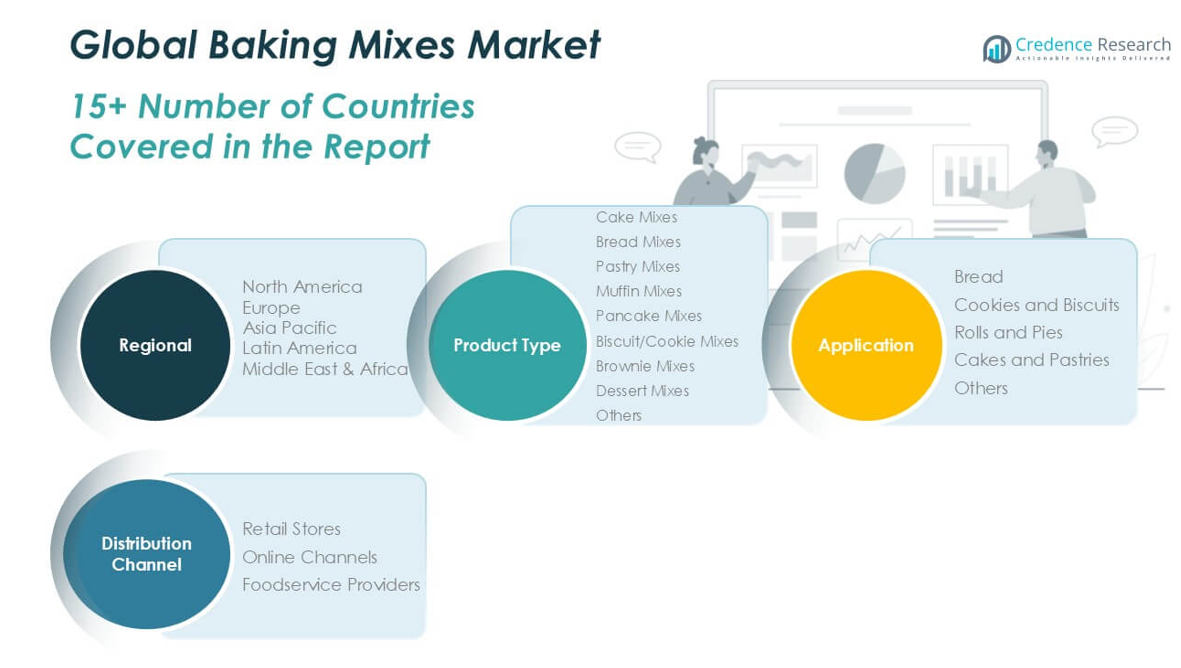
By Product Type
- Cake Mixes
- Bread Mixes
- Pastry Mixes
- Muffin Mixes
- Pancake Mixes
- Biscuit/Cookie Mixes
- Brownie Mixes
- Dessert Mixes
- Others
By Application
- Bread
- Cookies and Biscuits
- Rolls and Pies
- Cakes and Pastries
- Others
By Distribution Channel
- Retail Stores
- Online Channels
- Foodservice Providers
By Geography:
- North America
- U.S.
- Canada
- Mexico
- Europe
- Germany
- France
- U.K.
- Italy
- Spain
- Rest of Europe
- Asia Pacific
- China
- Japan
- India
- South Korea
- South-east Asia
- Rest of Asia Pacific
- Latin America
- Brazil
- Argentina
- Rest of Latin America
- Middle East & Africa
- GCC Countries
- South Africa
- Rest of the Middle East and Africa
Competitive Landscape
The Baking Mixes market features a moderately fragmented competitive landscape, with a mix of global giants and regional players competing on product variety, pricing, and brand recognition. Leading companies such as Nestlé, Associated British Foods plc, and Lesaffre continue to dominate through extensive distribution networks, strong R&D capabilities, and diversified product portfolios. These players actively invest in innovation, introducing health-oriented and clean-label baking solutions to cater to evolving consumer preferences. Emerging brands and regional manufacturers are also gaining traction by offering niche products, including organic, gluten-free, and locally inspired mixes. Private label offerings by large retail chains have intensified competition by providing cost-effective alternatives. The market has witnessed strategic initiatives such as mergers, acquisitions, and product launches aimed at expanding global footprints and tapping into new consumer segments. Digital engagement, especially through e-commerce platforms and social media, plays a growing role in enhancing visibility and brand loyalty across all tiers of competition.
Key Player Analysis
- Nestlé
- Lesaffre
- Synova
- KCG Corporation Public Company Limited
- Pondan
- Manildra Group
- K. Ingredients (M) Sdn. Bhd.
- Midas Foods International
- Heliofood
- Swiss Bake Ingredients Pvt. Ltd.
- AAK AB
- Associated British Foods plc
Recent Developments
- In June 2025, Nestlé Toll House launched two new cookie dough products: Peanut Butter Chocolate Chip Cookie Dough and the Everyday Sugar Cookie Dough Tub. The latter, previously a seasonal item, is now a permanent offering, reflecting a trend toward nostalgic flavors and convenient, ready-to-bake solutions.
- In March 2024, Pillsbury Company, a U.S.-based company owned by General Mills, launched two new product lines, including stuffed cookie kits and moist supreme creamy cake mixes.
- In August 2023, Puratos Group, an international group offering a range of innovative food ingredients and services for the bakery, patisserie, and chocolate sectors, launched millet-based bakery mixes, including easy Puravita millet bread mix and Tegral Satin millet cake mix.
- In March 2022, White Lily, a flour and cornmeal manufacturer, has introduced five baking mixes. Dark chocolate brownie, chocolate fudge brownie, vanilla glazed pound cake, cinnamon crumb cake with cinnamon streusel topping, and lemon glazed lemon pound cake are among the new flavours available from the company.
Market Concentration & Characteristics
The Baking Mixes Market exhibits a moderately fragmented structure, characterized by a mix of multinational corporations and regional players competing across diverse price points and product formats. It reflects a strong consumer inclination toward convenience, with high demand for ready-to-use mixes that reduce preparation time while ensuring consistent results. The market is innovation-driven, with leading companies focusing on health-centric formulations such as gluten-free, organic, and low-sugar variants to align with shifting dietary preferences. It benefits from strong distribution networks, particularly through supermarkets, hypermarkets, and online platforms, which support brand visibility and accessibility. Consumer loyalty plays a key role, especially in developed regions where brand trust influences repeat purchases. In emerging markets, affordability and localized taste profiles shape buying decisions, allowing smaller players to capture niche segments. Product differentiation through clean-label ingredients, flavor diversity, and premium positioning further intensifies competition. The Baking Mixes Market continues to evolve with digital engagement, packaging advancements, and private-label expansion, making it dynamic and opportunity-rich for both established and new entrants.
Report Coverage
The research report offers an in-depth analysis based on Product Type, Application, Distribution Channel and Geography. It details leading market players, providing an overview of their business, product offerings, investments, revenue streams, and key applications. Additionally, the report includes insights into the competitive environment, SWOT analysis, current market trends, as well as the primary drivers and constraints. Furthermore, it discusses various factors that have driven market expansion in recent years. The report also explores market dynamics, regulatory scenarios, and technological advancements that are shaping the industry. It assesses the impact of external factors and global economic changes on market growth. Lastly, it provides strategic recommendations for new entrants and established companies to navigate the complexities of the market.
Future Outlook
- The baking mixes market will continue to grow steadily, supported by rising consumer demand for convenient and time-saving food options.
- Health-conscious consumers will drive demand for gluten-free, organic, and low-sugar baking mix variants.
- E-commerce and direct-to-consumer channels will play an increasingly important role in expanding market reach.
- Innovation in flavors, packaging, and functional ingredients will help brands differentiate their products.
- Urbanization and changing dietary habits in emerging economies will create new growth opportunities.
- Premium and artisanal baking mixes will gain popularity among consumers seeking indulgent yet easy-to-prepare options.
- Private-label brands will expand, offering cost-effective alternatives to branded products.
- Sustainability in ingredients and packaging will become a key focus area for manufacturers.
- Technological advancements in food processing will enhance product shelf life and quality.
- Strategic partnerships, acquisitions, and new product launches will remain central to competitive growth.
Request a Free Sample
Fill in your details and we'll send you a free sample report.
- Sample data tables & charts
- Research methodology
Need a Custom Version of This Report?
Tailor the scope, geography, or segments to your exact requirements.
- Custom geography or segment scope
- Direct access to our analyst team
Frequently Asked Questions
What is the current size of the Baking Mixes Market?
What are the key segments within the Baking Mixes Market?
What are some challenges faced by the Baking Mixes Market?
Who are the major players in the Baking Mixes Market?
Table of Content
Chapter 1. Report Introduction
- 1.1 Report Description & Purpose
- 1.1.1 Report Title & Market Definition
- 1.1.2 Unique Selling Propositions (USP) & Key Differentiators
- 1.1.3 Value Proposition for Stakeholders
- 1.2 Research Objectives
- 1.2.1 Market Sizing Objectives (Volume & Revenue)
- 1.2.2 Segmentation Objectives
- 1.2.3 Competitive Intelligence Objectives
- 1.2.4 Forecast & Scenario Objectives
- 1.3 Report Scope
- 1.3.1 Baking Mixes Scope – Types & Subtypes Covered
- 1.3.2 Geographic Scope – Regions & Countries Covered
- 1.3.3 Historical Period, Base Year & Forecast Period (2024; forecast to 2032)
- 1.3.4 Inclusions & Exclusions
- 1.4 HS Code & Classification Framework
- 1.5 Currency, Units & Pricing Basis
- 1.6 Target Stakeholders
- 1.7 Limitations & Assumptions
Chapter 2. Executive Summary
- 2.1 Global Baking Mixes Market Snapshot
- 2.1.1 Market Size – Historical (2024) & Forecast (2024-2032) (2024: USD 2,427.00 million → 2032: USD 3,503.70 million)
- 2.1.2 Volume & Revenue – Global Totals
- 2.1.3 Key Market Highlights – Top Five Facts
- 2.2 Baking Mixes Market Segmentation Snapshot
- 2.2.1 Market Split by Region – 2024 vs. 2032
- 2.3 Competitive Snapshot
- 2.3.1 Top 10 Players by Revenue Share – 2024
- 2.3.2 Top 10 Players by Volume Share – 2024
- 2.3.3 Recent Strategic Developments (18-Month Summary)
- 2.4 Key Investment Highlights & Strategic Conclusions
Chapter 3. Baking Mixes Market Dynamics & Industry Analysis
- 3.1 Market Overview & Context
- 3.1.1 Baking Mixes Market Position in the Broader Automotive Value Chain
- 3.1.2 OEM vs. Replacement Market Dynamics
- 3.1.3 Market Maturity & Development Stage by Region
- 3.2 Baking Mixes Market Drivers
- 3.3 Baking Mixes Market Restraints & Challenges
- 3.4 Baking Mixes Market Opportunities
- 3.5 Porter's Five Forces Analysis
- 3.5.1 Threat of New Entrants
- 3.5.2 Bargaining Power of Suppliers
- 3.5.3 Bargaining Power of Buyers
- 3.5.4 Threat of Substitutes
- 3.5.5 Competitive Rivalry – Intensity Assessment
- 3.6 Baking Mixes Value Chain Analysis
- 3.6.1 Upstream – Raw Material/Input Suppliers
- 3.6.1.1 Raw Material/Input 1
- 3.6.1.2 Raw Material/Input 2
- 3.6.1.3 Raw Material/Input 3
- 3.6.2 Midstream – Production/Manufacturing/Service Delivery
- 3.6.2.1 Production/Process Overview
- 3.6.2.2 Key Facility Locations & Capacity by Manufacturer
- 3.6.3 Downstream – Distribution & End Consumer
- 3.6.3.1 Primary Channel – B2B/OEM
- 3.6.3.2 Secondary Channels – Dealer, Retail, Online, Direct
- 3.6.4 Value Chain Profitability Analysis
- 3.6.1 Upstream – Raw Material/Input Suppliers
- 3.7 PESTEL Analysis
- 3.7.1 Political Factors
- 3.7.2 Economic Factors
- 3.7.3 Social Factors
- 3.7.4 Technological Factors
- 3.7.5 Environmental Factors
- 3.7.6 Legal Factors
- 3.8 Baking Mixes Supply Chain Analysis
- 3.8.1 Raw Material/Input Supply Risk Assessment
- 3.8.2 Manufacturing Concentration Risk (Geographic Exposure)
- 3.8.3 Trade Disruption Impact Analysis
- 3.9 Regulatory & Policy Landscape
Note: The regulatory and policy landscape section covers regulations based on their applicability to the market, Baking Mixes category, geography, and scope of the study. Only regulatory frameworks with a material impact on operations, compliance, trade, sustainability, or market access are analyzed in detail.
Chapter 4. Key Investment Pockets & Opportunity Analysis
- 4.1 Baking Mixes Market Attractiveness Analysis
- 4.1.1 By Region – Investment Attractiveness Matrix (Volume × CAGR)
- 4.2 Absolute Revenue Growth Opportunity
- 4.2.1 By Region – Absolute USD Growth Through 2032
- 4.3 Incremental Volume Opportunity
- 4.3.1 By Region – Incremental Volume Through 2032
- 4.3.2 Segment – Incremental Volume
- 4.4 Emerging Submarket Opportunity Deep Dive (Subject to Applicability)
- 4.5 Emerging Market Opportunity Scorecards
- 4.5.1 United States
- 4.5.2 Europe
- 4.5.3 Asia
- 4.5.4 Middle East & Africa
Note: Emerging Market Opportunity Scorecards will be included based on relevance and strategic importance. Regions listed are indicative and may vary depending on data availability and market dynamics.
Chapter 5. Baking Mixes Import-Export Analysis & Trade Flows
- 5.1 Global Trade Overview
- 5.1.1 Global Export Value by Country (2024)
- 5.1.2 Global Export Volume by Country (2024)
- 5.1.3 Global Import Value by Country (2024)
- 5.1.4 Global Import Volume by Country (2024)
- 5.1.5 Net Trade Balance by Country (2024)
- 5.2 Export Analysis – Segment
- 5.2.1 Type 1 (HS Code)
- 5.2.2 Type 2 (HS Code)
- 5.2.3 Type 3 (HS Code)
- 5.2.4 Type 4 (HS Code)
- 5.2.5 Type 5 (HS Code)
- 5.3 Import Analysis – Segment
- 5.3.1 Type 1 (HS Code)
- 5.3.2 Type 2 (HS Code)
- 5.3.3 Type 3 (HS Code)
- 5.3.4 Type 4 (HS Code)
- 5.3.5 Type 5 (HS Code)
- 5.4 Average Unit Trade Prices
- 5.4.1 Average Export Price – Segment & Country
- 5.4.2 Average Import Price – Segment & Source Country
- 5.4.3 Price Trends (2024)
- 5.5 Key Trade Route Analysis
- 5.5.1 Trade Route 1
- 5.5.2 Trade Route 2
- 5.5.3 Trade Route 3
- 5.5.4 Trade Route 4
- 5.5.5 Trade Route 5
- 5.6 Trade Policy Impact Assessment
- 5.6.1 US Anti-Dumping & Section 301 Tariffs
- 5.6.2 EU Customs Union Impact
- 5.6.3 Major Free Trade Agreements
- 5.6.4 USMCA Rules of Origin
Note: Trade policy analysis will be included only where relevant to the Baking Mixes market.
Chapter 6. Competitive Landscape & Company Benchmarking
- 6.1 Baking Mixes Market Concentration & Structure
- 6.1.1 Herfindahl-Hirschman Index (HHI) – vs. 2024
- 6.1.2 Tier 1, Tier 2 & Tier 3 Market Structure
- 6.1.3 Global, Regional & Local Player Dynamics
- 6.2 Baking Mixes Market Share Analysis – 2024
- 6.2.1 Global Revenue Share by Company
- 6.2.2 Global Volume Share by Company
- 6.2.3 Regional Revenue Share
- 6.2.4 Market Share Evolution ( vs. 2024)
- 6.2.5 OEM Segment Share by Company
- 6.2.6 Replacement Segment Share by Company
- 6.3 Production/Delivery Capacity & Facility Analysis
- 6.3.1 Global Installed Capacity
- 6.3.2 Capacity Utilization Rates
- 6.3.3 Production/Output Volume
- 6.3.4 Facility Locations & Capacity Map
- 6.3.5 Planned Capacity Additions
- 6.4 Baking Mixes Competitive Benchmarking Matrix
- 6.4.1 Revenue, Volume, CAGR & Profitability Comparison
- 6.4.2 Channel Revenue Mix
- 6.4.3 Geographic Revenue Exposure
- 6.4.4 R&D Intensity
- 6.4.5 Sustainability Maturity
- 6.5 Strategic Developments in Baking Mixes (Last 24 Months)
- 6.5.1 Mergers, Acquisitions & Divestments
- 6.5.2 New Baking Mixes Launches
- 6.5.3 Facility Expansions
- 6.5.4 Strategic Alliances, Joint Ventures & Partnerships
- 6.5.5 Distribution Expansion & Market Entry
- 6.5.6 Sustainability & ESG Initiatives
- 6.6 Competitive Strategy Mapping
- 6.6.1 Leader, Challenger, Follower & Niche Classification
- 6.6.2 Pricing Strategy Comparison
- 6.6.3 Channel Strategy Matrix
Note: Strategic developments are included based on their materiality and the availability of reliable information.
Chapter 7. Global Baking Mixes Market – By Distribution Channel
- 7.1 Segment Overview
- 7.1.1 Volume & Revenue Split by Channel (2024 & 2032)
- 7.1.2 Channel Mix Evolution (2024-2032)
Chapter 8. Regional Market Analysis – Global Overview
- 8.1 Global Regional Overview
- 8.1.1 Regional Volume Share
- 8.1.2 Regional Revenue Share
- 8.1.3 Regional Volume by Region
- 8.1.4 Regional Revenue by Region
- 8.1.5 Regional Forecast Through 2032
- 8.2 Cross-Regional Segment Analysis
- 8.2.1 By Distribution Channel
- 8.2.2 By Brand/Price Tier
Chapter 9. North America Baking Mixes Market
- 9.1 United States
- 9.2 Canada
- 9.3 Mexico
Chapter 10. Europe Baking Mixes Market
- 10.1 Germany
- 10.2 France
- 10.3 Italy
- 10.4 United Kingdom
- 10.5 Spain
- 10.6 Poland
- 10.7 Russia
- 10.8 Netherlands
- 10.9 Belgium
- 10.10 Sweden
- 10.11 Denmark
- 10.12 Norway
- 10.13 Rest of Europe
Chapter 11. Asia Pacific Baking Mixes Market
- 11.1 China
- 11.2 India
- 11.3 Japan
- 11.4 South Korea
- 11.5 Thailand
- 11.6 Indonesia
- 11.7 Vietnam
- 11.8 Malaysia
- 11.9 Australia
- 11.10 Rest of Asia Pacific
Chapter 12. Latin America Baking Mixes Market
- 12.1 Brazil
- 12.2 Argentina
- 12.3 Colombia
- 12.4 Chile
- 12.5 Rest of Latin America
Chapter 13. Middle East Baking Mixes Market
- 13.1 Saudi Arabia
- 13.2 United Arab Emirates
- 13.3 Turkey
- 13.4 Israel
- 13.5 Iran
- 13.6 Rest of the Middle East
Chapter 14. Africa Baking Mixes Market
- 14.1 South Africa
- 14.2 Egypt
- 14.3 Nigeria
- 14.4 Morocco
- 14.5 Rest of Africa
Chapter 15. Baking Mixes Company Profiles
- 15.1 [Company 01]
- 15.1.1 Company Overview
- 15.1.2 Key Management Personnel
- 15.1.3 Products & Services Portfolio
- 15.1.4 Financial Performance
- 15.1.5 Key Market Focus & Geographic Presence
- 15.1.6 Recent Developments & Strategic Initiatives
Note: The company profile list is preliminary and may change based on research findings, market developments, data availability, and client requirements.
Chapter 16. Appendices
- Appendix A – List of Abbreviations & Acronyms
- Appendix B – Industry Classification Code Reference – Full Series
- Appendix C – Production & Capacity Data Tables
- Appendix D – End-Use & Demand Base Tables
- Appendix E – Consumption & Replacement Rate Assumptions
- Appendix F – ASP Reference Tables
- Appendix G – Manufacturing & Facility Database
- Appendix H – Import-Export Data Tables
- Appendix I – Regulatory Summary Tables
- Appendix J – Primary Research Participant List (Anonymized)
- Appendix K – Primary Research Questionnaire Framework
- Appendix L – Data Sources & Bibliography
- Appendix M – Market Size Divergence & Source Comparison
Chapter 17. Research Methodology
- 17.1 Research Framework & Philosophy
- 17.2 Secondary Research – Sources, Hierarchy & Data Extraction
- 17.3 Data Modeling – Bottom-Up & Top-Down Market Sizing
- 17.4 Primary Research – Stakeholder Framework, LOI & Sample Sizes
- 17.5 Forecast Methodology – Regression, Scenario & Sensitivity Analysis
- 17.6 Quality Control – Four-Layer Validation Framework
- 17.7 Limitations & Standard Assumptions
- 17.8 Disclaimer
