
Market Overview:
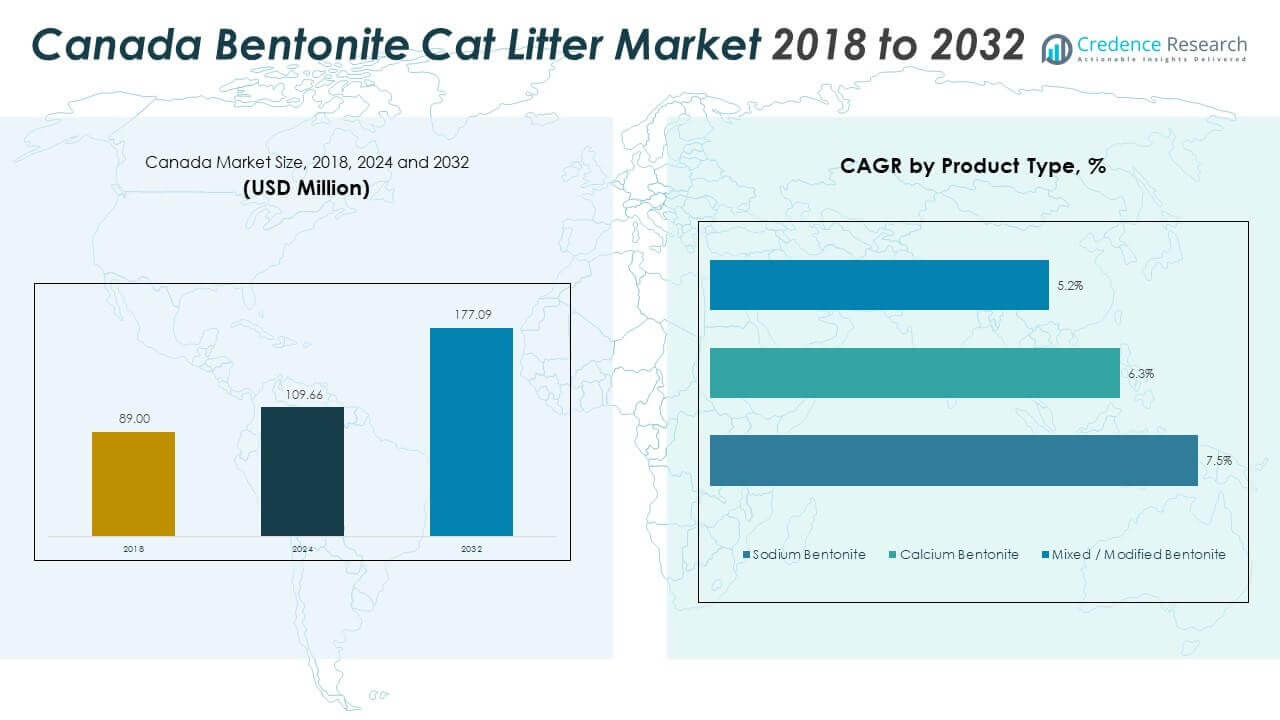
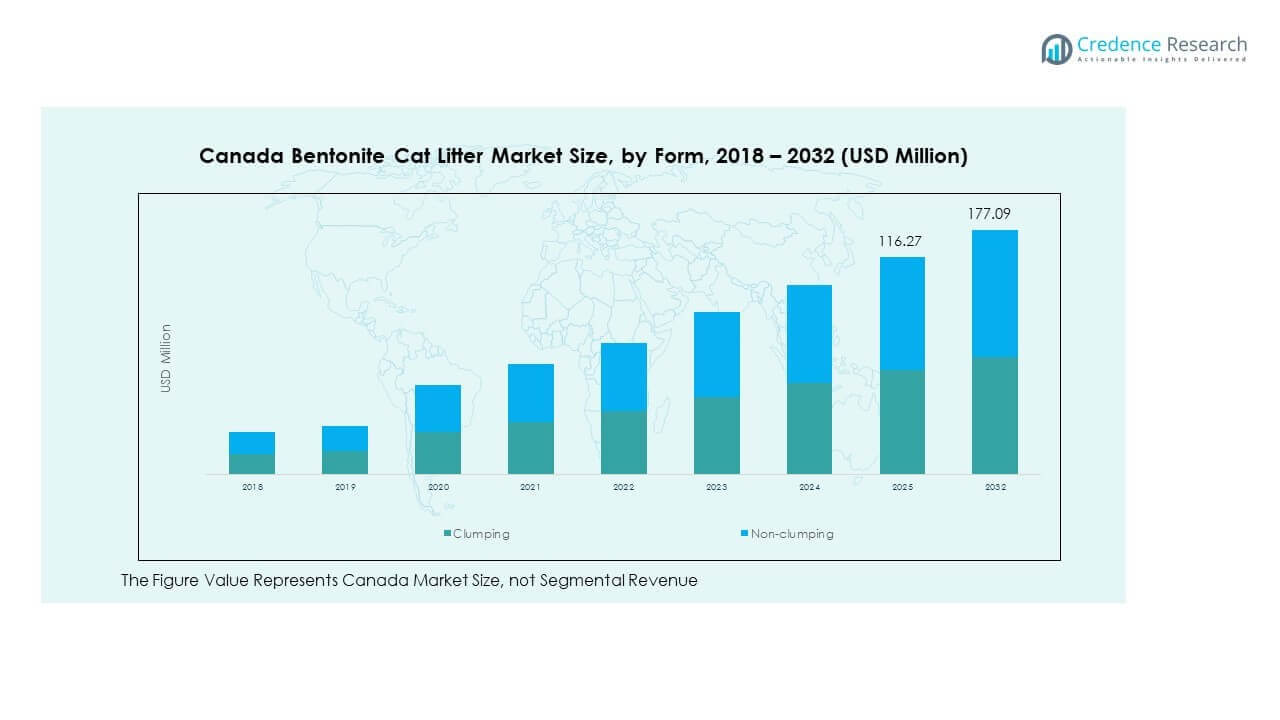
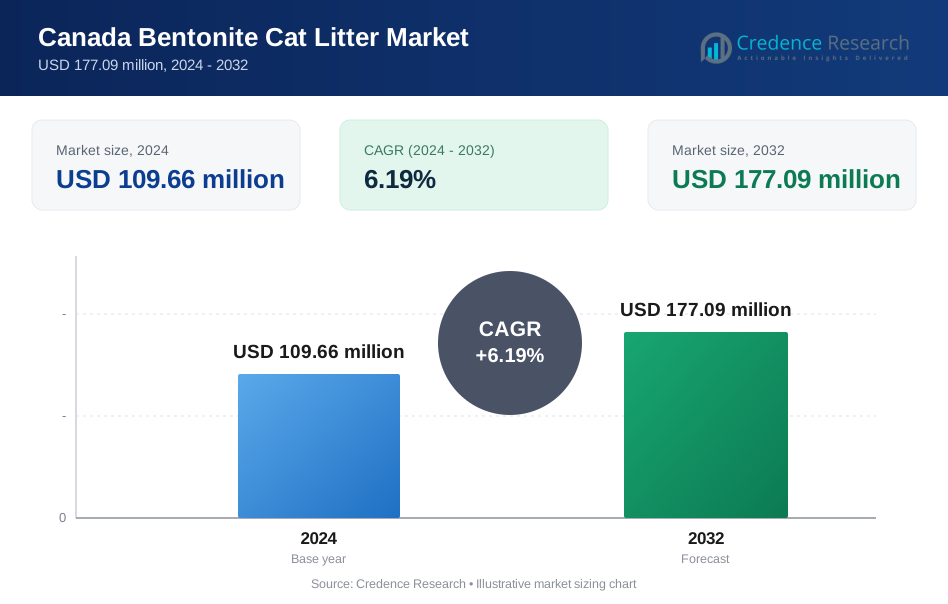
The Canada Bentonite Cat Litter Market size was valued at USD 89.00 million in 2018 to USD 109.66 million in 2024 and is anticipated to reach USD 177.09 million by 2032, at a CAGR of 6.19% during the forecast period.
| REPORT ATTRIBUTE | DETAILS |
|---|---|
| Historical Period | 2020-2023 |
| Base Year | 2024 |
| Forecast Period | 2025-2032 |
| Canada Bentonite Cat Litter Market Size 2024 | USD 109.66 million |
| Canada Bentonite Cat Litter Market , CAGR | 6.19% |
| Canada Bentonite Cat Litter Market Size 2032 | USD 177.09 million |
Market growth is supported by rising cat ownership across urban households. Indoor living increases the need for reliable litter solutions. Bentonite offers strong clumping and effective odor control. These features reduce cleaning time for pet owners. Consumers value hygiene and ease of maintenance. Multi-cat households increase replacement frequency. Product availability across retail formats supports steady demand. E-commerce access improves purchase convenience. Brand innovation in low-dust formulas strengthens consumer preference. Premium variants attract higher spending urban buyers.
Ontario and Quebec lead the market due to dense urban populations. These regions show high indoor pet adoption rates. Strong retail and online distribution support consistent supply. British Columbia follows with demand for premium products. Alberta emerges through steady pet adoption in suburban areas. Prairie provinces show gradual uptake through online channels. Atlantic Canada remains smaller but shows improving access. Regional growth depends on retail reach and logistics strength.
Market Insights
- The Canada Bentonite Cat Litter Market was valued at USD 89.00 million in 2018, reached USD 109.66 million in 2024, and is expected to hit USD 177.09 million by 2032, growing at a CAGR of 6.19%.
- Ontario leads with 38% market share due to dense urban populations and strong retail distribution, followed by Quebec at 26% and British Columbia at 18%, driven by premium product demand and high indoor cat ownership.
- Alberta is the fastest-growing region with a 12% share, supported by growing suburban pet adoption and improved mid-range product access.
- Clumping form accounts for a larger share of the market and continues to grow steadily, favored for hygiene and daily convenience across households.
- Among product types, Mixed/Modified Bentonite is the fastest-growing with a CAGR of 7.5%, outperforming Calcium Bentonite (6.3%) and Sodium Bentonite (5.2%) due to its blend of performance and cost-efficiency.
Market Drivers
Rising Cat Ownership and Indoor Pet Habits Fuel Continuous Demand Across Canadian Households
The Canada Bentonite Cat Litter Market benefits from a steady rise in cat ownership across urban and suburban areas. With more families adopting cats as indoor pets, demand for hygienic and easy-to-maintain litter solutions increases. Indoor cats require litter boxes for daily waste, which makes clumping bentonite litter a necessity. Consumers value odor control, ease of cleaning, and minimal tracking—features where bentonite performs well. Population aging also plays a role, as seniors prefer cats due to lower maintenance needs compared to dogs. Busy professionals living in apartments also drive adoption due to space-saving needs. As households seek low-effort pet care products, bentonite cat litter offers a practical solution. The Canada Bentonite Cat Litter Market capitalizes on these behavioral and demographic shifts.
High Performance of Bentonite in Clumping and Odor Neutralization Drives Consumer Preference
Clumping performance is the primary selling point of bentonite litter, which appeals to both new and experienced cat owners. Bentonite swells and forms tight clumps, making waste removal fast and sanitary. This feature reduces odor and improves overall litter box hygiene, which is essential for multiple-cat households. The material’s natural odor-absorbing properties reduce the need for synthetic additives. Retailers stock bentonite-based variants prominently due to their strong performance and brand popularity. Veterinarians and pet care advisors also recommend bentonite-based litter for its health and hygiene benefits. This endorsement reinforces customer trust in the material. The Canada Bentonite Cat Litter Market gains traction due to this technical superiority over alternative materials.
- For example, Angelcare Group launched Litter Genie® Light, a new Canadian‑made clumping clay litter made from natural bentonite clay with 99% dust‑free performance and superior odor control, expanding its product lineup and distribution across major Canadian retail channels.
Expansion of E-Commerce and Subscription Models Enables Convenient Product Access
The shift toward online shopping supports sustained growth in bentonite litter sales across Canada. Major e-commerce platforms like Amazon, Walmart Canada, and Chewy offer a wide range of litter options. Subscription services allow pet owners to receive products at regular intervals, avoiding last-minute purchases. This model helps brands secure repeat customers and stabilize demand. E-retailers promote bundled offers and home delivery, attracting price-conscious and convenience-focused buyers. Reviews, recommendations, and auto-replenishment features increase brand visibility and consumer trust. Mobile apps and digital payment options improve access for remote or busy customers. The Canada Bentonite Cat Litter Market leverages these digital channels to deepen customer engagement and loyalty.
Product Innovation in Fragrance, Dust Control, and Packaging Enhances Market Growth
Manufacturers continue to upgrade bentonite cat litter products with new features that enhance user satisfaction. Low-dust formulas are in demand among consumers who seek cleaner indoor air. Scented variants with lavender, citrus, or activated charcoal mask odors effectively. Eco-conscious packaging options such as recyclable paper bags gain popularity. Multi-cat formulas address the needs of homes with multiple pets. Lightweight bentonite blends reduce lifting effort for elderly users. Anti-tracking additives limit litter spillage across floors. These product innovations meet varied user needs, allowing the Canada Bentonite Cat Litter Market to retain a competitive edge.
- For example, Wyo‑Ben, Inc. launched a dedicated pet division producing sodium bentonite cat litter and expanded bentonite production capacity, supporting supply for cat litter manufacturers and reinforcing its role in the industry supply chain.
Market Trends
Rising Consumer Shift Toward Premium and Specialty Bentonite-Based Cat Litter Segments
The Canada Bentonite Cat Litter Market sees growing demand for premium variants with added features. Pet owners are willing to pay more for litters with stronger odor control, dust suppression, or natural fragrances. Specialty formulas cater to sensitive cats, households with allergies, or those seeking all-natural ingredients. Brands now offer probiotic-coated litter that suppresses harmful bacteria growth. Color-changing litters that indicate health changes also enter the market. These innovations attract informed buyers who prioritize pet wellness. Retailers promote premium products as safer, longer-lasting, and cleaner options. Premiumization increases average spend per customer and strengthens market margins.
Private Label Growth Across Major Retailers Enhances Competition and Market Reach
Large retailers in Canada are expanding their private label offerings in the bentonite cat litter space. Stores like Walmart (Exquisicat), Canadian Tire, and Pet Valu introduce affordable options to attract budget-conscious consumers. These private label products often mimic features of national brands at lower prices. The consistent in-store availability builds customer trust and encourages recurring purchases. Retailers use in-house branding to control supply chain, pricing, and shelf space more efficiently. Online platforms also offer white-labeled bentonite litters to support direct-to-consumer growth. The Canada Bentonite Cat Litter Market benefits from this retail diversification, but also faces pricing pressure due to internal brand competition.
- For example, ExquisiCat® branded litter is widely stocked by PetSmart Canada, with variations that offer natural clumping and fragrance‑free options. Its availability across large retail footprints demonstrates how private label and retailer‑exclusive listings expand access for price‑conscious consumers.
Sustainability-Focused Innovations in Packaging and Mining Methods Gain Popularity
Environmental impact influences consumer choices in the bentonite cat litter market. Brands now adopt recyclable packaging, compostable bags, and paper-based alternatives to plastic. Some companies invest in greener mining practices or cleaner transportation methods to reduce their carbon footprint. Manufacturers highlight these steps in marketing to appeal to eco-conscious buyers. Local sourcing of bentonite is under exploration to cut reliance on imports and reduce emissions. Regulatory pressures around waste management further encourage sustainable practices. Consumers respond positively to transparent sustainability efforts. This focus supports long-term brand equity within the Canada Bentonite Cat Litter Market.
- For example, MCL Bentonite’s premium bentonite cat litter emphasizes high‑quality bentonite sourced and refined with attention to cleanliness and strong clumping performance, showing manufacturer focus on product quality and environmental standards in processing and supply.
Growth of Pet-Centric Social Media and Online Reviews Shapes Buying Behavior
Digital platforms influence product discovery and customer decision-making in the bentonite cat litter segment. Pet owners frequently share reviews, photos, and usage tips on Instagram, YouTube, and Reddit. Influencer partnerships and unboxing videos highlight product performance and scent quality. Viral content showing odor control tests or “cat satisfaction” encourages trial. Real user feedback builds trust and guides new buyers. Brands that engage with communities through comments and tutorials gain stronger visibility. Online ratings affect e-commerce performance significantly. This trend amplifies word-of-mouth marketing in the Canada Bentonite Cat Litter Market.
Market Challenges Analysis
Environmental Impact of Bentonite Mining and Disposal Limits Long-Term Sustainability of Product
The Canada Bentonite Cat Litter Market faces scrutiny over its environmental footprint. Bentonite mining is land-intensive and can disrupt ecosystems if not managed responsibly. Post-use disposal of clumped litter into landfills contributes to non-biodegradable waste. Rising consumer awareness about sustainability makes clay-based litters less appealing to a niche but growing group. Municipal waste regulations in some provinces restrict non-compostable pet waste disposal. Unlike plant-based alternatives, bentonite lacks biodegradability and cannot be flushed or composted easily. This limits its appeal among zero-waste households. Manufacturers must address ecological concerns through cleaner sourcing and disposal messaging. Failing to act could slow market growth over time.
Rising Cost of Bentonite Imports and Supply Chain Disruptions Pressure Product Pricing
Canada imports much of its bentonite supply from international markets, including the U.S. and overseas producers. Any fluctuation in global freight rates or mining costs directly impacts retail prices. Currency volatility further complicates import cost management for local distributors. Pandemic-related delays and geopolitical tensions highlight vulnerabilities in raw material sourcing. Domestic mining capacity for bentonite is limited and underdeveloped. Retailers experience increased logistics expenses when distributing to remote regions. These cost pressures may limit product availability or push buyers toward cheaper alternatives. The Canada Bentonite Cat Litter Market must build resilience against such supply chain risks to maintain growth.
Market Opportunities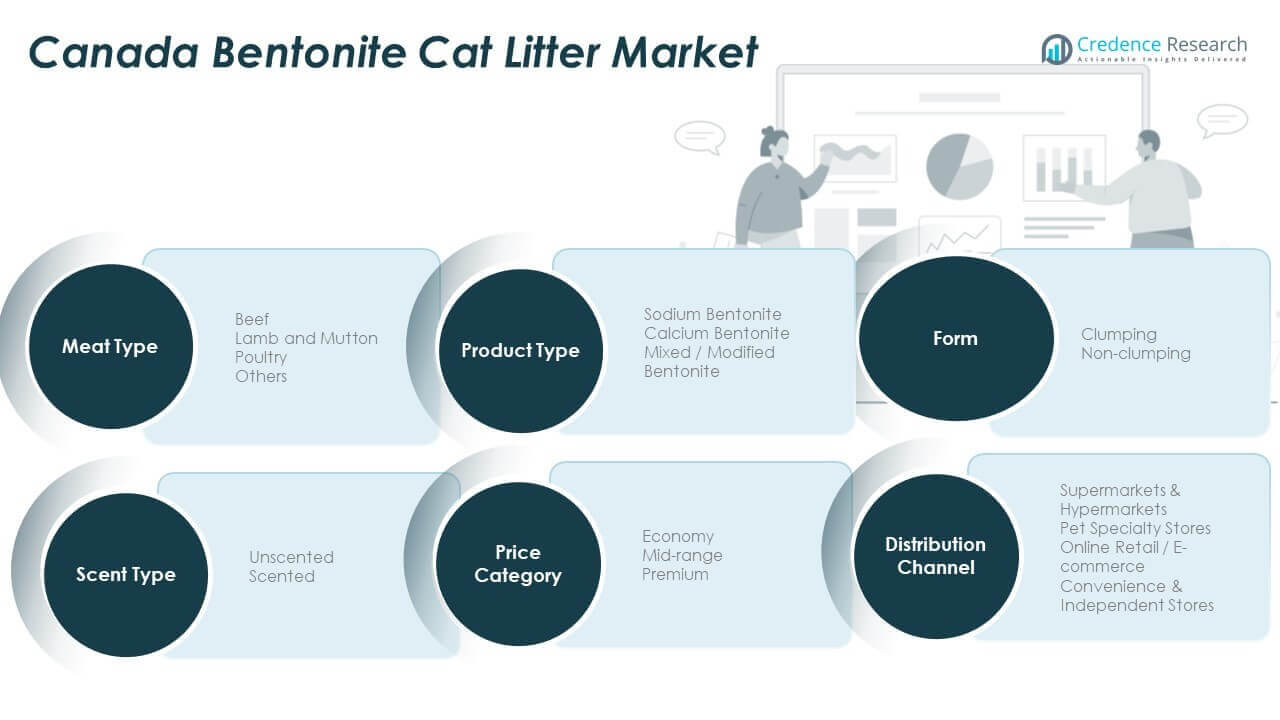
Emerging Demand in Remote Provinces and Semi-Urban Areas with Rising Pet Ownership
Regions beyond major metros such as Alberta, Manitoba, and Saskatchewan show growing pet adoption rates. These areas offer untapped potential for bentonite litter distribution. As retail chains and online delivery expand into smaller cities, access improves for underserved consumers. The Canada Bentonite Cat Litter Market can grow by strengthening regional warehousing and logistics. Price-sensitive buyers in these regions prefer bulk and economical packs. Targeted marketing in these provinces may increase awareness and brand loyalty.
Product Differentiation Through Innovation in Lightweight, Low-Dust, and Health-Monitoring Formulas
There is clear opportunity in enhancing bentonite litter with value-added features. Lightweight blends help reduce shipping weight and ease handling for seniors. Anti-dust technologies appeal to health-conscious consumers. Color-changing indicators that detect pH or blood offer veterinary-linked benefits. These innovations meet modern pet care expectations. The Canada Bentonite Cat Litter Market can grow by focusing on such product differentiation to retain consumers seeking both function and innovation.
Market Segmentation Analysis
By Meat Type
In the Canada Bentonite Cat Litter Market, the meat type segment refers to scented variants inspired by protein-based fragrances. Poultry and beef scents are more common due to their familiarity to domestic cats. Lamb and mutton scents are niche but gaining interest among multi-cat households. Some brands offer "Others" category with herbal-protein blends to appeal to sensitive or allergic cats. While scent preference varies, meat-based aromas aim to create comfort and reduce litter box avoidance. These fragrances also help mask ammonia odors. Demand for meat-based scents is linked to pet owner interest in behavioral enrichment. Product developers target meat-scented formulas primarily for premium buyers.
By Product Type
Sodium bentonite dominates the Canada Bentonite Cat Litter Market due to its strong clumping properties and superior absorption. Calcium bentonite, although less absorbent, appeals to price-sensitive buyers and often appears in economy blends. Mixed or modified bentonite types are growing steadily, combining performance and cost benefits. These blends often include additives for scent, anti-bacterial function, or lightweight texture. Modified versions improve dust control and support premium segment growth. Product type decisions strongly influence branding strategies. Companies differentiate offerings based on mineral source and processing methods. Bentonite type directly impacts customer retention and product satisfaction.
- For example, Natural Bentonite Cat Litter uses ultra‑absorbent sodium bentonite clay that forms solid clumps and controls moisture, showing how sodium bentonite dominates product performance due to strong absorption and clumping traits in Canada’s market.
By Form
Clumping litter leads the market due to its convenience in daily cleaning and superior odor control. It allows quick removal of waste, reducing litter box maintenance time. Clumping is especially popular in multi-cat households and urban apartments. Non-clumping litter finds use in specific veterinary settings and low-cost applications. Some buyers still prefer non-clumping types for younger cats or temporary use. However, its demand is steadily declining. The Canada Bentonite Cat Litter Market aligns closely with the dominance of clumping forms. Innovation in fast-acting and hard-clump formulas continues to shape this segment.
- For example, Intersand Odourlock Cat Litter, which clumps effectively for easy scooping and odour neutralisation in multi‑cat homes. Its popularity in Canadian retail channels underscores the widespread dominance of clumping forms over non‑clumping types.
By Scent Type
Unscented bentonite cat litter remains preferred among owners of sensitive or allergic cats. It is often recommended by veterinarians for cats prone to respiratory issues. However, scented variants dominate retail sales due to their ability to mask strong odors. Common scents include lavender, pine, citrus, and protein-based blends. Scented types appeal to households with multiple pets and smaller living spaces. Brand loyalty often hinges on scent performance and consistency. The Canada Bentonite Cat Litter Market benefits from continuous fragrance innovation. Hybrid formulas offer mild fragrance with odor-neutralizing agents for broader appeal.
By Price Category
The economy segment attracts value-conscious buyers and bulk purchasers, including pet shelters and rural users. Mid-range offerings balance cost and performance, often using blended bentonite with moderate clumping strength. Premium products feature low-dust, lightweight, scented, and anti-bacterial properties. The premium category shows the fastest growth, driven by urban customers seeking advanced hygiene. Price category segmentation also reflects packaging formats, with bulk bags in economy and resealable boxes in premium. Promotions and loyalty programs further impact consumer behavior. The Canada Bentonite Cat Litter Market sees rising trade-up from economy to mid-range as incomes stabilize. Pricing tiers allow flexible market positioning for new entrants.
By Distribution Channel
Supermarkets and hypermarkets remain key distribution channels due to their shelf space and footfall. They offer bulk packs and private labels catering to mainstream buyers. Pet specialty stores stock premium and veterinarian-recommended products, supporting brand variety and consultation. Online retail and e-commerce channels are growing rapidly, driven by subscription models, doorstep delivery, and product variety. They enable direct customer feedback and influencer marketing reach. Convenience and independent stores maintain regional access, especially in remote communities. The Canada Bentonite Cat Litter Market leverages multichannel presence to maximize coverage. Each channel supports different pricing and packaging strategies to match shopper preferences.
Segmentation
By Meat Type
- Beef
- Lamb and Mutton
- Poultry
- Others
By Product Type
- Sodium Bentonite
- Calcium Bentonite
- Mixed / Modified Bentonite
By Form
- Clumping
- Non-clumping
By Scent Type
- Unscented
- Scented
By Price Category
- Economy
- Mid-range
- Premium
By Distribution Channel
- Supermarkets & Hypermarkets
- Pet Specialty Stores
- Online Retail / E-commerce
- Convenience & Independent Stores
Regional Analysis
Ontario and Quebec Dominate Demand Through Urban Density and Retail Strength
Ontario holds the largest share of the Canada Bentonite Cat Litter Market at around 38%, supported by high urban population density and strong pet ownership rates. The province benefits from wide availability across supermarkets, pet specialty chains, and online platforms. Quebec follows closely with nearly 26% share, driven by apartment living and preference for indoor cats. Strong private label penetration supports volume sales in both regions. High awareness of pet hygiene sustains demand for clumping bentonite litter. Distribution efficiency also supports consistent product availability. These provinces continue to anchor national market performance.
Western Canada Shows Stable Growth Led by British Columbia and Alberta
British Columbia accounts for approximately 18% of the market, supported by premium product demand and strong e-commerce adoption. Consumers in the province show interest in low-dust and scented variants suited for compact living spaces. Alberta contributes close to 12% share, supported by steady pet adoption and growth in mid-range pricing segments. Retail expansion across suburban centers supports accessibility. Bulk purchasing remains common in Alberta, favoring economy and mid-range packs. Western Canada shows balanced demand across forms and scent types. Regional logistics efficiency supports competitive pricing.
Atlantic Canada and Prairie Provinces Represent Emerging Growth Markets
Atlantic Canada and remaining Prairie provinces together account for about 6% of total market share. These regions show gradual growth due to rising pet adoption and improving retail penetration. Independent stores and regional chains play a stronger role compared to national retailers. Online retail helps bridge access gaps in remote communities. Price sensitivity remains higher, favoring economy and non-clumping variants. Brand awareness continues to improve through digital channels. These regions offer long-term expansion potential as infrastructure develops.
Key Player Analysis
- Nestlé Purina PetCare
- Church & Dwight (Arm & Hammer)
- Mars Petcare
- Intersand Group
- Oil-Dri Corporation of America
Competitive Analysis
The Canada Bentonite Cat Litter Market features a mix of multinational brands, regional players, and private label offerings. Leading companies compete on clumping performance, odor control, dust reduction, and scent innovation. Major brands focus on sodium bentonite formulations to maintain product differentiation and customer loyalty. Private labels from large retailers exert pricing pressure while expanding shelf presence. Companies invest in packaging upgrades, such as resealable and recyclable formats, to improve user convenience. Distribution strength across supermarkets, pet specialty stores, and e-commerce platforms defines competitive positioning. Product portfolios increasingly target premium and mid-range segments to improve margins. Brands emphasize low-dust and lightweight formulas to appeal to urban households and elderly users. Marketing strategies rely on digital reviews, subscription models, and influencer engagement to strengthen visibility. Supply chain reliability plays a critical role due to import dependence for bentonite raw material. Players with diversified sourcing and strong logistics networks gain an operational advantage. Innovation cycles remain steady, with focus on fragrance blends and multi-cat solutions. Competitive intensity remains moderate, supported by stable demand and high product repeat rates.
Recent Developments
- In July 2025, Progressive Planet announced a key partnership by signing a deal with a publicly traded international sorbent company to license its recipe for producing lightweight clumping cat litter using Red Lake Earth diatomaceous earth, shifting from traditional bentonite clay to meet consumer demand for lighter products in the Canadian market.
Report Coverage
The research report offers an in-depth analysis based on Meat Type, Product Type, Form, Scent Type, Price Category and Distribution Channel. It details leading market players, providing an overview of their business, product offerings, investments, revenue streams, and key applications. Additionally, the report includes insights into the competitive environment, SWOT analysis, current market trends, as well as the primary drivers and constraints. Furthermore, it discusses various factors that have driven market expansion in recent years. The report also explores market dynamics, regulatory scenarios, and technological advancements that are shaping the industry. It assesses the impact of external factors and global economic changes on market growth. Lastly, it provides strategic recommendations for new entrants and established companies to navigate the complexities of the market.
Future Outlook
- Increasing urbanization and indoor pet ownership will sustain steady demand across major provinces.
- Product innovation will focus on lightweight, low-dust, and scented variants to meet hygiene expectations.
- Premiumization will drive value growth as consumers trade up from basic to advanced formulas.
- Subscription-based e-commerce models will gain traction for convenience and repeat purchasing.
- Private labels will expand further in retail chains, offering budget-friendly alternatives to global brands.
- Regional players may emerge stronger by focusing on eco-friendly packaging and local sourcing.
- Supply chain optimization will become critical as bentonite imports remain sensitive to freight costs.
- Multi-cat and veterinary-friendly formulas will gain share due to shifting household pet dynamics.
- Regulatory focus on mining and waste disposal could push brands toward sustainable formulations.
- Digital marketing and influencer content will continue shaping customer behavior and brand loyalty.
Request a Free Sample
Fill in your details and we'll send you a free sample report.
- Sample data tables & charts
- Research methodology
Need a Custom Version of This Report?
Tailor the scope, geography, or segments to your exact requirements.
- Custom geography or segment scope
- Direct access to our analyst team
Frequently Asked Questions
What is the current market size for Canada Bentonite Cat Litter Market, and what is its projected size in 2032?
At what Compound Annual Growth Rate is the Canada Bentonite Cat Litter Market projected to grow between 2024 and 2032?
Which Canada Bentonite Cat Litter Market segment held the largest share in 2024?
What are the primary factors fueling the growth of the Canada Bentonite Cat Litter Market?
Who are the leading companies in the Canada Bentonite Cat Litter Market?
Which region commanded the largest share of the Canada Bentonite Cat Litter Market in 2024?
Table of Content
Chapter 1. Report Introduction
- 1.1 Report Description & Purpose
- 1.1.1 Report Title & Market Definition
- 1.1.2 Unique Selling Propositions (USP) & Key Differentiators
- 1.1.3 Value Proposition for Stakeholders
- 1.2 Research Objectives
- 1.2.1 Market Sizing Objectives (Volume & Revenue)
- 1.2.2 Segmentation Objectives
- 1.2.3 Competitive Intelligence Objectives
- 1.2.4 Forecast & Scenario Objectives
- 1.3 Report Scope
- 1.3.1 Canada Bentonite Cat Litter Scope – Types & Subtypes Covered
- 1.3.2 Geographic Scope – Regions & Countries Covered
- 1.3.3 Historical Period, Base Year & Forecast Period (2024; forecast to 2032)
- 1.3.4 Inclusions & Exclusions
- 1.4 HS Code & Classification Framework
- 1.5 Currency, Units & Pricing Basis
- 1.6 Target Stakeholders
- 1.7 Limitations & Assumptions
Chapter 2. Executive Summary
- 2.1 Global Canada Bentonite Cat Litter Market Snapshot
- 2.1.1 Market Size – Historical (2024) & Forecast (2024-2032) (2024: USD 109.66 million → 2032: USD 177.09 million)
- 2.1.2 Volume & Revenue – Global Totals
- 2.1.3 Key Market Highlights – Top Five Facts
- 2.2 Canada Bentonite Cat Litter Market Segmentation Snapshot
- 2.2.1 Market Split by Region – 2024 vs. 2032
- 2.3 Competitive Snapshot
- 2.3.1 Top 10 Players by Revenue Share – 2024
- 2.3.2 Top 10 Players by Volume Share – 2024
- 2.3.3 Recent Strategic Developments (18-Month Summary)
- 2.4 Key Investment Highlights & Strategic Conclusions
Chapter 3. Canada Bentonite Cat Litter Market Dynamics & Industry Analysis
- 3.1 Market Overview & Context
- 3.1.1 Canada Bentonite Cat Litter Market Position in the Broader Automotive Value Chain
- 3.1.2 OEM vs. Replacement Market Dynamics
- 3.1.3 Market Maturity & Development Stage by Region
- 3.2 Canada Bentonite Cat Litter Market Drivers
- 3.3 Canada Bentonite Cat Litter Market Restraints & Challenges
- 3.4 Canada Bentonite Cat Litter Market Opportunities
- 3.5 Porter's Five Forces Analysis
- 3.5.1 Threat of New Entrants
- 3.5.2 Bargaining Power of Suppliers
- 3.5.3 Bargaining Power of Buyers
- 3.5.4 Threat of Substitutes
- 3.5.5 Competitive Rivalry – Intensity Assessment
- 3.6 Canada Bentonite Cat Litter Value Chain Analysis
- 3.6.1 Upstream – Raw Material/Input Suppliers
- 3.6.1.1 Raw Material/Input 1
- 3.6.1.2 Raw Material/Input 2
- 3.6.1.3 Raw Material/Input 3
- 3.6.2 Midstream – Production/Manufacturing/Service Delivery
- 3.6.2.1 Production/Process Overview
- 3.6.2.2 Key Facility Locations & Capacity by Manufacturer
- 3.6.3 Downstream – Distribution & End Consumer
- 3.6.3.1 Primary Channel – B2B/OEM
- 3.6.3.2 Secondary Channels – Dealer, Retail, Online, Direct
- 3.6.4 Value Chain Profitability Analysis
- 3.6.1 Upstream – Raw Material/Input Suppliers
- 3.7 PESTEL Analysis
- 3.7.1 Political Factors
- 3.7.2 Economic Factors
- 3.7.3 Social Factors
- 3.7.4 Technological Factors
- 3.7.5 Environmental Factors
- 3.7.6 Legal Factors
- 3.8 Canada Bentonite Cat Litter Supply Chain Analysis
- 3.8.1 Raw Material/Input Supply Risk Assessment
- 3.8.2 Manufacturing Concentration Risk (Geographic Exposure)
- 3.8.3 Trade Disruption Impact Analysis
- 3.9 Regulatory & Policy Landscape
Note: The regulatory and policy landscape section covers regulations based on their applicability to the market, Canada Bentonite Cat Litter category, geography, and scope of the study. Only regulatory frameworks with a material impact on operations, compliance, trade, sustainability, or market access are analyzed in detail.
Chapter 4. Key Investment Pockets & Opportunity Analysis
- 4.1 Canada Bentonite Cat Litter Market Attractiveness Analysis
- 4.1.1 By Region – Investment Attractiveness Matrix (Volume × CAGR)
- 4.2 Absolute Revenue Growth Opportunity
- 4.2.1 By Region – Absolute USD Growth Through 2032
- 4.3 Incremental Volume Opportunity
- 4.3.1 By Region – Incremental Volume Through 2032
- 4.3.2 Segment – Incremental Volume
- 4.4 Emerging Submarket Opportunity Deep Dive (Subject to Applicability)
- 4.5 Emerging Market Opportunity Scorecards
- 4.5.1 United States
- 4.5.2 Europe
- 4.5.3 Asia
- 4.5.4 Middle East & Africa
Note: Emerging Market Opportunity Scorecards will be included based on relevance and strategic importance. Regions listed are indicative and may vary depending on data availability and market dynamics.
Chapter 5. Canada Bentonite Cat Litter Import-Export Analysis & Trade Flows
- 5.1 Global Trade Overview
- 5.1.1 Global Export Value by Country (2024)
- 5.1.2 Global Export Volume by Country (2024)
- 5.1.3 Global Import Value by Country (2024)
- 5.1.4 Global Import Volume by Country (2024)
- 5.1.5 Net Trade Balance by Country (2024)
- 5.2 Export Analysis – Segment
- 5.2.1 Type 1 (HS Code)
- 5.2.2 Type 2 (HS Code)
- 5.2.3 Type 3 (HS Code)
- 5.2.4 Type 4 (HS Code)
- 5.2.5 Type 5 (HS Code)
- 5.3 Import Analysis – Segment
- 5.3.1 Type 1 (HS Code)
- 5.3.2 Type 2 (HS Code)
- 5.3.3 Type 3 (HS Code)
- 5.3.4 Type 4 (HS Code)
- 5.3.5 Type 5 (HS Code)
- 5.4 Average Unit Trade Prices
- 5.4.1 Average Export Price – Segment & Country
- 5.4.2 Average Import Price – Segment & Source Country
- 5.4.3 Price Trends (2024)
- 5.5 Key Trade Route Analysis
- 5.5.1 Trade Route 1
- 5.5.2 Trade Route 2
- 5.5.3 Trade Route 3
- 5.5.4 Trade Route 4
- 5.5.5 Trade Route 5
- 5.6 Trade Policy Impact Assessment
- 5.6.1 US Anti-Dumping & Section 301 Tariffs
- 5.6.2 EU Customs Union Impact
- 5.6.3 Major Free Trade Agreements
- 5.6.4 USMCA Rules of Origin
Note: Trade policy analysis will be included only where relevant to the Canada Bentonite Cat Litter market.
Chapter 6. Competitive Landscape & Company Benchmarking
- 6.1 Canada Bentonite Cat Litter Market Concentration & Structure
- 6.1.1 Herfindahl-Hirschman Index (HHI) – vs. 2024
- 6.1.2 Tier 1, Tier 2 & Tier 3 Market Structure
- 6.1.3 Global, Regional & Local Player Dynamics
- 6.2 Canada Bentonite Cat Litter Market Share Analysis – 2024
- 6.2.1 Global Revenue Share by Company
- 6.2.2 Global Volume Share by Company
- 6.2.3 Regional Revenue Share
- 6.2.4 Market Share Evolution ( vs. 2024)
- 6.2.5 OEM Segment Share by Company
- 6.2.6 Replacement Segment Share by Company
- 6.3 Production/Delivery Capacity & Facility Analysis
- 6.3.1 Global Installed Capacity
- 6.3.2 Capacity Utilization Rates
- 6.3.3 Production/Output Volume
- 6.3.4 Facility Locations & Capacity Map
- 6.3.5 Planned Capacity Additions
- 6.4 Canada Bentonite Cat Litter Competitive Benchmarking Matrix
- 6.4.1 Revenue, Volume, CAGR & Profitability Comparison
- 6.4.2 Channel Revenue Mix
- 6.4.3 Geographic Revenue Exposure
- 6.4.4 R&D Intensity
- 6.4.5 Sustainability Maturity
- 6.5 Strategic Developments in Canada Bentonite Cat Litter (Last 24 Months)
- 6.5.1 Mergers, Acquisitions & Divestments
- 6.5.2 New Canada Bentonite Cat Litter Launches
- 6.5.3 Facility Expansions
- 6.5.4 Strategic Alliances, Joint Ventures & Partnerships
- 6.5.5 Distribution Expansion & Market Entry
- 6.5.6 Sustainability & ESG Initiatives
- 6.6 Competitive Strategy Mapping
- 6.6.1 Leader, Challenger, Follower & Niche Classification
- 6.6.2 Pricing Strategy Comparison
- 6.6.3 Channel Strategy Matrix
Note: Strategic developments are included based on their materiality and the availability of reliable information.
Chapter 7. Global Canada Bentonite Cat Litter Market – By Distribution Channel
- 7.1 Segment Overview
- 7.1.1 Volume & Revenue Split by Channel (2024 & 2032)
- 7.1.2 Channel Mix Evolution (2024-2032)
Chapter 8. Regional Market Analysis – Global Overview
- 8.1 Global Regional Overview
- 8.1.1 Regional Volume Share
- 8.1.2 Regional Revenue Share
- 8.1.3 Regional Volume by Region
- 8.1.4 Regional Revenue by Region
- 8.1.5 Regional Forecast Through 2032
- 8.2 Cross-Regional Segment Analysis
- 8.2.1 By Distribution Channel
- 8.2.2 By Brand/Price Tier
Chapter 9. North America Canada Bentonite Cat Litter Market
- 9.1 United States
- 9.2 Canada
- 9.3 Mexico
Chapter 10. Europe Canada Bentonite Cat Litter Market
- 10.1 Germany
- 10.2 France
- 10.3 Italy
- 10.4 United Kingdom
- 10.5 Spain
- 10.6 Poland
- 10.7 Russia
- 10.8 Netherlands
- 10.9 Belgium
- 10.10 Sweden
- 10.11 Denmark
- 10.12 Norway
- 10.13 Rest of Europe
Chapter 11. Asia Pacific Canada Bentonite Cat Litter Market
- 11.1 China
- 11.2 India
- 11.3 Japan
- 11.4 South Korea
- 11.5 Thailand
- 11.6 Indonesia
- 11.7 Vietnam
- 11.8 Malaysia
- 11.9 Australia
- 11.10 Rest of Asia Pacific
Chapter 12. Latin America Canada Bentonite Cat Litter Market
- 12.1 Brazil
- 12.2 Argentina
- 12.3 Colombia
- 12.4 Chile
- 12.5 Rest of Latin America
Chapter 13. Middle East Canada Bentonite Cat Litter Market
- 13.1 Saudi Arabia
- 13.2 United Arab Emirates
- 13.3 Turkey
- 13.4 Israel
- 13.5 Iran
- 13.6 Rest of the Middle East
Chapter 14. Africa Canada Bentonite Cat Litter Market
- 14.1 South Africa
- 14.2 Egypt
- 14.3 Nigeria
- 14.4 Morocco
- 14.5 Rest of Africa
Chapter 15. Canada Bentonite Cat Litter Company Profiles
- 15.1 [Company 01]
- 15.1.1 Company Overview
- 15.1.2 Key Management Personnel
- 15.1.3 Products & Services Portfolio
- 15.1.4 Financial Performance
- 15.1.5 Key Market Focus & Geographic Presence
- 15.1.6 Recent Developments & Strategic Initiatives
Note: The company profile list is preliminary and may change based on research findings, market developments, data availability, and client requirements.
Chapter 16. Appendices
- Appendix A – List of Abbreviations & Acronyms
- Appendix B – Industry Classification Code Reference – Full Series
- Appendix C – Production & Capacity Data Tables
- Appendix D – End-Use & Demand Base Tables
- Appendix E – Consumption & Replacement Rate Assumptions
- Appendix F – ASP Reference Tables
- Appendix G – Manufacturing & Facility Database
- Appendix H – Import-Export Data Tables
- Appendix I – Regulatory Summary Tables
- Appendix J – Primary Research Participant List (Anonymized)
- Appendix K – Primary Research Questionnaire Framework
- Appendix L – Data Sources & Bibliography
- Appendix M – Market Size Divergence & Source Comparison
Chapter 17. Research Methodology
- 17.1 Research Framework & Philosophy
- 17.2 Secondary Research – Sources, Hierarchy & Data Extraction
- 17.3 Data Modeling – Bottom-Up & Top-Down Market Sizing
- 17.4 Primary Research – Stakeholder Framework, LOI & Sample Sizes
- 17.5 Forecast Methodology – Regression, Scenario & Sensitivity Analysis
- 17.6 Quality Control – Four-Layer Validation Framework
- 17.7 Limitations & Standard Assumptions
- 17.8 Disclaimer
