Market Overview:
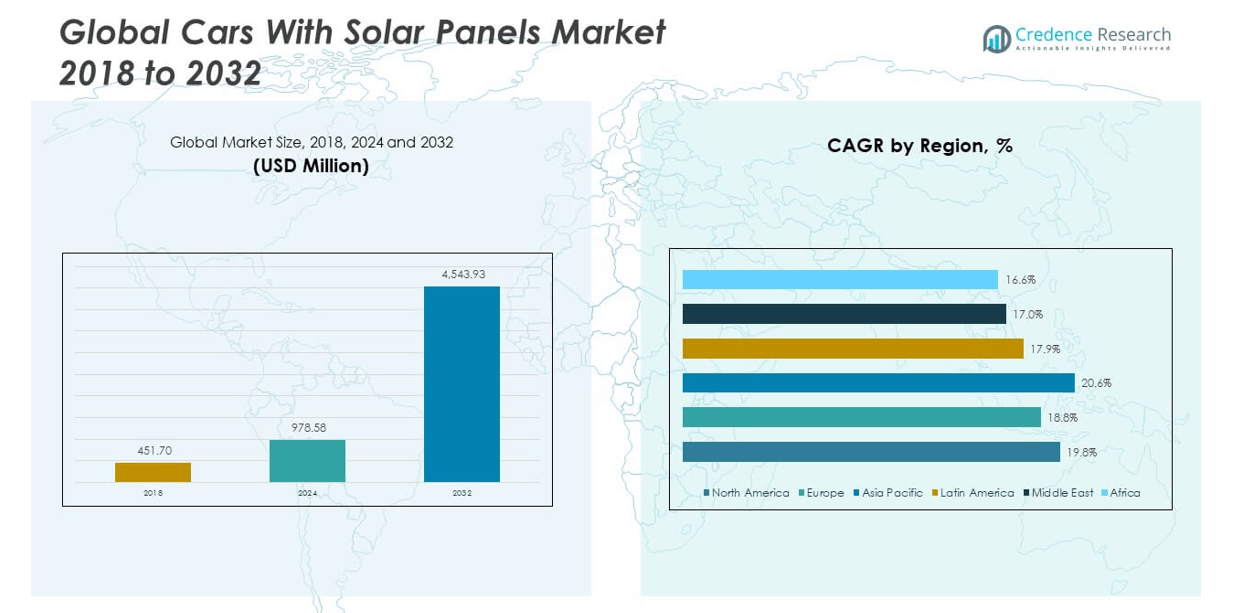
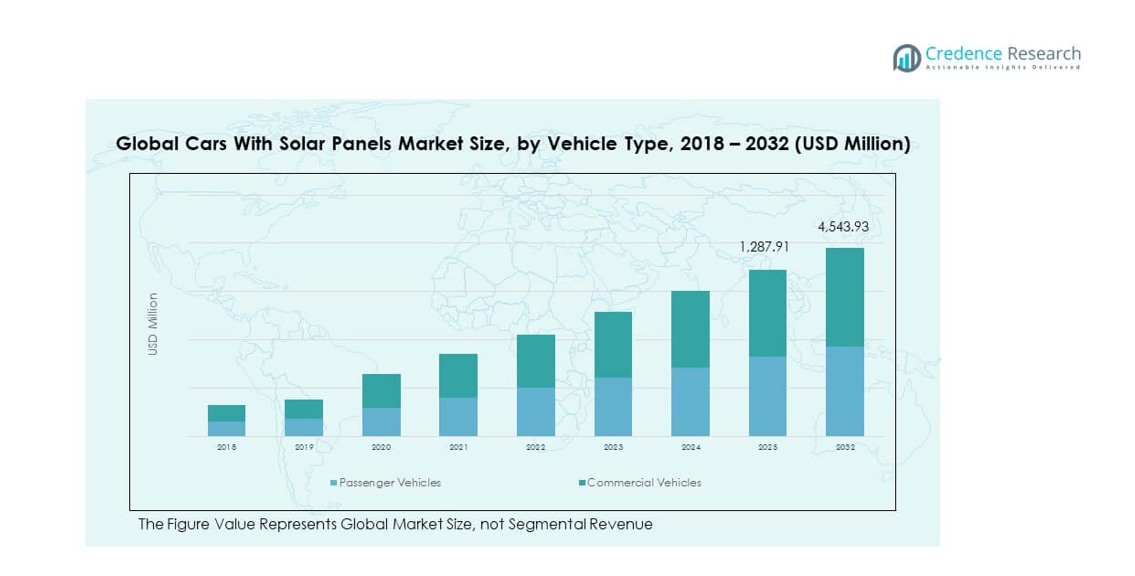
The Global Cars With Solar Panels Market size was valued at USD 451.70 million in 2018 to USD 978.58 million in 2024 and is anticipated to reach USD 4,543.93 million by 2032, at a CAGR of 19.73% during the forecast period.
| REPORT ATTRIBUTE | DETAILS |
|---|---|
| Historical Period | 2020-2023 |
| Base Year | 2024 |
| Forecast Period | 2025-2032 |
| Cars with Solar Panels Market Size 2024 | USD 978.58 million |
| Cars with Solar Panels Market, CAGR | 19.73% |
| Cars with Solar Panels Market Size 2032 | USD 4,543.93 million |
The market is gaining strong momentum due to growing demand for sustainable transportation, rising fuel prices, and increased environmental awareness. Automakers are investing in solar panel integration to enhance vehicle efficiency and reduce dependence on charging infrastructure. Advances in photovoltaic cell technology have made solar integration more viable, offering extended range and lower emissions. Government incentives and stricter emissions regulations are further encouraging the development and commercialization of solar-powered cars, supporting adoption among both consumers and fleet operators.
Asia Pacific leads the market due to strong government support for renewable technologies and a rapidly growing electric vehicle ecosystem in countries like China, Japan, and South Korea. Europe follows, driven by stringent emission norms and innovation in green mobility. North America is showing steady growth with increasing interest from eco-conscious consumers and startups. Emerging regions in Latin America and the Middle East are witnessing gradual uptake, supported by growing investments in EV infrastructure and solar energy integration.
Market Insights:
- The Global Cars with Solar Panels Market was valued at USD 978.58 million in 2024 and is projected to reach USD 4,543.93 million by 2032, growing at a CAGR of 19.73%.
- Increasing demand for sustainable transport solutions and rising fuel prices are accelerating the adoption of solar-integrated vehicles.
- High initial costs and limited energy generation capacity from onboard solar panels pose challenges to mass adoption.
- Asia Pacific holds the largest market share due to rapid EV adoption, strong solar infrastructure, and government incentives in China, Japan, and South Korea.
- North America is witnessing steady growth, supported by EV-friendly policies and early commercialization efforts by startups and established automakers.
- Europe remains a key innovation hub, driven by emission reduction mandates and high consumer interest in clean technologies.
- Technological advancements in monocrystalline panel efficiency and lightweight integration methods are expanding the practical applications of solar-powered cars.
Market Drivers:
Rising Environmental Concerns and Shift Toward Sustainable Mobility
The growing global emphasis on reducing greenhouse gas emissions is driving innovation in cleaner transportation alternatives. Consumers and governments are actively pushing for solutions that reduce dependency on fossil fuels. The Global Cars with Solar Panels Market benefits from this shift as it aligns with sustainability goals. Solar panel integration enables passive charging, reducing the need for traditional electricity sources. This sustainable model is gaining traction among environmentally conscious buyers. Regulatory bodies are also mandating emission reductions, supporting demand for solar-integrated vehicles. This alignment with eco-friendly policies is strengthening its market position. The sector continues to attract investment aimed at reducing vehicle carbon footprints.
Surge in Research and Development Investments for Solar Integration
Automotive and renewable energy sectors are significantly increasing their R&D budgets to enhance solar panel efficiency and adaptability in vehicles. The evolution of thin-film and high-efficiency photovoltaic cells has improved the feasibility of solar integration. Companies are working to increase energy conversion rates without compromising vehicle design. The Global Cars with Solar Panels Market is witnessing prototype launches and concept vehicles that demonstrate technological viability. Partnerships between solar technology firms and automakers are accelerating innovation cycles. This technical synergy is fueling a pipeline of advanced, next-gen models. Continuous innovation is creating pathways for better performance and extended range. It positions solar-integrated vehicles as competitive alternatives to conventional EVs.
- For instance, Dutch startup Lightyear developed the Lightyear One (later Lightyear 0), featuring an energy consumption rate of approximately 83 Wh/km under the WLTP standard and a driving range of up to 725 km on a single charge. Its double‑curved 5 m² solar array can generate up to 70 km of range per day in optimal sunlight conditions and deliver an annual solar yield of up to around 11,000 km in the sunniest environments.
Growing EV Adoption Coupled with Renewable Charging Infrastructure Expansion
The expansion of electric vehicle adoption has created a complementary demand for sustainable charging methods. Governments and private players are establishing renewable energy-powered charging stations, creating an ecosystem suitable for solar-powered cars. The Global Cars with Solar Panels Market fits seamlessly into this infrastructure expansion by reducing pressure on centralized charging. Solar-charging cars offer an off-grid solution, particularly beneficial in regions with limited charging infrastructure. This decentralized model enhances convenience and supports EV adoption in remote or underdeveloped areas. It also enables greater energy independence for users. These advantages collectively push the market forward. Solar-enabled vehicles stand to bridge infrastructure gaps and improve EV adoption rates.
Incentivization Policies and Supportive Government Frameworks Across Regions
Government incentives are playing a critical role in supporting market development through subsidies, tax rebates, and research grants. Policies encouraging renewable energy usage in transportation directly impact the Global Cars with Solar Panels Market. Several countries have launched national-level programs to promote solar-integrated mobility solutions. These initiatives reduce the cost barrier for consumers and manufacturers alike. Regulatory support helps early-stage companies develop viable solar mobility platforms. It also encourages established players to diversify product lines with solar variants. Governments are promoting vehicle-to-grid (V2G) and decentralized solar power systems. This policy-driven momentum continues to drive adoption and innovation in the sector.
- For instance, Germany offers up to €9,000 in EV purchase incentives and a 10-year vehicle tax exemption, while France provides up to €7,000 along with subsidies for charging infrastructure. The Netherlands supports EV adoption through extensive public charging networks and tax reductions for electric vehicle owners.
Market Trends:
Integration of Solar Roofing Technology into Mass-Market Electric Vehicles
Major automakers are increasingly incorporating solar roofing modules into mainstream EV models. These innovations extend the range and improve the energy autonomy of vehicles without external charging. The Global Cars with Solar Panels Market is witnessing a trend toward embedded solar cells in panoramic roofs and hoods. Car brands are actively prototyping and testing high-efficiency solar glass panels. These features are being adopted not only in high-end cars but also in mid-range EVs. Manufacturers aim to create a balance between aesthetic appeal and functional output. Consumers perceive solar integration as a premium feature that aligns with eco-conscious lifestyles. This trend supports broader adoption across diverse vehicle classes. Solar roofs are evolving from niche innovations into standard offerings.
- For instance, Tesla’s SR72T1 solar tiles deliver 22% more power than earlier models, and the company’s Gigafactory in Texas is building what is expected to be the world’s largest solar roof, capable of producing 30MW of power. Tesla’s Solar Roof system matches a typical 6kW setup, capable of generating approximately 9,000kWh of electricity per year.
Expansion of Solar Mobility in Commercial Vehicle Fleets and Logistics
Commercial fleets are exploring solar technologies to optimize operational costs and improve sustainability metrics. Light commercial vehicles, vans, and delivery trucks are being outfitted with solar panels for auxiliary power. The Global Cars with Solar Panels Market benefits from this trend as logistics companies seek long-term energy savings. Solar panels help run secondary systems like refrigeration and telematics. This reduces fuel consumption and carbon emissions across delivery routes. The trend is particularly strong in last-mile delivery operations. Companies are using solar retrofits and hybrid solar-EV models to maximize efficiency. Market players are launching targeted solutions for fleet electrification. Commercial use cases are expanding the market beyond personal transport.
Innovation in Lightweight Solar Materials and Aerodynamic Designs
The pursuit of higher solar yield has encouraged material innovation in lightweight and flexible photovoltaic panels. Manufacturers are moving toward advanced polymers and ultra-thin solar films that enhance energy capture without compromising vehicle aerodynamics. The Global Cars with Solar Panels Market is embracing this trend to improve performance under varied weather conditions. Design engineers focus on integrating panels seamlessly into curved surfaces and compact spaces. These materials support creative design approaches for concept vehicles and production-ready models. Car brands are testing composite solar skins and paint-on solar coatings. Such breakthroughs push the industry toward more aesthetically pleasing and energy-efficient cars. Form factor evolution is setting new standards in solar mobility.
- For instance, Sono Motors, a European tech startup, partnered with major battery and component suppliers such as Continental to support the development of its Sion EV. The Sion features integrated solar cells and uses a 54 kWh LFP battery, delivering a real-world range of approximately 305 km, with solar charging contributing up to 112 km of additional range per week under typical conditions.
Growing Collaboration Between Tech Startups and Traditional Automakers
Startups specializing in renewable technologies are forging partnerships with traditional car manufacturers to commercialize solar-powered mobility. These collaborations enable faster prototyping and mass production of solar-integrated vehicles. The Global Cars with Solar Panels Market is witnessing a surge in co-developed concept cars and pilot programs. Automakers benefit from the agility and innovation of startups, while startups leverage established distribution and R&D platforms. Strategic alliances are focusing on both hardware (solar modules, energy systems) and software (energy management systems). This joint innovation accelerates time-to-market and supports scalable product rollouts. It reflects a shift toward ecosystem development rather than isolated innovations. The collaborative approach is shaping future product pipelines in solar-powered transport.
Market Challenges Analysis:
High Initial Cost and Technological Constraints in Solar Integration
The integration of solar panels into vehicles significantly increases the overall cost, limiting adoption to premium buyers and niche markets. This upfront cost remains a major barrier for middle-income consumers. The Global Cars with Solar Panels Market is struggling to balance performance with affordability. Photovoltaic efficiency still falls short in cloudy or shaded environments, affecting energy reliability. Battery limitations and solar power storage inefficiencies restrict continuous usage. Engineering constraints in panel placement and vehicle design further complicate mass adoption. Manufacturers also face durability issues with flexible or curved solar panels. Achieving optimal solar yield while maintaining visual appeal and safety requires ongoing R&D. These factors collectively slow down mainstream acceptance.
Limited Charging Output and Geographical Dependency on Sunlight Availability
Solar-powered vehicles cannot yet fully replace traditional EVs due to their limited charging capacity. The power generated through current vehicle-integrated panels often covers only a fraction of daily driving needs. The Global Cars with Solar Panels Market is constrained in high-latitude and low-sunlight regions. Seasonal variations and cloud cover significantly impact charging performance. Urban environments with high-rise buildings reduce sun exposure, further limiting energy intake. This dependence on sunlight availability reduces the market’s reliability perception. Users in regions with unpredictable weather conditions may see little benefit. Without consistent solar input, consumers tend to rely on hybrid or plug-in alternatives. These regional inconsistencies challenge uniform global growth.
Market Opportunities:
Adoption in Developing Regions With Limited Charging Infrastructure
Emerging markets with underdeveloped EV charging networks present strong opportunities for solar-integrated vehicles. The Global Cars with Solar Panels Market can address power access issues by enabling self-sustained energy generation. Remote and rural areas benefit from reduced grid dependency. Governments in developing countries are exploring solar mobility to expand EV coverage. Off-grid transportation solutions align with regional energy security goals. These factors create demand for affordable, solar-supported EV models. The opportunity lies in localized production and assembly for regional markets. Manufacturers targeting energy-deficient geographies can establish early market leadership.
Technological Advancements Enabling Scalable and Affordable Solutions
Continuous innovation in photovoltaic materials and vehicle integration is reducing production costs and improving energy output. The Global Cars with Solar Panels Market can capitalize on breakthroughs in perovskite cells, flexible substrates, and multi-layer panels. These improvements support mass production and broader accessibility. Automotive OEMs are investing in solar-powered variants of mainstream models. Scalable technologies allow wider applications across sedan, SUV, and commercial vehicle categories. Companies that refine cost-performance ratios will gain competitive advantage. Expanding use cases in urban and suburban transport also support volume growth.
Market Segmentation Analysis:
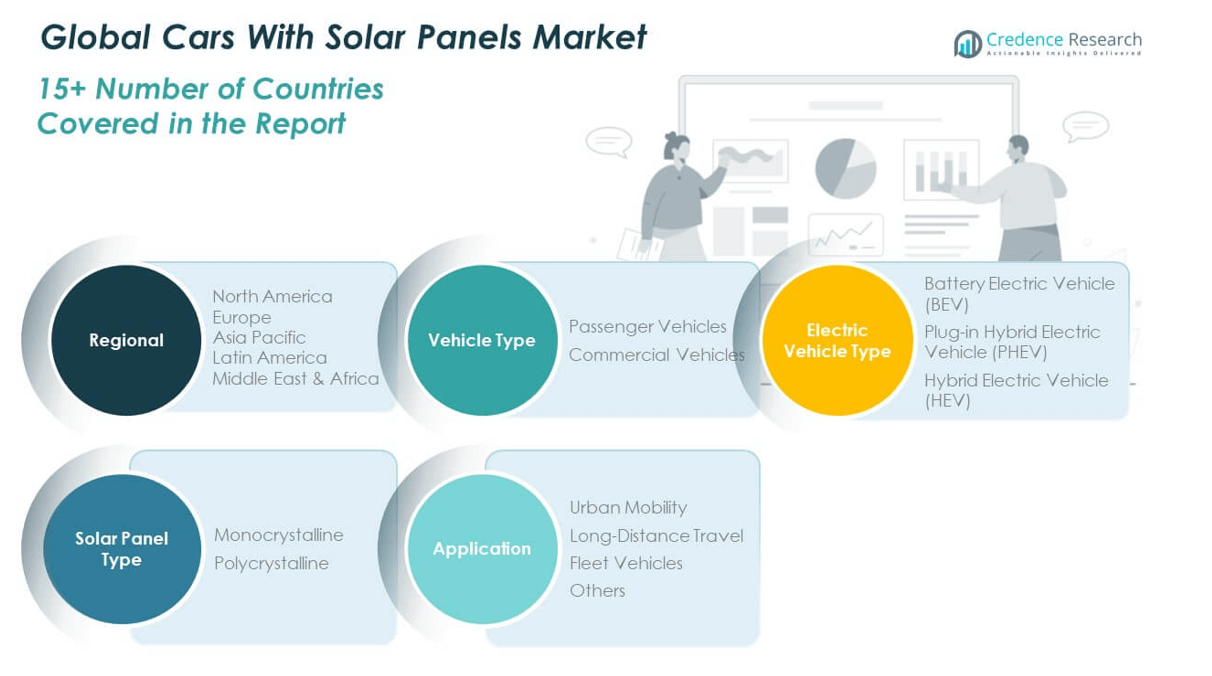
The Global Cars with Solar Panels Market is segmented by vehicle type, electric vehicle type, solar panel type, and application.
By vehicle type, passenger vehicles hold a significant share due to increasing consumer demand for sustainable personal transport. Commercial vehicles are gaining traction as fleet operators seek cost-effective, energy-efficient alternatives for urban and last-mile delivery operations.
- For example, StreetScooter, a subsidiary of Deutsche Post DHL Group, piloted solar panel systems on its electric delivery vans. In 2022, DHL installed TRAiLAR thin-film solar mats on 67 vehicles in the U.S., providing supplemental energy for auxiliary systems like lift gates and air conditioning, helping cut fuel use and emissions.
By electric vehicle type, Battery Electric Vehicles (BEVs) dominate the market, supported by their complete reliance on electricity and potential to maximize solar integration. Plug-in Hybrid Electric Vehicles (PHEVs) follow, offering flexibility for users in regions with inconsistent solar exposure. Hybrid Electric Vehicles (HEVs) also contribute to market growth, particularly in markets transitioning from internal combustion to fully electric platforms.
- For instance, Aptera Motors achieved an independently tested efficiency of approximately 100 Wh per mile equivalent to about 10 miles per kWh making the vehicle over twice as efficient as a Tesla Model 3.
By solar panel type, monocrystalline panels lead the market owing to their superior efficiency and space-saving design. Polycrystalline panels hold a secondary position due to their affordability, appealing to cost-sensitive segments.
By application, urban mobility represents the largest segment as solar vehicles align with short-range, city-based commuting. Long-distance travel benefits from enhanced energy independence, supporting the adoption of solar-assisted systems. Fleet vehicles are emerging as a growth segment driven by commercial interest in sustainability. The “others” category includes specialized use cases such as recreational and experimental solar-powered transport. The market’s segmentation reflects the diverse pathways for adoption across consumer and commercial domains.
Segmentation:
By Vehicle Type
- Passenger Vehicles
- Commercial Vehicles
By Electric Vehicle Type
- Battery Electric Vehicle (BEV)
- Plug-in Hybrid Electric Vehicle (PHEV)
- Hybrid Electric Vehicle (HEV)
By Solar Panel Type
- Monocrystalline
- Polycrystalline
By Application
- Urban Mobility
- Long-Distance Travel
- Fleet Vehicles
- Others
By Region
- North America
- U.S.
- Canada
- Mexico
- Europe
- Germany
- France
- U.K.
- Italy
- Spain
- Rest of Europe
- Asia Pacific
- China
- Japan
- India
- South Korea
- South-east Asia
- Rest of Asia Pacific
- Latin America
- Brazil
- Argentina
- Rest of Latin America
- Middle East & Africa
- GCC Countries
- South Africa
- Rest of the Middle East and Africa
Regional Analysis:
North America
The North America Global Cars With Solar Panels Market size was valued at USD 82.91 million in 2018 to USD 175.19 million in 2024 and is anticipated to reach USD 818.93 million by 2032, at a CAGR of 19.8% during the forecast period. North America accounts for 18.6% of the global market share. The region benefits from advanced automotive infrastructure and strong government incentives for clean mobility. Key states in the U.S., including California and New York, offer tax rebates and subsidies for solar-powered vehicles. Manufacturers are conducting pilot programs and early deployments to evaluate consumer response. Strong environmental awareness among consumers boosts market interest. Technological innovation is driven by active R&D from both startups and traditional OEMs. Canada is emerging with supportive policies and infrastructure investments. The region maintains a favorable regulatory climate that supports renewable integration in transport.
Europe
The Europe Global Cars With Solar Panels Market size was valued at USD 128.79 million in 2018 to USD 269.00 million in 2024 and is anticipated to reach USD 1,176.39 million by 2032, at a CAGR of 18.8% during the forecast period. Europe represents 23.7% of the global market share. Countries such as Germany, the Netherlands, and Norway are leading in adoption due to stringent emissions regulations. The EU’s green mobility policies and renewable energy targets support the integration of solar-powered systems in vehicles. Consumers in the region exhibit a high degree of environmental responsibility. Automakers based in Europe are investing in solar R&D and production. Urban centers offer ideal conditions for solar charging due to developed infrastructure. Regulatory consistency across member states strengthens long-term market viability. Public-private collaborations further encourage innovation in solar mobility.
Asia Pacific
The Asia Pacific Global Cars With Solar Panels Market size was valued at USD 199.31 million in 2018 to USD 447.57 million in 2024 and is anticipated to reach USD 2,203.85 million by 2032, at a CAGR of 20.6% during the forecast period. Asia Pacific holds the largest share at 48.5% of the global market. China dominates the region with large-scale manufacturing, government incentives, and strong EV infrastructure. Japan and South Korea are advancing high-efficiency solar module integration in vehicles. It benefits from fast-paced industrialization and urbanization, creating demand for eco-friendly transport. High solar irradiance across parts of the region enhances system effectiveness. Public demand for energy independence and innovation drives market momentum. Regional automakers are accelerating commercialization through government partnerships. Strong investment in EV and renewable sectors reinforces market growth prospects.
Latin America
The Latin America Global Cars With Solar Panels Market size was valued at USD 21.29 million in 2018 to USD 45.54 million in 2024 and is anticipated to reach USD 187.10 million by 2032, at a CAGR of 17.9% during the forecast period. Latin America accounts for 4.1% of the global market share. Countries such as Brazil, Chile, and Mexico are investing in solar and EV technologies. It benefits from high solar potential, which supports solar-powered vehicle use. Government incentives remain limited but are gradually expanding. Urban areas in Brazil and Colombia are piloting clean transport solutions. Private sector initiatives are playing a key role in adoption. Consumers show growing interest in sustainable mobility despite economic variability. Solar panel integration in light-duty and fleet vehicles is under testing. Partnerships between energy and automotive firms are expected to drive future demand.
Middle East
The Middle East Global Cars With Solar Panels Market size was valued at USD 11.85 million in 2018 to USD 23.32 million in 2024 and is anticipated to reach USD 90.09 million by 2032, at a CAGR of 17.0% during the forecast period. The region holds a 2.0% share of the global market. It benefits from abundant sunlight, making solar-powered mobility a technically viable option. The UAE and Saudi Arabia are leading efforts in green transport development. Government-funded pilot projects are assessing feasibility for broader rollout. Luxury car brands are exploring solar integration in premium EVs. Public awareness and infrastructure remain in early stages. Initiatives are aligned with national energy diversification strategies. Renewable energy investment plans support clean vehicle programs. The market remains nascent but holds long-term potential due to environmental goals.
Africa
The Africa Global Cars With Solar Panels Market size was valued at USD 7.56 million in 2018 to USD 17.96 million in 2024 and is anticipated to reach USD 67.57 million by 2032, at a CAGR of 16.6% during the forecast period. Africa contributes 1.5% of the global market share. It faces infrastructure and affordability challenges that limit large-scale adoption. Countries such as South Africa and Kenya are taking early steps in solar and EV integration. Solar-powered vehicles offer an off-grid solution in areas with unreliable electricity. NGOs and international development agencies are introducing solar mobility pilots. Local startups are experimenting with low-cost solar vehicle designs. Public awareness remains low but is gradually increasing. Favorable solar conditions across the continent support future expansion. Long-term growth depends on infrastructure improvements and financing mechanisms.
Key Player Analysis:
- Toyota Motor Corporation
- Lightyear
- Aptera Motors
- Sono Motors GmbH
- Hyundai Motor Company
- Tesla, Inc.
- Fisker Inc.
- BMW Group
- Stella (Solar Team Eindhoven)
- Sun Mobility
Competitive Analysis:
The Global Cars with Solar Panels Market features a competitive landscape driven by innovation, early adoption, and strategic partnerships. Key players such as Lightyear, Sono Motors, Aptera Motors, and Toyota are leading efforts in commercializing solar-integrated vehicles. These companies are focusing on energy efficiency, lightweight materials, and extended range solutions. Startups are collaborating with photovoltaic technology firms to develop scalable models, while traditional automakers are entering the space through R&D and concept vehicles. It is characterized by continuous prototype launches and expanding intellectual property portfolios. Competition centers on performance optimization, solar yield, and affordability. Companies are targeting both personal mobility and commercial applications to broaden market reach. The race to achieve cost-effective solar integration remains central to competitive positioning. Industry leaders prioritize long-term investment in materials science and system efficiency. Competitive intensity is expected to rise as solar vehicle adoption expands across key regions.
Recent Developments:
- In June 2025, Aptera Motors prepared to unveil its first fully built solar electric validation vehicle, marking a significant step toward mass production. Earlier in the year, at CES 2025 in Las Vegas, Aptera showcased its production-ready solar electric vehicle boasting up to 400 miles of range and daily solar-powered driving capabilities, representing a major advancement in solar mobility.
- In June 2025, Tesla, Inc. launched a refreshed Model Y (codenamed "Juniper") in the UK, with global deliveries set for the following months. Tesla is also preparing to release lower-cost variants of both the Model Y and Model 3, with volume production planned for late 2025. These new models are expected to make electric driving more affordable and accessible to a wider market
- In May 2025, Toyota Motor Corporation announced the debut of an all-new sixth-generation RAV4, available exclusively as a hybrid or plug-in hybrid electric vehicle. This new RAV4 introduces advanced technology features such as the Arene software platform and updated Toyota Safety Sense, signaling Toyota's ongoing shift toward electrified and sustainable vehicles.
- In February 2025, Sono Motors GmbH (through its parent company Sono Group) expanded its product portfolio with the launch of new solar kits designed specifically for coach buses and panel vans. These kits are engineered to support auxiliary systems with solar-generated energy, reducing fuel consumption and emissions for commercial fleets.
Market Concentration & Characteristics:
The Global Cars with Solar Panels Market demonstrates moderate concentration with a blend of established automakers and agile startups shaping early growth. It is in a developmental phase, marked by niche demand, limited production volumes, and high innovation intensity. Solar integration in vehicles remains technology-driven, with most offerings positioned in the premium or prototype segments. The market shows early signs of scalability, especially in regions with strong EV infrastructure and solar availability. It exhibits high barriers to entry due to technological complexity and capital requirements. Differentiation relies heavily on energy efficiency, solar panel placement, and system integration. Competitive dynamics are influenced by cross-sector collaborations involving automotive, solar, and electronics industries. Market characteristics favor companies that can deliver viable energy autonomy while maintaining design and safety standards.
Report Coverage:
The research report offers an in-depth analysis based on vehicle type, electric vehicle type, solar panel type, and application. It details leading market players, providing an overview of their business, product offerings, investments, revenue streams, and key applications. Additionally, the report includes insights into the competitive environment, SWOT analysis, current market trends, as well as the primary drivers and constraints. Furthermore, it discusses various factors that have driven market expansion in recent years. The report also explores market dynamics, regulatory scenarios, and technological advancements that are shaping the industry. It assesses the impact of external factors and global economic changes on market growth. Lastly, it provides strategic recommendations for new entrants and established companies to navigate the complexities of the market.
Future Outlook:
- Rising demand for sustainable transportation will continue to drive adoption of solar-integrated vehicles across global markets.
- Advancements in photovoltaic materials will enhance solar energy conversion efficiency and vehicle range.
- Automakers are expected to expand solar panel offerings across multiple vehicle segments beyond premium models.
- Government policies promoting renewable energy and zero-emission transport will support market expansion.
- Collaboration between solar technology firms and automotive OEMs will accelerate innovation and commercialization.
- Increasing EV adoption in emerging markets will open new opportunities for solar vehicle deployment.
- Integration of solar modules into vehicle roofs, hoods, and exteriors will become more streamlined and aesthetic.
- Development of hybrid solar-electric models for commercial fleets will expand applications in logistics and delivery.
- Consumer preference for off-grid mobility solutions will influence product design and regional targeting.
- Market players will invest in lowering production costs to make solar vehicles more accessible to mass-market consumers.

Request a Free Sample
Fill in your details and we'll send you a free sample report.
- Sample data tables & charts
- Research methodology
Need a Custom Version of This Report?
Tailor the scope, geography, or segments to your exact requirements.
- Custom geography or segment scope
- Direct access to our analyst team
Frequently Asked Questions
What is the current market size for GLOBAL CARS WITH SOLAR PANELS MARKET, and what is its projected size in 2032?
Which GLOBAL CARS WITH SOLAR PANELS MARKET market segment held the largest share in 2024?
Who are the leading companies in the GLOBAL CARS WITH SOLAR PANELS MARKET?
Which region commanded the largest share of the GLOBAL CARS WITH SOLAR PANELS MARKET in 2024?
Table of Content
Chapter 1. Report Introduction
- 1.1 Report Description & Purpose
- 1.1.1 Report Title & Market Definition
- 1.1.2 Unique Selling Propositions (USP) & Key Differentiators
- 1.1.3 Value Proposition for Stakeholders
- 1.2 Research Objectives
- 1.2.1 Market Sizing Objectives (Volume & Revenue)
- 1.2.2 Segmentation Objectives
- 1.2.3 Competitive Intelligence Objectives
- 1.2.4 Forecast & Scenario Objectives
- 1.3 Report Scope
- 1.3.1 Cars with Solar Panels Scope – Types & Subtypes Covered
- 1.3.2 Geographic Scope – Regions & Countries Covered
- 1.3.3 Historical Period, Base Year & Forecast Period (2024; forecast to 2032)
- 1.3.4 Inclusions & Exclusions
- 1.4 HS Code & Classification Framework
- 1.5 Currency, Units & Pricing Basis
- 1.6 Target Stakeholders
- 1.7 Limitations & Assumptions
Chapter 2. Executive Summary
- 2.1 Global Cars with Solar Panels Market Snapshot
- 2.1.1 Market Size – Historical (2024) & Forecast (2024-2032) (2024: USD 978.58 million → 2032: USD 4,543.93 million)
- 2.1.2 Volume & Revenue – Global Totals
- 2.1.3 Key Market Highlights – Top Five Facts
- 2.2 Cars with Solar Panels Market Segmentation Snapshot
- 2.2.1 Market Split by Region – 2024 vs. 2032
- 2.3 Competitive Snapshot
- 2.3.1 Top 10 Players by Revenue Share – 2024
- 2.3.2 Top 10 Players by Volume Share – 2024
- 2.3.3 Recent Strategic Developments (18-Month Summary)
- 2.4 Key Investment Highlights & Strategic Conclusions
Chapter 3. Cars with Solar Panels Market Dynamics & Industry Analysis
- 3.1 Market Overview & Context
- 3.1.1 Cars with Solar Panels Market Position in the Broader Automotive Value Chain
- 3.1.2 OEM vs. Replacement Market Dynamics
- 3.1.3 Market Maturity & Development Stage by Region
- 3.2 Cars with Solar Panels Market Drivers
- 3.3 Cars with Solar Panels Market Restraints & Challenges
- 3.4 Cars with Solar Panels Market Opportunities
- 3.5 Porter's Five Forces Analysis
- 3.5.1 Threat of New Entrants
- 3.5.2 Bargaining Power of Suppliers
- 3.5.3 Bargaining Power of Buyers
- 3.5.4 Threat of Substitutes
- 3.5.5 Competitive Rivalry – Intensity Assessment
- 3.6 Cars with Solar Panels Value Chain Analysis
- 3.6.1 Upstream – Raw Material/Input Suppliers
- 3.6.1.1 Raw Material/Input 1
- 3.6.1.2 Raw Material/Input 2
- 3.6.1.3 Raw Material/Input 3
- 3.6.2 Midstream – Production/Manufacturing/Service Delivery
- 3.6.2.1 Production/Process Overview
- 3.6.2.2 Key Facility Locations & Capacity by Manufacturer
- 3.6.3 Downstream – Distribution & End Consumer
- 3.6.3.1 Primary Channel – B2B/OEM
- 3.6.3.2 Secondary Channels – Dealer, Retail, Online, Direct
- 3.6.4 Value Chain Profitability Analysis
- 3.6.1 Upstream – Raw Material/Input Suppliers
- 3.7 PESTEL Analysis
- 3.7.1 Political Factors
- 3.7.2 Economic Factors
- 3.7.3 Social Factors
- 3.7.4 Technological Factors
- 3.7.5 Environmental Factors
- 3.7.6 Legal Factors
- 3.8 Cars with Solar Panels Supply Chain Analysis
- 3.8.1 Raw Material/Input Supply Risk Assessment
- 3.8.2 Manufacturing Concentration Risk (Geographic Exposure)
- 3.8.3 Trade Disruption Impact Analysis
- 3.9 Regulatory & Policy Landscape
Note: The regulatory and policy landscape section covers regulations based on their applicability to the market, Cars with Solar Panels category, geography, and scope of the study. Only regulatory frameworks with a material impact on operations, compliance, trade, sustainability, or market access are analyzed in detail.
Chapter 4. Key Investment Pockets & Opportunity Analysis
- 4.1 Cars with Solar Panels Market Attractiveness Analysis
- 4.1.1 By Region – Investment Attractiveness Matrix (Volume × CAGR)
- 4.2 Absolute Revenue Growth Opportunity
- 4.2.1 By Region – Absolute USD Growth Through 2032
- 4.3 Incremental Volume Opportunity
- 4.3.1 By Region – Incremental Volume Through 2032
- 4.3.2 Segment – Incremental Volume
- 4.4 Emerging Submarket Opportunity Deep Dive (Subject to Applicability)
- 4.5 Emerging Market Opportunity Scorecards
- 4.5.1 United States
- 4.5.2 Europe
- 4.5.3 Asia
- 4.5.4 Middle East & Africa
Note: Emerging Market Opportunity Scorecards will be included based on relevance and strategic importance. Regions listed are indicative and may vary depending on data availability and market dynamics.
Chapter 5. Cars with Solar Panels Import-Export Analysis & Trade Flows
- 5.1 Global Trade Overview
- 5.1.1 Global Export Value by Country (2024)
- 5.1.2 Global Export Volume by Country (2024)
- 5.1.3 Global Import Value by Country (2024)
- 5.1.4 Global Import Volume by Country (2024)
- 5.1.5 Net Trade Balance by Country (2024)
- 5.2 Export Analysis – Segment
- 5.2.1 Type 1 (HS Code)
- 5.2.2 Type 2 (HS Code)
- 5.2.3 Type 3 (HS Code)
- 5.2.4 Type 4 (HS Code)
- 5.2.5 Type 5 (HS Code)
- 5.3 Import Analysis – Segment
- 5.3.1 Type 1 (HS Code)
- 5.3.2 Type 2 (HS Code)
- 5.3.3 Type 3 (HS Code)
- 5.3.4 Type 4 (HS Code)
- 5.3.5 Type 5 (HS Code)
- 5.4 Average Unit Trade Prices
- 5.4.1 Average Export Price – Segment & Country
- 5.4.2 Average Import Price – Segment & Source Country
- 5.4.3 Price Trends (2024)
- 5.5 Key Trade Route Analysis
- 5.5.1 Trade Route 1
- 5.5.2 Trade Route 2
- 5.5.3 Trade Route 3
- 5.5.4 Trade Route 4
- 5.5.5 Trade Route 5
- 5.6 Trade Policy Impact Assessment
- 5.6.1 US Anti-Dumping & Section 301 Tariffs
- 5.6.2 EU Customs Union Impact
- 5.6.3 Major Free Trade Agreements
- 5.6.4 USMCA Rules of Origin
Note: Trade policy analysis will be included only where relevant to the Cars with Solar Panels market.
Chapter 6. Competitive Landscape & Company Benchmarking
- 6.1 Cars with Solar Panels Market Concentration & Structure
- 6.1.1 Herfindahl-Hirschman Index (HHI) – vs. 2024
- 6.1.2 Tier 1, Tier 2 & Tier 3 Market Structure
- 6.1.3 Global, Regional & Local Player Dynamics
- 6.2 Cars with Solar Panels Market Share Analysis – 2024
- 6.2.1 Global Revenue Share by Company
- 6.2.2 Global Volume Share by Company
- 6.2.3 Regional Revenue Share
- 6.2.4 Market Share Evolution ( vs. 2024)
- 6.2.5 OEM Segment Share by Company
- 6.2.6 Replacement Segment Share by Company
- 6.3 Production/Delivery Capacity & Facility Analysis
- 6.3.1 Global Installed Capacity
- 6.3.2 Capacity Utilization Rates
- 6.3.3 Production/Output Volume
- 6.3.4 Facility Locations & Capacity Map
- 6.3.5 Planned Capacity Additions
- 6.4 Cars with Solar Panels Competitive Benchmarking Matrix
- 6.4.1 Revenue, Volume, CAGR & Profitability Comparison
- 6.4.2 Channel Revenue Mix
- 6.4.3 Geographic Revenue Exposure
- 6.4.4 R&D Intensity
- 6.4.5 Sustainability Maturity
- 6.5 Strategic Developments in Cars with Solar Panels (Last 24 Months)
- 6.5.1 Mergers, Acquisitions & Divestments
- 6.5.2 New Cars with Solar Panels Launches
- 6.5.3 Facility Expansions
- 6.5.4 Strategic Alliances, Joint Ventures & Partnerships
- 6.5.5 Distribution Expansion & Market Entry
- 6.5.6 Sustainability & ESG Initiatives
- 6.6 Competitive Strategy Mapping
- 6.6.1 Leader, Challenger, Follower & Niche Classification
- 6.6.2 Pricing Strategy Comparison
- 6.6.3 Channel Strategy Matrix
Note: Strategic developments are included based on their materiality and the availability of reliable information.
Chapter 7. Global Cars with Solar Panels Market – By Distribution Channel
- 7.1 Segment Overview
- 7.1.1 Volume & Revenue Split by Channel (2024 & 2032)
- 7.1.2 Channel Mix Evolution (2024-2032)
Chapter 8. Regional Market Analysis – Global Overview
- 8.1 Global Regional Overview
- 8.1.1 Regional Volume Share
- 8.1.2 Regional Revenue Share
- 8.1.3 Regional Volume by Region
- 8.1.4 Regional Revenue by Region
- 8.1.5 Regional Forecast Through 2032
- 8.2 Cross-Regional Segment Analysis
- 8.2.1 By Distribution Channel
- 8.2.2 By Brand/Price Tier
Chapter 9. North America Cars with Solar Panels Market
- 9.1 United States
- 9.2 Canada
- 9.3 Mexico
Chapter 10. Europe Cars with Solar Panels Market
- 10.1 Germany
- 10.2 France
- 10.3 Italy
- 10.4 United Kingdom
- 10.5 Spain
- 10.6 Poland
- 10.7 Russia
- 10.8 Netherlands
- 10.9 Belgium
- 10.10 Sweden
- 10.11 Denmark
- 10.12 Norway
- 10.13 Rest of Europe
Chapter 11. Asia Pacific Cars with Solar Panels Market
- 11.1 China
- 11.2 India
- 11.3 Japan
- 11.4 South Korea
- 11.5 Thailand
- 11.6 Indonesia
- 11.7 Vietnam
- 11.8 Malaysia
- 11.9 Australia
- 11.10 Rest of Asia Pacific
Chapter 12. Latin America Cars with Solar Panels Market
- 12.1 Brazil
- 12.2 Argentina
- 12.3 Colombia
- 12.4 Chile
- 12.5 Rest of Latin America
Chapter 13. Middle East Cars with Solar Panels Market
- 13.1 Saudi Arabia
- 13.2 United Arab Emirates
- 13.3 Turkey
- 13.4 Israel
- 13.5 Iran
- 13.6 Rest of the Middle East
Chapter 14. Africa Cars with Solar Panels Market
- 14.1 South Africa
- 14.2 Egypt
- 14.3 Nigeria
- 14.4 Morocco
- 14.5 Rest of Africa
Chapter 15. Cars with Solar Panels Company Profiles
- 15.1 [Company 01]
- 15.1.1 Company Overview
- 15.1.2 Key Management Personnel
- 15.1.3 Products & Services Portfolio
- 15.1.4 Financial Performance
- 15.1.5 Key Market Focus & Geographic Presence
- 15.1.6 Recent Developments & Strategic Initiatives
Note: The company profile list is preliminary and may change based on research findings, market developments, data availability, and client requirements.
Chapter 16. Appendices
- Appendix A – List of Abbreviations & Acronyms
- Appendix B – Industry Classification Code Reference – Full Series
- Appendix C – Production & Capacity Data Tables
- Appendix D – End-Use & Demand Base Tables
- Appendix E – Consumption & Replacement Rate Assumptions
- Appendix F – ASP Reference Tables
- Appendix G – Manufacturing & Facility Database
- Appendix H – Import-Export Data Tables
- Appendix I – Regulatory Summary Tables
- Appendix J – Primary Research Participant List (Anonymized)
- Appendix K – Primary Research Questionnaire Framework
- Appendix L – Data Sources & Bibliography
- Appendix M – Market Size Divergence & Source Comparison
Chapter 17. Research Methodology
- 17.1 Research Framework & Philosophy
- 17.2 Secondary Research – Sources, Hierarchy & Data Extraction
- 17.3 Data Modeling – Bottom-Up & Top-Down Market Sizing
- 17.4 Primary Research – Stakeholder Framework, LOI & Sample Sizes
- 17.5 Forecast Methodology – Regression, Scenario & Sensitivity Analysis
- 17.6 Quality Control – Four-Layer Validation Framework
- 17.7 Limitations & Standard Assumptions
- 17.8 Disclaimer