
Casing and Cementation Hardware Market Overview:
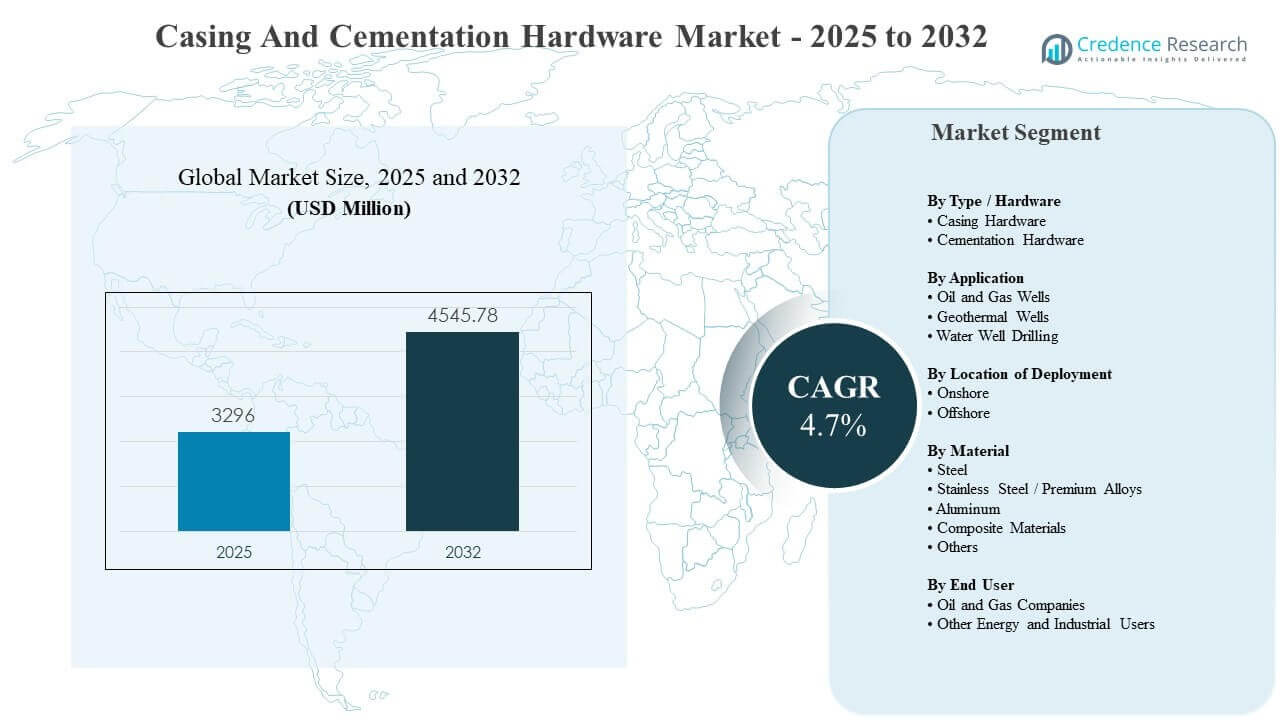
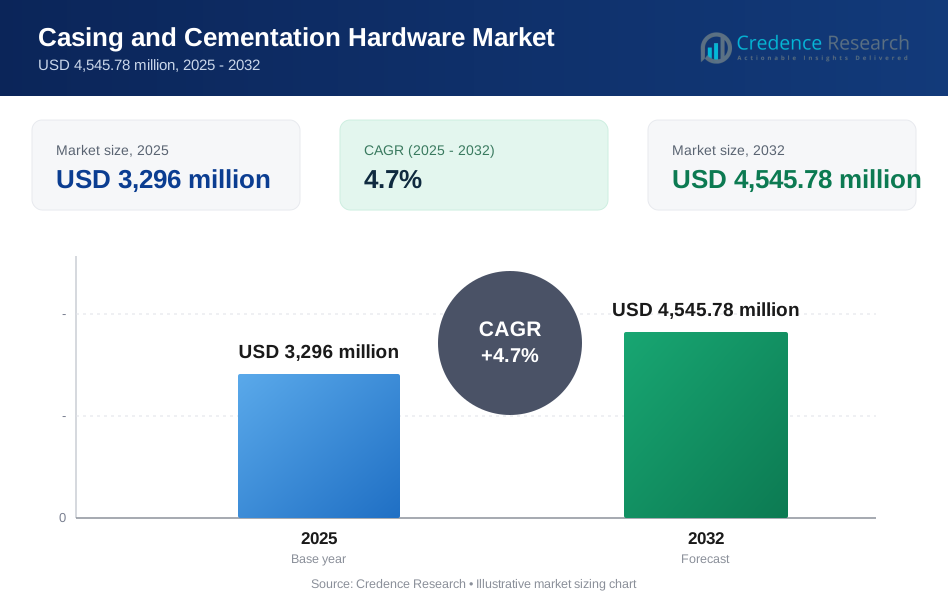
The global Casing and cementation hardware market size was estimated at USD 3,296 million in 2025 and is expected to reach USD 4,545.78 million by 2032, growing at a CAGR of 4.7% from 2025 to 2032. Rising drilling and completion intensity in complex well designs is increasing demand for dependable casing accessories and cementation systems that protect zonal isolation and long-term wellbore integrity. Increased focus on operational efficiency and job consistency across high-activity basins is also accelerating adoption of performance-oriented hardware specifications across major regions.
| REPORT ATTRIBUTE | DETAILS |
|---|---|
| Historical Period | 2020-2024 |
| Base Year | 2025 |
| Forecast Period | 2026-2032 |
| Casing and Cementation Hardware Market Size 2025 | USD 3,296 million |
| Casing and Cementation Hardware Market, CAGR | 4.7% |
| Casing and Cementation Hardware Market Size 2032 | USD 4,545.78 million |
Key Market Trends & Insights
- The Casing and cementation hardware market is projected to expand from USD 3,296 million (2025) to USD 4,545.78 million (2032), reflecting a 4.7% CAGR during 2025–2032.
- North America represented 42% share in 2025, supported by high well counts, mature service ecosystems, and strong drilling program continuity.
- Casing Hardware held the leading share of 58% in 2025, reflecting sustained demand for reliable running, centralization, and integrity-focused casing components.
- Onshore deployments accounted for 69% share in 2025, driven by repeatable well programs, faster cycle times, and broader rig availability relative to offshore projects.
- Oil and Gas Wells accounted for 85% share in 2025, showing that upstream well construction remains the largest demand center for casing and cementation hardware.
Segment Analysis
The Casing and cementation hardware market shows demand patterns closely linked to drilling activity levels, completion complexity, and well integrity standards. Hardware selection is increasingly influenced by the need to reduce non-productive time, improve cement placement outcomes, and manage risks in extended-reach, high-pressure, and high-temperature environments. Procurement decisions often prioritize compatibility with existing well construction workflows and field-proven reliability, especially in high-frequency onshore programs.
Material and deployment choices are also shifting as operators target longer well life and improved production assurance. Premium materials gain preference in corrosive or sour-service conditions, and high-spec hardware adoption rises where intervention costs are high. Service integration and standardization across drilling campaigns strengthens repeat purchasing for proven product families and bundled offerings.
By Type / Hardware Insights
Casing Hardware accounted for the largest share of 58% in 2025. Casing Hardware demand remains high because casing accessories directly affect running efficiency, string stability, and the success of cementation outcomes. Centralizers, float equipment, and related components support uniform annular clearance and consistent cement sheath formation across varied well geometries. Standardization across high-volume programs also favors casing hardware solutions that demonstrate repeatable field performance and fast availability.
By Application Insights
Oil and Gas Wells accounted for the largest share of 85% in 2025. Oil and Gas Wells dominate demand because well construction and integrity requirements create continuous consumption of casing and cementation hardware across drilling, completion, and workover cycles. Unconventional development increases the number of wells and compresses execution timelines, raising the value of dependable hardware that reduces operational variability. Complex well designs also require higher specification components to maintain isolation and protect long-term production performance.
By Location of Deployment Insights
Onshore accounted for the largest share of 69% in 2025. Onshore activity leads because high well counts and shorter project cycles translate into larger cumulative hardware volumes. Multi-well pad development encourages repeatable processes, which supports standardized casing and cementation hardware selection. Strong regional supply chains and service capacity also enable faster mobilization and consistent execution across onshore basins.
By Material Insights
Steel accounted for the largest share of 61% in 2025. Steel remains the preferred material due to a strong balance of strength, cost efficiency, and established manufacturing scale. Steel-based hardware supports a wide range of well conditions and remains compatible with common casing and cementing workflows. Premium alloys and composites expand in corrosive, sour, and high-temperature wells, but steel continues to anchor volume demand across most applications.
By End User Insights
Oil and Gas Companies accounted for the largest share of 74% in 2025. Oil and Gas Companies lead purchasing influence because operators are accountable for well integrity outcomes, compliance standards, and long-term asset performance. Operator procurement frameworks often standardize preferred hardware families across drilling campaigns to improve reliability and control total well cost. Integrated well construction models also strengthen operator demand for bundled casing and cementation solutions that reduce interface risk.
Casing and Cementation Hardware Market Drivers
Increasing Focus on Well Integrity and Zonal Isolation
Well integrity requirements continue to shape the Casing and cementation hardware market as operators prioritize consistent zonal isolation and reduced remediation risk. Casing accessories that improve centralization and casing stability support better cement placement outcomes across complex well geometries. Cementation hardware selection increasingly targets reliable slurry displacement and improved bonding performance. Regulatory expectations and long-life production targets reinforce demand for proven hardware designs. Operational teams also value standardized tool performance that supports repeatable execution across multi-well campaigns.
- For instance, Schlumberger reported that its zonal isolation workflows based on cement evaluation and bond logging reduced sustained casing pressure incidents by about 60% across a portfolio of deepwater wells compared with legacy cementing practices, while maintaining hydraulic isolation over multi‑year production periods.
Higher Complexity in Modern Well Designs
Modern well designs increase hardware requirements because extended laterals, higher pressures, and varied formations create more challenging operating conditions. High-deviation wellbores raise the need for casing hardware that reduces drag and supports clean running operations. Cementation equipment requirements rise as isolation needs grow across multi-stage completions and challenging annular profiles. Specialized hardware becomes more important when intervention costs are high and failure consequences increase. Procurement emphasis shifts toward high-spec components that reduce variability during critical installation steps.
Efficiency Pressure and Lower Non-Productive Time Targets
Efficiency pressure influences purchasing decisions as well economics depend on shorter cycle times and predictable execution. Reliable casing and cementation hardware reduces rework risk and supports faster transitions from drilling to completion. Integrated workflows strengthen demand for compatible equipment sets that reduce interface issues between casing running and cementing operations. Field teams prefer solutions that simplify job planning and minimize on-site troubleshooting. As drilling programs scale, repeatable hardware performance becomes a key driver of supplier selection and contract continuity.
Growth of Energy Transition Adjacent Drilling Activity
Energy transition drilling activity supports incremental demand for casing and cementation hardware beyond conventional upstream development. Geothermal wells require robust integrity solutions due to high-temperature exposure and long operating life expectations. Some industrial drilling applications also need dependable casing and cementation methods to protect subsurface stability and manage fluid pathways. Project developers often favor designs with strong reliability records to reduce operational risk. This mix widens the demand base and encourages product development for specialized operating conditions.
- For instance, experimental work on geothermal casings and cements at the Hellisheiði and FORGE projects showed that production casings and cement systems tested under cyclic temperatures up to about 262 °C maintained structural integrity and cement–metal bonding when designs specifically accounted for thermal loads, supporting decades‑long geothermal operation targets.
Casing and Cementation Hardware Market Challenges
Supply chain volatility and material cost variability challenge project planning in the Casing and cementation hardware market. Steel pricing swings and lead-time fluctuations can disrupt procurement schedules, especially in high-activity basins that require rapid replenishment. Quality consistency across suppliers becomes critical because hardware performance directly affects well integrity outcomes. Qualification requirements and customer approvals can slow supplier switching, increasing exposure to constrained availability. These factors collectively increase procurement complexity and can pressure margins across the value chain.
- For instance, ArcelorMittal has reported raw material cost swings driving iron ore between about 40 and 230 per tonne and metallurgical coal between about 100 and 600 per tonne over recent years, creating 200–400 per tonne variations in finished steel production cost that propagate into casing and tubing price volatility for oilfield hardware manufacturers.
Operational risk and performance accountability also constrain adoption of new designs in the Casing and cementation hardware market. Field teams require proven reliability because hardware issues can trigger costly remediation and production delays. Compatibility across different well designs, cement systems, and completion practices adds testing requirements. Offshore environments intensify standards due to higher intervention costs and corrosion exposure. As a result, product qualification cycles can lengthen and delay broader market penetration for new technologies.
Market Trends and Opportunities
Digital-enabled monitoring and job optimization are expanding as operators prioritize consistency and reduced variability in cementing operations. Equipment health tracking and real-time operational insights support preventative maintenance and more predictable job execution. Standardization across large drilling programs increases demand for integrated hardware packages that simplify planning and reduce interface risk. Service integration also supports bundled offerings that combine casing hardware, cementation equipment, and execution support. These trends create opportunities for differentiated suppliers that deliver reliability, traceability, and field-ready performance.
- For instance, AI-driven health scoring in cement plants that applies continuous vibration and temperature monitoring on high‑impact assets has been shown to reduce unplanned downtime by 15–20% after integration with predictive maintenance workflows and automated work orders.
Premiumization is increasing where operating conditions require higher corrosion resistance, higher temperature tolerance, or extended service life. Stainless steel and premium alloys gain adoption in sour-service and offshore environments, where integrity failures carry high cost. Composite materials expand selectively in applications that value corrosion resistance, handling efficiency, or specialized performance. The onshore base continues to drive volume, but offshore and geothermal projects can lift average selling prices through higher specification requirements. Supplier capability in testing, certification, and performance validation becomes a competitive advantage.
Regional Insights
North America
North America held 42% share in 2025, supported by large-scale drilling activity and established service ecosystems. High well counts and multi-well development models drive repeat demand for casing and cementation hardware. Operator preference for standardized tool strings strengthens purchasing consistency across campaigns. Strong logistics and manufacturing capacity improve availability across key basins. Technology adoption is accelerated by rapid field feedback and performance benchmarking across large operator portfolios.
Europe
Europe held 24% share in 2025, shaped by strict operational standards and a strong focus on integrity-driven well construction. Project execution often favors higher-spec solutions that support reliability and compliance expectations. Offshore exposure in parts of the region supports demand for corrosion-resistant materials and robust cementation hardware. Supply chain qualification and documented performance evidence influence procurement decisions. Regional activity levels can be variable, but specification intensity remains high.
Asia Pacific
Asia Pacific held 20% share in 2025, supported by ongoing upstream development and a growing focus on improving well construction outcomes. Large national operators and service providers influence procurement through long-cycle project planning and standardized equipment requirements. The region can show strong demand for cost-effective solutions that still meet reliability thresholds. Offshore projects and complex geology in several markets encourage adoption of premium materials and specialized equipment. Local manufacturing and partnership ecosystems can affect lead times and pricing competitiveness.
Latin America
Latin America held 6% share in 2025, supported by upstream projects that require dependable well construction hardware and consistent execution support. Offshore and deepwater exposure increases the need for high-reliability casing and cementation solutions, especially where intervention costs are high. Procurement can prioritize supplier capability to support logistics and field service requirements. Project timing can be influenced by investment cycles and regulatory factors. Long-term contracts and integrated services can strengthen supplier positioning.
Middle East & Africa
Middle East & Africa held 8% share in 2025, driven by sustained upstream development and large-scale field operations requiring standardized integrity solutions. High-temperature and corrosive environments increase demand for premium materials and performance-proven hardware. Large operators often procure through structured frameworks that emphasize qualification and execution reliability. Regional projects can require strong service support and inventory readiness. Scale and long-life asset strategies reinforce demand for consistent well integrity outcomes.
Competitive Landscape
The Casing and cementation hardware market remains moderately consolidated, with global oilfield service leaders and tubular specialists competing through performance reliability, field support, and integrated well construction offerings. Product differentiation is increasingly tied to job consistency, material performance under harsh conditions, and compatibility with standardized drilling and completion workflows. Contract strength often depends on operational track record, supply assurance, and the ability to bundle hardware with execution support across multi-well programs.
Halliburton Company strengthens competitive positioning through integrated cementing workflows and equipment-centric solutions that support repeatable job execution across high-activity regions. Halliburton Company benefits from scale in field deployment, established customer relationships, and operational support models that reduce variability in cementing operations. Halliburton Company also emphasizes technology-driven monitoring and maintenance approaches to improve equipment uptime and job consistency across drilling campaigns.
The industry research and growth report includes detailed analyses of the competitive landscape of the market and information about key companies, including:
- Halliburton Company
- Schlumberger Limited (SLB)
- Baker Hughes Company
- NOV Inc.
- Weatherford International plc
- Tenaris S.A.
- Vallourec S.A.
- TMK Group
- Trican Well Service Ltd.
- Forum Energy Technologies Inc.
- Nabors Industries Ltd.
- Centek Holdings Ltd.
Qualitative and quantitative analysis of companies has been conducted to help clients understand the wider business environment as well as the strengths and weaknesses of key industry players. Data is qualitatively analyzed to categorize companies as pure play, category-focused, industry-focused, and diversified; it is quantitatively analyzed to categorize companies as dominant, leading, strong, tentative, and weak.
Recent Developments
- In July 2024, NOV Inc. launched its Digital Cementing Platform, integrating smart float equipment with real-time analytics to improve cement placement accuracy and reduce non-productive time in complex wells.
- In September 2024, Baker Hughes Co. secured a major five-year contract to supply comprehensive casing and cementing hardware for a large deepwater project offshore Brazil, strengthening its regional footprint in high-spec offshore developments.
- In November 2024, Schlumberger Ltd. entered a strategic collaboration with a leading cloud provider to combine real-time drilling data with AI-driven cement job modeling, targeting improved zonal isolation and cement bond assurance in challenging wells.
Report Scope
| Report Attribute | Details |
| Market size value in 2025 | USD 3296 million |
| Revenue forecast in 2032 | USD 4545.78 million |
| Growth rate (CAGR) | 4.7% (2025–2032) |
| Base year | 2025 |
| Forecast period | 2026-2032 |
| Quantitative units | USD million |
| Segments covered | By Type / Hardware Outlook: Casing Hardware, Cementation Hardware; By Application Outlook: Oil and Gas Wells, Geothermal Wells, Water Well Drilling; By Location of Deployment Outlook: Onshore, Offshore; By Material Outlook: Steel, Stainless Steel / Premium Alloys, Aluminum, Composite Materials, Others; By End User Outlook: Oil and Gas Companies, Other Energy and Industrial Users |
| Regional scope | North America, Europe, Asia Pacific, Latin America, Middle East & Africa |
| Key companies profiled | Halliburton Company; Schlumberger Limited (SLB); Baker Hughes Company; NOV Inc.; Weatherford International plc; Tenaris S.A.; Vallourec S.A.; TMK Group; Trican Well Service Ltd.; Forum Energy Technologies Inc.; Nabors Industries Ltd.; Nabors Industries Ltd.; Centek Holdings Ltd. |
| No. of Pages | 330 |
Segmentation
By Type / Hardware
- Casing Hardware
- Cementation Hardware
By Application
- Oil and Gas Wells
- Geothermal Wells
- Water Well Drilling
By Location Of Deployment
- Onshore
- Offshore
By Material
- Steel
- Stainless Steel / Premium Alloys
- Aluminum
- Composite Materials
- Others
By End User
- Oil and Gas Companies
- Other Energy and Industrial Users
By Region
- North America
- U.S.
- Canada
- Mexico
- Europe
- Germany
- France
- U.K.
- Italy
- Spain
- Rest of Europe
- Asia Pacific
- China
- Japan
- India
- South Korea
- South-east Asia
- Rest of Asia Pacific
- Latin America
- Brazil
- Argentina
- Rest of Latin America
- Middle East & Africa
- GCC Countries
- South Africa
- Rest of the Middle East and Africa
Request a Free Sample
Fill in your details and we'll send you a free sample report.
- Sample data tables & charts
- Research methodology
Need a Custom Version of This Report?
Tailor the scope, geography, or segments to your exact requirements.
- Custom geography or segment scope
- Direct access to our analyst team
Frequently Asked Questions
What is the current size of the Casing and cementation hardware market?
What is the forecast value for the Casing and cementation hardware market?
What is the CAGR for the Casing and cementation hardware market during 2025–2032?
Which segment leads the market by type in 2025?
Who are the key players in the Casing and cementation hardware market?
Which region leads the Casing and cementation hardware market in 2025?
Table of Content
Chapter 1. Report Introduction
- 1.1 Report Description & Purpose
- 1.1.1 Report Title & Market Definition
- 1.1.2 Unique Selling Propositions (USP) & Key Differentiators
- 1.1.3 Value Proposition for Stakeholders
- 1.2 Research Objectives
- 1.2.1 Market Sizing Objectives (Volume & Revenue)
- 1.2.2 Segmentation Objectives
- 1.2.3 Competitive Intelligence Objectives
- 1.2.4 Forecast & Scenario Objectives
- 1.3 Report Scope
- 1.3.1 Casing and Cementation Hardware Scope – Types & Subtypes Covered
- 1.3.2 Geographic Scope – Regions & Countries Covered
- 1.3.3 Historical Period, Base Year & Forecast Period (2025; forecast to 2032)
- 1.3.4 Inclusions & Exclusions
- 1.4 HS Code & Classification Framework
- 1.5 Currency, Units & Pricing Basis
- 1.6 Target Stakeholders
- 1.7 Limitations & Assumptions
Chapter 2. Executive Summary
- 2.1 Global Casing and Cementation Hardware Market Snapshot
- 2.1.1 Market Size – Historical (2025) & Forecast (2025-2032) (2025: USD 3,296 million → 2032: USD 4,545.78 million)
- 2.1.2 Volume & Revenue – Global Totals
- 2.1.3 Key Market Highlights – Top Five Facts
- 2.2 Casing and Cementation Hardware Market Segmentation Snapshot
- 2.2.1 Market Split by Region – 2025 vs. 2032
- 2.3 Competitive Snapshot
- 2.3.1 Top 10 Players by Revenue Share – 2025
- 2.3.2 Top 10 Players by Volume Share – 2025
- 2.3.3 Recent Strategic Developments (18-Month Summary)
- 2.4 Key Investment Highlights & Strategic Conclusions
Chapter 3. Casing and Cementation Hardware Market Dynamics & Industry Analysis
- 3.1 Market Overview & Context
- 3.1.1 Casing and Cementation Hardware Market Position in the Broader Automotive Value Chain
- 3.1.2 OEM vs. Replacement Market Dynamics
- 3.1.3 Market Maturity & Development Stage by Region
- 3.2 Casing and Cementation Hardware Market Drivers
- 3.3 Casing and Cementation Hardware Market Restraints & Challenges
- 3.4 Casing and Cementation Hardware Market Opportunities
- 3.5 Porter's Five Forces Analysis
- 3.5.1 Threat of New Entrants
- 3.5.2 Bargaining Power of Suppliers
- 3.5.3 Bargaining Power of Buyers
- 3.5.4 Threat of Substitutes
- 3.5.5 Competitive Rivalry – Intensity Assessment
- 3.6 Casing and Cementation Hardware Value Chain Analysis
- 3.6.1 Upstream – Raw Material/Input Suppliers
- 3.6.1.1 Raw Material/Input 1
- 3.6.1.2 Raw Material/Input 2
- 3.6.1.3 Raw Material/Input 3
- 3.6.2 Midstream – Production/Manufacturing/Service Delivery
- 3.6.2.1 Production/Process Overview
- 3.6.2.2 Key Facility Locations & Capacity by Manufacturer
- 3.6.3 Downstream – Distribution & End Consumer
- 3.6.3.1 Primary Channel – B2B/OEM
- 3.6.3.2 Secondary Channels – Dealer, Retail, Online, Direct
- 3.6.4 Value Chain Profitability Analysis
- 3.6.1 Upstream – Raw Material/Input Suppliers
- 3.7 PESTEL Analysis
- 3.7.1 Political Factors
- 3.7.2 Economic Factors
- 3.7.3 Social Factors
- 3.7.4 Technological Factors
- 3.7.5 Environmental Factors
- 3.7.6 Legal Factors
- 3.8 Casing and Cementation Hardware Supply Chain Analysis
- 3.8.1 Raw Material/Input Supply Risk Assessment
- 3.8.2 Manufacturing Concentration Risk (Geographic Exposure)
- 3.8.3 Trade Disruption Impact Analysis
- 3.9 Regulatory & Policy Landscape
Note: The regulatory and policy landscape section covers regulations based on their applicability to the market, Casing and Cementation Hardware category, geography, and scope of the study. Only regulatory frameworks with a material impact on operations, compliance, trade, sustainability, or market access are analyzed in detail.
Chapter 4. Key Investment Pockets & Opportunity Analysis
- 4.1 Casing and Cementation Hardware Market Attractiveness Analysis
- 4.1.1 By Region – Investment Attractiveness Matrix (Volume × CAGR)
- 4.2 Absolute Revenue Growth Opportunity
- 4.2.1 By Region – Absolute USD Growth Through 2032
- 4.3 Incremental Volume Opportunity
- 4.3.1 By Region – Incremental Volume Through 2032
- 4.3.2 Segment – Incremental Volume
- 4.4 Emerging Submarket Opportunity Deep Dive (Subject to Applicability)
- 4.5 Emerging Market Opportunity Scorecards
- 4.5.1 United States
- 4.5.2 Europe
- 4.5.3 Asia
- 4.5.4 Middle East & Africa
Note: Emerging Market Opportunity Scorecards will be included based on relevance and strategic importance. Regions listed are indicative and may vary depending on data availability and market dynamics.
Chapter 5. Casing and Cementation Hardware Import-Export Analysis & Trade Flows
- 5.1 Global Trade Overview
- 5.1.1 Global Export Value by Country (2025)
- 5.1.2 Global Export Volume by Country (2025)
- 5.1.3 Global Import Value by Country (2025)
- 5.1.4 Global Import Volume by Country (2025)
- 5.1.5 Net Trade Balance by Country (2025)
- 5.2 Export Analysis – Segment
- 5.2.1 Type 1 (HS Code)
- 5.2.2 Type 2 (HS Code)
- 5.2.3 Type 3 (HS Code)
- 5.2.4 Type 4 (HS Code)
- 5.2.5 Type 5 (HS Code)
- 5.3 Import Analysis – Segment
- 5.3.1 Type 1 (HS Code)
- 5.3.2 Type 2 (HS Code)
- 5.3.3 Type 3 (HS Code)
- 5.3.4 Type 4 (HS Code)
- 5.3.5 Type 5 (HS Code)
- 5.4 Average Unit Trade Prices
- 5.4.1 Average Export Price – Segment & Country
- 5.4.2 Average Import Price – Segment & Source Country
- 5.4.3 Price Trends (2025)
- 5.5 Key Trade Route Analysis
- 5.5.1 Trade Route 1
- 5.5.2 Trade Route 2
- 5.5.3 Trade Route 3
- 5.5.4 Trade Route 4
- 5.5.5 Trade Route 5
- 5.6 Trade Policy Impact Assessment
- 5.6.1 US Anti-Dumping & Section 301 Tariffs
- 5.6.2 EU Customs Union Impact
- 5.6.3 Major Free Trade Agreements
- 5.6.4 USMCA Rules of Origin
Note: Trade policy analysis will be included only where relevant to the Casing and Cementation Hardware market.
Chapter 6. Competitive Landscape & Company Benchmarking
- 6.1 Casing and Cementation Hardware Market Concentration & Structure
- 6.1.1 Herfindahl-Hirschman Index (HHI) – vs. 2025
- 6.1.2 Tier 1, Tier 2 & Tier 3 Market Structure
- 6.1.3 Global, Regional & Local Player Dynamics
- 6.2 Casing and Cementation Hardware Market Share Analysis – 2025
- 6.2.1 Global Revenue Share by Company
- 6.2.2 Global Volume Share by Company
- 6.2.3 Regional Revenue Share
- 6.2.4 Market Share Evolution ( vs. 2025)
- 6.2.5 OEM Segment Share by Company
- 6.2.6 Replacement Segment Share by Company
- 6.3 Production/Delivery Capacity & Facility Analysis
- 6.3.1 Global Installed Capacity
- 6.3.2 Capacity Utilization Rates
- 6.3.3 Production/Output Volume
- 6.3.4 Facility Locations & Capacity Map
- 6.3.5 Planned Capacity Additions
- 6.4 Casing and Cementation Hardware Competitive Benchmarking Matrix
- 6.4.1 Revenue, Volume, CAGR & Profitability Comparison
- 6.4.2 Channel Revenue Mix
- 6.4.3 Geographic Revenue Exposure
- 6.4.4 R&D Intensity
- 6.4.5 Sustainability Maturity
- 6.5 Strategic Developments in Casing and Cementation Hardware (Last 24 Months)
- 6.5.1 Mergers, Acquisitions & Divestments
- 6.5.2 New Casing and Cementation Hardware Launches
- 6.5.3 Facility Expansions
- 6.5.4 Strategic Alliances, Joint Ventures & Partnerships
- 6.5.5 Distribution Expansion & Market Entry
- 6.5.6 Sustainability & ESG Initiatives
- 6.6 Competitive Strategy Mapping
- 6.6.1 Leader, Challenger, Follower & Niche Classification
- 6.6.2 Pricing Strategy Comparison
- 6.6.3 Channel Strategy Matrix
Note: Strategic developments are included based on their materiality and the availability of reliable information.
Chapter 7. Global Casing and Cementation Hardware Market – By Distribution Channel
- 7.1 Segment Overview
- 7.1.1 Volume & Revenue Split by Channel (2025 & 2032)
- 7.1.2 Channel Mix Evolution (2025-2032)
Chapter 8. Regional Market Analysis – Global Overview
- 8.1 Global Regional Overview
- 8.1.1 Regional Volume Share
- 8.1.2 Regional Revenue Share
- 8.1.3 Regional Volume by Region
- 8.1.4 Regional Revenue by Region
- 8.1.5 Regional Forecast Through 2032
- 8.2 Cross-Regional Segment Analysis
- 8.2.1 By Distribution Channel
- 8.2.2 By Brand/Price Tier
Chapter 9. North America Casing and Cementation Hardware Market
- 9.1 United States
- 9.2 Canada
- 9.3 Mexico
Chapter 10. Europe Casing and Cementation Hardware Market
- 10.1 Germany
- 10.2 France
- 10.3 Italy
- 10.4 United Kingdom
- 10.5 Spain
- 10.6 Poland
- 10.7 Russia
- 10.8 Netherlands
- 10.9 Belgium
- 10.10 Sweden
- 10.11 Denmark
- 10.12 Norway
- 10.13 Rest of Europe
Chapter 11. Asia Pacific Casing and Cementation Hardware Market
- 11.1 China
- 11.2 India
- 11.3 Japan
- 11.4 South Korea
- 11.5 Thailand
- 11.6 Indonesia
- 11.7 Vietnam
- 11.8 Malaysia
- 11.9 Australia
- 11.10 Rest of Asia Pacific
Chapter 12. Latin America Casing and Cementation Hardware Market
- 12.1 Brazil
- 12.2 Argentina
- 12.3 Colombia
- 12.4 Chile
- 12.5 Rest of Latin America
Chapter 13. Middle East Casing and Cementation Hardware Market
- 13.1 Saudi Arabia
- 13.2 United Arab Emirates
- 13.3 Turkey
- 13.4 Israel
- 13.5 Iran
- 13.6 Rest of the Middle East
Chapter 14. Africa Casing and Cementation Hardware Market
- 14.1 South Africa
- 14.2 Egypt
- 14.3 Nigeria
- 14.4 Morocco
- 14.5 Rest of Africa
Chapter 15. Casing and Cementation Hardware Company Profiles
- 15.1 [Company 01]
- 15.1.1 Company Overview
- 15.1.2 Key Management Personnel
- 15.1.3 Products & Services Portfolio
- 15.1.4 Financial Performance
- 15.1.5 Key Market Focus & Geographic Presence
- 15.1.6 Recent Developments & Strategic Initiatives
Note: The company profile list is preliminary and may change based on research findings, market developments, data availability, and client requirements.
Chapter 16. Appendices
- Appendix A – List of Abbreviations & Acronyms
- Appendix B – Industry Classification Code Reference – Full Series
- Appendix C – Production & Capacity Data Tables
- Appendix D – End-Use & Demand Base Tables
- Appendix E – Consumption & Replacement Rate Assumptions
- Appendix F – ASP Reference Tables
- Appendix G – Manufacturing & Facility Database
- Appendix H – Import-Export Data Tables
- Appendix I – Regulatory Summary Tables
- Appendix J – Primary Research Participant List (Anonymized)
- Appendix K – Primary Research Questionnaire Framework
- Appendix L – Data Sources & Bibliography
- Appendix M – Market Size Divergence & Source Comparison
Chapter 17. Research Methodology
- 17.1 Research Framework & Philosophy
- 17.2 Secondary Research – Sources, Hierarchy & Data Extraction
- 17.3 Data Modeling – Bottom-Up & Top-Down Market Sizing
- 17.4 Primary Research – Stakeholder Framework, LOI & Sample Sizes
- 17.5 Forecast Methodology – Regression, Scenario & Sensitivity Analysis
- 17.6 Quality Control – Four-Layer Validation Framework
- 17.7 Limitations & Standard Assumptions
- 17.8 Disclaimer
