
Centrifugal Compressors Market Overview:
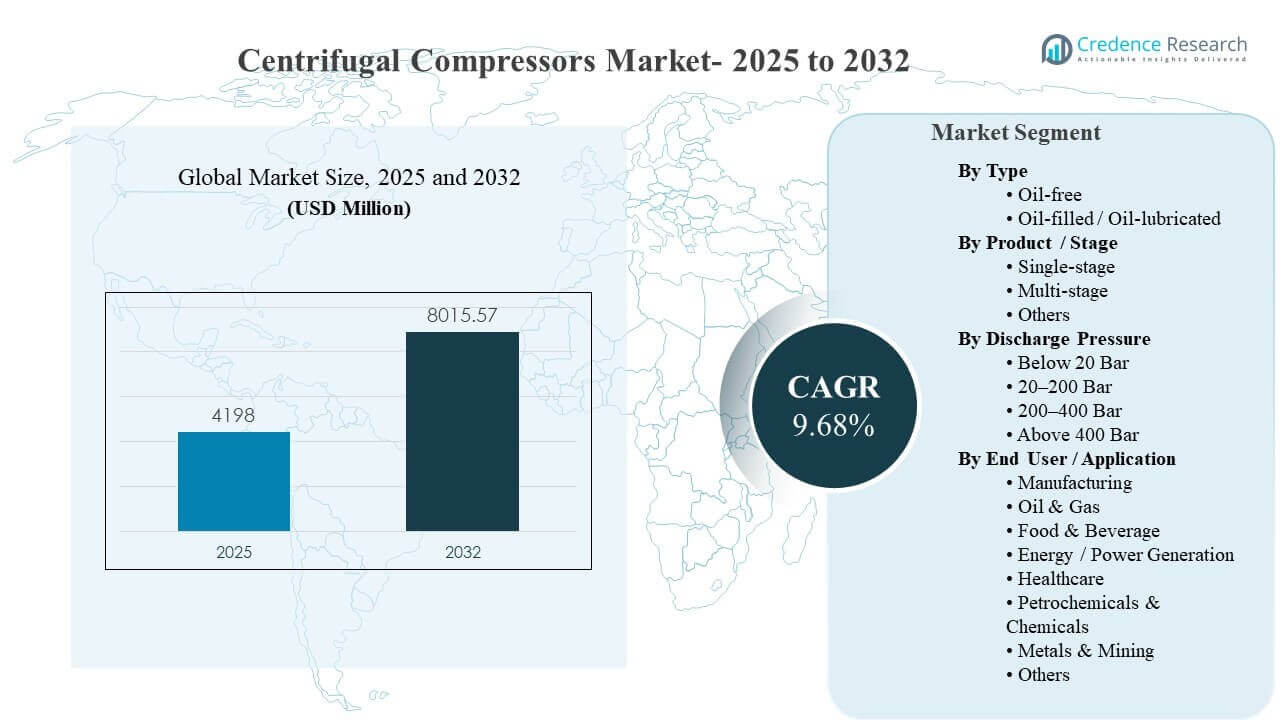
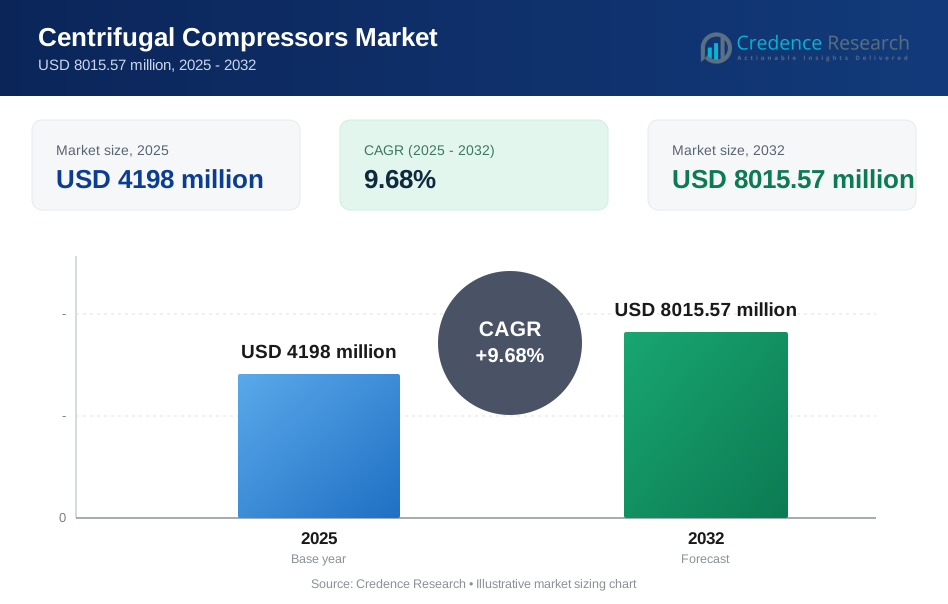
The global centrifugal compressors market size was estimated at USD 4198 million in 2025 and is expected to reach USD 8015.57 million by 2032, growing at a CAGR of 9.68% from 2025 to 2032. Growth momentum is reinforced by rising demand for continuous-duty compression across gas processing, petrochemicals, and large-scale manufacturing operations where uptime and efficiency influence equipment selection. Asia Pacific continues to remain a high-volume consumption and installation region as industrial capacity additions and energy infrastructure programs accelerate equipment replacement and new project deployments.
| REPORT ATTRIBUTE | DETAILS |
|---|---|
| Historical Period | 2020-2024 |
| Base Year | 2025 |
| Forecast Period | 2026-2032 |
| Centrifugal Compressors Market Size 2025 | USD 4198 million |
| Centrifugal Compressors Market, CAGR | 9.68% |
| Centrifugal Compressors Market Size 2032 | USD 8015.57 million |
Key Market Trends & Insights
- The centrifugal compressors market expands from USD 4198 million (2025) to USD 8015.57 million (2032), reflecting a 9.68% CAGR (2025–2032).
- Asia Pacific accounted for 39.4% in 2025, supported by industrial buildouts that require high-flow and reliable compression for process applications.
- Europe held 24.8% share in 2025, driven by efficiency upgrades and modernization programs across chemicals, refining, and process manufacturing sites.
- Single-stage accounted for the largest share of 57.8% in 2025, supported by broad suitability across plant utilities and mainstream process duties.
- Oil & Gas accounted for the largest share of 33.9% in 2025, reflecting sustained demand for compression in gas processing, transmission, and LNG-linked infrastructure.
Segment Analysis
The centrifugal compressors market demand profile is anchored in applications that require stable flow, high reliability, and long operating cycles across industrial sites. Procurement decisions increasingly weigh lifecycle performance, maintenance accessibility, and service responsiveness, particularly for critical processes where downtime carries production and safety risks. Efficiency-driven replacement cycles are strengthening, supported by digital monitoring and predictive maintenance approaches that help operators manage operating conditions and reduce unplanned stops. Project-based demand from energy and process industries remains a key contributor to large order sizes and engineered package customization.
End-use diversification continues as manufacturing, energy, petrochemicals, and metals processing expand capacity and optimize compressed air and gas systems. Oil & gas remains central to demand due to continuous-duty requirements for gas handling, processing, and transport, along with emissions and reliability expectations across midstream and downstream assets. Food & beverage and healthcare users prioritize contamination control and operational consistency, influencing technology and configuration choices. Across sectors, procurement teams increasingly favor vendors with strong aftermarket networks, spares availability, and field-service capability.
By Type Insights
Oil-free configurations gain attention in contamination-sensitive environments where product integrity and process cleanliness influence purchasing priorities. Food and beverage production lines and select healthcare-related operations commonly prefer oil-free compression to reduce downstream filtration needs and minimize contamination risk. Oil-filled or oil-lubricated systems remain prevalent in heavy-duty industrial services where established maintenance routines, rugged performance expectations, and cost optimization shape selection. Service accessibility, reliability targets, and energy efficiency improvements continue to influence type selection across project and replacement cycles.
By Product / Stage Insights
Single-stage accounted for the largest share of 57.8% in 2025. Single-stage adoption benefits from simpler design and broad applicability across plant utilities and many mainstream process duties. Maintenance planning is often more straightforward for single-stage packages, which supports adoption among users focused on uptime and predictable servicing. Multi-stage solutions remain important where higher pressure ratios and staged compression support process needs in petrochemicals, gas processing, and specialized industrial applications.
By Discharge Pressure Insights
Below 20 bar demand is commonly associated with utility and general industrial duties where moderate pressure levels meet plant requirements. The 20–200 bar range is frequently aligned with mainstream process compression needs and many pipeline and plant systems that require balanced pressure capability and efficiency. Higher discharge pressure ranges such as 200–400 bar and above 400 bar tend to be concentrated in specialized process duties and engineered project deployments with stricter safety and performance specifications. Pressure-class selection is also shaped by site safety requirements, energy consumption targets, and reliability expectations for continuous-duty operation.
By End User / Application Insights
Oil & Gas accounted for the largest share of 33.9% in 2025. Oil & gas demand is supported by continuous-duty compression across gas processing, transmission, storage, and LNG-linked assets where reliability and throughput are critical. Project execution capability and long-term service support influence supplier selection in the oil & gas value chain due to operational criticality. Petrochemicals and chemicals also contribute strongly through capacity additions and revamp cycles, while manufacturing and power generation demand is reinforced by plant reliability targets and efficiency upgrades.
Centrifugal Compressors Market Drivers
Expansion Of Gas Processing And LNG Infrastructure
Gas processing, transmission, and LNG-linked infrastructure expands centrifugal compressor demand due to continuous-duty operating requirements and the need for high-flow compression. Many projects require engineered packages that integrate performance, safety, and reliability across long operating cycles. Project development also creates demand for commissioning support and lifecycle service contracts. The centrifugal compressors market benefits from ongoing replacement cycles where operators improve reliability and reduce downtime through upgraded compression systems.
Industrial Capacity Additions In Process Manufacturing
Process industries such as petrochemicals, chemicals, and metals processing increase compressor demand through capacity expansion and revamp projects. Industrial plants often require stable, high-throughput compression to support core process steps and plant utilities. Procurement teams value predictable performance, serviceability, and aftermarket coverage that reduces operational risk. The centrifugal compressors market gains from modernization programs where older equipment is replaced to improve efficiency and support higher production targets.
- For instance, Atlas Copco states that its T-Series centrifugal compressors for chemical and petrochemical applications can handle discharge pressures up to 45 bar and flow volumes up to 150,000 m3/h, while conforming to API 617 Chapter 2 and API 614 standards.
Efficiency And Reliability Focus In Continuous-Duty Applications
Energy efficiency and reliability requirements increasingly shape compressor selection, especially in facilities operating around the clock. Operators prioritize systems that reduce energy waste while maintaining stable discharge performance across variable operating conditions. Digital monitoring and predictive maintenance approaches improve operational control and reduce unplanned downtime. The centrifugal compressors market advances as more end users adopt lifecycle-based procurement models that emphasize uptime and maintenance optimization.
- For instance, Baker Hughes says its Bently Nevada condition-monitoring portfolio supports centrifugal compressors, has more than 9 million sensors installed worldwide, and can provide accurate machinery diagnostics in under 60 minutes.
Strong Aftermarket And Service-Led Procurement
Aftermarket service capability influences supplier selection because many centrifugal compressor deployments serve critical processes. Service networks, spare parts availability, and field technical expertise reduce the risk of extended outages. Long-term service agreements can support predictable operating costs and faster troubleshooting cycles. The centrifugal compressors market benefits when vendors differentiate through service responsiveness and performance optimization offerings that extend asset life.
Centrifugal Compressors Market Challenges
Centrifugal compressor deployments often require high upfront investment, engineered customization, and careful integration into plant systems, which can slow purchase decisions. Project timelines can shift due to permitting, financing, or broader industrial capex constraints, creating demand variability across end-user sectors. Specialized installation and commissioning requirements also increase dependence on skilled technical support and field service. The centrifugal compressors market faces pressure when buyers prioritize shorter payback cycles and defer large upgrades.
- For instance, Siemens Energy states that its standardized integrally geared compressors are 80% pre-engineered and 20% customizable, cover 10,000-400,000 m3/h, and sit alongside a single-stage centrifugal design rated up to 1,000,000 m3/h, while the company also notes that large units are delivered as separate main-train components for site installation, highlighting how scale and plant integration can increase project complexity.
Operating environments can be harsh, and performance expectations are high, creating challenges related to maintenance planning and availability of qualified technicians. Supply-chain disruptions for critical components and extended lead times can delay project execution and equipment replacement cycles. Performance guarantees and reliability requirements can also increase engineering complexity and testing needs. The centrifugal compressors market must address these constraints through service readiness, inventory planning, and robust project management capability.
Centrifugal Compressors Market Trends and Opportunities
Digital monitoring, condition-based maintenance, and analytics-enabled service models continue to expand across industrial compression assets. Many buyers increasingly request integrated controls, diagnostics, and performance optimization to reduce downtime and improve lifecycle economics. Digital capabilities also support remote troubleshooting, better spares planning, and improved operational transparency for multi-site operators. The centrifugal compressors market gains opportunity as service-led differentiation becomes more important in supplier selection.
- For instance, Atlas Copco states that its SMARTLINK Uptime platform uploads compressor data every 5 minutes, and the company’s SMARTLINK materials say connected monitoring can help users save up to 30% through energy-focused diagnostics and proactive troubleshooting.
Energy transition initiatives create opportunities for specialized compression needs in low-carbon industrial projects. Applications linked to hydrogen, carbon capture, and new process configurations can increase demand for engineered centrifugal compression solutions with higher efficiency and robust reliability. Industrial decarbonization efforts also encourage replacement cycles where plants improve energy performance and reduce operational losses. The centrifugal compressors market can benefit from engineered project pipelines and long-term service demand tied to new infrastructure.
Regional Insights
North America
North America held 21.3% share in 2025, supported by industrial modernization and ongoing investment across energy infrastructure and process manufacturing. Operational reliability requirements in North America strengthen demand for robust designs and strong aftermarket coverage. Buyers often prioritize service responsiveness, spares availability, and lifecycle maintenance planning for critical assets. Replacement demand remains relevant across mature facilities pursuing efficiency and uptime improvements.
Europe
Europe represented 24.8% share in 2025, driven by modernization programs and efficiency-led upgrades across chemicals, refining, and industrial manufacturing sites. Reliability and engineering standards influence the selection of high-performance compression systems and structured service support. Maintenance regimes often favor predictable service intervals and performance optimization. Demand momentum also benefits from plant revamps aligned with productivity and sustainability priorities.
Asia Pacific
Asia Pacific captured 39.4% share in 2025, supported by large-scale industrial capacity additions and expanding infrastructure across manufacturing and process industries. New project deployments increase demand for engineered packages designed for high-flow and continuous operation. Supplier selection in Asia Pacific often emphasizes delivery capability, localized service support, and lifecycle cost competitiveness. Industrial expansion and modernization programs continue to reinforce regional demand.
Latin America
Latin America accounted for 5.8% share in 2025, shaped by project-driven investments in oil & gas, mining, and selective industrial processing. Demand patterns can be episodic due to capex cycles and commodity-linked spending trends. Reliability and service coverage remain important for remote operations and harsh environments. Replacement demand is also supported by modernization of legacy facilities and infrastructure.
Middle East & Africa
Middle East & Africa held 8.7% share in 2025, underpinned by hydrocarbon processing capacity, industrial diversification projects, and infrastructure expansion. Continuous-duty operations and high utilization rates increase the importance of reliability, engineered project execution, and long-term service support. Harsh operating conditions amplify the value of robust design and maintenance readiness. Large projects in refining and gas processing continue to sustain demand.
Competitive Landscape
Competition in the centrifugal compressors market is characterized by performance-driven product portfolios, engineered-to-order project execution, and long-term service and maintenance offerings. Vendors differentiate through energy-efficiency improvements, reliability performance, integration capability with plant systems, and service ecosystem depth. Aftermarket service contracts and spares availability influence buyer selection, particularly in continuous-duty operations where downtime cost is high. Project execution experience and global/local support coverage remain key decision factors.
Ingersoll Rand Inc. competes through industrial compression expertise, application-specific packaging, and service offerings designed for uptime-critical environments. Product development focus often emphasizes efficiency, reliability, and maintainability to support lifecycle economics for industrial operators. Service networks and field support capability help address commissioning needs and ongoing performance optimization. Portfolio depth across industrial applications supports cross-selling and long-term customer relationships.
The industry research and growth report includes detailed analyses of the competitive landscape of the market and information about key companies, including:
- Ingersoll Rand Inc.
- Atlas Copco AB
- Siemens Energy AG
- Baker Hughes Company
- Mitsubishi Heavy Industries, Ltd.
- MAN Energy Solutions
- Kawasaki Heavy Industries, Ltd.
- Flowserve Corporation
- Kaishan Group
- Kobe Steel, Ltd. (Kobelco)
- IHI Rotating Machinery Engineering Co., Ltd.
- FS-Elliott Co., LLC
Qualitative and quantitative analysis of companies has been conducted to help clients understand the wider business environment as well as the strengths and weaknesses of key industry players. Data is qualitatively analyzed to categorize companies as pure play, category-focused, industry-focused, and diversified; it is quantitatively analyzed to categorize companies as dominant, leading, strong, tentative, and weak.
Recent Developments
- In May 2025, IHI Rotating Machinery Engineering Co., Ltd. launched the new high-efficiency TRZ Series centrifugal compressor, designed for the world’s largest market segment with motor outputs from 500 kW to 1,120 kW and discharge air volumes from 5,600 to 12,320 m³/h.
- In June 2025, Honeywell announced that it had completed its acquisition of Sundyne for $2.16 billion in cash, expanding Honeywell’s process-industry portfolio with Sundyne’s highly engineered pumps and gas compressors.
- In October 2024, Baker Hughes announced a partnership-driven supply agreement with Saipem for TotalEnergies’ Kaminho FPSO project in Angola, under which Baker Hughes will provide centrifugal BCL compressors and electrically driven Integrated Compressor Line technology to help reduce emissions and eliminate routine flaring.
Report Scope
| Report Attribute | Details |
| Market size value in 2025 | USD 4198 million |
| Revenue forecast in 2032 | USD 8015.57 million by 2032 |
| Growth rate (CAGR) | 9.68% (2025–2032) |
| Base year | 2025 |
| Forecast period | 2026-2032 |
| Quantitative units | USD million |
| Segments covered | By Type Outlook: Oil-free, Oil-filled / Oil-lubricated; By Product / Stage Outlook: Single-stage, Multi-stage, Others; By Discharge Pressure Outlook: Below 20 Bar, 20–200 Bar, 200–400 Bar, Above 400 Bar; By End User / Application Outlook: Manufacturing, Oil & Gas, Food & Beverage, Energy / Power Generation, Healthcare, Petrochemicals & Chemicals, Metals & Mining, Others |
| Regional scope | North America, Europe, Asia Pacific, Latin America, Middle East & Africa |
| Key companies profiled | Ingersoll Rand Inc.; Atlas Copco AB; Siemens Energy AG; Baker Hughes Company; Mitsubishi Heavy Industries, Ltd.; MAN Energy Solutions; Kawasaki Heavy Industries, Ltd.; Flowserve Corporation; Kaishan Group; Kobe Steel, Ltd. (Kobelco); IHI Rotating Machinery Engineering Co., Ltd.; FS-Elliott Co., LLC |
| No.of Pages | 335 |
Segmentation
By Type
- Oil-free
- Oil-filled / Oil-lubricated
By Product / Stage
- Single-stage
- Multi-stage
- Others
By Discharge Pressure
- Below 20 Bar
- 20–200 Bar
- 200–400 Bar
- Above 400 Bar
By End User / Application
- Manufacturing
- Oil & Gas
- Food & Beverage
- Energy / Power Generation
- Healthcare
- Petrochemicals & Chemicals
- Metals & Mining
- Others
By Region
- North America
- U.S.
- Canada
- Mexico
- Europe
- Germany
- France
- U.K.
- Italy
- Spain
- Rest of Europe
- Asia Pacific
- China
- Japan
- India
- South Korea
- South-east Asia
- Rest of Asia Pacific
- Latin America
- Brazil
- Argentina
- Rest of Latin America
- Middle East & Africa
- GCC Countries
- South Africa
- Rest of the Middle East and Africa
Request a Free Sample
Fill in your details and we'll send you a free sample report.
- Sample data tables & charts
- Research methodology
Need a Custom Version of This Report?
Tailor the scope, geography, or segments to your exact requirements.
- Custom geography or segment scope
- Direct access to our analyst team
Frequently Asked Questions
What is the market size of the centrifugal compressors market in 2025 and 2032?
What is the CAGR for the centrifugal compressors market during 2025–2032?
Which segment holds the largest share in the centrifugal compressors market?
What are the key growth factors supporting the centrifugal compressors market?
Which companies are leading in the centrifugal compressors market?
Which region leads the centrifugal compressors market?
Table of Content
Chapter 1. Report Introduction
- 1.1 Report Description & Purpose
- 1.1.1 Report Title & Market Definition
- 1.1.2 Unique Selling Propositions (USP) & Key Differentiators
- 1.1.3 Value Proposition for Stakeholders
- 1.2 Research Objectives
- 1.2.1 Market Sizing Objectives (Volume & Revenue)
- 1.2.2 Segmentation Objectives
- 1.2.3 Competitive Intelligence Objectives
- 1.2.4 Forecast & Scenario Objectives
- 1.3 Report Scope
- 1.3.1 Centrifugal Compressors Scope – Types & Subtypes Covered
- 1.3.2 Geographic Scope – Regions & Countries Covered
- 1.3.3 Historical Period, Base Year & Forecast Period (2025; forecast to 2032)
- 1.3.4 Inclusions & Exclusions
- 1.4 HS Code & Classification Framework
- 1.5 Currency, Units & Pricing Basis
- 1.6 Target Stakeholders
- 1.7 Limitations & Assumptions
Chapter 2. Executive Summary
- 2.1 Global Centrifugal Compressors Market Snapshot
- 2.1.1 Market Size – Historical (2025) & Forecast (2025-2032) (2025: USD 4198 million → 2032: USD 8015.57 million)
- 2.1.2 Volume & Revenue – Global Totals
- 2.1.3 Key Market Highlights – Top Five Facts
- 2.2 Centrifugal Compressors Market Segmentation Snapshot
- 2.2.1 Market Split by Region – 2025 vs. 2032
- 2.3 Competitive Snapshot
- 2.3.1 Top 10 Players by Revenue Share – 2025
- 2.3.2 Top 10 Players by Volume Share – 2025
- 2.3.3 Recent Strategic Developments (18-Month Summary)
- 2.4 Key Investment Highlights & Strategic Conclusions
Chapter 3. Centrifugal Compressors Market Dynamics & Industry Analysis
- 3.1 Market Overview & Context
- 3.1.1 Centrifugal Compressors Market Position in the Broader Automotive Value Chain
- 3.1.2 OEM vs. Replacement Market Dynamics
- 3.1.3 Market Maturity & Development Stage by Region
- 3.2 Centrifugal Compressors Market Drivers
- 3.3 Centrifugal Compressors Market Restraints & Challenges
- 3.4 Centrifugal Compressors Market Opportunities
- 3.5 Porter's Five Forces Analysis
- 3.5.1 Threat of New Entrants
- 3.5.2 Bargaining Power of Suppliers
- 3.5.3 Bargaining Power of Buyers
- 3.5.4 Threat of Substitutes
- 3.5.5 Competitive Rivalry – Intensity Assessment
- 3.6 Centrifugal Compressors Value Chain Analysis
- 3.6.1 Upstream – Raw Material/Input Suppliers
- 3.6.1.1 Raw Material/Input 1
- 3.6.1.2 Raw Material/Input 2
- 3.6.1.3 Raw Material/Input 3
- 3.6.2 Midstream – Production/Manufacturing/Service Delivery
- 3.6.2.1 Production/Process Overview
- 3.6.2.2 Key Facility Locations & Capacity by Manufacturer
- 3.6.3 Downstream – Distribution & End Consumer
- 3.6.3.1 Primary Channel – B2B/OEM
- 3.6.3.2 Secondary Channels – Dealer, Retail, Online, Direct
- 3.6.4 Value Chain Profitability Analysis
- 3.6.1 Upstream – Raw Material/Input Suppliers
- 3.7 PESTEL Analysis
- 3.7.1 Political Factors
- 3.7.2 Economic Factors
- 3.7.3 Social Factors
- 3.7.4 Technological Factors
- 3.7.5 Environmental Factors
- 3.7.6 Legal Factors
- 3.8 Centrifugal Compressors Supply Chain Analysis
- 3.8.1 Raw Material/Input Supply Risk Assessment
- 3.8.2 Manufacturing Concentration Risk (Geographic Exposure)
- 3.8.3 Trade Disruption Impact Analysis
- 3.9 Regulatory & Policy Landscape
Note: The regulatory and policy landscape section covers regulations based on their applicability to the market, Centrifugal Compressors category, geography, and scope of the study. Only regulatory frameworks with a material impact on operations, compliance, trade, sustainability, or market access are analyzed in detail.
Chapter 4. Key Investment Pockets & Opportunity Analysis
- 4.1 Centrifugal Compressors Market Attractiveness Analysis
- 4.1.1 By Region – Investment Attractiveness Matrix (Volume × CAGR)
- 4.2 Absolute Revenue Growth Opportunity
- 4.2.1 By Region – Absolute USD Growth Through 2032
- 4.3 Incremental Volume Opportunity
- 4.3.1 By Region – Incremental Volume Through 2032
- 4.3.2 Segment – Incremental Volume
- 4.4 Emerging Submarket Opportunity Deep Dive (Subject to Applicability)
- 4.5 Emerging Market Opportunity Scorecards
- 4.5.1 United States
- 4.5.2 Europe
- 4.5.3 Asia
- 4.5.4 Middle East & Africa
Note: Emerging Market Opportunity Scorecards will be included based on relevance and strategic importance. Regions listed are indicative and may vary depending on data availability and market dynamics.
Chapter 5. Centrifugal Compressors Import-Export Analysis & Trade Flows
- 5.1 Global Trade Overview
- 5.1.1 Global Export Value by Country (2025)
- 5.1.2 Global Export Volume by Country (2025)
- 5.1.3 Global Import Value by Country (2025)
- 5.1.4 Global Import Volume by Country (2025)
- 5.1.5 Net Trade Balance by Country (2025)
- 5.2 Export Analysis – Segment
- 5.2.1 Type 1 (HS Code)
- 5.2.2 Type 2 (HS Code)
- 5.2.3 Type 3 (HS Code)
- 5.2.4 Type 4 (HS Code)
- 5.2.5 Type 5 (HS Code)
- 5.3 Import Analysis – Segment
- 5.3.1 Type 1 (HS Code)
- 5.3.2 Type 2 (HS Code)
- 5.3.3 Type 3 (HS Code)
- 5.3.4 Type 4 (HS Code)
- 5.3.5 Type 5 (HS Code)
- 5.4 Average Unit Trade Prices
- 5.4.1 Average Export Price – Segment & Country
- 5.4.2 Average Import Price – Segment & Source Country
- 5.4.3 Price Trends (2025)
- 5.5 Key Trade Route Analysis
- 5.5.1 Trade Route 1
- 5.5.2 Trade Route 2
- 5.5.3 Trade Route 3
- 5.5.4 Trade Route 4
- 5.5.5 Trade Route 5
- 5.6 Trade Policy Impact Assessment
- 5.6.1 US Anti-Dumping & Section 301 Tariffs
- 5.6.2 EU Customs Union Impact
- 5.6.3 Major Free Trade Agreements
- 5.6.4 USMCA Rules of Origin
Note: Trade policy analysis will be included only where relevant to the Centrifugal Compressors market.
Chapter 6. Competitive Landscape & Company Benchmarking
- 6.1 Centrifugal Compressors Market Concentration & Structure
- 6.1.1 Herfindahl-Hirschman Index (HHI) – vs. 2025
- 6.1.2 Tier 1, Tier 2 & Tier 3 Market Structure
- 6.1.3 Global, Regional & Local Player Dynamics
- 6.2 Centrifugal Compressors Market Share Analysis – 2025
- 6.2.1 Global Revenue Share by Company
- 6.2.2 Global Volume Share by Company
- 6.2.3 Regional Revenue Share
- 6.2.4 Market Share Evolution ( vs. 2025)
- 6.2.5 OEM Segment Share by Company
- 6.2.6 Replacement Segment Share by Company
- 6.3 Production/Delivery Capacity & Facility Analysis
- 6.3.1 Global Installed Capacity
- 6.3.2 Capacity Utilization Rates
- 6.3.3 Production/Output Volume
- 6.3.4 Facility Locations & Capacity Map
- 6.3.5 Planned Capacity Additions
- 6.4 Centrifugal Compressors Competitive Benchmarking Matrix
- 6.4.1 Revenue, Volume, CAGR & Profitability Comparison
- 6.4.2 Channel Revenue Mix
- 6.4.3 Geographic Revenue Exposure
- 6.4.4 R&D Intensity
- 6.4.5 Sustainability Maturity
- 6.5 Strategic Developments in Centrifugal Compressors (Last 24 Months)
- 6.5.1 Mergers, Acquisitions & Divestments
- 6.5.2 New Centrifugal Compressors Launches
- 6.5.3 Facility Expansions
- 6.5.4 Strategic Alliances, Joint Ventures & Partnerships
- 6.5.5 Distribution Expansion & Market Entry
- 6.5.6 Sustainability & ESG Initiatives
- 6.6 Competitive Strategy Mapping
- 6.6.1 Leader, Challenger, Follower & Niche Classification
- 6.6.2 Pricing Strategy Comparison
- 6.6.3 Channel Strategy Matrix
Note: Strategic developments are included based on their materiality and the availability of reliable information.
Chapter 7. Global Centrifugal Compressors Market – By Distribution Channel
- 7.1 Segment Overview
- 7.1.1 Volume & Revenue Split by Channel (2025 & 2032)
- 7.1.2 Channel Mix Evolution (2025-2032)
Chapter 8. Regional Market Analysis – Global Overview
- 8.1 Global Regional Overview
- 8.1.1 Regional Volume Share
- 8.1.2 Regional Revenue Share
- 8.1.3 Regional Volume by Region
- 8.1.4 Regional Revenue by Region
- 8.1.5 Regional Forecast Through 2032
- 8.2 Cross-Regional Segment Analysis
- 8.2.1 By Distribution Channel
- 8.2.2 By Brand/Price Tier
Chapter 9. North America Centrifugal Compressors Market
- 9.1 United States
- 9.2 Canada
- 9.3 Mexico
Chapter 10. Europe Centrifugal Compressors Market
- 10.1 Germany
- 10.2 France
- 10.3 Italy
- 10.4 United Kingdom
- 10.5 Spain
- 10.6 Poland
- 10.7 Russia
- 10.8 Netherlands
- 10.9 Belgium
- 10.10 Sweden
- 10.11 Denmark
- 10.12 Norway
- 10.13 Rest of Europe
Chapter 11. Asia Pacific Centrifugal Compressors Market
- 11.1 China
- 11.2 India
- 11.3 Japan
- 11.4 South Korea
- 11.5 Thailand
- 11.6 Indonesia
- 11.7 Vietnam
- 11.8 Malaysia
- 11.9 Australia
- 11.10 Rest of Asia Pacific
Chapter 12. Latin America Centrifugal Compressors Market
- 12.1 Brazil
- 12.2 Argentina
- 12.3 Colombia
- 12.4 Chile
- 12.5 Rest of Latin America
Chapter 13. Middle East Centrifugal Compressors Market
- 13.1 Saudi Arabia
- 13.2 United Arab Emirates
- 13.3 Turkey
- 13.4 Israel
- 13.5 Iran
- 13.6 Rest of the Middle East
Chapter 14. Africa Centrifugal Compressors Market
- 14.1 South Africa
- 14.2 Egypt
- 14.3 Nigeria
- 14.4 Morocco
- 14.5 Rest of Africa
Chapter 15. Centrifugal Compressors Company Profiles
- 15.1 [Company 01]
- 15.1.1 Company Overview
- 15.1.2 Key Management Personnel
- 15.1.3 Products & Services Portfolio
- 15.1.4 Financial Performance
- 15.1.5 Key Market Focus & Geographic Presence
- 15.1.6 Recent Developments & Strategic Initiatives
Note: The company profile list is preliminary and may change based on research findings, market developments, data availability, and client requirements.
Chapter 16. Appendices
- Appendix A – List of Abbreviations & Acronyms
- Appendix B – Industry Classification Code Reference – Full Series
- Appendix C – Production & Capacity Data Tables
- Appendix D – End-Use & Demand Base Tables
- Appendix E – Consumption & Replacement Rate Assumptions
- Appendix F – ASP Reference Tables
- Appendix G – Manufacturing & Facility Database
- Appendix H – Import-Export Data Tables
- Appendix I – Regulatory Summary Tables
- Appendix J – Primary Research Participant List (Anonymized)
- Appendix K – Primary Research Questionnaire Framework
- Appendix L – Data Sources & Bibliography
- Appendix M – Market Size Divergence & Source Comparison
Chapter 17. Research Methodology
- 17.1 Research Framework & Philosophy
- 17.2 Secondary Research – Sources, Hierarchy & Data Extraction
- 17.3 Data Modeling – Bottom-Up & Top-Down Market Sizing
- 17.4 Primary Research – Stakeholder Framework, LOI & Sample Sizes
- 17.5 Forecast Methodology – Regression, Scenario & Sensitivity Analysis
- 17.6 Quality Control – Four-Layer Validation Framework
- 17.7 Limitations & Standard Assumptions
- 17.8 Disclaimer
