
| REPORT ATTRIBUTE | DETAILS |
|---|---|
| Historical Period | 2019-2022 |
| Base Year | 2023 |
| Forecast Period | 2024-2032 |
| Cereal Bars Market Size 2023 | USD 13512.2 Million |
| Cereal Bars Market, CAGR | 7.20% |
| Cereal Bars Market Size 2032 | USD 25262.66 Million |
Market Insights
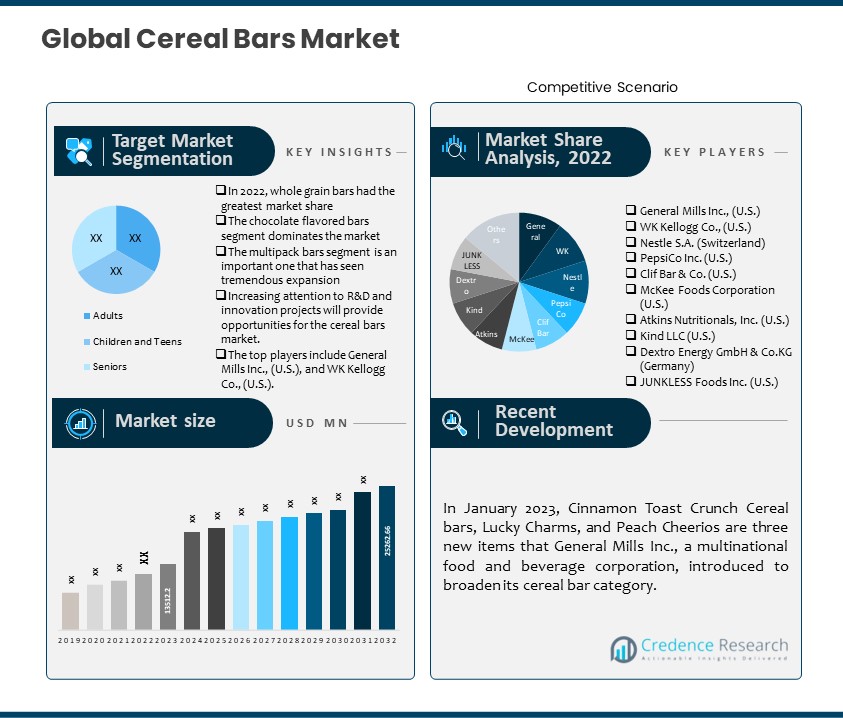
- The global market for cereal bars is expected to develop at a compound annual growth rate (CAGR) of 7.20% between 2024 and 2032, from its estimated USD 13512.2 million in 2023 to USD 25262.66 million in 2032.
- The largest category is whole grain bars. Nut and seed bars, on the other hand, are expected to grow at a strong CAGR.
- Chocolate-flavored bars are at the top of the flavor segment.
- The CAGR for energy bars is expected to be the highest during the projection period.
- The multipack bars will have the highest CAGR throughout the prediction period.
- Children and teens are estimated to have the greatest CAGR during the forecast period.
- Asia Pacific dominated the cereal bars market.
- Regarding the market share of cereal bars, Europe is expected to come second.
- In the cereal bars market, North America is anticipated to grow fastest.
- Increased obesity rates, taste preferences, and health and wellness trends are influencing the global market for cereal bars.
- The potential for the global cereal bar market is influenced by factors such as rising disposable income, increasing urbanization, the need for foods that can be consumed on the go, and advancements in product composition.
Executive Summary
Market Definition
The production, distribution, and retailing of snack bars largely composed of cereal grains-such as oats, wheat, rice, or corn-as well as additional ingredients, including nuts, dried fruits, sweeteners, and flavorings, are collectively referred to as the cereal bar market. These bars are frequently promoted as portable, healthy snacks that are great for eating on the run. They contain a mix of fiber, protein, carbs, and vitamins and minerals.
Market Overview
The cereal bars sector is estimated to develop at a 7.20% compound annual growth rate (CAGR) between 2024 and 2032, maintaining its current upward trend. The market will continue to develop, rising from its estimated USD 13512.2 million in 2023 to USD 25262.66 million in 2032.
Consumers belonging to Generation Z and Millennials are more likely to choose bars that offer advantages, including meeting energy and nutritional demands, helping with weight loss, and promoting better sleep. Protein cereal bars are also bought by certain customers as a supporting snack for at-home workout regimens and as a means of obtaining vital nutrients. Additionally, the industry's efforts to develop new cereal bars are supported by the expanding plant-based and ketogenic dietary trends. This is an additional element that favorably influences the market's expansion. For example, in June 2021, Munk-Pack, a newly established manufacturer of low-sugar bars, increased the availability of their keto granola bars in over 1,000 Walmart stores nationwide. The company offered two distinct flavors: coconut cocoa chip and blueberry almond vanilla.
There are many opportunities for the adoption of cereal bars in the South Korean market, as the population's demand for both candy-based and organic, healthful cereal bars is nearly equal. Furthermore, because of its therapeutic qualities, red ginseng has grown to be a well-liked superfood ingredient for cereal bars offered in South Korea.
Due to a growing priority on being healthy and in shape, health clubs and gyms have sprung up quickly, and nutritional support for sports has also become more and more important. Furthermore, certain customers can be impulsive purchases; therefore, it is believed that appealing packaging, competitive prices, and deals on cereal bars will draw in these clients. Furthermore, as instant meals have become more popular generally, cereal bar acceptance has been increasing as well, primarily as a result of the rise in single- and dual-income households.
Segmentation by Ingredient
- Whole grain bars are the market leader by ingredient. Health and well-being are becoming more and more important to consumers, and awareness of the advantages of whole grains is increasing. Because whole grains are high in fiber, vitamins, minerals, and antioxidants, whole grain bars are thought to be a healthy snack option. Whole grain bars and other nutritious snacks are in high demand as people's awareness of their health issues grows.
- The nut and seed bars category will exhibit a sizable CAGR during the projected period. Since nuts and seeds are naturally high in protein, nut and seed bars are a popular alternative for people looking for high-protein snack options. Protein is necessary for satiety, general energy levels, and muscle growth and repair. Nut and seed bars can be an easy way for people who follow vegetarian or vegan diets to get their protein fix, or they can be used as pre- or post-workout snacks.
- Other ingredients, including fruit bars, protein bars, gluten-free bars, and low-sugar or no-sugar-added bars, support the need for cereal bars.
Segmentation by Flavor
- The best flavor category is chocolate-flavored bars. Because chocolate contains a combination of fats, carbohydrates, and sugars, it is frequently touted as an energy-boosting food. These bars' rapid energy might be helpful for people who need a pick-me-up during the day or as a pre-or post-workout breakfast.
- The nutty-flavored bars category will likely register a significant CAGR during forecasting. The rising demand for bars with nutty flavors has spurred innovation and industry growth. In order to satisfy consumer tastes and demand, manufacturers are constantly offering new flavors, formulas, and package formats.
- Other flavors, such as fruity, spiced, and vanilla-flavored bars, also contribute to the demand for cereal bars.
Segmentation by Functionality
- The energy bars category is projected to grow faster over the projection period. Energy bars are available in a wide variety of flavors and compositions that cater to a wide range of dietary needs and taste preferences. Customers can choose from a wide variety of flavors to select bars that appeal to their palate, ranging from traditional flavors like chocolate and peanut butter to more unusual possibilities like matcha or coconut. Personalized energy bars are also becoming more and more popular, allowing customers to choose the ingredients or nutritional value that best suits them.
- Other functionality influence the need for cereal bars, including meal replacement bars, snack bars, and weight management bars.
Segmentation by Packaging and Format
- The multipack bars category will likely have the highest CAGR during the projection period. Cereal bars in multipacks are a popular choice for houses and families with several members, including adults and children. These bigger packages are ideal for households with different tastes and nutritional concerns because they can satisfy the snacking needs of several people.
- Other packaging and formats, such as single-serve bars and bulk bars, also contribute to the demand for cereal bars.
Segmentation by Target Market
- Children and teens are expected to have the foremost CAGR during the prediction period. Food preferences in children and teenagers are frequently shaped by social trends and peer groups. In these demographics, cereal bars that are well-liked by friends or appear in the content of social media influencers may grow in demand as snacks due to social acceptance and trends.
- Other target markets, such as adults and seniors, also contribute to the demand for cereal bars.
Segmentation by Region
- The Asia Pacific leads the cereal bars industry. The retail infrastructure of the Asia Pacific area, which includes convenience stores, supermarkets, hypermarkets, and online platforms, has grown significantly. The market is growing as a result of the expansion of distribution channels, which has made cereal bars more available and accessible to customers in both urban and rural locations.
- Europe is estimated to rank second in market size for cereal bars.
- The cereal bars industry is predicted to flourish rapidly in North America.
- Regions such as Africa, the Middle East, and Latin America cover the remaining requirement for cereal bars.
With growing health consciousness among Indian customers and major businesses introducing easy packaging for these bars, the Indian cereal bar market is expected to rise at a significant rate. India is expected to see a rise in cereal bar sales as people become more conscious of the value of a healthy diet and the negative impacts of processed meals.
Based on projections, the cereal bars market is anticipated to be controlled by Asia Pacific. In Japan and Indonesia, cereal bars are growing in popularity as people look for healthier, portable options. These nutrient-dense bars are a satisfying, full snack choice that is suitable for any place and any time. Cereal bars are becoming more and more popular in these two nations for a variety of reasons. As people's awareness of their health increases, they are searching for snacks that are higher in nutrients than junk food. Cereal bars can also be transported anywhere and are convenient to consume. These bars are a terrific choice for customers on a tight budget because they are reasonably priced. It is anticipated that these variables will propel the Indonesian and Japanese markets.
The cereal bars market in North America is anticipated to expand fastest throughout the forecast. Due to consumer demand for easy-to-transport snack options, the cereal bar industry in North America experienced growth. Moreover, the most widely consumed snacks in this area are cereal and energy bars. The market being researched in North America may be driven by new goods, a rise in the demand for low-fat cereal bars, the popularity of breakfasts that can be eaten on the move, changes in snacking culture, and widespread retail distribution that supports both planned and impulsive purchases. With innovation in and access to a vast array of products, the United States holds a majority stake in North America. Product marketing is used by companies including General Mills, Nestle, Kellogg's, and Clif Bar & Co.
Key Highlights of the Report
The global cereal bars market is segmented by ingredient segmentation, flavor segmentation, functionality segmentation, packaging and format segmentation, target market segmentation, and region. As far as the ingredient segmentation is concerned, whole grain bars are the market spearhead. Chocolate flavored bars is the top category. The energy bars category is anticipated to increase at the highest CAGR throughout the projection period. The multipack bars category will experience the highest CAGR during the forecast period. The cereal bar market is expanding mostly in the Asia Pacific.
Continued developments in packaging technology to increase convenience and shelf life, as well as the use of superfoods, less added sugar, and improved flavor and texture in product formulas, all serve to pique consumers' interest and foster brand loyalty. Globalization and increasing urbanization have caused eating choices and habits to change. When looking for handy and healthier snack options, urban consumers find cereal bars to be a versatile and adaptable option.
Asia Pacific is expected to account for the largest cereal bars market globally. Asia Pacific shoppers are looking for food goods that are more authentic and transparent. Cereal bars manufactured without artificial flavors, colors, or preservatives and with natural, clean-label ingredients are becoming more and more acceptable. In response to this trend, businesses are repurposing their goods and stressing the clean label claims on product packaging and promotional materials. The North American region is also assumed to have the market's sharpest growth. This is due to customers' shifting eating and food consumption habits. Additionally, customers in this region are increasingly choosing healthy food substitutes over junk food.
Which Key Factors Are Driving The Global Cereal Bars Market?
The market for cereal bars is expanding due to several causes, such as the growing popularity of protein supplements, knowledge of celiac disease and gluten intolerance, and the impact of social media and influencers.
What are The Main Challenges Confronting The Cereal Bars Market Globally?
Increasing consumer preferences for whole, minimally processed foods may create negative associations with cereal bars, which could negatively impact their appeal and sales. Another obstacle to the industry's growth is concerns about possible health risks associated with specific ingredients or manufacturing processes used in cereal bars.
What Market Opportunities Exist For Cereal Bars Globally?
The market for cereal bars could grow as a result of a number of factors, such as the introduction of variety packs containing a variety of cereal bar flavors to give consumers more options and encourage brand loyalty, as well as meeting customer requirements for transparency and clean label products by formulating cereal bars with natural, recognizable ingredients free of artificial additives, colors, and preservatives.
Market Drivers
Multiple factors propel the cereal bars industry across the globe. The primary factors propelling the global cereal bars market are as follows:
Growing Number of New Companies Entering the Market
In numerous nations, such as the United States, China, Brazil, and Vietnam, young consumers are favoring on-the-go snacking over regular meals. Globally, the "snackification" movement is growing and transforming the grocery and supermarket shelves. Players are entering the market as a result of the steadily rising demand for snack category products like cakes, pastries, cereal bars, and breakfast cereals. Because of this, newcomers are looking to investors for financial backing in order to grow their businesses. For example, in June 2022, the low-sugar snack bar company Munk Pack raised USD 5 million from its financing round to further its product innovation, growth, and distribution operations.
Market Restraints
There are several obstacles that the global cereal bars market must overcome to continue growing. Among them are the following:
High Sugar Level and Exorbitant Costs
Granola bars are favored by many consumers due to their ease of use, nutritional value, tasty delight, and adaptability. These bars are an excellent source of fiber and protein. But they have a lot of added sugar, carbohydrates, and artificial additives. Furthermore, a typical serving of granola bars can have up to 15 grams of sugar. Consuming too much added sugar increases the chance of developing diabetes, obesity, and heart disease, among other health issues.
Additionally, the majority of granola bars and health bars cost between $2 and $3 each piece. Furthermore, there are plenty of less expensive alternatives to the bar on the market. It is a significant aspect that affects how purchasing decisions alter, which hampers market expansion.
Opportunities
There are plenty of potential prospects in the global cereal bars industry. Among these are the following:
Increasing Attention to R&D and Innovation Projects
Better-for-you snack products with lots of nutrition have become increasingly important since consumers are more focused on improving their health. More customers also favor snack goods with straightforward ingredients and nutrition, like granola and breakfast bars. In response to the growing customer demand for healthier RTE snack goods, such as cereal bars, manufacturers are encouraged by this factor to create novel, nutrient-dense, and fortified products. As a result, major players in the marketplace place a strong emphasis on product innovation and R&D efforts to increase demand for goods, including granola bars, cereal bars, and protein cereal bars. For example, the FDA approved an increase in Vitamin D3 fortification in the breakfast cereal and grain-based bar categories in January 2023 for the multinational cereal and bar manufacturer Kellogg's Company.
Competitive Landscape
Key Players
Several major competitors exist in the fiercely competitive global cereal bars market. The following are a few of the leading market participants and their market shares:
- General Mills Inc., (U.S.)
- WK Kellogg Co., (U.S.)
- Nestle S.A. (Switzerland)
- PepsiCo Inc. (U.S.)
- Clif Bar & Co. (U.S.)
- McKee Foods Corporation (U.S.)
- Atkins Nutritionals, Inc. (U.S.)
- Kind LLC (U.S.)
- Dextro Energy GmbH & Co.KG (Germany)
- JUNKLESS Foods Inc. (U.S.)
- Others
These companies prioritize product innovation, distribution channel expansion, mergers, and acquisitions to remain competitive.
The largest suppliers in the global cereal bars market continuously work to stay one step ahead of the competition by developing innovative concepts and products.
In March 2023, The Indian company Barrys India launched three new energy bar variants: Choco Nut Delight, Signature Crunch, and Fruits, Nuts & Seeds. These bars come with multi-grains, nuts, and other components.
In February 2022, the snack bar manufacturer McKee Foods Corp. introduced chewy granola bars under the Panada brand, adding to its Sunbelt Bakery portfolio. The product comes in a family pack of eight bars and includes healthy grains, white chocolate chips, and corn syrup.
In January 2022, A limited-edition cereal bar in the flavors of cookies and cream and cocoa peanut butter was introduced by Magic Spoon, a cereal manufacturing company, into the cereal bar market.
In January 2021, The international cereal and snack giant Kellogg's Company released two varieties of keto-friendly snack bars: chocolate almond fudge and peanut butter fudge. The product can be found on store shelves all around the United States.
Summary of Key Findings
- Customers are searching for novel and intriguing flavors. This is probably going to spark innovation in the cereal bar sector, resulting in the introduction of novel flavor profiles and component combinations.
- The market is segmented by ingredient segmentation, flavor segmentation, functionality segmentation, packaging and format segmentation, target market segmentation, and region.
- The most popular ingredient in the market is whole grain bars.
- Chocolate-flavored bars are the foremost flavor category.
- Energy bars are expected to grow fastest in terms of CAGR during the forecast period.
- The children and teens category will likely see the highest CAGR during the anticipated time frame.
- Asia Pacific is leading market development; the market is highly competitive with key players including General Mills Inc. (U.S.), WK Kellogg Co. (U.S.), Nestle S.A. (Switzerland), PepsiCo Inc. (U.S.), Clif Bar & Co. (U.S.), McKee Foods Corporation (U.S.), Atkins Nutritionals, Inc. (U.S.), Kind LLC (U.S.), Dextro Energy GmbH & Co.KG (Germany), JUNKLESS Foods Inc. (U.S.), and Others.
Future Outlook
- The cereal bar industry is expected to increase significantly in Asia Pacific, and its outlook is positive worldwide.
- Consumers are prepared to pay extra when purchasing high-end goods. As a result, the demand for premium cereal bars, which are produced with premium ingredients and have a more complex flavor profile, is probably going to rise.
- Insufficient innovation in product compositions, tastes, and packaging could potentially hamper cereal bar manufacturers' capacity to stand out from the competition, pique consumers' attention, and remain relevant in the marketplace.
- To stay ahead of the competition, key enterprises must develop new products, expand their market reach, and keep their prices competitive.
How CXOs Can Benefit from the Credence Research Cereal Bars Market Report
CXOs may get a detailed picture of the market in the Credence Research Cereal Bars Market Report, which includes:
- Market size and growth forecast: The report provides detailed estimates of the global cereal bars market size, segmented by ingredient segmentation, flavor segmentation, functionality segmentation, packaging and format segmentation, target market segmentation, and region. It also includes forecasts for the market through 2032 based on key trends and drivers.
- Market segmentation: The research report breaks down the market for cereal bars into segments based on ingredient segmentation, flavor segmentation, functionality segmentation, packaging and format segmentation, target market segmentation, and region. This segmentation provides CXOs with a granular understanding of the market and the opportunities in each segment.
- Competitive landscape: The research report offers a detailed analysis of the major companies in the cereal bars industry, including information on their business plans, product lines, and earnings. CXOs can use this information to evaluate and identify their competitors.
- Key trends and drivers: The research report identifies and evaluates the main trends and factors influencing the cereal bars market. CXOs can use this information to make well-informed choices regarding their plans and investments.
CXOs can use the insights from the Credence Research Cereal Bars Market Report to:
- Identify growth opportunities: This analysis may help CXOs identify new growth opportunities in the cereal bars sector. For example, the report identifies the growing demand for cereal bars from the food & beverage industry as a key opportunity.
- Make informed investment decisions: The report helps CXOs choose cereal bars wisely. For example, the research study provides information on the critical factors to consider when selecting cereal bar solutions and evaluating suppliers.
- Develop competitive strategies: CXOs can use the research report to develop competitive strategies for their cereal bars businesses. For example, the research paper outlines the main strategies that cereal bar suppliers utilize to differentiate themselves from competitors.
- Track market developments: This research report may help CXOs stay ahead of the curve by tracking market developments. For instance, it offers insights into the most recent developments and trends in the cereal bars market.
CXOs seeking to expand their industry knowledge and spot growth prospects will find the Credence Research Cereal Bars Market Report useful.
Segmentation
- By Ingredient Segmentation
- Whole Grain Bars
- Nut and Seed Bars
- Fruit Bars
- Protein Bars
- Gluten-Free Bars
- Low-sugar or No-Sugar-Added Bars
- By Flavor Segmentation
- Chocolate Flavored Bars
- Nutty Flavored Bars
- Fruity Flavored Bars
- Spiced Flavored Bars
- Vanilla Flavored Bars
- By Functionality Segmentation
- Energy Bars
- Meal Replacement Bars
- Snack Bars
- Weight Management Bars
- By Packaging and Format Segmentation
- Single-Serve Bars
- Multipack Bars
- Bulk Bars
- By Target Market Segmentation
- Adults
- Children and Teens
- Seniors
- By Region
- North America
- The U.S.
- Canada
- Mexico
- Europe
- Germany
- France
- The U.K.
- Italy
- Spain
- Rest of Europe
- Asia Pacific
- China
- Japan
- India
- South Korea
- South-east Asia
- Rest of Asia Pacific
- Latin America
- Brazil
- Argentina
- Rest of Latin America
- Middle East & Africa
- GCC Countries
- South Africa
- The Rest of the Middle East and Africa
- North America

Request a Free Sample
Fill in your details and we'll send you a free sample report.
- Sample data tables & charts
- Research methodology
Market Dynamics
Health and Wellness Trends
Increasing consumer focus on health, fitness, and balanced nutrition is driving demand for cereal bars, especially those with whole grains, high protein, and low sugar content.
On-the-Go Convenience
Urbanization and busy lifestyles are boosting the popularity of portable, ready-to-eat snacks like cereal bars, which are seen as convenient meal replacements or energy boosters.
Product Innovation and Clean Labeling
Manufacturers are introducing new flavors, functional ingredients, and clean-label formulations (e.g., plant-based, gluten-free, low-sugar), attracting health-conscious and diverse consumer segments.
Expanding Retail and E-commerce Channels
Wider availability of cereal bars through supermarkets, convenience stores, and online platforms, especially in Asia Pacific, is increasing product accessibility and market penetration.
Influence of Social Media and Marketing
Social media trends and influencer endorsements are shaping consumer preferences, particularly among children, teens, and young adults, accelerating the adoption of new cereal bar products.
Need a Custom Version of This Report?
Tailor the scope, geography, or segments to your exact requirements.
- Custom geography or segment scope
- Direct access to our analyst team
Frequently Asked Questions
How much does the global market currently hold for cereal bars?
What is the cereal bars market's projected growth rate between 2024 and 2032?
In terms of ingredients, which market category is leading?
Which functionality segment is estimated to have the highest CAGR throughout the forecast period?
Who are the main players in the cereal bars industry globally?
Table of Content
Chapter 1 Market Segmentation
- 1.1 Segmentation Framework
- 1.1.1 Product and Service Classification
- 1.1.2 Application and End-Use Classification
- 1.1.3 Technology and Solution Classification
- 1.1.4 Customer and Distribution Channel Classification
- 1.1.5 Geographic Segmentation
- 1.1.6 Market Segment Definitions and Boundaries
- 1.2 By Flavor
- 1.2.1 Chocolate Flavored Bars
- 1.2.2 Nutty Flavored Bars
- 1.2.3 Fruity Flavored Bars
- 1.2.4 Spiced Flavored Bars
- 1.2.5 Vanilla Flavored Bars
- 1.3 By Ingredient
- 1.3.1 Whole Grain Bars
- 1.3.2 Nut and Seed Bars
- 1.3.3 Fruit Bars
- 1.3.4 Protein Bars
- 1.3.5 Gluten-Free Bars
- 1.3.6 Low-sugar or No-Sugar-Added Bars
- 1.4 By Functionality
- 1.4.1 Energy Bars
- 1.4.2 Meal Replacement Bars
- 1.4.3 Snack Bars
- 1.4.4 Weight Management Bars
- 1.5 By Packaging and Format
- 1.5.1 Single-Serve Bars
- 1.5.2 Multipack Bars
- 1.5.3 Bulk Bars
Chapter 2 Introduction
- 2.1 Report Objectives and Scope
- 2.2 Product Definition and Industry Terminology
- 2.3 Market Inclusions and Exclusions
- 2.4 Research Process
- 2.4.1 Primary Research and Expert Interviews
- 2.4.2 Secondary Research and Source Review
- 2.4.3 Top-Down and Bottom-Up Estimation
- 2.4.4 Data Triangulation and Verification
- 2.5 Market Size Measurement Basis
- 2.5.1 2023: USD 13,512.2 million → 2032: USD 25,262.66 million
- 2.6 Historical and Forecast Reference Periods
- 2.6.1 Base Year: 2023
- 2.6.2 Forecast Period: 2023-2032
- 2.7 Research Assumptions and Limitations
Chapter 3 Executive Summary
- 3.1 Market Snapshot and Key Findings
- 3.2 Base-Year Market Size, 2023
- 3.3 Forecast Market Size, 2032
- 3.4 Revenue and Volume Growth Outlook
- 3.5 Key Demand and Supply Indicators
- 3.6 Leading Market Segments
- 3.7 Fastest-Growing Market Opportunities
- 3.8 Regional Performance Highlights
- 3.9 Technology and Industry Transformation
- 3.10 Competitive Landscape Summary
- 3.11 Analyst View and Strategic Implications
Chapter 4 Global Cereal Bars Market Trends and Developments
- 4.1 Historical Industry Development
- 4.2 Recent Market Trends and Developments
- 4.3 Demand and Customer Behavior Trends
- 4.4 Technology and Product Innovation
- 4.5 Artificial Intelligence, Automation and Digitalization
- 4.6 Local Manufacturing and Supply Chain Realignment
- 4.7 Industry Partnerships, Mergers and Acquisitions
- 4.8 Sustainability and Circular Economy Developments
- 4.9 Government and Private Sector Investment Trends
- 4.10 Emerging Business Models and Commercialization
- 4.11 Industry Developments and Announcements
Chapter 5 Global Cereal Bars Market Production, Supply and Demand Analysis
- 5.1 Demand Trend and Consumption Analysis
- 5.2 Demand Forecast, 2023-2032
- 5.3 Production and Output Trend
- 5.4 Production and Output Forecast, 2023-2032
- 5.5 Installed Capacity and Capacity Utilization
- 5.6 Company-Wise Production Plants and Statistics
- 5.6.1 Installed Production Capacity
- 5.6.2 Actual Production
- 5.6.3 Planned Capacity and Expansion Targets
- 5.7 Supply Chain Structure and Procurement Trends
- 5.8 Supply-Demand Gap and Bottlenecks
- 5.9 Import Dependence and Sourcing Structure
- 5.10 Contract Manufacturing and Outsourcing
- 5.11 Regional Supply and Demand Concentration
Chapter 6 Global Cereal Bars Market Pricing Analysis
- 6.1 Pricing Structure and Measurement
- 6.2 Historical Pricing Trends
- 6.3 Pricing Outlook, 2023-2032
- 6.4 Average Selling Price and Unit Economics
- 6.5 Pricing by Product and Market Segment
- 6.6 Geographic Pricing Differences
- 6.7 Key Input, Energy, Labor and Logistics Costs
- 6.8 Contract Pricing and Purchasing Models
- 6.9 Pricing Sensitivity and Competitive Positioning
- 6.10 Price, Margin and Profitability Implications
Chapter 7 Global Cereal Bars Market Dynamics
- 7.1 Market Growth Drivers
- 7.1.1 Demand-Side Drivers
- 7.1.2 Technology and Innovation Drivers
- 7.1.3 Infrastructure and Investment Drivers
- 7.1.4 Regulatory and Policy Drivers
- 7.2 Market Restraints
- 7.2.1 Cost and Affordability Constraints
- 7.2.2 Technology and Adoption Barriers
- 7.2.3 Supply Chain and Operational Constraints
- 7.3 Market Challenges
- 7.3.1 Competitive Pressure and Margin Erosion
- 7.3.2 Skills, Infrastructure and Implementation Gaps
- 7.4 Emerging Market Opportunities
- 7.5 Market Dynamics Impact and Time-Horizon Assessment
Chapter 8 Global Cereal Bars Value Chain Analysis
- 8.1 Industry Value Chain Overview
- 8.2 Upstream Suppliers and Critical Inputs
- 8.3 Technology and Component Providers
- 8.4 Manufacturing or Service Delivery
- 8.5 Distribution, Channel Partners and Integrators
- 8.6 Downstream Applications and End Users
- 8.7 Value Addition and Profit Pools
- 8.8 Vertical Integration and Outsourcing
- 8.9 Supplier Concentration and Risk
- 8.10 Supply Chain Localization and Resilience
Chapter 9 Global Cereal Bars Market Regulations and Policies
- 9.1 Relevant Laws, Standards and Compliance Frameworks
- 9.2 Product, Service, Safety and Quality Requirements
- 9.3 Government Policies, Incentives and Subsidies
- 9.4 Imports, Exports and Trade Barriers
- 9.5 Public Procurement and Local Content Requirements
- 9.6 Environmental and Sustainability Compliance
- 9.7 Upcoming Policy Changes and Market Implications
Chapter 10 Global Cereal Bars Market Hotspots and Opportunities
- 10.1 Market Opportunity Mapping and Growth Hotspots
- 10.2 High-Growth Applications and Customer Groups
- 10.3 Underserved Markets and White-Space Opportunities
- 10.4 Emerging Technology and Product Opportunities
- 10.5 New Capacity and Investment Hotspots
- 10.6 Market Entry and Expansion Opportunities
- 10.7 Distribution and Partnership Opportunities
- 10.8 Near-Term and Long-Term Commercial Potential
- 10.9 Opportunity Attractiveness and Execution Risks
Chapter 11 Global Cereal Bars Market Outlook, 2023-2032
- 11.1 Market Size and Analysis
- 11.1.1 Revenue (Market Measurement: 2023: USD 13,512.2 million → 2032: USD 25,262.66 million)
- 11.1.2 Market Volume and Quantity Sold
- 11.1.3 Historical Market Size
- 11.1.4 Base-Year Market Size, 2023
- 11.2 Market Forecast, 2023-2032
- 11.2.1 Revenue Forecast to 2032
- 11.2.2 Volume Forecast to 2032
- 11.2.3 CAGR and Year-on-Year Growth
- 11.2.4 Incremental Revenue Opportunity
- 11.3 Forecast Assumptions and Scenario Analysis
- 11.3.1 Base-Case Forecast
- 11.3.2 Optimistic and Conservative Scenarios
- 11.3.3 Technology, Pricing and Policy Sensitivities
- 11.4 Market Attractiveness and Growth Outlook
Chapter 12 Global Cereal Bars Market Segmentation and Outlook
- 12.1 Segmentation Summary and Market Shares, 2023
- 12.2 Largest and Fastest-Growing Segments
- 12.3 By Flavor - Market Size and Forecast, 2023-2032
- 12.3.1 Segment Definition and Scope
- 12.3.2 Historical Market Size
- 12.3.3 Revenue Forecast, 2023-2032
- 12.3.4 Volume Forecast, 2023-2032
- 12.3.5 Base-Year Market Share, 2023
- 12.3.6 Segment CAGR and Growth Drivers
- 12.3.7 Subsegment Market Size and Forecast
- 12.3.7.1 Chocolate Flavored Bars
- 12.3.7.2 Nutty Flavored Bars
- 12.3.7.3 Fruity Flavored Bars
- 12.3.7.4 Spiced Flavored Bars
- 12.3.7.5 Vanilla Flavored Bars
- 12.3.8 Subsegment Pricing and Adoption Trends
- 12.3.9 Leading Suppliers and Competition
- 12.3.10 Regional Demand and Opportunities
- 12.4 By Ingredient - Market Size and Forecast, 2023-2032
- 12.4.1 Segment Definition and Scope
- 12.4.2 Historical Market Size
- 12.4.3 Revenue Forecast, 2023-2032
- 12.4.4 Volume Forecast, 2023-2032
- 12.4.5 Base-Year Market Share, 2023
- 12.4.6 Segment CAGR and Growth Drivers
- 12.4.7 Subsegment Market Size and Forecast
- 12.4.7.1 Whole Grain Bars
- 12.4.7.2 Nut and Seed Bars
- 12.4.7.3 Fruit Bars
- 12.4.7.4 Protein Bars
- 12.4.7.5 Gluten-Free Bars
- 12.4.7.6 Low-sugar or No-Sugar-Added Bars
- 12.4.8 Subsegment Pricing and Adoption Trends
- 12.4.9 Leading Suppliers and Competition
- 12.4.10 Regional Demand and Opportunities
- 12.5 By Functionality - Market Size and Forecast, 2023-2032
- 12.5.1 Segment Definition and Scope
- 12.5.2 Historical Market Size
- 12.5.3 Revenue Forecast, 2023-2032
- 12.5.4 Volume Forecast, 2023-2032
- 12.5.5 Base-Year Market Share, 2023
- 12.5.6 Segment CAGR and Growth Drivers
- 12.5.7 Subsegment Market Size and Forecast
- 12.5.7.1 Energy Bars
- 12.5.7.2 Meal Replacement Bars
- 12.5.7.3 Snack Bars
- 12.5.7.4 Weight Management Bars
- 12.5.8 Subsegment Pricing and Adoption Trends
- 12.5.9 Leading Suppliers and Competition
- 12.5.10 Regional Demand and Opportunities
- 12.6 By Packaging and Format - Market Size and Forecast, 2023-2032
- 12.6.1 Segment Definition and Scope
- 12.6.2 Historical Market Size
- 12.6.3 Revenue Forecast, 2023-2032
- 12.6.4 Volume Forecast, 2023-2032
- 12.6.5 Base-Year Market Share, 2023
- 12.6.6 Segment CAGR and Growth Drivers
- 12.6.7 Subsegment Market Size and Forecast
- 12.6.7.1 Single-Serve Bars
- 12.6.7.2 Multipack Bars
- 12.6.7.3 Bulk Bars
- 12.6.8 Subsegment Pricing and Adoption Trends
- 12.6.9 Leading Suppliers and Competition
- 12.6.10 Regional Demand and Opportunities
- 12.7 Segment Growth Comparison
- 12.8 Segment Attractiveness and Priority Matrix
Chapter 13 Global Cereal Bars Geographic Market Outlook, 2023-2032
- 13.1 Regional Market Size and Share, 2023
- 13.2 Regional Market Forecast, 2023-2032
- 13.3 Regional Pricing, Production and Demand Differences
- 13.4 North America
- 13.4.1 United States
- 13.4.2 Canada
- 13.4.3 Mexico
- 13.5 Europe
- 13.5.1 Germany
- 13.5.2 France
- 13.5.3 Italy
- 13.5.4 United Kingdom
- 13.5.5 Spain
- 13.5.6 Poland
- 13.5.7 Russia
- 13.5.8 Netherlands
- 13.5.9 Belgium
- 13.5.10 Sweden
- 13.5.11 Denmark
- 13.5.12 Norway
- 13.5.13 Rest of Europe
- 13.6 Asia Pacific
- 13.6.1 China
- 13.6.2 India
- 13.6.3 Japan
- 13.6.4 South Korea
- 13.6.5 Thailand
- 13.6.6 Indonesia
- 13.6.7 Vietnam
- 13.6.8 Malaysia
- 13.6.9 Australia
- 13.6.10 Rest of Asia Pacific
- 13.7 Latin America
- 13.7.1 Brazil
- 13.7.2 Argentina
- 13.7.3 Colombia
- 13.7.4 Chile
- 13.7.5 Rest of Latin America
- 13.8 Middle East
- 13.8.1 Saudi Arabia
- 13.8.2 United Arab Emirates
- 13.8.3 Turkey
- 13.8.4 Israel
- 13.8.5 Iran
- 13.8.6 Rest of the Middle East
- 13.9 Africa
- 13.9.1 South Africa
- 13.9.2 Egypt
- 13.9.3 Nigeria
- 13.9.4 Morocco
- 13.9.5 Rest of Africa
- 13.10 Regional Investment, Policy and Supply Chain Differences
- 13.11 Regional Competitive Landscape
- 13.12 Geographic Growth Hotspots
Chapter 14 Global Cereal Bars Technology, Innovation and Sustainability Outlook
- 14.1 Technology Landscape and Maturity
- 14.2 Product, Process and Service Innovation
- 14.3 AI, Automation and Digital Tools in the Industry
- 14.4 Technology Adoption and Performance Benchmarking
- 14.5 Innovation Pipeline and R&D Investment
- 14.6 Patent and Intellectual Property Trends
- 14.7 Energy Efficiency and Resource Management
- 14.8 Sustainability, Recycling and Circularity
- 14.9 Technology Roadmap, 2023-2032
- 14.10 Risks of Obsolescence and Technology Substitution
Chapter 15 Global Cereal Bars Market Key Strategic Imperatives
- 15.1 Growth and Market Entry Priorities
- 15.2 High-Return Products and Segments
- 15.3 Pricing, Profitability and Cost Optimization
- 15.4 Technology Investment and Product Differentiation
- 15.5 Supply Chain Localization and Resilience
- 15.6 Distribution and Customer Acquisition
- 15.7 Partnership, Acquisition and Capacity Strategy
- 15.8 Regional Expansion Priorities
- 15.9 Short-, Medium- and Long-Term Actions
Chapter 16 Competition Outlook
- 16.1 Industry Competition Characteristics
- 16.2 Market Structure and Concentration
- 16.3 Market Share and Competitive Positioning, 2023
- 16.4 Company-Wise Revenue and Product Benchmarking
- 16.5 Production and Service Capacity Benchmarking
- 16.6 Technology, Pricing and Differentiation
- 16.7 Regional Footprint and Distribution Strength
- 16.8 Mergers, Acquisitions and Strategic Alliances
- 16.9 New Entrants and Competitive Threats
- 16.10 Porter's Five Forces and Industry Attractiveness
- 16.11 Competitive Outlook, 2023-2032
Chapter 17 Company Profiles
- 17.1 Company Coverage and Selection Criteria
- 17.2 General Mills Inc.
- 17.2.1 Business Description
- 17.2.2 Company Ownership and Geographic Presence
- 17.2.3 Product and Service Portfolio
- 17.2.4 Manufacturing and Operating Footprint
- 17.2.5 Production Capacity and Expansion Plans
- 17.2.6 Financial Performance and Investment
- 17.2.7 Market Share and Competitive Position
- 17.2.8 Technology and Innovation Capabilities
- 17.2.9 Strategic Alliances or Partnerships
- 17.2.10 Recent Developments
- 17.2.11 Growth Strategy and Outlook
- 17.3 WK Kellogg Co.
- 17.4 Nestle S.A.
- 17.5 PepsiCo Inc.
- 17.6 Clif Bar & Co.
- 17.7 McKee Foods Corporation
- 17.8 Atkins Nutritionals, Inc.
- 17.9 Kind LLC
- 17.10 Dextro Energy GmbH & Co.KG
- 17.11 JUNKLESS Foods Inc.
- 17.12 Other Relevant Market Participants
Note: Every listed company is profiled on the structure shown under the first company. The company list is preliminary and may change based on research findings, market developments, data availability and client requirements.
Chapter 18 Disclaimer
- 18.1 Research and Forecast Disclaimer
- 18.2 Data Source and Estimation Limitations
Note: The depth of individual sections depends on data availability for this market. Volume, capacity, trade and other unit-based metrics are included where applicable.

