Crystalline Silicon Solar PV Market Overview:
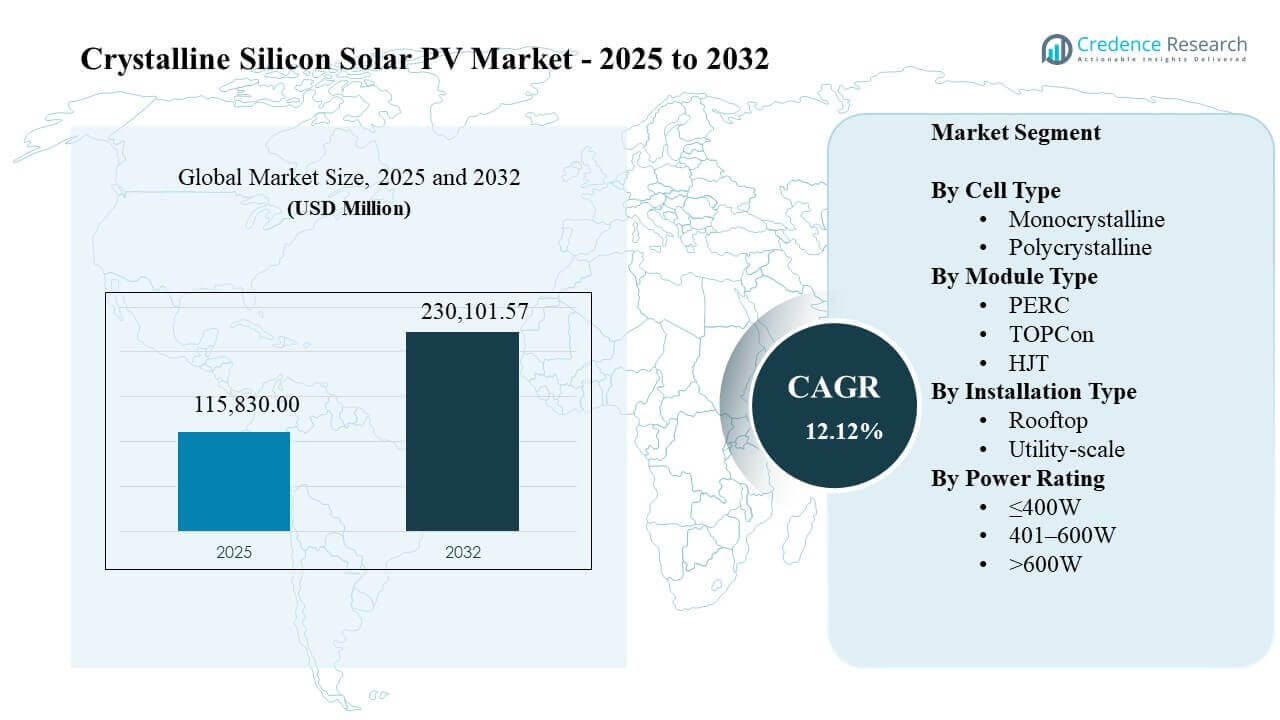
The global Crystalline Silicon Solar PV Market size was estimated at USD 115,830.00 million in 2025 and is expected to reach USD 230,101.57 million by 2032, growing at a CAGR of 12.12% from 2025 to 2032. Growth is anchored in accelerating utility-scale project pipelines and corporate procurement that demand high-volume, bankable module supply with improving efficiency. Asia Pacific remains the largest manufacturing and installation hub, supporting scale-driven cost reduction and rapid technology transitions across mainstream crystalline silicon platforms.
| REPORT ATTRIBUTE | DETAILS |
|---|---|
| Historical Period | 2020-2024 |
| Base Year | 2025 |
| Forecast Period | 2026-2032 |
| Crystalline Silicon Solar PV Market Size 2025 | USD 115,830.00million |
| Crystalline Silicon Solar PV Market, CAGR | 12.12% |
| Crystalline Silicon Solar PV Market Size 2032 | USD 230,101.57 million |
Key Market Trends & Insights
- The Crystalline Silicon Solar PV Market expands at a CAGR of 12.12% during 2025–2032, supported by scale manufacturing and faster adoption of higher-efficiency cell architectures.
- Asia Pacific accounted for 49.6% of Crystalline Silicon Solar PV Market revenue in 2025, reflecting concentration of capacity additions, supply chains, and module production ecosystems.
- Utility-scale represented 60.8% of Crystalline Silicon Solar PV Market demand in 2025, driven by grid-connected project economics and standardized procurement.
- TOPCon held 54.2% share by module type in 2025, signaling an accelerated shift toward n-type platforms in mainstream module shipments.
- Monocrystalline accounted for 88.6% share by cell type in 2025, supported by higher efficiency, stronger bankability, and broad availability across power classes.
Segment Analysis
The Crystalline Silicon Solar PV Market is shaped by rapid technology iteration and procurement that increasingly values energy yield, reliability, and lifecycle economics. Utility-scale deployments dominate volume demand because large projects can standardize module formats, negotiate long-term supply agreements, and optimize balance-of-system cost. Rooftop demand remains important for distributed resilience and behind-the-meter economics, but rooftop adoption is more sensitive to local policy design, financing availability, and installer capacity.
Technology competition within crystalline silicon modules is intensifying as n-type architectures expand into mainstream shipments. Buyers increasingly compare performance attributes such as temperature behavior, degradation profiles, and field reliability alongside nameplate wattage. Higher-wattage formats are gaining traction in large projects because fewer modules and fewer connections can improve build speed and reduce labor intensity, influencing procurement toward higher power classes.
By Cell Type Insights
Monocrystalline accounted for the largest share of 88.6% in 2025. Procurement favors monocrystalline formats because higher efficiency supports more power per square meter, improving project economics in both space-constrained commercial rooftops and land-optimized utility sites. Manufacturing scale and mature qualification cycles strengthen supplier bankability, which is critical for long-duration asset financing. Product road maps and supply availability across multiple vendors reinforce monocrystalline leadership across standard and large-format modules.
By Module Type Insights
TOPCon accounted for the largest share of 54.2% in 2025. Buyers are shifting toward TOPCon as module portfolios emphasize higher conversion efficiency and stronger energy yield under real operating conditions. Vendor competition is also driving faster cost-down for n-type platforms, narrowing the premium versus legacy architectures. Procurement teams increasingly use performance warranties and long-term supply stability as selection criteria, which supports broader adoption of TOPCon across utility and high-volume commercial projects.
By Installation Type Insights
Utility-scale accounted for the largest share of 60.8% in 2025. Utility-scale projects lead because project developers can aggregate demand, standardize engineering designs, and secure long-term offtake structures such as auctions and corporate agreements. Large project pipelines support predictable module demand and multi-year supply planning. Grid expansion, interconnection queues, and permitting shape timing, but utility-scale procurement remains the primary volume driver for crystalline silicon module shipments.
By Power Rating Insights
>600W accounted for the largest share of 46.7% in 2025. Large-format modules are increasingly selected for utility-scale sites where fewer panels reduce racking complexity and shorten installation timelines. Higher wattage also reduces the number of electrical connections and associated fieldwork, supporting total installed cost optimization. Technology upgrades in cell and module architecture enable higher nameplate power without proportionate cost increases, strengthening adoption in high-volume projects.
Crystalline Silicon Solar PV Market Drivers
Utility-scale buildout and standardized procurement
Utility-scale development continues to expand as grid-connected solar becomes a cornerstone of new power capacity planning. Project developers increasingly standardize module formats, racking, and electrical design, enabling repeatable procurement cycles and faster construction execution. Competitive auctions and corporate procurement models create predictable demand that supports multi-year supply contracting. Crystalline silicon manufacturing scale and bankability align with the risk management needs of large, financed projects.
- For instance, Trina Solar signed a 1 GW supply agreement with Low Carbon covering Vertex N 605W modules and Vertex 670W+ modules; the 605W series is based on 210 mm n-type i-TOPCon cells, while the 670W+ series reaches up to 21.6% maximum efficiency, which supports standardized utility-scale procurement across large project pipelines.
Technology transitions that raise energy yield
Technology road maps are accelerating across n-type platforms and next-generation module architectures. Procurement priorities increasingly emphasize energy yield and reliability rather than only nameplate power, supporting adoption of higher-efficiency designs. Vendor competition strengthens product differentiation through performance assurance, improved degradation behavior, and better real-world output. These technology upgrades support stronger lifetime economics, which increases adoption in both large projects and premium commercial applications.
- For instance, LONGi’s HPBC 2.0 platform has reached a world-record module efficiency of 25.4% under laboratory certification, while its commercial Hi-MO X10/Hi-MO 9 products deliver up to 670W and 24.8% module efficiency. LONGi also states that the anti-shading design reduces power loss by 70% versus TOPCon modules under shading conditions.
Scale manufacturing and supply-chain maturation
High-volume manufacturing ecosystems improve cost structure, quality consistency, and delivery reliability for crystalline silicon modules. Supply-chain integration across wafers, cells, and modules supports faster iteration and improved product qualification. Mature manufacturing and testing processes also reduce perceived risk for financiers and large buyers. The market benefits from continuous process improvements that lower per-watt costs and enable faster expansion of advanced module designs.
Policy support and investment in domestic capacity
Many markets are reinforcing solar deployment through updated targets, incentives, and grid modernization programs. Policy frameworks also stimulate investment in local manufacturing, diversification of sourcing, and supply resilience strategies. Buyers respond by prioritizing bankable vendors with stable delivery, product documentation, and compliance alignment. These factors increase the addressable pipeline for crystalline silicon modules across utility, commercial, and residential segments.
Crystalline Silicon Solar PV Market Challenges
Crystalline Silicon Solar PV Market participants face persistent margin pressure because module pricing remains highly competitive and often responds quickly to supply-demand shifts. Rapid technology change can also create inventory and qualification risk, especially when buyers shift quickly toward newer architectures. Trade and policy variability adds uncertainty to sourcing and project economics, which can disrupt supply planning and delivery schedules.
- For instance, JinkoSolar’s Tiger Neo n-type TOPCon modules have achieved up to 23% module efficiency in commercial products and converted more than 90 GW of its shipments to n‑type technology within a few years, forcing frequent portfolio transitions and tighter qualification cycles for developers.
Project execution risk remains a practical barrier in many regions because grid interconnection queues, permitting complexity, and transmission constraints can delay deployments. Installation capacity, land access, and financing availability can also limit near-term realization of demand. Quality consistency and long-term field reliability remain critical because performance variability can raise warranty exposure and affect bankability perceptions.
Crystalline Silicon Solar PV Market Trends and Opportunities
N-type platform adoption is expanding as procurement teams seek higher efficiency and stronger lifetime output. Product portfolios increasingly emphasize performance-based differentiation, including improvements in degradation behavior and reliability assurance. Large-format modules and higher power classes support faster build cycles and lower balance-of-system costs, strengthening demand in utility-scale projects. These dynamics create opportunities for suppliers with strong qualification capability and stable large-volume delivery.
- For instance, LONGi introduced its Hi-MO 7 series based on N-type HPDC technology, achieving a module efficiency above 22.6% with an annual degradation rate reduced to less than 0.4%, enabling projects to sustain high-output performance across more than 30 years of operation.
Distributed solar remains an opportunity where rooftops benefit from energy cost volatility management and on-site resilience. Commercial buyers increasingly evaluate integrated solutions that combine modules with inverters, monitoring, and storage to improve asset performance. Emerging high-irradiance markets also create demand for products optimized for heat, dust, and challenging operating conditions. These areas support premium positioning for suppliers that can demonstrate real-world performance and long-term service support.
Regional Insights
North America
North America represented 18.9% of Crystalline Silicon Solar PV Market revenue in 2025. Utility-scale procurement drives volume demand, supported by large project pipelines and growing interest in supply diversification. Investment in domestic manufacturing strengthens availability of locally produced modules and improves procurement optionality for developers. Competitive differentiation increasingly focuses on bankability, delivery assurance, and long-term performance confidence for financed assets.
Europe
Europe captured 21.7% of Crystalline Silicon Solar PV Market revenue in 2025. Distributed and utility-scale deployments both contribute, with procurement influenced by policy design, power market dynamics, and grid modernization priorities. Buyers emphasize lifecycle economics, compliance alignment, and quality documentation due to stringent operating and regulatory expectations. Technology upgrades that improve energy yield are increasingly attractive where land constraints and permitting complexity raise the value of higher-efficiency modules.
Asia Pacific
Asia Pacific accounted for the largest share at 49.6% in 2025. The region benefits from dense manufacturing ecosystems and high installation momentum, which reinforce scale economics and rapid technology transitions. Large project pipelines and industrial demand support ongoing capacity additions, while established supplier networks improve delivery reliability. Competitive dynamics remain intense as leading manufacturers push higher-efficiency road maps and higher-wattage module formats.
Latin America
Latin America held 5.4% of Crystalline Silicon Solar PV Market revenue in 2025. Utility-scale projects remain central, supported by auction mechanisms and corporate procurement in leading markets. Project timing can be affected by grid constraints, financing conditions, and permitting lead times. Suppliers that provide stable delivery, bankable warranties, and strong field support are better positioned as developers prioritize execution certainty.
Middle East & Africa
Middle East & Africa accounted for 4.4% of Crystalline Silicon Solar PV Market revenue in 2025. Large tender-driven utility projects are a major demand driver, especially in high-irradiance environments. Procurement often emphasizes reliability under heat and dust exposure and the ability to deliver consistent quality at scale. Opportunities are expanding where energy transition targets, new transmission projects, and industrial decarbonization initiatives strengthen solar project pipelines.
Competitive Landscape
The Crystalline Silicon Solar PV Market is highly competitive, shaped by scale manufacturing, rapid technology upgrades, and intense pricing dynamics. Leading suppliers compete through efficiency road maps, bankability credentials, warranty strength, and the ability to deliver high volumes on predictable schedules. Product differentiation increasingly centers on energy yield performance, reliability assurance, and module formats that reduce installation complexity. Partnerships across developers, EPC firms, and distribution channels reinforce market access and project pipeline visibility.
LONGi emphasizes advanced crystalline silicon road maps and large-scale manufacturing to strengthen positioning in high-volume procurement cycles. LONGi product strategy focuses on higher-efficiency architectures and mainstream adoption pathways that support utility-scale and premium commercial requirements. LONGi supply capability and qualification processes support large tender participation, where delivery assurance and long-term performance confidence influence buyer selection. LONGi competitive posture also reflects continuous cost optimization to protect competitiveness during pricing pressure.
The industry research and growth report includes detailed analyses of the competitive landscape of the market and information about key companies, including:
- LONGi
- JinkoSolar
- Trina Solar
- JA Solar
- Canadian Solar
- First Solar
- Hanwha Q CELLS
- REC Group
- Risen Energy
- Tongwei
Qualitative and quantitative analysis of companies has been conducted to help clients understand the wider business environment as well as the strengths and weaknesses of key industry players. Data is qualitatively analyzed to categorize companies as pure play, category-focused, industry-focused, and diversified; it is quantitatively analyzed to categorize companies as dominant, leading, strong, tentative, and weak.
Recent Developments
- In January 2026, JinkoSolar entered a strategic partnership with XtalPi to accelerate research and development for perovskite-crystalline-silicon tandem solar cells using AI, robotic execution, and data feedback. The collaboration also includes plans for a joint venture and a closed-loop tandem development line to improve efficiency and stability faster than traditional trial-and-error workflows.
- In December 2025, Websol Energy signed a memorandum of understanding with Linton Crystal Technologies to jointly establish a photovoltaic silicon ingot and wafer production line in India. Under the agreement, Websol will procure core production equipment from Linton and receive technical support, which expands upstream crystalline silicon manufacturing capability in the Indian market.
- In August 2025, Premier Energies launched advanced 620 W TOPCon solar modules for the market. This product launch reflects continued movement toward higher-efficiency crystalline silicon module designs based on TOPCon architecture.
- In February 2025, TALON PV announced a strategic multi-GW, long-term supply agreement with Trina Solar, under which TALON will supply high-efficiency N-type TOPCon solar cells beginning in the first half of 2026. The partnership is aimed at strengthening high-efficiency crystalline silicon module production and supporting domestic solar manufacturing in the United States.
Report Scope
| Report Attribute | Details |
| Market size value in 2025 | USD 115,830.00 million |
| Revenue forecast in 2032 | USD 230,101.57 million |
| Growth rate (CAGR) | 12.12% (2025–2032) |
| Base year | 2025 |
| Forecast period | 2026-2032 |
| Quantitative units | USD million |
| Segments covered | By Cell Type Outlook: Monocrystalline, Polycrystalline; By Module Type Outlook: PERC, TOPCon, HJT; By Installation Type Outlook: Rooftop, Utility-scale; By Power Rating Outlook: ≤400W, 401–600W, >600W |
| Regional scope | North America, Europe, Asia Pacific, Latin America, Middle East & Africa |
| Key companies profiled | LONGi, JinkoSolar, Trina Solar, JA Solar, Canadian Solar, First Solar, Hanwha Q CELLS, REC Group, Risen Energy, Tongwei |
| No.of Pages | 328 |
Segmentation
By Cell Type
- Monocrystalline
- Polycrystalline
By Module Type
- PERC
- TOPCon
- HJT
By Installation Type
- Rooftop
- Utility-scale
By Power Rating
- ≤400W
- 401–600W
- >600W
By Region
- North America
- U.S.
- Canada
- Mexico
- Europe
- Germany
- France
- U.K.
- Italy
- Spain
- Rest of Europe
- Asia Pacific
- China
- Japan
- India
- South Korea
- South-east Asia
- Rest of Asia Pacific
- Latin America
- Brazil
- Argentina
- Rest of Latin America
- Middle East & Africa
- GCC Countries
- South Africa
- Rest of the Middle East and Africa

Request a Free Sample
Fill in your details and we'll send you a free sample report.
- Sample data tables & charts
- Research methodology
Need a Custom Version of This Report?
Tailor the scope, geography, or segments to your exact requirements.
- Custom geography or segment scope
- Direct access to our analyst team
Frequently Asked Questions
What is the Crystalline Silicon Solar PV Market size and forecast?
What is the growth rate for the Crystalline Silicon Solar PV Market?
Which segment is largest in the Crystalline Silicon Solar PV Market?
What factors are driving Crystalline Silicon Solar PV Market growth?
Which companies are covered in the Crystalline Silicon Solar PV Market report?
Which region leads the Crystalline Silicon Solar PV Market?
Table of Content
Chapter 1 Market Segmentation
- 1.1 Segmentation Framework
- 1.1.1 Product and Service Classification
- 1.1.2 Application and End-Use Classification
- 1.1.3 Technology and Solution Classification
- 1.1.4 Customer and Distribution Channel Classification
- 1.1.5 Geographic Segmentation
- 1.1.6 Market Segment Definitions and Boundaries
Chapter 2 Introduction
- 2.1 Report Objectives and Scope
- 2.2 Product Definition and Industry Terminology
- 2.3 Market Inclusions and Exclusions
- 2.4 Research Process
- 2.4.1 Primary Research and Expert Interviews
- 2.4.2 Secondary Research and Source Review
- 2.4.3 Top-Down and Bottom-Up Estimation
- 2.4.4 Data Triangulation and Verification
- 2.5 Market Size Measurement Basis
- 2.5.1 2025: USD 115,830.00 million → 2032: USD 230,101.57 million
- 2.6 Historical and Forecast Reference Periods
- 2.6.1 Base Year: 2025
- 2.6.2 Forecast Period: 2025-2032
- 2.7 Research Assumptions and Limitations
Chapter 3 Executive Summary
- 3.1 Market Snapshot and Key Findings
- 3.2 Base-Year Market Size, 2025
- 3.3 Forecast Market Size, 2032
- 3.4 Revenue and Volume Growth Outlook
- 3.5 Key Demand and Supply Indicators
- 3.6 Leading Market Segments
- 3.7 Fastest-Growing Market Opportunities
- 3.8 Regional Performance Highlights
- 3.9 Technology and Industry Transformation
- 3.10 Competitive Landscape Summary
- 3.11 Analyst View and Strategic Implications
Chapter 4 Global Crystalline Silicon Solar PV Market Trends and Developments
- 4.1 Historical Industry Development
- 4.2 Recent Market Trends and Developments
- 4.3 Demand and Customer Behavior Trends
- 4.4 Technology and Product Innovation
- 4.5 Artificial Intelligence, Automation and Digitalization
- 4.6 Local Manufacturing and Supply Chain Realignment
- 4.7 Industry Partnerships, Mergers and Acquisitions
- 4.8 Sustainability and Circular Economy Developments
- 4.9 Government and Private Sector Investment Trends
- 4.10 Emerging Business Models and Commercialization
- 4.11 Industry Developments and Announcements
Chapter 5 Global Crystalline Silicon Solar PV Market Production, Supply and Demand Analysis
- 5.1 Demand Trend and Consumption Analysis
- 5.2 Demand Forecast, 2025-2032
- 5.3 Production and Output Trend
- 5.4 Production and Output Forecast, 2025-2032
- 5.5 Installed Capacity and Capacity Utilization
- 5.6 Company-Wise Production Plants and Statistics
- 5.6.1 Installed Production Capacity
- 5.6.2 Actual Production
- 5.6.3 Planned Capacity and Expansion Targets
- 5.7 Supply Chain Structure and Procurement Trends
- 5.8 Supply-Demand Gap and Bottlenecks
- 5.9 Import Dependence and Sourcing Structure
- 5.10 Contract Manufacturing and Outsourcing
- 5.11 Regional Supply and Demand Concentration
Chapter 6 Global Crystalline Silicon Solar PV Market Pricing Analysis
- 6.1 Pricing Structure and Measurement
- 6.2 Historical Pricing Trends
- 6.3 Pricing Outlook, 2025-2032
- 6.4 Average Selling Price and Unit Economics
- 6.5 Pricing by Product and Market Segment
- 6.6 Geographic Pricing Differences
- 6.7 Key Input, Energy, Labor and Logistics Costs
- 6.8 Contract Pricing and Purchasing Models
- 6.9 Pricing Sensitivity and Competitive Positioning
- 6.10 Price, Margin and Profitability Implications
Chapter 7 Global Crystalline Silicon Solar PV Market Dynamics
- 7.1 Market Growth Drivers
- 7.1.1 Demand-Side Drivers
- 7.1.2 Technology and Innovation Drivers
- 7.1.3 Infrastructure and Investment Drivers
- 7.1.4 Regulatory and Policy Drivers
- 7.2 Market Restraints
- 7.2.1 Cost and Affordability Constraints
- 7.2.2 Technology and Adoption Barriers
- 7.2.3 Supply Chain and Operational Constraints
- 7.3 Market Challenges
- 7.3.1 Competitive Pressure and Margin Erosion
- 7.3.2 Skills, Infrastructure and Implementation Gaps
- 7.4 Emerging Market Opportunities
- 7.5 Market Dynamics Impact and Time-Horizon Assessment
Chapter 8 Global Crystalline Silicon Solar PV Value Chain Analysis
- 8.1 Industry Value Chain Overview
- 8.2 Upstream Suppliers and Critical Inputs
- 8.3 Technology and Component Providers
- 8.4 Manufacturing or Service Delivery
- 8.5 Distribution, Channel Partners and Integrators
- 8.6 Downstream Applications and End Users
- 8.7 Value Addition and Profit Pools
- 8.8 Vertical Integration and Outsourcing
- 8.9 Supplier Concentration and Risk
- 8.10 Supply Chain Localization and Resilience
Chapter 9 Global Crystalline Silicon Solar PV Market Regulations and Policies
- 9.1 Relevant Laws, Standards and Compliance Frameworks
- 9.2 Product, Service, Safety and Quality Requirements
- 9.3 Government Policies, Incentives and Subsidies
- 9.4 Imports, Exports and Trade Barriers
- 9.5 Public Procurement and Local Content Requirements
- 9.6 Environmental and Sustainability Compliance
- 9.7 Upcoming Policy Changes and Market Implications
Chapter 10 Global Crystalline Silicon Solar PV Market Hotspots and Opportunities
- 10.1 Market Opportunity Mapping and Growth Hotspots
- 10.2 High-Growth Applications and Customer Groups
- 10.3 Underserved Markets and White-Space Opportunities
- 10.4 Emerging Technology and Product Opportunities
- 10.5 New Capacity and Investment Hotspots
- 10.6 Market Entry and Expansion Opportunities
- 10.7 Distribution and Partnership Opportunities
- 10.8 Near-Term and Long-Term Commercial Potential
- 10.9 Opportunity Attractiveness and Execution Risks
Chapter 11 Global Crystalline Silicon Solar PV Market Outlook, 2025-2032
- 11.1 Market Size and Analysis
- 11.1.1 Revenue (Market Measurement: 2025: USD 115,830.00 million → 2032: USD 230,101.57 million)
- 11.1.2 Market Volume and Quantity Sold
- 11.1.3 Historical Market Size
- 11.1.4 Base-Year Market Size, 2025
- 11.2 Market Forecast, 2025-2032
- 11.2.1 Revenue Forecast to 2032
- 11.2.2 Volume Forecast to 2032
- 11.2.3 CAGR and Year-on-Year Growth
- 11.2.4 Incremental Revenue Opportunity
- 11.3 Forecast Assumptions and Scenario Analysis
- 11.3.1 Base-Case Forecast
- 11.3.2 Optimistic and Conservative Scenarios
- 11.3.3 Technology, Pricing and Policy Sensitivities
- 11.4 Market Attractiveness and Growth Outlook
Chapter 12 Global Crystalline Silicon Solar PV Market Segmentation and Outlook
- 12.1 Segmentation Summary and Market Shares, 2025
- 12.2 Largest and Fastest-Growing Segments
- 12.3 Segment Growth Comparison
- 12.4 Segment Attractiveness and Priority Matrix
Chapter 13 Global Crystalline Silicon Solar PV Geographic Market Outlook, 2025-2032
- 13.1 Regional Market Size and Share, 2025
- 13.2 Regional Market Forecast, 2025-2032
- 13.3 Regional Pricing, Production and Demand Differences
- 13.4 North America
- 13.4.1 United States
- 13.4.2 Canada
- 13.4.3 Mexico
- 13.5 Europe
- 13.5.1 Germany
- 13.5.2 France
- 13.5.3 Italy
- 13.5.4 United Kingdom
- 13.5.5 Spain
- 13.5.6 Poland
- 13.5.7 Russia
- 13.5.8 Netherlands
- 13.5.9 Belgium
- 13.5.10 Sweden
- 13.5.11 Denmark
- 13.5.12 Norway
- 13.5.13 Rest of Europe
- 13.6 Asia Pacific
- 13.6.1 China
- 13.6.2 India
- 13.6.3 Japan
- 13.6.4 South Korea
- 13.6.5 Thailand
- 13.6.6 Indonesia
- 13.6.7 Vietnam
- 13.6.8 Malaysia
- 13.6.9 Australia
- 13.6.10 Rest of Asia Pacific
- 13.7 Latin America
- 13.7.1 Brazil
- 13.7.2 Argentina
- 13.7.3 Colombia
- 13.7.4 Chile
- 13.7.5 Rest of Latin America
- 13.8 Middle East
- 13.8.1 Saudi Arabia
- 13.8.2 United Arab Emirates
- 13.8.3 Turkey
- 13.8.4 Israel
- 13.8.5 Iran
- 13.8.6 Rest of the Middle East
- 13.9 Africa
- 13.9.1 South Africa
- 13.9.2 Egypt
- 13.9.3 Nigeria
- 13.9.4 Morocco
- 13.9.5 Rest of Africa
- 13.10 Regional Investment, Policy and Supply Chain Differences
- 13.11 Regional Competitive Landscape
- 13.12 Geographic Growth Hotspots
Chapter 14 Global Crystalline Silicon Solar PV Technology, Innovation and Sustainability Outlook
- 14.1 Technology Landscape and Maturity
- 14.2 Product, Process and Service Innovation
- 14.3 AI, Automation and Digital Tools in the Industry
- 14.4 Technology Adoption and Performance Benchmarking
- 14.5 Innovation Pipeline and R&D Investment
- 14.6 Patent and Intellectual Property Trends
- 14.7 Energy Efficiency and Resource Management
- 14.8 Sustainability, Recycling and Circularity
- 14.9 Technology Roadmap, 2025-2032
- 14.10 Risks of Obsolescence and Technology Substitution
Chapter 15 Global Crystalline Silicon Solar PV Market Key Strategic Imperatives
- 15.1 Growth and Market Entry Priorities
- 15.2 High-Return Products and Segments
- 15.3 Pricing, Profitability and Cost Optimization
- 15.4 Technology Investment and Product Differentiation
- 15.5 Supply Chain Localization and Resilience
- 15.6 Distribution and Customer Acquisition
- 15.7 Partnership, Acquisition and Capacity Strategy
- 15.8 Regional Expansion Priorities
- 15.9 Short-, Medium- and Long-Term Actions
Chapter 16 Competition Outlook
- 16.1 Industry Competition Characteristics
- 16.2 Market Structure and Concentration
- 16.3 Market Share and Competitive Positioning, 2025
- 16.4 Company-Wise Revenue and Product Benchmarking
- 16.5 Production and Service Capacity Benchmarking
- 16.6 Technology, Pricing and Differentiation
- 16.7 Regional Footprint and Distribution Strength
- 16.8 Mergers, Acquisitions and Strategic Alliances
- 16.9 New Entrants and Competitive Threats
- 16.10 Porter's Five Forces and Industry Attractiveness
- 16.11 Competitive Outlook, 2025-2032
Chapter 17 Company Profiles
- 17.1 Company Coverage and Selection Criteria
- 17.2 Leading Market Participants – Standard Profile Structure
- 17.2.1 Business Description
- 17.2.2 Company Ownership and Geographic Presence
- 17.2.3 Product and Service Portfolio
- 17.2.4 Manufacturing and Operating Footprint
- 17.2.5 Production Capacity and Expansion Plans
- 17.2.6 Financial Performance and Investment
- 17.2.7 Market Share and Competitive Position
- 17.2.8 Technology and Innovation Capabilities
- 17.2.9 Strategic Alliances or Partnerships
- 17.2.10 Recent Developments
- 17.2.11 Growth Strategy and Outlook
- 17.3 Other Relevant Market Participants
Note: Every listed company is profiled on the structure shown under the first company. The company list is preliminary and may change based on research findings, market developments, data availability and client requirements.
Chapter 18 Disclaimer
- 18.1 Research and Forecast Disclaimer
- 18.2 Data Source and Estimation Limitations
Note: The depth of individual sections depends on data availability for this market. Volume, capacity, trade and other unit-based metrics are included where applicable.