Coiled Tubing Services Market Overview:
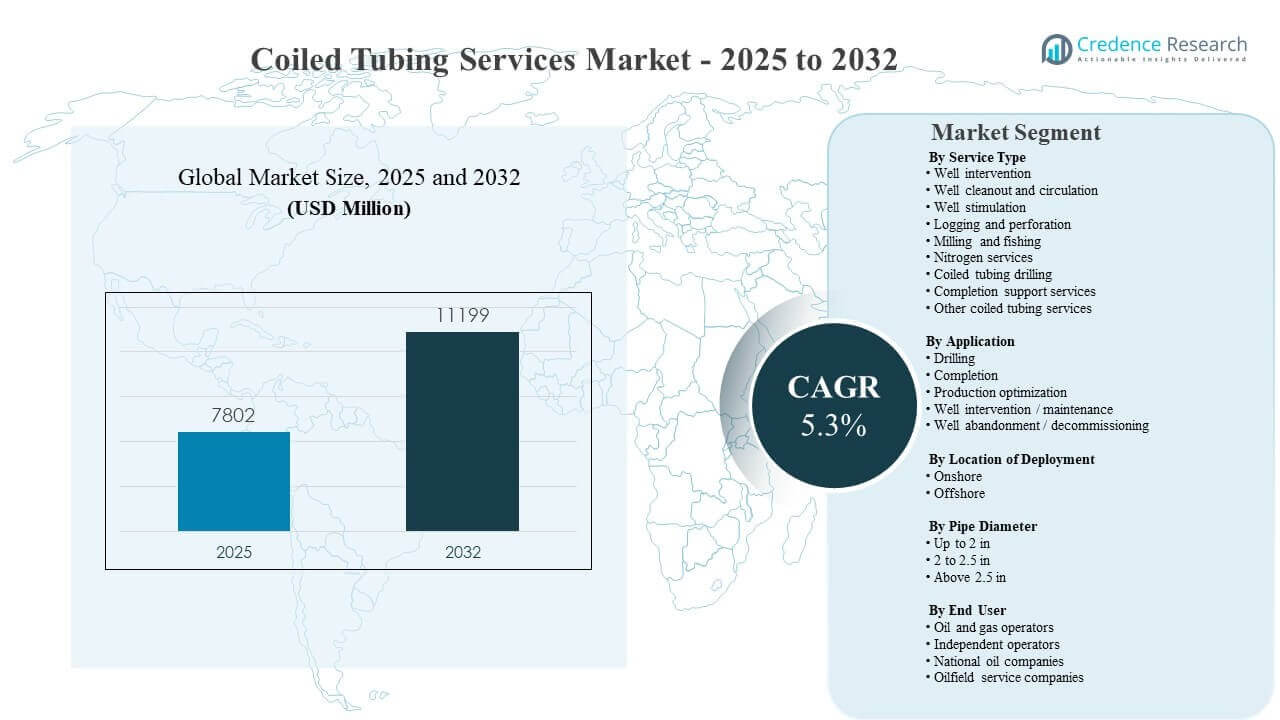
The global Coiled Tubing Services Market size was estimated at USD 7,802 million in 2025 and is expected to reach USD 11,199 million by 2032, growing at a CAGR of 5.3% from 2025 to 2032. Growth is anchored in the expanding use of coiled tubing for intervention-led productivity improvement, where operators prioritize faster execution, reduced downtime, and repeatable outcomes across mature well inventories. Coiled Tubing Services Market adoption remains most concentrated in high-activity upstream regions where service intensity is sustained by recurring maintenance and optimization cycles.
| REPORT ATTRIBUTE | DETAILS |
|---|---|
| Historical Period | 2020-2024 |
| Base Year | 2025 |
| Forecast Period | 2026-2032 |
| Coiled Tubing Services Market Size 2025 | USD 7,802 million |
| Coiled Tubing Services Market, CAGR | 5.3% |
| Coiled Tubing Services Market Size 2032 | USD 11,199 million |
Key Market Trends & Insights
- The Coiled Tubing Services Market is projected to expand from USD 7,802 million (2025) to USD 11,199 million (2032) at a 5.3% CAGR (2025–2032).
- North America held 49.8% share in 2025, reflecting dense well counts and sustained intervention activity across mature producing basins.
- Europe represented 17.6% share in 2025, supported by ongoing integrity-led interventions and production optimization programs.
- By Service Type, well cleanout and circulation plus well stimulation captured 52.9% share in 2025, driven by repeat cleanout and pump-down requirements.
- By Location of Deployment, onshore accounted for 76.8% share in 2025, reflecting faster mobilization economics and larger addressable well stock.
Segment Analysis
Coiled Tubing Services Market demand is shaped by intervention-heavy operating models that emphasize production restoration, flow assurance, and workover avoidance. Service providers increasingly bundle cleanout, stimulation, conveyance, and mechanical remediation capabilities to improve job efficiency and reduce total well downtime. Procurement patterns favor providers with robust fleet availability, fast mobilization, and strong HSE execution, particularly for time-sensitive intervention windows. Buyers also prioritize reliability across long laterals and complex completions, which has increased attention on fatigue performance, real-time monitoring, and toolstring compatibility.
Segment momentum is reinforced by the operational fit of coiled tubing across recurring well-life events, including cleanouts, scale removal, stimulation support, and selective mechanical work. Demand intensity typically rises in mature assets where intervention frequency increases over time, and it expands in regions scaling unconventional or redevelopment programs. Service competitiveness also depends on integrated planning, fluid compatibility, and execution consistency in varied well conditions. Coiled Tubing Services Market evolution continues to favor scalable service models that can flex across basins, job types, and operating constraints without compromising cycle time.
By Service Type Insights
Well cleanout and circulation plus well stimulation accounted for the largest share of 52.9% in 2025. This leadership reflects the steady cadence of cleanout and circulation needs tied to solids management, debris removal, and flow assurance. Stimulation-related activity remains strong where operators seek cost-effective productivity uplift without full workovers. Coiled tubing also enables precise placement and efficient pumping operations that support predictable outcomes across repeat interventions. Service providers with strong execution playbooks and fit-for-purpose toolstrings sustain higher utilization in this service cluster.
By Application Insights
Well intervention and maintenance accounted for the largest share of 66.2% in 2025. Mature producing wells require frequent maintenance cycles to manage declining production, solids, and wellbore restrictions. Coiled tubing interventions reduce the need for more disruptive workover approaches, supporting lower downtime in many operating contexts. Operators also use coiled tubing for targeted remediation programs that protect base production and reduce deferred output. As well complexity increases, intervention planning and repeatability become key determinants of service selection.
By Location of Deployment Insights
Onshore accounted for the largest share of 76.8% in 2025. Onshore dominance reflects larger well counts, shorter mobilization cycles, and more flexible scheduling across multi-well campaigns. Intervention programs are easier to scale onshore because service logistics and equipment movement are generally less constrained. Offshore coiled tubing activity remains strategic where integrity-driven interventions and specialized execution requirements concentrate value per job. Service providers differentiate through offshore-ready packages, integrated workflows, and consistent performance under more complex conditions.
By Pipe Diameter Insights
2 to 2.5 inches accounted for the largest share of 44.1% in 2025. This diameter band is widely used because it supports a practical balance of pump rates, reach, and operational robustness across common intervention designs. Compatibility with frequently deployed toolstrings and job types helps sustain standardized fleet utilization. The diameter range also supports repeat intervention cycles where fatigue performance and reliability influence total cost of ownership. Providers emphasize inspection discipline and operational controls to sustain performance over demanding duty cycles.
By End User Insights
Coiled Tubing Services Market demand spans oil and gas operators, independent operators, national oil companies, and oilfield service companies, with procurement behavior shaped by contracting structures and asset strategies. National oil companies typically emphasize longer-term integrity programs and sustained production optimization across large portfolios. Independent operators often prioritize cycle-time compression, job-level economics, and rapid scheduling flexibility. Oilfield service companies compete by bundling coiled tubing with adjacent services, strengthening integrated delivery capability across intervention-heavy basins.
Coiled Tubing Services Market Drivers
Rising intervention intensity in mature assets
Coiled Tubing Services Market growth is supported by increasing intervention frequency across mature fields where decline management is a structural requirement. Operators use coiled tubing to restore flow, remove restrictions, and stabilize production without the full disruption of conventional workovers. The service fit improves when campaigns can be repeated efficiently across dense well inventories. Service providers that deliver consistent execution and minimized nonproductive time benefit from higher utilization and repeat awards.
Productivity optimization focus in unconventional and redevelopment programs
Coiled Tubing Services Market demand rises when operators pursue repeat optimization cycles to protect base production and improve recovery. Coiled tubing supports mechanical remediation and targeted pumping operations that align with fast decision cycles and standardized well designs. The ability to execute interventions with predictable outcomes strengthens adoption where programmatic operations dominate. As wells become more complex, integrated planning and execution discipline become a larger driver of service value.
Cost and downtime pressure across upstream operations
Coiled Tubing Services Market adoption is reinforced by operator pressure to reduce downtime and lower total intervention cost per well. Coiled tubing can shorten job duration in many intervention types, especially when mobilization and rig scheduling are constraints. Service models that combine fleet readiness, reliable toolstrings, and efficient logistics improve economic outcomes. Competitive differentiation increasingly centers on execution efficiency, operational reliability, and repeatable performance.
- For instance, on a multi-well subsea P&A campaign in the North Sea, Halliburton achieved a 98.59% operational efficiency rate, recorded only 1.41% non-productive time across the entire project duration, completed operations 22 days ahead of schedule, and delivered cost savings of approximately USD 4 million recovering 147 hours against the planned project timeline through the use of multi-skilled integrated crews.
Service bundling and integrated delivery strategies
Coiled Tubing Services Market growth is supported by integrated delivery approaches where providers bundle intervention services to reduce coordination burden for operators. Bundled offerings can improve planning continuity, cut idle time between steps, and reduce total well downtime. Integrated models also support better risk control and standardized workflows across large campaigns. Providers with broad capabilities and strong operational systems are positioned to capture larger scopes of work.
- For instance, SLB's ACTive™ powered downhole measurements system enabled operators to complete a full four-stage intervention workflow wellbore cleanout, saturation logging, water shutoff, and reperforation on a single coiled tubing conveyance, reducing offshore intervention time by 83%, eliminating 60 hours of high-risk pressure-deployment activity, and accelerating production restart by four months.
Coiled Tubing Services Market Challenges
Coiled Tubing Services Market performance is constrained by operational complexity, including fatigue management, equipment reliability, and job execution risk under variable downhole conditions. Coiled tubing strings experience mechanical and cyclic stresses that demand disciplined inspection, handling, and operational controls. Any reliability issue can create downtime and increase total job cost, which heightens buyer scrutiny during tendering. Service providers must continuously balance utilization targets with maintenance discipline to protect performance.
Coiled Tubing Services Market economics are also challenged by cost volatility and uneven activity levels across basins, which can pressure pricing and fleet planning. When upstream spending cycles soften, utilization drops and competition intensifies, particularly in commoditized job types. Supply chain constraints for specialized components and high-spec equipment can extend maintenance cycles and limit rapid scaling. Providers increasingly respond by optimizing fleet composition, tightening execution workflows, and expanding integrated offerings.
- For instance, Baker Hughes states that its Real-Time Coil (RtC) system is rated to 10,000 psi and 347°F, and it enables logging data acquisition without additional runs while transferring real-time data to the CT cabin, logging cabin, and onshore teams through Live Link, demonstrating how high-spec integrated systems can improve execution efficiency when operators are under pressure to control repeat interventions and maintenance-related delays.
Coiled Tubing Services Market Trends and Opportunities
Coiled Tubing Services Market trends increasingly emphasize efficiency-focused execution, standardization, and technology-enabled monitoring to reduce nonproductive time. Providers are investing in job planning discipline, real-time performance tracking, and operational controls that improve reliability across repeat campaigns. Buyers prefer service partners that can execute consistently across a variety of well conditions and maintain predictable cycle times. This trend supports opportunities for differentiated service models that combine operational excellence with scalable fleet readiness.
- For instance, Halliburton reported that its SPECTRUM real-time coiled tubing services used fiber-optic distributed temperature sensing to deliver 30 hours of continuous monitoring in a single trip downhole, eliminate dummy runs, and help the operator achieve an estimated 25% time saving compared with past projects.
Coiled Tubing Services Market opportunities are expanding in integrated intervention and integrity-led programs where service scope breadth influences award outcomes. Offshore and complex well environments create opportunities for high-value execution models that bundle multiple intervention steps. Regional redevelopment programs and mature-field optimization also create recurring demand patterns that favor providers with durable local presence. Providers that strengthen integrated delivery capability and enhance execution consistency can capture larger, longer-duration contracts.
Regional Insights
North America
Coiled Tubing Services Market activity in North America is led by a high density of producing wells and a sustained intervention and optimization cycle. North America accounted for 49.8% share in 2025, supported by recurring cleanout, stimulation support, and mechanical remediation programs. Buyers often prioritize cycle time, fleet availability, and execution consistency across multi-well campaigns. Competitive intensity remains high, favoring providers that combine operational scale with reliable performance.
Europe
Coiled Tubing Services Market demand in Europe is strongly tied to integrity-led interventions and production optimization needs across mature assets. Europe represented 17.6% share in 2025, reflecting the continued need for maintenance and remediation activity under strict operating requirements. Offshore exposure elevates the importance of execution discipline, planning rigor, and HSE performance. Service providers that maintain offshore-ready capabilities and integrated delivery models hold a strategic advantage.
Asia Pacific
Coiled Tubing Services Market growth in Asia Pacific is supported by upstream development needs, ongoing field optimization, and expanding intervention programs. Asia Pacific captured 12.4% share in 2025, reflecting a mix of redevelopment activity and production maintenance requirements. Operators increasingly seek scalable service delivery and consistent job outcomes across varied well conditions. Service providers with strong local execution capacity and flexible mobilization are positioned to benefit.
Latin America
Coiled Tubing Services Market expansion in Latin America is influenced by both onshore optimization and offshore intervention needs in key producing regions. Latin America held 8.2% share in 2025, supported by activity that prioritizes uptime and production continuity. Offshore environments increase the value of integrated intervention workflows and specialized execution capability. Providers with regional operational footprint and strong logistics resilience tend to perform better in multi-year programs.
Middle East & Africa
Coiled Tubing Services Market demand in the Middle East and Africa is supported by large producing portfolios and ongoing field optimization programs. Middle East and Africa accounted for 12.0% share in 2025, reflecting sustained intervention requirements and continued focus on production efficiency. Service partners are often evaluated on execution reliability, integrated delivery capability, and operational scale. Providers aligned with long-duration programs and strong local execution systems can capture repeat work scopes.
Competitive Landscape
Coiled Tubing Services Market competition is characterized by a mix of global integrated providers and regionally strong specialists competing on execution reliability, fleet availability, and integrated intervention capability. Differentiation increasingly depends on reducing nonproductive time, improving operational repeatability, and scaling service delivery across campaigns. Providers also compete through bundled offerings that combine intervention with adjacent services, improving continuity and simplifying operator coordination. Contract awards often reflect demonstrated performance, local footprint, and the ability to deliver under time and complexity constraints.
SLB maintains a broad upstream services footprint and positions coiled tubing within integrated intervention and production optimization delivery models. Coiled tubing execution is typically aligned with efficiency and reliability objectives where operators seek consistent outcomes across repeated campaigns. Service integration supports planning continuity and operational standardization, which can reduce downtime and improve program economics. SLB’s competitive strength is reinforced by its ability to support multi-basin execution and complex operating environments through scalable systems.
The industry research and growth report includes detailed analyses of the competitive landscape of the market and information about key companies, including:
- SLB
- Halliburton
- Baker Hughes
- Weatherford International
- Trican Well Service
- Calfrac Well Services
- STEP Energy Services
- Archer
- Cudd Energy Services
- Key Energy Services
- NexTier Oilfield Solutions
- Tenaris
Qualitative and quantitative analysis of companies has been conducted to help clients understand the wider business environment as well as the strengths and weaknesses of key industry players. Data is qualitatively analyzed to categorize companies as pure play, category-focused, industry-focused, and diversified; it is quantitatively analyzed to categorize companies as dominant, leading, strong, tentative, and weak.
Recent Developments
- In March 2025, Baker Hughes announced a multi-year contract with Dubai Petroleum Establishment, on behalf of Dubai Supply Authority, to provide integrated coiled-tubing drilling services for the Margham Gas Storage Project. The project combines Baker Hughes’ coiled-tubing drilling and underbalanced drilling capabilities with its CoilTrak coiled-tubing bottomhole assembly system to improve subsurface navigation and reservoir contact during horizontal drilling.
- In October 2025, Baker Hughes announced an award from Aramco to expand its integrated underbalanced coiled tubing drilling operations across Saudi Arabia’s natural gas fields. Under the multi-year agreement, Baker Hughes said it would increase its active UBCTD fleet from four units to ten and provide added support in underbalanced drilling services, operational management, well construction, and geosciences
- In October 2024, KLX Energy Services acquired Motley Services LLC for $148 million to strengthen its coiled tubing capabilities, especially for complex horizontal wells. The acquisition was also aimed at expanding KLX’s presence in active oilfield regions such as the Permian Basin, while adding Motley’s large-diameter coiled tubing expertise for difficult intervention work.
Report Scope
| Report Attribute | Details |
| Market size value in 2025 | USD 7,802 million |
| Revenue forecast in 2032 | USD 11,199 million |
| Growth rate (CAGR) | 5.3% (2025–2032) |
| Base year | 2025 |
| Forecast period | 2026–2032 |
| Quantitative units | USD million |
| Segments covered | By Service Type Outlook: well intervention, cleanout/circulation, stimulation, logging & perforation, milling & fishing, nitrogen services, coiled tubing drilling, completion support, other coiled tubing services; By Application Outlook: drilling, completion, production optimization, well intervention/maintenance, well abandonment/decommissioning; By Location of Deployment Outlook: onshore, offshore; By Pipe Diameter Outlook: up to 2 in, 2 to 2.5 in, above 2.5 in; By End User Outlook: oil and gas operators, independent operators, national oil companies, oilfield service companies |
| Regional scope | North America, Europe, Asia Pacific, Latin America, Middle East & Africa |
| Key companies profiled | SLB; Halliburton; Baker Hughes; Weatherford International; Trican Well Service; Calfrac Well Services; STEP Energy Services; Archer; Cudd Energy Services; Key Energy Services; NexTier Oilfield Solutions; Tenaris |
| No. of Pages | 340 |
Segmentation
By Service Type
- Well intervention
- Well cleanout and circulation
- Well stimulation
- Logging and perforation
- Milling and fishing
- Nitrogen services
- Coiled tubing drilling
- Completion support services
- Other coiled tubing services
By Application
- Drilling
- Completion
- Production optimization
- Well intervention / maintenance
- Well abandonment / decommissioning
By Location of Deployment
- Onshore
- Offshore
By Pipe Diameter
- Up to 2 in
- 2 to 2.5 in
- Above 2.5 in
By End User
- Oil and gas operators
- Independent operators
- National oil companies
- Oilfield service companies
By Region
- North America
- U.S.
- Canada
- Mexico
- Europe
- Germany
- France
- U.K.
- Italy
- Spain
- Rest of Europe
- Asia Pacific
- China
- Japan
- India
- South Korea
- South-east Asia
- Rest of Asia Pacific
- Latin America
- Brazil
- Argentina
- Rest of Latin America
- Middle East & Africa
- GCC Countries
- South Africa
- Rest of the Middle East and Africa

Request a Free Sample
Fill in your details and we'll send you a free sample report.
- Sample data tables & charts
- Research methodology
Need a Custom Version of This Report?
Tailor the scope, geography, or segments to your exact requirements.
- Custom geography or segment scope
- Direct access to our analyst team
Frequently Asked Questions
What is the market size of the Coiled Tubing Services Market in 2025 and the forecast for 2032?
What is the CAGR for the Coiled Tubing Services Market during 2025–2032?
Which segment is largest in the Coiled Tubing Services Market?
What factors are driving growth in the Coiled Tubing Services Market?
Who are the leading companies in the Coiled Tubing Services Market?
Which region leads the Coiled Tubing Services Market?
Table of Content
Chapter 1 Market Segmentation
- 1.1 Segmentation Framework
- 1.1.1 Product and Service Classification
- 1.1.2 Application and End-Use Classification
- 1.1.3 Technology and Solution Classification
- 1.1.4 Customer and Distribution Channel Classification
- 1.1.5 Geographic Segmentation
- 1.1.6 Market Segment Definitions and Boundaries
Chapter 2 Introduction
- 2.1 Report Objectives and Scope
- 2.2 Product Definition and Industry Terminology
- 2.3 Market Inclusions and Exclusions
- 2.4 Research Process
- 2.4.1 Primary Research and Expert Interviews
- 2.4.2 Secondary Research and Source Review
- 2.4.3 Top-Down and Bottom-Up Estimation
- 2.4.4 Data Triangulation and Verification
- 2.5 Market Size Measurement Basis
- 2.5.1 2025: USD 7,802 million → 2032: USD 11,199 million
- 2.6 Historical and Forecast Reference Periods
- 2.6.1 Base Year: 2025
- 2.6.2 Forecast Period: 2025-2032
- 2.7 Research Assumptions and Limitations
Chapter 3 Executive Summary
- 3.1 Market Snapshot and Key Findings
- 3.2 Base-Year Market Size, 2025
- 3.3 Forecast Market Size, 2032
- 3.4 Revenue and Volume Growth Outlook
- 3.5 Key Demand and Supply Indicators
- 3.6 Leading Market Segments
- 3.7 Fastest-Growing Market Opportunities
- 3.8 Regional Performance Highlights
- 3.9 Technology and Industry Transformation
- 3.10 Competitive Landscape Summary
- 3.11 Analyst View and Strategic Implications
Chapter 4 Global Coiled Tubing Services Market Trends and Developments
- 4.1 Historical Industry Development
- 4.2 Recent Market Trends and Developments
- 4.3 Demand and Customer Behavior Trends
- 4.4 Technology and Product Innovation
- 4.5 Artificial Intelligence, Automation and Digitalization
- 4.6 Local Manufacturing and Supply Chain Realignment
- 4.7 Industry Partnerships, Mergers and Acquisitions
- 4.8 Sustainability and Circular Economy Developments
- 4.9 Government and Private Sector Investment Trends
- 4.10 Emerging Business Models and Commercialization
- 4.11 Industry Developments and Announcements
Chapter 5 Global Coiled Tubing Services Market Supply and Demand Analysis
- 5.1 Demand Trend and Consumption Analysis
- 5.2 Demand Forecast, 2025-2032
- 5.3 Supply Chain Structure and Procurement Trends
- 5.4 Supply-Demand Gap and Bottlenecks
- 5.5 Import Dependence and Sourcing Structure
- 5.6 Regional Supply and Demand Concentration
Chapter 6 Global Coiled Tubing Services Market Pricing Analysis
- 6.1 Pricing Structure and Measurement
- 6.2 Historical Pricing Trends
- 6.3 Pricing Outlook, 2025-2032
- 6.4 Pricing by Product and Market Segment
- 6.5 Geographic Pricing Differences
- 6.6 Key Input, Energy, Labor and Logistics Costs
- 6.7 Contract Pricing and Purchasing Models
- 6.8 Pricing Sensitivity and Competitive Positioning
- 6.9 Price, Margin and Profitability Implications
Chapter 7 Global Coiled Tubing Services Market Dynamics
- 7.1 Market Growth Drivers
- 7.1.1 Demand-Side Drivers
- 7.1.2 Technology and Innovation Drivers
- 7.1.3 Infrastructure and Investment Drivers
- 7.1.4 Regulatory and Policy Drivers
- 7.2 Market Restraints
- 7.2.1 Cost and Affordability Constraints
- 7.2.2 Technology and Adoption Barriers
- 7.2.3 Supply Chain and Operational Constraints
- 7.3 Market Challenges
- 7.3.1 Competitive Pressure and Margin Erosion
- 7.3.2 Skills, Infrastructure and Implementation Gaps
- 7.4 Emerging Market Opportunities
- 7.5 Market Dynamics Impact and Time-Horizon Assessment
Chapter 8 Global Coiled Tubing Services Value Chain Analysis
- 8.1 Industry Value Chain Overview
- 8.2 Upstream Suppliers and Critical Inputs
- 8.3 Technology and Component Providers
- 8.4 Manufacturing or Service Delivery
- 8.5 Distribution, Channel Partners and Integrators
- 8.6 Downstream Applications and End Users
- 8.7 Value Addition and Profit Pools
- 8.8 Vertical Integration and Outsourcing
- 8.9 Supplier Concentration and Risk
- 8.10 Supply Chain Localization and Resilience
Chapter 9 Global Coiled Tubing Services Market Regulations and Policies
- 9.1 Relevant Laws, Standards and Compliance Frameworks
- 9.2 Product, Service, Safety and Quality Requirements
- 9.3 Government Policies, Incentives and Subsidies
- 9.4 Imports, Exports and Trade Barriers
- 9.5 Public Procurement and Local Content Requirements
- 9.6 Data Protection, AI and Cybersecurity Compliance
- 9.7 Upcoming Policy Changes and Market Implications
Chapter 10 Global Coiled Tubing Services Market Hotspots and Opportunities
- 10.1 Market Opportunity Mapping and Growth Hotspots
- 10.2 High-Growth Applications and Customer Groups
- 10.3 Underserved Markets and White-Space Opportunities
- 10.4 Emerging Technology and Product Opportunities
- 10.5 New Capacity and Investment Hotspots
- 10.6 Market Entry and Expansion Opportunities
- 10.7 Distribution and Partnership Opportunities
- 10.8 Near-Term and Long-Term Commercial Potential
- 10.9 Opportunity Attractiveness and Execution Risks
Chapter 11 Global Coiled Tubing Services Market Outlook, 2025-2032
- 11.1 Market Size and Analysis
- 11.1.1 Revenue (Market Measurement: 2025: USD 7,802 million → 2032: USD 11,199 million)
- 11.1.2 Historical Market Size
- 11.1.3 Base-Year Market Size, 2025
- 11.2 Market Forecast, 2025-2032
- 11.2.1 Revenue Forecast to 2032
- 11.2.2 CAGR and Year-on-Year Growth
- 11.2.3 Incremental Revenue Opportunity
- 11.3 Forecast Assumptions and Scenario Analysis
- 11.3.1 Base-Case Forecast
- 11.3.2 Optimistic and Conservative Scenarios
- 11.3.3 Technology, Pricing and Policy Sensitivities
- 11.4 Market Attractiveness and Growth Outlook
Chapter 12 Global Coiled Tubing Services Market Segmentation and Outlook
- 12.1 Segmentation Summary and Market Shares, 2025
- 12.2 Largest and Fastest-Growing Segments
- 12.3 Segment Growth Comparison
- 12.4 Segment Attractiveness and Priority Matrix
Chapter 13 Global Coiled Tubing Services Geographic Market Outlook, 2025-2032
- 13.1 Regional Market Size and Share, 2025
- 13.2 Regional Market Forecast, 2025-2032
- 13.3 Regional Pricing, Production and Demand Differences
- 13.4 North America
- 13.4.1 United States
- 13.4.2 Canada
- 13.4.3 Mexico
- 13.5 Europe
- 13.5.1 Germany
- 13.5.2 France
- 13.5.3 Italy
- 13.5.4 United Kingdom
- 13.5.5 Spain
- 13.5.6 Poland
- 13.5.7 Russia
- 13.5.8 Netherlands
- 13.5.9 Belgium
- 13.5.10 Sweden
- 13.5.11 Denmark
- 13.5.12 Norway
- 13.5.13 Rest of Europe
- 13.6 Asia Pacific
- 13.6.1 China
- 13.6.2 India
- 13.6.3 Japan
- 13.6.4 South Korea
- 13.6.5 Thailand
- 13.6.6 Indonesia
- 13.6.7 Vietnam
- 13.6.8 Malaysia
- 13.6.9 Australia
- 13.6.10 Rest of Asia Pacific
- 13.7 Latin America
- 13.7.1 Brazil
- 13.7.2 Argentina
- 13.7.3 Colombia
- 13.7.4 Chile
- 13.7.5 Rest of Latin America
- 13.8 Middle East
- 13.8.1 Saudi Arabia
- 13.8.2 United Arab Emirates
- 13.8.3 Turkey
- 13.8.4 Israel
- 13.8.5 Iran
- 13.8.6 Rest of the Middle East
- 13.9 Africa
- 13.9.1 South Africa
- 13.9.2 Egypt
- 13.9.3 Nigeria
- 13.9.4 Morocco
- 13.9.5 Rest of Africa
- 13.10 Regional Investment, Policy and Supply Chain Differences
- 13.11 Regional Competitive Landscape
- 13.12 Geographic Growth Hotspots
Chapter 14 Global Coiled Tubing Services Technology, Innovation and Sustainability Outlook
- 14.1 Technology Landscape and Maturity
- 14.2 Product, Process and Service Innovation
- 14.3 AI, Automation and Digital Tools in the Industry
- 14.4 Technology Adoption and Performance Benchmarking
- 14.5 Innovation Pipeline and R&D Investment
- 14.6 Energy Efficiency and Resource Management
- 14.7 Sustainability, Recycling and Circularity
- 14.8 Technology Roadmap, 2025-2032
- 14.9 Risks of Obsolescence and Technology Substitution
Chapter 15 Global Coiled Tubing Services Market Key Strategic Imperatives
- 15.1 Growth and Market Entry Priorities
- 15.2 High-Return Products and Segments
- 15.3 Pricing, Profitability and Cost Optimization
- 15.4 Technology Investment and Product Differentiation
- 15.5 Supply Chain Localization and Resilience
- 15.6 Distribution and Customer Acquisition
- 15.7 Partnership, Acquisition and Capacity Strategy
- 15.8 Regional Expansion Priorities
- 15.9 Short-, Medium- and Long-Term Actions
Chapter 16 Competition Outlook
- 16.1 Industry Competition Characteristics
- 16.2 Market Structure and Concentration
- 16.3 Market Share and Competitive Positioning, 2025
- 16.4 Company-Wise Revenue and Product Benchmarking
- 16.5 Production and Service Capacity Benchmarking
- 16.6 Technology, Pricing and Differentiation
- 16.7 Regional Footprint and Distribution Strength
- 16.8 Mergers, Acquisitions and Strategic Alliances
- 16.9 New Entrants and Competitive Threats
- 16.10 Porter's Five Forces and Industry Attractiveness
- 16.11 Competitive Outlook, 2025-2032
Chapter 17 Company Profiles
- 17.1 Company Coverage and Selection Criteria
- 17.2 Leading Market Participants – Standard Profile Structure
- 17.2.1 Business Description
- 17.2.2 Company Ownership and Geographic Presence
- 17.2.3 Product and Service Portfolio
- 17.2.4 Manufacturing and Operating Footprint
- 17.2.5 Financial Performance and Investment
- 17.2.6 Market Share and Competitive Position
- 17.2.7 Technology and Innovation Capabilities
- 17.2.8 Strategic Alliances or Partnerships
- 17.2.9 Recent Developments
- 17.2.10 Growth Strategy and Outlook
- 17.3 Other Relevant Market Participants
Note: Every listed company is profiled on the structure shown under the first company. The company list is preliminary and may change based on research findings, market developments, data availability and client requirements.
Chapter 18 Disclaimer
- 18.1 Research and Forecast Disclaimer
- 18.2 Data Source and Estimation Limitations
Note: The depth of individual sections depends on data availability for this market. Volume, capacity, trade and other unit-based metrics are included where applicable.