
| REPORT ATTRIBUTE | DETAILS |
|---|---|
| Historical Period | 2019-2022 |
| Base Year | 2023 |
| Forecast Period | 2024-2032 |
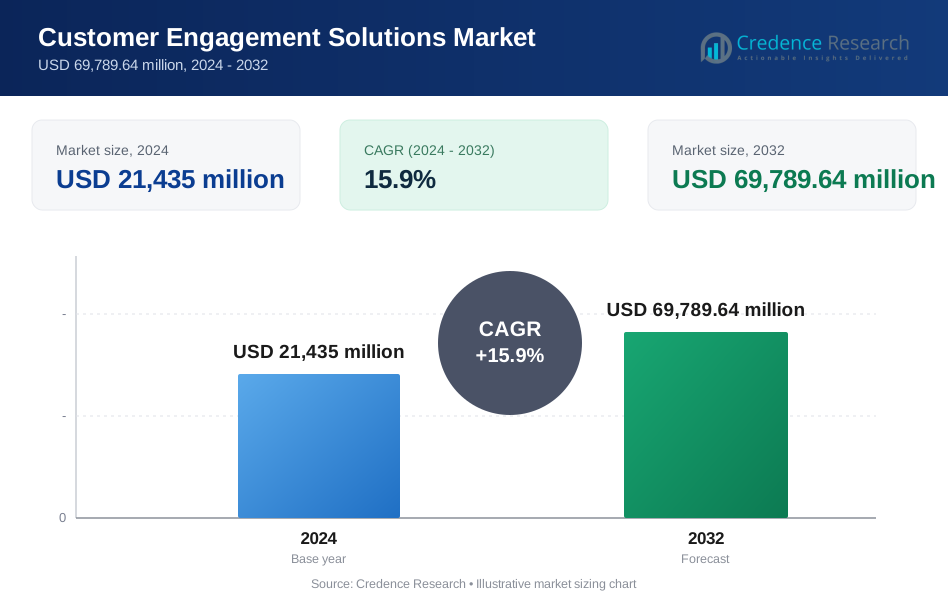
| Customer Engagement Solutions Market Size 2024 | USD 21,435 Million |
| Customer Engagement Solutions Market, CAGR | 15.9% |
| Customer Engagement Solutions Market Size 2032 | USD 69,789.64 Million |
Market Overview
The Customer Engagement Solutions Market is projected to grow from USD 21,435 million in 2024 to USD 69,789.64 million by 2032, registering a robust CAGR of 15.9% during the forecast period.
The Customer Engagement Solutions market is driven by the increasing demand for personalized customer experiences across industries. Organizations are adopting advanced engagement tools to enhance customer satisfaction, loyalty, and retention in a highly competitive market. The rise of omnichannel communication strategies, integrating platforms such as social media, chatbots, email, and mobile apps, is transforming customer interactions. Furthermore, the integration of artificial intelligence (AI) and machine learning (ML) enables businesses to analyze customer behavior, predict preferences, and deliver tailored solutions in real-time. The growing reliance on cloud-based solutions provides scalability, cost efficiency, and seamless accessibility, further boosting market adoption. Additionally, the shift toward digital transformation, fueled by evolving consumer expectations and increasing smartphone penetration, has amplified the need for innovative engagement strategies. Companies are also focusing on data security and compliance to address privacy concerns, ensuring trust and transparency in customer interactions. These factors collectively drive the market's growth trajectory.
The Customer Engagement Solutions market demonstrates strong geographical diversity, with North America leading, driven by advanced technological infrastructure and key players like Salesforce.com Inc., IBM Corporation, and Genesys. Asia-Pacific is emerging as the fastest-growing region, fueled by rapid digitalization, increasing internet penetration, and the expansion of e-commerce in countries like China and India. Europe also contributes significantly, leveraging advanced omnichannel platforms and compliance-driven adoption. Leading players such as NICE, SAP SE, Oracle Corporation, and Verint Systems Inc. play a pivotal role in shaping market dynamics globally. These companies drive innovation through AI-powered tools, omnichannel communication strategies, and strategic collaborations to meet evolving customer expectations and expand their global footprint.
Market Drivers:
Rising Demand for Personalized Customer Experiences:
The increasing need for personalized customer interactions is a primary driver of the Customer Engagement Solutions market. Modern consumers expect tailored experiences that resonate with their preferences and behaviors. For instance, a report by the Ministry of Electronics and Information Technology (MeitY) in India highlighted that businesses are leveraging advanced technologies, including AI and machine learning, to analyze customer data and deliver personalized communication across multiple channels. This trend is especially prominent in industries like retail, banking, and hospitality, where customer-centric strategies are vital for differentiation and loyalty.
Integration of Omnichannel Communication:
The shift towards omnichannel communication is transforming customer engagement approaches. For example, a survey by the National Institute of Standards and Technology (NIST) noted that organizations are moving beyond traditional methods to integrate platforms like social media, mobile apps, chatbots, and email to create seamless customer journeys. This integration ensures consistency in communication, improving overall customer satisfaction and retention rates. Omnichannel strategies also enable businesses to gather comprehensive insights into customer behavior, driving informed decision-making and enhancing operational efficiency.
Adoption of Advanced Technologies:
The rapid adoption of cutting-edge technologies is significantly boosting the market. For instance, a report by the International Data Corporation (IDC) emphasized that artificial intelligence, machine learning, and big data analytics empower companies to predict customer preferences, optimize interactions, and provide proactive support. Cloud-based customer engagement solutions are gaining traction due to their scalability, cost-effectiveness, and real-time access capabilities. Additionally, the incorporation of natural language processing (NLP) and voice recognition technologies enhances customer interaction quality, fostering deeper connections and trust.
Accelerated Digital Transformation:
The ongoing wave of digital transformation across industries is a critical factor driving the market. For example, a study by the European Commission highlighted that businesses are investing heavily in innovative engagement tools to meet evolving customer expectations and remain competitive. Increasing smartphone penetration and internet accessibility have further intensified the adoption of digital engagement solutions. Moreover, regulatory compliance requirements related to data privacy and security are prompting organizations to adopt robust platforms that ensure trust and transparency in customer interactions, reinforcing the market's growth potential.
Market Trends:
Increased Adoption of Omnichannel Platforms:
The growing emphasis on creating seamless customer journeys has led to the widespread adoption of omnichannel engagement platforms. For example, a survey by the European Commission noted that these solutions integrate multiple communication channels, such as social media, mobile apps, email, and live chat, to deliver a unified customer experience. Businesses are leveraging these platforms to ensure consistency in messaging and enhance interaction quality, regardless of the touchpoint. This trend has gained significant traction in industries like e-commerce, banking, and healthcare, where customer convenience is paramount.
Shift Towards Cloud-Based Solutions:
The shift to cloud-based customer engagement solutions is gaining momentum due to their scalability, cost efficiency, and accessibility. For instance, a report by the International Data Corporation (IDC) emphasized that cloud platforms offer advanced analytics, integration capabilities, and real-time data sharing, enabling businesses to enhance decision-making and customer support. The flexibility and ease of deployment provided by cloud solutions have made them a preferred choice for small and medium-sized enterprises (SMEs) and large corporations alike, driving their adoption across diverse industries.
Focus on Data Security and Compliance:
With growing concerns about data privacy, businesses are prioritizing secure customer engagement platforms that comply with stringent regulatory requirements, such as GDPR and CCPA. For example, a study by the U.S. Federal Trade Commission (FTC) highlighted that ensuring data security fosters customer trust and strengthens brand reputation. This trend has spurred innovation in encryption technologies, secure cloud services, and advanced authentication methods, ensuring that customer interactions remain protected while enabling businesses to maintain compliance.
Growth of AI-Driven Customer Engagement:
Artificial intelligence (AI) is revolutionizing the Customer Engagement Solutions market by enabling businesses to deliver smarter, more personalized experiences. For instance, a report by the National Institute of Standards and Technology (NIST) highlighted that AI-powered chatbots, virtual assistants, and predictive analytics tools are now integral to engagement strategies. These technologies allow companies to automate routine tasks, analyze customer data in real-time, and predict preferences, ensuring timely and relevant interactions. The use of AI-driven tools also enhances problem resolution, improving customer satisfaction and fostering loyalty.
Market Challenges Analysis:
High Implementation Costs and Complexity:
One of the significant challenges facing the Customer Engagement Solutions market is the high cost and complexity associated with implementing advanced systems. Many organizations, especially small and medium-sized enterprises (SMEs), struggle to allocate resources for deploying comprehensive customer engagement platforms. The integration of technologies such as artificial intelligence, machine learning, and big data analytics often requires significant upfront investment in infrastructure, software, and skilled personnel. Moreover, the customization of these solutions to align with specific business needs can add to implementation costs and time. These challenges act as barriers for smaller businesses seeking to adopt cutting-edge engagement tools, limiting market growth potential in this segment.
Data Privacy Concerns and Compliance Challenges:
The increasing reliance on customer data for personalized engagement strategies raises concerns about data privacy and security. Businesses must navigate stringent regulatory frameworks such as GDPR, CCPA, and HIPAA, which mandate strict protocols for data collection, storage, and usage. Non-compliance can result in hefty fines, legal consequences, and reputational damage. Additionally, the risk of data breaches and cyberattacks poses a persistent challenge, as companies must invest in advanced security measures to safeguard sensitive information. Balancing the need for data-driven insights with privacy considerations remains a critical challenge for businesses, requiring continuous efforts to build trust and ensure compliance in an evolving regulatory landscape.
Market Segmentation Analysis:
By Deployment
The Customer Engagement Solutions market is segmented into cloud-based and on-premises deployment models. The cloud-based segment is experiencing significant growth due to its scalability, cost-effectiveness, and ease of implementation. Cloud solutions enable businesses to access real-time data and integrate multiple platforms seamlessly, making them particularly attractive to small and medium-sized enterprises (SMEs). Additionally, the flexibility offered by cloud-based solutions allows organizations to adapt quickly to dynamic customer demands. Conversely, on-premises solutions remain popular among organizations that prioritize data security and control. Industries handling sensitive customer data, such as banking and healthcare, often opt for on-premises deployment to ensure compliance with stringent regulatory requirements.
By Component
The market is also segmented based on components, including software and services. The software segment dominates the market, driven by the demand for advanced tools such as customer analytics, omnichannel communication platforms, and AI-driven engagement solutions. These software tools enable businesses to deliver personalized and efficient customer experiences. The services segment, which includes consulting, implementation, and support services, is also witnessing substantial growth. As organizations increasingly adopt sophisticated customer engagement platforms, they require expert guidance for deployment, integration, and maintenance. The rising complexity of customer engagement ecosystems further amplifies the demand for these specialized services.
Segments:
Based on Component
- Solution
- Analytics & Reporting
- Omnichannel
- Robotic Process Optimization
- Self-service
- Workforce optimization
- Services
- Integration & deployment
- Support & maintenance
- Training & consulting
Based on Deployment
- Hosted
- On-Premise
Based on Enterprise Size
- SMEs
- Large enterprises
Based on End-use
- BFSI
- Retail & consumer goods
- Healthcare
- IT & telecom
- Government, energy & utilities
- Manufacturing
- Travel & hospitality
- Others
Based on the Geography:
- North America
- U.S.
- Canada
- Mexico
- Europe
- Germany
- France
- U.K.
- Italy
- Spain
- Rest of Europe
- Asia Pacific
- China
- Japan
- India
- South Korea
- South-east Asia
- Rest of Asia Pacific
- Latin America
- Brazil
- Argentina
- Rest of Latin America
- Middle East & Africa
- GCC Countries
- South Africa
- Rest of the Middle East and Africa
Regional Analysis:
North America
North America continues to lead the Customer Engagement Solutions market, accounting for approximately 35% of the global revenue in 2024. The region's dominance is supported by its advanced technological landscape, strong consumer demand for innovation, and a high level of digital literacy among businesses and end-users. The U.S., as the primary contributor, drives the region’s growth with its robust adoption of AI, machine learning (ML), and big data analytics across multiple industries, including retail, BFSI, and healthcare. The presence of global market leaders such as Salesforce, Adobe, and Oracle ensure consistent innovation and the availability of sophisticated solutions tailored to the needs of North American businesses. Additionally, the growing popularity of omnichannel communication strategies has prompted companies to integrate social media, mobile applications, and live chat tools, enabling seamless customer interactions. Regulatory measures like GDPR for global data security compliance and CCPA for local privacy laws compel organizations to adopt secure and compliant engagement platforms, further solidifying the region's market position. The region's mature e-commerce sector, combined with advanced cloud infrastructure, ensures continued investment in customer engagement solutions, making North America a benchmark for innovation in the industry.
Asia-Pacific
Asia-Pacific is emerging as the fastest-growing region in the Customer Engagement Solutions market, projected to account for over 25% of the global market share by 2032. Rapid urbanization, increasing internet connectivity, and smartphone penetration have transformed consumer behaviors, particularly in countries like China, India, and Japan, which are driving substantial growth. E-commerce giants like Alibaba, Flipkart, and Rakuten are leveraging advanced engagement tools to cater to an expanding customer base. Small and medium-sized enterprises (SMEs) in the region are rapidly adopting cloud-based solutions due to their scalability and affordability, further propelling market growth. Government initiatives, such as India's Digital India and China's Internet Plus, are fostering a favorable environment for technology adoption, particularly in the SME segment. Additionally, emerging markets in Southeast Asia, including Indonesia, Vietnam, and the Philippines, offer lucrative opportunities due to growing consumer awareness and increasing investments in digital infrastructure. Companies in the region are adopting localized engagement strategies and competitive pricing models to expand their market reach. With rising economic growth, significant investments, and untapped potential, Asia-Pacific is poised to become a critical player in the global Customer Engagement Solutions market landscape.
Europe
Europe accounts for about 25% of the Customer Engagement Solutions Market. The market is expected to grow steadily due to increasing investments in e-commerce platforms and a focus on improving customer interactions across various industries, including automotive and consumer goods. Germany and the UK are key markets. The European market's growth is also supported by stringent regulations that encourage businesses to adopt customer-centric approaches.
Latin America
Latin America holds a smaller share of 3%, but it shows potential for growth driven by improving economic conditions and rising health awareness among consumers. The region's as businesses increasingly adopt customer engagement solutions to enhance service delivery and customer loyalty.
Middle East & Africa
The Middle East and Africa represent about 2% of the market share. Growth in this region is primarily influenced by increasing investments in technology and digital transformation initiatives across various sectors. As local companies begin adopting more sophisticated customer engagement solutions to compete globally.
Key Player Analysis:
- Genesys
- Nuance Communications Inc.
- NICE
- Salesforce.com Inc.
- Pegasystems Inc.
- IBM Corporation
- OpenText Corporation
- Avaya Inc.
- Verint Systems Inc.
- SAP SE
Competitive Analysis:
The Customer Engagement Solutions market is highly competitive, with key players such as Salesforce.com Inc., IBM Corporation, Genesys, NICE, Oracle Corporation, Avaya Inc., Nuance Communications Inc., SAP SE, Pegasystems Inc., and Verint Systems Inc. driving innovation and market growth. These companies leverage advanced technologies, including artificial intelligence, machine learning, and big data analytics, to deliver sophisticated engagement tools tailored to diverse industries. For instance, Salesforce.com Inc. and IBM Corporation lead with robust cloud-based platforms, while Genesys and NICE specialize in omnichannel communication and customer analytics. Oracle Corporation and SAP SE focus on integrated enterprise solutions, ensuring seamless operational workflows. Avaya Inc. and Nuance Communications Inc. emphasize AI-driven personalization, while Pegasystems Inc. and Verint Systems Inc. deliver scalable solutions for customer retention and satisfaction. The competitive landscape is defined by continuous innovation, strategic partnerships, and expanding global footprints to address evolving customer needs and regulatory demands.
Recent Developments:
- In February 2024, CleverTap partnered with Zoomcar, a car rental company, to utilize its advanced AI capabilities and TesseractDB for creating personalized customer engagement. The collaboration focuses on re-engagement campaigns, maximizing customer lifetime value, and delivering optimized omnichannel experiences.
- In February 2024, SAP Emarsys collaborated with Annex Cloud, a loyalty management platform provider, to integrate the SAP Emarsys Customer Engagement Platform with Annex Cloud’s Loyalty Experience Platform. This integration aims to deliver personalized omnichannel experiences, track customers, manage promotions, score behaviors, and enhance customer interactions.
- In January 2024, Bharti AXA Life Insurance joined hands with MoEngage by deploying its engagement platform to streamline communications across WhatsApp, emails, and SMS. This partnership is set to transform Bharti AXA's customer engagement initiatives in the life insurance sector.
- In December 2023, Rayna Tours, a UAE-based tour operator, partnered with MoEngage to integrate its customer engagement platform. This integration enables Rayna Tours to leverage data-driven insights for personalized customer interactions, boost booking conversion rates, enhance user experiences, increase customer retention, and drive revenue growth.
Market Concentration & Characteristics:
The Customer Engagement Solutions market exhibits a moderately high level of market concentration, with a mix of global giants and regional players contributing to its dynamic landscape. Leading companies such as Salesforce.com Inc., Genesys, NICE, and IBM Corporation dominate the market with their extensive product portfolios and strong global presence. These players benefit from advanced technological capabilities, including artificial intelligence, machine learning, and big data analytics, which enable them to deliver innovative and scalable solutions. The market is characterized by rapid technological advancements, a growing emphasis on omnichannel communication, and increasing adoption of cloud-based platforms. Small and medium-sized enterprises (SMEs) are also making significant contributions, leveraging flexible and cost-effective solutions to enhance customer experiences. The competitive environment is shaped by continuous innovation, strategic collaborations, and the ability to adapt to evolving customer needs and regulatory requirements, ensuring robust market growth and differentiation among key players.
Report Coverage:
The research report offers an in-depth analysis based on Component, Deployment, Enterprise Size, End-User and Geography. It details leading market players, providing an overview of their business, product offerings, investments, revenue streams, and key applications. Additionally, the report includes insights into the competitive environment, SWOT analysis, current market trends, as well as the primary drivers and constraints. Furthermore, it discusses various factors that have driven market expansion in recent years. The report also explores market dynamics, regulatory scenarios, and technological advancements that are shaping the industry. It assesses the impact of external factors and global economic changes on market growth. Lastly, it provides strategic recommendations for new entrants and established companies to navigate the complexities of the market.
Future Outlook:
- The Customer Engagement Solutions market is expected to experience significant growth, driven by increasing demand for personalized customer interactions.
- Artificial intelligence and machine learning will play a pivotal role in enhancing customer analytics and automating engagement processes.
- The adoption of cloud-based platforms is projected to accelerate, offering scalability and cost efficiency to businesses of all sizes.
- Omnichannel communication strategies will remain a key focus, integrating social media, mobile apps, and live chat for seamless customer journeys.
- Data privacy and security will continue to shape the market, with businesses investing in compliance with stringent regulations.
- The rapid expansion of e-commerce in emerging markets will create new opportunities for customer engagement solutions providers.
- Small and medium-sized enterprises (SMEs) will increasingly adopt affordable and flexible engagement tools to enhance competitiveness.
- Advanced technologies like natural language processing and voice recognition will gain prominence in improving customer interactions.
- Partnerships and acquisitions among key players will drive innovation and market consolidation.
- Asia-Pacific is expected to emerge as a high-growth region, fueled by digital transformation and increasing smartphone penetration.
Request a Free Sample
Fill in your details and we'll send you a free sample report.
- Sample data tables & charts
- Research methodology
Need a Custom Version of This Report?
Tailor the scope, geography, or segments to your exact requirements.
- Custom geography or segment scope
- Direct access to our analyst team
Frequently Asked Questions
What is the current size of the Customer Engagement Solutions market?
What factors are driving the growth of the Customer Engagement Solutions market?
What are the key segments within the Customer Engagement Solutions market?
What are some challenges faced by the Customer Engagement Solutions market?
Who are the major players in the Customer Engagement Solutions market?
Table of Content
Chapter 1. Report Introduction
- 1.1 Report Description & Purpose
- 1.1.1 Report Title & Market Definition
- 1.1.2 Unique Selling Propositions (USP) & Key Differentiators
- 1.1.3 Value Proposition for Stakeholders
- 1.2 Research Objectives
- 1.2.1 Market Sizing Objectives (Volume & Revenue)
- 1.2.2 Segmentation Objectives
- 1.2.3 Competitive Intelligence Objectives
- 1.2.4 Forecast & Scenario Objectives
- 1.3 Report Scope
- 1.3.1 Customer Engagement Solutions Scope – Types & Subtypes Covered
- 1.3.2 Geographic Scope – Regions & Countries Covered
- 1.3.3 Historical Period, Base Year & Forecast Period (2024; forecast to 2032)
- 1.3.4 Inclusions & Exclusions
- 1.4 HS Code & Classification Framework
- 1.5 Currency, Units & Pricing Basis
- 1.6 Target Stakeholders
- 1.7 Limitations & Assumptions
Chapter 2. Executive Summary
- 2.1 Global Customer Engagement Solutions Market Snapshot
- 2.1.1 Market Size – Historical (2024) & Forecast (2024-2032) (2024: USD 21,435 million → 2032: USD 69,789.64 million)
- 2.1.2 Volume & Revenue – Global Totals
- 2.1.3 Key Market Highlights – Top Five Facts
- 2.2 Customer Engagement Solutions Market Segmentation Snapshot
- 2.2.1 Market Split by Region – 2024 vs. 2032
- 2.3 Competitive Snapshot
- 2.3.1 Top 10 Players by Revenue Share – 2024
- 2.3.2 Top 10 Players by Volume Share – 2024
- 2.3.3 Recent Strategic Developments (18-Month Summary)
- 2.4 Key Investment Highlights & Strategic Conclusions
Chapter 3. Customer Engagement Solutions Market Dynamics & Industry Analysis
- 3.1 Market Overview & Context
- 3.1.1 Customer Engagement Solutions Market Position in the Broader Automotive Value Chain
- 3.1.2 OEM vs. Replacement Market Dynamics
- 3.1.3 Market Maturity & Development Stage by Region
- 3.2 Customer Engagement Solutions Market Drivers
- 3.3 Customer Engagement Solutions Market Restraints & Challenges
- 3.4 Customer Engagement Solutions Market Opportunities
- 3.5 Porter's Five Forces Analysis
- 3.5.1 Threat of New Entrants
- 3.5.2 Bargaining Power of Suppliers
- 3.5.3 Bargaining Power of Buyers
- 3.5.4 Threat of Substitutes
- 3.5.5 Competitive Rivalry – Intensity Assessment
- 3.6 Customer Engagement Solutions Value Chain Analysis
- 3.6.1 Upstream – Raw Material/Input Suppliers
- 3.6.1.1 Raw Material/Input 1
- 3.6.1.2 Raw Material/Input 2
- 3.6.1.3 Raw Material/Input 3
- 3.6.2 Midstream – Production/Manufacturing/Service Delivery
- 3.6.2.1 Production/Process Overview
- 3.6.2.2 Key Facility Locations & Capacity by Manufacturer
- 3.6.3 Downstream – Distribution & End Consumer
- 3.6.3.1 Primary Channel – B2B/OEM
- 3.6.3.2 Secondary Channels – Dealer, Retail, Online, Direct
- 3.6.4 Value Chain Profitability Analysis
- 3.6.1 Upstream – Raw Material/Input Suppliers
- 3.7 PESTEL Analysis
- 3.7.1 Political Factors
- 3.7.2 Economic Factors
- 3.7.3 Social Factors
- 3.7.4 Technological Factors
- 3.7.5 Environmental Factors
- 3.7.6 Legal Factors
- 3.8 Customer Engagement Solutions Supply Chain Analysis
- 3.8.1 Raw Material/Input Supply Risk Assessment
- 3.8.2 Manufacturing Concentration Risk (Geographic Exposure)
- 3.8.3 Trade Disruption Impact Analysis
- 3.9 Regulatory & Policy Landscape
Note: The regulatory and policy landscape section covers regulations based on their applicability to the market, Customer Engagement Solutions category, geography, and scope of the study. Only regulatory frameworks with a material impact on operations, compliance, trade, sustainability, or market access are analyzed in detail.
Chapter 4. Key Investment Pockets & Opportunity Analysis
- 4.1 Customer Engagement Solutions Market Attractiveness Analysis
- 4.1.1 By Region – Investment Attractiveness Matrix (Volume × CAGR)
- 4.2 Absolute Revenue Growth Opportunity
- 4.2.1 By Region – Absolute USD Growth Through 2032
- 4.3 Incremental Volume Opportunity
- 4.3.1 By Region – Incremental Volume Through 2032
- 4.3.2 Segment – Incremental Volume
- 4.4 Emerging Submarket Opportunity Deep Dive (Subject to Applicability)
- 4.5 Emerging Market Opportunity Scorecards
- 4.5.1 United States
- 4.5.2 Europe
- 4.5.3 Asia
- 4.5.4 Middle East & Africa
Note: Emerging Market Opportunity Scorecards will be included based on relevance and strategic importance. Regions listed are indicative and may vary depending on data availability and market dynamics.
Chapter 5. Customer Engagement Solutions Import-Export Analysis & Trade Flows
- 5.1 Global Trade Overview
- 5.1.1 Global Export Value by Country (2024)
- 5.1.2 Global Export Volume by Country (2024)
- 5.1.3 Global Import Value by Country (2024)
- 5.1.4 Global Import Volume by Country (2024)
- 5.1.5 Net Trade Balance by Country (2024)
- 5.2 Export Analysis – Segment
- 5.2.1 Type 1 (HS Code)
- 5.2.2 Type 2 (HS Code)
- 5.2.3 Type 3 (HS Code)
- 5.2.4 Type 4 (HS Code)
- 5.2.5 Type 5 (HS Code)
- 5.3 Import Analysis – Segment
- 5.3.1 Type 1 (HS Code)
- 5.3.2 Type 2 (HS Code)
- 5.3.3 Type 3 (HS Code)
- 5.3.4 Type 4 (HS Code)
- 5.3.5 Type 5 (HS Code)
- 5.4 Average Unit Trade Prices
- 5.4.1 Average Export Price – Segment & Country
- 5.4.2 Average Import Price – Segment & Source Country
- 5.4.3 Price Trends (2024)
- 5.5 Key Trade Route Analysis
- 5.5.1 Trade Route 1
- 5.5.2 Trade Route 2
- 5.5.3 Trade Route 3
- 5.5.4 Trade Route 4
- 5.5.5 Trade Route 5
- 5.6 Trade Policy Impact Assessment
- 5.6.1 US Anti-Dumping & Section 301 Tariffs
- 5.6.2 EU Customs Union Impact
- 5.6.3 Major Free Trade Agreements
- 5.6.4 USMCA Rules of Origin
Note: Trade policy analysis will be included only where relevant to the Customer Engagement Solutions market.
Chapter 6. Competitive Landscape & Company Benchmarking
- 6.1 Customer Engagement Solutions Market Concentration & Structure
- 6.1.1 Herfindahl-Hirschman Index (HHI) – vs. 2024
- 6.1.2 Tier 1, Tier 2 & Tier 3 Market Structure
- 6.1.3 Global, Regional & Local Player Dynamics
- 6.2 Customer Engagement Solutions Market Share Analysis – 2024
- 6.2.1 Global Revenue Share by Company
- 6.2.2 Global Volume Share by Company
- 6.2.3 Regional Revenue Share
- 6.2.4 Market Share Evolution ( vs. 2024)
- 6.2.5 OEM Segment Share by Company
- 6.2.6 Replacement Segment Share by Company
- 6.3 Production/Delivery Capacity & Facility Analysis
- 6.3.1 Global Installed Capacity
- 6.3.2 Capacity Utilization Rates
- 6.3.3 Production/Output Volume
- 6.3.4 Facility Locations & Capacity Map
- 6.3.5 Planned Capacity Additions
- 6.4 Customer Engagement Solutions Competitive Benchmarking Matrix
- 6.4.1 Revenue, Volume, CAGR & Profitability Comparison
- 6.4.2 Channel Revenue Mix
- 6.4.3 Geographic Revenue Exposure
- 6.4.4 R&D Intensity
- 6.4.5 Sustainability Maturity
- 6.5 Strategic Developments in Customer Engagement Solutions (Last 24 Months)
- 6.5.1 Mergers, Acquisitions & Divestments
- 6.5.2 New Customer Engagement Solutions Launches
- 6.5.3 Facility Expansions
- 6.5.4 Strategic Alliances, Joint Ventures & Partnerships
- 6.5.5 Distribution Expansion & Market Entry
- 6.5.6 Sustainability & ESG Initiatives
- 6.6 Competitive Strategy Mapping
- 6.6.1 Leader, Challenger, Follower & Niche Classification
- 6.6.2 Pricing Strategy Comparison
- 6.6.3 Channel Strategy Matrix
Note: Strategic developments are included based on their materiality and the availability of reliable information.
Chapter 7. Global Customer Engagement Solutions Market – By Distribution Channel
- 7.1 Segment Overview
- 7.1.1 Volume & Revenue Split by Channel (2024 & 2032)
- 7.1.2 Channel Mix Evolution (2024-2032)
Chapter 8. Regional Market Analysis – Global Overview
- 8.1 Global Regional Overview
- 8.1.1 Regional Volume Share
- 8.1.2 Regional Revenue Share
- 8.1.3 Regional Volume by Region
- 8.1.4 Regional Revenue by Region
- 8.1.5 Regional Forecast Through 2032
- 8.2 Cross-Regional Segment Analysis
- 8.2.1 By Distribution Channel
- 8.2.2 By Brand/Price Tier
Chapter 9. North America Customer Engagement Solutions Market
- 9.1 United States
- 9.2 Canada
- 9.3 Mexico
Chapter 10. Europe Customer Engagement Solutions Market
- 10.1 Germany
- 10.2 France
- 10.3 Italy
- 10.4 United Kingdom
- 10.5 Spain
- 10.6 Poland
- 10.7 Russia
- 10.8 Netherlands
- 10.9 Belgium
- 10.10 Sweden
- 10.11 Denmark
- 10.12 Norway
- 10.13 Rest of Europe
Chapter 11. Asia Pacific Customer Engagement Solutions Market
- 11.1 China
- 11.2 India
- 11.3 Japan
- 11.4 South Korea
- 11.5 Thailand
- 11.6 Indonesia
- 11.7 Vietnam
- 11.8 Malaysia
- 11.9 Australia
- 11.10 Rest of Asia Pacific
Chapter 12. Latin America Customer Engagement Solutions Market
- 12.1 Brazil
- 12.2 Argentina
- 12.3 Colombia
- 12.4 Chile
- 12.5 Rest of Latin America
Chapter 13. Middle East Customer Engagement Solutions Market
- 13.1 Saudi Arabia
- 13.2 United Arab Emirates
- 13.3 Turkey
- 13.4 Israel
- 13.5 Iran
- 13.6 Rest of the Middle East
Chapter 14. Africa Customer Engagement Solutions Market
- 14.1 South Africa
- 14.2 Egypt
- 14.3 Nigeria
- 14.4 Morocco
- 14.5 Rest of Africa
Chapter 15. Customer Engagement Solutions Company Profiles
- 15.1 [Company 01]
- 15.1.1 Company Overview
- 15.1.2 Key Management Personnel
- 15.1.3 Products & Services Portfolio
- 15.1.4 Financial Performance
- 15.1.5 Key Market Focus & Geographic Presence
- 15.1.6 Recent Developments & Strategic Initiatives
Note: The company profile list is preliminary and may change based on research findings, market developments, data availability, and client requirements.
Chapter 16. Appendices
- Appendix A – List of Abbreviations & Acronyms
- Appendix B – Industry Classification Code Reference – Full Series
- Appendix C – Production & Capacity Data Tables
- Appendix D – End-Use & Demand Base Tables
- Appendix E – Consumption & Replacement Rate Assumptions
- Appendix F – ASP Reference Tables
- Appendix G – Manufacturing & Facility Database
- Appendix H – Import-Export Data Tables
- Appendix I – Regulatory Summary Tables
- Appendix J – Primary Research Participant List (Anonymized)
- Appendix K – Primary Research Questionnaire Framework
- Appendix L – Data Sources & Bibliography
- Appendix M – Market Size Divergence & Source Comparison
Chapter 17. Research Methodology
- 17.1 Research Framework & Philosophy
- 17.2 Secondary Research – Sources, Hierarchy & Data Extraction
- 17.3 Data Modeling – Bottom-Up & Top-Down Market Sizing
- 17.4 Primary Research – Stakeholder Framework, LOI & Sample Sizes
- 17.5 Forecast Methodology – Regression, Scenario & Sensitivity Analysis
- 17.6 Quality Control – Four-Layer Validation Framework
- 17.7 Limitations & Standard Assumptions
- 17.8 Disclaimer
