
Market Overview
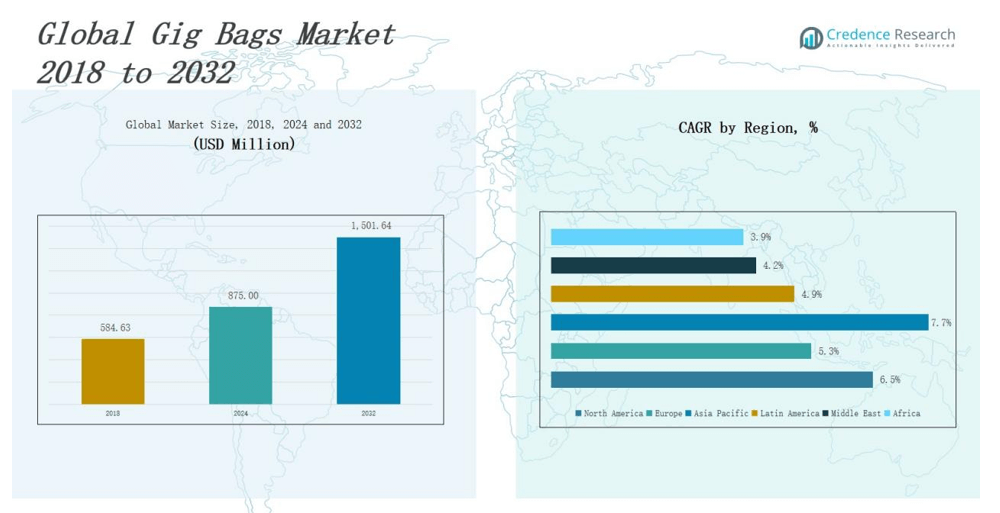
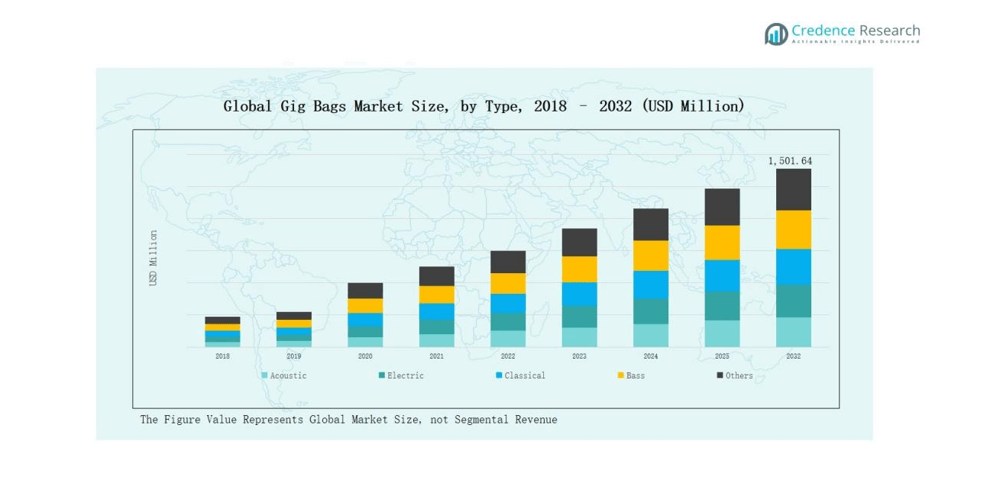
Gig Bags Market size was valued at USD 584.63 million in 2018 to USD 875.00 million in 2024 and is anticipated to reach USD 1,501.64 million by 2032, at a CAGR of 6.50% during the forecast period.
| REPORT ATTRIBUTE | DETAILS |
|---|---|
| Historical Period | 2020-2023 |
| Base Year | 2024 |
| Forecast Period | 2025-2032 |
| Gig Bags Market Size 2024 | USD 875.00 million |
| Gig Bags Market, CAGR | 6.50% |
| Gig Bags Market Size 2032 | USD 1,501.64 million |
The Gig Bags Market is characterized by the presence of leading manufacturers that maintain strong market positions through innovative designs, durable materials, and extensive distribution networks. Key players include Gator Cases, Fender Musical Instruments Corporation, Mono Creators Inc., Reunion Blues, SKB Corporation, and Gruv Gear, each offering a diverse portfolio catering to both professional and amateur musicians. North America dominates the global market, accounting for approximately 42.6% of total revenue in 2024, driven by a robust music industry, high consumer spending on premium instrument accessories, and a well-established retail and e-commerce infrastructure.
Market Insights
- The gig bags market is projected to grow steadily from USD 875.00 million in 2024 to USD 1,501.64 million by 2032, driven by rising global music participation.
- Electric gig bags lead the type segment due to their popularity across music genres and extensive use in live performances and studio recordings.
- The personal application segment dominates, supported by demand from hobbyists, students, and musicians seeking affordable, reliable protection for everyday use.
- Technological advancements in lightweight, water-resistant materials and customization options are enhancing product appeal and expanding consumer reach.
- Intense market competition, price sensitivity in emerging economies, and vulnerability to economic fluctuations remain key challenges for industry growth.
Market Segment Insights
By Type
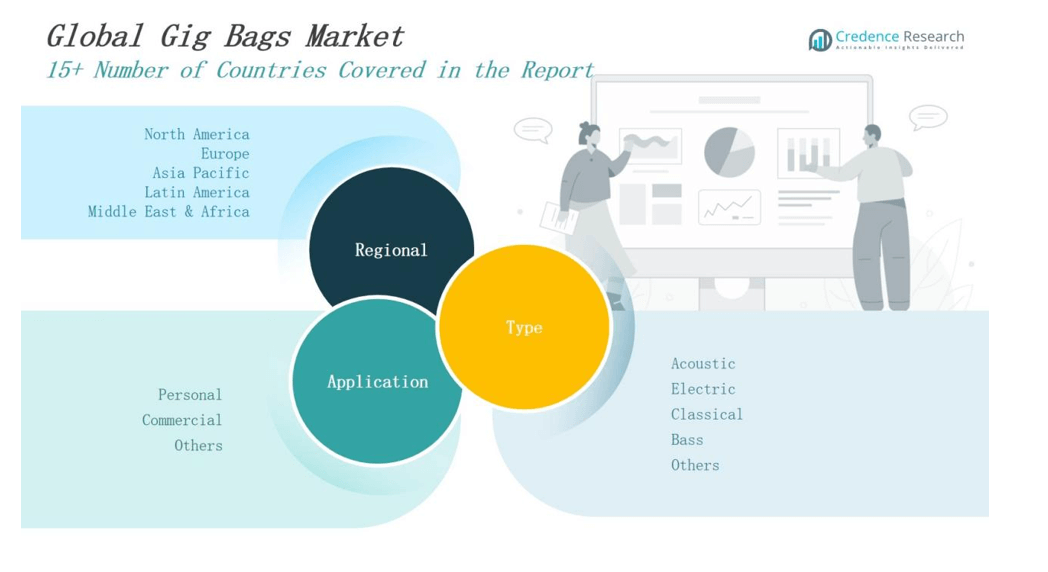
The gig bags market by type is led by electric gig bags, driven by their popularity across multiple music genres and extensive use in live performances and studio recordings. Demand is fueled by the need for durable, travel-friendly designs featuring enhanced impact resistance and customizable aesthetics. Acoustic gig bags follow closely, supported by their widespread use among hobbyists, students, and professional musicians, with growth further enhanced by the availability of lightweight, water-resistant designs. Bass gig bags benefit from the rising participation of bass players in bands and orchestras, while classical gig bags are supported by music education programs and traditional performance settings.
- For instance, Ibanez offers the POWERPAD Designer electric guitar gig bag, known for reinforced padding and a padded bottom that protects electric guitars during transport, meeting durability and impact resistance demands of touring musicians.
By Application
In terms of application, the personal segment holds the leading position, fueled by individual musicians and hobbyists seeking affordable yet reliable protection for daily use. Growth is further supported by the expansion of home studios, the popularity of online music learning platforms, and the rise of informal performance spaces. The commercial segment is driven by music schools, event organizers, and rental services that require bulk purchases of high-quality gig bags for frequent professional use. The remaining share belongs to other applications, including promotional merchandise and collector’s editions, where collaborations with brands and the availability of personalized designs are creating distinct market opportunities.
- For instance, SKB's iSeries waterproof acoustic guitar cases provide near-indestructible protection with corrosion-resistant materials, strong hinges, waterproof sealing, and internal pressure equalization valves, ideal for musicians in wetter climates or traveling frequently.
Market Overview
Rising Global Music Participation
The expansion of the music industry, coupled with increasing participation in amateur and professional music activities, is a major growth driver for the gig bags market. Growing enrollment in music schools, the popularity of live concerts, and the influence of music streaming platforms have encouraged more individuals to learn and play instruments. This trend boosts the demand for protective, portable, and stylish gig bags across multiple instrument categories. The availability of designs catering to different skill levels and budgets further enhances adoption among diverse consumer segments.
- For instance, SKB Cases has focused on lightweight materials and ergonomic designs to cater to musicians who attend live concerts and music schools, reflecting the trend of increased music participation.
Technological Advancements in Material Design
Innovations in materials and manufacturing techniques are propelling the gig bags market forward. The adoption of lightweight, water-resistant fabrics, reinforced padding, and shock-absorbing components enhances durability and protection while maintaining portability. Advanced stitching methods and ergonomic carrying solutions improve user comfort, making these products more appealing to traveling musicians. Additionally, the introduction of sustainable and recycled materials aligns with the growing preference for eco-friendly products, attracting environmentally conscious consumers and expanding the market’s potential reach.
- For instance, Belear Music produces acoustic guitar gig bags featuring high-quality nylon fabric and thick padding to enhance protection, specifically for professional musicians.
Expansion of E-Commerce and Customization Options
The rapid growth of online retail platforms has significantly increased the accessibility of gig bags to a global customer base. E-commerce channels enable consumers to compare features, prices, and designs with ease, fostering competitive pricing and brand visibility. Furthermore, customization options-such as personalized embroidery, color choices, and adjustable compartments-allow buyers to match gig bags to their instruments and personal style. This combination of convenience, variety, and personalization fuels demand, particularly among younger demographics seeking unique and functional products.
Key Trends & Opportunities
Sustainability-Driven Product Innovation
A growing emphasis on sustainability presents an opportunity for manufacturers to develop gig bags using eco-friendly materials and ethical production methods. Consumers are increasingly seeking products made from recycled fabrics, plant-based alternatives, or low-impact synthetic fibers. Brands that integrate sustainable practices into their supply chains can differentiate themselves in a competitive market while appealing to environmentally conscious buyers. This shift not only meets rising consumer expectations but also aligns with global initiatives promoting sustainable manufacturing in the accessories industry.
- For instance, Maurice’s Lacroix uses recycled plastic pellets made from post-consumer waste, reducing dependence on new plastics and diverting waste from landfills.
Integration of Smart Features
The emergence of smart gig bags equipped with tracking devices, anti-theft locks, and climate-control compartments is creating a niche yet promising market segment. These innovations cater to professional musicians who frequently travel and need added security and environmental protection for their instruments. As technology becomes more affordable, the integration of IoT-enabled features could expand to mid-range products, offering both functional benefits and a unique selling proposition. This trend is expected to enhance brand value and attract tech-savvy consumers.
- For instance, Arista Vault offers laptop bags and travel bags equipped with fingerprint locks that allow multiple users to access the bag, Bluetooth-enabled anti-theft alarms that alert both the bag and phone if separated beyond 8 meters, and live location GPS trackers accessible through a phone app.
- '
Key Challenges
Intense Market Competition
The gig bags market faces strong competition from both global brands and local manufacturers offering low-cost alternatives. This saturation can lead to price wars, compressing profit margins and limiting brand differentiation. Established players must continuously innovate in design, materials, and marketing to maintain a competitive edge. Smaller brands, while agile, often struggle with scaling production and distribution to compete effectively in multiple regions, particularly in mature markets where brand loyalty is well-established.
Price Sensitivity in Emerging Markets
In many developing economies, consumers remain highly price-sensitive, often prioritizing affordability over premium features. This limits the adoption of high-end gig bags and poses a challenge for manufacturers aiming to introduce advanced materials or smart technologies. Balancing cost-efficiency with product quality is essential for capturing these markets without compromising brand value. Additionally, fluctuating currency exchange rates and import tariffs can further impact pricing strategies in these regions.
Vulnerability to Economic Fluctuations
The gig bags market is closely tied to discretionary spending patterns, making it vulnerable to economic downturns. During periods of reduced consumer confidence, purchases of musical instruments and related accessories often decline, directly affecting sales. Events such as recessions, inflationary pressures, or disruptions in global trade can also slow market growth. To mitigate this risk, companies may need to diversify their product portfolios, explore alternative distribution channels, and focus on value-driven offerings that maintain demand during challenging economic conditions.
Regional Analysis
North America
North America leads the global gig bags market, accounting for 34.2% of the total share in 2024, valued at USD 368.02 million. Growth is supported by a mature music industry, high consumer spending, and strong demand for premium-quality accessories. The region benefits from a dense network of music schools, recording studios, and live performance venues, which drives consistent demand from both professional and amateur musicians. The U.S. remains the largest contributor, with extensive retail and e-commerce infrastructure facilitating widespread product availability. Steady growth at a CAGR of 6.5% is projected to take the market to USD 633.38 million by 2032.
Europe
Europe holds a 14.9% market share in 2024, valued at USD 160.91 million, driven by a strong cultural association with music, established manufacturing hubs, and growing demand for eco-friendly gig bag designs. Germany, the UK, and France lead the region due to vibrant live music scenes and large bases of amateur musicians. The presence of premium gig bag brands supports steady growth, aided by increasing online sales and participation in music education programs. With a CAGR of 5.3%, the market is expected to reach USD 252.12 million by 2032.
Asia Pacific
Asia Pacific represents 24.6% of the gig bags market in 2024, valued at USD 264.67 million, and is the fastest-growing region with a CAGR of 7.7%. Rising disposable incomes, expanding urban music culture, and increasing adoption of Western musical instruments in China, Japan, India, and South Korea drive growth. E-commerce proliferation and the influence of music-based social media content are accelerating sales. Government investments in cultural and educational programs further boost demand. By 2032, the market is projected to reach USD 495.72 million, supported by demand across both premium and entry-level categories.
Latin America
Latin America captures 3.9% of the global market in 2024, valued at USD 42.47 million, with a CAGR of 4.9% supported by the region’s rich musical heritage and rising interest in contemporary music genres. Brazil and Mexico dominate due to strong guitar sales and vibrant live performance cultures. The market benefits from a growing amateur musician base and gradual retail expansion, though price sensitivity limits premium sales. By 2032, the market is forecast to reach USD 64.83 million, aided by increasing e-commerce adoption and the entry of affordable international brands.
Middle East
The Middle East accounts for 2.0% of the gig bags market in 2024, valued at USD 21.72 million, and is growing at a CAGR of 4.2%. Demand is concentrated in GCC countries, supported by cultural events, music festivals, and educational initiatives promoting music learning. Expatriate communities contribute to the popularity of Western instruments, while the premium segment appeals to affluent buyers. By 2032, the market is projected to reach USD 31.28 million, with opportunities arising from online sales expansion and increasing youth participation in music-related activities.
Africa
Africa holds a 1.6% share of the global gig bags market in 2024, valued at USD 17.21 million, with a CAGR of 3.9%. Growth is driven by strong regional music traditions, rising youth interest in contemporary genres, and expanding music education programs. South Africa leads the market, followed by Nigeria and Kenya. Limited premium product availability and price-sensitive consumer behavior favor mid- and low-priced options. By 2032, the market is forecast to reach USD 24.32 million, supported by growing internet penetration and cross-border e-commerce improving product accessibility.
Market Segmentations:
By Type
- Acoustic
- Electric
- Classical
- Bass
- Others
By Application
- Personal
- Commercial
- Others
By Region
- North America
- U.S.
- Canada
- Mexico
- Europe
- Germany
- France
- U.K.
- Italy
- Spain
- Rest of Europe
- Asia Pacific
- China
- Japan
- India
- South Korea
- South-east Asia
- Rest of Asia Pacific
- Latin America
- Brazil
- Argentina
- Rest of Latin America
- Middle East & Africa
- GCC Countries
- South Africa
- Rest of the Middle East and Africa
Competitive Landscape
The competitive landscape of the gig bags market is characterized by a diverse mix of global brands and regional manufacturers competing on design innovation, product quality, and pricing strategies. Key players such as Fusion Bags, Guardian Cases, ChromaCast, BAM Cases, AP International, RITTER BAGS, Continental, Fender Musical Instruments Corporation, TKL Europe, Phitz, and Gator maintain market presence through broad product portfolios, advanced protective materials, and strong distribution networks. These companies focus on durability, ergonomic designs, and aesthetic appeal to attract both professional and amateur musicians. Strategic moves include new product launches, artist collaborations, and market expansion into high-growth regions. Regional manufacturers strengthen their position by offering cost-effective, customized solutions and leveraging local supply chains. The growth of e-commerce platforms has intensified competition, enabling smaller brands to reach global consumers. As sustainability and smart features gain traction, leading companies are increasingly investing in eco-friendly materials and integrated technologies to enhance market differentiation.
Key Players
- ChromaCast
- Continental
- Gator
- Fender Musical Instruments Corporation
- Guardian Cases
- AP International
- Phitz
- TKL Europe
- BAM Cases
- Fusion Bags
- RITTER BAGS
Recent Developments
- In June 2025, ChromaCast introduced the Pro Series Electric Guitar Padded Gig Bag featuring 20mm thick padding and reinforced straps, designed for durability and protection during transport.
- In January 2024, TKL Products Corp, in partnership with BenjiLock and Fingerprints, introduced biometric security for instrument cases at NAMM 2024.
- In August 2023, RITTER BAGS introduced its Swiss Collection Bern series for brass and woodwind gig bags, featuring enhanced padding and ergonomic design for improved protection and comfort.
- In 2025, BAM Cases released the BAMTECH Electric Guitar Gig Bag, designed with high-density foam protection and rugged Cordura construction to ensure durability and instrument safety.
Market Concentration & Characteristics
The Gig Bags Market exhibits a moderately fragmented structure, with a balance between established international brands and numerous regional players. It features intense competition driven by product differentiation, pricing strategies, and brand reputation. Leading companies hold significant market influence through innovation in materials, ergonomic design, and protective features, while regional manufacturers compete by offering cost-effective and customizable solutions. It benefits from steady demand across professional and amateur segments, supported by growing music participation and rising e-commerce adoption. The market is characterized by frequent product launches, collaborations with artists, and gradual integration of eco-friendly materials and smart functionalities, shaping long-term competitive dynamics.
Report Coverage
The research report offers an in-depth analysis based on Type, Application and Region. It details leading market players, providing an overview of their business, product offerings, investments, revenue streams, and key applications. Additionally, the report includes insights into the competitive environment, SWOT analysis, current market trends, as well as the primary drivers and constraints. Furthermore, it discusses various factors that have driven market expansion in recent years. The report also explores market dynamics, regulatory scenarios, and technological advancements that are shaping the industry. It assesses the impact of external factors and global economic changes on market growth. Lastly, it provides strategic recommendations for new entrants and established companies to navigate the complexities of the market.
Future Outlook
- Demand for eco-friendly gig bags will rise due to increasing consumer preference for sustainable materials.
- Customization options will gain traction as musicians seek personalized designs and functional features.
- E-commerce platforms will expand market reach for both global and regional brands.
- Smart gig bags with tracking and security features will attract professional musicians.
- Premium product demand will grow with the rising popularity of live performances and touring.
- Affordable mid-range products will dominate sales in emerging markets.
- Collaborations with artists and influencers will strengthen brand visibility.
- Technological innovations in lightweight and durable materials will enhance product appeal.
- Music education programs will continue to drive demand among students and institutions.
- Expanding distribution networks in untapped regions will create new growth opportunities.

Request a Free Sample
Fill in your details and we'll send you a free sample report.
- Sample data tables & charts
- Research methodology
Need a Custom Version of This Report?
Tailor the scope, geography, or segments to your exact requirements.
- Custom geography or segment scope
- Direct access to our analyst team
Frequently Asked Questions
What is the current market size for the Gig Bags Market, and what is its projected size in 2032?
Which Gig Bags Market segment held the largest share in 2024?
What are the primary factors fueling the growth of the Gig Bags Market?
Who are the leading companies in the Gig Bags Market?
Table of Content
Chapter 1. Report Introduction
- 1.1 Report Description & Purpose
- 1.1.1 Report Title & Market Definition
- 1.1.2 Unique Selling Propositions (USP) & Key Differentiators
- 1.1.3 Value Proposition for Stakeholders
- 1.2 Research Objectives
- 1.2.1 Market Sizing Objectives (Volume & Revenue) (Volume Where Applicable)
- 1.2.2 Segmentation Objectives
- 1.2.3 Competitive Intelligence Objectives
- 1.2.4 Forecast & Scenario Objectives
- 1.3 Report Scope
- 1.3.1 Gig Bags Scope – Segments & Subsegments Covered
- 1.3.2 Geographic Scope – Regions & Countries Covered
- 1.3.3 Historical Period, Base Year & Forecast Period (2024; forecast to 2032)
- 1.3.4 Inclusions & Exclusions
- 1.4 Industry Classification & Applicable Codes
- 1.5 Currency, Measurement Units & Valuation Basis
- 1.6 Target Stakeholders
- 1.7 Limitations & Assumptions
Chapter 2. Executive Summary
- 2.1 Global Gig Bags Market Snapshot
- 2.1.1 Market Size – Historical (2024) & Forecast (2024-2032) (2024: USD 875.00 million → 2032: USD 1,501.64 million)
- 2.1.2 Volume & Revenue – Global Totals (Volume Where Applicable)
- 2.1.3 Key Market Highlights – Top Five Facts
- 2.2 Gig Bags Market Segmentation Snapshot
- 2.2.1 Market Split by Region – 2024 vs. 2032
- 2.3 Competitive Snapshot
- 2.3.1 Top 10 Players by Revenue Share – 2024
- 2.3.2 Top 10 Players by Volume Share – 2024 (Volume Where Applicable)
- 2.3.3 Recent Strategic Developments (18-Month Summary)
- 2.4 Key Investment Highlights & Strategic Conclusions
Chapter 3. Gig Bags Market Dynamics & Industry Analysis
- 3.1 Market Overview & Context
- 3.1.1 Gig Bags Market Position in the Broader Industry Value Chain
- 3.1.2 Demand Structure & Purchasing Dynamics
- 3.1.3 Market Maturity & Development Stage by Region
- 3.2 Gig Bags Market Drivers
- 3.3 Gig Bags Market Restraints & Challenges
- 3.4 Gig Bags Market Opportunities
- 3.5 Porter's Five Forces Analysis
- 3.5.1 Threat of New Entrants
- 3.5.2 Bargaining Power of Suppliers
- 3.5.3 Bargaining Power of Buyers
- 3.5.4 Threat of Substitutes
- 3.5.5 Competitive Rivalry – Intensity Assessment
- 3.6 Gig Bags Value Chain Analysis
- 3.6.1 Upstream – Key Inputs, Resources & Suppliers
- 3.6.1.1 Key Input/Resource 1
- 3.6.1.2 Key Input/Resource 2
- 3.6.1.3 Key Input/Resource 3
- 3.6.2 Midstream – Core Operations & Value Creation
- 3.6.2.1 Operating Model & Process Overview
- 3.6.2.2 Key Operating Locations & Capabilities by Company
- 3.6.3 Downstream – Market Channels & End Users
- 3.6.3.1 Direct Sales & Customer Engagement Channels
- 3.6.3.2 Indirect Sales, Intermediaries & Partner Channels
- 3.6.4 Value Chain Profitability Analysis
- 3.6.1 Upstream – Key Inputs, Resources & Suppliers
- 3.7 PESTEL Analysis
- 3.7.1 Political Factors
- 3.7.2 Economic Factors
- 3.7.3 Social Factors
- 3.7.4 Technological Factors
- 3.7.5 Environmental Factors
- 3.7.6 Legal Factors
- 3.8 Gig Bags Supply Chain Analysis
- 3.8.1 Critical Input & Resource Availability Risk Assessment
- 3.8.2 Supplier & Operational Concentration Risk (Geographic Exposure)
- 3.8.3 Supply & Service Disruption Impact Analysis
- 3.9 Regulatory & Policy Landscape
Note: The regulatory and policy landscape section covers regulations based on their applicability to the market, Gig Bags category, geography, and scope of the study. Only regulatory frameworks with a material impact on operations, compliance, trade, sustainability, or market access are analyzed in detail.
Chapter 4. Key Investment Pockets & Opportunity Analysis
- 4.1 Gig Bags Market Attractiveness Analysis
- 4.1.1 By Region – Investment Attractiveness Matrix (Market Size × CAGR)
- 4.2 Absolute Revenue Growth Opportunity
- 4.2.1 By Region – Absolute Revenue Growth Through 2032
- 4.3 Incremental Demand Opportunity
- 4.3.1 By Region – Incremental Demand Through 2032
- 4.3.2 Segment – Incremental Demand
- 4.4 Emerging Submarket Opportunity Deep Dive (Subject to Applicability)
- 4.5 Priority Market Opportunity Scorecards
- 4.5.1 United States
- 4.5.2 Europe
- 4.5.3 Asia
- 4.5.4 Middle East & Africa
Note: Priority market opportunity scorecards reflect the geographic scope and strategic relevance of the study. Listed markets are indicative and may be adapted to the industry.
Chapter 5. Gig Bags Cross-Border Trade & Market Access Analysis
- 5.1 International Trade & Cross-Border Activity Overview
- 5.1.1 Global Export Value by Country (2024)
- 5.1.2 Global Export Volume by Country (2024) (Volume Where Applicable)
- 5.1.3 Global Import Value by Country (2024)
- 5.1.4 Global Import Volume by Country (2024) (Volume Where Applicable)
- 5.1.5 Net Trade Balance by Country (2024)
- 5.2 Export Analysis – Segment
- 5.2.1 Category 1 (Applicable Classification Code)
- 5.2.2 Category 2 (Applicable Classification Code)
- 5.2.3 Category 3 (Applicable Classification Code)
- 5.2.4 Category 4 (Applicable Classification Code)
- 5.2.5 Category 5 (Applicable Classification Code)
- 5.3 Import Analysis – Segment
- 5.3.1 Category 1 (Applicable Classification Code)
- 5.3.2 Category 2 (Applicable Classification Code)
- 5.3.3 Category 3 (Applicable Classification Code)
- 5.3.4 Category 4 (Applicable Classification Code)
- 5.3.5 Category 5 (Applicable Classification Code)
- 5.4 Cross-Border Pricing & Transaction Benchmarks
- 5.4.1 Export Pricing – Segment & Country
- 5.4.2 Import Pricing – Segment & Source Country
- 5.4.3 Price Trends (2024)
- 5.5 Key Cross-Border Trade & Delivery Routes
- 5.5.1 Cross-Border Trade/Delivery Route 1
- 5.5.2 Cross-Border Trade/Delivery Route 2
- 5.5.3 Cross-Border Trade/Delivery Route 3
- 5.5.4 Cross-Border Trade/Delivery Route 4
- 5.5.5 Cross-Border Trade/Delivery Route 5
- 5.6 Trade Policy & Market Access Impact Assessment
- 5.6.1 Tariff & Non-Tariff Barriers
- 5.6.2 Regional Trade & Economic Integration Frameworks
- 5.6.3 Bilateral & Multilateral Trade Agreements
- 5.6.4 Cross-Border Operating, Licensing & Localization Requirements
Note: This chapter applies where cross-border trade or delivery is relevant to Gig Bags. Goods, services, and digital offerings are assessed using applicable classifications and transaction measures. Import-export volumes, trade balances, and route analyses are included only where meaningful to the market.
Chapter 6. Competitive Landscape & Company Benchmarking
- 6.1 Gig Bags Market Concentration & Structure
- 6.1.1 Herfindahl-Hirschman Index (HHI) – vs. 2024
- 6.1.2 Leading, Mid-Sized & Emerging Player Structure
- 6.1.3 Global, Regional & Local Player Dynamics
- 6.2 Gig Bags Market Share Analysis – 2024
- 6.2.1 Global Revenue Share by Company
- 6.2.2 Global Volume Share by Company (Volume Where Applicable)
- 6.2.3 Regional Revenue Share
- 6.2.4 Market Share Evolution ( vs. 2024)
- 6.2.5 Company Market Share by Key Segment
- 6.2.6 Company Market Share by Customer Group
- 6.3 Operating Scale, Capacity & Infrastructure Analysis
- 6.3.1 Global Operating Scale & Supply Capacity
- 6.3.2 Resource Utilization & Operating Efficiency
- 6.3.3 Output, Service Delivery & Activity Metrics
- 6.3.4 Operating Footprint & Infrastructure Map
- 6.3.5 Planned Operational & Capacity Expansion
- 6.4 Gig Bags Competitive Benchmarking Matrix
- 6.4.1 Revenue, Growth, Profitability & Operating Metric Comparison
- 6.4.2 Channel Revenue Mix
- 6.4.3 Geographic Revenue Exposure
- 6.4.4 R&D Intensity
- 6.4.5 Sustainability Maturity
- 6.5 Strategic Developments in Gig Bags (Last 24 Months)
- 6.5.1 Mergers, Acquisitions & Divestments
- 6.5.2 New Products, Services & Solutions in Gig Bags
- 6.5.3 Operational & Infrastructure Expansions
- 6.5.4 Strategic Alliances, Joint Ventures & Partnerships
- 6.5.5 Distribution Expansion & Market Entry
- 6.5.6 Sustainability & ESG Initiatives
- 6.6 Competitive Strategy Mapping
- 6.6.1 Leader, Challenger, Follower & Niche Classification
- 6.6.2 Pricing Strategy Comparison
- 6.6.3 Channel Strategy Matrix
Note: Strategic developments are included based on their materiality and the availability of reliable information.
Chapter 7. Global Gig Bags Market – By Sales & Delivery Channel
- 7.1 Segment Overview
- 7.1.1 Volume & Revenue Split by Channel (2024 & 2032) (Volume Where Applicable)
- 7.1.2 Channel Mix Evolution (2024-2032)
Chapter 8. Regional Market Analysis – Global Overview
- 8.1 Global Regional Overview
- 8.1.1 Regional Volume Share (Volume Where Applicable)
- 8.1.2 Regional Revenue Share
- 8.1.3 Regional Volume by Region (Volume Where Applicable)
- 8.1.4 Regional Revenue by Region
- 8.1.5 Regional Forecast Through 2032
- 8.2 Cross-Regional Segment Analysis
- 8.2.1 By Sales & Delivery Channel
- 8.2.2 By Competitive Positioning & Price Tier
Chapter 9. North America Gig Bags Market
- 9.1 United States
- 9.2 Canada
- 9.3 Mexico
Chapter 10. Europe Gig Bags Market
- 10.1 Germany
- 10.2 France
- 10.3 Italy
- 10.4 United Kingdom
- 10.5 Spain
- 10.6 Poland
- 10.7 Russia
- 10.8 Netherlands
- 10.9 Belgium
- 10.10 Sweden
- 10.11 Denmark
- 10.12 Norway
- 10.13 Rest of Europe
Chapter 11. Asia Pacific Gig Bags Market
- 11.1 China
- 11.2 India
- 11.3 Japan
- 11.4 South Korea
- 11.5 Thailand
- 11.6 Indonesia
- 11.7 Vietnam
- 11.8 Malaysia
- 11.9 Australia
- 11.10 Rest of Asia Pacific
Chapter 12. Latin America Gig Bags Market
- 12.1 Brazil
- 12.2 Argentina
- 12.3 Colombia
- 12.4 Chile
- 12.5 Rest of Latin America
Chapter 13. Middle East Gig Bags Market
- 13.1 Saudi Arabia
- 13.2 United Arab Emirates
- 13.3 Turkey
- 13.4 Israel
- 13.5 Iran
- 13.6 Rest of the Middle East
Chapter 14. Africa Gig Bags Market
- 14.1 South Africa
- 14.2 Egypt
- 14.3 Nigeria
- 14.4 Morocco
- 14.5 Rest of Africa
Chapter 15. Gig Bags Company Profiles
- 15.1 [Company 01]
- 15.1.1 Company Overview
- 15.1.2 Key Management Personnel
- 15.1.3 Products & Services Portfolio
- 15.1.4 Financial Performance
- 15.1.5 Key Market Focus & Geographic Presence
- 15.1.6 Recent Developments & Strategic Initiatives
Note: The company profile list is preliminary and may change based on research findings, market developments, data availability, and client requirements.
Chapter 16. Appendices
- Appendix A – List of Abbreviations & Acronyms
- Appendix B – Industry Classification Code Reference – Full Series
- Appendix C – Supply, Output & Operating Capacity Data Tables
- Appendix D – End-Use & Demand Base Tables
- Appendix E – Demand, Adoption & Usage Assumptions
- Appendix F – Pricing & Revenue Metric Reference Tables
- Appendix G – Company Operations & Infrastructure Database
- Appendix H – Cross-Border Trade & Activity Data Tables (Where Applicable)
- Appendix I – Regulatory Summary Tables
- Appendix J – Primary Research Participant List (Anonymized)
- Appendix K – Primary Research Questionnaire Framework
- Appendix L – Data Sources & Bibliography
- Appendix M – Market Size Divergence & Source Comparison
Chapter 17. Research Methodology
- 17.1 Research Framework & Philosophy
- 17.2 Secondary Research – Sources, Hierarchy & Data Extraction
- 17.3 Data Modeling – Bottom-Up & Top-Down Market Sizing
- 17.4 Primary Research – Stakeholder Framework, LOI & Sample Sizes
- 17.5 Forecast Methodology – Regression, Scenario & Sensitivity Analysis
- 17.6 Quality Control – Four-Layer Validation Framework
- 17.7 Limitations & Standard Assumptions
- 17.8 Disclaimer
