
| REPORT ATTRIBUTE | DETAILS |
|---|---|
| Historical Period | 2020-2023 |
| Base Year | 2024 |
| Forecast Period | 2025-2032 |
| Elevator Modernization Market Size 2024 | USD 15183.11 Million |
| Elevator Modernization Market, CAGR | 12.53% |
| Elevator Modernization Market Size 2032 | USD 39039.77 Million |
Market Overview:
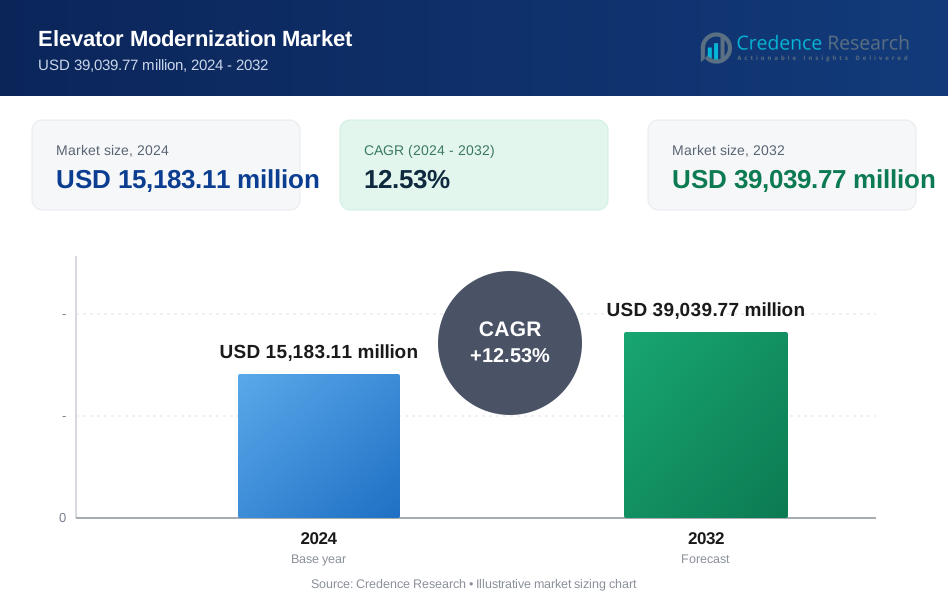
The Elevator Modernization Market is projected to grow from USD 15183.11 million in 2024 to an estimated USD 39039.77 million by 2032, with a compound annual growth rate (CAGR) of 12.53% from 2024 to 2032.
The elevator modernization market is driven by several key factors. One of the primary drivers is the aging infrastructure of existing elevator systems, which increases maintenance challenges and safety concerns. As elevators operate beyond their intended lifespan, there is a growing need to modernize them to comply with safety regulations and enhance their reliability. Another significant driver is the rapid technological advancements in the elevator industry, including the integration of IoT, artificial intelligence, and predictive maintenance systems, which improve the efficiency and performance of elevators. Additionally, the increasing emphasis on energy efficiency and sustainability in building operations is pushing for the adoption of modernized elevators equipped with energy-saving technologies. Furthermore, urbanization and the development of high-rise buildings are boosting the demand for efficient vertical transportation, making modernization essential for meeting the demands of modern infrastructure.
The elevator modernization market shows varying trends across different regions. North America leads the market due to the presence of aging infrastructure and stringent safety regulations, driving the demand for elevator upgrades. Europe also holds a significant market share, supported by a strong focus on safety, sustainability, and building renovations. The Asia-Pacific region, driven by rapid urbanization and industrial growth in countries like China, India, and Japan, is experiencing robust growth in modernization activities. In Latin America and the Middle East & Africa, modernization is gaining traction as urban development accelerates and building owners increasingly prioritize energy efficiency and safety upgrades. These regional variations underscore the global demand for modernization solutions tailored to local needs and regulatory standards.
Market Insights:
- The Elevator Modernization Market is projected to grow significantly, reaching an estimated USD 39,039.77 million by 2032, driven by a strong CAGR of 12.53% from 2024 to 2032.
- Aging infrastructure is a major driver, with many elevators exceeding their intended lifespan, prompting a need for modernization to enhance safety, compliance, and reliability.
- Technological advancements, including the integration of IoT, artificial intelligence, and predictive maintenance, are improving elevator performance and reducing operational costs, fueling modernization demand.
- Energy efficiency and sustainability are key factors, with growing emphasis on eco-friendly solutions like regenerative drives and LED lighting, making modernization an attractive option for building owners.
- Rapid urbanization, particularly in Asia-Pacific, and the rise of high-rise buildings, have increased the demand for efficient vertical transportation systems, boosting the need for elevator upgrades.
- The market faces challenges such as high initial costs and complex installation processes, with downtime during modernization projects potentially affecting building operations.
- Regionally, North America leads the market due to stringent safety regulations and aging infrastructure, while Asia-Pacific experiences robust growth due to rapid urban development and industrialization.
 Market Drivers:
Aging Infrastructure and Safety Compliance
One of the primary drivers of the elevator modernization market is the aging infrastructure of existing elevator systems. Many elevators, especially in commercial and residential buildings, are operating beyond their intended lifespans. This not only leads to frequent breakdowns and costly repairs but also poses significant safety risks. For instance, in the U.S., some elevators have been in operation for over 40 years, significantly exceeding their expected reliability and safety standards. Reports indicate that outdated systems often comply with safety codes that are more than 28 years old, contributing to over 200 breakdown callouts annually in certain institutions. Modernizing these systems ensures compliance with evolving safety standards and regulations, addressing potential hazards such as outdated emergency systems, insufficient load capacities, and other safety-related issues. As the need to enhance occupant safety becomes more critical, building owners and managers are increasingly turning to elevator modernization as a strategic solution.
Technological Advancements and Operational Efficiency
Technological advancements play a significant role in driving the elevator modernization market. With the integration of cutting-edge technologies such as the Internet of Things (IoT), artificial intelligence (AI), and predictive analytics, elevator systems can now be monitored in real time, enabling proactive maintenance and troubleshooting. These innovations enhance the overall performance of elevators, reduce operational costs, and improve reliability. For example, Magnetic Rope Testing (MRT) technology has revolutionized elevator inspections by detecting internal defects in wire ropes with high precision, improving safety and operational efficiency. Additionally, the inclusion of smart systems allows for features such as personalized user experiences, better energy management, and optimized traffic handling, all of which contribute to the increased demand for elevator modernization in both commercial and residential buildings.
Energy Efficiency and Sustainability
As global awareness of environmental sustainability grows, the demand for energy-efficient systems continues to rise. Modernizing elevators with energy-saving components, such as regenerative drives and LED lighting, helps to reduce energy consumption and lower the carbon footprint of buildings. These upgrades align with the broader trend of creating more sustainable and environmentally friendly buildings. Additionally, energy-efficient elevators contribute to reduced operating costs, making modernization an attractive option for building owners looking to cut down on long-term expenses. The focus on energy efficiency not only helps meet regulatory standards but also satisfies the growing consumer demand for greener and more sustainable infrastructure solutions.
Urbanization and High-Rise Development
Rapid urbanization and the continuous growth of high-rise buildings are significant drivers of the elevator modernization market. In densely populated urban areas, the demand for vertical transportation systems is on the rise due to the increasing number of skyscrapers and multi-story buildings. Elevators in these structures need to be modernized to handle high traffic volumes, improve speed, and enhance overall performance. Moreover, the growing trend of mixed-use developments, which combine residential, commercial, and office spaces in one building, further amplifies the need for modern, efficient elevator systems. As urban landscapes evolve, the modernization of existing elevator systems becomes essential to meet the demands of modern infrastructure and the expectations of building occupants.
Market Trends:
Integration of Smart Technologies
The elevator modernization market is increasingly embracing smart technologies to enhance operational efficiency and user experience. Integrating the Internet of Things (IoT), Artificial Intelligence (AI), and machine learning into elevator systems enables predictive maintenance, real-time monitoring, and personalized user interactions. For instance, Johnson Elevators introduced an IoT-based wireless software gadget called "Watch" in September 2022, which enables real-time monitoring and predictive maintenance by linking elevators to a centralized data center. These advancements reduce downtime, optimize energy consumption, and improve safety protocols, aligning with the growing demand for intelligent building solutions. As a result, these technologies not only improve performance but also position buildings as more competitive and technologically advanced in the marketplace.
Focus on Energy Efficiency
Energy efficiency has become a central focus in elevator modernization projects. Upgrading to regenerative drives, LED lighting, and low-energy motors significantly reduces power consumption and operational costs. These eco-friendly solutions not only contribute to sustainability goals but also appeal to building owners and occupants seeking cost-effective and environmentally responsible options. Moreover, with rising energy prices globally, energy-efficient systems are seen as a long-term solution to reduce overall building operating costs, making them a priority for modernizing infrastructure.
Regulatory Compliance and Safety Enhancements
Stringent safety regulations and standards are driving the need for elevator system upgrades. Modernization ensures compliance with evolving codes, addressing safety concerns associated with aging infrastructure. For example, compliance with codes like ASME A17.1 ensures that elevators meet updated safety standards, including advanced emergency communication systems and overload sensors. Enhanced safety features, such as advanced emergency communication systems and improved accessibility options, are being integrated to meet regulatory requirements and cater to the diverse needs of building occupants. These upgrades not only enhance safety but also help building owners avoid legal liabilities and penalties associated with non-compliance.
Market Consolidation and Strategic Partnerships
The elevator industry is experiencing consolidation, with companies exploring strategic partnerships and acquisitions to expand their market presence and technological capabilities. For instance, Japanese lift maker Fujitec has been exploring potential sales to private equity groups, indicating a trend toward mergers and acquisitions within the sector. This consolidation aims to leverage synergies, enhance innovation, and better meet the evolving demands of the modernization market. As the market becomes more competitive, companies are focusing on strengthening their position through collaboration and acquisition of new technologies.
Market Challenges Analysis:
High Initial Costs
One of the key challenges in the elevator modernization market is the high initial investment required for system upgrades. For instance, a mid-century office building in Europe faced a significant financial burden when modernizing its elevator system, as the project required reconfiguring the elevator shaft and installing a compact machine room on a higher floor to accommodate modern control cabinets. While the long-term benefits, such as energy efficiency and reduced maintenance costs, can offset these initial expenses, the upfront financial burden remains a significant barrier for many property owners, particularly in developing regions. Smaller buildings or those with limited budgets may find it difficult to justify the expense, which can slow the adoption of modernization solutions.
Complex Installation and Downtime
Elevator modernization projects often require complex installations, which can lead to significant downtime for the building’s elevator systems. During the modernization process, elevators may be out of service for extended periods, impacting the mobility of residents or employees, particularly in high-traffic buildings. This disruption can be inconvenient and may negatively affect the reputation of building owners or managers. Additionally, coordinating the installation of new components without causing major interruptions to building operations can be a logistical challenge, requiring careful planning and scheduling.
Regulatory and Compliance Issues
The elevator modernization market is also hindered by the challenge of adhering to various local and international regulatory standards. Each region may have its own set of codes and regulations governing elevator safety, accessibility, and energy efficiency. Keeping up with these constantly evolving requirements can be a daunting task for building owners and service providers. Failing to meet compliance standards can result in legal penalties, safety concerns, or the need for additional upgrades, all of which can increase the cost and complexity of modernization projects.
Limited Skilled Workforce
The shortage of skilled technicians trained in the latest elevator technologies presents another restraint in the market. Modernizing elevators requires expertise in complex systems and new technologies, such as IoT integration and energy-efficient components. The limited availability of qualified professionals can delay projects and lead to suboptimal installations, further compounding the costs and risks associated with elevator modernization.
Market Opportunities:
The elevator modernization market presents significant opportunities for growth driven by the increasing demand for energy-efficient and technologically advanced systems. As urbanization continues to accelerate, particularly in emerging economies, the need for modernization in both commercial and residential buildings is becoming more critical. Building owners are increasingly seeking solutions that improve operational efficiency, reduce energy consumption, and enhance safety. Modernizing elevator systems with features such as regenerative drives, smart sensors, and AI-driven predictive maintenance not only helps meet these demands but also aligns with global sustainability goals. This growing focus on sustainability provides a substantial market opportunity for companies offering eco-friendly and cost-effective modernization solutions.
Additionally, the global push toward improving infrastructure, coupled with stringent safety and regulatory standards, opens up new avenues for market expansion. As older buildings undergo renovation, elevator modernization becomes a necessary component to meet updated building codes and enhance overall safety. This trend is particularly noticeable in developed markets like North America and Europe, where aging infrastructure presents a substantial need for upgrades. Furthermore, technological advancements such as the Internet of Things (IoT) and artificial intelligence (AI) offer the potential for significant enhancements in elevator performance and user experience. Companies that can capitalize on these emerging technologies and offer integrated, scalable solutions are well-positioned to capture a larger share of the expanding modernization market.
Market Segmentation Analysis:
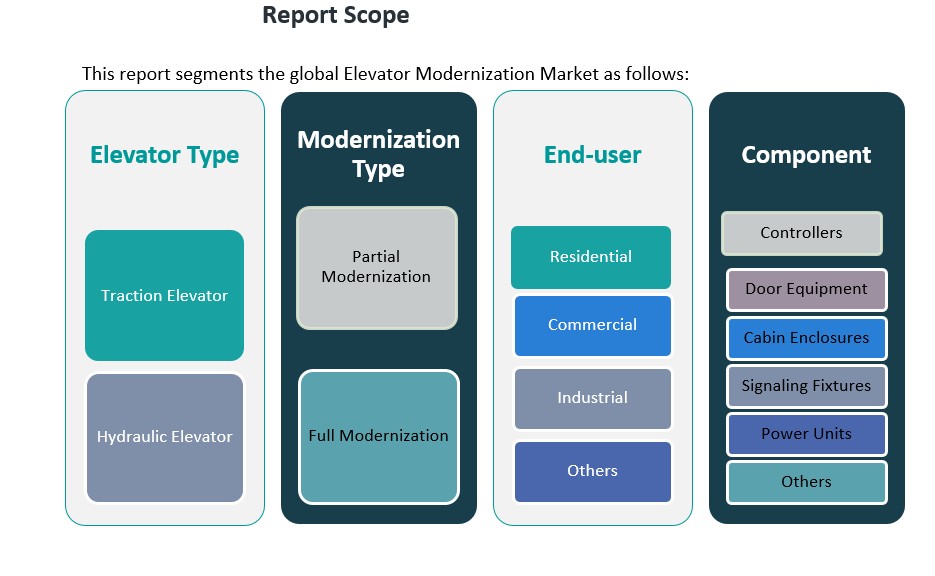
The elevator modernization market is divided into several key segments that cater to diverse needs across industries and regions.
By Elevator Type Segment
The market is primarily segmented into traction and hydraulic elevators. Traction elevators are widely used in high-rise buildings due to their efficiency in handling large passenger volumes, contributing to their dominant market share. Hydraulic elevators, on the other hand, are common in low- and mid-rise buildings, offering smoother and quieter operations, which makes them popular for residential and small commercial applications.
By Modernization Type Segment
Modernization projects are classified into partial and full modernization. Partial modernization involves upgrading specific components like the control system or door equipment, offering a cost-effective solution. Full modernization, which involves comprehensive upgrades, is gaining traction as it enhances overall system performance, safety, and energy efficiency.
By End-User Segment
The elevator modernization market caters to various end-users, including residential, commercial, and industrial sectors. Residential buildings focus on modernization for improved comfort and safety, while the commercial sector emphasizes energy-efficient solutions and compliance with regulatory standards. Industrial users require reliable, high-performance elevators, often necessitating full modernization. Additionally, the "Others" segment includes special applications in healthcare, hospitality, and public infrastructure.
By Components Segment
Key components in the elevator modernization market include controllers, door equipment, cabin enclosures, signaling fixtures, and power units. Controllers are critical for improving efficiency and reliability, while door equipment and signaling fixtures ensure safety and convenience. Cabin enclosures and power units are essential for enhancing the aesthetic appeal and overall performance of modernized elevators. Other components focus on specific needs, such as security and accessibility.
Segmentation:
By Elevator Type Segment
- Traction Elevator
- Hydraulic Elevator
By Modernization Type Segment
- Partial Modernization
- Full Modernization
By End-User Segment
- Residential
- Commercial
- Industrial
- Others
By Components Segment
- Controllers
- Door Equipment
- Cabin Enclosures
- Signaling Fixtures
- Power Units
- Others
Regional Analysis:
The elevator modernization market demonstrates varied growth trends across different regions, driven by local infrastructure needs, regulatory requirements, and technological advancements. As a result, the market is experiencing dynamic changes across North America, Europe, Asia-Pacific, Latin America, and the Middle East & Africa.
North America
North America holds the largest market share in the elevator modernization sector, accounting for approximately 30% of the global market. This dominance is primarily attributed to the presence of a large number of aging buildings and the region’s stringent safety and regulatory standards. In the U.S., the demand for elevator modernization is driven by the need to upgrade older buildings to meet updated codes and improve energy efficiency. The focus on sustainability and the growing adoption of smart technologies are further propelling the demand for advanced modernization solutions in the region. Additionally, the region’s strong economic position allows for continued investment in infrastructure improvements, supporting further market growth.
Europe
Europe also represents a significant portion of the global elevator modernization market, with a market share of around 27%. The European market is driven by a combination of regulatory requirements, building renovations, and sustainability goals. Countries such as Germany, the UK, and France are leading the way in elevator modernization due to their aging building stock and the region’s commitment to reducing energy consumption. The integration of energy-efficient systems and eco-friendly components in modernized elevators aligns with the European Union’s energy efficiency directives, fueling the demand for modernization projects. Furthermore, the emphasis on accessibility and safety standards within Europe contributes to market growth.
Asia-Pacific
The Asia-Pacific region is witnessing rapid growth in the elevator modernization market, with a market share of approximately 25%. This growth is largely driven by urbanization, increasing construction activities, and the need to modernize aging elevator systems in high-rise buildings. Countries like China, Japan, and India are investing heavily in infrastructure upgrades, including elevator modernization, to meet the demands of rapidly growing urban populations. In particular, China’s extensive urban development and focus on modernizing infrastructure in older buildings contribute to the region’s rising market share.
Latin America and the Middle East & Africa
The Latin American and Middle East & Africa regions together account for about 18% of the global elevator modernization market. In these regions, the market is largely driven by ongoing urban development and infrastructure investments. As cities grow and more high-rise buildings are constructed, the demand for efficient and modern elevator systems increases. The focus on safety and energy efficiency in building operations is expected to fuel future market growth in these regions, especially in countries like Brazil, Saudi Arabia, and the UAE, where large-scale infrastructure projects are underway.
Key Player Analysis:
- Mitsubishi Electric
- Otis Elevator Company
- Hyundai Elevator
- KONE Corporation
- Schindler Group
Competitive Analysis:
The elevator modernization market is highly competitive, with several established players vying for market share through technological advancements, strategic partnerships, and regional expansion. Key players such as Otis, Kone, Schindler, Thyssenkrupp, and Mitsubishi Electric dominate the market by offering a wide range of modernization solutions that integrate smart technologies, energy-efficient components, and advanced safety features. These companies are investing heavily in research and development to enhance their product offerings and remain competitive in an evolving market. In addition to established players, several smaller regional players are also capitalizing on niche markets by offering customized modernization solutions tailored to specific regional needs. The competition is further intensified by the growing demand for energy-efficient, eco-friendly, and smart elevator systems, with companies striving to develop innovative solutions that align with sustainability goals and regulatory requirements. Strategic partnerships and acquisitions are common, as companies aim to strengthen their technological capabilities and expand their market presence.
Recent Developments:
- In January 2024, Otis Brazil completed a significant 36-month renovation project in São Paulo's iconic Birmann 21 building. This modernization involved upgrading the technology and aesthetics of 13 elevators, showcasing Otis Worldwide Corporation's leadership in elevator production, installation, and maintenance.
- In June 2024, Fujitec Co., Ltd., through its group company FUJITEC (HK) Co. Ltd., supplied 44 elevators to Three Garden Road in Hong Kong's financial district. This included 16 high-speed units operating at 480 meters per minute, representing the largest quantity of units supplied by Fujitec for office upgrades.
- In March 2025, Mitsubishi Electric Building Solutions Corporation launched a new control renewal menu for elevators manufactured by other companies. This innovative solution includes an auto-tuning function that optimizes ride comfort and safety while promoting sustainability by reusing existing equipment. The initiative is part of Mitsubishi Electric's strategy to expand its global maintenance and renewal business
- On March 28, 2025, Otis Electric launched a new smart elevator designed for both new constructions and modernization projects. This system emphasizes improved safety, reliability, and passenger experience while incorporating advanced digital solutions for seamless operation.
Market Concentration & Characteristics:
The elevator modernization market exhibits moderate concentration, with a few key players commanding significant market share. Major companies such as Otis, Kone, Schindler, Thyssenkrupp, and Mitsubishi Electric lead the market due to their global reach, advanced technological capabilities, and extensive product portfolios. These established players dominate through their broad range of elevator modernization solutions, which include energy-efficient systems, smart technologies, and enhanced safety features. However, the market also includes a number of regional and smaller players that cater to specific local needs, offering customized solutions and personalized service. Market characteristics include a strong focus on innovation, with companies continuously investing in research and development to integrate cutting-edge technologies such as IoT, AI, and energy-saving components. The demand for sustainability, energy efficiency, and regulatory compliance further influences market dynamics. As the market evolves, strategic partnerships, mergers, and acquisitions are becoming increasingly common as companies seek to enhance their competitive advantage.
Report Coverage:
The research report offers an in-depth analysis based on By Elevator Type Segment, By Modernization Type Segment, By End-User Segment and By Components Segment. It details leading market players, providing an overview of their business, product offerings, investments, revenue streams, and key applications. Additionally, the report includes insights into the competitive environment, SWOT analysis, current market trends, as well as the primary drivers and constraints. Furthermore, it discusses various factors that have driven market expansion in recent years. The report also explores market dynamics, regulatory scenarios, and technological advancements that are shaping the industry. It assesses the impact of external factors and global economic changes on market growth. Lastly, it provides strategic recommendations for new entrants and established companies to navigate the complexities of the market.
Future Outlook:
- The global elevator modernization market is expected to continue growing at a robust pace, driven by increasing demand for energy-efficient systems and sustainability goals.
- Technological innovations, including IoT integration and AI-powered predictive maintenance, will enhance operational efficiency and safety features.
- Regulatory pressures around safety and energy efficiency will push more building owners toward modernization to comply with updated codes.
- Smart building trends will spur demand for elevators with advanced connectivity and user personalization features.
- Aging infrastructure in developed markets like North America and Europe will lead to an ongoing need for upgrades.
- The rising urbanization in Asia-Pacific, especially in China and India, will contribute significantly to market expansion.
- Energy-efficient components, such as regenerative drives and low-power motors, will be in high demand to reduce building operating costs.
- Increasing competition will drive the development of more cost-effective and technologically advanced modernization solutions.
- Strategic mergers, acquisitions, and partnerships will reshape the competitive landscape, enhancing market consolidation.
- The focus on enhancing accessibility in elevators will create opportunities for modernization in both residential and commercial sectors.
Request a Free Sample
Fill in your details and we'll send you a free sample report.
- Sample data tables & charts
- Research methodology
Need a Custom Version of This Report?
Tailor the scope, geography, or segments to your exact requirements.
- Custom geography or segment scope
- Direct access to our analyst team
Frequently Asked Questions
What is the current size of the Elevator Modernization Market?
What factors are driving the growth of the Elevator Modernization Market?
What are the key segments within the Elevator Modernization Market?
What are some challenges faced by the Elevator Modernization Market?
Who are the major players in the Elevator Modernization Market?
Table of Content
Chapter 1. Report Introduction
- 1.1 Report Description & Purpose
- 1.1.1 Report Title & Market Definition
- 1.1.2 Unique Selling Propositions (USP) & Key Differentiators
- 1.1.3 Value Proposition for Stakeholders
- 1.2 Research Objectives
- 1.2.1 Market Sizing Objectives (Volume & Revenue)
- 1.2.2 Segmentation Objectives
- 1.2.3 Competitive Intelligence Objectives
- 1.2.4 Forecast & Scenario Objectives
- 1.3 Report Scope
- 1.3.1 Elevator Modernization Scope – Types & Subtypes Covered
- 1.3.2 Geographic Scope – Regions & Countries Covered
- 1.3.3 Historical Period, Base Year & Forecast Period (2024; forecast to 2032)
- 1.3.4 Inclusions & Exclusions
- 1.4 HS Code & Classification Framework
- 1.5 Currency, Units & Pricing Basis
- 1.6 Target Stakeholders
- 1.7 Limitations & Assumptions
Chapter 2. Executive Summary
- 2.1 Global Elevator Modernization Market Snapshot
- 2.1.1 Market Size – Historical (2024) & Forecast (2024-2032) (2024: USD 15,183.11 million → 2032: USD 39,039.77 million)
- 2.1.2 Volume & Revenue – Global Totals
- 2.1.3 Key Market Highlights – Top Five Facts
- 2.2 Elevator Modernization Market Segmentation Snapshot
- 2.2.1 Market Split by Region – 2024 vs. 2032
- 2.3 Competitive Snapshot
- 2.3.1 Top 10 Players by Revenue Share – 2024
- 2.3.2 Top 10 Players by Volume Share – 2024
- 2.3.3 Recent Strategic Developments (18-Month Summary)
- 2.4 Key Investment Highlights & Strategic Conclusions
Chapter 3. Elevator Modernization Market Dynamics & Industry Analysis
- 3.1 Market Overview & Context
- 3.1.1 Elevator Modernization Market Position in the Broader Automotive Value Chain
- 3.1.2 OEM vs. Replacement Market Dynamics
- 3.1.3 Market Maturity & Development Stage by Region
- 3.2 Elevator Modernization Market Drivers
- 3.3 Elevator Modernization Market Restraints & Challenges
- 3.4 Elevator Modernization Market Opportunities
- 3.5 Porter's Five Forces Analysis
- 3.5.1 Threat of New Entrants
- 3.5.2 Bargaining Power of Suppliers
- 3.5.3 Bargaining Power of Buyers
- 3.5.4 Threat of Substitutes
- 3.5.5 Competitive Rivalry – Intensity Assessment
- 3.6 Elevator Modernization Value Chain Analysis
- 3.6.1 Upstream – Raw Material/Input Suppliers
- 3.6.1.1 Raw Material/Input 1
- 3.6.1.2 Raw Material/Input 2
- 3.6.1.3 Raw Material/Input 3
- 3.6.2 Midstream – Production/Manufacturing/Service Delivery
- 3.6.2.1 Production/Process Overview
- 3.6.2.2 Key Facility Locations & Capacity by Manufacturer
- 3.6.3 Downstream – Distribution & End Consumer
- 3.6.3.1 Primary Channel – B2B/OEM
- 3.6.3.2 Secondary Channels – Dealer, Retail, Online, Direct
- 3.6.4 Value Chain Profitability Analysis
- 3.6.1 Upstream – Raw Material/Input Suppliers
- 3.7 PESTEL Analysis
- 3.7.1 Political Factors
- 3.7.2 Economic Factors
- 3.7.3 Social Factors
- 3.7.4 Technological Factors
- 3.7.5 Environmental Factors
- 3.7.6 Legal Factors
- 3.8 Elevator Modernization Supply Chain Analysis
- 3.8.1 Raw Material/Input Supply Risk Assessment
- 3.8.2 Manufacturing Concentration Risk (Geographic Exposure)
- 3.8.3 Trade Disruption Impact Analysis
- 3.9 Regulatory & Policy Landscape
Note: The regulatory and policy landscape section covers regulations based on their applicability to the market, Elevator Modernization category, geography, and scope of the study. Only regulatory frameworks with a material impact on operations, compliance, trade, sustainability, or market access are analyzed in detail.
Chapter 4. Key Investment Pockets & Opportunity Analysis
- 4.1 Elevator Modernization Market Attractiveness Analysis
- 4.1.1 By Region – Investment Attractiveness Matrix (Volume × CAGR)
- 4.2 Absolute Revenue Growth Opportunity
- 4.2.1 By Region – Absolute USD Growth Through 2032
- 4.3 Incremental Volume Opportunity
- 4.3.1 By Region – Incremental Volume Through 2032
- 4.3.2 Segment – Incremental Volume
- 4.4 Emerging Submarket Opportunity Deep Dive (Subject to Applicability)
- 4.5 Emerging Market Opportunity Scorecards
- 4.5.1 United States
- 4.5.2 Europe
- 4.5.3 Asia
- 4.5.4 Middle East & Africa
Note: Emerging Market Opportunity Scorecards will be included based on relevance and strategic importance. Regions listed are indicative and may vary depending on data availability and market dynamics.
Chapter 5. Elevator Modernization Import-Export Analysis & Trade Flows
- 5.1 Global Trade Overview
- 5.1.1 Global Export Value by Country (2024)
- 5.1.2 Global Export Volume by Country (2024)
- 5.1.3 Global Import Value by Country (2024)
- 5.1.4 Global Import Volume by Country (2024)
- 5.1.5 Net Trade Balance by Country (2024)
- 5.2 Export Analysis – Segment
- 5.2.1 Type 1 (HS Code)
- 5.2.2 Type 2 (HS Code)
- 5.2.3 Type 3 (HS Code)
- 5.2.4 Type 4 (HS Code)
- 5.2.5 Type 5 (HS Code)
- 5.3 Import Analysis – Segment
- 5.3.1 Type 1 (HS Code)
- 5.3.2 Type 2 (HS Code)
- 5.3.3 Type 3 (HS Code)
- 5.3.4 Type 4 (HS Code)
- 5.3.5 Type 5 (HS Code)
- 5.4 Average Unit Trade Prices
- 5.4.1 Average Export Price – Segment & Country
- 5.4.2 Average Import Price – Segment & Source Country
- 5.4.3 Price Trends (2024)
- 5.5 Key Trade Route Analysis
- 5.5.1 Trade Route 1
- 5.5.2 Trade Route 2
- 5.5.3 Trade Route 3
- 5.5.4 Trade Route 4
- 5.5.5 Trade Route 5
- 5.6 Trade Policy Impact Assessment
- 5.6.1 US Anti-Dumping & Section 301 Tariffs
- 5.6.2 EU Customs Union Impact
- 5.6.3 Major Free Trade Agreements
- 5.6.4 USMCA Rules of Origin
Note: Trade policy analysis will be included only where relevant to the Elevator Modernization market.
Chapter 6. Competitive Landscape & Company Benchmarking
- 6.1 Elevator Modernization Market Concentration & Structure
- 6.1.1 Herfindahl-Hirschman Index (HHI) – vs. 2024
- 6.1.2 Tier 1, Tier 2 & Tier 3 Market Structure
- 6.1.3 Global, Regional & Local Player Dynamics
- 6.2 Elevator Modernization Market Share Analysis – 2024
- 6.2.1 Global Revenue Share by Company
- 6.2.2 Global Volume Share by Company
- 6.2.3 Regional Revenue Share
- 6.2.4 Market Share Evolution ( vs. 2024)
- 6.2.5 OEM Segment Share by Company
- 6.2.6 Replacement Segment Share by Company
- 6.3 Production/Delivery Capacity & Facility Analysis
- 6.3.1 Global Installed Capacity
- 6.3.2 Capacity Utilization Rates
- 6.3.3 Production/Output Volume
- 6.3.4 Facility Locations & Capacity Map
- 6.3.5 Planned Capacity Additions
- 6.4 Elevator Modernization Competitive Benchmarking Matrix
- 6.4.1 Revenue, Volume, CAGR & Profitability Comparison
- 6.4.2 Channel Revenue Mix
- 6.4.3 Geographic Revenue Exposure
- 6.4.4 R&D Intensity
- 6.4.5 Sustainability Maturity
- 6.5 Strategic Developments in Elevator Modernization (Last 24 Months)
- 6.5.1 Mergers, Acquisitions & Divestments
- 6.5.2 New Elevator Modernization Launches
- 6.5.3 Facility Expansions
- 6.5.4 Strategic Alliances, Joint Ventures & Partnerships
- 6.5.5 Distribution Expansion & Market Entry
- 6.5.6 Sustainability & ESG Initiatives
- 6.6 Competitive Strategy Mapping
- 6.6.1 Leader, Challenger, Follower & Niche Classification
- 6.6.2 Pricing Strategy Comparison
- 6.6.3 Channel Strategy Matrix
Note: Strategic developments are included based on their materiality and the availability of reliable information.
Chapter 7. Global Elevator Modernization Market – By Distribution Channel
- 7.1 Segment Overview
- 7.1.1 Volume & Revenue Split by Channel (2024 & 2032)
- 7.1.2 Channel Mix Evolution (2024-2032)
Chapter 8. Regional Market Analysis – Global Overview
- 8.1 Global Regional Overview
- 8.1.1 Regional Volume Share
- 8.1.2 Regional Revenue Share
- 8.1.3 Regional Volume by Region
- 8.1.4 Regional Revenue by Region
- 8.1.5 Regional Forecast Through 2032
- 8.2 Cross-Regional Segment Analysis
- 8.2.1 By Distribution Channel
- 8.2.2 By Brand/Price Tier
Chapter 9. North America Elevator Modernization Market
- 9.1 United States
- 9.2 Canada
- 9.3 Mexico
Chapter 10. Europe Elevator Modernization Market
- 10.1 Germany
- 10.2 France
- 10.3 Italy
- 10.4 United Kingdom
- 10.5 Spain
- 10.6 Poland
- 10.7 Russia
- 10.8 Netherlands
- 10.9 Belgium
- 10.10 Sweden
- 10.11 Denmark
- 10.12 Norway
- 10.13 Rest of Europe
Chapter 11. Asia Pacific Elevator Modernization Market
- 11.1 China
- 11.2 India
- 11.3 Japan
- 11.4 South Korea
- 11.5 Thailand
- 11.6 Indonesia
- 11.7 Vietnam
- 11.8 Malaysia
- 11.9 Australia
- 11.10 Rest of Asia Pacific
Chapter 12. Latin America Elevator Modernization Market
- 12.1 Brazil
- 12.2 Argentina
- 12.3 Colombia
- 12.4 Chile
- 12.5 Rest of Latin America
Chapter 13. Middle East Elevator Modernization Market
- 13.1 Saudi Arabia
- 13.2 United Arab Emirates
- 13.3 Turkey
- 13.4 Israel
- 13.5 Iran
- 13.6 Rest of the Middle East
Chapter 14. Africa Elevator Modernization Market
- 14.1 South Africa
- 14.2 Egypt
- 14.3 Nigeria
- 14.4 Morocco
- 14.5 Rest of Africa
Chapter 15. Elevator Modernization Company Profiles
- 15.1 [Company 01]
- 15.1.1 Company Overview
- 15.1.2 Key Management Personnel
- 15.1.3 Products & Services Portfolio
- 15.1.4 Financial Performance
- 15.1.5 Key Market Focus & Geographic Presence
- 15.1.6 Recent Developments & Strategic Initiatives
Note: The company profile list is preliminary and may change based on research findings, market developments, data availability, and client requirements.
Chapter 16. Appendices
- Appendix A – List of Abbreviations & Acronyms
- Appendix B – Industry Classification Code Reference – Full Series
- Appendix C – Production & Capacity Data Tables
- Appendix D – End-Use & Demand Base Tables
- Appendix E – Consumption & Replacement Rate Assumptions
- Appendix F – ASP Reference Tables
- Appendix G – Manufacturing & Facility Database
- Appendix H – Import-Export Data Tables
- Appendix I – Regulatory Summary Tables
- Appendix J – Primary Research Participant List (Anonymized)
- Appendix K – Primary Research Questionnaire Framework
- Appendix L – Data Sources & Bibliography
- Appendix M – Market Size Divergence & Source Comparison
Chapter 17. Research Methodology
- 17.1 Research Framework & Philosophy
- 17.2 Secondary Research – Sources, Hierarchy & Data Extraction
- 17.3 Data Modeling – Bottom-Up & Top-Down Market Sizing
- 17.4 Primary Research – Stakeholder Framework, LOI & Sample Sizes
- 17.5 Forecast Methodology – Regression, Scenario & Sensitivity Analysis
- 17.6 Quality Control – Four-Layer Validation Framework
- 17.7 Limitations & Standard Assumptions
- 17.8 Disclaimer
