
Market Overview
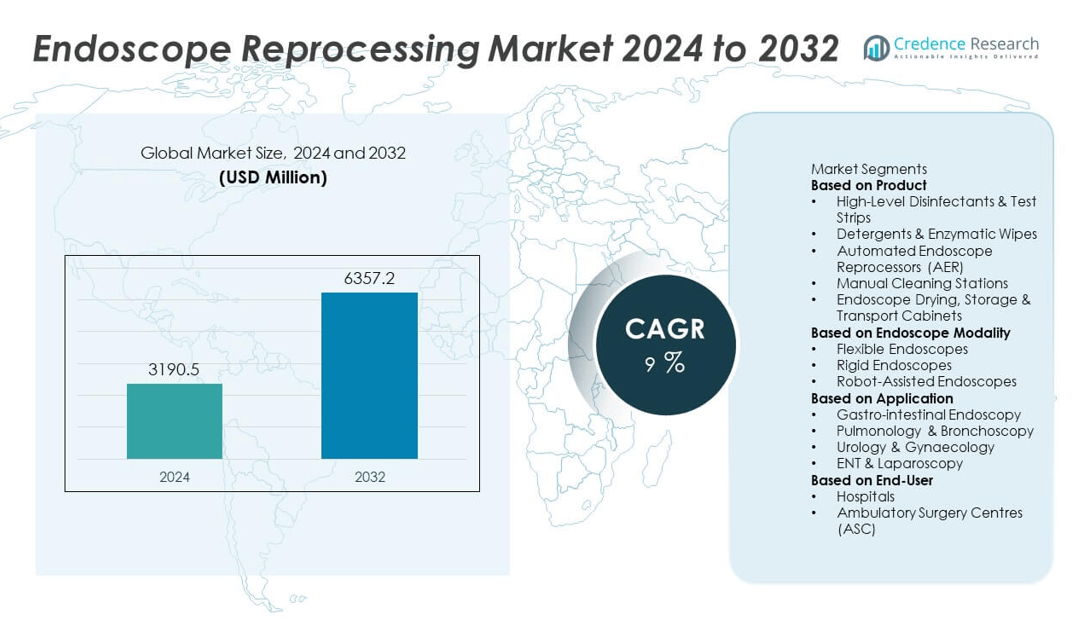
The Endoscope Reprocessing Market was valued at USD 3,190.5 million in 2024 and is projected to reach USD 6,357.2 million by 2032, registering a CAGR of 9% during the forecast period.
| REPORT ATTRIBUTE | DETAILS |
|---|---|
| Historical Period | 2020-2023 |
| Base Year | 2024 |
| Forecast Period | 2025-2032 |
| Endoscope Reprocessing Market Size 2024 | USD 3,190.5 million |
| Endoscope Reprocessing Market, CAGR | 9% |
| Endoscope Reprocessing Market Size 2032 | USD 6,357.2 million |
The Endoscope Reprocessing Market grows with rising demand for infection prevention and compliance with stringent sterilization standards in healthcare facilities. Increasing procedural volumes in gastroenterology, pulmonology, and urology drive the need for efficient and automated reprocessing systems. It benefits from technological advancements such as low-temperature sterilization, high-level disinfection systems, and traceability software that improve workflow efficiency and patient safety.
The Endoscope Reprocessing Market has a strong geographical presence across North America, Europe, Asia Pacific, Latin America, and the Middle East & Africa, each driven by distinct healthcare infrastructure and adoption rates of sterilization technologies. North America leads in technological adoption due to advanced healthcare facilities, strict infection control regulations, and high procedural volumes. Europe benefits from standardized clinical protocols and strong emphasis on patient safety, while Asia Pacific is witnessing rapid growth fueled by expanding hospital networks and rising awareness of infection prevention. Latin America and the Middle East & Africa are gradually increasing adoption through healthcare modernization initiatives and government-led quality control programs. Key players shaping the market include Olympus, Ecolab, ASP, and Getinge, all focusing on advanced automated reprocessing systems, eco-friendly sterilization methods, and compliance-driven innovations to enhance safety.
Market Insights
- The Endoscope Reprocessing Market was valued at USD 3,190.5 million in 2024 and is projected to reach USD 6,357.2 million by 2032, growing at a CAGR of 9% during the forecast period.
- Rising incidence of hospital-acquired infections and strict infection control regulations are driving the demand for advanced endoscope reprocessing solutions across healthcare facilities.
- Trends include growing adoption of fully automated reprocessing systems, eco-friendly disinfectants, and integration of tracking technologies to ensure compliance and procedural safety.
- The market is competitive, with leading players such as Olympus, Ecolab, ASP, and Getinge focusing on innovation, product portfolio expansion, and strategic partnerships to strengthen their global presence.
- High equipment costs, complex reprocessing protocols, and limited availability of skilled staff in emerging economies act as restraints for faster adoption.
- North America leads the market due to strong regulatory enforcement, advanced healthcare infrastructure, and high procedural volumes, followed by Europe with well-established patient safety frameworks.
- Asia Pacific shows the fastest growth driven by expanding hospital capacity, increasing awareness of infection prevention, and government-led healthcare modernization initiatives, while Latin America and the Middle East & Africa steadily expand through targeted public health investments
Market Drivers
Rising Incidence of Hospital-Acquired Infections (HAIs)
The Endoscope Reprocessing Market is driven by increasing awareness and prevention efforts against hospital-acquired infections. Flexible endoscopes are complex devices with intricate channels, making them susceptible to microbial contamination if not properly reprocessed. It supports adoption of advanced cleaning, disinfection, and sterilization technologies that ensure patient safety. Stringent infection control protocols in hospitals and clinics fuel demand for automated endoscope reprocessors (AERs) and chemical sterilants. Healthcare providers focus on eliminating cross-contamination risks during gastrointestinal, urological, and pulmonary procedures. The growing emphasis on patient safety directly influences the adoption of high-performance reprocessing systems.
- For instance, Advanced Sterilization Products (ASP)’s EVOTECH Endoscope Cleaner and Reprocessor processed up to 6 endoscopes per hour, achieving 98.8% protein removal on external surfaces and 99.7% microbial reduction inside lumens in independent clinical trials.
Stringent Regulatory Standards and Compliance Requirements
Regulatory authorities mandate strict adherence to validated cleaning and sterilization procedures for reusable endoscopes. The Endoscope Reprocessing Market benefits from compliance-driven investments by healthcare facilities to meet guidelines from bodies such as the FDA, CDC, and European Society of Gastrointestinal Endoscopy (ESGE). It encourages procurement of reprocessing equipment with documented validation cycles and traceability features. Regular audits and inspections reinforce the importance of standardized workflows and quality assurance measures. Manufacturers respond by integrating automated record-keeping and process monitoring into their systems. This regulatory environment ensures consistent demand for advanced, standards-compliant solutions.
- For instance, Olympus’s OER-Elite Automated Endoscope Reprocessor can complete a validated high-level disinfection cycle in approximately 28 minutes, processing up to 12 endoscopes per hour while meeting ISO 15883-4 standards for microbial reduction.
Advancements in Automated and Low-Temperature Sterilization Technologies
Technological innovation is a core driver of growth in the Endoscope Reprocessing Market. Automated systems enhance cleaning efficiency, reduce manual handling errors, and provide repeatable, validated processes. It enables faster turnaround times between procedures while maintaining compliance with disinfection standards. Low-temperature sterilization technologies, such as hydrogen peroxide gas plasma and peracetic acid systems, preserve device integrity and extend lifespan. Manufacturers invest in compact, high-throughput AER designs to optimize space in busy healthcare environments. These advancements strengthen operational efficiency while ensuring patient safety.
Growing Endoscopy Procedure Volumes Across Specialties
The increasing use of endoscopy in diagnostics and minimally invasive treatments drives demand for effective reprocessing solutions. The Endoscope Reprocessing Market benefits from rising procedure volumes in gastroenterology, pulmonology, urology, and otolaryngology. It creates a need for scalable reprocessing capabilities that support high daily throughput without compromising quality. The expansion of outpatient surgical centers and same-day endoscopy services intensifies demand for rapid and reliable reprocessing cycles. Global trends toward early disease detection and preventive healthcare contribute to procedural growth. This sustained demand reinforces the critical role of efficient reprocessing in clinical operations.
Market Trends
Integration of Automation and Digital Traceability
The Endoscope Reprocessing Market is witnessing a strong shift toward automation and digital process tracking. Automated Endoscope Reprocessors (AERs) with integrated barcode scanning and data logging capabilities are becoming standard to ensure compliance and reduce manual error risks. It enables healthcare providers to track each reprocessing cycle, link it to specific patient cases, and maintain verifiable records for audits. Cloud-based monitoring platforms are emerging, allowing remote supervision and predictive maintenance of reprocessing units. Integration with hospital information systems streamlines workflow and improves operational efficiency. This trend aligns with regulatory emphasis on process validation and documentation.
- For instance, Getinge’s ED-Flow AER processes up to 16 flexible endoscopes per hour and integrates RFID-based tracking, achieving 100% traceability for each cycle in compliance with ISO 15883-4 standards.
Rising Demand for Single-Use and Hybrid Endoscope Solutions
Single-use and hybrid endoscope designs are gaining traction as part of infection prevention strategies. The Endoscope Reprocessing Market is adapting by developing specialized cleaning systems for hybrid devices while single-use scopes reduce reprocessing needs altogether. It offers healthcare facilities a balance between cost efficiency and infection control by integrating both options into procedural workflows. Manufacturers are focusing on compatibility across multiple scope types to maximize equipment utility. The shift is driven by the need to minimize contamination risks without fully abandoning reusable devices. Hybrid adoption is particularly strong in high-volume endoscopy centers.
- For instance, Ambu A/S produced over 1.3 million single-use endoscopes in 2023, with models like the Ambu® aScope™ 4 Broncho significantly reducing post-procedure contamination risks to near-zero in independent clinical evaluations.
Advancements in Low-Temperature Sterilization Methods
Low-temperature sterilization continues to shape product development in the Endoscope Reprocessing Market. Hydrogen peroxide gas plasma, ozone-based systems, and peracetic acid sterilization are increasingly preferred to preserve delicate endoscope components. It allows thorough microbial inactivation without compromising device performance or longevity. Manufacturers are refining sterilization cycles to reduce processing time while maintaining efficacy. Compact, high-throughput sterilizers are being designed for busy surgical and diagnostic centers. This evolution supports both patient safety and operational efficiency.
Focus on Eco-Friendly and Water-Efficient Reprocessing Systems
Sustainability is becoming a notable factor influencing innovation in the Endoscope Reprocessing Market. New AERs and cleaning systems are engineered to reduce water consumption, chemical usage, and energy demand. It reflects the growing environmental responsibility among healthcare providers and equipment manufacturers. Development of biodegradable disinfectants and recyclable packaging supports greener reprocessing practices. Facilities are also adopting closed-loop water systems to minimize waste. These initiatives contribute to cost savings while supporting global environmental goals in medical technology.
Market Challenges Analysis
High Operational Costs and Resource Requirements
The Endoscope Reprocessing Market faces challenges due to the high costs associated with acquiring, operating, and maintaining advanced reprocessing equipment. It requires continuous investment in consumables, disinfectants, and sterilization agents, which adds to operational expenses. Facilities must allocate trained personnel to manage the complex reprocessing workflow, further increasing labor costs. The need for dedicated reprocessing rooms with specialized ventilation and plumbing infrastructure raises capital investment requirements. Smaller healthcare centers often struggle to justify the expenditure, leading to uneven adoption rates. This cost barrier can limit the widespread implementation of best-in-class reprocessing technologies in low- and middle-income markets.
Risk of Cross-Contamination and Compliance Complexity
Strict adherence to reprocessing protocols is essential to prevent infection outbreaks, yet it remains a persistent challenge in the Endoscope Reprocessing Market. It demands precise execution of cleaning, disinfection, and drying procedures to ensure patient safety. Any deviation from validated protocols can compromise device sterility, leading to potential cross-contamination incidents. Evolving regulatory requirements across different regions increase the complexity of compliance for healthcare providers. The need for continuous staff training and competency assessments further adds to operational burdens. Facilities that fail to maintain stringent process control risk reputational damage and legal consequences, making compliance a critical yet resource-intensive challenge.
Market Opportunities
Rising Demand for Automated and AI-Integrated Reprocessing Systems
The Endoscope Reprocessing Market holds strong potential in the growing adoption of fully automated and AI-enhanced reprocessing systems. It benefits from the ability of automation to reduce human error, improve process consistency, and meet stringent infection control standards. AI-enabled systems can monitor each reprocessing cycle, detect deviations, and provide real-time alerts to ensure compliance with regulatory protocols. Hospitals and specialty clinics are increasingly investing in next-generation automated endoscope reprocessors that combine speed with accuracy, reducing device turnaround times. Integration of digital tracking systems also enables comprehensive documentation for audits and quality control. This technological shift creates a substantial opportunity for manufacturers to offer advanced, data-driven solutions that improve both patient safety and operational efficiency.
Expanding Scope in Emerging Healthcare Markets
Emerging economies present significant growth avenues for the Endoscope Reprocessing Market due to rapid healthcare infrastructure expansion and rising adoption of minimally invasive procedures. It is supported by government-led initiatives aimed at improving infection control and hospital hygiene standards. Increasing investments in new hospitals, ambulatory surgical centers, and specialized gastroenterology units create sustained demand for reprocessing equipment. Partnerships between global manufacturers and local distributors enhance product availability and after-sales service in underserved regions. Training programs supported by industry leaders are equipping healthcare professionals with the skills to implement advanced reprocessing protocols. This expansion into developing markets offers long-term growth prospects, particularly in regions with increasing procedural volumes and tightening regulatory oversight.
Market Segmentation Analysis:
By Product
The Endoscope Reprocessing Market is segmented by product into automated endoscope reprocessors (AERs), detergents and disinfectants, drying and storage cabinets, and other reprocessing accessories. Automated endoscope reprocessors account for a significant share due to their ability to deliver consistent, high-level disinfection while reducing manual handling errors. Detergents and disinfectants remain critical for ensuring thorough cleaning and preventing biofilm formation inside endoscopes. Drying and storage cabinets are gaining prominence for their role in maintaining device sterility between uses, particularly in high-volume endoscopy units. Other accessories, including flushing aids, inspection tools, and cleaning brushes, support complete reprocessing workflows. Continuous product innovation focuses on improving cycle efficiency, reducing chemical use, and enhancing traceability features for regulatory compliance.
- For instance, Olympus’ OER-Elite AER can process two flexible endoscopes in approximately 28 minutes and is installed in over 6,000 healthcare facilities worldwide, ensuring validated high-level disinfection across multiple scope types.
By Endoscope Modality
Segmentation by endoscope modality includes flexible endoscopes, rigid endoscopes, and other specialized scopes. Flexible endoscopes dominate the Endoscope Reprocessing Market due to their widespread use in gastrointestinal, pulmonary, and urological procedures. Their complex internal channels require advanced cleaning and disinfection systems to prevent cross-contamination. Rigid endoscopes are widely used in orthopedic, laparoscopic, and ENT surgeries, benefiting from simpler reprocessing requirements but still subject to strict sterilization protocols. Other specialized scopes, including capsule and robotic-assisted surgical scopes, are emerging as new areas of focus, requiring tailored reprocessing solutions. Market demand is driven by increasing procedural volumes across all modalities, supported by advancements in device durability and material compatibility with high-level disinfectants.
- For instance, Karl Storz manufactures more than 15,000 rigid endoscopes annually, with each device capable of undergoing over 1,000 sterilization cycles without degradation in optical clarity.
By Application
The Endoscope Reprocessing Market serves applications in hospitals, ambulatory surgical centers, and specialty clinics. Hospitals hold the largest share due to their high patient throughput and broad range of diagnostic and therapeutic procedures. Ambulatory surgical centers are expanding adoption as they increase their capabilities for same-day endoscopic interventions. Specialty clinics, including gastroenterology and pulmonology practices, are investing in compact and cost-efficient reprocessing units to meet strict hygiene standards. Growing regulatory scrutiny and accreditation requirements across all care settings are driving investment in advanced reprocessing technologies. It is also seeing growth from integrated infection control programs, where reprocessing systems are paired with training and documentation tools to ensure consistent compliance with global standards.
Segments:
Based on Product
- High-Level Disinfectants & Test Strips
- Detergents & Enzymatic Wipes
- Automated Endoscope Reprocessors (AER)
- Manual Cleaning Stations
- Endoscope Drying, Storage & Transport Cabinets
Based on Endoscope Modality
- Flexible Endoscopes
- Rigid Endoscopes
- Robot-Assisted Endoscopes
Based on Application
- Gastro-intestinal Endoscopy
- Pulmonology & Bronchoscopy
- Urology & Gynaecology
- ENT & Laparoscopy
Based on End-User
- Hospitals
- Ambulatory Surgery Centres (ASC)
Based on the Geography:
- North America
- U.S.
- Canada
- Mexico
- Europe
- UK
- France
- Germany
- Italy
- Spain
- Russia
- Belgium
- Netherlands
- Austria
- Sweden
- Poland
- Denmark
- Switzerland
- Rest of Europe
- Asia Pacific
- China
- Japan
- South Korea
- India
- Australia
- Thailand
- Indonesia
- Vietnam
- Malaysia
- Philippines
- Taiwan
- Rest of Asia Pacific
- Latin America
- Brazil
- Argentina
- Peru
- Chile
- Colombia
- Rest of Latin America
- Middle East
- UAE
- KSA
- Israel
- Turkey
- Iran
- Rest of Middle East
- Africa
- Egypt
- Nigeria
- Algeria
- Morocco
- Rest of Africa
Regional Analysis
North America
North America accounts for approximately 36% of the Endoscope Reprocessing Market, driven by advanced healthcare infrastructure, high procedural volumes, and stringent infection control regulations. The United States leads the region with a strong emphasis on compliance with Centers for Disease Control and Prevention (CDC) and U.S. Food and Drug Administration (FDA) guidelines for endoscope cleaning and disinfection. Demand is reinforced by frequent hospital accreditation audits and the need to meet Joint Commission standards. Canada follows with increasing investments in automated reprocessing systems to improve workflow efficiency and reduce manual handling errors. The presence of key market players, coupled with high awareness of healthcare-associated infection (HAI) risks, accelerates adoption of advanced technologies such as automated endoscope reprocessors (AERs) with digital traceability features. Government funding programs and hospital modernization initiatives further enhance the regional market’s growth trajectory.
Europe
Europe represents around 29% of the Endoscope Reprocessing Market, supported by robust regulatory frameworks and high awareness of patient safety protocols. Countries such as Germany, France, and the United Kingdom drive demand through strict compliance with European Society of Gastrointestinal Endoscopy (ESGE) guidelines. Hospitals and specialty clinics in the region invest heavily in drying and storage cabinets to maintain endoscope sterility between uses. The growing procedural volume in gastrointestinal and urology departments is increasing the need for high-level disinfectants that are compatible with delicate endoscopic materials. Technological innovation, including automated systems with integrated leak testing and barcode tracking, is widely adopted to meet ISO 15883 standards. Public health initiatives emphasizing infection prevention contribute to steady replacement cycles for older reprocessing units across both public and private healthcare sectors.
Asia Pacific
Asia Pacific holds approximately 24% of the Endoscope Reprocessing Market, emerging as one of the fastest-growing regions due to expanding hospital networks and rising procedural demand. China, Japan, India, and Australia dominate regional adoption with significant investments in advanced reprocessing equipment to reduce HAI risks. Japan’s long-standing expertise in endoscopic procedures drives strong compliance with rigorous cleaning protocols, while China’s rapid healthcare modernization fosters widespread procurement of automated reprocessing units in urban hospitals. India shows growing adoption among private healthcare providers as medical tourism expands. The increasing prevalence of gastrointestinal disorders and rising awareness among healthcare professionals about the risks of improper reprocessing are major growth drivers. Local manufacturing partnerships and government-led infection control programs further support market penetration in both urban and semi-urban settings.
Latin America
Latin America contributes around 7% to the Endoscope Reprocessing Market, with Brazil, Mexico, and Argentina at the forefront of adoption. Growth is propelled by improving healthcare infrastructure and greater emphasis on infection prevention in endoscopy units. Hospitals are replacing manual cleaning processes with automated reprocessors to meet international safety standards. Economic constraints and uneven reimbursement policies in some countries slow large-scale adoption, but private healthcare providers are leading in implementing advanced reprocessing solutions. Medical conferences and training programs by global manufacturers are enhancing awareness about best practices in scope cleaning and storage. Government health agencies are gradually integrating HAI prevention targets into national healthcare policies, supporting steady growth in this segment.
Middle East & Africa
The Middle East & Africa region holds about 4% of the Endoscope Reprocessing Market, with demand concentrated in the United Arab Emirates, Saudi Arabia, and South Africa. Investments in tertiary care facilities, medical tourism, and specialist surgical centers are driving the adoption of high-performance reprocessing equipment. Compliance with international infection control standards is becoming a priority in leading hospitals, prompting procurement of automated systems with integrated drying and storage capabilities. In Africa, limited access to advanced equipment in rural hospitals remains a challenge, but urban facilities are upgrading to meet accreditation requirements for patient safety. Partnerships between international suppliers and regional distributors are improving equipment availability and after-sales support. The region’s healthcare expansion plans and focus on improving clinical hygiene practices indicate sustained demand growth in the coming years.
Key Player Analysis
- Belimed
- Shinva Medical Instrument
- Olympus
- Metrex
- Getinge
- ARC Group of Companies
- ASP
- Ecolab
- CONMED Corporation
- Creo Medical
Competitive Analysis
The Endoscope Reprocessing Market features a competitive landscape with global leaders and regional specialists focusing on innovation, compliance, and service excellence. Key players include Olympus, Ecolab, ASP, Getinge, Shinva Medical Instrument, Metrex, Belimed, ARC Group of Companies, CONMED Corporation, and Creo Medical. Olympus holds a strong position with its integrated reprocessing systems, combining cleaning, disinfection, and drying technologies to improve workflow efficiency. Ecolab leverages its expertise in infection prevention to offer high-performance disinfectants and cleaning chemistries tailored for endoscope reprocessing. ASP focuses on advanced sterilization technologies, including low-temperature sterilization solutions that protect device integrity while meeting stringent safety standards. Getinge provides automated reprocessing units and service contracts that support high-volume hospital environments. Shinva Medical Instrument and Belimed have expanded their presence in Asia and Europe by offering cost-effective yet compliant solutions. Metrex specializes in enzymatic detergents and surface disinfectants, while ARC Group and CONMED strengthen the market with targeted product portfolios and strong distribution networks. Competition centers on meeting regulatory requirements, reducing turnaround times, and improving traceability to ensure patient safety and operational efficiency.
Recent Developments
- In September 2024, the Soluscope portfolio and production site received the EU Medical Device Regulation (MDR) certification. This certification signifies that Soluscope's devices and production processes meet the rigorous safety and performance standards established by the European Union.
- In June 2024, Steelco and Belimed finalized a joint venture, resulting in the combined entity SteelcoBelimed. This new company is focused on infection control and sterile processing, aiming to enhance capabilities in these areas by leveraging the strengths of both founding companies.
- In May 2025, Olympus introduced the ScopeLocker Air, a new endoscope drying cabinet. This cabinet features continuous airflow, HEPA filtration, and flexible sizing, accommodating up to 18 endoscopes.
Market Concentration & Characteristics
The Endoscope Reprocessing Market is moderately consolidated, with a mix of global leaders and specialized regional players competing through product innovation, compliance with stringent regulatory standards, and strategic partnerships. It is characterized by strong demand for automated reprocessors, advanced drying cabinets, and high-level disinfectants that ensure compliance with infection prevention protocols. Leading companies focus on developing systems with enhanced traceability, shorter cycle times, and integration with hospital IT networks to improve workflow efficiency and safety. High entry barriers exist due to regulatory approvals, capital investment requirements, and the need for proven device efficacy in reducing cross-contamination risks. It demonstrates a high degree of technological advancement, with manufacturers integrating smart monitoring systems, HEPA filtration, and user-friendly interfaces to meet the operational needs of healthcare facilities. Growing emphasis on sustainability has led to the adoption of eco-friendly disinfectants and water-saving technologies. The market maintains steady growth potential through continuous upgrades, training programs, and global standardization in reprocessing protocols.
Report Coverage
The research report offers an in-depth analysis based on Product, Endoscope Modality, Application, End-User and Geography. It details leading market players, providing an overview of their business, product offerings, investments, revenue streams, and key applications. Additionally, the report includes insights into the competitive environment, SWOT analysis, current market trends, as well as the primary drivers and constraints. Furthermore, it discusses various factors that have driven market expansion in recent years. The report also explores market dynamics, regulatory scenarios, and technological advancements that are shaping the industry. It assesses the impact of external factors and global economic changes on market growth. Lastly, it provides strategic recommendations for new entrants and established companies to navigate the complexities of the market.
Future Outlook
- Demand will grow with rising focus on infection prevention in endoscopy procedures.
- Automation in reprocessing systems will enhance efficiency and reduce manual errors.
- Eco-friendly disinfectants and water-saving technologies will gain wider adoption.
- Integration of digital tracking and reporting will improve compliance with safety standards.
- Increasing adoption of single-use accessories will influence reprocessing practices.
- Hospitals will invest more in staff training to ensure adherence to reprocessing protocols.
- Compact and modular reprocessing units will see higher demand in smaller healthcare facilities.
- Technological advancements will reduce cycle times while maintaining high disinfection efficacy.
- Emerging markets will experience faster growth with expanding endoscopy service infrastructure.
- Strategic collaborations between device manufacturers and healthcare providers will drive innovation.

Request a Free Sample
Fill in your details and we'll send you a free sample report.
- Sample data tables & charts
- Research methodology
Market Dynamics
Rising Incidence of Hospital-Acquired Infections (HAIs)
The increasing prevalence of HAIs has heightened the need for advanced endoscope reprocessing solutions, as flexible endoscopes are particularly susceptible to microbial contamination. This drives healthcare facilities to invest in automated, high-level disinfection and sterilization technologies to ensure patient safety and regulatory compliance.
Stringent Regulatory Standards and Compliance Requirements
Global and regional regulatory bodies mandate strict adherence to validated cleaning and sterilization protocols for reusable endoscopes, compelling healthcare providers to upgrade to advanced reprocessing systems with traceability and documentation features. Regular audits and evolving standards reinforce ongoing demand for compliant, high-performance equipment.
Advancements in Automated and Low-Temperature Sterilization Technologies
Technological innovation, such as automated endoscope reprocessors and low-temperature sterilization methods, enhances cleaning efficiency, reduces manual errors, and preserves device integrity. These advancements enable faster turnaround times and support the growing procedural volumes in modern healthcare settings.
Growing Endoscopy Procedure Volumes Across Specialties
The expanding use of endoscopy in diagnostics and minimally invasive treatments across gastroenterology, pulmonology, urology, and other specialties increases the need for scalable, efficient reprocessing solutions. Higher procedural throughput in hospitals and ambulatory centers directly boosts demand for reliable reprocessing systems.
Integration of Automation and Digital Traceability
The adoption of automated reprocessing systems with integrated digital tracking and data logging capabilities ensures compliance, reduces manual error, and streamlines workflow. This trend is reinforced by regulatory emphasis on process validation and the need for comprehensive documentation for audits and quality assurance.
Need a Custom Version of This Report?
Tailor the scope, geography, or segments to your exact requirements.
- Custom geography or segment scope
- Direct access to our analyst team
Frequently Asked Questions
What is the current market size for Endoscope Reprocessing, and what is its projected size in 2032?
At what Compound Annual Growth Rate is the Endoscope Reprocessing market projected to grow between 2025 and 2032?
What are the primary factors fueling the growth of the Endoscope Reprocessing market?
Who are the leading companies in the Endoscope Reprocessing market?
Table of Content
Chapter 1 Market Segmentation
- 1.1 Segmentation Framework
- 1.1.1 Product and Service Classification
- 1.1.2 Application and End-Use Classification
- 1.1.3 Technology and Solution Classification
- 1.1.4 Customer and Distribution Channel Classification
- 1.1.5 Geographic Segmentation
- 1.1.6 Market Segment Definitions and Boundaries
- 1.2 By Product
- 1.2.1 High-Level Disinfectants & Test Strips
- 1.2.2 Detergents & Enzymatic Wipes
- 1.2.3 Automated Endoscope Reprocessors (AER)
- 1.2.4 Manual Cleaning Stations
- 1.2.5 Endoscope Drying, Storage & Transport Cabinets
- 1.3 By End-User
- 1.3.1 Hospitals
- 1.3.2 Ambulatory Surgery Centres (ASC)
- 1.4 By Application
- 1.4.1 Gastro-intestinal Endoscopy
- 1.4.2 Pulmonology & Bronchoscopy
- 1.4.3 Urology & Gynaecology
- 1.4.4 ENT & Laparoscopy
- 1.5 By Endoscope Modality
- 1.5.1 Flexible Endoscopes
- 1.5.2 Rigid Endoscopes
- 1.5.3 Robot-Assisted Endoscopes
Chapter 2 Introduction
- 2.1 Report Objectives and Scope
- 2.2 Product Definition and Industry Terminology
- 2.3 Market Inclusions and Exclusions
- 2.4 Research Process
- 2.4.1 Primary Research and Expert Interviews
- 2.4.2 Secondary Research and Source Review
- 2.4.3 Top-Down and Bottom-Up Estimation
- 2.4.4 Data Triangulation and Verification
- 2.5 Market Size Measurement Basis
- 2.5.1 2024: USD 3,190.5 million → 2032: USD 6,357.2 million
- 2.6 Historical and Forecast Reference Periods
- 2.6.1 Base Year: 2024
- 2.6.2 Forecast Period: 2024-2032
- 2.7 Research Assumptions and Limitations
Chapter 3 Executive Summary
- 3.1 Market Snapshot and Key Findings
- 3.2 Base-Year Market Size, 2024
- 3.3 Forecast Market Size, 2032
- 3.4 Revenue and Volume Growth Outlook
- 3.5 Key Demand and Supply Indicators
- 3.6 Leading Market Segments
- 3.7 Fastest-Growing Market Opportunities
- 3.8 Regional Performance Highlights
- 3.9 Technology and Industry Transformation
- 3.10 Competitive Landscape Summary
- 3.11 Analyst View and Strategic Implications
Chapter 4 Global Endoscope Reprocessing Market Trends and Developments
- 4.1 Historical Industry Development
- 4.2 Recent Market Trends and Developments
- 4.3 Demand and Customer Behavior Trends
- 4.4 Technology and Product Innovation
- 4.5 Artificial Intelligence, Automation and Digitalization
- 4.6 Local Manufacturing and Supply Chain Realignment
- 4.7 Industry Partnerships, Mergers and Acquisitions
- 4.8 Sustainability and Circular Economy Developments
- 4.9 Government and Private Sector Investment Trends
- 4.10 Emerging Business Models and Commercialization
- 4.11 Industry Developments and Announcements
Chapter 5 Global Endoscope Reprocessing Market Production, Supply and Demand Analysis
- 5.1 Demand Trend and Consumption Analysis
- 5.2 Demand Forecast, 2024-2032
- 5.3 Production and Output Trend
- 5.4 Production and Output Forecast, 2024-2032
- 5.5 Installed Capacity and Capacity Utilization
- 5.6 Company-Wise Production Plants and Statistics
- 5.6.1 Installed Production Capacity
- 5.6.2 Actual Production
- 5.6.3 Planned Capacity and Expansion Targets
- 5.7 Supply Chain Structure and Procurement Trends
- 5.8 Supply-Demand Gap and Bottlenecks
- 5.9 Import Dependence and Sourcing Structure
- 5.10 Contract Manufacturing and Outsourcing
- 5.11 Regional Supply and Demand Concentration
Chapter 6 Global Endoscope Reprocessing Market Pricing Analysis
- 6.1 Pricing Structure and Measurement
- 6.2 Historical Pricing Trends
- 6.3 Pricing Outlook, 2024-2032
- 6.4 Average Selling Price and Unit Economics
- 6.5 Pricing by Product and Market Segment
- 6.6 Geographic Pricing Differences
- 6.7 Key Input, Energy, Labor and Logistics Costs
- 6.8 Contract Pricing and Purchasing Models
- 6.9 Pricing Sensitivity and Competitive Positioning
- 6.10 Price, Margin and Profitability Implications
Chapter 7 Global Endoscope Reprocessing Market Dynamics
- 7.1 Market Growth Drivers
- 7.1.1 Demand-Side Drivers
- 7.1.2 Technology and Innovation Drivers
- 7.1.3 Infrastructure and Investment Drivers
- 7.1.4 Regulatory and Policy Drivers
- 7.2 Market Restraints
- 7.2.1 Cost and Affordability Constraints
- 7.2.2 Technology and Adoption Barriers
- 7.2.3 Supply Chain and Operational Constraints
- 7.3 Market Challenges
- 7.3.1 Competitive Pressure and Margin Erosion
- 7.3.2 Skills, Infrastructure and Implementation Gaps
- 7.4 Emerging Market Opportunities
- 7.5 Market Dynamics Impact and Time-Horizon Assessment
Chapter 8 Global Endoscope Reprocessing Value Chain Analysis
- 8.1 Industry Value Chain Overview
- 8.2 Upstream Suppliers and Critical Inputs
- 8.3 Technology and Component Providers
- 8.4 Manufacturing or Service Delivery
- 8.5 Distribution, Channel Partners and Integrators
- 8.6 Downstream Applications and End Users
- 8.7 Value Addition and Profit Pools
- 8.8 Vertical Integration and Outsourcing
- 8.9 Supplier Concentration and Risk
- 8.10 Supply Chain Localization and Resilience
Chapter 9 Global Endoscope Reprocessing Market Regulations and Policies
- 9.1 Relevant Laws, Standards and Compliance Frameworks
- 9.2 Product, Service, Safety and Quality Requirements
- 9.3 Government Policies, Incentives and Subsidies
- 9.4 Imports, Exports and Trade Barriers
- 9.5 Public Procurement and Local Content Requirements
- 9.6 Environmental and Sustainability Compliance
- 9.7 Upcoming Policy Changes and Market Implications
Chapter 10 Global Endoscope Reprocessing Market Hotspots and Opportunities
- 10.1 Market Opportunity Mapping and Growth Hotspots
- 10.2 High-Growth Applications and Customer Groups
- 10.3 Underserved Markets and White-Space Opportunities
- 10.4 Emerging Technology and Product Opportunities
- 10.5 New Capacity and Investment Hotspots
- 10.6 Market Entry and Expansion Opportunities
- 10.7 Distribution and Partnership Opportunities
- 10.8 Near-Term and Long-Term Commercial Potential
- 10.9 Opportunity Attractiveness and Execution Risks
Chapter 11 Global Endoscope Reprocessing Market Outlook, 2024-2032
- 11.1 Market Size and Analysis
- 11.1.1 Revenue (Market Measurement: 2024: USD 3,190.5 million → 2032: USD 6,357.2 million)
- 11.1.2 Market Volume and Quantity Sold
- 11.1.3 Historical Market Size
- 11.1.4 Base-Year Market Size, 2024
- 11.2 Market Forecast, 2024-2032
- 11.2.1 Revenue Forecast to 2032
- 11.2.2 Volume Forecast to 2032
- 11.2.3 CAGR and Year-on-Year Growth
- 11.2.4 Incremental Revenue Opportunity
- 11.3 Forecast Assumptions and Scenario Analysis
- 11.3.1 Base-Case Forecast
- 11.3.2 Optimistic and Conservative Scenarios
- 11.3.3 Technology, Pricing and Policy Sensitivities
- 11.4 Market Attractiveness and Growth Outlook
Chapter 12 Global Endoscope Reprocessing Market Segmentation and Outlook
- 12.1 Segmentation Summary and Market Shares, 2024
- 12.2 Largest and Fastest-Growing Segments
- 12.3 By Product - Market Size and Forecast, 2024-2032
- 12.3.1 Segment Definition and Scope
- 12.3.2 Historical Market Size
- 12.3.3 Revenue Forecast, 2024-2032
- 12.3.4 Volume Forecast, 2024-2032
- 12.3.5 Base-Year Market Share, 2024
- 12.3.6 Segment CAGR and Growth Drivers
- 12.3.7 Subsegment Market Size and Forecast
- 12.3.7.1 High-Level Disinfectants & Test Strips
- 12.3.7.2 Detergents & Enzymatic Wipes
- 12.3.7.3 Automated Endoscope Reprocessors (AER)
- 12.3.7.4 Manual Cleaning Stations
- 12.3.7.5 Endoscope Drying, Storage & Transport Cabinets
- 12.3.8 Subsegment Pricing and Adoption Trends
- 12.3.9 Leading Suppliers and Competition
- 12.3.10 Regional Demand and Opportunities
- 12.4 By End-User - Market Size and Forecast, 2024-2032
- 12.4.1 Segment Definition and Scope
- 12.4.2 Historical Market Size
- 12.4.3 Revenue Forecast, 2024-2032
- 12.4.4 Volume Forecast, 2024-2032
- 12.4.5 Base-Year Market Share, 2024
- 12.4.6 Segment CAGR and Growth Drivers
- 12.4.7 Subsegment Market Size and Forecast
- 12.4.7.1 Hospitals
- 12.4.7.2 Ambulatory Surgery Centres (ASC)
- 12.4.8 Subsegment Pricing and Adoption Trends
- 12.4.9 Leading Suppliers and Competition
- 12.4.10 Regional Demand and Opportunities
- 12.5 By Application - Market Size and Forecast, 2024-2032
- 12.5.1 Segment Definition and Scope
- 12.5.2 Historical Market Size
- 12.5.3 Revenue Forecast, 2024-2032
- 12.5.4 Volume Forecast, 2024-2032
- 12.5.5 Base-Year Market Share, 2024
- 12.5.6 Segment CAGR and Growth Drivers
- 12.5.7 Subsegment Market Size and Forecast
- 12.5.7.1 Gastro-intestinal Endoscopy
- 12.5.7.2 Pulmonology & Bronchoscopy
- 12.5.7.3 Urology & Gynaecology
- 12.5.7.4 ENT & Laparoscopy
- 12.5.8 Subsegment Pricing and Adoption Trends
- 12.5.9 Leading Suppliers and Competition
- 12.5.10 Regional Demand and Opportunities
- 12.6 By Endoscope Modality - Market Size and Forecast, 2024-2032
- 12.6.1 Segment Definition and Scope
- 12.6.2 Historical Market Size
- 12.6.3 Revenue Forecast, 2024-2032
- 12.6.4 Volume Forecast, 2024-2032
- 12.6.5 Base-Year Market Share, 2024
- 12.6.6 Segment CAGR and Growth Drivers
- 12.6.7 Subsegment Market Size and Forecast
- 12.6.7.1 Flexible Endoscopes
- 12.6.7.2 Rigid Endoscopes
- 12.6.7.3 Robot-Assisted Endoscopes
- 12.6.8 Subsegment Pricing and Adoption Trends
- 12.6.9 Leading Suppliers and Competition
- 12.6.10 Regional Demand and Opportunities
- 12.7 Segment Growth Comparison
- 12.8 Segment Attractiveness and Priority Matrix
Chapter 13 Global Endoscope Reprocessing End-Use and Application Market Outlook
- 13.1 End-Use Industry and Customer Demand Structure
- 13.2 Leading Applications and Customer Groups
- 13.3 End-Use Market Size, Share and Forecast
- 13.4 Major End-Use Industry Deep Dives
- 13.4.1 Customer Requirements and Use Cases
- 13.4.2 Demand and Replacement Cycles
- 13.4.3 Technical and Regulatory Considerations
- 13.4.4 Purchasing and Procurement Models
- 13.4.5 Leading Vendors and Distribution Channels
- 13.4.6 Forecast and Commercial Opportunities
- 13.5 Emerging Applications and Cross-Segment Demand
- 13.6 End-Use Industry Investment Priorities
Chapter 14 Global Endoscope Reprocessing Geographic Market Outlook, 2024-2032
- 14.1 Regional Market Size and Share, 2024
- 14.2 Regional Market Forecast, 2024-2032
- 14.3 Regional Pricing, Production and Demand Differences
- 14.4 North America
- 14.4.1 United States
- 14.4.2 Canada
- 14.4.3 Mexico
- 14.5 Europe
- 14.5.1 Germany
- 14.5.2 France
- 14.5.3 Italy
- 14.5.4 United Kingdom
- 14.5.5 Spain
- 14.5.6 Poland
- 14.5.7 Russia
- 14.5.8 Netherlands
- 14.5.9 Belgium
- 14.5.10 Sweden
- 14.5.11 Denmark
- 14.5.12 Norway
- 14.5.13 Rest of Europe
- 14.6 Asia Pacific
- 14.6.1 China
- 14.6.2 India
- 14.6.3 Japan
- 14.6.4 South Korea
- 14.6.5 Thailand
- 14.6.6 Indonesia
- 14.6.7 Vietnam
- 14.6.8 Malaysia
- 14.6.9 Australia
- 14.6.10 Rest of Asia Pacific
- 14.7 Latin America
- 14.7.1 Brazil
- 14.7.2 Argentina
- 14.7.3 Colombia
- 14.7.4 Chile
- 14.7.5 Rest of Latin America
- 14.8 Middle East
- 14.8.1 Saudi Arabia
- 14.8.2 United Arab Emirates
- 14.8.3 Turkey
- 14.8.4 Israel
- 14.8.5 Iran
- 14.8.6 Rest of the Middle East
- 14.9 Africa
- 14.9.1 South Africa
- 14.9.2 Egypt
- 14.9.3 Nigeria
- 14.9.4 Morocco
- 14.9.5 Rest of Africa
- 14.10 Regional Investment, Policy and Supply Chain Differences
- 14.11 Regional Competitive Landscape
- 14.12 Geographic Growth Hotspots
Chapter 15 Global Endoscope Reprocessing Technology, Innovation and Sustainability Outlook
- 15.1 Technology Landscape and Maturity
- 15.2 Product, Process and Service Innovation
- 15.3 AI, Automation and Digital Tools in the Industry
- 15.4 Technology Adoption and Performance Benchmarking
- 15.5 Innovation Pipeline and R&D Investment
- 15.6 Patent and Intellectual Property Trends
- 15.7 Energy Efficiency and Resource Management
- 15.8 Sustainability, Recycling and Circularity
- 15.9 Technology Roadmap, 2024-2032
- 15.10 Risks of Obsolescence and Technology Substitution
Chapter 16 Global Endoscope Reprocessing Market Key Strategic Imperatives
- 16.1 Growth and Market Entry Priorities
- 16.2 High-Return Products and Segments
- 16.3 Pricing, Profitability and Cost Optimization
- 16.4 Technology Investment and Product Differentiation
- 16.5 Supply Chain Localization and Resilience
- 16.6 Distribution and Customer Acquisition
- 16.7 Partnership, Acquisition and Capacity Strategy
- 16.8 Regional Expansion Priorities
- 16.9 Short-, Medium- and Long-Term Actions
Chapter 17 Competition Outlook
- 17.1 Industry Competition Characteristics
- 17.2 Market Structure and Concentration
- 17.3 Market Share and Competitive Positioning, 2024
- 17.4 Company-Wise Revenue and Product Benchmarking
- 17.5 Production and Service Capacity Benchmarking
- 17.6 Technology, Pricing and Differentiation
- 17.7 Regional Footprint and Distribution Strength
- 17.8 Mergers, Acquisitions and Strategic Alliances
- 17.9 New Entrants and Competitive Threats
- 17.10 Porter's Five Forces and Industry Attractiveness
- 17.11 Competitive Outlook, 2024-2032
Chapter 18 Company Profiles
- 18.1 Company Coverage and Selection Criteria
- 18.2 Olympus
- 18.2.1 Business Description
- 18.2.2 Company Ownership and Geographic Presence
- 18.2.3 Product and Service Portfolio
- 18.2.4 Manufacturing and Operating Footprint
- 18.2.5 Production Capacity and Expansion Plans
- 18.2.6 Financial Performance and Investment
- 18.2.7 Market Share and Competitive Position
- 18.2.8 Technology and Innovation Capabilities
- 18.2.9 Strategic Alliances or Partnerships
- 18.2.10 Recent Developments
- 18.2.11 Growth Strategy and Outlook
- 18.3 Ecolab
- 18.4 ASP (Advanced Sterilization Products)
- 18.5 Getinge
- 18.6 Shinva Medical Instrument
- 18.7 Belimed
- 18.8 Metrex
- 18.9 ARC Group of Companies
- 18.10 CONMED Corporation
- 18.11 Creo Medical
- 18.12 Other Relevant Market Participants
Note: Every listed company is profiled on the structure shown under the first company. The company list is preliminary and may change based on research findings, market developments, data availability and client requirements.
Chapter 19 Disclaimer
- 19.1 Research and Forecast Disclaimer
- 19.2 Data Source and Estimation Limitations
Note: The depth of individual sections depends on data availability for this market. Volume, capacity, trade and other unit-based metrics are included where applicable.

