
Cancer screening and scope replacement lift endoscope sales
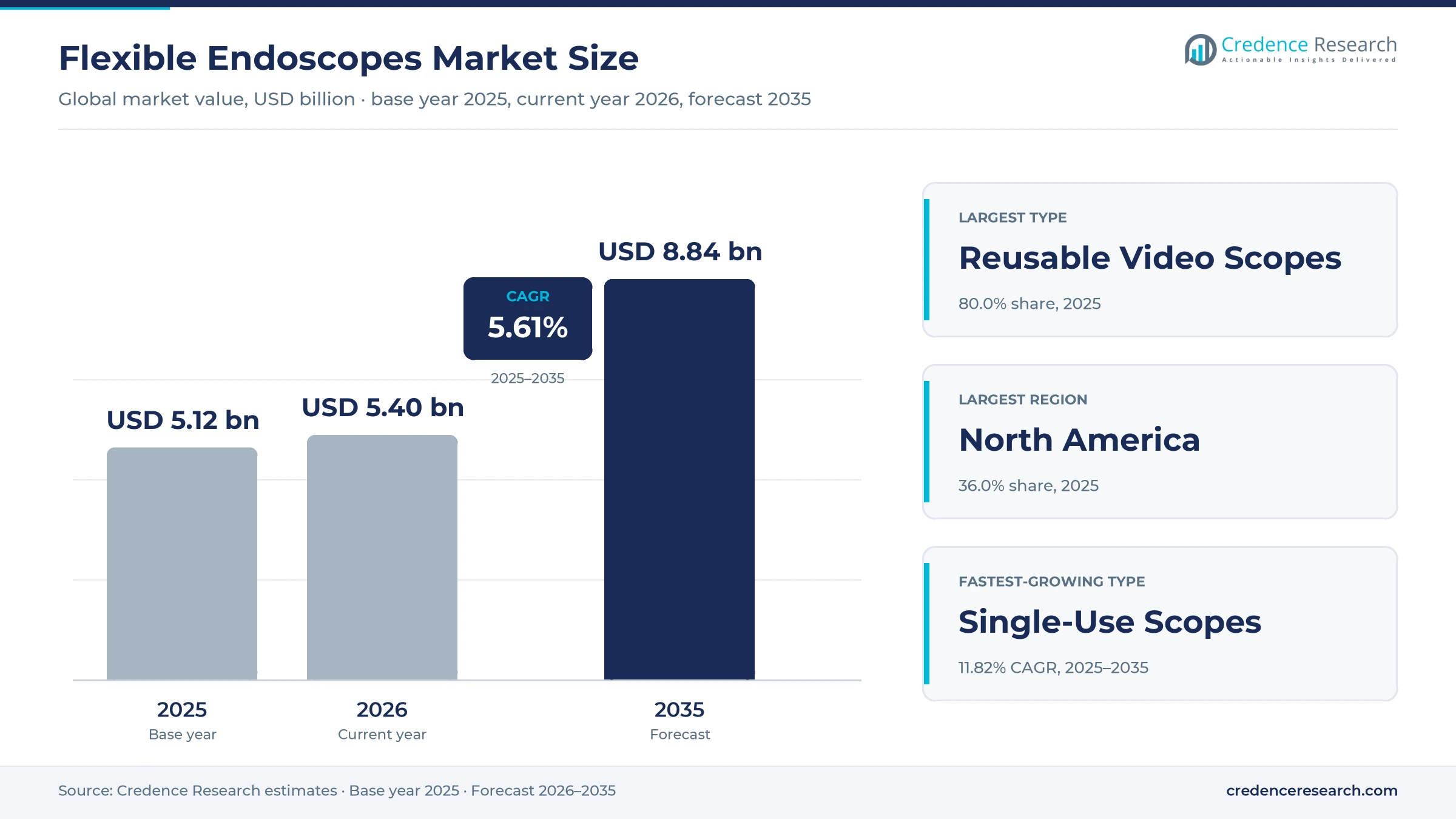
The flexible endoscopes market was valued at USD 5.12 billion in 2025 and is projected to increase from USD 5.40 billion in 2026 to USD 8.84 billion by 2035, registering a CAGR of 5.61% during 2025–2035. Demand comes from colorectal and gastric cancer screening, aging populations that need more diagnostic and therapeutic endoscopy, infection-control pressure on reusable scopes and imaging upgrades that pull scope replacement. North America held the largest regional share, 36.0% in 2025, supported by high colonoscopy volumes and early use of single-use bronchoscopes and duodenoscopes. Asia Pacific is the fastest-growing region at 7.40% a year as China adds endoscopy rooms in county hospitals and India expands private GI centers. The main regulatory change came in June 2025, when the U.S. Food and Drug Administration told providers about import alerts on certain Olympus scopes made in Japan, leaving U.S. hospitals to plan fleets around the affected models.
How do hospitals buy flexible endoscopes?
Hospitals and clinics buy most flexible endoscopes as part of a platform. A video processor and light source set the generation, and compatible gastroscopes, colonoscopes, duodenoscopes, bronchoscopes, cystoscopes and ureteroscopes follow. Each procedure room needs a working set of scopes plus spares to cover repair downtime, so growth in procedures turns into fleet purchases, and a new processor generation starts a replacement cycle. Single-use scopes are bought per case instead, which moves part of the spending from capital budgets to consumables.
The estimate counts reusable video endoscopes, single-use flexible endoscopes and fiber-optic endoscopes, which remain in use for ENT, intubation and low-cost settings. It excludes video processors, light sources, monitors and endoscopy towers, capsule endoscopes, endotherapy accessories such as snares, clips and biopsy forceps, and repair contracts and reprocessing equipment, as well as rigid scopes.
Flexible Endoscopes Market Insights
- The flexible endoscopes market is projected to rise from USD 5.40 billion in 2026 to USD 8.84 billion by 2035, a 5.61% CAGR, as screening and aging populations add procedures.
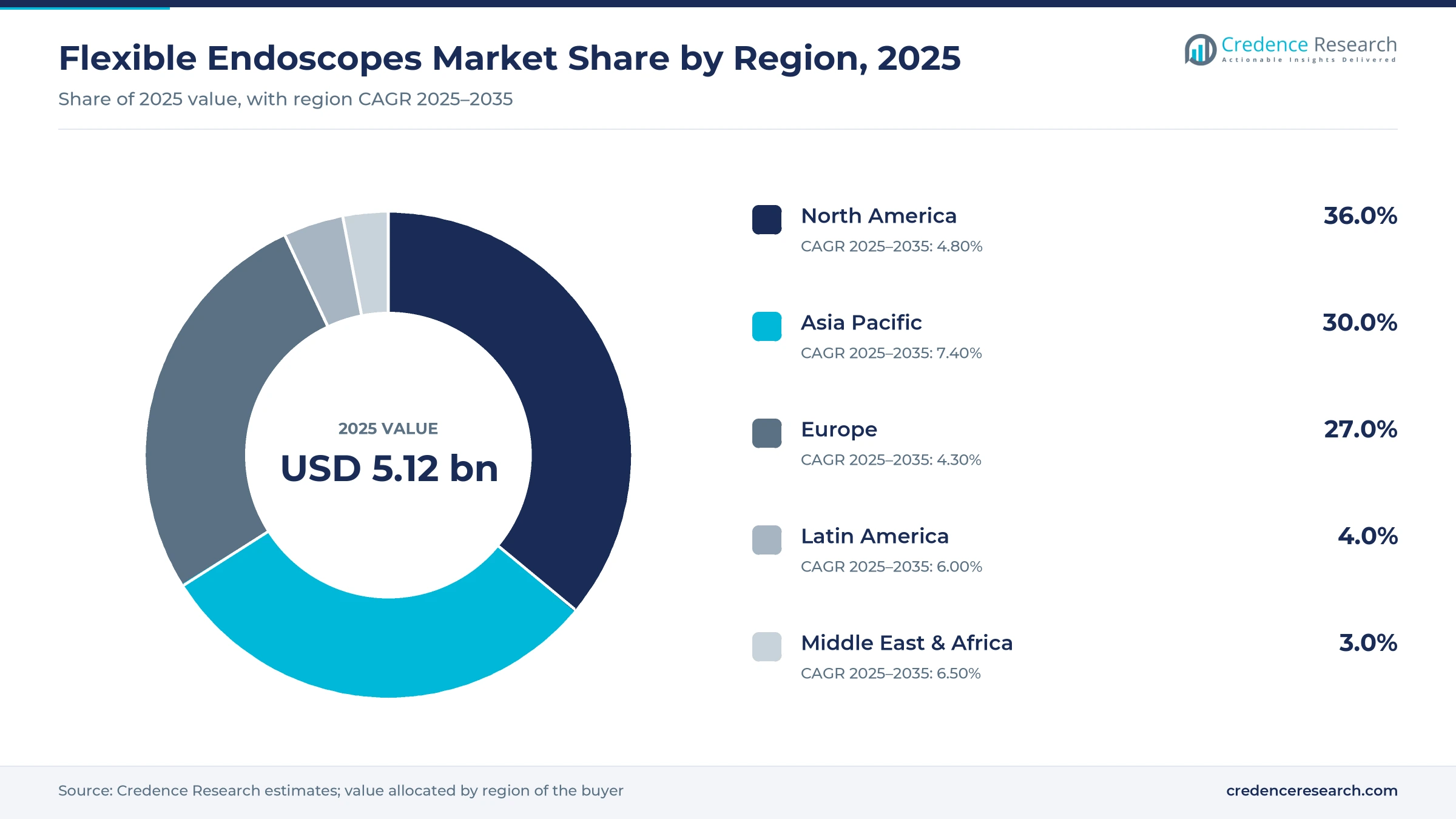
- North America held 36.0% of 2025 value, the largest regional share, on high colonoscopy volumes, while Asia Pacific grows fastest at 7.40% a year.
- Reusable video endoscopes accounted for 80.0% of 2025 value because high-volume gastrointestinal units still get the lowest cost per case from reusable scopes.
- Single-use flexible endoscopes grow fastest at 11.82% a year through 2035 as infection-control concerns carry disposable scopes from bronchoscopy into urology and ERCP.
- A June 2025 FDA import alert on certain Olympus scopes showed how concentrated reusable supply is, while Fujifilm announced a 4K platform showing for DDW 2026.
Reusable scopes lead while single-use and urology grow
Reusable video scopes lead by type while single-use scopes grow fastest
Based on type, the market is categorized into reusable video endoscopes, single-use flexible endoscopes and fiber-optic endoscopes. Reusable video endoscopes led with 80.0% of 2025 value, because high-volume GI units run each gastroscope and colonoscope through thousands of procedures, keeping cost per case low. Single-use flexible endoscopes grow fastest at 11.82% a year as contamination concerns push hospitals toward disposable bronchoscopes, duodenoscopes and ureteroscopes, which favors makers with dedicated single-use lines. Fiber-optic scopes, meanwhile, keep giving way to video scopes in most settings.
Gastrointestinal endoscopy leads applications while urology grows fastest
Based on application, the market is categorized into gastrointestinal endoscopy, bronchoscopy, urology, ENT and gynecology and other uses. Gastrointestinal endoscopy led with 62.0% of 2025 value, anchored in colonoscopy and gastroscopy for colorectal and stomach cancer detection. Urology grows fastest at 7.60% a year as flexible ureteroscopy replaces open and rigid approaches for kidney stones, a shift that also lifts single-use ureteroscopes and suppliers with strong urology portfolios.
| Segment Group | Leading Sub-segment | Share, 2025 | Fastest-growing Sub-segment | CAGR, 2025–2035 |
|---|---|---|---|---|
| By Type | Reusable Video Endoscopes | 80.0% | Single-Use Flexible Endoscopes | 11.82% |
| By Application | Gastrointestinal Endoscopy | 62.0% | Urology | 7.60% |
Request a Free Sample
Fill in your details and we'll send you a free sample report.
- Sample data tables & charts
- Research methodology
Screening, aging and infection control expand scope fleets
Colorectal and stomach cancer screening keeps GI units busy
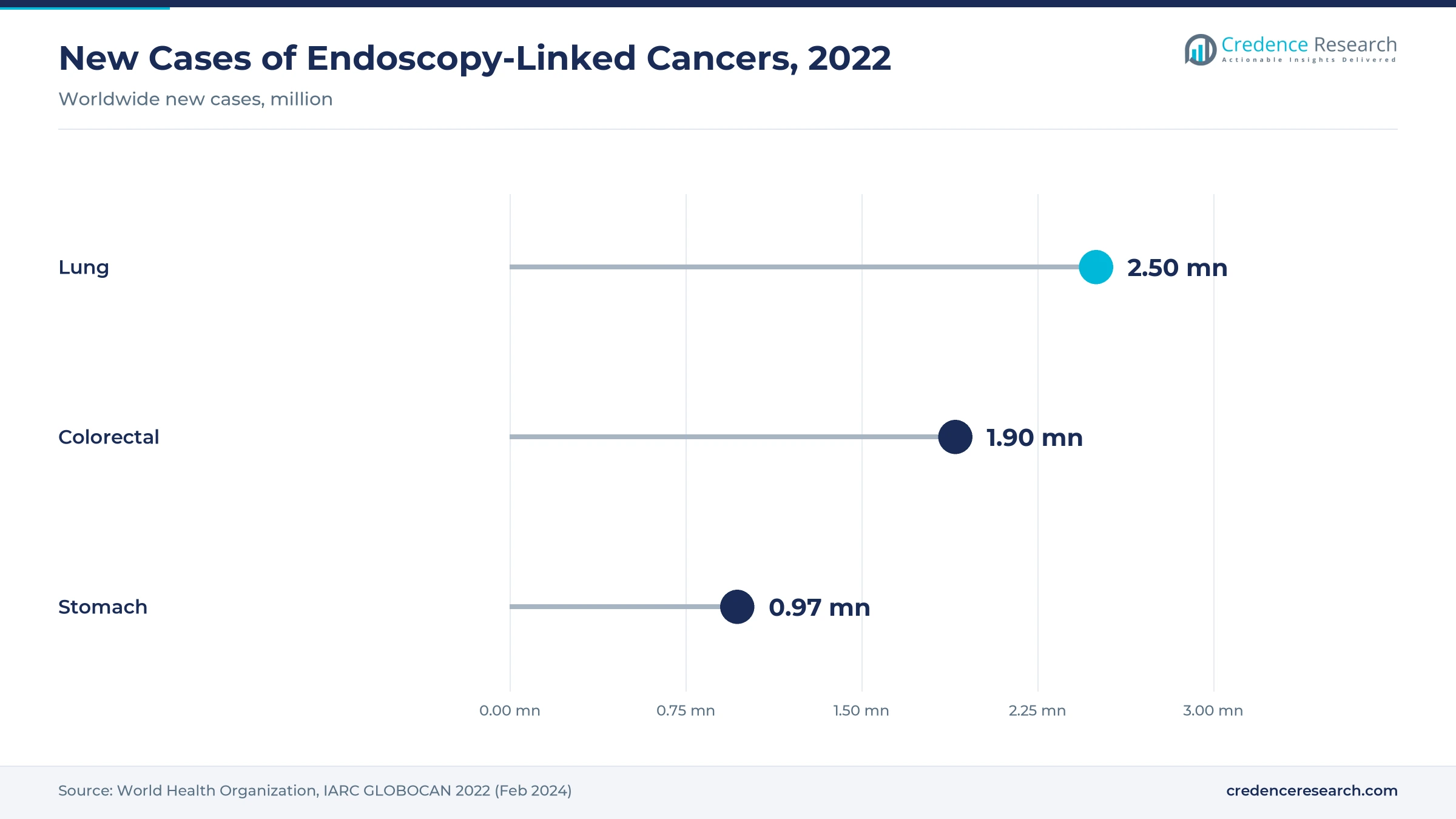
Colonoscopy and gastroscopy are the main tools for finding colorectal and stomach cancer early. Estimates published by the World Health Organization's cancer agency rank colorectal cancer third and stomach cancer fifth by new cases worldwide in 2022, at 1.9 million and 970,000 cases. National bowel screening programs in Europe and gastric screening in Japan and South Korea keep procedure rooms full, which sustains replacement demand for gastroscopes and colonoscopes across the full forecast to 2035.
Older patients and lung nodule workups add procedures
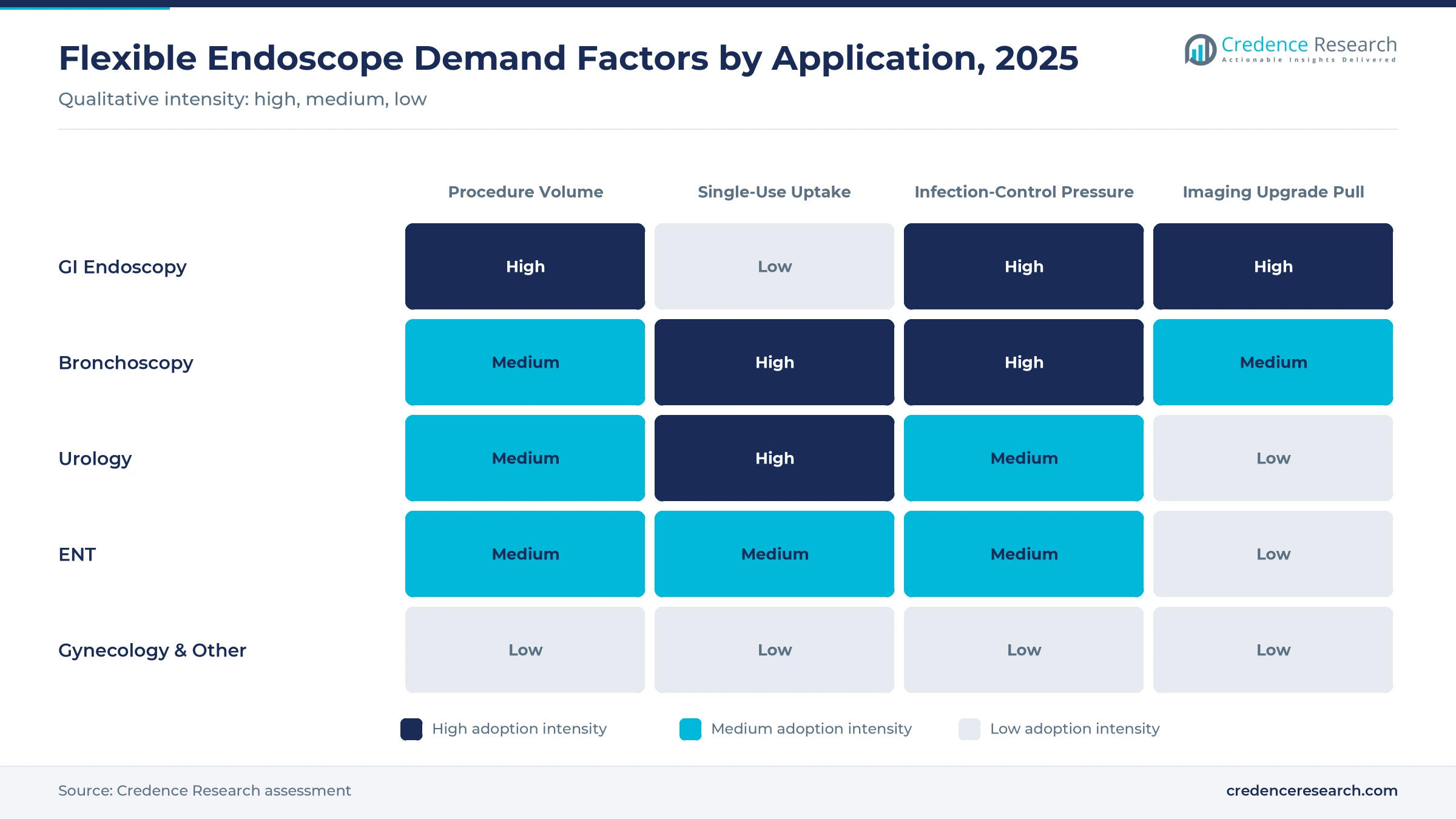
Older patients need more diagnostic and therapeutic endoscopy, since bleeding, polyps, bile duct stones, swallowing problems, lung nodules and kidney stones all become more common with age. Lung cancer was the most common cancer in 2022, with 2.5 million new cases, and bronchoscopy is central to diagnosing and staging it. Each new procedure room needs a working set of scopes and spares, so procedure growth in aging markets such as Japan, Europe and North America becomes fleet demand through the 2030s, with bronchoscopy growing faster than GI endoscopy.
Contamination cases push hospitals toward single-use scopes
Duodenoscope and bronchoscope contamination cases pushed hospitals toward disposable components and single-use scopes, especially in ERCP and bronchoscopy, where long, narrow channels are hard to clean. Ambu's 2024/25 annual report, released on Nov. 5, 2025, showed its endoscopy business growing faster than the group as a whole, a sign of steady uptake. The effect is strongest in North America and Europe over the next five years.
New 4K processor generations pull scope replacement
A new processor generation usually needs compatible scopes, so platform launches set the replacement cycle in GI and bronchoscopy units. On April 30, 2026, Fujifilm announced that it would show its recently launched ELUXEO 8000 Endoscopic Imaging System, a single-unit processor and light source with 4K imaging and a new Amber-Red Color Imaging mode, together with 800 Series upper endoscopes and colonoscopes, at Digestive Disease Week 2026 in Chicago. Hospitals that move to such platforms refresh scope fleets over the medium term, because processors and scopes must match.
Disposable scopes spread as 4K imaging resets replacement
Single-use scopes shift into urology, ERCP and gastroscopy
Single-use scopes started in bronchoscopy and intubation and are now used in urology, ERCP and gastroscopy. Ambu, Boston Scientific, Olympus, Karl Storz and OTU Medical all sell disposable scopes. The shift turns part of scope spending into a per-procedure consumable and favors suppliers that can lower unit cost while keeping image quality acceptable. Reusable makers answer with their own disposable lines, so the trend widens competition rather than removing incumbents from the procedures they already serve.
The rise of 4K, multi-light imaging and computer-aided detection
Scope makers are launching 4K processors with new light modes and computer-aided detection of polyps and lesions. Each generation competes on resolution, light modes and software assistance, and because processors and scopes must match, every step lifts scope replacement in GI units first and bronchoscopy next. Software that flags lesions during a procedure also raises the value of whole platforms rather than single scopes, which helps incumbents.
Urology and bronchoscopy outgrow GI endoscopy as a growth opportunity
Urology is the fastest-growing application at 7.60% a year, as flexible ureteroscopy replaces open and rigid approaches for kidney stones, and bronchoscopy also grows faster than GI endoscopy as lung nodule workups expand. Suppliers with ureteroscopes, cystoscopes and bronchoscopes, both reusable and single-use, can win share in these smaller but faster pools. The opening is largest in North America and Europe, where stone treatment and lung cancer workups are routine.
First-time fleet purchases across Asia Pacific open an opportunity
Asia Pacific is the fastest-growing region, with much of its demand coming from first-time fleet buyers in Chinese county hospitals and Indian private GI centers. Chinese makers such as SonoScape and Aohua win public tenders at home and export lower-priced video scopes to emerging markets. Suppliers that offer complete, affordable platforms with training and local service can capture these first-time purchases rather than replacement orders alone.
Reprocessing risk and repair bills hold spending back
Hard-to-clean channels make reprocessing a liability
Reusable flexible scopes have long, narrow channels that are hard to clean, and contamination cases lead to recalls, lawsuits and tighter rules. Hospitals and endoscopy units carry the cost through extra cleaning steps, testing and staff time, which raises the cost of each procedure and can take scopes out of service. Mitigation comes from better cleaning equipment, from disposable components on high-risk scopes and from selective use of single-use models in ERCP and bronchoscopy.
Repair bills and tight budgets stretch scope life
Flexible scopes are damaged often, and repair and loaner programs form a large part of their lifetime cost. When budgets tighten, hospitals and public tenders stretch scope life rather than buy new fleets, which delays replacement and slows unit sales, most visibly in Europe, where the market grows at 4.30% a year. Suppliers respond with service contracts, faster repair turnaround and loaner pools that keep buyers on their platforms through the next processor generation.
Per-case cost and plastic waste limit single-use adoption
Single-use scopes cost more per case than reusable scopes in high-volume GI units, and each one adds plastic waste. Hospital purchasing committees therefore restrict them to selected procedures, which caps adoption in gastroscopy and colonoscopy, the largest application. The commercial result is slower single-use growth in the biggest pool of procedures. Makers address the barrier by cutting unit prices and targeting high-risk cases such as ERCP and bronchoscopy, where avoided infections and faster room turnover justify the premium.
Concentrated supply turns a plant problem into a category shortage
A few makers supply most reusable scopes, so a quality problem at one plant can tighten supply for a whole category. In a June 24, 2025, letter, the U.S. Food and Drug Administration told providers about import alerts on certain Olympus bronchoscopes, ureterorenoscopes and reprocessors from its Aizu site in Japan, citing quality system violations. Providers could keep using working devices, but U.S. hospitals had to plan fleets around the affected models. For hospitals, second suppliers and single-use backups reduce the exposure.
North America buys the most scopes as Asia adds rooms
| Region | Share, 2025 | CAGR, 2025–2035 |
|---|---|---|
| North America | 36.0% | 4.80% |
| Asia Pacific | 30.0% | 7.40% |
| Europe | 27.0% | 4.30% |
| Latin America | 4.0% | 6.00% |
| Middle East & Africa | 3.0% | 6.50% |
North America combines high colonoscopy volumes with early single-use uptake
North America held 36.0% of 2025 value and grows at 4.80% a year. The United States accounts for most of it, with high colonoscopy volumes, routine bronchoscopy for lung nodules and early adoption of single-use bronchoscopes and duodenoscopes, which keep spending per procedure high. The June 2025 FDA import alert on certain Olympus models made in Japan left U.S. hospitals planning scope fleets around those models, while Fujifilm, Pentax Medical, Karl Storz and single-use makers compete for replacement orders.
Asia Pacific grows on gastric screening, county hospitals and private GI centers
Asia Pacific held 30.0% of 2025 value and is the fastest-growing region at 7.40% a year. Japan and South Korea run large gastric cancer screening programs, and the region is home to Olympus, Fujifilm and Pentax Medical, the three makers that supply most reusable scopes. China is adding endoscopy rooms in county hospitals, where SonoScape and Aohua win public tenders with lower-priced video scopes, and India is expanding private GI centers. First-time fleet purchases make the region the main source of new unit demand.
Europe pairs bowel screening volumes with long replacement cycles
Europe held 27.0% of 2025 value and grows at 4.30% a year, the slowest of the five regions. National bowel cancer screening programs keep colonoscopy volumes high, but public tenders and tight hospital budgets stretch scope life and favor long replacement cycles. Karl Storz and Richard Wolf compete strongly in ENT and urology scopes. Single-use uptake is selective, shaped by cost and plastic-waste concerns, so growth relies on platform upgrades and on urology and bronchoscopy procedures.
Latin America and Middle East & Africa rely on private hospitals and Gulf projects
Latin America held 4.0% of 2025 value and grows at 6.00% a year, as screening programs and private hospital groups add endoscopy rooms. The Middle East & Africa held 3.0% and grows at 6.50% a year, led by Gulf hospital projects. Both regions buy mostly mid-priced video platforms and are open to lower-cost scopes from Asian makers.
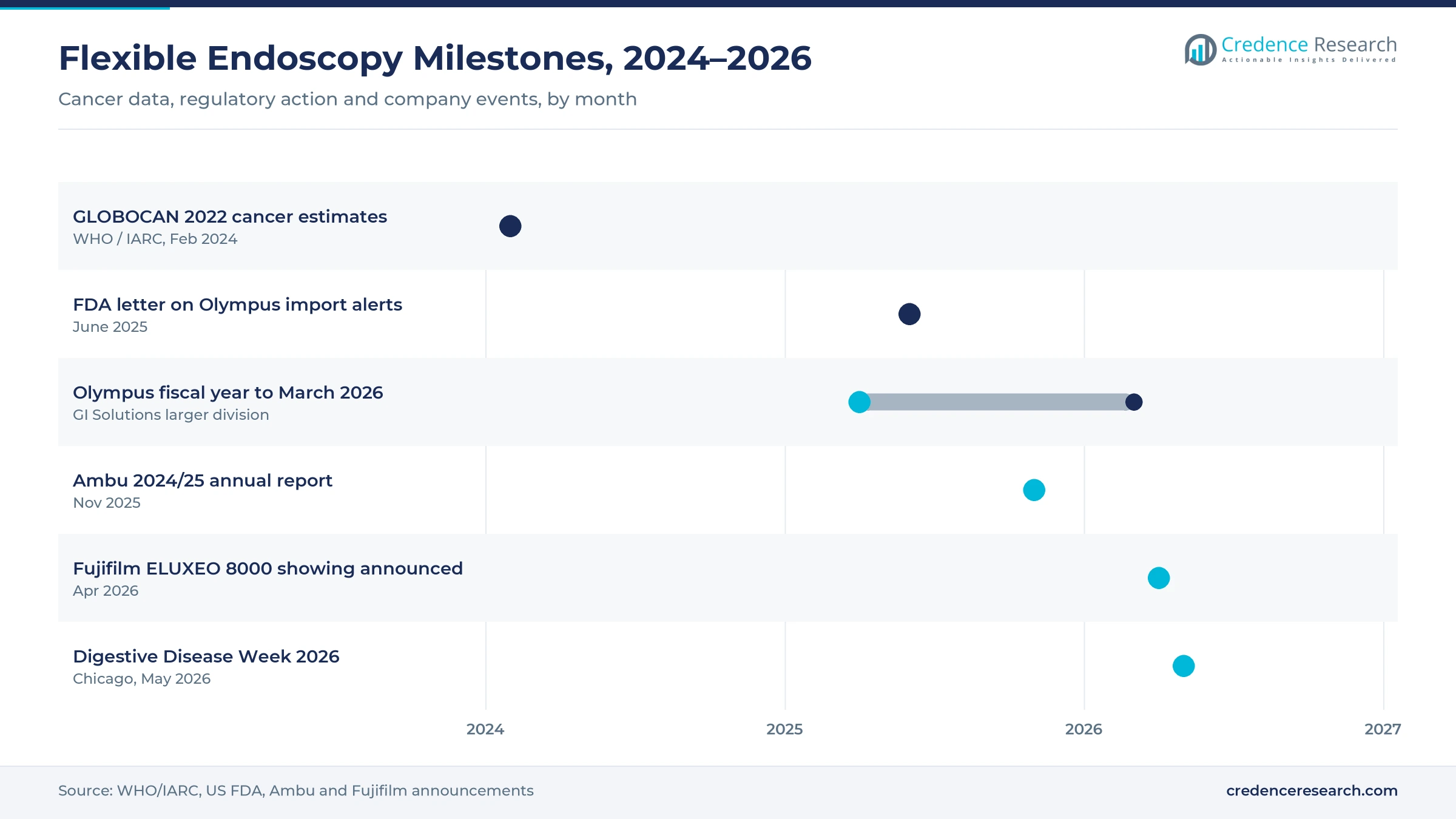
An FDA import alert and a 4K platform mark 2024–2026
| Development | Status and market relevance |
|---|---|
| In April 2026, Fujifilm announced on April 30 that it would show its recently launched ELUXEO 8000 4K imaging system and new 800 Series scopes at Digestive Disease Week 2026 in Chicago. | Announced. A new platform starts a scope replacement cycle. |
| In November 2025, Ambu released its 2024/25 annual report on Nov. 5, showing its endoscopy business growing faster than the group as a whole. | Reported. Confirms steady uptake of single-use scopes. |
| In June 2025, the U.S. FDA issued a June 24 letter to health care providers announcing import alerts on certain Olympus bronchoscopes, ureterorenoscopes, laparoscopes and reprocessors from its Aizu site in Japan. | In force. Tightens U.S. supply of some reusable scope models. |
| In February 2024, the World Health Organization's cancer agency published 2022 estimates ranking lung cancer first, colorectal third and stomach fifth by new cases. | Published. Frames screening and diagnostic demand for scopes. |
Imaging, single-use design and reprocessing shape buying
- Imaging advances such as 4K processors, new light modes like Fujifilm's Amber-Red Color Imaging and computer-aided detection of polyps raise detection and pull scope upgrades.
- Single-use design in disposable bronchoscopes, ureteroscopes and duodenoscopes removes reprocessing from high-risk procedures, with unit cost and plastic waste as the limits.
- Reprocessing improvements such as disposable components, better cleaning equipment and leak testing lower contamination risk across reusable fleets.
- Navigation through robotic and navigation bronchoscopy extends flexible scopes to peripheral lung nodules and adds procedures.
- Regulation through FDA quality-system enforcement, including the 2025 Olympus import alerts, makes manufacturing compliance a supply factor.
Need a Custom Version of This Report?
Tailor the scope, geography, or segments to your exact requirements.
- Custom geography or segment scope
- Direct access to our analyst team
Japanese platform makers face single-use and Chinese rivals
Competition splits into three groups, and the first is made up of Olympus, Fujifilm and Pentax Medical (HOYA), the three Japanese makers that supply most reusable scopes and sell full processor and scope platforms. Olympus is the clear leader in GI endoscopy, and its 2026 company profile shows Gastrointestinal Solutions as the larger of its two divisions in the year to March 2026. Karl Storz is strong in ENT, urology and intubation scopes, and Richard Wolf in urology. Single-use specialists led by Ambu, with Boston Scientific and OTU Medical, compete on infection risk and room turnover. SonoScape and Aohua compete on price in Chinese tenders and emerging markets. Buyers compare whole platforms, including repair turnaround and loaner scopes, which keeps incumbents in most replacement orders. No company reports flexible scope sales on a comparable basis, so no share ranking is given.
Companies profiled and their roles
| Company | Type | Role in the market |
|---|---|---|
| Olympus | Platform leader | Clear leader in GI endoscopy; also sells disposable scopes |
| Fujifilm | Platform maker | ELUXEO 8000 4K system and 800 Series scopes |
| Pentax Medical (HOYA) | Platform maker | Reusable GI video scopes and processors |
| Karl Storz | Specialty maker | ENT, urology and intubation scopes, plus disposable scopes |
| Richard Wolf | Specialty maker | Urology scopes |
| Ambu | Single-use specialist | Single-use bronchoscopes, extended into urology and GI |
| Boston Scientific | Single-use specialist | Single-use duodenoscopes, cholangioscopes and ureteroscopes |
| OTU Medical | Single-use specialist | Disposable flexible scopes |
| SonoScape | Chinese challenger | Lower-priced video scopes for Chinese tenders and export |
| Aohua | Chinese challenger | Lower-priced video scopes for Chinese tenders and export |
Replacement sets the base while single-use sets the pace
Credence Research's view is that flexible endoscopy remains a replacement-led market built on gastroscopes and colonoscopes, with value growth coming from single-use scopes in bronchoscopy, urology and ERCP and from 4K platforms that pull scope upgrades. The three Japanese makers will keep most GI demand, where installed processors lock in buyers, while single-use specialists and Chinese makers take share in faster pools. The main risk is supply disruption from quality enforcement at concentrated plants. Buyers and investors should watch FDA actions, single-use pricing and Chinese tender results.
How Credence Research sized flexible scope sales
The report uses 2025 as the base year and forecasts to 2035, with CAGR calculated over 2025–2035. Market values come from Credence Research's market model, built from endoscopy procedure volumes, installed scope fleets and replacement cycles and checked against the endoscopy segment disclosures of listed scope makers; segment and regional splits are Credence Research estimates. Supporting evidence comes from WHO cancer statistics, FDA notices, company annual reports and company announcements.
GI fleets anchor demand while urology and bronchoscopy grow
Through 2035, GI endoscopy will remain the core of demand, supported by cancer screening and aging populations, while urology and bronchoscopy grow faster. Single-use scopes will move further into ERCP, urology and selected gastroscopy, but cost and waste will keep reusable scopes dominant in high-volume units. Asia Pacific will gain share as China and India add procedure rooms, and North America will remain the largest region. Imaging generations with 4K and computer-aided detection will set replacement timing, and manufacturing quality will matter as much as image quality for supply.
Frequently Asked Questions
What was the size of the flexible endoscopes market in 2025?
What is the forecast value and CAGR of the flexible endoscopes market?
What does the flexible endoscopes market include?
Which region holds the largest share of the flexible endoscopes market?
Which flexible endoscope type leads the market?
Which application uses the most flexible endoscopes?
Who are the major companies in the flexible endoscopes market?
What challenges could slow the flexible endoscopes market?
Table of Content
Chapter 1 Market Segmentation
- 1.1 Segmentation Framework
- 1.1.1 Product and Service Classification
- 1.1.2 Application and End-Use Classification
- 1.1.3 Technology and Solution Classification
- 1.1.4 Customer and Distribution Channel Classification
- 1.1.5 Geographic Segmentation
- 1.1.6 Market Segment Definitions and Boundaries
- 1.2 By Type
- 1.2.1 Reusable Video Endoscopes
- 1.2.2 Single-Use Flexible Endoscopes
- 1.2.3 Fibreoptic Endoscopes
- 1.3 By Application
- 1.3.1 Gastrointestinal Endoscopy
- 1.3.2 Bronchoscopy
- 1.3.3 Urology
- 1.3.4 ENT
- 1.3.5 Gynaecology & Other
Chapter 2 Introduction
- 2.1 Report Objectives and Scope
- 2.2 Product Definition and Industry Terminology
- 2.3 Market Inclusions and Exclusions
- 2.4 Research Process
- 2.4.1 Primary Research and Expert Interviews
- 2.4.2 Secondary Research and Source Review
- 2.4.3 Top-Down and Bottom-Up Estimation
- 2.4.4 Data Triangulation and Verification
- 2.5 Market Size Measurement Basis
- 2.5.1 2025: USD 5.12 billion → 2035: USD 8.84 billion
- 2.6 Historical and Forecast Reference Periods
- 2.6.1 Historical Period: 2018-2025
- 2.6.2 Base Year: 2025
- 2.6.3 Forecast Period: 2025-2035
- 2.7 Research Assumptions and Limitations
Chapter 3 Executive Summary
- 3.1 Market Snapshot and Key Findings
- 3.2 Base-Year Market Size, 2025
- 3.3 Forecast Market Size, 2035
- 3.4 Revenue and Volume Growth Outlook
- 3.5 Key Demand and Supply Indicators
- 3.6 Leading Market Segments
- 3.7 Fastest-Growing Market Opportunities
- 3.8 Regional Performance Highlights
- 3.9 Technology and Industry Transformation
- 3.10 Competitive Landscape Summary
- 3.11 Analyst View and Strategic Implications
Chapter 4 Global Flexible Endoscopes Market Trends and Developments
- 4.1 Historical Industry Development, 2018-2025
- 4.2 Recent Market Trends and Developments
- 4.3 Demand and Customer Behavior Trends
- 4.4 Technology and Product Innovation
- 4.5 Artificial Intelligence, Automation and Digitalization
- 4.6 Local Manufacturing and Supply Chain Realignment
- 4.7 Industry Partnerships, Mergers and Acquisitions
- 4.8 Sustainability and Circular Economy Developments
- 4.9 Government and Private Sector Investment Trends
- 4.10 Emerging Business Models and Commercialization
- 4.11 Industry Developments and Announcements
Chapter 5 Global Flexible Endoscopes Market Production, Supply and Demand Analysis
- 5.1 Demand Trend and Consumption Analysis, 2018-2025
- 5.2 Demand Forecast, 2025-2035
- 5.3 Production and Output Trend, 2018-2025
- 5.4 Production and Output Forecast, 2025-2035
- 5.5 Installed Capacity and Capacity Utilization
- 5.6 Company-Wise Production Plants and Statistics
- 5.6.1 Installed Production Capacity
- 5.6.2 Actual Production
- 5.6.3 Planned Capacity and Expansion Targets
- 5.7 Supply Chain Structure and Procurement Trends
- 5.8 Supply-Demand Gap and Bottlenecks
- 5.9 Import Dependence and Sourcing Structure
- 5.10 Contract Manufacturing and Outsourcing
- 5.11 Regional Supply and Demand Concentration
Chapter 6 Global Flexible Endoscopes Market Pricing Analysis
- 6.1 Pricing Structure and Measurement
- 6.2 Historical Pricing Trends, 2018-2025
- 6.3 Pricing Outlook, 2025-2035
- 6.4 Average Selling Price and Unit Economics
- 6.5 Pricing by Product and Market Segment
- 6.6 Geographic Pricing Differences
- 6.7 Key Input, Energy, Labor and Logistics Costs
- 6.8 Contract Pricing and Purchasing Models
- 6.9 Pricing Sensitivity and Competitive Positioning
- 6.10 Price, Margin and Profitability Implications
Chapter 7 Global Flexible Endoscopes Market Dynamics
- 7.1 Market Growth Drivers
- 7.1.1 Demand-Side Drivers
- 7.1.2 Technology and Innovation Drivers
- 7.1.3 Infrastructure and Investment Drivers
- 7.1.4 Regulatory and Policy Drivers
- 7.2 Market Restraints
- 7.2.1 Cost and Affordability Constraints
- 7.2.2 Technology and Adoption Barriers
- 7.2.3 Supply Chain and Operational Constraints
- 7.3 Market Challenges
- 7.3.1 Competitive Pressure and Margin Erosion
- 7.3.2 Skills, Infrastructure and Implementation Gaps
- 7.4 Emerging Market Opportunities
- 7.5 Market Dynamics Impact and Time-Horizon Assessment
Chapter 8 Global Flexible Endoscopes Value Chain Analysis
- 8.1 Industry Value Chain Overview
- 8.2 Upstream Suppliers and Critical Inputs
- 8.3 Technology and Component Providers
- 8.4 Manufacturing or Service Delivery
- 8.5 Distribution, Channel Partners and Integrators
- 8.6 Downstream Applications and End Users
- 8.7 Value Addition and Profit Pools
- 8.8 Vertical Integration and Outsourcing
- 8.9 Supplier Concentration and Risk
- 8.10 Supply Chain Localization and Resilience
Chapter 9 Global Flexible Endoscopes Market Regulations and Policies
- 9.1 Relevant Laws, Standards and Compliance Frameworks
- 9.2 Product, Service, Safety and Quality Requirements
- 9.3 Government Policies, Incentives and Subsidies
- 9.4 Imports, Exports and Trade Barriers
- 9.5 Public Procurement and Local Content Requirements
- 9.6 Environmental and Sustainability Compliance
- 9.7 Upcoming Policy Changes and Market Implications
Chapter 10 Global Flexible Endoscopes Market Hotspots and Opportunities
- 10.1 Market Opportunity Mapping and Growth Hotspots
- 10.2 High-Growth Applications and Customer Groups
- 10.3 Underserved Markets and White-Space Opportunities
- 10.4 Emerging Technology and Product Opportunities
- 10.5 New Capacity and Investment Hotspots
- 10.6 Market Entry and Expansion Opportunities
- 10.7 Distribution and Partnership Opportunities
- 10.8 Near-Term and Long-Term Commercial Potential
- 10.9 Opportunity Attractiveness and Execution Risks
Chapter 11 Global Flexible Endoscopes Market Outlook, 2025-2035
- 11.1 Market Size and Analysis
- 11.1.1 Revenue (Market Measurement: 2025: USD 5.12 billion → 2035: USD 8.84 billion)
- 11.1.2 Market Volume and Quantity Sold
- 11.1.3 Historical Market Size, 2018-2025
- 11.1.4 Base-Year Market Size, 2025
- 11.2 Market Forecast, 2025-2035
- 11.2.1 Revenue Forecast to 2035
- 11.2.2 Volume Forecast to 2035
- 11.2.3 CAGR and Year-on-Year Growth
- 11.2.4 Incremental Revenue Opportunity
- 11.3 Forecast Assumptions and Scenario Analysis
- 11.3.1 Base-Case Forecast
- 11.3.2 Optimistic and Conservative Scenarios
- 11.3.3 Technology, Pricing and Policy Sensitivities
- 11.4 Market Attractiveness and Growth Outlook
Chapter 12 Global Flexible Endoscopes Market Segmentation and Outlook
- 12.1 Segmentation Summary and Market Shares, 2025
- 12.2 Largest and Fastest-Growing Segments
- 12.3 By Type - Market Size and Forecast, 2025-2035
- 12.3.1 Segment Definition and Scope
- 12.3.2 Historical Market Size, 2018-2025
- 12.3.3 Revenue Forecast, 2025-2035
- 12.3.4 Volume Forecast, 2025-2035
- 12.3.5 Base-Year Market Share, 2025
- 12.3.6 Segment CAGR and Growth Drivers
- 12.3.7 Subsegment Market Size and Forecast
- 12.3.7.1 Reusable Video Endoscopes
- 12.3.7.2 Single-Use Flexible Endoscopes
- 12.3.7.3 Fibreoptic Endoscopes
- 12.3.8 Subsegment Pricing and Adoption Trends
- 12.3.9 Leading Suppliers and Competition
- 12.3.10 Regional Demand and Opportunities
- 12.4 By Application - Market Size and Forecast, 2025-2035
- 12.4.1 Segment Definition and Scope
- 12.4.2 Historical Market Size, 2018-2025
- 12.4.3 Revenue Forecast, 2025-2035
- 12.4.4 Volume Forecast, 2025-2035
- 12.4.5 Base-Year Market Share, 2025
- 12.4.6 Segment CAGR and Growth Drivers
- 12.4.7 Subsegment Market Size and Forecast
- 12.4.7.1 Gastrointestinal Endoscopy
- 12.4.7.2 Bronchoscopy
- 12.4.7.3 Urology
- 12.4.7.4 ENT
- 12.4.7.5 Gynaecology & Other
- 12.4.8 Subsegment Pricing and Adoption Trends
- 12.4.9 Leading Suppliers and Competition
- 12.4.10 Regional Demand and Opportunities
- 12.5 Segment Growth Comparison
- 12.6 Segment Attractiveness and Priority Matrix
Chapter 13 Global Flexible Endoscopes End-Use and Application Market Outlook
- 13.1 End-Use Industry and Customer Demand Structure
- 13.2 Leading Applications and Customer Groups
- 13.3 End-Use Market Size, Share and Forecast
- 13.4 Major End-Use Industry Deep Dives
- 13.4.1 Customer Requirements and Use Cases
- 13.4.2 Demand and Replacement Cycles
- 13.4.3 Technical and Regulatory Considerations
- 13.4.4 Purchasing and Procurement Models
- 13.4.5 Leading Vendors and Distribution Channels
- 13.4.6 Forecast and Commercial Opportunities
- 13.5 Emerging Applications and Cross-Segment Demand
- 13.6 End-Use Industry Investment Priorities
Chapter 14 Global Flexible Endoscopes Geographic Market Outlook, 2025-2035
- 14.1 Regional Market Size and Share, 2025
- 14.2 Regional Market Forecast, 2025-2035
- 14.3 Regional Pricing, Production and Demand Differences
- 14.4 North America
- 14.4.1 United States
- 14.4.2 Canada
- 14.4.3 Mexico
- 14.5 Europe
- 14.5.1 Germany
- 14.5.2 France
- 14.5.3 Italy
- 14.5.4 United Kingdom
- 14.5.5 Spain
- 14.5.6 Poland
- 14.5.7 Russia
- 14.5.8 Netherlands
- 14.5.9 Belgium
- 14.5.10 Sweden
- 14.5.11 Denmark
- 14.5.12 Norway
- 14.5.13 Rest of Europe
- 14.6 Asia Pacific
- 14.6.1 China
- 14.6.2 India
- 14.6.3 Japan
- 14.6.4 South Korea
- 14.6.5 Thailand
- 14.6.6 Indonesia
- 14.6.7 Vietnam
- 14.6.8 Malaysia
- 14.6.9 Australia
- 14.6.10 Rest of Asia Pacific
- 14.7 Latin America
- 14.7.1 Brazil
- 14.7.2 Argentina
- 14.7.3 Colombia
- 14.7.4 Chile
- 14.7.5 Rest of Latin America
- 14.8 Middle East
- 14.8.1 Saudi Arabia
- 14.8.2 United Arab Emirates
- 14.8.3 Turkey
- 14.8.4 Israel
- 14.8.5 Iran
- 14.8.6 Rest of the Middle East
- 14.9 Africa
- 14.9.1 South Africa
- 14.9.2 Egypt
- 14.9.3 Nigeria
- 14.9.4 Morocco
- 14.9.5 Rest of Africa
- 14.10 Regional Investment, Policy and Supply Chain Differences
- 14.11 Regional Competitive Landscape
- 14.12 Geographic Growth Hotspots
Chapter 15 Global Flexible Endoscopes Technology, Innovation and Sustainability Outlook
- 15.1 Technology Landscape and Maturity
- 15.2 Product, Process and Service Innovation
- 15.3 AI, Automation and Digital Tools in the Industry
- 15.4 Technology Adoption and Performance Benchmarking
- 15.5 Innovation Pipeline and R&D Investment
- 15.6 Patent and Intellectual Property Trends
- 15.7 Energy Efficiency and Resource Management
- 15.8 Sustainability, Recycling and Circularity
- 15.9 Technology Roadmap, 2025-2035
- 15.10 Risks of Obsolescence and Technology Substitution
Chapter 16 Global Flexible Endoscopes Market Key Strategic Imperatives
- 16.1 Growth and Market Entry Priorities
- 16.2 High-Return Products and Segments
- 16.3 Pricing, Profitability and Cost Optimization
- 16.4 Technology Investment and Product Differentiation
- 16.5 Supply Chain Localization and Resilience
- 16.6 Distribution and Customer Acquisition
- 16.7 Partnership, Acquisition and Capacity Strategy
- 16.8 Regional Expansion Priorities
- 16.9 Short-, Medium- and Long-Term Actions
Chapter 17 Competition Outlook
- 17.1 Industry Competition Characteristics
- 17.2 Market Structure and Concentration
- 17.3 Market Share and Competitive Positioning, 2025
- 17.4 Company-Wise Revenue and Product Benchmarking
- 17.5 Production and Service Capacity Benchmarking
- 17.6 Technology, Pricing and Differentiation
- 17.7 Regional Footprint and Distribution Strength
- 17.8 Mergers, Acquisitions and Strategic Alliances
- 17.9 New Entrants and Competitive Threats
- 17.10 Porter's Five Forces and Industry Attractiveness
- 17.11 Competitive Outlook, 2025-2035
Chapter 18 Company Profiles
- 18.1 Company Coverage and Selection Criteria
- 18.2 Olympus
- 18.2.1 Business Description
- 18.2.2 Company Ownership and Geographic Presence
- 18.2.3 Product and Service Portfolio
- 18.2.4 Manufacturing and Operating Footprint
- 18.2.5 Production Capacity and Expansion Plans
- 18.2.6 Financial Performance and Investment
- 18.2.7 Market Share and Competitive Position
- 18.2.8 Technology and Innovation Capabilities
- 18.2.9 Strategic Alliances or Partnerships
- 18.2.10 Recent Developments
- 18.2.11 Growth Strategy and Outlook
- 18.3 Fujifilm
- 18.4 Pentax Medical (HOYA)
- 18.5 Karl Storz
- 18.6 Ambu
- 18.7 Boston Scientific
- 18.8 Richard Wolf
- 18.9 SonoScape
- 18.10 Aohua
- 18.11 OTU Medical
- 18.12 Other Relevant Market Participants
Note: Every listed company is profiled on the structure shown under the first company. The company list is preliminary and may change based on research findings, market developments, data availability and client requirements.
Chapter 19 Disclaimer
- 19.1 Research and Forecast Disclaimer
- 19.2 Data Source and Estimation Limitations
Note: The depth of individual sections depends on data availability for this market. Volume, capacity, trade and other unit-based metrics are included where applicable.

