
| REPORT ATTRIBUTE | DETAILS |
|---|---|
| Historical Period | 2019-2022 |
| Base Year | 2023 |
| Forecast Period | 2024-2032 |
| Enterprise Asset Management Market Size 2023 | USD 4951.2 Million |
| Enterprise Asset Management Market, CAGR | 6.00% |
| Enterprise Asset Management Market Size 2032 | USD 8364.94 Million |
Market Insights
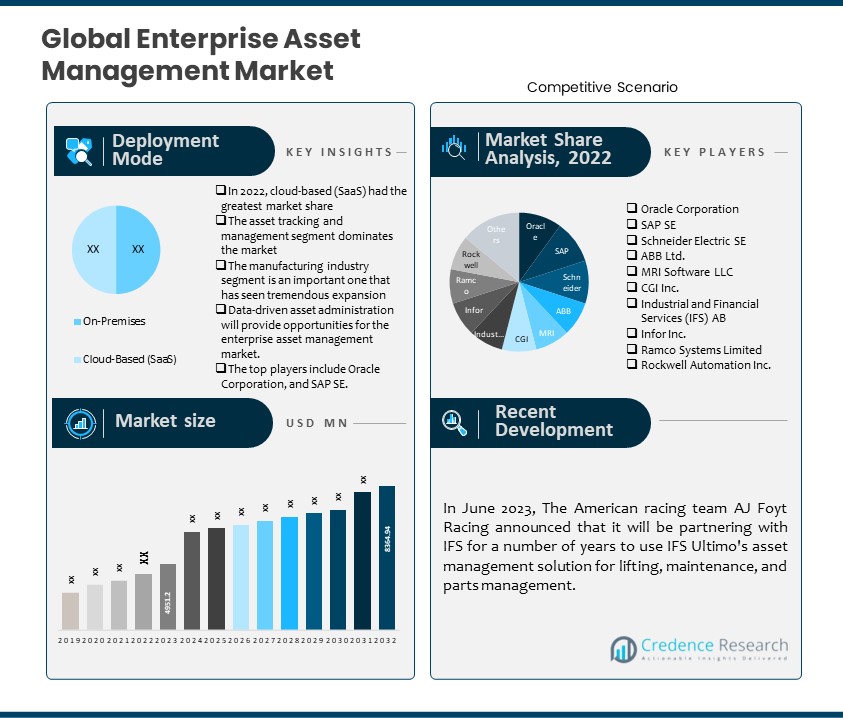
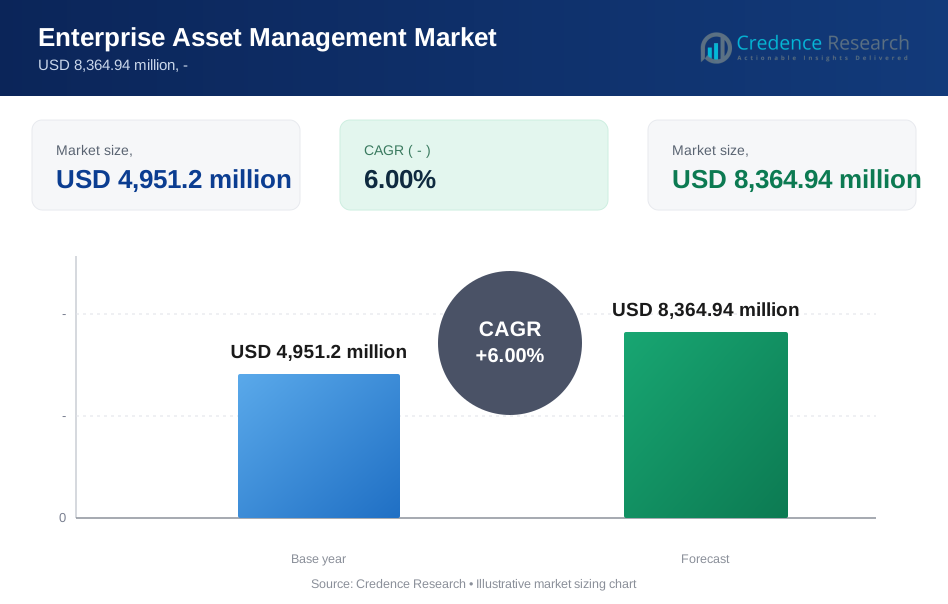
- The global market for enterprise asset management is expected to develop at a compound annual growth rate (CAGR) of 6.00% between 2024 and 2032, from its estimated USD 4951.2 million in 2023 to USD 8364.94 million in 2032.
- The largest category is cloud-based (SaaS). On-premises, on the other hand, is expected to grow at a strong CAGR.
- The asset tracking and management category will expand at a rapid rate of growth.
- The CAGR for the manufacturing industry is expected to be the highest during the projection period.
- North America dominated the enterprise asset management market.
- Regarding the market share of enterprise asset management, Europe is expected to come second.
- In the enterprise asset management market, Asia Pacific is anticipated to grow fastest.
- Corporations are spending more money on EAM solutions as a component of their digital transformation initiatives to boost productivity and competitiveness, which drives the growth of the global market.
- The expansion of IoT devices and sensor technologies is driving the demand for EAM systems to manage IoT data. These technologies make it possible to monitor asset health and performance in real-time, creating opportunities for the enterprise asset management market.
Executive Summary
Market Definition
A comprehensive strategy for managing an organization's physical assets from acquisition to disposal is known as enterprise asset management or EAM. These resources may consist of tools, machines, cars, buildings, and other infrastructure required for the day-to-day operations of the company. EAM's key objectives are to maximize asset performance, lower maintenance costs, cut down on downtime, and guarantee regulatory compliance.
Market Overview
The enterprise asset management sector is estimated to develop at a 6.00% compound annual growth rate (CAGR) between 2024 and 2032, maintaining its current upward trend. The market will continue to develop, rising from its estimated USD 4951.2 million in 2023 to USD 8364.94 million in 2032.
Businesses are realizing more and more how strategically important technology-driven solutions are for maximizing asset performance. The advancement of advanced asset management administration (EAM) systems has been made possible by ongoing innovation in sensor technologies, data analytics, and artificial intelligence. This has led to a paradigm change from reactive to proactive asset management. Enterprise Asset Management (EAM) solutions from companies such as IBM, SAP, and Oracle are leading the way in integrating AI-driven insights and predictive analytics. This allows enterprises to make data-driven decisions regarding asset performance optimization, maintenance, and overall operational efficiency. These technical developments boost asset reliability, save a considerable amount of money, and streamline asset management procedures. The advent of the Internet of Things (IoT) has had a significant influence since it makes real-time asset monitoring possible, facilitating predictive maintenance and reducing downtime.
Furthermore, by evaluating large datasets to forecast equipment failures, optimize maintenance schedules, and enhance overall asset performance, artificial intelligence (AI) and machine learning (ML) play a critical role in enterprise asset management (EAM). For example, IBM's Maximo Asset Performance Management uses AI to give insights into the condition of equipment, assisting businesses in making wise decisions. A new era for EAM solutions is being ushered in by these technical breakthroughs that together lead to decreased operating costs, better productivity, and more effective asset management.
Segmentation by Deployment Mode
- Cloud-based (SaaS) is the market leader in terms of deployment mode. Distributed teams, field techs, and management staff can all access cloud-based EAM systems remotely from any location with an internet connection. Furthermore, these solutions don't require major infrastructure or hardware updates, making them easily scalable to meet changing organizational needs or expanding asset portfolios.
- The on-premises category will exhibit a sizable CAGR during the projected period. With on-premises EAM solutions, businesses have total command over their software ecosystem. They can modify workflows according to internal procedures, link the system with current infrastructure, and personalize the system to meet certain business demands.
Segmentation by Solution Type
- Asset tracking and management is considered the best solution type category. With the help of asset tracking and management in EAM systems, organizations may more efficiently monitor, maintain, and optimize their physical assets. This leads to lower costs, better asset performance, and increased operational efficiency.
- The predictive maintenance category will likely register a significant CAGR during forecasting. With the constant improvement of algorithms and the availability of additional data, predictive maintenance systems learn and adapt over time. Organizations can then adjust to changing operational conditions or asset requirements, improve predictive models, and optimize maintenance methods.
- Other solution types, such as work order management, asset performance management (APM), mobile EAM, integration and connectivity, asset lifecycle management, GIS integration, energy and sustainability management, and security and compliance management, also contribute to the demand for enterprise asset management.
Segmentation by End-User Industry
- The manufacturing category is projected to grow faster over the projection period. Manufacturing facilities frequently possess a wide range of resources, such as equipment, consumables, tools, and spare parts. By using EAM systems to track the location, usage, and availability of assets in real-time, manufacturers may optimize inventory levels, decrease stockouts, and guarantee the timely availability of vital parts for production.
- Other end-user industries influence the need for enterprise asset management, including the energy and utilities, transportation and logistics, government and public sector, healthcare, construction and real estate, oil and gas, mining and metals, and telecommunications.
Segmentation by Region
- North America leads the enterprise asset management industry. The widespread use of EAM integration among large companies in the United States is anticipated to be driven primarily by the expanding amount of data and accelerating installation of cloud-based solutions.
- Europe is estimated to rank second in market size for enterprise asset management.
- The enterprise asset management industry is predicted to flourish rapidly in Asia Pacific.
- Regions such as Africa, the Middle East, and Latin America cover the remaining requirement for enterprise asset management.
Enhancing asset availability and lowering asset breakdowns that hinder business operations are given more priority, which is contributing to the market's expansion. Due to factors like the growing need for a 360-degree view of assets, the removal of compliance-related overheads, the incorporation of technologies like IoT, AI, and analytics, and the continued use of IoT platforms and devices to maintain enterprise assets, the enterprise asset management (EAM) market is anticipated to grow at a faster rate. Expanding data security concerns, the use of internet enterprises, and mobile devices that educate and empower users about utilizing highly efficient software have all had an impact on the demand for cloud-based EAM setups.
Based on projections, North America is anticipated to control the enterprise asset management market. The region's significant drivers are the presence of significant EAM players, including Aptean, AssetWorks, LLC, CGI Inc., and Infor, among others. This region's significant share is also attributed to the early adoption of the newest technologies, the growth of cloud-based deployments, a highly developed IT infrastructure, government investments in cutting-edge technologies, and an increasing emphasis on regulatory and compliance requirements by organizations.
Moreover, Asia Pacific is anticipated to increase at a high rate over the projection period. The demand for digital technologies is predicted to increase as a result of the notable expansion of corporate policies to facilitate enterprise operations in South Korea, Japan, India, and other countries. The region's need for effective asset operation has increased due to increased competitiveness.
Key Highlights of the Report
The global enterprise asset management market is segmented by deployment mode, solution type, end-user industry, and region. As far as the deployment mode is concerned, cloud-based (SaaS) is the market spearhead. Asset tracking and management is the top category. The manufacturing category is anticipated to increase at the highest CAGR throughout the projection period. The enterprise asset management market is expanding mostly in North America.
There should be plenty of opportunity for industry expansion in the European region. Advanced asset management installations and technologies, including the Internet of Things and predictive analytics, are being adopted by European industries and transport operators on a growing scale. By using these technologies, asset maintenance procedures may be optimized, and possible equipment and machinery failures can be predicted. For example, Hexagon AB's Asset Lifecycle Intelligence business unveiled HxGN EAM v12, a new version of enterprise asset management software that runs on the cloud. This was in December 2022. The package will include an EcoSys-based Asset Performance Management (APM) module with Root Cause Analysis (RCA) capabilities that allows Asset Investment Planning (AIP) visualization.
North America is expected to account for the largest Enterprise Asset Management market globally. The rapidly expanding asset-intensive sectors of the economy, including manufacturing, transportation, logistics, and oil and gas, are expected to cause Mexico's GDP to increase significantly. In the coming years, it is anticipated that the North American enterprise asset management industry will grow strongly due to the need for effective planning and management throughout drilling and production. The Asia Pacific region is also assumed to have the market's sharpest growth. Technology is advancing rapidly in Australia in a number of areas, including manufacturing, industrial sectors, and information technology. This presents a wealth of opportunities for Australian corporate asset management solutions providers. This has increased demand for cloud services for corporate applications, including collaborations and additional tools for process and efficiency optimization.
Which Key Factors Are Driving The Global Enterprise Asset Management Market?
The focus on asset performance, aging infrastructure, digital transformation initiatives, and the development of IoT and sensor technologies are some of the factors driving the growth of the enterprise asset management market.
What Are The Main Challenges Confronting The Global Enterprise Asset Management Market?
Substantial implementation costs, complex integration, a lack of skilled staff, and a scarcity of awareness and training about the benefits of enterprise asset management technologies are the main obstacles to the sector's expansion.
What Market Opportunities Exist For Enterprise Asset Management Globally?
The demand for real-time data statistical analysis, the expanding acceptance of cloud-based enterprise resource management (EAM) solutions, the focus on cost containment, and the emergence of mobile workforce administration all contribute to the potential growth of the enterprise asset management sector.
Market Drivers
Multiple factors propel the enterprise asset management industry across the globe. The primary factors propelling the global enterprise asset management market are as follows:
Increased Requirement for EAM Solutions Based on the Cloud
The demand for cloud-based EAM solutions is being driven by the high capital requirements for the on-premise implementation of enterprise asset management solutions, as well as the significant expenditures associated with locating the appropriate servers, storage devices, and communication infrastructure and hiring qualified personnel to maintain the system. As a result, it is pressuring businesses to choose for easy cloud installations that require little to no infrastructure aside from a few portable devices. Because their data centers are located across several regions, cloud-based solutions may be scaled to meet the requirements of an enterprise and are dependable.
Market Restraints
There are several obstacles that the global enterprise asset management market must overcome to continue growing. Among them are the following:
Concerns about Privacy and Data Security
Sensitive data susceptibility becomes a critical concern as firms depend more and more on digital platforms to manage their assets. Because EAM systems frequently hold vital information about asset performance, maintenance schedules, and operational specifics, data leaks, and hacks have caused organizations to become more anxious. Cyberattacks like the one that targeted SolarWinds in 2020 have highlighted how vulnerable digital systems are. This hack affected many different industries worldwide, including essential infrastructure. A survey conducted in 2021 by IBM Security and the Ponemon Institute found that the average cost of a data breach was USD 4.24 million. Healthcare and banking are two sectors that deal with sensitive data and are especially hesitant to implement complete asset management solutions in the context of EAM because of the possibility of crucial operational data being exposed. Many businesses have been hesitant to implement EAM solutions because of concerns about malicious activity, illegal access, and data leaks. These concerns are especially present in sectors like healthcare, finance, and defense, where highly confidential data is handled. An additional level of complexity and scrutiny is added by adhering to data protection laws, such as the General Data Protection Regulation (GDPR) in Europe.
Opportunities
There are plenty of potential prospects in the global enterprise asset management industry. Among these are the following:
Data-driven Asset Administration
In many firms, change is driven by data. In order to better understand enterprises and obtain a deeper understanding of their clients' demands, organizations are now developing data-driven business intelligence. Enterprises must have excellent data science capabilities in order to apply the cross-functional model across many functionalities. Intelligent asset management provides real-time data-driven insights for predictive maintenance, monitoring, and management across sectors. For instance, IBM added IBM Cloud Pak for Data to its Enterprise Asset Management platform, IBM Maximo Application Suite (MAS), in January 2022 to improve it and offer a framework for integrating diverse data from many departments inside an organization.
With the use of data-driven asset management, business decisions may be made that will save costs and optimize processes, prevent unscheduled downtime resulting from major issues, and more. A total of 54% of asset managers questioned responded positively to the IFS EAM Trend Report 2023, while 38% responded negatively, citing a lack of access to such data. In spite of this, when asked about the role that data analytics and predictive modeling play in improving asset management choices, over half of the participants responded that it is either very or somewhat important. This suggests that even among those who do not currently have access to the data, there is a consensus that having this knowledge would help to maximize asset management choices.
Competitive Landscape
Key Players
Several major competitors exist in the fiercely competitive global enterprise asset management market. The following are a few of the leading market participants and their market shares:
- Oracle Corporation
- SAP SE
- Schneider Electric SE
- ABB Ltd.
- MRI Software LLC
- CGI Inc.
- Industrial and Financial Services (IFS) AB
- Infor Inc.
- Ramco Systems Limited
- Rockwell Automation Inc.
- Bentley Systems Incorporated
- Others
These companies prioritize product innovation, distribution channel expansion, mergers, and acquisitions to remain competitive.
The largest suppliers in the global enterprise asset management market continuously work to stay one step ahead of the competition by developing innovative concepts and products.
In October 2022, Hexagon increased the number of its clients in Asia Pacific through collaborations and organic expansion to maximize digital asset management with HxGN EAM.
In October 2022, Oracle Fusion Cloud Applications Suite received a new asset-based service solution. By lowering expenses, increasing service effectiveness, and improving the general customer experience, it would assist companies in anticipating and preventing asset downtime.
In September 2022, Hitachi Energy revealed that Energinet has used the Lumada APM solution to speed up its digital transformation. The companies' cooperation would let TSO more accurately determine the grid reinvestments required to meet its 2030 carbon neutrality targets.
In January 2021, IBM and Atos partnered to use RedHat Open Shift and AI to speed up digital transformation in businesses. The partnership provides end customers with SMART waste/energy monitoring and optimization solutions, asset life cycle management solutions, asset monitoring and MRO optimization solutions, and packaging, transportation, and logistics optimization solutions.
Summary of Key Findings
- There is a growing need for Enterprise Asset Management (EAM) solutions to manage infrastructure assets, such as public buildings, roads, bridges, utilities, and infrastructure development projects.
- The market is segmented by deployment mode, solution type, end-user industry, and region.
- In the market, cloud-based (SaaS) is the most widely used deployment mode.
- Asset tracking and management is the foremost category.
- The manufacturing industry is expected to grow fastest in terms of CAGR during the forecast period.
- North America is leading market development; the market is highly competitive with key players including Oracle Corporation, SAP SE, Schneider Electric SE, ABB Ltd., MRI Software LLC, CGI Inc., Industrial and Financial Services (IFS) AB, Infor Inc., Ramco Systems Limited, Rockwell Automation Inc., Bentley Systems Incorporated, and Others.
Future Outlook
- The enterprise asset management industry is expected to increase significantly in North America, and its outlook is positive worldwide.
- The widespread utilization of EAM solutions with multi-site capabilities is supported by the demand for uniform asset management procedures across geographically distributed enterprises, which is driven by globalization.
- The implementation of EAM and investment priorities may be influenced by environmental concerns about the effects of resource consumption, carbon emissions, and asset-intensive businesses on the environment. These concerns may also lead to legislative pressures and sustainability standards. This factor restrains the growth of the global market.
- To stay ahead of the competition, key enterprises must develop new products, expand their market reach, and keep their prices competitive.
How CXOs Can Benefit from the Credence Research Enterprise Asset Management Market Report
CXOs may get a detailed picture of the market in the Credence Research Enterprise Asset Management Market Report, which includes:
- Market size and growth forecast: The report provides detailed estimates of the global enterprise asset management market size, segmented by deployment mode, solution type, end-user industry, and region. It also includes forecasts for the market through 2032 based on key trends and drivers.
- Market segmentation: The research report breaks down the market for enterprise asset management into segments based on deployment mode, solution type, end-user industry, and region. This segmentation provides CXOs with a granular understanding of the market and the opportunities in each segment.
- Competitive landscape: The research report offers a detailed analysis of the major companies in the enterprise asset management industry, including information on their business plans, product lines, and earnings. CXOs can use this information to evaluate and identify their competitors.
- Key trends and drivers: The research report identifies and evaluates the main trends and factors influencing the enterprise asset management market. CXOs can use this information to make well-informed choices regarding their plans and investments.
CXOs can use the insights from the Credence Research Enterprise Asset Management Market Report to:
- Identify growth opportunities: This analysis may help CXOs identify new growth opportunities in the enterprise asset management sector. For example, the report identifies the growing demand for enterprise asset management from the manufacturing industry as a key opportunity.
- Make informed investment decisions: The report helps CXOs make wise choices regarding enterprise asset management. For example, the research study provides information on the critical factors to consider when selecting enterprise asset management solutions and evaluating suppliers.
- Develop competitive strategies: CXOs can use the research report to develop competitive strategies for their enterprise asset management businesses. For example, the research paper outlines the main strategies that enterprise asset management suppliers utilize to differentiate themselves from competitors.
- Track market developments: This research report may help CXOs stay ahead of the curve by tracking market developments. For instance, it offers insights into the most recent developments and trends in the enterprise asset management market.
CXOs seeking to expand their industry knowledge and spot growth prospects will find the Credence Research Enterprise Asset Management Market Report useful.
Segmentation
- By Deployment Mode
- On-Premises
- Cloud-Based (SaaS)
- By Solution Type
- Asset Tracking and Management
- Predictive Maintenance
- Work Order Management
- Asset Performance Management (APM)
- Mobile EAM
- Integration and Connectivity
- Asset Lifecycle Management
- GIS Integration
- Energy and Sustainability Management
- Security and Compliance Management
- By End-User Industry
- Manufacturing
- Energy and Utilities
- Transportation and Logistics
- Government and Public Sector
- Healthcare
- Construction and Real Estate
- Oil and Gas
- Mining and Metals
- Telecommunications
- By Region
- North America
- The U.S.
- Canada
- Mexico
- Europe
- Germany
- France
- The U.K.
- Italy
- Spain
- Rest of Europe
- Asia Pacific
- China
- Japan
- India
- South Korea
- South-east Asia
- Rest of Asia Pacific
- Latin America
- Brazil
- Argentina
- Rest of Latin America
- Middle East & Africa
- GCC Countries
- South Africa
- The Rest of the Middle East and Africa
- North America
Request a Free Sample
Fill in your details and we'll send you a free sample report.
- Sample data tables & charts
- Research methodology
Need a Custom Version of This Report?
Tailor the scope, geography, or segments to your exact requirements.
- Custom geography or segment scope
- Direct access to our analyst team
Frequently Asked Questions
How much does the global market currently hold for enterprise asset management?
What is the enterprise asset management market's projected growth rate between 2024 and 2032?
In terms of deployment mode, which market category is leading?
Regarding solution type, which market category is in the lead?
Who are the main players in the global enterprise asset management industry?
Table of Content
Chapter 1. Report Introduction
- 1.1 Report Description & Purpose
- 1.1.1 Report Title & Market Definition
- 1.1.2 Unique Selling Propositions (USP) & Key Differentiators
- 1.1.3 Value Proposition for Stakeholders
- 1.2 Research Objectives
- 1.2.1 Market Sizing Objectives (Volume & Revenue)
- 1.2.2 Segmentation Objectives
- 1.2.3 Competitive Intelligence Objectives
- 1.2.4 Forecast & Scenario Objectives
- 1.3 Report Scope
- 1.3.1 Enterprise Asset Management Scope – Types & Subtypes Covered
- 1.3.2 Geographic Scope – Regions & Countries Covered
- 1.3.3 Historical Period, Base Year & Forecast Period (the historical period; forecast to the forecast period)
- 1.3.4 Inclusions & Exclusions
- 1.4 HS Code & Classification Framework
- 1.5 Currency, Units & Pricing Basis
- 1.6 Target Stakeholders
- 1.7 Limitations & Assumptions
Chapter 2. Executive Summary
- 2.1 Global Enterprise Asset Management Market Snapshot
- 2.1.1 Market Size – Historical (the historical period) & Forecast (the forecast period) (base year: USD 4,951.2 million → forecast year: USD 8,364.94 million)
- 2.1.2 Volume & Revenue – Global Totals
- 2.1.3 Key Market Highlights – Top Five Facts
- 2.2 Enterprise Asset Management Market Segmentation Snapshot
- 2.2.1 Market Split by Region – vs.
- 2.3 Competitive Snapshot
- 2.3.1 Top 10 Players by Revenue Share –
- 2.3.2 Top 10 Players by Volume Share –
- 2.3.3 Recent Strategic Developments (18-Month Summary)
- 2.4 Key Investment Highlights & Strategic Conclusions
Chapter 3. Enterprise Asset Management Market Dynamics & Industry Analysis
- 3.1 Market Overview & Context
- 3.1.1 Enterprise Asset Management Market Position in the Broader Automotive Value Chain
- 3.1.2 OEM vs. Replacement Market Dynamics
- 3.1.3 Market Maturity & Development Stage by Region
- 3.2 Enterprise Asset Management Market Drivers
- 3.3 Enterprise Asset Management Market Restraints & Challenges
- 3.4 Enterprise Asset Management Market Opportunities
- 3.5 Porter's Five Forces Analysis
- 3.5.1 Threat of New Entrants
- 3.5.2 Bargaining Power of Suppliers
- 3.5.3 Bargaining Power of Buyers
- 3.5.4 Threat of Substitutes
- 3.5.5 Competitive Rivalry – Intensity Assessment
- 3.6 Enterprise Asset Management Value Chain Analysis
- 3.6.1 Upstream – Raw Material/Input Suppliers
- 3.6.1.1 Raw Material/Input 1
- 3.6.1.2 Raw Material/Input 2
- 3.6.1.3 Raw Material/Input 3
- 3.6.2 Midstream – Production/Manufacturing/Service Delivery
- 3.6.2.1 Production/Process Overview
- 3.6.2.2 Key Facility Locations & Capacity by Manufacturer
- 3.6.3 Downstream – Distribution & End Consumer
- 3.6.3.1 Primary Channel – B2B/OEM
- 3.6.3.2 Secondary Channels – Dealer, Retail, Online, Direct
- 3.6.4 Value Chain Profitability Analysis
- 3.6.1 Upstream – Raw Material/Input Suppliers
- 3.7 PESTEL Analysis
- 3.7.1 Political Factors
- 3.7.2 Economic Factors
- 3.7.3 Social Factors
- 3.7.4 Technological Factors
- 3.7.5 Environmental Factors
- 3.7.6 Legal Factors
- 3.8 Enterprise Asset Management Supply Chain Analysis
- 3.8.1 Raw Material/Input Supply Risk Assessment
- 3.8.2 Manufacturing Concentration Risk (Geographic Exposure)
- 3.8.3 Trade Disruption Impact Analysis
- 3.9 Regulatory & Policy Landscape
Note: The regulatory and policy landscape section covers regulations based on their applicability to the market, Enterprise Asset Management category, geography, and scope of the study. Only regulatory frameworks with a material impact on operations, compliance, trade, sustainability, or market access are analyzed in detail.
Chapter 4. Key Investment Pockets & Opportunity Analysis
- 4.1 Enterprise Asset Management Market Attractiveness Analysis
- 4.1.1 By Region – Investment Attractiveness Matrix (Volume × CAGR)
- 4.2 Absolute Revenue Growth Opportunity
- 4.2.1 By Region – Absolute USD Growth Through the forecast period
- 4.3 Incremental Volume Opportunity
- 4.3.1 By Region – Incremental Volume Through the forecast period
- 4.3.2 Segment – Incremental Volume
- 4.4 Emerging Submarket Opportunity Deep Dive (Subject to Applicability)
- 4.5 Emerging Market Opportunity Scorecards
- 4.5.1 United States
- 4.5.2 Europe
- 4.5.3 Asia
- 4.5.4 Middle East & Africa
Note: Emerging Market Opportunity Scorecards will be included based on relevance and strategic importance. Regions listed are indicative and may vary depending on data availability and market dynamics.
Chapter 5. Enterprise Asset Management Import-Export Analysis & Trade Flows
- 5.1 Global Trade Overview
- 5.1.1 Global Export Value by Country (the historical period)
- 5.1.2 Global Export Volume by Country (the historical period)
- 5.1.3 Global Import Value by Country (the historical period)
- 5.1.4 Global Import Volume by Country (the historical period)
- 5.1.5 Net Trade Balance by Country (the historical period)
- 5.2 Export Analysis – Segment
- 5.2.1 Type 1 (HS Code)
- 5.2.2 Type 2 (HS Code)
- 5.2.3 Type 3 (HS Code)
- 5.2.4 Type 4 (HS Code)
- 5.2.5 Type 5 (HS Code)
- 5.3 Import Analysis – Segment
- 5.3.1 Type 1 (HS Code)
- 5.3.2 Type 2 (HS Code)
- 5.3.3 Type 3 (HS Code)
- 5.3.4 Type 4 (HS Code)
- 5.3.5 Type 5 (HS Code)
- 5.4 Average Unit Trade Prices
- 5.4.1 Average Export Price – Segment & Country
- 5.4.2 Average Import Price – Segment & Source Country
- 5.4.3 Price Trends (the historical period)
- 5.5 Key Trade Route Analysis
- 5.5.1 Trade Route 1
- 5.5.2 Trade Route 2
- 5.5.3 Trade Route 3
- 5.5.4 Trade Route 4
- 5.5.5 Trade Route 5
- 5.6 Trade Policy Impact Assessment
- 5.6.1 US Anti-Dumping & Section 301 Tariffs
- 5.6.2 EU Customs Union Impact
- 5.6.3 Major Free Trade Agreements
- 5.6.4 USMCA Rules of Origin
Note: Trade policy analysis will be included only where relevant to the Enterprise Asset Management market.
Chapter 6. Competitive Landscape & Company Benchmarking
- 6.1 Enterprise Asset Management Market Concentration & Structure
- 6.1.1 Herfindahl-Hirschman Index (HHI) – vs.
- 6.1.2 Tier 1, Tier 2 & Tier 3 Market Structure
- 6.1.3 Global, Regional & Local Player Dynamics
- 6.2 Enterprise Asset Management Market Share Analysis –
- 6.2.1 Global Revenue Share by Company
- 6.2.2 Global Volume Share by Company
- 6.2.3 Regional Revenue Share
- 6.2.4 Market Share Evolution ( vs. )
- 6.2.5 OEM Segment Share by Company
- 6.2.6 Replacement Segment Share by Company
- 6.3 Production/Delivery Capacity & Facility Analysis
- 6.3.1 Global Installed Capacity
- 6.3.2 Capacity Utilization Rates
- 6.3.3 Production/Output Volume
- 6.3.4 Facility Locations & Capacity Map
- 6.3.5 Planned Capacity Additions
- 6.4 Enterprise Asset Management Competitive Benchmarking Matrix
- 6.4.1 Revenue, Volume, CAGR & Profitability Comparison
- 6.4.2 Channel Revenue Mix
- 6.4.3 Geographic Revenue Exposure
- 6.4.4 R&D Intensity
- 6.4.5 Sustainability Maturity
- 6.5 Strategic Developments in Enterprise Asset Management (Last 24 Months)
- 6.5.1 Mergers, Acquisitions & Divestments
- 6.5.2 New Enterprise Asset Management Launches
- 6.5.3 Facility Expansions
- 6.5.4 Strategic Alliances, Joint Ventures & Partnerships
- 6.5.5 Distribution Expansion & Market Entry
- 6.5.6 Sustainability & ESG Initiatives
- 6.6 Competitive Strategy Mapping
- 6.6.1 Leader, Challenger, Follower & Niche Classification
- 6.6.2 Pricing Strategy Comparison
- 6.6.3 Channel Strategy Matrix
Note: Strategic developments are included based on their materiality and the availability of reliable information.
Chapter 7. Global Enterprise Asset Management Market – By Distribution Channel
- 7.1 Segment Overview
- 7.1.1 Volume & Revenue Split by Channel ( & )
- 7.1.2 Channel Mix Evolution (the forecast period)
Chapter 8. Regional Market Analysis – Global Overview
- 8.1 Global Regional Overview
- 8.1.1 Regional Volume Share
- 8.1.2 Regional Revenue Share
- 8.1.3 Regional Volume by Region
- 8.1.4 Regional Revenue by Region
- 8.1.5 Regional Forecast Through the forecast period
- 8.2 Cross-Regional Segment Analysis
- 8.2.1 By Distribution Channel
- 8.2.2 By Brand/Price Tier
Chapter 9. North America Enterprise Asset Management Market
- 9.1 United States
- 9.2 Canada
- 9.3 Mexico
Chapter 10. Europe Enterprise Asset Management Market
- 10.1 Germany
- 10.2 France
- 10.3 Italy
- 10.4 United Kingdom
- 10.5 Spain
- 10.6 Poland
- 10.7 Russia
- 10.8 Netherlands
- 10.9 Belgium
- 10.10 Sweden
- 10.11 Denmark
- 10.12 Norway
- 10.13 Rest of Europe
Chapter 11. Asia Pacific Enterprise Asset Management Market
- 11.1 China
- 11.2 India
- 11.3 Japan
- 11.4 South Korea
- 11.5 Thailand
- 11.6 Indonesia
- 11.7 Vietnam
- 11.8 Malaysia
- 11.9 Australia
- 11.10 Rest of Asia Pacific
Chapter 12. Latin America Enterprise Asset Management Market
- 12.1 Brazil
- 12.2 Argentina
- 12.3 Colombia
- 12.4 Chile
- 12.5 Rest of Latin America
Chapter 13. Middle East Enterprise Asset Management Market
- 13.1 Saudi Arabia
- 13.2 United Arab Emirates
- 13.3 Turkey
- 13.4 Israel
- 13.5 Iran
- 13.6 Rest of the Middle East
Chapter 14. Africa Enterprise Asset Management Market
- 14.1 South Africa
- 14.2 Egypt
- 14.3 Nigeria
- 14.4 Morocco
- 14.5 Rest of Africa
Chapter 15. Enterprise Asset Management Company Profiles
- 15.1 [Company 01]
- 15.1.1 Company Overview
- 15.1.2 Key Management Personnel
- 15.1.3 Products & Services Portfolio
- 15.1.4 Financial Performance
- 15.1.5 Key Market Focus & Geographic Presence
- 15.1.6 Recent Developments & Strategic Initiatives
Note: The company profile list is preliminary and may change based on research findings, market developments, data availability, and client requirements.
Chapter 16. Appendices
- Appendix A – List of Abbreviations & Acronyms
- Appendix B – Industry Classification Code Reference – Full Series
- Appendix C – Production & Capacity Data Tables
- Appendix D – End-Use & Demand Base Tables
- Appendix E – Consumption & Replacement Rate Assumptions
- Appendix F – ASP Reference Tables
- Appendix G – Manufacturing & Facility Database
- Appendix H – Import-Export Data Tables
- Appendix I – Regulatory Summary Tables
- Appendix J – Primary Research Participant List (Anonymized)
- Appendix K – Primary Research Questionnaire Framework
- Appendix L – Data Sources & Bibliography
- Appendix M – Market Size Divergence & Source Comparison
Chapter 17. Research Methodology
- 17.1 Research Framework & Philosophy
- 17.2 Secondary Research – Sources, Hierarchy & Data Extraction
- 17.3 Data Modeling – Bottom-Up & Top-Down Market Sizing
- 17.4 Primary Research – Stakeholder Framework, LOI & Sample Sizes
- 17.5 Forecast Methodology – Regression, Scenario & Sensitivity Analysis
- 17.6 Quality Control – Four-Layer Validation Framework
- 17.7 Limitations & Standard Assumptions
- 17.8 Disclaimer
