
Market Overview
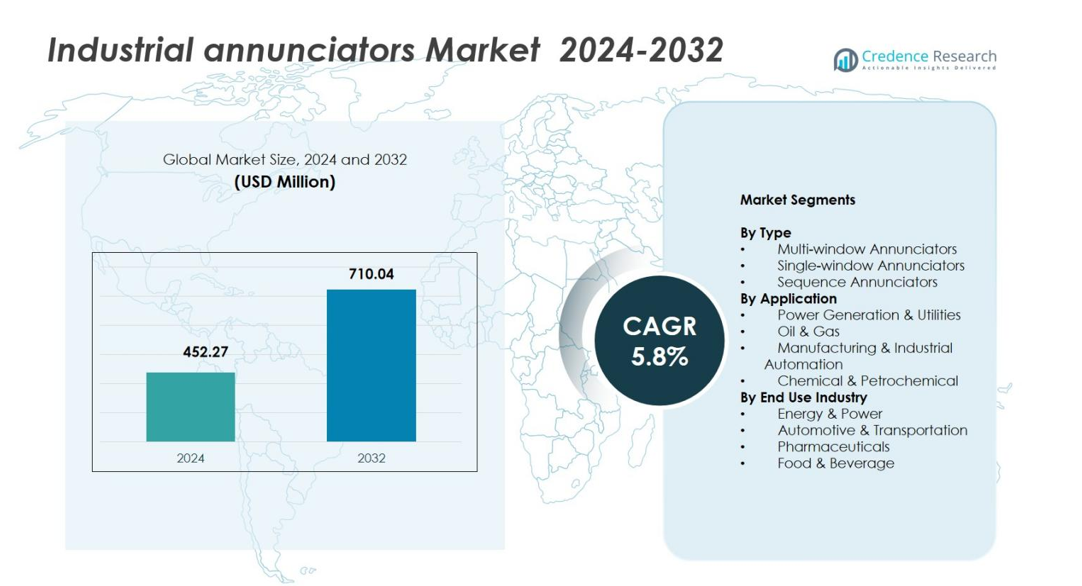
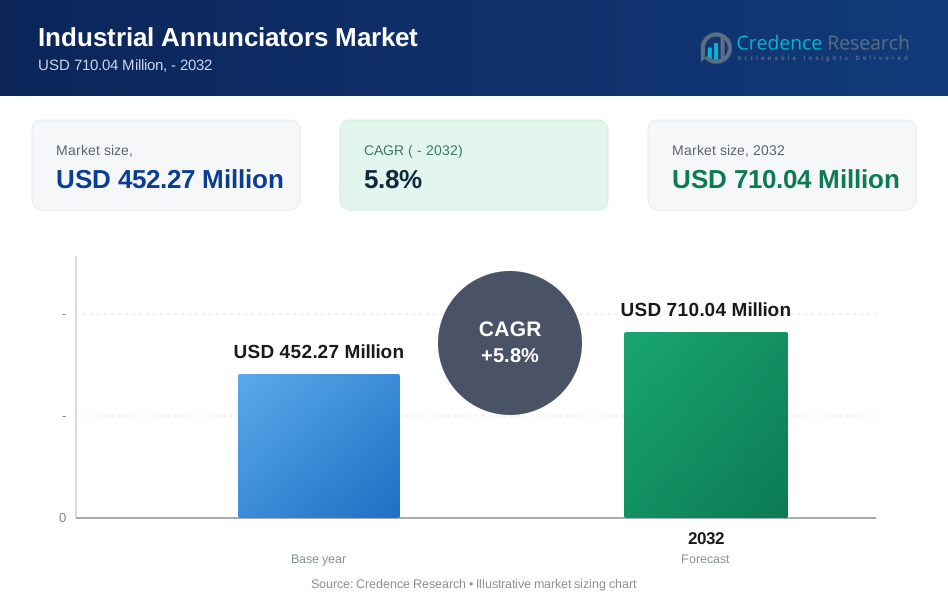
Industrial Annunciators Market size was valued at USD 452.27 Million in 2024 and is anticipated to reach USD 710.04 Million by 2032, at a CAGR of 5.8% during the forecast period.
| REPORT ATTRIBUTE | DETAILS |
|---|---|
| Historical Period | 2020-2023 |
| Base Year | 2024 |
| Forecast Period | 2025-2032 |
| Industrial Annunciators Market Size 2024 | USD 452.27 Million |
| Industrial Annunciators Market, CAGR | 5.8% |
| Industrial Annunciators Market Size 2032 | USD 710.04 Million |
Industrial Annunciators Market features prominent players such as Notifier, Honeywell International (Fire-Lite), ABB, Eaton Corporation, AMETEK, Inc., Automation Displays, Inc., OMEGA Engineering, Inc., Hirsch Electronics Corp., Linde North America, Inc., and Century Control Systems, Inc. These companies strengthen their presence through advanced alarm solutions, networked annunciator systems, and expanded industrial safety offerings. North America led the market with a 34.7% share in 2024, driven by strong automation adoption and strict safety regulations, followed by Europe with 27.9% and Asia-Pacific with 28.6%, supported by rapid industrial expansion and modernization across utilities, manufacturing, and energy sectors.
Market Insights
- Industrial Annunciators Market reached USD 452.27 Million in 2024 and will grow to USD 710.04 Million by 2032 at a 5.8% CAGR, supported by rising automation and safety compliance needs.
- Strong market drivers include increasing regulatory focus on real-time fault detection and high adoption of multi-window annunciators, which accounted for a 48.6% segment share in 2024.
- Key trends reflect rapid integration of smart, Ethernet-enabled annunciators and expanding deployment in hazardous sectors such as oil & gas, which captured a 27.5% application share.
- Leading players enhance technologically advanced offerings to strengthen market presence, while restraints include integration issues with legacy systems and high maintenance demands in harsh operating environments.
- Regional analysis shows North America leading with a 34.7% share, followed by Europe at 27.9% and Asia-Pacific at 28.6%, driven by industrial modernization, utility upgrades, and growing manufacturing activities.
Market Segmentation Analysis
By Type
The Industrial Annunciators Market by type is dominated by multi-window annunciators, holding a 48.6% share in 2024 due to their ability to monitor multiple process parameters simultaneously in complex industrial environments. Their widespread adoption in power plants, refineries, and high-risk facilities is driven by strong demand for real-time fault visualization and enhanced operator safety. Single-window annunciators captured 32.4%, serving smaller installations requiring basic alerting functions, while sequence annunciators held 19%, supported by their role in event sequencing and root-cause diagnostics for advanced automation systems.
- For instance, Seekirk's A1600 series provides customizable window configurations for visual alarm patterning in electrical power plants and substations.
By Application
Within applications, power generation & utilities led the Industrial Annunciators Market with a 41.2% share in 2024, driven by stringent safety mandates, rising electrical infrastructure upgrades, and the need for continuous equipment monitoring to prevent grid failures. Oil & gas accounted for 27.5%, supported by hazardous-area safety requirements and pipeline monitoring. Manufacturing & industrial automation held 21.3%, fueled by Industry 4.0 adoption, while chemical & petrochemical contributed 10%, relying on annunciators for explosion-proof signaling and strict process-safety compliance.
- For instance, American Electric Power upgraded the annunciator system at its Donald C. Cook Nuclear Plant by installing digital displays with 50 to 100 alarms each, replacing obsolete analog panels to enhance reliability and eliminate single points of failure.
By End Use Industry
The energy & power sector dominated the end-use segmentation with a 44.1% share in 2024, driven by frequent demand for system protection, fault alarms, and critical substation monitoring. Automotive & transportation captured 23.6%, supported by expanding manufacturing automation and quality assurance systems. Pharmaceuticals held 18.2%, where annunciators ensure environmental control, equipment validation, and regulatory compliance in sterile production zones. Food & beverage represented 14.1%, driven by increased automation, hygiene monitoring, and machine-safety requirements across modern processing facilities.
Key Growth Drivers
Rising Focus on Industrial Safety and Compliance
The Industrial Annunciators Market experiences strong growth as industries intensify their focus on operational safety and regulatory compliance. Power plants, chemical facilities, and oil & gas operations increasingly adopt annunciators to ensure instant fault detection and reduce downtime risks. Strict global safety standards, including OSHA and IEC guidelines, propel demand for advanced alarm management systems. Organizations prioritize systems that deliver real-time alerts and multi-window visibility, driving broader adoption across critical infrastructure and industrial automation environments.
- For instance, Curtiss-Wright upgraded annunciator systems at American Electric Power's Donald C. Cook Nuclear Plant, replacing legacy equipment in both nuclear units to provide immediate visual and audio indications of plant systems.
Expansion of Automation and Industry 4.0 Integration
Rapid industrial automation significantly boosts market growth as manufacturing, energy, and utility sectors integrate smart monitoring solutions. Annunciators support automated workflows by delivering precise fault signaling, event sequencing, and remote supervisory control. Industry 4.0 encourages adoption of intelligent annunciators that interface with PLCs, SCADA, and distributed control systems. As factories shift toward connected operations, demand rises for annunciators that enhance process transparency, accelerate root-cause diagnostics, and optimize overall equipment reliability in high-throughput production environments.
- For instance, Minilec's microprocessor-based alarm annunciators integrate with SCADA systems via RS485 Modbus RTU protocol, enabling centralized monitoring of alarm events with time-stamped data logging and HMI display for improved operator response in industrial plants.
Growing Investments in Power Infrastructure Modernization
Increasing investments in grid modernization and power reliability strengthen market expansion. Utilities upgrade legacy equipment with digital annunciators to improve fault isolation, protect substations, and enhance emergency response. Rising electricity demand, renewable energy integration, and aging transmission infrastructure further accelerate replacement cycles. Modern annunciators offer robust monitoring for transformers, switchgear, and distribution systems, supporting preventive maintenance and reducing blackout risks. This infrastructure push creates sustained demand across energy-intensive economies undergoing rapid industrial and urban development.
Key Trends & Opportunities
Adoption of Smart and Networked Annunciator Systems
A major trend reshaping the market is the shift toward smart annunciator systems equipped with Ethernet connectivity, event logging, and integration with cloud-based platforms. These advanced systems enable centralized monitoring, remote diagnostics, and predictive alerting. Industries increasingly seek annunciators that communicate seamlessly with SCADA and IoT architectures, creating opportunities for manufacturers offering customizable digital interfaces. As industrial operations evolve toward real-time data ecosystems, intelligent annunciators position themselves as critical components for improving operational efficiency and predictive maintenance outcomes.
- For instance, Omniflex alarm annunciators include RS232/485 Modbus and Ethernet interfaces for connection to top-end SCADA systems, supporting event logging in safety-certified designs compliant with IEC61508. These enable total alarm management across distributed nodes via local area networks.
Increasing Use of Annunciators in Hazardous and High-Risk Facilities
Growing industrial activity in hazardous environments creates significant opportunities for explosion-proof and high-integrity annunciator systems. Oil refineries, chemical plants, and LNG terminals demand high-reliability alerting solutions capable of functioning under thermal, corrosive, and mechanical stress. Enhanced design features such as rugged enclosures, fire-resistant materials, and redundant signaling systems expand application potential. This trend aligns with the global shift toward risk mitigation and operational resilience, increasing demand for annunciators engineered to meet stringent safety and environmental conditions.
- For instance, at the Sullom Voe oil terminal, Enquest replaced legacy alarm annunciators with IEC61508 SIL-1 certified units from Omniflex, ensuring compliance and reliability in a high-risk environment.
Key Challenges
Integration Complexity with Legacy Industrial Systems
A major challenge arises from the difficulty of integrating modern annunciators with aging equipment still widely used across industrial facilities. Many legacy systems lack compatible communication protocols, increasing installation time and costs. Organizations often face operational disruptions during system retrofitting or upgrades. This integration barrier slows digital transformation initiatives and forces industries to rely on hybrid configurations. Manufacturers must address compatibility gaps by developing flexible, backward-compatible annunciators to broaden adoption and minimize transition challenges.
High Maintenance Requirements and Reliability Concerns
Annunciators deployed in harsh operating conditions face accelerated wear, leading to higher maintenance needs and potential reliability issues. Dust, vibration, extreme temperatures, and corrosive environments can impair system longevity and signaling accuracy. Frequent calibration, component replacement, and inspection increase operational costs for industries operating continuous processes. Failure or delayed alerts can cause safety incidents, equipment damage, and unplanned downtime. These reliability concerns push manufacturers to innovate with durable materials, self-diagnostics, and low-maintenance designs to remain competitive.
Regional Analysis
North America
North America dominated the Industrial Annunciators Market with a 34.7% share in 2024, driven by advanced industrial automation, stringent safety regulations, and extensive modernization across power generation and oil & gas facilities. The U.S. leads regional demand due to strong investments in grid reliability, refinery expansions, and smart manufacturing adoption. Rising focus on minimizing operational downtime enhances the need for multi-window and networked annunciator systems. Canada contributes further growth through increased mining and energy infrastructure upgrades. Continuous regulatory enforcement and high digital adoption sustain North America’s leadership in the global market.
Europe
Europe held a 27.9% share of the Industrial Annunciators Market in 2024, supported by strong regulatory frameworks, widespread industrial digitalization, and investments in sustainable energy infrastructure. Germany, the U.K., and France are leading markets, driven by automation in manufacturing, chemical processing, and advanced transportation industries. The region’s push toward decarbonization and renewable power integration increases demand for annunciators in substations and grid monitoring systems. Stringent compliance requirements across pharmaceuticals and food processing also expand application potential. Europe’s focus on safety, energy efficiency, and smart industry initiatives continues to reinforce steady market growth.
Asia-Pacific
Asia-Pacific accounted for a 28.6% share in 2024, emerging as the fastest-growing region due to rapid industrial expansion, increasing power consumption, and widespread adoption of automation technologies. China, India, Japan, and South Korea lead demand, supported by strong manufacturing ecosystems, energy sector upgrades, and large-scale investments in petrochemicals. Growing emphasis on operational safety and process optimization drives extensive use of multi-window annunciators in high-volume industries. Urbanization and infrastructure modernization further accelerate deployments across utilities and transportation. Government-led industrial digitalization programs position Asia-Pacific as a major growth engine for the global market.
Latin America
Latin America captured a 5.2% share of the Industrial Annunciators Market in 2024, driven by rising investment in oil & gas exploration, mining operations, and power distribution upgrades. Brazil and Mexico lead the region with expanding industrial automation initiatives and increased adoption of alarm monitoring systems for safety compliance. Petrochemical manufacturing growth supports demand for rugged annunciators capable of withstanding harsh operating environments. Infrastructure development and regulatory improvements are gradually strengthening market penetration. Despite economic fluctuations, the region’s industrial modernization efforts continue to create new opportunities for annunciator suppliers.
Middle East & Africa
The Middle East & Africa region held a 3.6% share in 2024, shaped by significant activity in oil & gas, power generation, and large-scale industrial projects. Countries such as Saudi Arabia, UAE, and South Africa drive adoption through investments in refineries, utilities, and petrochemical facilities requiring advanced fault detection systems. Harsh environmental conditions increase the need for robust, corrosion-resistant annunciators. Growing emphasis on operational safety, coupled with expanding industrial infrastructure, supports long-term demand. While market penetration remains developing, strategic initiatives across energy diversification and industrial growth enhance future market potential.
Market Segmentations
By Type
- Multi-window Annunciators
- Single-window Annunciators
- Sequence Annunciators
By Application
- Power Generation & Utilities
- Oil & Gas
- Manufacturing & Industrial Automation
- Chemical & Petrochemical
By End Use Industry
- Energy & Power
- Automotive & Transportation
- Pharmaceuticals
- Food & Beverage
By Geography
- North America
- U.S.
- Canada
- Mexico
- Europe
- Germany
- France
- U.K.
- Italy
- Spain
- Rest of Europe
- Asia Pacific
- China
- Japan
- India
- South Korea
- South-east Asia
- Rest of Asia Pacific
- Latin America
- Brazil
- Argentina
- Rest of Latin America
- Middle East & Africa
- GCC Countries
- South Africa
- Rest of the Middle East and Africa
Competitive Landscape
The Industrial Annunciators Market features key players such as Notifier, Honeywell International (Fire-Lite), ABB, Eaton Corporation, AMETEK, Inc., Automation Displays, Inc., OMEGA Engineering, Inc., Hirsch Electronics Corp., Linde North America, Inc., and Century Control Systems, Inc. These companies strengthen their market positions through product innovation, expanded distribution networks, and integration of digital technologies. Manufacturers increasingly focus on advanced annunciator designs with Ethernet connectivity, multi-window configurations, and enhanced diagnostic capabilities to support Industry 4.0 environments. Strategic partnerships with automation solution providers and investments in R&D accelerate the development of intelligent alarm management systems. Leading players emphasize reliability, durability, and compliance with global safety standards to meet diverse industrial requirements. Additionally, expansion into high-growth sectors such as power distribution, petrochemicals, and manufacturing enables vendors to capture rising demand for monitoring and safety systems worldwide.
Key Player Analysis
- Notifier
- Linde North America, Inc.
- Automation Displays, Inc.
- Honeywell International (Fire-Lite)
- Century Control Systems, Inc.
- OMEGA Engineering, Inc.
- Hirsch Electronics Corp.
- ABB
- Eaton Corporation
- AMETEK, Inc.
Recent Developments
- In October 2025, Honeywell launched NOTIFIER INSPIRE in Canada, a new fire-alarm control panel that integrates with its Connected Life Safety Services for remote monitoring and maintenance.
- In August 2025, Eaton Corporation introduced a range of hazardous-area products including the “CEAG VLL Series Ex Lights” and “MTL Zone Guardian” systems -at the Automation Expo 2025 in Mumbai, aimed at harsh industrial and hazardous environments.
- In July 2025, Honeywell completed a strategic acquisition of the “Li-ion Tamer” business from Nexceris, expanding its portfolio of gas detection and related safety solutions
Report Coverage
The research report offers an in-depth analysis based on Type, Application, End User Industry and Geography. It details leading market players, providing an overview of their business, product offerings, investments, revenue streams, and key applications. Additionally, the report includes insights into the competitive environment, SWOT analysis, current market trends, as well as the primary drivers and constraints. Furthermore, it discusses various factors that have driven market expansion in recent years. The report also explores market dynamics, regulatory scenarios, and technological advancements that are shaping the industry. It assesses the impact of external factors and global economic changes on market growth. Lastly, it provides strategic recommendations for new entrants and established companies to navigate the complexities of the market.
Future Outlook
- The Industrial Annunciators Market will experience strong growth as industries intensify adoption of automation and real-time monitoring systems.
- Demand will rise for intelligent annunciators that integrate with SCADA, PLCs, and cloud-based platforms.
- Multi-window annunciators will continue leading due to expanding use in complex, high-risk industrial environments.
- Digital transformation initiatives will accelerate replacement of legacy alarm systems with advanced networked annunciators.
- Utilities and power generation facilities will increase investments in annunciators to support grid modernization and reliability.
- Oil & gas and chemical sectors will adopt rugged annunciators designed for hazardous and corrosive environments.
- Predictive maintenance capabilities will become essential as industries prioritize proactive operational safety.
- Manufacturers will focus on energy-efficient, low-maintenance annunciators to reduce lifecycle costs.
- Asia-Pacific will remain a significant growth engine driven by rapid industrial expansion and infrastructure upgrades.
- Vendors will strengthen portfolios through innovation, partnerships, and technology integration to meet evolving industrial safety needs.
Request a Free Sample
Fill in your details and we'll send you a free sample report.
- Sample data tables & charts
- Research methodology
Need a Custom Version of This Report?
Tailor the scope, geography, or segments to your exact requirements.
- Custom geography or segment scope
- Direct access to our analyst team
Frequently Asked Questions
What is the current market size for Industrial Annunciators Market, and what is its projected size in 2032?
At what Compound Annual Growth Rate is the Industrial Annunciators Market projected to grow between 2024 and 2032?
What is the major growth driving factors for global Industrial Annunciators market?
What are the primary factors fueling the growth of the Industrial Annunciators Market?
Who are the leading companies in the Industrial Annunciators Market?
Table of Content
Chapter 1. Report Introduction
- 1.1 Report Description & Purpose
- 1.1.1 Report Title & Market Definition
- 1.1.2 Unique Selling Propositions (USP) & Key Differentiators
- 1.1.3 Value Proposition for Stakeholders
- 1.2 Research Objectives
- 1.2.1 Market Sizing Objectives (Volume & Revenue)
- 1.2.2 Segmentation Objectives
- 1.2.3 Competitive Intelligence Objectives
- 1.2.4 Forecast & Scenario Objectives
- 1.3 Report Scope
- 1.3.1 Industrial Annunciators Scope – Types & Subtypes Covered
- 1.3.2 Geographic Scope – Regions & Countries Covered
- 1.3.3 Historical Period, Base Year & Forecast Period (the historical period; forecast to 2032)
- 1.3.4 Inclusions & Exclusions
- 1.4 HS Code & Classification Framework
- 1.5 Currency, Units & Pricing Basis
- 1.6 Target Stakeholders
- 1.7 Limitations & Assumptions
Chapter 2. Executive Summary
- 2.1 Global Industrial Annunciators Market Snapshot
- 2.1.1 Market Size – Historical (the historical period) & Forecast (2032) (base year: USD 452.27 Million → 2032: USD 710.04 Million)
- 2.1.2 Volume & Revenue – Global Totals
- 2.1.3 Key Market Highlights – Top Five Facts
- 2.2 Industrial Annunciators Market Segmentation Snapshot
- 2.2.1 Market Split by Region – vs. 2032
- 2.3 Competitive Snapshot
- 2.3.1 Top 10 Players by Revenue Share –
- 2.3.2 Top 10 Players by Volume Share –
- 2.3.3 Recent Strategic Developments (18-Month Summary)
- 2.4 Key Investment Highlights & Strategic Conclusions
Chapter 3. Industrial Annunciators Market Dynamics & Industry Analysis
- 3.1 Market Overview & Context
- 3.1.1 Industrial Annunciators Market Position in the Broader Automotive Value Chain
- 3.1.2 OEM vs. Replacement Market Dynamics
- 3.1.3 Market Maturity & Development Stage by Region
- 3.2 Industrial Annunciators Market Drivers
- 3.3 Industrial Annunciators Market Restraints & Challenges
- 3.4 Industrial Annunciators Market Opportunities
- 3.5 Porter's Five Forces Analysis
- 3.5.1 Threat of New Entrants
- 3.5.2 Bargaining Power of Suppliers
- 3.5.3 Bargaining Power of Buyers
- 3.5.4 Threat of Substitutes
- 3.5.5 Competitive Rivalry – Intensity Assessment
- 3.6 Industrial Annunciators Value Chain Analysis
- 3.6.1 Upstream – Raw Material/Input Suppliers
- 3.6.1.1 Raw Material/Input 1
- 3.6.1.2 Raw Material/Input 2
- 3.6.1.3 Raw Material/Input 3
- 3.6.2 Midstream – Production/Manufacturing/Service Delivery
- 3.6.2.1 Production/Process Overview
- 3.6.2.2 Key Facility Locations & Capacity by Manufacturer
- 3.6.3 Downstream – Distribution & End Consumer
- 3.6.3.1 Primary Channel – B2B/OEM
- 3.6.3.2 Secondary Channels – Dealer, Retail, Online, Direct
- 3.6.4 Value Chain Profitability Analysis
- 3.6.1 Upstream – Raw Material/Input Suppliers
- 3.7 PESTEL Analysis
- 3.7.1 Political Factors
- 3.7.2 Economic Factors
- 3.7.3 Social Factors
- 3.7.4 Technological Factors
- 3.7.5 Environmental Factors
- 3.7.6 Legal Factors
- 3.8 Industrial Annunciators Supply Chain Analysis
- 3.8.1 Raw Material/Input Supply Risk Assessment
- 3.8.2 Manufacturing Concentration Risk (Geographic Exposure)
- 3.8.3 Trade Disruption Impact Analysis
- 3.9 Regulatory & Policy Landscape
Note: The regulatory and policy landscape section covers regulations based on their applicability to the market, Industrial Annunciators category, geography, and scope of the study. Only regulatory frameworks with a material impact on operations, compliance, trade, sustainability, or market access are analyzed in detail.
Chapter 4. Key Investment Pockets & Opportunity Analysis
- 4.1 Industrial Annunciators Market Attractiveness Analysis
- 4.1.1 By Region – Investment Attractiveness Matrix (Volume × CAGR)
- 4.2 Absolute Revenue Growth Opportunity
- 4.2.1 By Region – Absolute USD Growth Through 2032
- 4.3 Incremental Volume Opportunity
- 4.3.1 By Region – Incremental Volume Through 2032
- 4.3.2 Segment – Incremental Volume
- 4.4 Emerging Submarket Opportunity Deep Dive (Subject to Applicability)
- 4.5 Emerging Market Opportunity Scorecards
- 4.5.1 United States
- 4.5.2 Europe
- 4.5.3 Asia
- 4.5.4 Middle East & Africa
Note: Emerging Market Opportunity Scorecards will be included based on relevance and strategic importance. Regions listed are indicative and may vary depending on data availability and market dynamics.
Chapter 5. Industrial Annunciators Import-Export Analysis & Trade Flows
- 5.1 Global Trade Overview
- 5.1.1 Global Export Value by Country (the historical period)
- 5.1.2 Global Export Volume by Country (the historical period)
- 5.1.3 Global Import Value by Country (the historical period)
- 5.1.4 Global Import Volume by Country (the historical period)
- 5.1.5 Net Trade Balance by Country (the historical period)
- 5.2 Export Analysis – Segment
- 5.2.1 Type 1 (HS Code)
- 5.2.2 Type 2 (HS Code)
- 5.2.3 Type 3 (HS Code)
- 5.2.4 Type 4 (HS Code)
- 5.2.5 Type 5 (HS Code)
- 5.3 Import Analysis – Segment
- 5.3.1 Type 1 (HS Code)
- 5.3.2 Type 2 (HS Code)
- 5.3.3 Type 3 (HS Code)
- 5.3.4 Type 4 (HS Code)
- 5.3.5 Type 5 (HS Code)
- 5.4 Average Unit Trade Prices
- 5.4.1 Average Export Price – Segment & Country
- 5.4.2 Average Import Price – Segment & Source Country
- 5.4.3 Price Trends (the historical period)
- 5.5 Key Trade Route Analysis
- 5.5.1 Trade Route 1
- 5.5.2 Trade Route 2
- 5.5.3 Trade Route 3
- 5.5.4 Trade Route 4
- 5.5.5 Trade Route 5
- 5.6 Trade Policy Impact Assessment
- 5.6.1 US Anti-Dumping & Section 301 Tariffs
- 5.6.2 EU Customs Union Impact
- 5.6.3 Major Free Trade Agreements
- 5.6.4 USMCA Rules of Origin
Note: Trade policy analysis will be included only where relevant to the Industrial Annunciators market.
Chapter 6. Competitive Landscape & Company Benchmarking
- 6.1 Industrial Annunciators Market Concentration & Structure
- 6.1.1 Herfindahl-Hirschman Index (HHI) – vs.
- 6.1.2 Tier 1, Tier 2 & Tier 3 Market Structure
- 6.1.3 Global, Regional & Local Player Dynamics
- 6.2 Industrial Annunciators Market Share Analysis –
- 6.2.1 Global Revenue Share by Company
- 6.2.2 Global Volume Share by Company
- 6.2.3 Regional Revenue Share
- 6.2.4 Market Share Evolution ( vs. )
- 6.2.5 OEM Segment Share by Company
- 6.2.6 Replacement Segment Share by Company
- 6.3 Production/Delivery Capacity & Facility Analysis
- 6.3.1 Global Installed Capacity
- 6.3.2 Capacity Utilization Rates
- 6.3.3 Production/Output Volume
- 6.3.4 Facility Locations & Capacity Map
- 6.3.5 Planned Capacity Additions
- 6.4 Industrial Annunciators Competitive Benchmarking Matrix
- 6.4.1 Revenue, Volume, CAGR & Profitability Comparison
- 6.4.2 Channel Revenue Mix
- 6.4.3 Geographic Revenue Exposure
- 6.4.4 R&D Intensity
- 6.4.5 Sustainability Maturity
- 6.5 Strategic Developments in Industrial Annunciators (Last 24 Months)
- 6.5.1 Mergers, Acquisitions & Divestments
- 6.5.2 New Industrial Annunciators Launches
- 6.5.3 Facility Expansions
- 6.5.4 Strategic Alliances, Joint Ventures & Partnerships
- 6.5.5 Distribution Expansion & Market Entry
- 6.5.6 Sustainability & ESG Initiatives
- 6.6 Competitive Strategy Mapping
- 6.6.1 Leader, Challenger, Follower & Niche Classification
- 6.6.2 Pricing Strategy Comparison
- 6.6.3 Channel Strategy Matrix
Note: Strategic developments are included based on their materiality and the availability of reliable information.
Chapter 7. Global Industrial Annunciators Market – By Distribution Channel
- 7.1 Segment Overview
- 7.1.1 Volume & Revenue Split by Channel ( & 2032)
- 7.1.2 Channel Mix Evolution (2032)
Chapter 8. Regional Market Analysis – Global Overview
- 8.1 Global Regional Overview
- 8.1.1 Regional Volume Share
- 8.1.2 Regional Revenue Share
- 8.1.3 Regional Volume by Region
- 8.1.4 Regional Revenue by Region
- 8.1.5 Regional Forecast Through 2032
- 8.2 Cross-Regional Segment Analysis
- 8.2.1 By Distribution Channel
- 8.2.2 By Brand/Price Tier
Chapter 9. North America Industrial Annunciators Market
- 9.1 United States
- 9.2 Canada
- 9.3 Mexico
Chapter 10. Europe Industrial Annunciators Market
- 10.1 Germany
- 10.2 France
- 10.3 Italy
- 10.4 United Kingdom
- 10.5 Spain
- 10.6 Poland
- 10.7 Russia
- 10.8 Netherlands
- 10.9 Belgium
- 10.10 Sweden
- 10.11 Denmark
- 10.12 Norway
- 10.13 Rest of Europe
Chapter 11. Asia Pacific Industrial Annunciators Market
- 11.1 China
- 11.2 India
- 11.3 Japan
- 11.4 South Korea
- 11.5 Thailand
- 11.6 Indonesia
- 11.7 Vietnam
- 11.8 Malaysia
- 11.9 Australia
- 11.10 Rest of Asia Pacific
Chapter 12. Latin America Industrial Annunciators Market
- 12.1 Brazil
- 12.2 Argentina
- 12.3 Colombia
- 12.4 Chile
- 12.5 Rest of Latin America
Chapter 13. Middle East Industrial Annunciators Market
- 13.1 Saudi Arabia
- 13.2 United Arab Emirates
- 13.3 Turkey
- 13.4 Israel
- 13.5 Iran
- 13.6 Rest of the Middle East
Chapter 14. Africa Industrial Annunciators Market
- 14.1 South Africa
- 14.2 Egypt
- 14.3 Nigeria
- 14.4 Morocco
- 14.5 Rest of Africa
Chapter 15. Industrial Annunciators Company Profiles
- 15.1 [Company 01]
- 15.1.1 Company Overview
- 15.1.2 Key Management Personnel
- 15.1.3 Products & Services Portfolio
- 15.1.4 Financial Performance
- 15.1.5 Key Market Focus & Geographic Presence
- 15.1.6 Recent Developments & Strategic Initiatives
Note: The company profile list is preliminary and may change based on research findings, market developments, data availability, and client requirements.
Chapter 16. Appendices
- Appendix A – List of Abbreviations & Acronyms
- Appendix B – Industry Classification Code Reference – Full Series
- Appendix C – Production & Capacity Data Tables
- Appendix D – End-Use & Demand Base Tables
- Appendix E – Consumption & Replacement Rate Assumptions
- Appendix F – ASP Reference Tables
- Appendix G – Manufacturing & Facility Database
- Appendix H – Import-Export Data Tables
- Appendix I – Regulatory Summary Tables
- Appendix J – Primary Research Participant List (Anonymized)
- Appendix K – Primary Research Questionnaire Framework
- Appendix L – Data Sources & Bibliography
- Appendix M – Market Size Divergence & Source Comparison
Chapter 17. Research Methodology
- 17.1 Research Framework & Philosophy
- 17.2 Secondary Research – Sources, Hierarchy & Data Extraction
- 17.3 Data Modeling – Bottom-Up & Top-Down Market Sizing
- 17.4 Primary Research – Stakeholder Framework, LOI & Sample Sizes
- 17.5 Forecast Methodology – Regression, Scenario & Sensitivity Analysis
- 17.6 Quality Control – Four-Layer Validation Framework
- 17.7 Limitations & Standard Assumptions
- 17.8 Disclaimer
