
Finishing Chemical for Coated Fabrics Market Overview:
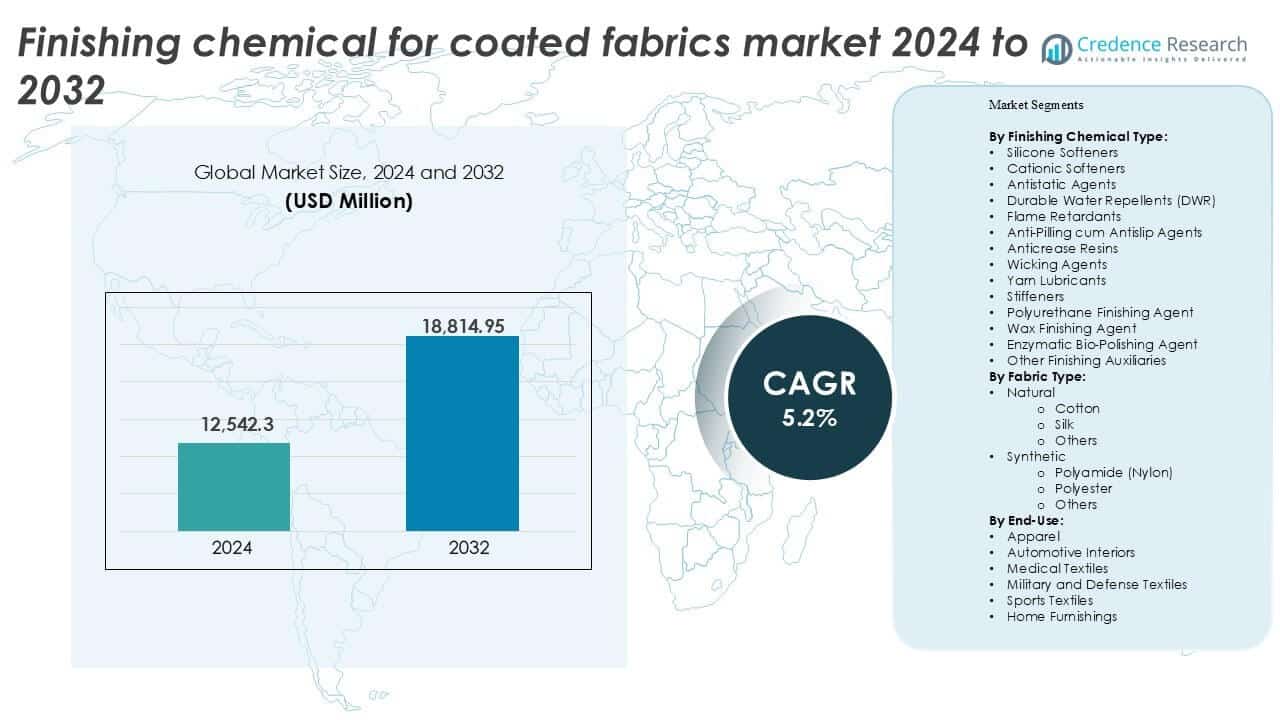
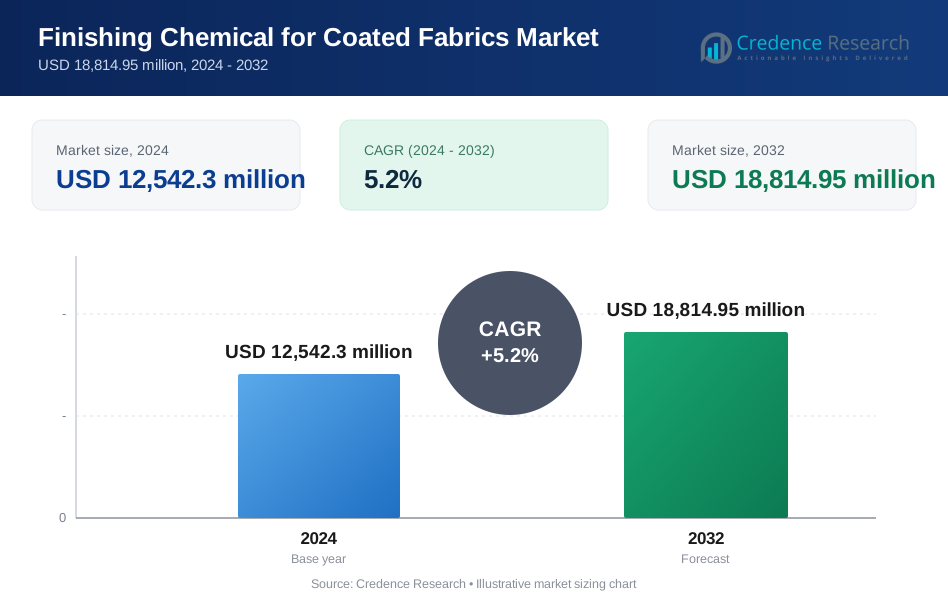
The Finishing Chemical for Coated Fabrics Market size was valued at USD 12,542.3 million in 2024 and is anticipated to reach USD 18,814.95 million by 2032, at a CAGR of 5.2% during the forecast period.
| REPORT ATTRIBUTE | DETAILS |
|---|---|
| Historical Period | 2020-2023 |
| Base Year | 2024 |
| Forecast Period | 2025-2032 |
| Finishing Chemical for Coated Fabrics Market Size 2024 | USD 12,542.3 million |
| Finishing Chemical for Coated Fabrics Market, CAGR | 5.2% |
| Finishing Chemical for Coated Fabrics Market Size 2032 | USD 18,814.95 million |
Top players in the finishing chemical for coated fabrics market include Sarex, Pidilite, FCL Fineotex, Chemicone, and Nisshinbo Textile Inc., each offering tailored solutions for textile processing across synthetic and natural fabric types. Asian suppliers such as Agrawal Drugs & Chemicals Pvt. Ltd., Colourinn, and Embassy Silicones maintain a strong foothold in cost-sensitive markets through wide product portfolios and local distribution networks. Meanwhile, global players like Kowa Emori Co Ltd and HT Fine Chemicals focus on sustainable and high-performance coatings for industrial and specialty applications. European companies such as William Clark, Pincroft, and Bekaert emphasize REACH-compliant, eco-friendly solutions for defense, home furnishings, and technical textiles. Asia Pacific leads regionally with a 42% market share, supported by its manufacturing scale and rising functional textile demand, followed by North America at 23% and Europe at 21%, where regulatory focus drives sustainable chemistry adoption.
Finishing Chemical for Coated Fabrics Market Insights
- The Finishing Chemical for Coated Fabrics Market was valued at USD 12,542.3 million in 2024 and is projected to reach USD 18,814.95 million by 2032, growing at a CAGR of 5.2% during the forecast period.
- Demand is driven by increased use of coated fabrics in apparel, automotive interiors, and defense textiles, with durable water repellents and flame retardants among the most used finishing chemicals.
- A key trend is the shift toward eco-friendly, non-fluorinated, and bio-based finishes due to rising environmental regulations and consumer awareness across global markets.
- Asia Pacific holds the largest regional share at 42%, led by textile manufacturing hubs in China and India; synthetic fabrics, particularly polyester, dominate with the highest segment share.
- Market growth is limited by regulatory challenges, especially in Europe and North America, where compliance with REACH and other chemical safety standards increases costs and slows product approvals.
Finishing Chemical for Coated Fabrics Market Segmentation Analysis:
By Finishing Chemical Type
Durable Water Repellents (DWR) hold the largest market share among finishing chemical types. Their dominance is driven by rising demand for water-resistant coated fabrics in outdoor apparel, tents, and upholstery. DWR coatings enhance the lifespan and performance of textiles exposed to moisture. Flame retardants and antistatic agents also witness steady uptake across industrial and automotive applications. Wicking agents and enzymatic bio-polishing agents gain traction in sportswear and high-performance textiles. Growing regulatory focus on sustainable chemistries supports the shift toward bio-based and non-fluorinated finishing agents, especially in apparel and furnishing applications.
- For instance, 3M Scotchgard fabric protector provides water repellency with a surface tension reduction to about 22 dyn/cm, helping coated textiles shed moisture.
By Fabric Type
Synthetic fabrics dominate the market, led by polyester, which accounts for the highest share. Polyester's widespread use in coated fabrics across apparel, automotive, and home furnishings stems from its durability, affordability, and easy compatibility with finishing chemicals. Polyamide (nylon) also plays a key role in high-performance and technical textile applications. Natural fabrics, especially cotton, maintain a strong presence in apparel and home furnishing use cases due to their comfort and breathability. Finishing chemicals tailored for cotton support softness, wrinkle resistance, and color retention, expanding their value in premium textiles.
- For instance, Invista’s polyester fibers used in coated fabrics often have tenacity values around 6.0 g/d, promoting strength in outdoor and automotive uses.
By End-Use
The apparel segment leads the market by end-use, driven by strong global demand for functional clothing. Finishing chemicals enhance garment comfort, water resistance, flame resistance, and durability, supporting everyday and technical wear needs. Sports textiles follow closely, with increasing adoption of moisture-wicking and antistatic treatments. Automotive interiors and home furnishings represent growing markets as consumers demand improved aesthetics, stain resistance, and longevity. Medical and military textiles require specialized finishes such as antimicrobial or flame-retardant properties, which continue to spur niche demand from institutional buyers and government contracts.
Finishing Chemical for Coated Fabrics Market Overview
Key Growth Drivers
Rising Demand for Functional and Performance Textiles
The need for high-performance coated fabrics continues to rise across sectors such as apparel, automotive, medical, and defense. Consumers and industries increasingly demand textile products that offer enhanced durability, water resistance, fire retardancy, and antistatic behavior. This has boosted the use of finishing chemicals like durable water repellents (DWR), flame retardants, and antistatic agents. Outdoor apparel brands prioritize features such as breathability and stain resistance, driving innovation in finishing solutions. Automotive manufacturers also apply these chemicals to interior fabrics for safety and comfort enhancements. Additionally, military and medical sectors require coated fabrics with specialized finishes to meet stringent hygiene, thermal, and protective standards. The growing emphasis on multi-functional textiles across commercial and industrial use cases continues to stimulate steady demand for advanced finishing chemicals worldwide.
- For instance, Polygiene’s antimicrobial textile finish achieves bacterial reduction of 99 % in treated fabrics, supporting hygiene needs in medical and activewear.
Expansion of Technical Textile Applications in Emerging Markets
Emerging economies are rapidly adopting technical and industrial textiles across key end-use sectors. Infrastructure development, healthcare expansion, and automotive production growth in Asia-Pacific, Latin America, and the Middle East support rising consumption of coated fabrics. Countries like India, China, Brazil, and Vietnam are investing heavily in textile processing capabilities. This includes backward integration in chemical finishing units to serve domestic and export markets. Industrial users in these regions increasingly favor coated textiles for applications requiring weatherproofing, hygiene control, or insulation. As global manufacturing footprints shift toward cost-efficient regions, suppliers of finishing chemicals benefit from closer proximity to textile clusters. Localized demand from construction, transport, and protective equipment also supports chemical adoption. This regional growth, combined with favorable policies, sustains long-term market expansion for finishing chemicals tailored to coated fabrics.
- For instance, textile parks in Surat and Tirupur increase local finishing capacity by thousands of tonnes annually, reducing reliance on imports.
Sustainability Push and Development of Eco-Friendly Finishes
The shift toward sustainable and environmentally responsible textile production significantly influences the finishing chemical landscape. Regulatory bodies and consumers both demand lower-impact chemical formulations. This has spurred investment in water-based, solvent-free, and bio-based finishing agents. Non-fluorinated DWR finishes, biodegradable softeners, and enzyme-based bio-polishing agents are gaining market traction. Global brands in apparel and furnishings increasingly impose chemical compliance standards on suppliers, accelerating green chemical adoption. Voluntary certifications like OEKO-TEX, Bluesign®, and ZDHC protocols encourage mills to upgrade to safer chemistries. Innovations in biotechnology and green chemistry continue to create viable substitutes for conventional agents without compromising performance. This transition not only reduces environmental footprint but also creates differentiation opportunities for finishing chemical manufacturers committed to circular and sustainable textile solutions.
Finishing Chemical for Coated Fabrics Market Key Trends & Opportunities
Integration of Smart Coating Technologies
Smart and functional coatings are a growing trend in the finishing chemical market for coated fabrics. These coatings respond to stimuli such as temperature, light, or pressure. Self-cleaning, UV-blocking, antimicrobial, and phase-change finishes are being incorporated into high-value applications across medical, sports, and defense sectors. For example, antimicrobial finishes help prevent bacterial buildup in hospital textiles and are in demand post-pandemic. Textile R&D labs increasingly explore nanotechnology-based chemical coatings that enhance durability without affecting breathability. Smart coatings also support wearable electronics and sensor-embedded fabrics, opening new use cases in healthcare and fitness. Finishing chemical suppliers focusing on innovation in adaptive coatings stand to gain significant market advantage by tapping into these high-margin applications.
- For instance, Schoeller’s nano‑coating achieves water repellency with contact angles above 150°, helping fabrics shed moisture and resist staining in outdoor and workwear.
Digital Textile Printing Compatibility and Custom Finishing
The rise of digital textile printing creates an opportunity for compatible finishing chemicals that maintain print sharpness and fabric flexibility. Customized fashion and short-run apparel production drive demand for coated fabrics that support high-resolution, vibrant printing. Finishing chemicals tailored to preserve surface smoothness, ink absorption, and wash durability are in focus. Brands seeking just-in-time manufacturing and low-inventory models benefit from quick-drying, print-ready finishes. This also aligns with the growing demand for on-demand home décor and interior applications, where fabrics require personalized coatings. Chemical suppliers that offer solutions optimized for digital workflows, including pre-treatment and post-treatment finishes, can capitalize on the booming custom textile ecosystem.
Finishing Chemical for Coated Fabrics Market Key Challenges
Environmental Regulations and Compliance Pressures
Stringent environmental regulations continue to challenge the finishing chemicals industry. Several widely used chemicals face increasing scrutiny due to toxicity, non-biodegradability, and persistence in the environment. Regulatory bans on certain fluorochemicals and formaldehyde-based resins disrupt supply chains and force reformulation efforts. Compliance with REACH, EPA, and GHS standards requires manufacturers to invest heavily in R&D and safety testing. Smaller players in developing markets often lack the resources to meet these evolving regulations, which limits their participation in global supply chains. The cost of certification and transitioning to green alternatives can increase operational burden, reducing margins for chemical producers and textile processors alike.
High Cost and Performance Trade-offs of Sustainable Alternatives
While eco-friendly finishing chemicals are in demand, many alternatives still face performance limitations or cost barriers. Non-fluorinated water repellents, for instance, often underperform in extreme conditions compared to traditional formulations. Bio-based or enzyme-based agents may require longer processing times, affecting production throughput. For manufacturers seeking to balance performance, cost, and sustainability, the transition is complex. Premium pricing for green chemistries may also deter adoption in price-sensitive markets such as mass apparel and automotive textiles. Achieving consistent results across different fabric types and coating processes remains a technical hurdle. Bridging this performance-cost gap is a key challenge for broader adoption of sustainable finishing solutions.
Finishing Chemical for Coated Fabrics Market Regional Analysis
North America
North America holds a significant share in the finishing chemical for coated fabrics market, driven by strong demand from automotive, defense, and home furnishing sectors. The United States leads the region due to its advanced textile processing infrastructure and high adoption of functional coatings. Flame retardants and antistatic agents see steady consumption in industrial and protective clothing. The region accounted for around 23% of the global market in 2024. Regulatory support for sustainable chemicals and R&D investment in smart coatings further strengthen North America’s role as a key innovation hub in the global finishing chemical landscape.
Europe
Europe represents approximately 21% of the global finishing chemical for coated fabrics market, supported by strict environmental compliance and a strong technical textiles sector. Germany, Italy, and France dominate regional production, especially for automotive interiors, industrial apparel, and upholstery. EU regulations such as REACH and the Green Deal push textile mills to adopt eco-friendly and fluorine-free finishing agents. Brands across fashion and furniture segments emphasize sustainable sourcing, boosting demand for water-based and bio-polishing chemicals. The presence of leading chemical manufacturers and textile OEMs ensures continued regional adoption of innovative and compliant finishing formulations.
Asia Pacific
Asia Pacific leads the global market with over 42% share, driven by large-scale coated fabric production in China, India, Japan, and Southeast Asia. Rapid industrialization, growing apparel exports, and domestic demand for technical textiles contribute to the dominance. Polyester- and nylon-based synthetic fabrics with chemical finishes are widely used in outdoor apparel, automotive, and military sectors. Cost-effective manufacturing and expanding infrastructure investments support market expansion. Regional governments promote green manufacturing practices, accelerating the adoption of non-toxic and water-efficient finishing chemicals. Strong backward integration and investment in textile chemicals further reinforce Asia Pacific’s leadership.
Latin America
Latin America accounts for roughly 7% of the finishing chemical for coated fabrics market, with Brazil and Mexico as key contributors. The region sees growing demand for finished coated fabrics in automotive, construction, and furniture applications. Rising textile production and export-oriented policies drive use of water-repellent, flame-retardant, and softening agents. However, limited chemical manufacturing capabilities create reliance on imports. Environmental regulations are evolving, encouraging gradual adoption of safer and sustainable finishing solutions. The market holds growth potential as local industries modernize and regional consumers show increasing preference for functional and durable coated fabric products.
Middle East & Africa (MEA)
The MEA region holds about 5% of the global market, with the UAE, Saudi Arabia, and South Africa driving demand. Growth stems from expanding construction activity, automotive assembly, and military procurement. Coated fabrics with finishing chemicals are used in tents, uniforms, and vehicle interiors. Extreme climatic conditions further increase the need for UV-resistant, water-repellent, and flame-retardant finishes. However, limited domestic production and weak infrastructure slow market penetration. Imports meet most of the regional demand, though investment in local textile zones and partnerships with global suppliers may improve chemical accessibility and drive adoption in the coming years.
Finishing Chemical for Coated Fabrics Market Segmentations:
By Finishing Chemical Type
- Silicone Softeners
- Cationic Softeners
- Antistatic Agents
- Durable Water Repellents (DWR)
- Flame Retardants
- Anti-Pilling cum Antislip Agents
- Anticrease Resins
- Wicking Agents
- Yarn Lubricants
- Stiffeners
- Polyurethane Finishing Agent
- Wax Finishing Agent
- Enzymatic Bio-Polishing Agent
- Other Finishing Auxiliaries
By Fabric Type
- Natural
- Cotton
- Silk
- Others
- Synthetic
- Polyamide (Nylon)
- Polyester
- Others
By End-Use
- Apparel
- Automotive Interiors
- Medical Textiles
- Military and Defense Textiles
- Sports Textiles
- Home Furnishings
By Geography
- North America
- U.S.
- Canada
- Mexico
- Europe
- Germany
- France
- U.K.
- Italy
- Spain
- Rest of Europe
- Asia Pacific
- China
- Japan
- India
- South Korea
- South-east Asia
- Rest of Asia Pacific
- Latin America
- Brazil
- Argentina
- Rest of Latin America
- Middle East & Africa
- GCC Countries
- South Africa
- Rest of the Middle East and Africa
Competitive Landscape
The finishing chemical for coated fabrics market features a mix of global and regional players competing on product innovation, performance, and regulatory compliance. Companies like Pidilite, Sarex, and FCL Fineotex maintain strong presence in Asia with extensive textile chemical portfolios and tailored solutions for synthetic and natural fabrics. Global players such as Nisshinbo Textile Inc., Kowa Emori Co Ltd, and HT Fine Chemicals focus on advanced formulations, including non-fluorinated repellents and bio-based agents. European firms like William Clark, Pincroft, and Bekaert emphasize sustainability, offering REACH-compliant finishes for industrial and defense textiles. Local suppliers such as Chemicone, Colourinn, and Agrawal Drugs & Chemicals Pvt. Ltd. serve price-sensitive markets with value-based products. Strategic partnerships, capacity expansion, and R&D investments remain key strategies. As regulations tighten and demand shifts toward sustainable finishes, players that can balance performance, cost-efficiency, and eco-compliance are better positioned to lead the competitive landscape.
Key Player Analysis
- Pidilite
- NICAA
- Bekaert
- William Clark
- Colourinn
- Nisshinbo Textile Inc.
- FCL Fineotex
- Chemicone
- Kowa Emori Co Ltd
- Sarex
- HT Fine Chemicals
- Embassy Silicones
- Agrawal Drugs and Chemicals Pvt. Ltd.
- Pincroft
Recent Developments
- In April 2024, Devan Chemicals, a Belgium-based innovative textile solutions provider, introduced Devan Stain Release, a new textile finishing technology. The release can help wash off both oil- and water-based stains with a high focus on sustainability. The release efficiently prevents stains like oils, tea, mid, ketchup, and grass from entering deep into the fibers. The product is specifically made for those who require the dual benefits of wicking and stain-release properties.
- In 2022, United Kingdom-based Pincroft adopted the unique TexCoat™ G4 system of Baldwin Technology. The company focuses on moving toward a sustainable future in the textile industry. The new precision spray technology would help the company to provide high-quality products and lower carbon emissions.
Report Coverage
The research report offers an in-depth analysis based on Finishing Chemical Type, Fabric Type, End-Use and Geography. It details leading market players, providing an overview of their business, product offerings, investments, revenue streams, and key applications. Additionally, the report includes insights into the competitive environment, SWOT analysis, current market trends, as well as the primary drivers and constraints. Furthermore, it discusses various factors that have driven market expansion in recent years. The report also explores market dynamics, regulatory scenarios, and technological advancements that are shaping the industry. It assesses the impact of external factors and global economic changes on market growth. Lastly, it provides strategic recommendations for new entrants and established companies to navigate the complexities of the market.
Future Outlook
- Demand for eco-friendly and non-toxic finishing chemicals will continue to rise across all sectors.
- Manufacturers will invest in bio-based and water-based alternatives to meet global sustainability goals.
- Smart and functional coatings such as antimicrobial and UV-resistant finishes will gain wider use.
- Polyester and other synthetic fabrics will remain dominant due to durability and compatibility with advanced finishes.
- Asia Pacific will maintain its lead in production and consumption due to large-scale textile operations.
- Automotive and defense textiles will drive demand for flame retardant and antistatic finishing agents.
- Increased adoption of digital textile printing will boost demand for print-compatible finishing chemicals.
- Smaller regional players will face pressure to upgrade formulations to comply with strict regulations.
- Research and development will focus on improving performance of green finishing agents.
- Strategic collaborations between chemical suppliers and textile mills will support faster market adaptation.
Request a Free Sample
Fill in your details and we'll send you a free sample report.
- Sample data tables & charts
- Research methodology
Need a Custom Version of This Report?
Tailor the scope, geography, or segments to your exact requirements.
- Custom geography or segment scope
- Direct access to our analyst team
Frequently Asked Questions
What is the current market size for the Finishing chemical for coated fabrics market, and what is its projected size in 2032?
At what Compound Annual Growth Rate is the Finishing chemical for coated fabrics market projected to grow between 2024 and 2032?
Which Finishing chemical for coated fabrics market segment held the largest share in 2024?
What are the primary factors fueling the growth of the Finishing chemical for coated fabrics market?
Who are the leading companies in the Finishing chemical for coated fabrics market?
Which region commanded the largest share of the Finishing chemical for coated fabrics market in 2024?
Table of Content
Chapter 1. Report Introduction
- 1.1 Report Description & Purpose
- 1.1.1 Report Title & Market Definition
- 1.1.2 Unique Selling Propositions (USP) & Key Differentiators
- 1.1.3 Value Proposition for Stakeholders
- 1.2 Research Objectives
- 1.2.1 Market Sizing Objectives (Volume & Revenue)
- 1.2.2 Segmentation Objectives
- 1.2.3 Competitive Intelligence Objectives
- 1.2.4 Forecast & Scenario Objectives
- 1.3 Report Scope
- 1.3.1 Finishing Chemical for Coated Fabrics Scope – Types & Subtypes Covered
- 1.3.2 Geographic Scope – Regions & Countries Covered
- 1.3.3 Historical Period, Base Year & Forecast Period (2024; forecast to 2032)
- 1.3.4 Inclusions & Exclusions
- 1.4 HS Code & Classification Framework
- 1.5 Currency, Units & Pricing Basis
- 1.6 Target Stakeholders
- 1.7 Limitations & Assumptions
Chapter 2. Executive Summary
- 2.1 Global Finishing Chemical for Coated Fabrics Market Snapshot
- 2.1.1 Market Size – Historical (2024) & Forecast (2024-2032) (2024: USD 12,542.3 million → 2032: USD 18,814.95 million)
- 2.1.2 Volume & Revenue – Global Totals
- 2.1.3 Key Market Highlights – Top Five Facts
- 2.2 Finishing Chemical for Coated Fabrics Market Segmentation Snapshot
- 2.2.1 Market Split by Region – 2024 vs. 2032
- 2.3 Competitive Snapshot
- 2.3.1 Top 10 Players by Revenue Share – 2024
- 2.3.2 Top 10 Players by Volume Share – 2024
- 2.3.3 Recent Strategic Developments (18-Month Summary)
- 2.4 Key Investment Highlights & Strategic Conclusions
Chapter 3. Finishing Chemical for Coated Fabrics Market Dynamics & Industry Analysis
- 3.1 Market Overview & Context
- 3.1.1 Finishing Chemical for Coated Fabrics Market Position in the Broader Automotive Value Chain
- 3.1.2 OEM vs. Replacement Market Dynamics
- 3.1.3 Market Maturity & Development Stage by Region
- 3.2 Finishing Chemical for Coated Fabrics Market Drivers
- 3.3 Finishing Chemical for Coated Fabrics Market Restraints & Challenges
- 3.4 Finishing Chemical for Coated Fabrics Market Opportunities
- 3.5 Porter's Five Forces Analysis
- 3.5.1 Threat of New Entrants
- 3.5.2 Bargaining Power of Suppliers
- 3.5.3 Bargaining Power of Buyers
- 3.5.4 Threat of Substitutes
- 3.5.5 Competitive Rivalry – Intensity Assessment
- 3.6 Finishing Chemical for Coated Fabrics Value Chain Analysis
- 3.6.1 Upstream – Raw Material/Input Suppliers
- 3.6.1.1 Raw Material/Input 1
- 3.6.1.2 Raw Material/Input 2
- 3.6.1.3 Raw Material/Input 3
- 3.6.2 Midstream – Production/Manufacturing/Service Delivery
- 3.6.2.1 Production/Process Overview
- 3.6.2.2 Key Facility Locations & Capacity by Manufacturer
- 3.6.3 Downstream – Distribution & End Consumer
- 3.6.3.1 Primary Channel – B2B/OEM
- 3.6.3.2 Secondary Channels – Dealer, Retail, Online, Direct
- 3.6.4 Value Chain Profitability Analysis
- 3.6.1 Upstream – Raw Material/Input Suppliers
- 3.7 PESTEL Analysis
- 3.7.1 Political Factors
- 3.7.2 Economic Factors
- 3.7.3 Social Factors
- 3.7.4 Technological Factors
- 3.7.5 Environmental Factors
- 3.7.6 Legal Factors
- 3.8 Finishing Chemical for Coated Fabrics Supply Chain Analysis
- 3.8.1 Raw Material/Input Supply Risk Assessment
- 3.8.2 Manufacturing Concentration Risk (Geographic Exposure)
- 3.8.3 Trade Disruption Impact Analysis
- 3.9 Regulatory & Policy Landscape
Note: The regulatory and policy landscape section covers regulations based on their applicability to the market, Finishing Chemical for Coated Fabrics category, geography, and scope of the study. Only regulatory frameworks with a material impact on operations, compliance, trade, sustainability, or market access are analyzed in detail.
Chapter 4. Key Investment Pockets & Opportunity Analysis
- 4.1 Finishing Chemical for Coated Fabrics Market Attractiveness Analysis
- 4.1.1 By Region – Investment Attractiveness Matrix (Volume × CAGR)
- 4.2 Absolute Revenue Growth Opportunity
- 4.2.1 By Region – Absolute USD Growth Through 2032
- 4.3 Incremental Volume Opportunity
- 4.3.1 By Region – Incremental Volume Through 2032
- 4.3.2 Segment – Incremental Volume
- 4.4 Emerging Submarket Opportunity Deep Dive (Subject to Applicability)
- 4.5 Emerging Market Opportunity Scorecards
- 4.5.1 United States
- 4.5.2 Europe
- 4.5.3 Asia
- 4.5.4 Middle East & Africa
Note: Emerging Market Opportunity Scorecards will be included based on relevance and strategic importance. Regions listed are indicative and may vary depending on data availability and market dynamics.
Chapter 5. Finishing Chemical for Coated Fabrics Import-Export Analysis & Trade Flows
- 5.1 Global Trade Overview
- 5.1.1 Global Export Value by Country (2024)
- 5.1.2 Global Export Volume by Country (2024)
- 5.1.3 Global Import Value by Country (2024)
- 5.1.4 Global Import Volume by Country (2024)
- 5.1.5 Net Trade Balance by Country (2024)
- 5.2 Export Analysis – Segment
- 5.2.1 Type 1 (HS Code)
- 5.2.2 Type 2 (HS Code)
- 5.2.3 Type 3 (HS Code)
- 5.2.4 Type 4 (HS Code)
- 5.2.5 Type 5 (HS Code)
- 5.3 Import Analysis – Segment
- 5.3.1 Type 1 (HS Code)
- 5.3.2 Type 2 (HS Code)
- 5.3.3 Type 3 (HS Code)
- 5.3.4 Type 4 (HS Code)
- 5.3.5 Type 5 (HS Code)
- 5.4 Average Unit Trade Prices
- 5.4.1 Average Export Price – Segment & Country
- 5.4.2 Average Import Price – Segment & Source Country
- 5.4.3 Price Trends (2024)
- 5.5 Key Trade Route Analysis
- 5.5.1 Trade Route 1
- 5.5.2 Trade Route 2
- 5.5.3 Trade Route 3
- 5.5.4 Trade Route 4
- 5.5.5 Trade Route 5
- 5.6 Trade Policy Impact Assessment
- 5.6.1 US Anti-Dumping & Section 301 Tariffs
- 5.6.2 EU Customs Union Impact
- 5.6.3 Major Free Trade Agreements
- 5.6.4 USMCA Rules of Origin
Note: Trade policy analysis will be included only where relevant to the Finishing Chemical for Coated Fabrics market.
Chapter 6. Competitive Landscape & Company Benchmarking
- 6.1 Finishing Chemical for Coated Fabrics Market Concentration & Structure
- 6.1.1 Herfindahl-Hirschman Index (HHI) – vs. 2024
- 6.1.2 Tier 1, Tier 2 & Tier 3 Market Structure
- 6.1.3 Global, Regional & Local Player Dynamics
- 6.2 Finishing Chemical for Coated Fabrics Market Share Analysis – 2024
- 6.2.1 Global Revenue Share by Company
- 6.2.2 Global Volume Share by Company
- 6.2.3 Regional Revenue Share
- 6.2.4 Market Share Evolution ( vs. 2024)
- 6.2.5 OEM Segment Share by Company
- 6.2.6 Replacement Segment Share by Company
- 6.3 Production/Delivery Capacity & Facility Analysis
- 6.3.1 Global Installed Capacity
- 6.3.2 Capacity Utilization Rates
- 6.3.3 Production/Output Volume
- 6.3.4 Facility Locations & Capacity Map
- 6.3.5 Planned Capacity Additions
- 6.4 Finishing Chemical for Coated Fabrics Competitive Benchmarking Matrix
- 6.4.1 Revenue, Volume, CAGR & Profitability Comparison
- 6.4.2 Channel Revenue Mix
- 6.4.3 Geographic Revenue Exposure
- 6.4.4 R&D Intensity
- 6.4.5 Sustainability Maturity
- 6.5 Strategic Developments in Finishing Chemical for Coated Fabrics (Last 24 Months)
- 6.5.1 Mergers, Acquisitions & Divestments
- 6.5.2 New Finishing Chemical for Coated Fabrics Launches
- 6.5.3 Facility Expansions
- 6.5.4 Strategic Alliances, Joint Ventures & Partnerships
- 6.5.5 Distribution Expansion & Market Entry
- 6.5.6 Sustainability & ESG Initiatives
- 6.6 Competitive Strategy Mapping
- 6.6.1 Leader, Challenger, Follower & Niche Classification
- 6.6.2 Pricing Strategy Comparison
- 6.6.3 Channel Strategy Matrix
Note: Strategic developments are included based on their materiality and the availability of reliable information.
Chapter 7. Global Finishing Chemical for Coated Fabrics Market – By Distribution Channel
- 7.1 Segment Overview
- 7.1.1 Volume & Revenue Split by Channel (2024 & 2032)
- 7.1.2 Channel Mix Evolution (2024-2032)
Chapter 8. Regional Market Analysis – Global Overview
- 8.1 Global Regional Overview
- 8.1.1 Regional Volume Share
- 8.1.2 Regional Revenue Share
- 8.1.3 Regional Volume by Region
- 8.1.4 Regional Revenue by Region
- 8.1.5 Regional Forecast Through 2032
- 8.2 Cross-Regional Segment Analysis
- 8.2.1 By Distribution Channel
- 8.2.2 By Brand/Price Tier
Chapter 9. North America Finishing Chemical for Coated Fabrics Market
- 9.1 United States
- 9.2 Canada
- 9.3 Mexico
Chapter 10. Europe Finishing Chemical for Coated Fabrics Market
- 10.1 Germany
- 10.2 France
- 10.3 Italy
- 10.4 United Kingdom
- 10.5 Spain
- 10.6 Poland
- 10.7 Russia
- 10.8 Netherlands
- 10.9 Belgium
- 10.10 Sweden
- 10.11 Denmark
- 10.12 Norway
- 10.13 Rest of Europe
Chapter 11. Asia Pacific Finishing Chemical for Coated Fabrics Market
- 11.1 China
- 11.2 India
- 11.3 Japan
- 11.4 South Korea
- 11.5 Thailand
- 11.6 Indonesia
- 11.7 Vietnam
- 11.8 Malaysia
- 11.9 Australia
- 11.10 Rest of Asia Pacific
Chapter 12. Latin America Finishing Chemical for Coated Fabrics Market
- 12.1 Brazil
- 12.2 Argentina
- 12.3 Colombia
- 12.4 Chile
- 12.5 Rest of Latin America
Chapter 13. Middle East Finishing Chemical for Coated Fabrics Market
- 13.1 Saudi Arabia
- 13.2 United Arab Emirates
- 13.3 Turkey
- 13.4 Israel
- 13.5 Iran
- 13.6 Rest of the Middle East
Chapter 14. Africa Finishing Chemical for Coated Fabrics Market
- 14.1 South Africa
- 14.2 Egypt
- 14.3 Nigeria
- 14.4 Morocco
- 14.5 Rest of Africa
Chapter 15. Finishing Chemical for Coated Fabrics Company Profiles
- 15.1 [Company 01]
- 15.1.1 Company Overview
- 15.1.2 Key Management Personnel
- 15.1.3 Products & Services Portfolio
- 15.1.4 Financial Performance
- 15.1.5 Key Market Focus & Geographic Presence
- 15.1.6 Recent Developments & Strategic Initiatives
Note: The company profile list is preliminary and may change based on research findings, market developments, data availability, and client requirements.
Chapter 16. Appendices
- Appendix A – List of Abbreviations & Acronyms
- Appendix B – Industry Classification Code Reference – Full Series
- Appendix C – Production & Capacity Data Tables
- Appendix D – End-Use & Demand Base Tables
- Appendix E – Consumption & Replacement Rate Assumptions
- Appendix F – ASP Reference Tables
- Appendix G – Manufacturing & Facility Database
- Appendix H – Import-Export Data Tables
- Appendix I – Regulatory Summary Tables
- Appendix J – Primary Research Participant List (Anonymized)
- Appendix K – Primary Research Questionnaire Framework
- Appendix L – Data Sources & Bibliography
- Appendix M – Market Size Divergence & Source Comparison
Chapter 17. Research Methodology
- 17.1 Research Framework & Philosophy
- 17.2 Secondary Research – Sources, Hierarchy & Data Extraction
- 17.3 Data Modeling – Bottom-Up & Top-Down Market Sizing
- 17.4 Primary Research – Stakeholder Framework, LOI & Sample Sizes
- 17.5 Forecast Methodology – Regression, Scenario & Sensitivity Analysis
- 17.6 Quality Control – Four-Layer Validation Framework
- 17.7 Limitations & Standard Assumptions
- 17.8 Disclaimer
