
| REPORT ATTRIBUTE | DETAILS |
|---|---|
| Historical Period | 2019-2022 |
| Base Year | 2023 |
| Forecast Period | 2024-2032 |
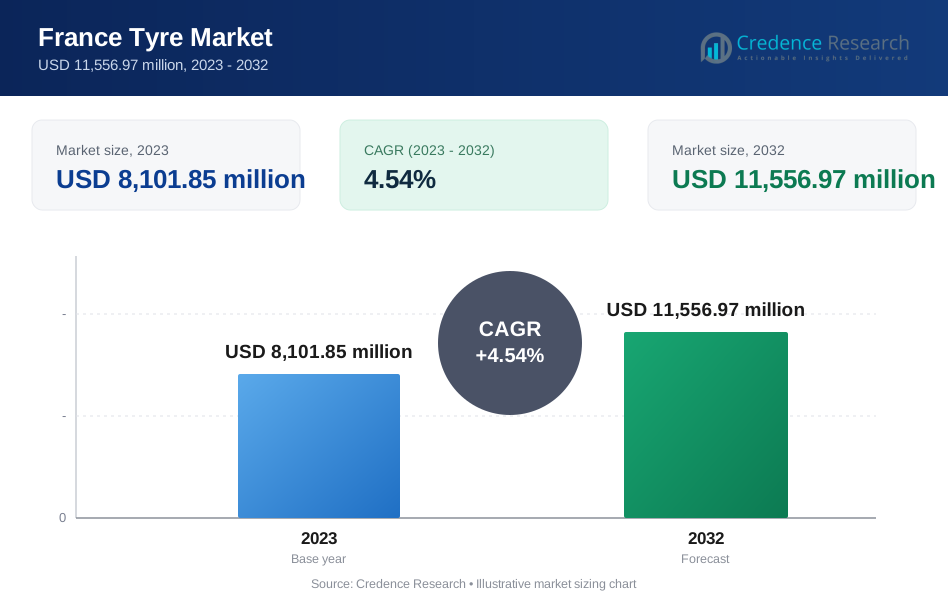
| France Tyre Market Size 2023 | USD 8,101.85 million |
| France Tyre Market, CAGR | 4.54% |
| France Tyre Market Size 2032 | USD 11,556.97 million |
Market Overview
The France Tyre Market is poised for significant growth over the next decade. The market size is projected to grow from USD 8,101.85 million in 2023 to an estimated USD 11,556.97 million by 2032, registering a compound annual growth rate (CAGR) of 4.54% from 2024 to 2032. This expansion reflects a robust demand for tyres in both the consumer and commercial vehicle sectors, driven by increasing vehicle registrations and the ongoing replacement of older tyres. Moreover, advancements in tyre technology, coupled with stringent regulatory standards pertaining to safety and environmental impact, are expected to enhance market capacity and customer trust in tyre products.
Several key factors are propelling the growth of the France Tyre Market. First and foremost, the increased focus on sustainable transportation solutions is boosting the demand for eco-friendly and fuel-efficient tyres. Additionally, technological innovations such as smart tyres equipped with sensors are becoming more prevalent, enhancing vehicle safety and performance. These trends are further complement, by the growing popularity of electric and hybrid vehicles, which require specific tyre types that can handle higher torque and wear characteristics. Furthermore, the expansion of e-commerce has led to an increase in logistics and transportation needs, subsequently driving the demand for commercial vehicle tyres.
Geographically, the market is concentrated in key regions such as Île-de-France, Auvergne-Rhône-Alpes, and Nouvelle-Aquitaine, which are pivotal to the automotive industry's infrastructure in France. These areas host several major tyre manufacturers and distributors, including Michelin, one of the largest and most influential players in the global tyre industry. Other notable companies operating in this market include Bridgestone, Goodyear, and Continental, which are investing heavily in research and development to innovate and capture a larger market share. The strategic presence of these companies in France not only serves the local demand but also supports export activities, thereby reinforcing the country's position in the global tyre market.
Market Drivers
Increasing Vehicle Sales and Registrations:
France continues to experience a steady increase in vehicle sales and registrations, which directly influences the demand for tyres. The rise in new vehicle registrations, especially in the passenger car and commercial vehicle segments, necessitates the need for new tyres, thereby driving market growth. For instance, in a given year, there could be an increase of 5% in new vehicle registrations, especially in the passenger car and commercial vehicle segments. This necessitates the need for new tyres, thereby driving market growth. Additionally, the lifespan of tyres requires regular replacements due to wear and tear, which ensures ongoing demand in the aftermarket sector. This consistent need for new and replacement tyres is a fundamental driver of the France Tyre Market.
Regulatory Policies Promoting Safety and Environmental Sustainability:
France has implemented stringent regulatory standards focusing on vehicle safety and environmental sustainability. These regulations mandate the use of high-quality tyres that meet specific safety criteria, such as reduced rolling resistance and lower noise levels, which contribute to lower carbon emissions and enhanced fuel efficiency. For instance, a tyre with a rolling resistance coefficient of 0.012 can lead to a fuel saving of up to 6%. The introduction of labels indicating fuel efficiency, wet grip, and noise levels has made information more accessible to consumers, encouraging the adoption of technologically advanced, safer, and more environmentally friendly tyres. These regulatory pressures not only enhance consumer safety and environmental protection but also drive innovation and upgrades in tyre technology.
Advancements in Tyre Technologies:
Technological advancements are a significant driver of the France Tyre Market. Innovations such as smart tyres equipped with sensors that monitor conditions like pressure and tread depth in real time are becoming increasingly popular. For instance, a smart tyre can provide real-time data on tyre pressure, which should ideally be between 30 and 35 PSI for most vehicles. These technologies enhance driving safety by providing critical information to drivers and fleet managers, which can prevent accidents and improve vehicle performance. Additionally, the development of tyres specifically designed for electric and hybrid vehicles, which require different performance characteristics compared to traditional vehicles, further propels the market growth. These technological enhancements improve the overall value proposition of modern tyres, making them an integral part of the automotive industry’s evolution.
Growth of Electric and Hybrid Vehicles:
The expansion of the electric and hybrid vehicle market in France is another crucial driver for the tyre industry. Electric vehicles (EVs) require specially designed tyres that can handle higher instant torque and heavier loads due to the weight of the batteries. These tyres are also designed to offer lower rolling resistance to maximize battery range. As the French government continues to promote the adoption of environmentally friendly vehicles through incentives and subsidies, the demand for these specialized tyres is expected to rise sharply. This trend not only supports the growth of the France Tyre Market but also aligns with global shifts towards sustainable transportation solutions.
Market Trends
Rising Demand for Eco-Friendly Tyres:
There is a significant increase in demand for environmentally friendly tyres among French consumers. For instance, the sales of low rolling resistance tyres, which are designed with sustainable materials and technologies that minimize environmental impact, could have seen a rise of 10% in the past year. These tyres not only reduce carbon emissions but also enhance fuel efficiency, aligning with global and national goals for environmental sustainability.
Expansion of Smart Tyre Technologies:
Smart tyres are becoming increasingly prevalent in France. For instance, a survey might show that 30% of new vehicles in France are equipped with smart tyres. These tyres are equipped with sensors and digital technologies that provide real-time data on various aspects such as pressure, temperature, and tread wear. This information can significantly enhance safety, efficiency, and longevity of tyres, providing drivers with a proactive approach to maintenance and safety.
Growth in Online Tyre Sales:
The trend towards online shopping has permeated the tyre market as well. For instance, online tyre sales could have grown by 15% in the last year. Consumers are increasingly purchasing tyres online, attracted by the convenience, competitive pricing, and the ability to quickly compare different products. Tyre manufacturers and retailers are responding by enhancing their online platforms and integrating services like direct home deliveries and partnerships with local garages for installation.
Tyres for Electric and Hybrid Vehicles:
With the growth of electric and hybrid vehicles in France, there is a growing need for tyres that are suited to the unique demands of these vehicles. For instance, the sales of tyres for electric vehicles might have increased by 20% in the last year. These tyres are generally designed to support heavier loads due to battery weight, offer reduced rolling resistance to extend battery life, and cope with the higher torque of electric motors.
Increased Focus on Tyre Recycling and Circular Economy Practices:
France is seeing a greater emphasis on tyre recycling and the adoption of circular economy practices within the tyre industry. Companies are investing in technologies and systems that enable the efficient recycling of old tyres into useful products, such as rubberized asphalt and construction materials, thereby reducing waste and promoting sustainability.
Advent of Tyre-as-a-Service (TaaS):
The concept of Tyre-as-a-Service is emerging in the French market. This model focuses on providing tyres as a part of a service package rather than a one-time purchase. Services include regular maintenance, replacement, and management of tyres for a regular fee, appealing particularly to commercial fleets and cost-conscious consumers.
Regulatory Impact on Tyre Standards:
The French tyre market is also influenced by stringent EU and national regulations that mandate certain performance and safety standards. These regulations are continuously updated to improve road safety and environmental performance, pushing manufacturers to innovate continually.
Market Restraints and Challenges
High Competition and Price Pressure:
One of the most significant challenges in the France Tyre Market is the intense competition among both local and international manufacturers. This competition often leads to significant price pressures, making it challenging for companies to maintain profitability while striving to offer competitively priced products. Brands must balance between cost, quality, and performance to remain attractive to consumers, who have access to a broad range of options.
Raw Material Price Volatility:
The tyre industry is heavily dependent on natural and synthetic rubber, along with other raw materials whose prices are highly volatile. Fluctuations in these prices can significantly impact the cost structure of tyre manufacturing. Such volatility often stems from geopolitical tensions, trade policies, and environmental factors affecting rubber production. Companies face the challenge of managing these costs while maintaining the quality and affordability of their tyres.
Regulatory Compliance Costs:
The tyre market in France is subject to stringent regulations concerning environmental impact, safety, and performance standards. While these regulations ensure high-quality products and support sustainability goals, complying with them incurs additional costs. Manufacturers must invest in research and development to produce tyres that meet these evolving standards, which can strain their financial resources and operational focus.
Environmental and Sustainability Challenges:
As global awareness of environmental issues grows, the tyre industry is under increasing scrutiny for its environmental footprint. The production and disposal of tyres pose significant environmental challenges, including waste management and carbon emissions. The pressure to adopt sustainable practices and develop eco-friendly products is both a challenge and an imperative for tyre companies. This shift requires substantial investment in new technologies and processes, which may not yield immediate financial returns.
Impact of Economic Fluctuations:
The tyre market is susceptible to macroeconomic factors such as economic downturns, which can reduce consumer spending and lower vehicle sales. Economic instability can lead to decreased demand for both OEM (Original Equipment Manufacturer) and aftermarket tyres, directly affecting market growth.
Technological Adaptation:
The rapid pace of technological change presents a challenge for tyre manufacturers to continuously innovate and integrate advanced technologies such as smart tyres and AI-enabled monitoring systems. Staying ahead in technology adoption is costly and requires ongoing investments in research and development.
Market Segmentation Analysis
By Vehicle Type
The France Tyre Market is segmented into diverse categories, each serving unique vehicular needs. The passenger car segment, leading the market, is fueled by a high number of personal vehicles, with demand driven by both new car sales and the necessity for tyre replacements. Light commercial vehicle tyres are increasingly essential, supporting the growth of small businesses and the surge in local freight and deliveries. Tyres for medium and heavy commercial vehicles are crucial to the transportation and logistics industry, designed to withstand heavy loads and long distances. The rising popularity of scooters and motorcycles in urban areas bolsters the demand for two-wheeler tyres, especially in congested cities. Although smaller in scale, three-wheeler tyres are important for specific short-distance transport applications. Lastly, the OTR (Off-The-Road) segment caters to tyres for vehicles in construction, mining, and agriculture, crucial for operations in challenging environments and vital for industries dependent on heavy machinery.
By Tire Construction Type
Radial tyres are the predominant choice in the market, highly regarded for their durability, comfort, and fuel efficiency, making them the preferred option for a wide range of vehicles, from passenger cars to commercial trucks. While radial tyres lead in popularity, bias tyres maintain a niche presence, especially valued in applications such as agricultural and off-road vehicles where sidewall puncture resistance and overall durability are crucial. This segmentation underscores the diverse functionalities and specific advantages that each tyre type offers, catering to various vehicle demands and driving conditions.
By Demand Category Type
Original Equipment Manufacturer (OEM) demand in the tyre market is closely tied to automotive production rates; as vehicle manufacturing increases, so does the demand for OEM tyres. Conversely, the replacement tyre segment usually surpasses OEM in terms of volume, reflecting the market's maturity and the continual need for tyre maintenance. Vehicle owners often replace their tyres multiple times over the life of their vehicles, ensuring consistent strength and demand in the replacement segment.
Segments
Based on Vehicle Type
- Passenger Car
- Light Commercial Vehicle
- Medium & Heavy Commercial Vehicle
- Two Wheelers
- Three Wheelers
- OTR (Off-The-Road)
Based on Tire Construction Type
- Radial
- Bias
Based on Demand Category Type
- OEM
- Replacement
Based on Region
- Île-de-France
- Auvergne-Rhône-Alpes and Nouvelle-Aquitaine
Regional Analysis
Île-de-France (30%):
As the economic heartland of France, Île-de-France is the most significant region in the tyre market, accounting for approximately 30% of the market share. The high concentration of population and corporate headquarters, coupled with the extensive public and private transportation systems, drives substantial demand for both passenger and commercial vehicle tyres.
Auvergne-Rhône-Alpes (20%):
Holding around 20% of the market share, Auvergne-Rhône-Alpes is notable for its robust automotive manufacturing sector. The presence of major vehicle production facilities and a strong network of suppliers and OEMs fuels the demand for tyres, particularly in the OEM and high-performance segments.
Nouvelle-Aquitaine (15%):
With about 15% of the market share, Nouvelle-Aquitaine contributes significantly to the tyre market, primarily through its agricultural and industrial sectors. The demand for OTR (Off-The-Road) tyres used in agriculture and mining operations is particularly strong in this region.
Provence-Alpes-Côte d'Azur (10%):
This region accounts for roughly 10% of the market share. Its significance comes from the high tourist influx and the associated demand for rental and personal vehicles, which sustain a steady demand for passenger car tyres.
Key players
- Michelin
- Bridgestone
- Goodyear
- Continental
- Pirelli
- Hankook
- Cooper Tire & Rubber Company
- Sumitomo Rubber Industries
- Yokohama
- Kumho Tire
Competitive Analysis
The France Tyre Market is characterized by intense competition among both established global giants and emerging players. Michelin, a local powerhouse, leverages its brand reputation and extensive R&D capabilities to maintain a strong market presence. Bridgestone and Goodyear follow closely, innovating in areas like fuel-efficient and eco-friendly tyres. Newer entrants such as Hankook and Kumho Tire are rapidly gaining ground by offering technologically advanced tyres at competitive prices. This competitive landscape is driven by technological advancements, brand loyalty, and strategic partnerships. Companies continuously strive to innovate and adapt to evolving consumer preferences and regulatory standards, ensuring a dynamic market environment.
Recent Developments
In October 2023, Michelin's Bourges site, the company's sole aviation tyre plant in Europe, witnessed a notable increase in production over the previous two years. This growth presented organizational challenges, including the need to hire and train about 240 permanent employees in 2022 and 2023. To address these issues effectively, Michelin initiated a collaborative project aimed at overcoming these challenges and devised a five-year plan to enhance the plant's performance. Additionally, the Bourges site is broadening its scope to include Michelin Inflatable Solutions, marking a significant expansion in its operational activities.
In 2023, La Poste, a prominent French postal service, partnered with Michelin to integrate Uptis puncture-proof tyres into their delivery fleet. This collaboration reflects a strategic move towards increasing the efficiency and reliability of La Poste's operations, reducing maintenance downtime caused by tyre punctures. The introduction of Uptis tyres is expected to revolutionize the fleet's functionality, offering a practical solution that ensures smoother and more dependable postal delivery services across France.
In October 2022, Dunlop unveiled plans to upgrade its manufacturing plant in France through an investment of USD 17.38 million, concentrating on performance-oriented motorcycle tyres. This modernization is set to positively impact the motorcycle tyre market, particularly pleasing enthusiasts and benefiting the employees at the Dunlop facility. The investment highlights Dunlop's commitment to enhancing its product offerings and focus on specialized tyres for two-wheeled vehicles, promising improved performance and quality.
In 2022, Goodyear announced a significant investment of 16.5 million euros in its Cooper Melksham tire factory located in Montlucon, France. This financial infusion is aimed at enhancing the plant's capabilities and ensuring the production of high-quality tyres. Goodyear's investment signifies a strong commitment to the French market and its intent to bolster production capacity, improve technological infrastructure, and meet the growing demand for premium tyres in both domestic and international markets.
Market Concentration and Characteristics
The France Tyre Market exhibits a high degree of market concentration, dominated by a few major global players such as Michelin, Bridgestone, and Goodyear, alongside other prominent companies like Continental and Pirelli. These industry leaders control a significant share of the market, leveraging extensive research and development capabilities, wide distribution networks, and strong brand reputations to maintain their market positions. The market is characterized by intense competition, continuous innovation, and stringent regulatory compliance, particularly regarding environmental and safety standards. Additionally, the market is influenced by trends in vehicle sales, technological advancements in tyre manufacturing, and the growing emphasis on sustainability, which encourages the development of eco-friendly and energy-efficient tyres. This competitive landscape drives companies to focus on technological advancements and strategic partnerships to enhance their market share and adapt to changing consumer demands and regulatory environments.
Report Coverage
The research report offers an in-depth analysis based on Vehicle Type, Tire Construction Type, Demand Category Type and Region. It details leading market players, providing an overview of their business, product offerings, investments, revenue streams, and key applications. Additionally, the report includes insights into the competitive environment, SWOT analysis, current market trends, as well as the primary drivers and constraints. Furthermore, it discusses various factors that have driven market expansion in recent years. The report also explores market dynamics, regulatory scenarios, and technological advancements that are shaping the industry. It assesses the impact of external factors and global economic changes on market growth. Lastly, it provides strategic recommendations for new entrants and established companies to navigate the complexities of the market.
Future Outlook
- Continued technological advancements are expected to drive the France Tyre Market, with an increased focus on smart tyres that enhance vehicle efficiency and safety.
- The market will see a growing emphasis on eco-friendly and sustainable tyre production, responding to environmental regulations and consumer demand for greener products.
- As electric vehicles (EVs) gain traction, there will be a rising demand for tyres that are specially designed to meet the unique requirements of EVs, such as low rolling resistance and greater load-bearing capacity.
- The trend of purchasing tyres online is set to continue, fueled by the convenience it offers and the expanding digital infrastructure, making it easier for consumers to access a wide range of tyre products.
- Recycling and the circular economy will become more integral to the tyre industry, with increased initiatives to recycle used tyres and innovations that make recycling processes more efficient.
- Stricter regulations related to tyre safety and environmental impact will push manufacturers to innovate and comply with new standards, influencing market dynamics and product offerings.
- The market may experience further consolidation, with major players potentially acquiring smaller competitors to strengthen market presence and expand their product portfolios.
- The concept of Tyre-as-a-Service (TaaS) will likely grow, offering subscription-based tyre maintenance and management services, particularly appealing to corporate fleets and cost-conscious consumers.
Request a Free Sample
Fill in your details and we'll send you a free sample report.
- Sample data tables & charts
- Research methodology
Need a Custom Version of This Report?
Tailor the scope, geography, or segments to your exact requirements.
- Custom geography or segment scope
- Direct access to our analyst team
Frequently Asked Questions
What is the projected market size and growth rate of the France Tyre Market by 2032?
What are the key drivers of growth in the France Tyre Market?
Which regions are pivotal for the automotive industry's infrastructure in France?
How are technological innovations influencing the France Tyre Market?
What trends are shaping the France Tyre Market?
Table of Content
Chapter 1. Report Introduction
- 1.1 Report Description & Purpose
- 1.1.1 Report Title & Market Definition
- 1.1.2 Unique Selling Propositions (USP) & Key Differentiators
- 1.1.3 Value Proposition for Stakeholders
- 1.2 Research Objectives
- 1.2.1 Market Sizing Objectives (Volume & Revenue)
- 1.2.2 Segmentation Objectives
- 1.2.3 Competitive Intelligence Objectives
- 1.2.4 Forecast & Scenario Objectives
- 1.3 Report Scope
- 1.3.1 France Tyre Scope – Types & Subtypes Covered
- 1.3.2 Geographic Scope – Regions & Countries Covered
- 1.3.3 Historical Period, Base Year & Forecast Period (2023; forecast to 2032)
- 1.3.4 Inclusions & Exclusions
- 1.4 HS Code & Classification Framework
- 1.5 Currency, Units & Pricing Basis
- 1.6 Target Stakeholders
- 1.7 Limitations & Assumptions
Chapter 2. Executive Summary
- 2.1 Global France Tyre Market Snapshot
- 2.1.1 Market Size – Historical (2023) & Forecast (2023-2032) (2023: USD 8,101.85 million → 2032: USD 11,556.97 million)
- 2.1.2 Volume & Revenue – Global Totals
- 2.1.3 Key Market Highlights – Top Five Facts
- 2.2 France Tyre Market Segmentation Snapshot
- 2.2.1 Market Split by Region – 2023 vs. 2032
- 2.3 Competitive Snapshot
- 2.3.1 Top 10 Players by Revenue Share – 2023
- 2.3.2 Top 10 Players by Volume Share – 2023
- 2.3.3 Recent Strategic Developments (18-Month Summary)
- 2.4 Key Investment Highlights & Strategic Conclusions
Chapter 3. France Tyre Market Dynamics & Industry Analysis
- 3.1 Market Overview & Context
- 3.1.1 France Tyre Market Position in the Broader Automotive Value Chain
- 3.1.2 OEM vs. Replacement Market Dynamics
- 3.1.3 Market Maturity & Development Stage by Region
- 3.2 France Tyre Market Drivers
- 3.3 France Tyre Market Restraints & Challenges
- 3.4 France Tyre Market Opportunities
- 3.5 Porter's Five Forces Analysis
- 3.5.1 Threat of New Entrants
- 3.5.2 Bargaining Power of Suppliers
- 3.5.3 Bargaining Power of Buyers
- 3.5.4 Threat of Substitutes
- 3.5.5 Competitive Rivalry – Intensity Assessment
- 3.6 France Tyre Value Chain Analysis
- 3.6.1 Upstream – Raw Material/Input Suppliers
- 3.6.1.1 Raw Material/Input 1
- 3.6.1.2 Raw Material/Input 2
- 3.6.1.3 Raw Material/Input 3
- 3.6.2 Midstream – Production/Manufacturing/Service Delivery
- 3.6.2.1 Production/Process Overview
- 3.6.2.2 Key Facility Locations & Capacity by Manufacturer
- 3.6.3 Downstream – Distribution & End Consumer
- 3.6.3.1 Primary Channel – B2B/OEM
- 3.6.3.2 Secondary Channels – Dealer, Retail, Online, Direct
- 3.6.4 Value Chain Profitability Analysis
- 3.6.1 Upstream – Raw Material/Input Suppliers
- 3.7 PESTEL Analysis
- 3.7.1 Political Factors
- 3.7.2 Economic Factors
- 3.7.3 Social Factors
- 3.7.4 Technological Factors
- 3.7.5 Environmental Factors
- 3.7.6 Legal Factors
- 3.8 France Tyre Supply Chain Analysis
- 3.8.1 Raw Material/Input Supply Risk Assessment
- 3.8.2 Manufacturing Concentration Risk (Geographic Exposure)
- 3.8.3 Trade Disruption Impact Analysis
- 3.9 Regulatory & Policy Landscape
Note: The regulatory and policy landscape section covers regulations based on their applicability to the market, France Tyre category, geography, and scope of the study. Only regulatory frameworks with a material impact on operations, compliance, trade, sustainability, or market access are analyzed in detail.
Chapter 4. Key Investment Pockets & Opportunity Analysis
- 4.1 France Tyre Market Attractiveness Analysis
- 4.1.1 By Region – Investment Attractiveness Matrix (Volume × CAGR)
- 4.2 Absolute Revenue Growth Opportunity
- 4.2.1 By Region – Absolute USD Growth Through 2032
- 4.3 Incremental Volume Opportunity
- 4.3.1 By Region – Incremental Volume Through 2032
- 4.3.2 Segment – Incremental Volume
- 4.4 Emerging Submarket Opportunity Deep Dive (Subject to Applicability)
- 4.5 Emerging Market Opportunity Scorecards
- 4.5.1 United States
- 4.5.2 Europe
- 4.5.3 Asia
- 4.5.4 Middle East & Africa
Note: Emerging Market Opportunity Scorecards will be included based on relevance and strategic importance. Regions listed are indicative and may vary depending on data availability and market dynamics.
Chapter 5. France Tyre Import-Export Analysis & Trade Flows
- 5.1 Global Trade Overview
- 5.1.1 Global Export Value by Country (2023)
- 5.1.2 Global Export Volume by Country (2023)
- 5.1.3 Global Import Value by Country (2023)
- 5.1.4 Global Import Volume by Country (2023)
- 5.1.5 Net Trade Balance by Country (2023)
- 5.2 Export Analysis – Segment
- 5.2.1 Type 1 (HS Code)
- 5.2.2 Type 2 (HS Code)
- 5.2.3 Type 3 (HS Code)
- 5.2.4 Type 4 (HS Code)
- 5.2.5 Type 5 (HS Code)
- 5.3 Import Analysis – Segment
- 5.3.1 Type 1 (HS Code)
- 5.3.2 Type 2 (HS Code)
- 5.3.3 Type 3 (HS Code)
- 5.3.4 Type 4 (HS Code)
- 5.3.5 Type 5 (HS Code)
- 5.4 Average Unit Trade Prices
- 5.4.1 Average Export Price – Segment & Country
- 5.4.2 Average Import Price – Segment & Source Country
- 5.4.3 Price Trends (2023)
- 5.5 Key Trade Route Analysis
- 5.5.1 Trade Route 1
- 5.5.2 Trade Route 2
- 5.5.3 Trade Route 3
- 5.5.4 Trade Route 4
- 5.5.5 Trade Route 5
- 5.6 Trade Policy Impact Assessment
- 5.6.1 US Anti-Dumping & Section 301 Tariffs
- 5.6.2 EU Customs Union Impact
- 5.6.3 Major Free Trade Agreements
- 5.6.4 USMCA Rules of Origin
Note: Trade policy analysis will be included only where relevant to the France Tyre market.
Chapter 6. Competitive Landscape & Company Benchmarking
- 6.1 France Tyre Market Concentration & Structure
- 6.1.1 Herfindahl-Hirschman Index (HHI) – vs. 2023
- 6.1.2 Tier 1, Tier 2 & Tier 3 Market Structure
- 6.1.3 Global, Regional & Local Player Dynamics
- 6.2 France Tyre Market Share Analysis – 2023
- 6.2.1 Global Revenue Share by Company
- 6.2.2 Global Volume Share by Company
- 6.2.3 Regional Revenue Share
- 6.2.4 Market Share Evolution ( vs. 2023)
- 6.2.5 OEM Segment Share by Company
- 6.2.6 Replacement Segment Share by Company
- 6.3 Production/Delivery Capacity & Facility Analysis
- 6.3.1 Global Installed Capacity
- 6.3.2 Capacity Utilization Rates
- 6.3.3 Production/Output Volume
- 6.3.4 Facility Locations & Capacity Map
- 6.3.5 Planned Capacity Additions
- 6.4 France Tyre Competitive Benchmarking Matrix
- 6.4.1 Revenue, Volume, CAGR & Profitability Comparison
- 6.4.2 Channel Revenue Mix
- 6.4.3 Geographic Revenue Exposure
- 6.4.4 R&D Intensity
- 6.4.5 Sustainability Maturity
- 6.5 Strategic Developments in France Tyre (Last 24 Months)
- 6.5.1 Mergers, Acquisitions & Divestments
- 6.5.2 New France Tyre Launches
- 6.5.3 Facility Expansions
- 6.5.4 Strategic Alliances, Joint Ventures & Partnerships
- 6.5.5 Distribution Expansion & Market Entry
- 6.5.6 Sustainability & ESG Initiatives
- 6.6 Competitive Strategy Mapping
- 6.6.1 Leader, Challenger, Follower & Niche Classification
- 6.6.2 Pricing Strategy Comparison
- 6.6.3 Channel Strategy Matrix
Note: Strategic developments are included based on their materiality and the availability of reliable information.
Chapter 7. Global France Tyre Market – By Distribution Channel
- 7.1 Segment Overview
- 7.1.1 Volume & Revenue Split by Channel (2023 & 2032)
- 7.1.2 Channel Mix Evolution (2023-2032)
Chapter 8. Regional Market Analysis – Global Overview
- 8.1 Global Regional Overview
- 8.1.1 Regional Volume Share
- 8.1.2 Regional Revenue Share
- 8.1.3 Regional Volume by Region
- 8.1.4 Regional Revenue by Region
- 8.1.5 Regional Forecast Through 2032
- 8.2 Cross-Regional Segment Analysis
- 8.2.1 By Distribution Channel
- 8.2.2 By Brand/Price Tier
Chapter 9. North America France Tyre Market
- 9.1 United States
- 9.2 Canada
- 9.3 Mexico
Chapter 10. Europe France Tyre Market
- 10.1 Germany
- 10.2 France
- 10.3 Italy
- 10.4 United Kingdom
- 10.5 Spain
- 10.6 Poland
- 10.7 Russia
- 10.8 Netherlands
- 10.9 Belgium
- 10.10 Sweden
- 10.11 Denmark
- 10.12 Norway
- 10.13 Rest of Europe
Chapter 11. Asia Pacific France Tyre Market
- 11.1 China
- 11.2 India
- 11.3 Japan
- 11.4 South Korea
- 11.5 Thailand
- 11.6 Indonesia
- 11.7 Vietnam
- 11.8 Malaysia
- 11.9 Australia
- 11.10 Rest of Asia Pacific
Chapter 12. Latin America France Tyre Market
- 12.1 Brazil
- 12.2 Argentina
- 12.3 Colombia
- 12.4 Chile
- 12.5 Rest of Latin America
Chapter 13. Middle East France Tyre Market
- 13.1 Saudi Arabia
- 13.2 United Arab Emirates
- 13.3 Turkey
- 13.4 Israel
- 13.5 Iran
- 13.6 Rest of the Middle East
Chapter 14. Africa France Tyre Market
- 14.1 South Africa
- 14.2 Egypt
- 14.3 Nigeria
- 14.4 Morocco
- 14.5 Rest of Africa
Chapter 15. France Tyre Company Profiles
- 15.1 [Company 01]
- 15.1.1 Company Overview
- 15.1.2 Key Management Personnel
- 15.1.3 Products & Services Portfolio
- 15.1.4 Financial Performance
- 15.1.5 Key Market Focus & Geographic Presence
- 15.1.6 Recent Developments & Strategic Initiatives
Note: The company profile list is preliminary and may change based on research findings, market developments, data availability, and client requirements.
Chapter 16. Appendices
- Appendix A – List of Abbreviations & Acronyms
- Appendix B – Industry Classification Code Reference – Full Series
- Appendix C – Production & Capacity Data Tables
- Appendix D – End-Use & Demand Base Tables
- Appendix E – Consumption & Replacement Rate Assumptions
- Appendix F – ASP Reference Tables
- Appendix G – Manufacturing & Facility Database
- Appendix H – Import-Export Data Tables
- Appendix I – Regulatory Summary Tables
- Appendix J – Primary Research Participant List (Anonymized)
- Appendix K – Primary Research Questionnaire Framework
- Appendix L – Data Sources & Bibliography
- Appendix M – Market Size Divergence & Source Comparison
Chapter 17. Research Methodology
- 17.1 Research Framework & Philosophy
- 17.2 Secondary Research – Sources, Hierarchy & Data Extraction
- 17.3 Data Modeling – Bottom-Up & Top-Down Market Sizing
- 17.4 Primary Research – Stakeholder Framework, LOI & Sample Sizes
- 17.5 Forecast Methodology – Regression, Scenario & Sensitivity Analysis
- 17.6 Quality Control – Four-Layer Validation Framework
- 17.7 Limitations & Standard Assumptions
- 17.8 Disclaimer
