
| REPORT ATTRIBUTE | DETAILS |
|---|---|
| Historical Period | 2020-2023 |
| Base Year | 2024 |
| Forecast Period | 2025-2032 |
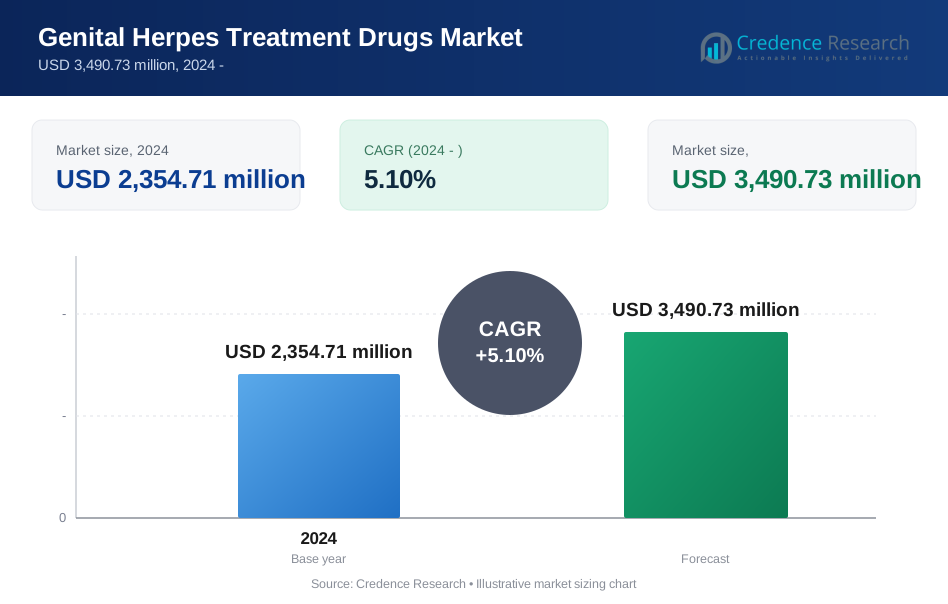
| Genital Herpes Treatment Market Size 2024 | USD 2,354.71 million |
| Genital Herpes Treatment Market, CAGR | 5.10% |
| Genital Herpes Treatment Market Size 2032 | USD 3,490.73 million |
Market Overview
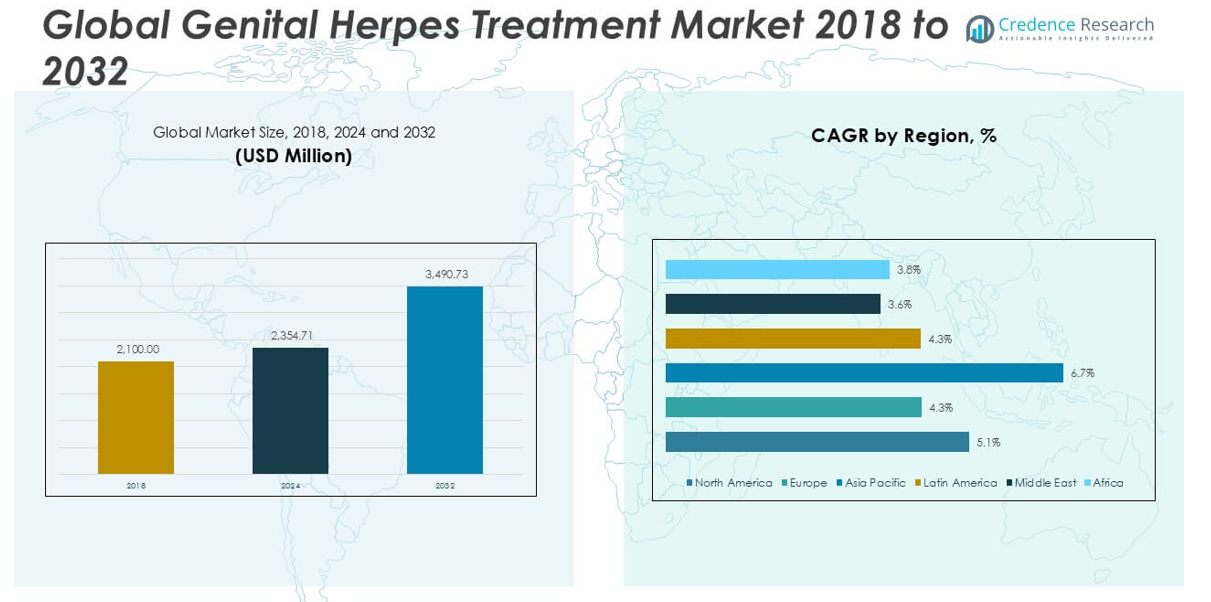
The Genital Herpes Treatment Market size was valued at USD 2,100.00 million in 2018, increased to USD 2,354.71 million in 2024, and is anticipated to reach USD 3,490.73 million by 2032, growing at a CAGR of 5.10% during the forecast period.
The Genital Herpes Treatment market is highly competitive, with top players including GlaxoSmithKline (GSK), Merck & Co., Inc., Pfizer Inc., Novartis AG, Abbott Laboratories, Sanofi, Biohaven Pharmaceuticals, Genocea Biosciences, and Vir Biotechnology. These companies focus on expanding antiviral drug portfolios, developing innovative immunotherapies, and advancing vaccine candidates to strengthen their market position. North America leads the global market, accounting for 38.1% of the total market share in 2024, driven by a high prevalence of genital herpes, strong healthcare infrastructure, and wide access to antiviral medications. Asia Pacific is emerging as the fastest-growing region, supported by rising awareness and improving healthcare access.
Market Insights
- The Genital Herpes Treatment market was valued at USD 2,354.71 million in 2024 and is projected to reach USD 3,490.73 million by 2032, growing at a CAGR of 5.10% during the forecast period.
- Market growth is driven by the increasing global prevalence of HSV-2 infections, rising awareness, and the growing demand for long-term suppressive therapies to manage recurrent outbreaks.
- Key trends include the rising adoption of oral antiviral drugs, which hold over 60% market share, and expanding access to treatment in emerging markets like Asia Pacific, which is the fastest-growing region with a CAGR of 6.7%.
- The market is highly competitive, with major players such as GlaxoSmithKline, Merck & Co., Pfizer, and Novartis focusing on new product development, vaccine research, and regional expansion.
- Market growth is restrained by social stigma, underdiagnosis, and the absence of curative treatments, particularly in regions like Africa and the Middle East, which have smaller market shares.
Market Segmentation Analysis:
By Drug Class:
The Genital Herpes Treatment market, based on drug class, is segmented into antiviral drugs, immunotherapy, and vaccine development. Among these, the antiviral drug segment holds the dominant market share, accounting for over 65% in 2024. This dominance is driven by the widespread use of antiviral medications such as acyclovir, valacyclovir, and famciclovir, which are the first line of treatment for genital herpes due to their proven efficacy in reducing symptoms and viral shedding. The increasing prevalence of herpes simplex virus (HSV) infections and the growing awareness about early treatment options further propel the demand for antiviral drugs.
- For instance, GSK’s Valtrex (valacyclovir) generated £845 million in global sales in 2007, with £600 million derived from U.S. suppressive therapy prescriptions.
By Indication
In terms of indication, the market is classified into HSV-1 and HSV-2. HSV-2 is the dominant sub-segment, capturing approximately 70% of the market share in 2024. This is primarily due to HSV-2 being the most common cause of genital herpes globally. The segment’s growth is supported by the rising incidence of HSV-2 infections, particularly among sexually active adults. Additionally, the higher recurrence rate of HSV-2 compared to HSV-1 drives the consistent demand for long-term suppressive therapies, further strengthening the market position of this sub-segment.
- For instance, in a pivotal N Engl J Med clinical trial, participants taking 500 mg daily valacyclovir experienced only 4 new symptomatic HSV‑2 cases out of 743, compared to 16 cases out of 741 in the placebo
By Route of Administration
Based on the route of administration, the market is divided into topical, oral, and parenteral treatments. The oral segment leads the market with a dominant share of over 60% in 2024. Oral administration is widely preferred due to its convenience, higher patient compliance, and systemic effectiveness in controlling both primary and recurrent herpes outbreaks. The increasing adoption of oral antiviral therapies, supported by their accessibility and rapid symptom relief, continues to drive growth in this segment. Additionally, the availability of generic oral formulations makes them cost-effective and widely prescribed across healthcare settings.
Market Overview
Rising Global Prevalence of Genital Herpes
The increasing global prevalence of genital herpes significantly drives market growth. The World Health Organization estimates that billions are infected with herpes simplex virus types 1 and 2, creating a continuous demand for effective treatment options. The widespread transmission of HSV-2, particularly among sexually active populations, has heightened awareness and diagnosis rates. This rising patient pool fuels the need for antiviral drugs and preventive therapies, thereby encouraging pharmaceutical companies to expand their product portfolios and improve accessibility to effective treatment solutions.
- For instance, an eight-month multicenter trial involving 1,484 heterosexual couples demonstrated that daily valacyclovir reduced transmission events from 27 in the placebo cohort to 14 in the treatment arm.
Advancements in Antiviral Therapies
Continuous advancements in antiviral drug formulations are a key growth driver in the genital herpes treatment market. Pharmaceutical companies are focusing on developing novel therapies that offer better viral suppression, reduced dosing frequency, and improved patient compliance. The introduction of combination therapies and extended-release formulations provides more effective management of recurrent outbreaks. Additionally, research into targeted drug delivery systems enhances treatment outcomes, driving patient preference toward newer therapies. These innovations support market expansion by addressing the limitations of existing antiviral treatments and offering enhanced clinical benefits.
- For instance, Med Chem Express data confirmed that 500 mg valacyclovir once daily matched the effectiveness of acyclovir administered five times daily over five-day treatment courses.
Growing Focus on Preventive Vaccines and Immunotherapy
The increasing investment in vaccine development and immunotherapy presents significant growth potential for the genital herpes treatment market. Several vaccines and immune-based therapies are in clinical trials, aiming to provide long-term protection and reduce viral transmission. This proactive approach reflects a shift from symptom management to disease prevention. Successful vaccine development could drastically reshape the market by reducing new infections and the dependence on lifelong antiviral medication. Pharmaceutical collaborations and growing government support for sexually transmitted infection (STI) control further accelerate research, creating opportunities for innovative preventive solutions.
Key Trends & Opportunities
Increasing Adoption of Suppressive Therapy
A notable trend in the genital herpes treatment market is the rising adoption of suppressive therapy, especially for patients with frequent recurrences. Suppressive therapy not only reduces the severity of outbreaks but also lowers the risk of transmission to partners. This growing preference for long-term management strategies over episodic treatment reflects a shift toward more proactive disease control. Pharmaceutical companies are capitalizing on this trend by introducing drugs that offer improved safety profiles for chronic use, thereby creating opportunities to expand patient adherence and market share.
- For instance, GSK’s valacyclovir daily regimen resulted in a reduction of asymptomatic viral shedding from 10.8% of days in the placebo group to 2.9% in the treatment group.
Expanding Access in Emerging Markets
Emerging markets present significant growth opportunities for the genital herpes treatment industry. Increasing awareness about sexually transmitted infections, improving healthcare infrastructure, and the growing availability of affordable generic antiviral drugs are driving demand in regions such as Asia-Pacific, Latin America, and parts of Africa. Governments and non-profit organizations are also intensifying public health campaigns to encourage early diagnosis and treatment. This expanded access, combined with the untapped patient population, positions emerging markets as key areas for future market penetration and pharmaceutical investment.
- For instance, Aurobindo Pharma has secured regulatory approval to export generic acyclovir to over 125 countries, vastly increasing global availability in budget-constrained markets.
Key Challenges
Social Stigma and Underdiagnosis
The social stigma associated with genital herpes significantly hampers market growth. Many individuals with herpes symptoms delay seeking medical attention due to embarrassment, leading to underdiagnosis and untreated cases. This reluctance negatively impacts disease tracking, early treatment, and public awareness efforts. Despite the availability of effective therapies, the social barriers to discussing and managing genital herpes remain high. Addressing this challenge requires sustained educational initiatives and destigmatization campaigns to improve diagnosis rates and encourage more people to seek timely medical intervention.
Limited Curative Treatment Options
One of the major challenges in the genital herpes treatment market is the lack of curative therapies. Current treatments primarily focus on symptom relief and viral suppression, rather than eliminating the virus from the body. The lifelong nature of the disease requires patients to manage recurring outbreaks and the psychological burden of chronic infection. This limitation highlights the unmet need for more effective therapeutic breakthroughs, such as vaccines or curative antivirals, to improve patient outcomes and reduce the long-term reliance on suppressive drug regimens.
Developmental Challenges in Vaccine Research
Despite considerable efforts, vaccine development for genital herpes faces significant scientific and clinical hurdles. The complex immune response of the herpes simplex virus and its ability to remain dormant in nerve cells make it difficult to create effective preventive vaccines. Several vaccine candidates have failed to demonstrate sufficient efficacy in clinical trials, delaying the introduction of a viable solution. These developmental challenges not only prolong dependence on symptomatic treatments but also limit the pace of innovation in the prevention landscape, posing a long-term obstacle for market transformation.
Regional Analysis
North America
North America holds the largest share in the Genital Herpes Treatment market, accounting for approximately 38.1% of the global market in 2024. The market size in the region increased from USD 808.50 million in 2018 to USD 896.19 million in 2024 and is projected to reach USD 1,326.83 million by 2032, growing at a CAGR of 5.1%. The growth is driven by a high prevalence of genital herpes, advanced healthcare infrastructure, and the presence of leading pharmaceutical companies. Increased public awareness and accessibility to antiviral medications further support market expansion in North America.
Europe
Europe holds a significant position in the Genital Herpes Treatment market, with a 23.5% market share in 2024. The market was valued at USD 514.50 million in 2018, reaching USD 552.82 million in 2024, and is expected to grow to USD 770.59 million by 2032 at a CAGR of 4.3%. Market growth is supported by increasing awareness about sexually transmitted infections (STIs), improved diagnostic practices, and strong government support for public health initiatives. The demand for advanced antiviral therapies and preventive care is contributing to the steady growth of the European market.
Asia Pacific
Asia Pacific is the fastest-growing region in the Genital Herpes Treatment market, holding a 21.6% share in 2024 and growing at a CAGR of 6.7%. The market expanded from USD 429.45 million in 2018 to USD 507.08 million in 2024 and is forecasted to reach USD 848.20 million by 2032. Rapid population growth, rising STI prevalence, and increasing healthcare accessibility in countries like China and India are key drivers. Additionally, the growing availability of affordable generic medications and expanding public health awareness initiatives contribute to the region’s robust market growth.
Latin America
Latin America contributes to 7.4% of the global market share in 2024 in the Genital Herpes Treatment sector. The market size increased from USD 156.45 million in 2018 to USD 173.99 million in 2024, with expectations to reach USD 242.15 million by 2032, growing at a CAGR of 4.3%. Growth in this region is driven by improving healthcare systems, increasing awareness of sexually transmitted infections, and rising access to antiviral therapies. Pharmaceutical companies are also focusing on expanding their presence in this emerging market to capture the growing patient population.
Middle East
The Middle East holds a modest 3.0% market share in 2024 within the Genital Herpes Treatment market. The regional market was valued at USD 72.45 million in 2018, reaching USD 75.57 million in 2024, and is projected to attain USD 99.85 million by 2032 at a CAGR of 3.6%. Although the market is smaller compared to other regions, gradual improvements in healthcare infrastructure and increasing public health education are supporting steady growth. Efforts to improve STI diagnosis and treatment accessibility contribute to the incremental expansion of the Middle Eastern market.
Africa
Africa accounts for 6.3% of the global Genital Herpes Treatment market in 2024. The market size rose from USD 118.65 million in 2018 to USD 149.06 million in 2024 and is expected to reach USD 203.11 million by 2032, growing at a CAGR of 3.8%. Growth in the region is driven by rising STI prevalence, increasing awareness, and expanding healthcare outreach programs. However, limited access to advanced antiviral treatments and healthcare disparities pose challenges. Ongoing efforts by international health organizations to improve STI management and education are gradually enhancing the market potential in Africa.
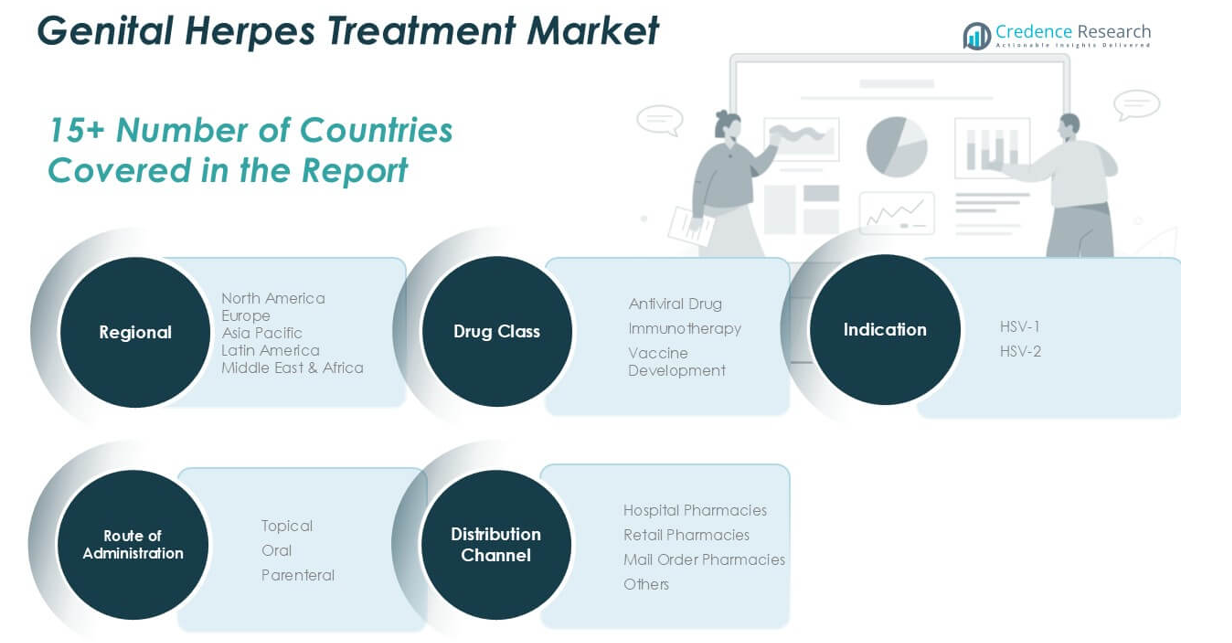
Market Segmentations:
By Drug Class
- Antiviral Drug
- Immunotherapy
- Vaccine Development
By Indication
- HSV-1
- HSV-2
By Route of Administration
- Topical
- Oral
- Parenteral
By Distribution Channel
- Hospital Pharmacies
- Retail Pharmacies
- Mail Order Pharmacies
- Others
By Geography
- North America
- U.S.
- Canada
- Mexico
- Europe
- Germany
- France
- U.K.
- Italy
- Spain
- Rest of Europe
- Asia Pacific
- China
- Japan
- India
- South Korea
- South-east Asia
- Rest of Asia Pacific
- Latin America
- Brazil
- Argentina
- Rest of Latin America
- Middle East & Africa
- GCC Countries
- South Africa
- Rest of the Middle East and Africa
Competitive Landscape
The Genital Herpes Treatment market is characterized by intense competition among key pharmaceutical players focusing on expanding their product portfolios and strengthening their global presence. Leading companies such as GlaxoSmithKline (GSK), Merck & Co., Inc., Pfizer Inc., Novartis AG, and Abbott Laboratories dominate the market, offering a broad range of antiviral drugs with proven efficacy. These players are actively engaged in research and development to introduce advanced therapies with improved dosing regimens and enhanced patient compliance. Emerging biotech firms like Biohaven Pharmaceuticals, Genocea Biosciences, and Vir Biotechnology are investing in vaccine development and innovative immunotherapies, aiming to address the unmet need for curative solutions. Strategic collaborations, mergers, and acquisitions are common across the competitive landscape, enabling companies to leverage technological advancements and expand their geographic reach. Additionally, increasing efforts to develop affordable generic options are intensifying competition, particularly in emerging markets, where cost-effective treatments are in high demand.
Key Player Analysis
- GlaxoSmithKline (GSK)
- Merck & Co., Inc.
- Novartis AG
- Abbott Laboratories
- Pfizer Inc.
- Sanofi
- Biohaven Pharmaceuticals
- Genocea Biosciences
- Vir Biotechnology
Recent Developments
- In March 2025, Biohaven reported positive data for its degrader BHV-1300, showing substantial reduction in total IgG. However, there is no direct evidence from the search results that this program is targeting genital herpes specifically.
- In September 2024, GSK completed primary data analysis from its Phase I/II trial of the therapeutic HSV vaccine candidate GSK3943104. The vaccine did not meet its primary efficacy objective, so it will not move to Phase III. No safety concerns were observed. GSK will continue safety monitoring and consider future HSV research.
- In August 2024, Novartis was researching combination therapies using Famvir (famciclovir) and other antiviral drugs for herpes simplex virus (HSV)The goal was to improve treatment effectiveness by attacking the virus through multiple pathways. However, there were no new major drug approvals or late-stage clinical trial results reported for these therapies in the past year, according to BioSpace.
Market Concentration & Characteristics
The Genital Herpes Treatment Market demonstrates moderate to high market concentration, with a few leading pharmaceutical companies holding significant shares. It is driven by continuous advancements in antiviral therapies and growing efforts in vaccine development. The market features a strong presence of established players such as GlaxoSmithKline, Merck & Co., Pfizer, and Novartis, which consistently invest in research and product development. It remains highly competitive, supported by the introduction of generic formulations that increase accessibility, particularly in cost-sensitive regions. The market is characterized by steady demand, supported by the chronic nature of the disease and the need for long-term management. It benefits from increasing patient awareness and improved diagnostic capabilities, especially in developed regions. The availability of various treatment options, including oral, topical, and parenteral therapies, offers flexibility in clinical decision-making. It faces challenges from social stigma and underreporting, which limit early diagnosis and market penetration in some regions. The Genital Herpes Treatment Market exhibits growth potential in emerging economies due to expanding healthcare infrastructure and the rising prevalence of herpes infections. It continues to attract significant R&D investments aimed at developing preventive vaccines and next-generation therapies that could reshape treatment strategies in the future.
Report Coverage
The research report offers an in-depth analysis based on Drug Class, Indication, Route of Administration, Distribution Channel and Geography. It details leading market players, providing an overview of their business, product offerings, investments, revenue streams, and key applications. Additionally, the report includes insights into the competitive environment, SWOT analysis, current market trends, as well as the primary drivers and constraints. Furthermore, it discusses various factors that have driven market expansion in recent years. The report also explores market dynamics, regulatory scenarios, and technological advancements that are shaping the industry. It assesses the impact of external factors and global economic changes on market growth. Lastly, it provides strategic recommendations for new entrants and established companies to navigate the complexities of the market.
Future Outlook
- The Genital Herpes Treatment Market is expected to witness steady growth driven by the increasing global prevalence of HSV infections.
- Ongoing advancements in antiviral drug formulations will continue to improve treatment efficacy and patient compliance.
- The market is likely to see rising adoption of suppressive therapy for long-term management of recurrent outbreaks.
- Vaccine development efforts are anticipated to accelerate, aiming to provide preventive solutions and reduce new infection rates.
- Emerging markets will present significant growth opportunities due to expanding healthcare infrastructure and rising awareness.
- Oral antiviral drugs will continue to dominate the market owing to their convenience and widespread availability.
- Increasing availability of generic medications will improve treatment accessibility, particularly in cost-sensitive regions.
- Pharmaceutical collaborations and investments in immunotherapy will strengthen the pipeline for innovative treatment options.
- Social stigma and underdiagnosis will remain key barriers, potentially limiting early treatment and market penetration.
- Successful clinical trials for preventive vaccines or novel therapies could significantly transform the future market landscape.
Request a Free Sample
Fill in your details and we'll send you a free sample report.
- Sample data tables & charts
- Research methodology
Need a Custom Version of This Report?
Tailor the scope, geography, or segments to your exact requirements.
- Custom geography or segment scope
- Direct access to our analyst team
Frequently Asked Questions
What is the current size of the Genital Herpes Treatment Market?
What are the key segments within the Genital Herpes Treatment Market?
What are some challenges faced by the Genital Herpes Treatment Market?
Who are the major players in the Genital Herpes Treatment Market?
Table of Content
Chapter 1. Report Introduction
- 1.1 Report Description & Purpose
- 1.1.1 Report Title & Market Definition
- 1.1.2 Unique Selling Propositions (USP) & Key Differentiators
- 1.1.3 Value Proposition for Stakeholders
- 1.2 Research Objectives
- 1.2.1 Market Sizing Objectives (Volume & Revenue)
- 1.2.2 Segmentation Objectives
- 1.2.3 Competitive Intelligence Objectives
- 1.2.4 Forecast & Scenario Objectives
- 1.3 Report Scope
- 1.3.1 Genital Herpes Treatment Drugs Scope – Types & Subtypes Covered
- 1.3.2 Geographic Scope – Regions & Countries Covered
- 1.3.3 Historical Period, Base Year & Forecast Period (2024; forecast to the forecast period)
- 1.3.4 Inclusions & Exclusions
- 1.4 HS Code & Classification Framework
- 1.5 Currency, Units & Pricing Basis
- 1.6 Target Stakeholders
- 1.7 Limitations & Assumptions
Chapter 2. Executive Summary
- 2.1 Global Genital Herpes Treatment Drugs Market Snapshot
- 2.1.1 Market Size – Historical (2024) & Forecast (the forecast period) (2024: USD 2,354.71 million → forecast year: USD 3,490.73 million)
- 2.1.2 Volume & Revenue – Global Totals
- 2.1.3 Key Market Highlights – Top Five Facts
- 2.2 Genital Herpes Treatment Drugs Market Segmentation Snapshot
- 2.2.1 Market Split by Region – 2024 vs.
- 2.3 Competitive Snapshot
- 2.3.1 Top 10 Players by Revenue Share – 2024
- 2.3.2 Top 10 Players by Volume Share – 2024
- 2.3.3 Recent Strategic Developments (18-Month Summary)
- 2.4 Key Investment Highlights & Strategic Conclusions
Chapter 3. Genital Herpes Treatment Drugs Market Dynamics & Industry Analysis
- 3.1 Market Overview & Context
- 3.1.1 Genital Herpes Treatment Drugs Market Position in the Broader Automotive Value Chain
- 3.1.2 OEM vs. Replacement Market Dynamics
- 3.1.3 Market Maturity & Development Stage by Region
- 3.2 Genital Herpes Treatment Drugs Market Drivers
- 3.3 Genital Herpes Treatment Drugs Market Restraints & Challenges
- 3.4 Genital Herpes Treatment Drugs Market Opportunities
- 3.5 Porter's Five Forces Analysis
- 3.5.1 Threat of New Entrants
- 3.5.2 Bargaining Power of Suppliers
- 3.5.3 Bargaining Power of Buyers
- 3.5.4 Threat of Substitutes
- 3.5.5 Competitive Rivalry – Intensity Assessment
- 3.6 Genital Herpes Treatment Drugs Value Chain Analysis
- 3.6.1 Upstream – Raw Material/Input Suppliers
- 3.6.1.1 Raw Material/Input 1
- 3.6.1.2 Raw Material/Input 2
- 3.6.1.3 Raw Material/Input 3
- 3.6.2 Midstream – Production/Manufacturing/Service Delivery
- 3.6.2.1 Production/Process Overview
- 3.6.2.2 Key Facility Locations & Capacity by Manufacturer
- 3.6.3 Downstream – Distribution & End Consumer
- 3.6.3.1 Primary Channel – B2B/OEM
- 3.6.3.2 Secondary Channels – Dealer, Retail, Online, Direct
- 3.6.4 Value Chain Profitability Analysis
- 3.6.1 Upstream – Raw Material/Input Suppliers
- 3.7 PESTEL Analysis
- 3.7.1 Political Factors
- 3.7.2 Economic Factors
- 3.7.3 Social Factors
- 3.7.4 Technological Factors
- 3.7.5 Environmental Factors
- 3.7.6 Legal Factors
- 3.8 Genital Herpes Treatment Drugs Supply Chain Analysis
- 3.8.1 Raw Material/Input Supply Risk Assessment
- 3.8.2 Manufacturing Concentration Risk (Geographic Exposure)
- 3.8.3 Trade Disruption Impact Analysis
- 3.9 Regulatory & Policy Landscape
Note: The regulatory and policy landscape section covers regulations based on their applicability to the market, Genital Herpes Treatment Drugs category, geography, and scope of the study. Only regulatory frameworks with a material impact on operations, compliance, trade, sustainability, or market access are analyzed in detail.
Chapter 4. Key Investment Pockets & Opportunity Analysis
- 4.1 Genital Herpes Treatment Drugs Market Attractiveness Analysis
- 4.1.1 By Region – Investment Attractiveness Matrix (Volume × CAGR)
- 4.2 Absolute Revenue Growth Opportunity
- 4.2.1 By Region – Absolute USD Growth Through the forecast period
- 4.3 Incremental Volume Opportunity
- 4.3.1 By Region – Incremental Volume Through the forecast period
- 4.3.2 Segment – Incremental Volume
- 4.4 Emerging Submarket Opportunity Deep Dive (Subject to Applicability)
- 4.5 Emerging Market Opportunity Scorecards
- 4.5.1 United States
- 4.5.2 Europe
- 4.5.3 Asia
- 4.5.4 Middle East & Africa
Note: Emerging Market Opportunity Scorecards will be included based on relevance and strategic importance. Regions listed are indicative and may vary depending on data availability and market dynamics.
Chapter 5. Genital Herpes Treatment Drugs Import-Export Analysis & Trade Flows
- 5.1 Global Trade Overview
- 5.1.1 Global Export Value by Country (2024)
- 5.1.2 Global Export Volume by Country (2024)
- 5.1.3 Global Import Value by Country (2024)
- 5.1.4 Global Import Volume by Country (2024)
- 5.1.5 Net Trade Balance by Country (2024)
- 5.2 Export Analysis – Segment
- 5.2.1 Type 1 (HS Code)
- 5.2.2 Type 2 (HS Code)
- 5.2.3 Type 3 (HS Code)
- 5.2.4 Type 4 (HS Code)
- 5.2.5 Type 5 (HS Code)
- 5.3 Import Analysis – Segment
- 5.3.1 Type 1 (HS Code)
- 5.3.2 Type 2 (HS Code)
- 5.3.3 Type 3 (HS Code)
- 5.3.4 Type 4 (HS Code)
- 5.3.5 Type 5 (HS Code)
- 5.4 Average Unit Trade Prices
- 5.4.1 Average Export Price – Segment & Country
- 5.4.2 Average Import Price – Segment & Source Country
- 5.4.3 Price Trends (2024)
- 5.5 Key Trade Route Analysis
- 5.5.1 Trade Route 1
- 5.5.2 Trade Route 2
- 5.5.3 Trade Route 3
- 5.5.4 Trade Route 4
- 5.5.5 Trade Route 5
- 5.6 Trade Policy Impact Assessment
- 5.6.1 US Anti-Dumping & Section 301 Tariffs
- 5.6.2 EU Customs Union Impact
- 5.6.3 Major Free Trade Agreements
- 5.6.4 USMCA Rules of Origin
Note: Trade policy analysis will be included only where relevant to the Genital Herpes Treatment Drugs market.
Chapter 6. Competitive Landscape & Company Benchmarking
- 6.1 Genital Herpes Treatment Drugs Market Concentration & Structure
- 6.1.1 Herfindahl-Hirschman Index (HHI) – vs. 2024
- 6.1.2 Tier 1, Tier 2 & Tier 3 Market Structure
- 6.1.3 Global, Regional & Local Player Dynamics
- 6.2 Genital Herpes Treatment Drugs Market Share Analysis – 2024
- 6.2.1 Global Revenue Share by Company
- 6.2.2 Global Volume Share by Company
- 6.2.3 Regional Revenue Share
- 6.2.4 Market Share Evolution ( vs. 2024)
- 6.2.5 OEM Segment Share by Company
- 6.2.6 Replacement Segment Share by Company
- 6.3 Production/Delivery Capacity & Facility Analysis
- 6.3.1 Global Installed Capacity
- 6.3.2 Capacity Utilization Rates
- 6.3.3 Production/Output Volume
- 6.3.4 Facility Locations & Capacity Map
- 6.3.5 Planned Capacity Additions
- 6.4 Genital Herpes Treatment Drugs Competitive Benchmarking Matrix
- 6.4.1 Revenue, Volume, CAGR & Profitability Comparison
- 6.4.2 Channel Revenue Mix
- 6.4.3 Geographic Revenue Exposure
- 6.4.4 R&D Intensity
- 6.4.5 Sustainability Maturity
- 6.5 Strategic Developments in Genital Herpes Treatment Drugs (Last 24 Months)
- 6.5.1 Mergers, Acquisitions & Divestments
- 6.5.2 New Genital Herpes Treatment Drugs Launches
- 6.5.3 Facility Expansions
- 6.5.4 Strategic Alliances, Joint Ventures & Partnerships
- 6.5.5 Distribution Expansion & Market Entry
- 6.5.6 Sustainability & ESG Initiatives
- 6.6 Competitive Strategy Mapping
- 6.6.1 Leader, Challenger, Follower & Niche Classification
- 6.6.2 Pricing Strategy Comparison
- 6.6.3 Channel Strategy Matrix
Note: Strategic developments are included based on their materiality and the availability of reliable information.
Chapter 7. Global Genital Herpes Treatment Drugs Market – By Distribution Channel
- 7.1 Segment Overview
- 7.1.1 Volume & Revenue Split by Channel (2024 & )
- 7.1.2 Channel Mix Evolution (the forecast period)
Chapter 8. Regional Market Analysis – Global Overview
- 8.1 Global Regional Overview
- 8.1.1 Regional Volume Share
- 8.1.2 Regional Revenue Share
- 8.1.3 Regional Volume by Region
- 8.1.4 Regional Revenue by Region
- 8.1.5 Regional Forecast Through the forecast period
- 8.2 Cross-Regional Segment Analysis
- 8.2.1 By Distribution Channel
- 8.2.2 By Brand/Price Tier
Chapter 9. North America Genital Herpes Treatment Drugs Market
- 9.1 United States
- 9.2 Canada
- 9.3 Mexico
Chapter 10. Europe Genital Herpes Treatment Drugs Market
- 10.1 Germany
- 10.2 France
- 10.3 Italy
- 10.4 United Kingdom
- 10.5 Spain
- 10.6 Poland
- 10.7 Russia
- 10.8 Netherlands
- 10.9 Belgium
- 10.10 Sweden
- 10.11 Denmark
- 10.12 Norway
- 10.13 Rest of Europe
Chapter 11. Asia Pacific Genital Herpes Treatment Drugs Market
- 11.1 China
- 11.2 India
- 11.3 Japan
- 11.4 South Korea
- 11.5 Thailand
- 11.6 Indonesia
- 11.7 Vietnam
- 11.8 Malaysia
- 11.9 Australia
- 11.10 Rest of Asia Pacific
Chapter 12. Latin America Genital Herpes Treatment Drugs Market
- 12.1 Brazil
- 12.2 Argentina
- 12.3 Colombia
- 12.4 Chile
- 12.5 Rest of Latin America
Chapter 13. Middle East Genital Herpes Treatment Drugs Market
- 13.1 Saudi Arabia
- 13.2 United Arab Emirates
- 13.3 Turkey
- 13.4 Israel
- 13.5 Iran
- 13.6 Rest of the Middle East
Chapter 14. Africa Genital Herpes Treatment Drugs Market
- 14.1 South Africa
- 14.2 Egypt
- 14.3 Nigeria
- 14.4 Morocco
- 14.5 Rest of Africa
Chapter 15. Genital Herpes Treatment Drugs Company Profiles
- 15.1 [Company 01]
- 15.1.1 Company Overview
- 15.1.2 Key Management Personnel
- 15.1.3 Products & Services Portfolio
- 15.1.4 Financial Performance
- 15.1.5 Key Market Focus & Geographic Presence
- 15.1.6 Recent Developments & Strategic Initiatives
Note: The company profile list is preliminary and may change based on research findings, market developments, data availability, and client requirements.
Chapter 16. Appendices
- Appendix A – List of Abbreviations & Acronyms
- Appendix B – Industry Classification Code Reference – Full Series
- Appendix C – Production & Capacity Data Tables
- Appendix D – End-Use & Demand Base Tables
- Appendix E – Consumption & Replacement Rate Assumptions
- Appendix F – ASP Reference Tables
- Appendix G – Manufacturing & Facility Database
- Appendix H – Import-Export Data Tables
- Appendix I – Regulatory Summary Tables
- Appendix J – Primary Research Participant List (Anonymized)
- Appendix K – Primary Research Questionnaire Framework
- Appendix L – Data Sources & Bibliography
- Appendix M – Market Size Divergence & Source Comparison
Chapter 17. Research Methodology
- 17.1 Research Framework & Philosophy
- 17.2 Secondary Research – Sources, Hierarchy & Data Extraction
- 17.3 Data Modeling – Bottom-Up & Top-Down Market Sizing
- 17.4 Primary Research – Stakeholder Framework, LOI & Sample Sizes
- 17.5 Forecast Methodology – Regression, Scenario & Sensitivity Analysis
- 17.6 Quality Control – Four-Layer Validation Framework
- 17.7 Limitations & Standard Assumptions
- 17.8 Disclaimer
