
Market Overview:
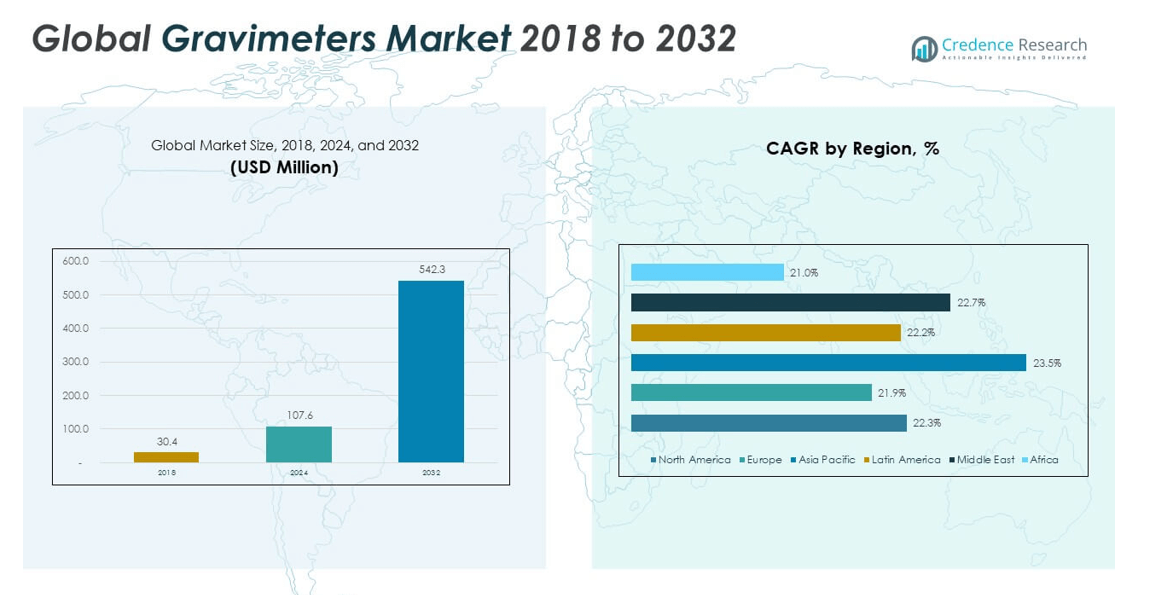
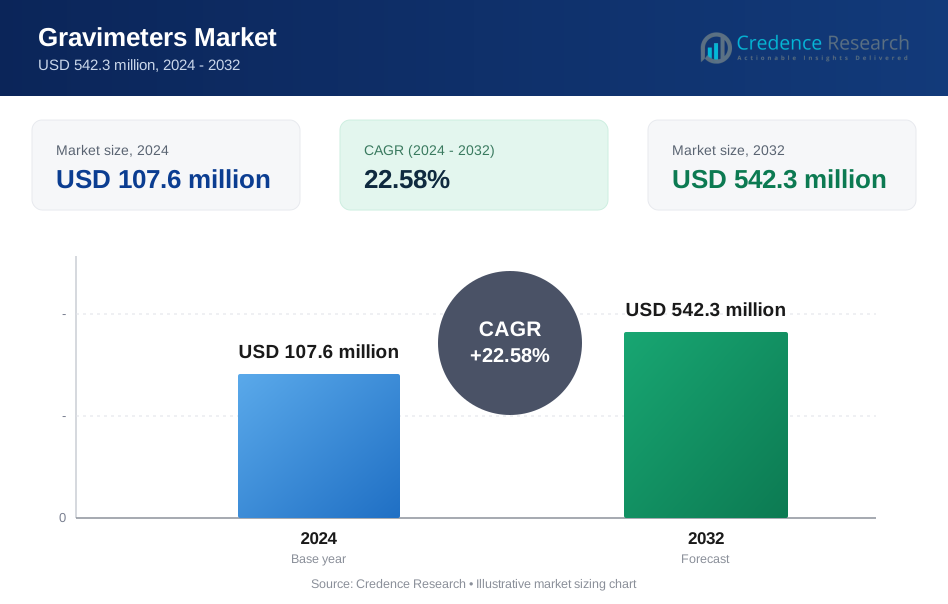
The Global Gravimeters Market size was valued at USD 30.4 million in 2018 to USD 107.6 million in 2024 and is anticipated to reach USD 542.3 million by 2032, at a CAGR of 22.58% during the forecast period.
| REPORT ATTRIBUTE | DETAILS |
|---|---|
| Historical Period | 2020-2023 |
| Base Year | 2024 |
| Forecast Period | 2025-2032 |
| Gravimeters Market Size 2024 | USD 107.6 million |
| Gravimeters Market, CAGR | 22.58% |
| Gravimeters Market Size 2032 | USD 542.3 million |
The market growth is driven by rising demand for advanced geophysical tools across oil and gas exploration, mining, and civil engineering. Gravimeters help in detecting subsurface density variations, which makes them essential for resource mapping and infrastructure development projects. Growing investments in renewable energy, coupled with expanding applications in environmental studies, further boost adoption. Continuous advancements in sensor technology, miniaturization, and accuracy are also increasing their appeal among research organizations and commercial users worldwide.
Regionally, North America and Europe dominate the gravimeters market due to strong investments in geophysical research, resource exploration, and advanced infrastructure. Asia-Pacific is emerging as a high-growth region, driven by expanding mining activities, energy projects, and increasing government focus on geoscience research in China and India. Latin America shows rising demand owing to large-scale mineral exploration, while the Middle East and Africa are witnessing steady adoption due to oil and gas activities and infrastructure development.
Market Insights:
- The Global Gravimeters Market was valued at USD 30.4 million in 2018, reached USD 107.6 million in 2024, and is anticipated to hit USD 542.3 million by 2032, registering a CAGR of 22.58%.
- Asia Pacific led with 32% share in 2024, followed by Europe at 26% and North America at 23%, driven by strong mining, infrastructure, and research investments across these regions.
- Asia Pacific remains the fastest-growing region with its large-scale adoption in mining, seismic monitoring, and infrastructure projects, especially in China, India, and Australia.
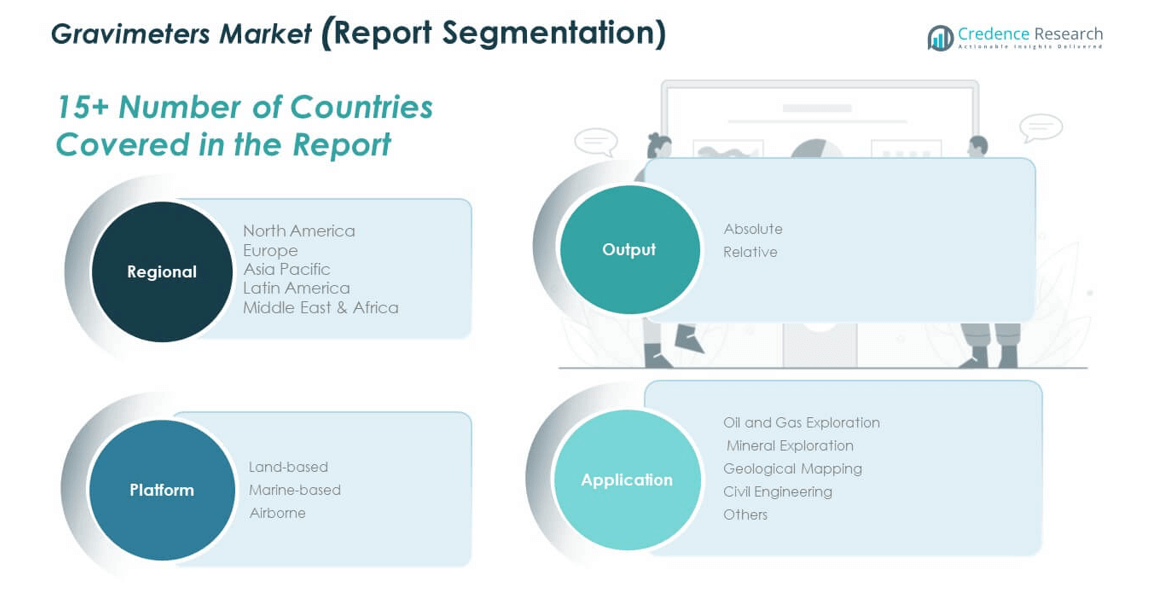
- Land-based gravimeters held the largest segment share at about 40% in 2024, supported by extensive use in civil engineering, exploration, and research.
- Marine-based accounted for nearly 35% in 2024, reflecting strong uptake in offshore oil exploration and oceanographic studies, while airborne platforms covered the balance.
Market Drivers:
Rising Adoption of Gravimeters in Oil, Gas, and Mining Exploration:
The Global Gravimeters Market is strongly driven by the growing use of precision instruments in oil, gas, and mining sectors. Gravimeters provide reliable data for locating resources and assessing subsurface density variations. Their role in reducing exploration costs and enhancing accuracy makes them highly valuable. Oil and gas operators continue to expand exploration projects to meet global energy demands. Mining companies invest heavily in advanced geophysical tools for resource mapping. Governments support exploration with favorable policies, creating consistent demand. It strengthens the reliance on gravimeters as a core component of exploration technology.
- For instance, CGG’s airborne gravity gradiometer technology, capable of flying as close as 35 meters above ground with helicopter-based units, offers significantly improved data resolution for oil and mining exploration in regions like Papua New Guinea, enabling faster and cheaper surveys than traditional seismic methods by refining target areas and reducing unnecessary surveying.
Growing Applications in Civil Engineering and Infrastructure Development:
Infrastructure development initiatives worldwide create strong momentum for gravimeter adoption. Gravimeters assist in evaluating ground stability and subsurface conditions for tunnels, bridges, and dams. Engineers rely on these instruments to minimize risks in complex projects. Their role in ensuring structural safety attracts rising demand from construction firms. The Global Gravimeters Market benefits from smart city initiatives and urban expansion. Advanced sensor technology enables detailed subsurface analysis, making projects more efficient. It ensures reduced risk of failure in high-investment infrastructure development. Increasing infrastructure budgets strengthen adoption across both developed and developing regions.
- For instance, precision spring-based gravimeters can collect data as closely spaced as 2 to 15 meters apart for microgravity measurements, enabling high-resolution characterization of localized geologic conditions vital for assessing tunnel and dam safety.
Expansion of Environmental Monitoring and Climate Research Projects:
The demand for gravimeters expands due to their critical use in environmental monitoring. Gravimeters assist in tracking groundwater changes, glacier movements, and seismic activities. Their precision supports climate research and disaster management projects. Rising concerns about water scarcity push adoption in hydrological surveys. Governments and research institutes integrate gravimeters for monitoring natural resources. The Global Gravimeters Market gains momentum from international collaborations on climate change studies. It contributes to sustainable policies and risk assessment strategies. The growing focus on environmental resilience keeps demand on a strong trajectory.
Technological Advancements Driving Greater Accuracy and Efficiency:
Advances in gravimeter technology enhance measurement accuracy and portability. Miniaturization and digital integration make instruments more user-friendly. Their increasing reliability expands usage across commercial and research applications. The Global Gravimeters Market experiences steady growth with adoption of automated systems. It helps organizations collect real-time data for faster decisions. Integration with GPS and satellite systems improves functionality and coverage. Manufacturers invest in R&D to improve sensitivity and cost efficiency. The push toward advanced designs continues to strengthen their role across industries.
Market Trends:
Integration of Gravimeters with Remote Sensing and Satellite Technologies:
The Global Gravimeters Market witnesses significant progress with integration into remote sensing systems. Gravimeters linked with satellites allow for larger-scale data collection. Their role in geophysical mapping becomes vital for global research projects. Space agencies employ gravimeters to enhance planetary exploration missions. Integration improves the accuracy of climate and geological studies. It creates pathways for cross-sector adoption beyond traditional industries. The trend positions gravimeters as a part of advanced earth observation technologies. The combination of ground-based and satellite gravimetry strengthens scientific and commercial applications.
- For instance, NASA and DLR’s GRACE mission used two satellites 220 km apart, measuring inter-satellite distance changes to a precision of a few micrometers, achieving unprecedented spatial resolution of Earth’s gravity field variations crucial for climate and geological research.
Rising Role of Gravimeters in Renewable Energy Resource Assessment:
The shift to renewable energy creates new applications for gravimeters. These instruments are used in geothermal energy exploration to locate heat sources. They also help in assessing wind farm sites by mapping underground structures. The Global Gravimeters Market gains from the rising focus on low-carbon energy. Research teams rely on accurate measurements to optimize energy project planning. It strengthens adoption among companies pursuing green infrastructure investments. Environmental concerns accelerate deployment across energy sustainability projects. Gravimeters emerge as crucial instruments for renewable energy assessments.
- For instance, Metatek’s Full Tensor Gravity Gradiometry solutions combined with high-resolution magnetics have been instrumental in precisely imaging host geology and mineralization critical for battery component exploration and geothermal site assessments in renewable energy projects.
Emergence of Portable and Cost-Effective Gravimeter Models:
Portable gravimeters transform the market by improving accessibility and efficiency. Compact models make field surveys faster and more practical. Universities and research organizations invest in affordable versions for academic use. The Global Gravimeters Market benefits from rising demand among small firms. It helps diversify applications across industries with limited resources. The portability trend reduces logistical barriers for remote-area projects. It encourages adoption in developing regions where budget constraints exist. Manufacturers respond with lighter, digital-enabled instruments that widen accessibility.
Collaboration Between Industry and Research Institutes to Expand Usage:
The market experiences momentum from collaborations between research bodies and private firms. Universities partner with companies to develop advanced gravimeter technology. Government-backed research funds support these collaborative projects. The Global Gravimeters Market benefits from the creation of knowledge-sharing networks. It ensures continuous innovation in sensor design and data integration. Joint ventures encourage adoption of gravimeters in emerging sectors. It helps create instruments that meet both academic and commercial needs. Collaborative research enhances product development cycles and strengthens market growth.
Market Challenges Analysis:
High Cost of Gravimeters and Limited Accessibility Across Developing Markets:
The Global Gravimeters Market faces challenges due to the high cost of equipment. Gravimeters require significant investment, making them less accessible to smaller firms. Developing markets often lack financial resources to purchase advanced models. Limited affordability restricts widespread use in educational and research institutions. It slows adoption in regions where infrastructure budgets are constrained. Maintenance and calibration expenses add to the total cost of ownership. The high initial and ongoing costs create entry barriers. Addressing price sensitivity remains a critical challenge for manufacturers.
Complexity of Operations and Lack of Skilled Workforce in Emerging Economies:
Gravimeters require specialized training for effective operation and data interpretation. The Global Gravimeters Market encounters obstacles in emerging economies due to skill gaps. Limited availability of trained professionals restricts their use in research and exploration. Complex calibration and handling procedures discourage adoption in small-scale projects. It creates dependence on external experts for instrument operation. Governments and institutions often struggle to provide adequate training programs. The shortage of skilled operators impacts productivity in key industries. Expanding awareness and training initiatives becomes vital for broader adoption.
Market Opportunities:
Expanding Role of Gravimeters in Smart Infrastructure and Urban Planning:
The Global Gravimeters Market holds strong potential in smart infrastructure development. Gravimeters provide detailed data for underground mapping in urban areas. They enhance the efficiency of planning tunnels, metros, and other projects. Rising global investments in urban modernization fuel opportunities. It supports governments in reducing risks of construction failures. Demand grows with sustainable planning initiatives across major cities. Their role in enabling safe and resilient infrastructure opens new applications. Future adoption is expected to rise with urban innovation programs.
Increasing Deployment of Gravimeters in Advanced Space and Planetary Exploration:
Space exploration programs create fresh opportunities for gravimeter adoption. Agencies use gravimeters to study gravitational fields of planets and moons. The Global Gravimeters Market benefits from international collaborations in space missions. It strengthens applications in planetary science and aerospace research. Gravimeters contribute to expanding knowledge of extraterrestrial resources. New missions to Mars and lunar projects expand demand scope. It positions gravimeters as critical instruments for global space exploration. Advancements in lightweight designs further support deployment in future missions.
Market Segmentation Analysis:
By Output
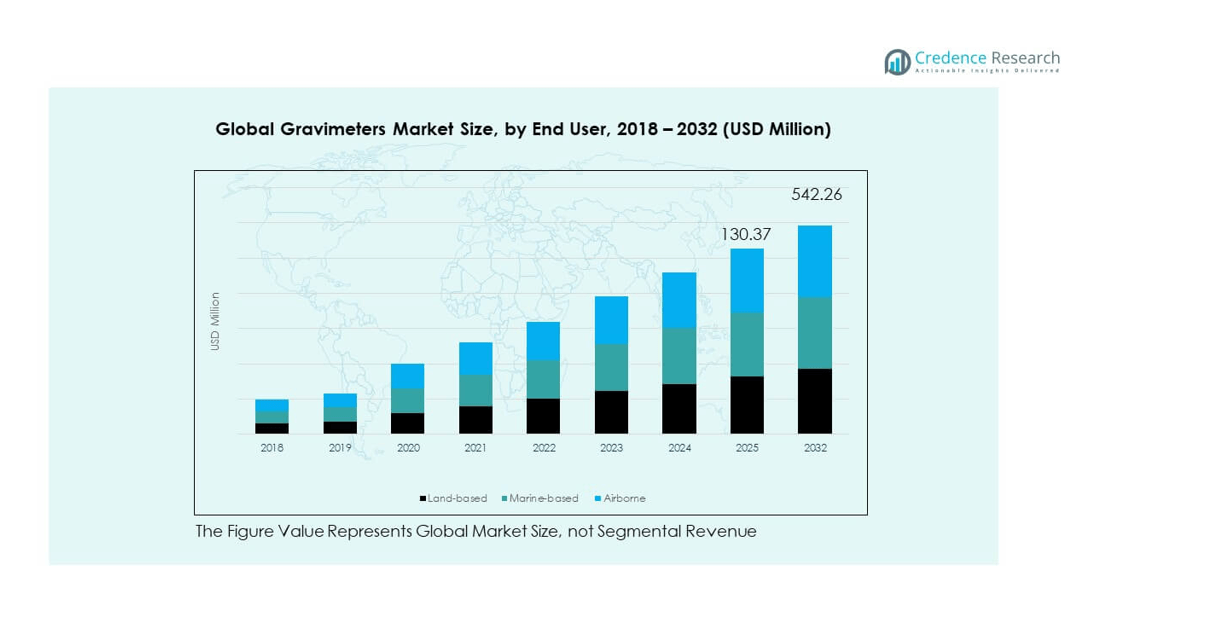
The Global Gravimeters Market is segmented into absolute and relative gravimeters. Absolute gravimeters are witnessing strong adoption due to their ability to deliver high precision in geophysical surveys and research applications. Their advanced technology makes them suitable for long-term monitoring of geodynamic processes. Relative gravimeters dominate field exploration activities due to their practicality and lower cost. Mining, oil, and civil engineering projects rely on relative models for quick subsurface assessments. The balance of accuracy and affordability drives strong demand across both categories.
- For instance, the JILA absolute gravimeter, used by the National Geodetic Survey in the late 1980s, could achieve a high degree of repeatability, with precision as high as ±1 microgal under optimal conditions. While its initial projected accuracy was between ±3 and ±5 microgals, the instrument enabled the precise monitoring of vertical ground motions, which is valuable for geodynamic studies and the calibration of relative instruments.
By Application
Gravimeters are widely used across oil and gas exploration, mineral exploration, geological mapping, civil engineering, and other applications. Oil and gas operators depend on gravimeters for reliable subsurface density measurements that reduce drilling risks. Mineral exploration projects use them to identify deposits with improved efficiency. Geological mapping benefits from their accuracy in structural studies. Civil engineering leverages gravimeters for infrastructure planning, especially for tunnels, dams, and bridges. Other applications include environmental monitoring and hydrology. This diverse demand base supports sustained growth.
- For example, GOCE satellite data collected at 255 km altitude by ESA has been effectively used in mineral exploration to map gravity disturbances and delineate terrain types, with over 600 control points confirmed via ground truthing, demonstrating the utility of gravimetry in large-scale geological classification.
By Platform
The market is categorized into land-based, marine-based, and airborne platforms. Land-based gravimeters dominate due to their extensive use in civil projects, exploration, and academic research. Marine-based platforms play a vital role in offshore oil exploration and seafloor mapping. Airborne gravimeters are gaining traction with their ability to cover large survey areas quickly, particularly in remote or inaccessible regions. It reflects strong adoption across industries that require accurate and efficient gravity data collection, ensuring steady growth across all platform segments.
Segmentation:
By Output
- Absolute Gravimeters
- Relative Gravimeters
By Application
- Oil and Gas Exploration
- Mineral Exploration
- Geological Mapping
- Civil Engineering
- Others
By Platform
- Land-based Gravimeters
- Marine-based Gravimeters
- Airborne Gravimeters
By Region
- North America
- U.S.
- Canada
- Mexico
- Europe
- UK
- France
- Germany
- Italy
- Spain
- Russia
- Rest of Europe
- Asia Pacific
- China
- Japan
- South Korea
- India
- Australia
- Southeast Asia
- Rest of Asia Pacific
- Latin America
- Brazil
- Argentina
- Rest of Latin America
- Middle East
- GCC Countries
- Israel
- Turkey
- Rest of Middle East
- Africa
- South Africa
- Egypt
- Rest of Africa
Regional Analysis:
North America
The North America Gravimeters Market size was valued at USD 7.20 million in 2018 to USD 25.12 million in 2024 and is anticipated to reach USD 124.18 million by 2032, at a CAGR of 22.3% during the forecast period. North America holds a strong share of the Global Gravimeters Market, driven by advanced exploration activities across oil, gas, and mineral industries. The region benefits from established research infrastructure and significant investment in geophysical technologies. Universities, government agencies, and private firms actively deploy gravimeters for environmental monitoring and civil engineering projects. It also benefits from growing adoption in hydrological surveys and seismic studies. The U.S. leads regional demand, supported by strong funding for innovation and large-scale exploration programs. Canada contributes significantly with extensive mining activities and geological mapping. Mexico also shows increasing uptake in infrastructure and energy projects. North America accounts for around 23% of the market share in 2024, positioning it as a key revenue generator.
Europe
The Europe Gravimeters Market size was valued at USD 8.18 million in 2018 to USD 28.07 million in 2024 and is anticipated to reach USD 135.56 million by 2032, at a CAGR of 21.9% during the forecast period. Europe secures a significant portion of the Global Gravimeters Market, supported by its strong academic research ecosystem and advanced infrastructure projects. Gravimeters play a critical role in geological mapping, seismic studies, and environmental monitoring. It sees rising demand in countries such as Germany, France, and the UK, where investments in renewable energy and underground infrastructure remain high. Civil engineering projects, including tunnels, metro systems, and bridges, create steady demand. Russia also contributes with exploration of natural resources and mining activities. The European Union’s focus on environmental sustainability accelerates adoption in hydrology and glacier monitoring studies. The combination of industrial, academic, and governmental use cases ensures broad adoption. Europe holds nearly 26% of the market share in 2024, reflecting its strong regional dominance.
Asia Pacific
The Asia Pacific Gravimeters Market size was valued at USD 9.20 million in 2018 to USD 34.12 million in 2024 and is anticipated to reach USD 182.58 million by 2032, at a CAGR of 23.5% during the forecast period. Asia Pacific leads the Global Gravimeters Market with rapid expansion across exploration and infrastructure sectors. China and India drive strong demand due to extensive mining activities and large-scale infrastructure projects. It also sees increasing adoption in seismic monitoring and earthquake risk assessment due to regional vulnerabilities. Japan and South Korea integrate gravimeters in advanced research and renewable energy programs. Australia contributes significantly through mining and environmental studies. Southeast Asia expands adoption through hydrological monitoring and civil engineering projects. Regional governments support investment in geophysical surveys to enhance resource management. Asia Pacific accounts for about 32% of the market share in 2024, making it the largest regional contributor.
Latin America
The Latin America Gravimeters Market size was valued at USD 2.71 million in 2018 to USD 9.42 million in 2024 and is anticipated to reach USD 46.36 million by 2032, at a CAGR of 22.2% during the forecast period. Latin America contributes steadily to the Global Gravimeters Market with a focus on mineral exploration and resource mapping. Countries like Brazil and Argentina lead demand due to extensive mining operations. It also benefits from hydrological studies that support agriculture and water resource management. Geological mapping remains vital in addressing environmental and land development challenges. The market is supported by regional collaborations with international research institutes. Civil engineering projects in urban centers also create opportunities for gravimeter adoption. Rising focus on renewable energy projects strengthens the demand base. Latin America secures around 9% of the market share in 2024, reflecting its growing but niche presence.
Middle East
The Middle East Gravimeters Market size was valued at USD 2.06 million in 2018 to USD 7.35 million in 2024 and is anticipated to reach USD 37.42 million by 2032, at a CAGR of 22.7% during the forecast period. The Middle East shows consistent adoption of gravimeters, supported by its oil and gas industry. Exploration of subsurface reserves remains the primary driver of demand. It also supports infrastructure development in urban expansion projects across GCC nations. Israel contributes through advanced research and environmental monitoring applications. Turkey sees rising adoption in energy and civil engineering projects. Gravimeters also play a role in hydrological studies in water-scarce regions. Governments invest in technology to enhance geological mapping and exploration efficiency. The Middle East holds around 7% of the market share in 2024, with growth tied closely to energy and infrastructure projects.
Africa
The Africa Gravimeters Market size was valued at USD 1.07 million in 2018 to USD 3.55 million in 2024 and is anticipated to reach USD 16.16 million by 2032, at a CAGR of 21.0% during the forecast period. Africa remains an emerging market for gravimeters, with demand concentrated in mining and exploration projects. South Africa leads regional adoption due to its strong mining industry. It also benefits from hydrological monitoring and environmental studies. Egypt contributes through infrastructure development and geological mapping initiatives. Other countries show rising uptake with support from international collaborations. The limited availability of advanced infrastructure slows wider adoption, but opportunities are growing. Rising investments in resource exploration projects drive market momentum. Africa accounts for about 3% of the market share in 2024, marking it as a growing but smaller regional contributor.
Key Player Analysis:
- Muquans
- KMS Technologies
- Micro-g LaCoste
- GWR Instruments
- Scintrex Limited
- iXblue
- Q-CTRL
- AOSense, Inc.
- Honeywell International Inc.
- Teledyne Technologies Incorporated
- Other Key Players
Competitive Analysis:
The Global Gravimeters Market is characterized by the presence of specialized companies focusing on precision instruments for exploration, research, and infrastructure applications. Competition is shaped by product innovation, accuracy improvements, and integration with digital technologies. Key players emphasize strategic partnerships with research institutes and governments to expand adoption. It is also influenced by growing demand for portable and cost-efficient models that broaden accessibility across industries. The market remains moderately concentrated, with firms like Scintrex Limited, Micro-g LaCoste, GWR Instruments, and Muquans leading technological advancements.
Recent Developments:
- In May 2025, KMS Technology appointed Choon Aun Quek as Chief Growth Officer. With over 20 years of experience at leading global tech firms, his role focuses on expanding KMS's global delivery, enhancing AI-driven solutions, and driving client success across industries.
- In November 2024, KMS Technology secured a strategic investment from Sunstone Partners to boost growth and innovation. This investment is aimed at building teams, deepening service offerings, and expanding the company's impact globally, especially in AI-driven engineering solutions and digital transformation services.
Report Coverage:
The research report offers an in-depth analysis based on Output, Application, and Platform. It details leading market players, providing an overview of their business, product offerings, investments, revenue streams, and key applications. Additionally, the report includes insights into the competitive environment, SWOT analysis, current market trends, as well as the primary drivers and constraints. Furthermore, it discusses various factors that have driven market expansion in recent years. The report also explores market dynamics, regulatory scenarios, and technological advancements that are shaping the industry. It assesses the impact of external factors and global economic changes on market growth. Lastly, it provides strategic recommendations for new entrants and established companies to navigate the complexities of the market.
Future Outlook:
- Demand for gravimeters will expand with rising exploration activities across oil, gas, and mining.
- Civil engineering projects will integrate gravimeters to ensure safer infrastructure development.
- Advancements in quantum technology will enhance accuracy and operational efficiency.
- Portable gravimeter models will gain adoption in academic and field survey applications.
- Marine-based gravimeters will see growth with offshore exploration initiatives.
- Airborne gravimeters will strengthen their role in covering remote and inaccessible terrains.
- Research funding will boost environmental and hydrological monitoring applications.
- Asia Pacific will remain the fastest-growing regional hub with diverse applications.
- Collaborations between industry and academia will accelerate technology innovation.
- Long-term opportunities will emerge in planetary and space exploration projects.
Request a Free Sample
Fill in your details and we'll send you a free sample report.
- Sample data tables & charts
- Research methodology
Need a Custom Version of This Report?
Tailor the scope, geography, or segments to your exact requirements.
- Custom geography or segment scope
- Direct access to our analyst team
Frequently Asked Questions
What is the current market size for Global Gravimeters Market, and what is its projected size in 2032?
At what Compound Annual Growth Rate is the Global Gravimeters Market projected to grow between 2025 and 2032?
Which Global Gravimeters Market segment held the largest share in 2024?
What are the primary factors fueling the growth of the Global Gravimeters Market?
Who are the major players in this market?
Table of Content
Chapter 1. Report Introduction
- 1.1 Report Description & Purpose
- 1.1.1 Report Title & Market Definition
- 1.1.2 Unique Selling Propositions (USP) & Key Differentiators
- 1.1.3 Value Proposition for Stakeholders
- 1.2 Research Objectives
- 1.2.1 Market Sizing Objectives (Volume & Revenue)
- 1.2.2 Segmentation Objectives
- 1.2.3 Competitive Intelligence Objectives
- 1.2.4 Forecast & Scenario Objectives
- 1.3 Report Scope
- 1.3.1 Gravimeters Scope – Types & Subtypes Covered
- 1.3.2 Geographic Scope – Regions & Countries Covered
- 1.3.3 Historical Period, Base Year & Forecast Period (2024; forecast to 2032)
- 1.3.4 Inclusions & Exclusions
- 1.4 HS Code & Classification Framework
- 1.5 Currency, Units & Pricing Basis
- 1.6 Target Stakeholders
- 1.7 Limitations & Assumptions
Chapter 2. Executive Summary
- 2.1 Global Gravimeters Market Snapshot
- 2.1.1 Market Size – Historical (2024) & Forecast (2024-2032) (2024: USD 107.6 million → 2032: USD 542.3 million)
- 2.1.2 Volume & Revenue – Global Totals
- 2.1.3 Key Market Highlights – Top Five Facts
- 2.2 Gravimeters Market Segmentation Snapshot
- 2.2.1 Market Split by Region – 2024 vs. 2032
- 2.3 Competitive Snapshot
- 2.3.1 Top 10 Players by Revenue Share – 2024
- 2.3.2 Top 10 Players by Volume Share – 2024
- 2.3.3 Recent Strategic Developments (18-Month Summary)
- 2.4 Key Investment Highlights & Strategic Conclusions
Chapter 3. Gravimeters Market Dynamics & Industry Analysis
- 3.1 Market Overview & Context
- 3.1.1 Gravimeters Market Position in the Broader Automotive Value Chain
- 3.1.2 OEM vs. Replacement Market Dynamics
- 3.1.3 Market Maturity & Development Stage by Region
- 3.2 Gravimeters Market Drivers
- 3.3 Gravimeters Market Restraints & Challenges
- 3.4 Gravimeters Market Opportunities
- 3.5 Porter's Five Forces Analysis
- 3.5.1 Threat of New Entrants
- 3.5.2 Bargaining Power of Suppliers
- 3.5.3 Bargaining Power of Buyers
- 3.5.4 Threat of Substitutes
- 3.5.5 Competitive Rivalry – Intensity Assessment
- 3.6 Gravimeters Value Chain Analysis
- 3.6.1 Upstream – Raw Material/Input Suppliers
- 3.6.1.1 Raw Material/Input 1
- 3.6.1.2 Raw Material/Input 2
- 3.6.1.3 Raw Material/Input 3
- 3.6.2 Midstream – Production/Manufacturing/Service Delivery
- 3.6.2.1 Production/Process Overview
- 3.6.2.2 Key Facility Locations & Capacity by Manufacturer
- 3.6.3 Downstream – Distribution & End Consumer
- 3.6.3.1 Primary Channel – B2B/OEM
- 3.6.3.2 Secondary Channels – Dealer, Retail, Online, Direct
- 3.6.4 Value Chain Profitability Analysis
- 3.6.1 Upstream – Raw Material/Input Suppliers
- 3.7 PESTEL Analysis
- 3.7.1 Political Factors
- 3.7.2 Economic Factors
- 3.7.3 Social Factors
- 3.7.4 Technological Factors
- 3.7.5 Environmental Factors
- 3.7.6 Legal Factors
- 3.8 Gravimeters Supply Chain Analysis
- 3.8.1 Raw Material/Input Supply Risk Assessment
- 3.8.2 Manufacturing Concentration Risk (Geographic Exposure)
- 3.8.3 Trade Disruption Impact Analysis
- 3.9 Regulatory & Policy Landscape
Note: The regulatory and policy landscape section covers regulations based on their applicability to the market, Gravimeters category, geography, and scope of the study. Only regulatory frameworks with a material impact on operations, compliance, trade, sustainability, or market access are analyzed in detail.
Chapter 4. Key Investment Pockets & Opportunity Analysis
- 4.1 Gravimeters Market Attractiveness Analysis
- 4.1.1 By Region – Investment Attractiveness Matrix (Volume × CAGR)
- 4.2 Absolute Revenue Growth Opportunity
- 4.2.1 By Region – Absolute USD Growth Through 2032
- 4.3 Incremental Volume Opportunity
- 4.3.1 By Region – Incremental Volume Through 2032
- 4.3.2 Segment – Incremental Volume
- 4.4 Emerging Submarket Opportunity Deep Dive (Subject to Applicability)
- 4.5 Emerging Market Opportunity Scorecards
- 4.5.1 United States
- 4.5.2 Europe
- 4.5.3 Asia
- 4.5.4 Middle East & Africa
Note: Emerging Market Opportunity Scorecards will be included based on relevance and strategic importance. Regions listed are indicative and may vary depending on data availability and market dynamics.
Chapter 5. Gravimeters Import-Export Analysis & Trade Flows
- 5.1 Global Trade Overview
- 5.1.1 Global Export Value by Country (2024)
- 5.1.2 Global Export Volume by Country (2024)
- 5.1.3 Global Import Value by Country (2024)
- 5.1.4 Global Import Volume by Country (2024)
- 5.1.5 Net Trade Balance by Country (2024)
- 5.2 Export Analysis – Segment
- 5.2.1 Type 1 (HS Code)
- 5.2.2 Type 2 (HS Code)
- 5.2.3 Type 3 (HS Code)
- 5.2.4 Type 4 (HS Code)
- 5.2.5 Type 5 (HS Code)
- 5.3 Import Analysis – Segment
- 5.3.1 Type 1 (HS Code)
- 5.3.2 Type 2 (HS Code)
- 5.3.3 Type 3 (HS Code)
- 5.3.4 Type 4 (HS Code)
- 5.3.5 Type 5 (HS Code)
- 5.4 Average Unit Trade Prices
- 5.4.1 Average Export Price – Segment & Country
- 5.4.2 Average Import Price – Segment & Source Country
- 5.4.3 Price Trends (2024)
- 5.5 Key Trade Route Analysis
- 5.5.1 Trade Route 1
- 5.5.2 Trade Route 2
- 5.5.3 Trade Route 3
- 5.5.4 Trade Route 4
- 5.5.5 Trade Route 5
- 5.6 Trade Policy Impact Assessment
- 5.6.1 US Anti-Dumping & Section 301 Tariffs
- 5.6.2 EU Customs Union Impact
- 5.6.3 Major Free Trade Agreements
- 5.6.4 USMCA Rules of Origin
Note: Trade policy analysis will be included only where relevant to the Gravimeters market.
Chapter 6. Competitive Landscape & Company Benchmarking
- 6.1 Gravimeters Market Concentration & Structure
- 6.1.1 Herfindahl-Hirschman Index (HHI) – vs. 2024
- 6.1.2 Tier 1, Tier 2 & Tier 3 Market Structure
- 6.1.3 Global, Regional & Local Player Dynamics
- 6.2 Gravimeters Market Share Analysis – 2024
- 6.2.1 Global Revenue Share by Company
- 6.2.2 Global Volume Share by Company
- 6.2.3 Regional Revenue Share
- 6.2.4 Market Share Evolution ( vs. 2024)
- 6.2.5 OEM Segment Share by Company
- 6.2.6 Replacement Segment Share by Company
- 6.3 Production/Delivery Capacity & Facility Analysis
- 6.3.1 Global Installed Capacity
- 6.3.2 Capacity Utilization Rates
- 6.3.3 Production/Output Volume
- 6.3.4 Facility Locations & Capacity Map
- 6.3.5 Planned Capacity Additions
- 6.4 Gravimeters Competitive Benchmarking Matrix
- 6.4.1 Revenue, Volume, CAGR & Profitability Comparison
- 6.4.2 Channel Revenue Mix
- 6.4.3 Geographic Revenue Exposure
- 6.4.4 R&D Intensity
- 6.4.5 Sustainability Maturity
- 6.5 Strategic Developments in Gravimeters (Last 24 Months)
- 6.5.1 Mergers, Acquisitions & Divestments
- 6.5.2 New Gravimeters Launches
- 6.5.3 Facility Expansions
- 6.5.4 Strategic Alliances, Joint Ventures & Partnerships
- 6.5.5 Distribution Expansion & Market Entry
- 6.5.6 Sustainability & ESG Initiatives
- 6.6 Competitive Strategy Mapping
- 6.6.1 Leader, Challenger, Follower & Niche Classification
- 6.6.2 Pricing Strategy Comparison
- 6.6.3 Channel Strategy Matrix
Note: Strategic developments are included based on their materiality and the availability of reliable information.
Chapter 7. Global Gravimeters Market – By Distribution Channel
- 7.1 Segment Overview
- 7.1.1 Volume & Revenue Split by Channel (2024 & 2032)
- 7.1.2 Channel Mix Evolution (2024-2032)
Chapter 8. Regional Market Analysis – Global Overview
- 8.1 Global Regional Overview
- 8.1.1 Regional Volume Share
- 8.1.2 Regional Revenue Share
- 8.1.3 Regional Volume by Region
- 8.1.4 Regional Revenue by Region
- 8.1.5 Regional Forecast Through 2032
- 8.2 Cross-Regional Segment Analysis
- 8.2.1 By Distribution Channel
- 8.2.2 By Brand/Price Tier
Chapter 9. North America Gravimeters Market
- 9.1 United States
- 9.2 Canada
- 9.3 Mexico
Chapter 10. Europe Gravimeters Market
- 10.1 Germany
- 10.2 France
- 10.3 Italy
- 10.4 United Kingdom
- 10.5 Spain
- 10.6 Poland
- 10.7 Russia
- 10.8 Netherlands
- 10.9 Belgium
- 10.10 Sweden
- 10.11 Denmark
- 10.12 Norway
- 10.13 Rest of Europe
Chapter 11. Asia Pacific Gravimeters Market
- 11.1 China
- 11.2 India
- 11.3 Japan
- 11.4 South Korea
- 11.5 Thailand
- 11.6 Indonesia
- 11.7 Vietnam
- 11.8 Malaysia
- 11.9 Australia
- 11.10 Rest of Asia Pacific
Chapter 12. Latin America Gravimeters Market
- 12.1 Brazil
- 12.2 Argentina
- 12.3 Colombia
- 12.4 Chile
- 12.5 Rest of Latin America
Chapter 13. Middle East Gravimeters Market
- 13.1 Saudi Arabia
- 13.2 United Arab Emirates
- 13.3 Turkey
- 13.4 Israel
- 13.5 Iran
- 13.6 Rest of the Middle East
Chapter 14. Africa Gravimeters Market
- 14.1 South Africa
- 14.2 Egypt
- 14.3 Nigeria
- 14.4 Morocco
- 14.5 Rest of Africa
Chapter 15. Gravimeters Company Profiles
- 15.1 [Company 01]
- 15.1.1 Company Overview
- 15.1.2 Key Management Personnel
- 15.1.3 Products & Services Portfolio
- 15.1.4 Financial Performance
- 15.1.5 Key Market Focus & Geographic Presence
- 15.1.6 Recent Developments & Strategic Initiatives
Note: The company profile list is preliminary and may change based on research findings, market developments, data availability, and client requirements.
Chapter 16. Appendices
- Appendix A – List of Abbreviations & Acronyms
- Appendix B – Industry Classification Code Reference – Full Series
- Appendix C – Production & Capacity Data Tables
- Appendix D – End-Use & Demand Base Tables
- Appendix E – Consumption & Replacement Rate Assumptions
- Appendix F – ASP Reference Tables
- Appendix G – Manufacturing & Facility Database
- Appendix H – Import-Export Data Tables
- Appendix I – Regulatory Summary Tables
- Appendix J – Primary Research Participant List (Anonymized)
- Appendix K – Primary Research Questionnaire Framework
- Appendix L – Data Sources & Bibliography
- Appendix M – Market Size Divergence & Source Comparison
Chapter 17. Research Methodology
- 17.1 Research Framework & Philosophy
- 17.2 Secondary Research – Sources, Hierarchy & Data Extraction
- 17.3 Data Modeling – Bottom-Up & Top-Down Market Sizing
- 17.4 Primary Research – Stakeholder Framework, LOI & Sample Sizes
- 17.5 Forecast Methodology – Regression, Scenario & Sensitivity Analysis
- 17.6 Quality Control – Four-Layer Validation Framework
- 17.7 Limitations & Standard Assumptions
- 17.8 Disclaimer
