Market Overview:
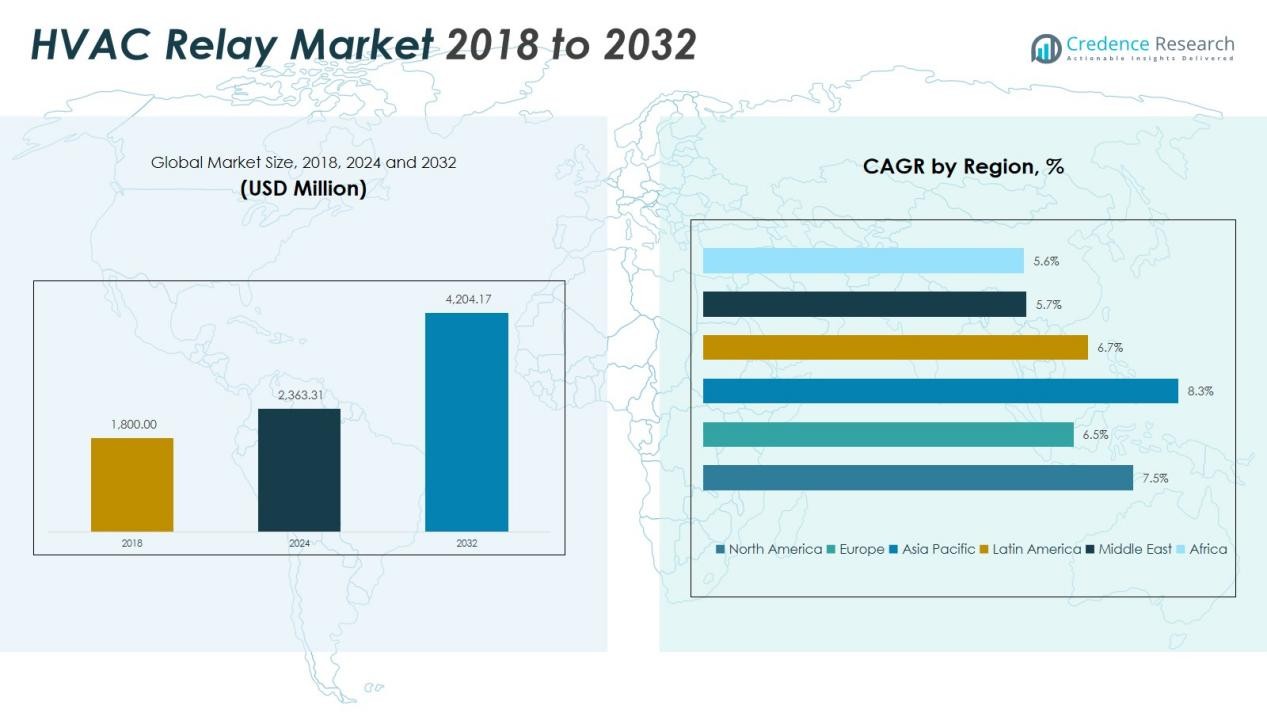
The Global HVAC Relay Market size was valued at USD 1,800 million in 2018 to USD 2,363.31 million in 2024 and is anticipated to reach USD 4,204.17 million by 2032, at a CAGR of 7.51% during the forecast period.
| REPORT ATTRIBUTE | DETAILS |
|---|---|
| Historical Period | 2020-2023 |
| Base Year | 2024 |
| Forecast Period | 2025-2032 |
| HVAC Relay Market Size 2024 | USD 2,363.31 Million |
| HVAC Relay Market, CAGR | 7.51% |
| HVAC Relay Market Size 2032 | USD 4,204.17 Million |
Growth is driven by the rising demand for energy-efficient HVAC systems and increasing construction of commercial and residential buildings. Stricter energy-efficiency regulations and the rapid adoption of smart building technologies are accelerating HVAC relay integration. Expanding applications in automotive climate-control systems and replacement of legacy units also boost market growth.
Asia Pacific dominates the global HVAC relay market due to rapid urbanization, a surge in construction activity, and expanding automotive manufacturing in China, India, and Southeast Asia. North America follows, supported by strong adoption of green-building technologies and the replacement of outdated HVAC systems in the United States and Canada. Europe records moderate growth, backed by regulatory emphasis on energy efficiency and refurbishment of older infrastructure.
Market Insights:
- The Global HVAC Relay Market was valued at USD 1,800 million in 2018, reached USD 2,363.31 million in 2024, and is projected to attain USD 4,204.17 million by 2032, growing at a CAGR of 7.51% during the forecast period.
- Asia Pacific leads with a 35% share due to rapid urbanization, construction growth, and expanding automotive production in China and India. North America follows with a 28% share, supported by energy-efficiency regulations and modernization of HVAC systems in the U.S. and Canada. Europe holds a 23% share, driven by strong environmental policies and renovation of aging infrastructure.
- Asia Pacific remains the fastest-growing region, benefiting from government-backed smart city initiatives, industrial expansion, and a strong manufacturing base across emerging economies.
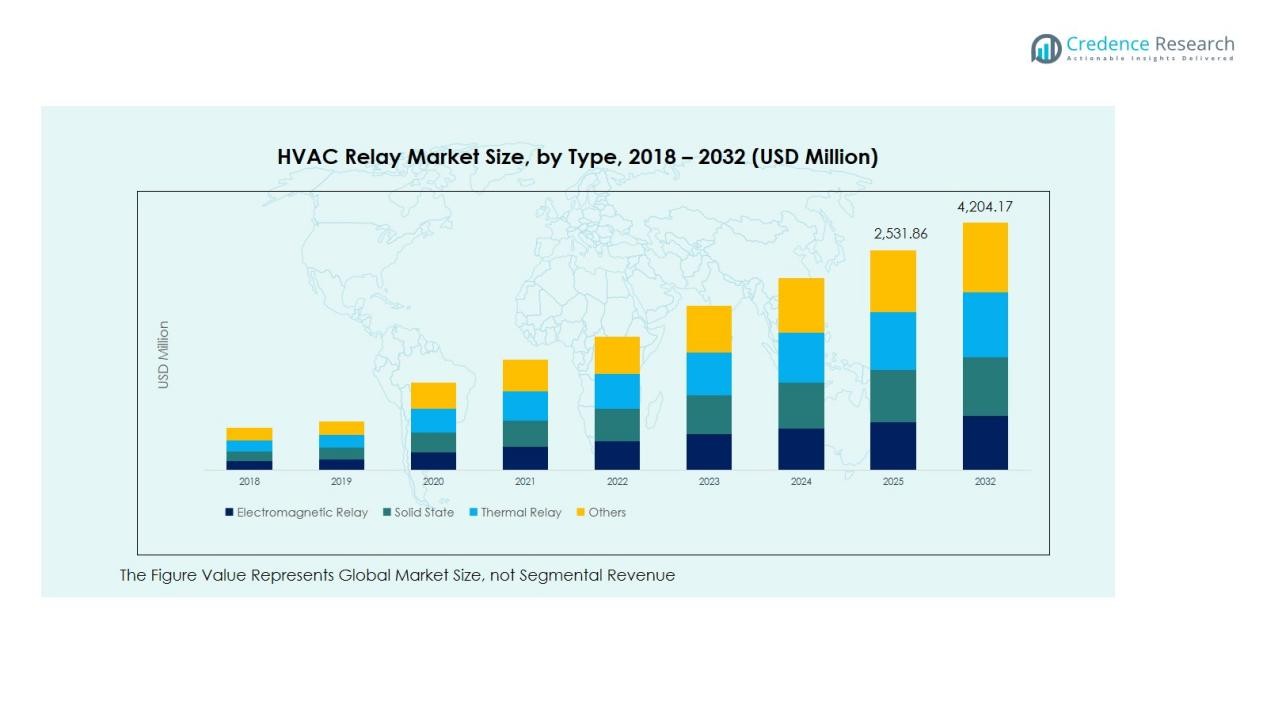
- By type, electromagnetic relays account for 42% of total revenue, driven by reliability and widespread adoption across HVAC systems. Solid-state relays hold 27% market share, reflecting rising demand for compact, efficient, and long-lasting relay solutions.
Market Drivers:
Rising Demand for Energy-Efficient HVAC Systems across Commercial and Residential Sectors
The Global HVAC Relay Market benefits from growing awareness of energy conservation and sustainability. Consumers and building owners are focusing on systems that reduce electricity usage and operating costs. Energy-efficient HVAC relays improve control precision, minimize power loss, and enhance system reliability. Governments across regions are introducing stricter building energy codes, pushing industries toward high-efficiency components. It continues to gain traction with retrofitting programs in older commercial buildings.
- For instance, during a pilot program at Hamdan Bin Mohammed Smart University (HBMSU), the Honeywell Forge Energy Optimization solution alone demonstrated an initial 10% energy savings, which helps decrease a building's carbon footprint. Honeywell reports executing 240 projects in 2022 aimed at reducing their own carbon footprint, and their technologies are used in over 10 million buildings globally to help meet sustainability goals.
Expansion of Smart Building Infrastructure and Automation Integration
The integration of automation and smart technologies across commercial and industrial facilities drives demand for intelligent HVAC relays. These relays support programmable logic control and remote monitoring, enabling adaptive temperature management and fault detection. Smart relays also assist in predictive maintenance, reducing equipment downtime and service costs. The growing use of IoT-enabled HVAC systems in offices, data centers, and hospitals supports this trend. It aligns with global movement toward digital building management.
- For instance, a major US hospital network consisting of 6 hospitals, 1 medical warehouse, and 1 medical laboratory implemented a unified smart building platform integrating 48,993 total connection points and over 800 real-time energy metering sensors, which achieved $2.7 million in annual savings through optimized HVAC operations and fault diagnostics.
Growth in Automotive HVAC Applications and Electrification Trends
Automotive manufacturers are increasingly installing advanced HVAC systems to enhance passenger comfort and safety. The transition toward electric and hybrid vehicles creates new demand for compact, high-performance relays capable of handling variable loads. It benefits from the integration of relays that manage heating, cooling, and ventilation within battery-driven platforms. Rising vehicle production in Asia and Europe strengthens the application base.
Government Regulations Promoting Green Technologies and Safety Standards
Government policies emphasizing sustainability and lower emissions encourage adoption of eco-friendly HVAC technologies. Relay manufacturers are innovating to meet safety and energy compliance standards set by international agencies. It experiences demand from retrofits and new installations aimed at achieving LEED and Energy Star certifications. Regulatory incentives for renewable-powered HVAC systems also support steady market expansion.
Market Trends:
Adoption of Smart Relays and IoT-Integrated HVAC Control Systems
The Global HVAC Relay Market is witnessing a strong shift toward smart and connected control solutions. Manufacturers are introducing relays equipped with IoT functionality, remote monitoring, and digital diagnostics to enhance efficiency and reliability. Smart relays allow automated fault detection, real-time temperature optimization, and communication with building management systems. It supports predictive maintenance and energy optimization in large-scale facilities. The trend aligns with the growth of smart cities and intelligent infrastructure projects. Demand for relays compatible with AI-driven control platforms and cloud-based monitoring continues to rise. Manufacturers are expanding production of compact, programmable, and high-load relays tailored for next-generation HVAC systems.
- For instance, ControlByWeb's WebRelay-10 industrial-grade smart relay platform features integrated no-code logic builders, peer-to-peer communication protocols, and support for 10 independent Form-C SPDT relays with up to 16 networked temperature sensor integration points, enabling distributed HVAC control across multiple facility zones without requiring proprietary programming expertise.
Increasing Focus on Miniaturization, Solid-State Relays, and Sustainable Materials
Miniaturized and solid-state relays are gaining traction across HVAC applications for their durability, low noise, and improved switching performance. It reflects the growing preference for lightweight and space-saving solutions in compact air conditioning and ventilation units. Solid-state designs offer longer life cycles and improved resistance to vibration and temperature fluctuations. Manufacturers are investing in recyclable and halogen-free materials to meet environmental compliance standards. The transition from electromechanical to solid-state models enhances operational safety and energy efficiency. Demand is expanding among industrial HVAC systems that require precise load control and higher switching frequency. The shift toward sustainable and high-performance materials reinforces innovation across relay design and production processes.
- For Instance, Littelfuse introduced its SRP1 Solid-State Relay series in August 2024 for applications such as HVAC, offering models with a 25A output capacity.
Market Challenges Analysis:
High Product Cost and Complexity of Advanced Relay Systems
The Global HVAC Relay Market faces challenges linked to the high cost of advanced electronic and solid-state relay systems. Manufacturers often struggle to balance performance, reliability, and affordability for large-scale applications. Complex relay configurations require skilled technicians for installation and maintenance, increasing operational expenses. It faces slow adoption in cost-sensitive regions where mechanical relays still dominate. Limited standardization across HVAC designs further complicates system integration. The cost of developing energy-efficient and IoT-enabled relays also pressures smaller manufacturers with limited R&D budgets.
Supply Chain Disruptions and Shortage of Semiconductor Components
Ongoing supply chain instability and semiconductor shortages create production delays and pricing pressure. HVAC relay manufacturers face challenges in sourcing critical components like coils, contacts, and chips. It impacts delivery schedules and reduces inventory flexibility for OEMs. The dependence on imported electronic parts exposes manufacturers to geopolitical risks and currency fluctuations. Strict regulatory compliance regarding electronic waste and safety testing adds to manufacturing costs. The shortage of skilled labor in electrical and automation industries further slows production and innovation cycles.
Market Opportunities:
Expansion of Smart Infrastructure and Renewable Energy Integration
The Global HVAC Relay Market is positioned to benefit from growing investments in smart buildings and renewable-powered infrastructure. Governments and developers are prioritizing automation, remote control, and energy efficiency across residential and commercial projects. Integration of HVAC systems with solar and wind energy sources creates new demand for advanced relays capable of dynamic load balancing. It supports growth through applications in energy-efficient data centers, airports, and healthcare facilities. The trend toward net-zero buildings strengthens the need for adaptive relay systems. Partnerships between relay manufacturers and smart system integrators open new revenue channels.
Technological Advancements and Shift Toward Predictive Maintenance Solutions
Technological progress in digital sensors and AI-driven control systems is creating strong opportunities for HVAC relay innovation. Smart relays capable of condition monitoring and predictive fault detection are gaining wide acceptance. It helps reduce maintenance costs and improves overall equipment reliability. Manufacturers are exploring advanced semiconductor materials to enhance switching efficiency and thermal performance. Demand for relays compatible with cloud-based monitoring platforms is expanding across industrial and automotive sectors. The shift toward intelligent HVAC systems presents a scalable opportunity for global manufacturers focused on automation-driven efficiency.
Market Segmentation Analysis:
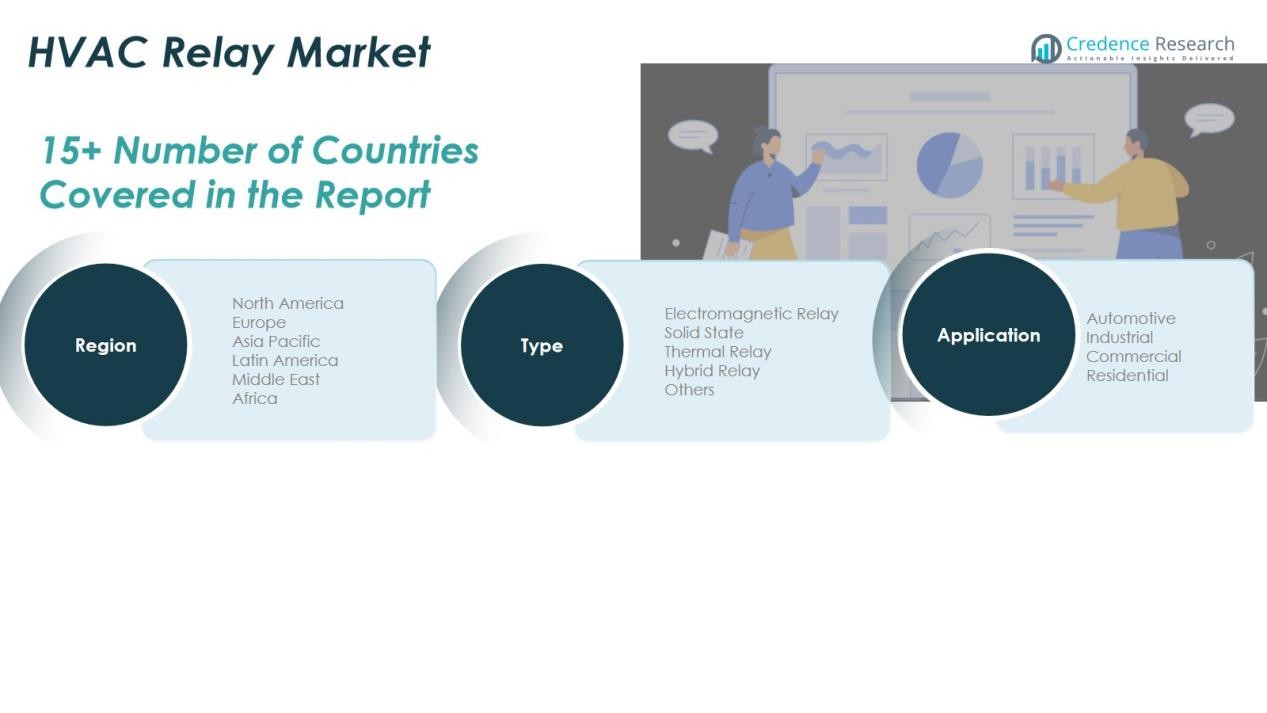
By Type
The Global HVAC Relay Market is segmented into electromagnetic, solid-state, thermal, hybrid, and other relay types. Electromagnetic relays hold a significant share due to their reliability, cost-effectiveness, and wide adoption in traditional HVAC systems. Solid-state relays are gaining traction for their silent operation, durability, and ability to handle high-frequency switching. Hybrid relays combine the strengths of electromagnetic and solid-state designs, offering extended life and better energy efficiency. It benefits from the rising shift toward compact, high-performance relays that meet modern HVAC system requirements. Thermal relays continue to serve in protective and overload applications, ensuring operational safety.
- For instance, Honeywell offers various switches and relays, where a mechanical life of 1,000,000 cycles is a common specification for certain product lines, such as the GPR (General Purpose Relay) series or specific micro switches.
By Application
The market is classified into automotive, industrial, commercial, and residential applications. Industrial and commercial segments dominate due to large-scale HVAC installations requiring precise control and reliability. Automotive applications are expanding rapidly with the increasing integration of climate-control systems in electric and hybrid vehicles. Residential adoption grows with smart home trends and consumer demand for energy-efficient comfort systems. It experiences consistent growth through modernization of existing buildings and increased focus on automation across all sectors. Each application segment contributes to advancing relay innovation and reinforcing energy efficiency standards globally.
- For instance, Phoenix Contact's PLC-INTERFACE relay circuit breaker won the Control Engineering 2025 Product of the Year Award in the "Power" category, featuring a compact 6.2 mm width design that optimizes control cabinet space while maintaining rated currents from 1 to 6 A with individual configuration capability via DIP switches.
Segmentations:
By Type
- Electromagnetic Relay
- Solid-State Relay
- Thermal Relay
- Hybrid Relay
- Others
By Application
- Automotive
- Industrial
- Commercial
- Residential
By Region
North America
- U.S.
- Canada
- Mexico
- Europe
- UK
- France
- Germany
- Italy
- Spain
- Russia
- Rest of Europe
Asia Pacific
- China
- Japan
- South Korea
- India
- Australia
- Southeast Asia
- Rest of Asia Pacific
Latin America
- Brazil
- Argentina
- Rest of Latin America
Middle East
- GCC Countries
- Israel
- Turkey
- Rest of Middle East
Africa
- South Africa
- Egypt
- Rest of Africa
Regional Analysis:
North America
The North America HVAC Relay Market size was valued at USD 447.66 million in 2018 to USD 577.34 million in 2024 and is anticipated to reach USD 1,024.98 million by 2032, at a CAGR of 7.5% during the forecast period. North America holds 28% of the global market share, supported by advanced infrastructure and strong adoption of energy-efficient HVAC technologies. The region benefits from regulatory mandates promoting eco-friendly and smart HVAC systems. High demand for automated building management systems in the U.S. and Canada drives consistent relay usage. It gains further momentum from large-scale replacement of legacy units in commercial buildings and industrial facilities. Strong presence of leading manufacturers such as General Electric and Eaton enhances regional competitiveness.
Europe
The Europe HVAC Relay Market size was valued at USD 350.10 million in 2018 to USD 435.49 million in 2024 and is anticipated to reach USD 715.77 million by 2032, at a CAGR of 6.5% during the forecast period. Europe captures 23% of the global share, driven by growing emphasis on energy performance standards and environmental compliance. Stringent EU directives encourage the use of advanced control components in HVAC systems. The market expands through the refurbishment of aging infrastructure in Germany, France, and the UK. It witnesses steady adoption of solid-state and hybrid relays across industrial and commercial sectors. Investments in smart city projects and renewable-powered buildings further strengthen demand.
Asia Pacific
The Asia Pacific HVAC Relay Market size was valued at USD 757.80 million in 2018 to USD 1,020.59 million in 2024 and is anticipated to reach USD 1,926.77 million by 2032, at a CAGR of 8.3% during the forecast period. Asia Pacific dominates the Global HVAC Relay Market with 35% share, led by rapid urbanization and industrialization in China and India. Strong construction activity and rising disposable incomes contribute to increased HVAC adoption. It benefits from government initiatives promoting smart cities and energy-efficient infrastructure. Expanding automotive manufacturing in Japan and South Korea also supports relay integration. The presence of major regional players and cost-effective production facilities enhances supply scalability.
Latin America
The Latin America HVAC Relay Market size was valued at USD 140.40 million in 2018 to USD 182.90 million in 2024 and is anticipated to reach USD 306.36 million by 2032, at a CAGR of 6.7% during the forecast period. Latin America accounts for 8% of the global share, supported by steady economic recovery and expansion of commercial construction. Brazil and Mexico lead regional adoption, driven by urban housing demand and industrial modernization. It experiences growth through government-backed energy efficiency programs and rising air-conditioning installations. Increasing investment in retail and hospitality sectors stimulates further deployment of HVAC relays. Technological imports from North America strengthen market competitiveness.
Middle East
The Middle East HVAC Relay Market size was valued at USD 52.02 million in 2018 to USD 62.61 million in 2024 and is anticipated to reach USD 96.72 million by 2032, at a CAGR of 5.7% during the forecast period. The region represents 4% of the global market share, supported by large-scale infrastructure and commercial projects. High temperatures and continuous cooling needs sustain HVAC demand. It benefits from construction expansion across GCC countries and smart infrastructure initiatives in the UAE and Saudi Arabia. Adoption of solid-state relays is rising due to enhanced performance in high-temperature environments. International partnerships in sustainable building design strengthen technological integration.
Africa
The Africa HVAC Relay Market size was valued at USD 52.02 million in 2018 to USD 84.38 million in 2024 and is anticipated to reach USD 133.56 million by 2032, at a CAGR of 5.6% during the forecast period. Africa holds 2% of the global market share, with growth driven by improving industrial infrastructure and urban development. South Africa leads regional consumption, supported by rising construction of commercial spaces and public facilities. It gains traction through gradual modernization of HVAC systems in Egypt and Nigeria. Limited local manufacturing capacity presents challenges but opens opportunities for global suppliers. Growing awareness of energy efficiency and climate control in hot regions sustains long-term demand.
Key Player Analysis:
- General Electric
- TTI Electronics
- Eaton Corporation Plc
- Siemens AG
- C & S Electric Limited
- ABB Limited
- Littelfuse Inc.
- Mitsubishi Electric Corporation
- Rockwell Automation
- Toshiba Corporation
- Hitachi Limited
- Schneider Electric SE
- OMRON Corporation
Competitive Analysis:
The Global HVAC Relay Market features strong competition among leading manufacturers focusing on innovation, efficiency, and compliance with energy standards. Key players include General Electric, TTI Electronics, Eaton Corporation Plc, Siemens AG, C & S Electric Limited, ABB Limited, and Littelfuse Inc. These companies emphasize advanced product design, digital control compatibility, and high-performance relay solutions for diverse HVAC applications. It continues to witness strategic partnerships, acquisitions, and regional expansions to strengthen supply networks and technology portfolios. Manufacturers are investing in automation and IoT integration to support smart building systems. Competitive intensity remains high due to the presence of global and regional participants aiming to enhance reliability, durability, and cost efficiency in relay operations.
Recent Developments:
- In August 2025, GE Appliances announced a $3 billion investment over five years to expand its U.S. manufacturing, which aims to modernize plants and increase production capacity, reinforcing its commitment to technology and product innovation.
- In October 2025, GE's aerospace division planned to invest nearly $1 billion in U.S. manufacturing, focusing on increasing the use of innovative parts and strengthening supply chains.
Report Coverage:
The research report offers an in-depth analysis based on Type, Application and Region. It details leading market players, providing an overview of their business, product offerings, investments, revenue streams, and key applications. Additionally, the report includes insights into the competitive environment, SWOT analysis, current market trends, as well as the primary drivers and constraints. Furthermore, it discusses various factors that have driven market expansion in recent years. The report also explores market dynamics, regulatory scenarios, and technological advancements that are shaping the industry. It assesses the impact of external factors and global economic changes on market growth. Lastly, it provides strategic recommendations for new entrants and established companies to navigate the complexities of the market.
Future Outlook:
- The Global HVAC Relay Market is expected to witness continued growth driven by energy-efficient technology adoption.
- Integration of IoT-enabled smart relays will enhance monitoring, diagnostics, and predictive maintenance functions.
- Manufacturers will emphasize compact and solid-state relay designs to improve performance and reduce system size.
- Automation in industrial and commercial buildings will accelerate demand for intelligent HVAC control systems.
- It will benefit from rising construction activity and modernization of existing infrastructure in developing economies.
- Growing focus on environmental sustainability will support innovation in recyclable and low-emission relay materials.
- The automotive industry will create new opportunities through advanced climate-control integration in electric and hybrid vehicles.
- Strategic collaborations between relay manufacturers and smart system developers will expand application potential.
- Investment in R&D will intensify to improve reliability, switching efficiency, and thermal resistance.
- It will experience steady expansion across Asia Pacific and North America due to strong manufacturing ecosystems and government-led energy initiatives.

Request a Free Sample
Fill in your details and we'll send you a free sample report.
- Sample data tables & charts
- Research methodology
Market Dynamics
Energy-Efficiency Regulations and Sustainability Initiatives
Stricter government regulations and building codes are pushing the adoption of energy-efficient HVAC systems, which require advanced relays for precise control and reduced power loss. This is further supported by retrofitting programs and incentives for green building certifications.
Expansion of Smart Building and Automation Technologies
The integration of IoT, automation, and smart control systems in commercial and industrial facilities is driving demand for intelligent HVAC relays that enable remote monitoring, predictive maintenance, and adaptive temperature management.
Growth in Automotive HVAC Applications
The increasing production of electric and hybrid vehicles, especially in Asia and Europe, is boosting demand for compact, high-performance relays to manage advanced climate-control systems within vehicles.
Urbanization and Construction Boom in Emerging Markets
Rapid urbanization and large-scale construction activities in Asia Pacific and Latin America are expanding the installed base of HVAC systems, directly increasing the need for reliable and efficient relay solutions.
Technological Advancements in Relay Design
Ongoing innovation in solid-state and hybrid relay technologies, including miniaturization and the use of sustainable materials, is enhancing performance, durability, and compliance with environmental standards, making advanced relays more attractive for modern HVAC applications.
Need a Custom Version of This Report?
Tailor the scope, geography, or segments to your exact requirements.
- Custom geography or segment scope
- Direct access to our analyst team
Frequently Asked Questions
What is the current market size for the Global HVAC Relay Market, and what is its projected size in 2032?
At what Compound Annual Growth Rate is the Global HVAC Relay Market projected to grow between 2024 and 2032?
Which market segment held the largest share in 2024?
What are the primary factors fueling the growth of the Global HVAC Relay Market?
Who are the leading companies in the Global HVAC Relay Market?
Which region commanded the largest share of the Global HVAC Relay Market in 2024?
Table of Content
Chapter 1 Market Segmentation
- 1.1 Segmentation Framework
- 1.1.1 Product and Service Classification
- 1.1.2 Application and End-Use Classification
- 1.1.3 Technology and Solution Classification
- 1.1.4 Customer and Distribution Channel Classification
- 1.1.5 Geographic Segmentation
- 1.1.6 Market Segment Definitions and Boundaries
- 1.2 By Type
- 1.2.1 Electromagnetic Relay
- 1.2.2 Solid-State Relay
- 1.2.3 Thermal Relay
- 1.2.4 Hybrid Relay
- 1.2.5 Others
- 1.3 By Application
- 1.3.1 Automotive
- 1.3.2 Industrial
- 1.3.3 Commercial
- 1.3.4 Residential
Chapter 2 Introduction
- 2.1 Report Objectives and Scope
- 2.2 Product Definition and Industry Terminology
- 2.3 Market Inclusions and Exclusions
- 2.4 Research Process
- 2.4.1 Primary Research and Expert Interviews
- 2.4.2 Secondary Research and Source Review
- 2.4.3 Top-Down and Bottom-Up Estimation
- 2.4.4 Data Triangulation and Verification
- 2.5 Market Size Measurement Basis
- 2.5.1 2018: USD 1,800 million → Forecast year: USD 4,204.17 million
- 2.6 Historical and Forecast Reference Periods
- 2.6.1 Base Year: 2018
- 2.7 Research Assumptions and Limitations
Chapter 3 Executive Summary
- 3.1 Market Snapshot and Key Findings
- 3.2 Base-Year Market Size, 2018
- 3.3 Forecast Market Size
- 3.4 Revenue and Volume Growth Outlook
- 3.5 Key Demand and Supply Indicators
- 3.6 Leading Market Segments
- 3.7 Fastest-Growing Market Opportunities
- 3.8 Regional Performance Highlights
- 3.9 Technology and Industry Transformation
- 3.10 Competitive Landscape Summary
- 3.11 Analyst View and Strategic Implications
Chapter 4 Global HVAC Relay Market Trends and Developments
- 4.1 Historical Industry Development
- 4.2 Recent Market Trends and Developments
- 4.3 Demand and Customer Behavior Trends
- 4.4 Technology and Product Innovation
- 4.5 Artificial Intelligence, Automation and Digitalization
- 4.6 Local Manufacturing and Supply Chain Realignment
- 4.7 Industry Partnerships, Mergers and Acquisitions
- 4.8 Sustainability and Circular Economy Developments
- 4.9 Government and Private Sector Investment Trends
- 4.10 Emerging Business Models and Commercialization
- 4.11 Industry Developments and Announcements
Chapter 5 Global HVAC Relay Market Production, Supply and Demand Analysis
- 5.1 Demand Trend and Consumption Analysis
- 5.2 Demand Forecast
- 5.3 Production and Output Trend
- 5.4 Production and Output Forecast
- 5.5 Installed Capacity and Capacity Utilization
- 5.6 Company-Wise Production Plants and Statistics
- 5.6.1 Installed Production Capacity
- 5.6.2 Actual Production
- 5.6.3 Planned Capacity and Expansion Targets
- 5.7 Supply Chain Structure and Procurement Trends
- 5.8 Supply-Demand Gap and Bottlenecks
- 5.9 Import Dependence and Sourcing Structure
- 5.10 Contract Manufacturing and Outsourcing
- 5.11 Regional Supply and Demand Concentration
Chapter 6 Global HVAC Relay Market Pricing Analysis
- 6.1 Pricing Structure and Measurement
- 6.2 Historical Pricing Trends
- 6.3 Pricing Outlook
- 6.4 Average Selling Price and Unit Economics
- 6.5 Pricing by Product and Market Segment
- 6.6 Geographic Pricing Differences
- 6.7 Key Input, Energy, Labor and Logistics Costs
- 6.8 Contract Pricing and Purchasing Models
- 6.9 Pricing Sensitivity and Competitive Positioning
- 6.10 Price, Margin and Profitability Implications
Chapter 7 Global HVAC Relay Market Dynamics
- 7.1 Market Growth Drivers
- 7.1.1 Demand-Side Drivers
- 7.1.2 Technology and Innovation Drivers
- 7.1.3 Infrastructure and Investment Drivers
- 7.1.4 Regulatory and Policy Drivers
- 7.2 Market Restraints
- 7.2.1 Cost and Affordability Constraints
- 7.2.2 Technology and Adoption Barriers
- 7.2.3 Supply Chain and Operational Constraints
- 7.3 Market Challenges
- 7.3.1 Competitive Pressure and Margin Erosion
- 7.3.2 Skills, Infrastructure and Implementation Gaps
- 7.4 Emerging Market Opportunities
- 7.5 Market Dynamics Impact and Time-Horizon Assessment
Chapter 8 Global HVAC Relay Value Chain Analysis
- 8.1 Industry Value Chain Overview
- 8.2 Upstream Suppliers and Critical Inputs
- 8.3 Technology and Component Providers
- 8.4 Manufacturing or Service Delivery
- 8.5 Distribution, Channel Partners and Integrators
- 8.6 Downstream Applications and End Users
- 8.7 Value Addition and Profit Pools
- 8.8 Vertical Integration and Outsourcing
- 8.9 Supplier Concentration and Risk
- 8.10 Supply Chain Localization and Resilience
Chapter 9 Global HVAC Relay Market Regulations and Policies
- 9.1 Relevant Laws, Standards and Compliance Frameworks
- 9.2 Product, Service, Safety and Quality Requirements
- 9.3 Government Policies, Incentives and Subsidies
- 9.4 Imports, Exports and Trade Barriers
- 9.5 Public Procurement and Local Content Requirements
- 9.6 Environmental and Sustainability Compliance
- 9.7 Upcoming Policy Changes and Market Implications
Chapter 10 Global HVAC Relay Market Hotspots and Opportunities
- 10.1 Market Opportunity Mapping and Growth Hotspots
- 10.2 High-Growth Applications and Customer Groups
- 10.3 Underserved Markets and White-Space Opportunities
- 10.4 Emerging Technology and Product Opportunities
- 10.5 New Capacity and Investment Hotspots
- 10.6 Market Entry and Expansion Opportunities
- 10.7 Distribution and Partnership Opportunities
- 10.8 Near-Term and Long-Term Commercial Potential
- 10.9 Opportunity Attractiveness and Execution Risks
Chapter 11 Global HVAC Relay Market Outlook
- 11.1 Market Size and Analysis
- 11.1.1 Revenue (Market Measurement: 2018: USD 1,800 million → Forecast year: USD 4,204.17 million)
- 11.1.2 Market Volume and Quantity Sold
- 11.1.3 Historical Market Size
- 11.1.4 Base-Year Market Size, 2018
- 11.2 Market Forecast
- 11.2.1 Revenue Forecast
- 11.2.2 Volume Forecast
- 11.2.3 CAGR and Year-on-Year Growth
- 11.2.4 Incremental Revenue Opportunity
- 11.3 Forecast Assumptions and Scenario Analysis
- 11.3.1 Base-Case Forecast
- 11.3.2 Optimistic and Conservative Scenarios
- 11.3.3 Technology, Pricing and Policy Sensitivities
- 11.4 Market Attractiveness and Growth Outlook
Chapter 12 Global HVAC Relay Market Segmentation and Outlook
- 12.1 Segmentation Summary and Market Shares, 2018
- 12.2 Largest and Fastest-Growing Segments
- 12.3 By Type - Market Size and Forecast
- 12.3.1 Segment Definition and Scope
- 12.3.2 Historical Market Size
- 12.3.3 Revenue Forecast
- 12.3.4 Volume Forecast
- 12.3.5 Base-Year Market Share, 2018
- 12.3.6 Segment CAGR and Growth Drivers
- 12.3.7 Subsegment Market Size and Forecast
- 12.3.7.1 Electromagnetic Relay
- 12.3.7.2 Solid-State Relay
- 12.3.7.3 Thermal Relay
- 12.3.7.4 Hybrid Relay
- 12.3.7.5 Others
- 12.3.8 Subsegment Pricing and Adoption Trends
- 12.3.9 Leading Suppliers and Competition
- 12.3.10 Regional Demand and Opportunities
- 12.4 By Application - Market Size and Forecast
- 12.4.1 Segment Definition and Scope
- 12.4.2 Historical Market Size
- 12.4.3 Revenue Forecast
- 12.4.4 Volume Forecast
- 12.4.5 Base-Year Market Share, 2018
- 12.4.6 Segment CAGR and Growth Drivers
- 12.4.7 Subsegment Market Size and Forecast
- 12.4.7.1 Automotive
- 12.4.7.2 Industrial
- 12.4.7.3 Commercial
- 12.4.7.4 Residential
- 12.4.8 Subsegment Pricing and Adoption Trends
- 12.4.9 Leading Suppliers and Competition
- 12.4.10 Regional Demand and Opportunities
- 12.5 Segment Growth Comparison
- 12.6 Segment Attractiveness and Priority Matrix
Chapter 13 Global HVAC Relay End-Use and Application Market Outlook
- 13.1 End-Use Industry and Customer Demand Structure
- 13.2 Leading Applications and Customer Groups
- 13.3 End-Use Market Size, Share and Forecast
- 13.4 Major End-Use Industry Deep Dives
- 13.4.1 Customer Requirements and Use Cases
- 13.4.2 Demand and Replacement Cycles
- 13.4.3 Technical and Regulatory Considerations
- 13.4.4 Purchasing and Procurement Models
- 13.4.5 Leading Vendors and Distribution Channels
- 13.4.6 Forecast and Commercial Opportunities
- 13.5 Emerging Applications and Cross-Segment Demand
- 13.6 End-Use Industry Investment Priorities
Chapter 14 Global HVAC Relay Geographic Market Outlook
- 14.1 Regional Market Size and Share, 2018
- 14.2 Regional Market Forecast
- 14.3 Regional Pricing, Production and Demand Differences
- 14.4 North America
- 14.4.1 United States
- 14.4.2 Canada
- 14.4.3 Mexico
- 14.5 Europe
- 14.5.1 Germany
- 14.5.2 France
- 14.5.3 Italy
- 14.5.4 United Kingdom
- 14.5.5 Spain
- 14.5.6 Poland
- 14.5.7 Russia
- 14.5.8 Netherlands
- 14.5.9 Belgium
- 14.5.10 Sweden
- 14.5.11 Denmark
- 14.5.12 Norway
- 14.5.13 Rest of Europe
- 14.6 Asia Pacific
- 14.6.1 China
- 14.6.2 India
- 14.6.3 Japan
- 14.6.4 South Korea
- 14.6.5 Thailand
- 14.6.6 Indonesia
- 14.6.7 Vietnam
- 14.6.8 Malaysia
- 14.6.9 Australia
- 14.6.10 Rest of Asia Pacific
- 14.7 Latin America
- 14.7.1 Brazil
- 14.7.2 Argentina
- 14.7.3 Colombia
- 14.7.4 Chile
- 14.7.5 Rest of Latin America
- 14.8 Middle East
- 14.8.1 Saudi Arabia
- 14.8.2 United Arab Emirates
- 14.8.3 Turkey
- 14.8.4 Israel
- 14.8.5 Iran
- 14.8.6 Rest of the Middle East
- 14.9 Africa
- 14.9.1 South Africa
- 14.9.2 Egypt
- 14.9.3 Nigeria
- 14.9.4 Morocco
- 14.9.5 Rest of Africa
- 14.10 Regional Investment, Policy and Supply Chain Differences
- 14.11 Regional Competitive Landscape
- 14.12 Geographic Growth Hotspots
Chapter 15 Global HVAC Relay Technology, Innovation and Sustainability Outlook
- 15.1 Technology Landscape and Maturity
- 15.2 Product, Process and Service Innovation
- 15.3 AI, Automation and Digital Tools in the Industry
- 15.4 Technology Adoption and Performance Benchmarking
- 15.5 Innovation Pipeline and R&D Investment
- 15.6 Patent and Intellectual Property Trends
- 15.7 Energy Efficiency and Resource Management
- 15.8 Sustainability, Recycling and Circularity
- 15.9 Technology Roadmap
- 15.10 Risks of Obsolescence and Technology Substitution
Chapter 16 Global HVAC Relay Market Key Strategic Imperatives
- 16.1 Growth and Market Entry Priorities
- 16.2 High-Return Products and Segments
- 16.3 Pricing, Profitability and Cost Optimization
- 16.4 Technology Investment and Product Differentiation
- 16.5 Supply Chain Localization and Resilience
- 16.6 Distribution and Customer Acquisition
- 16.7 Partnership, Acquisition and Capacity Strategy
- 16.8 Regional Expansion Priorities
- 16.9 Short-, Medium- and Long-Term Actions
Chapter 17 Competition Outlook
- 17.1 Industry Competition Characteristics
- 17.2 Market Structure and Concentration
- 17.3 Market Share and Competitive Positioning, 2018
- 17.4 Company-Wise Revenue and Product Benchmarking
- 17.5 Production and Service Capacity Benchmarking
- 17.6 Technology, Pricing and Differentiation
- 17.7 Regional Footprint and Distribution Strength
- 17.8 Mergers, Acquisitions and Strategic Alliances
- 17.9 New Entrants and Competitive Threats
- 17.10 Porter's Five Forces and Industry Attractiveness
- 17.11 Competitive Outlook
Chapter 18 Company Profiles
- 18.1 Company Coverage and Selection Criteria
- 18.2 General Electric
- 18.2.1 Business Description
- 18.2.2 Company Ownership and Geographic Presence
- 18.2.3 Product and Service Portfolio
- 18.2.4 Manufacturing and Operating Footprint
- 18.2.5 Production Capacity and Expansion Plans
- 18.2.6 Financial Performance and Investment
- 18.2.7 Market Share and Competitive Position
- 18.2.8 Technology and Innovation Capabilities
- 18.2.9 Strategic Alliances or Partnerships
- 18.2.10 Recent Developments
- 18.2.11 Growth Strategy and Outlook
- 18.3 Eaton Corporation Plc
- 18.4 Siemens AG
- 18.5 ABB Limited
- 18.6 Littelfuse Inc.
- 18.7 Mitsubishi Electric Corporation
- 18.8 Rockwell Automation
- 18.9 Schneider Electric SE
- 18.10 OMRON Corporation
- 18.11 TTI Electronics
- 18.12 Other Relevant Market Participants
Note: Every listed company is profiled on the structure shown under the first company. The company list is preliminary and may change based on research findings, market developments, data availability and client requirements.
Chapter 19 Disclaimer
- 19.1 Research and Forecast Disclaimer
- 19.2 Data Source and Estimation Limitations
Note: The depth of individual sections depends on data availability for this market. Volume, capacity, trade and other unit-based metrics are included where applicable.