
Insomnia Treatment Market Overview:
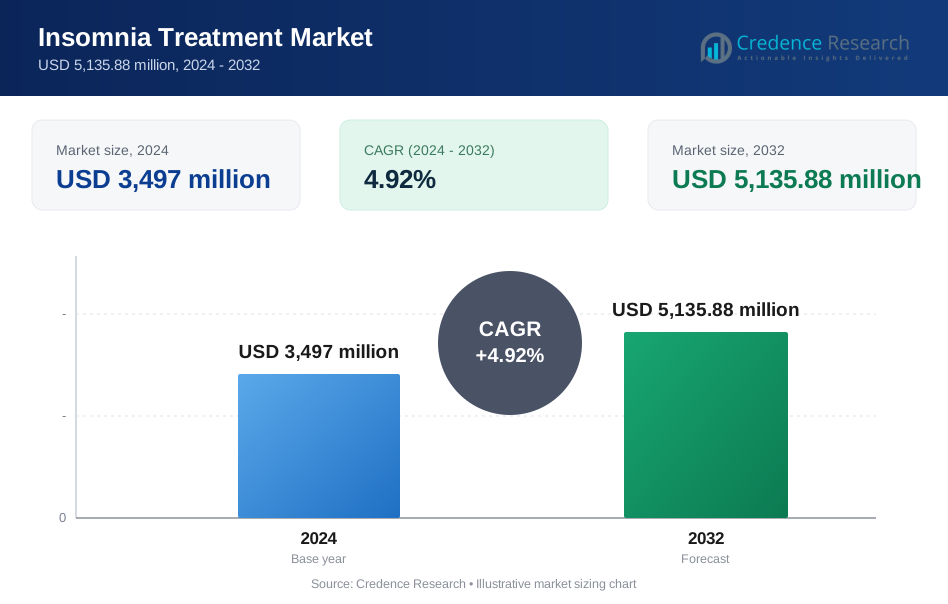
Insomnia Treatment Market size was valued at USD 3,497 million in 2024 and is anticipated to reach USD 5,135.88 million by 2032, at a CAGR of 4.92% during the forecast period.
| REPORT ATTRIBUTE | DETAILS |
|---|---|
| Historical Period | 2020-2023 |
| Base Year | 2024 |
| Forecast Period | 2025-2032 |
| Insomnia Treatment Market Size 2024 | USD 3,497 million |
| Insomnia Treatment Market, CAGR | 4.92% |
| Insomnia Treatment Market Size 2032 | USD 5,135.88 million |
Insomnia Treatment Market Insights
- Market growth is driven by increasing prevalence of sleep disorders, growing geriatric population, higher stress levels, and rising physician preference for prescription-based therapies, with prescription drugs holding 68.4% share in 2024 due to superior clinical efficacy.
- Key market trends include growing adoption of orexin receptor antagonists, rising acceptance of digital therapeutics and CBT-I platforms, and increasing integration of telemedicine for insomnia diagnosis and prescription fulfillment.
- Leading companies focus on expanding drug pipelines, lifecycle management, and strategic collaborations, while safety profiles, regulatory approvals, and broad pharmacy distribution networks remain critical factors influencing market positioning.
- Regionally, North America led with 38.6% share in 2024, followed by Europe at 27.4%, Asia Pacific at 22.1%, Latin America at 7.1%, and Middle East & Africa at 4.8%, reflecting varied healthcare access and awareness levels.
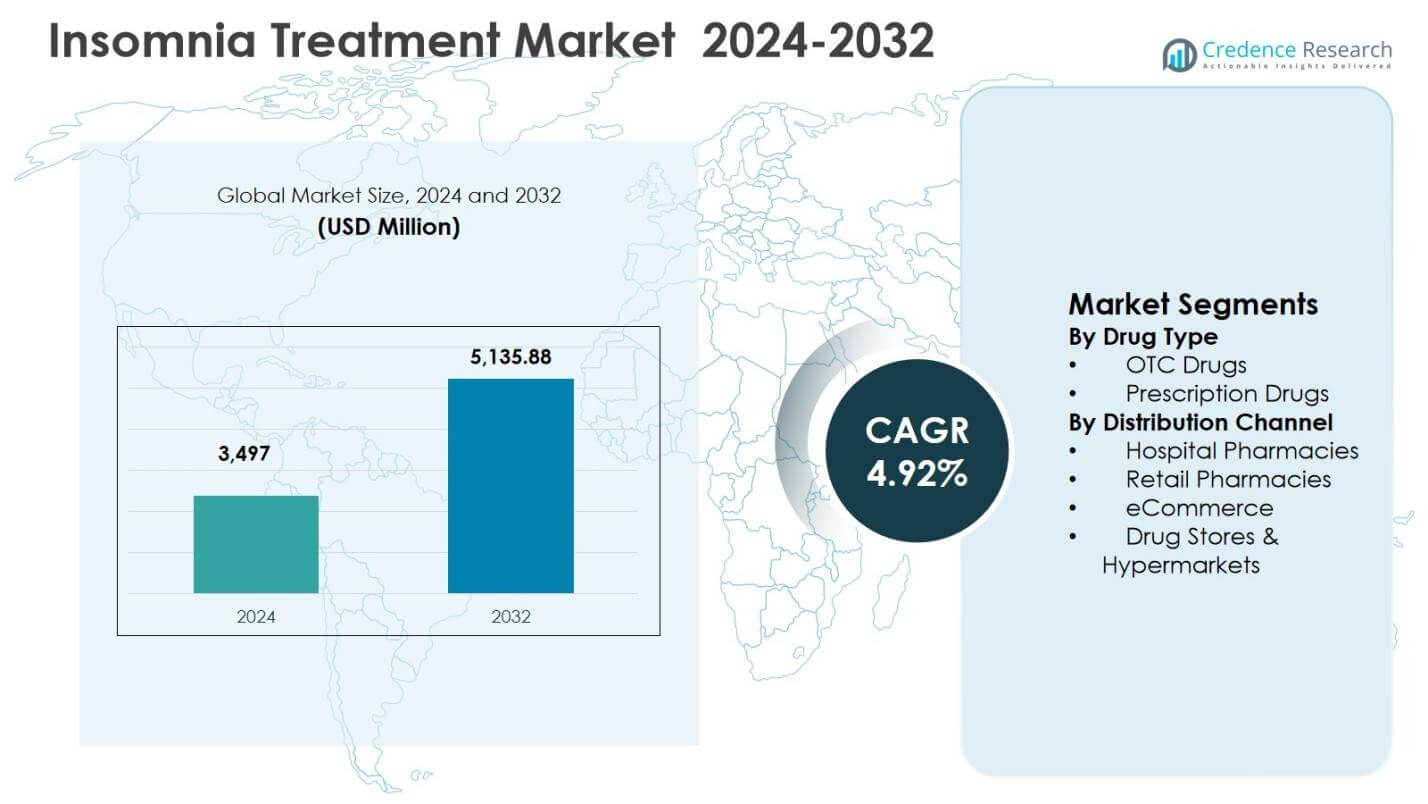
Insomnia Treatment Market Segmentation Analysis:
By Drug Type:
The Insomnia Treatment Market by drug type is led by Prescription Drugs, which accounted for 68.4% market share in 2024, driven by higher clinical efficacy, physician recommendations, and increasing diagnosis of chronic insomnia. Prescription therapies, including benzodiazepines, non-benzodiazepine hypnotics, and orexin receptor antagonists, dominate due to their proven effectiveness in moderate to severe cases. Rising prevalence of sleep disorders, growing geriatric population, and improved access to sleep clinics further support demand. OTC drugs held 31.6% share, supported by self-medication trends and affordability, but remain secondary due to limited long-term efficacy.
- For instance, zolpidem (Ambien) at 10 mg nightly increased total sleep time and sleep efficiency while reducing sleep latency and wake after sleep onset in chronic insomnia patients over 8 months, as shown in a randomized polysomnography trial.
By Distribution Channel:
The Insomnia Treatment Market by distribution channel is dominated by Retail Pharmacies, holding 42.7% market share in 2024, supported by wide geographic presence, easy access to prescription refills, and pharmacist-led counseling. Retail outlets benefit from strong consumer trust and consistent foot traffic for chronic therapy purchases. Hospital pharmacies accounted for 29.8% share, driven by inpatient treatments and specialist-prescribed therapies. eCommerce captured 17.5% share, fueled by digital prescriptions and home delivery, while drug stores and hypermarkets held 10.0% share, supported by OTC product sales and bundled healthcare offerings.
- For instance, Walgreens Boots Alliance expanded same-day prescription delivery and digital refill platforms, improving patient adherence for sleep medications prescribed on a recurring basis.
Key Growth Drivers
Rising Prevalence of Sleep Disorders
The Insomnia Treatment Market is significantly driven by the increasing prevalence of sleep disorders worldwide. Rapid urbanization, high work-related stress, prolonged screen exposure, and irregular sleep cycles contribute to a growing patient population. The expanding geriatric demographic further accelerates demand, as older adults show higher susceptibility to chronic insomnia and related neurological conditions. Increased awareness of sleep health, improved diagnostic capabilities through sleep clinics, and early screening initiatives strengthen diagnosis rates, directly supporting higher adoption of both prescription and non-prescription insomnia therapies.
- For instance, Eisai's DAYVIGO (lemborexant) 5 mg and 10 mg reduced subjective sleep onset latency by at least 20 minutes from baseline in 45.5% and 44.9% of patients respectively at six months, outperforming placebo at 30.4% in the SUNRISE 2 study.
Growing Demand for Prescription-Based Therapies
Rising demand for prescription-based therapies acts as a major growth driver in the Insomnia Treatment Market. Physicians increasingly prefer clinically validated drugs such as non-benzodiazepine hypnotics, melatonin receptor agonists, and orexin receptor antagonists due to improved safety and efficacy profiles. Higher diagnosis rates of moderate to severe insomnia, often associated with anxiety and depression, reinforce prescription volumes. Expanded insurance coverage and integration of sleep medicine into routine healthcare further improve patient access to long-term pharmacological treatment options.
- For instance, Suvorexant (Belsomra by Merck), a dual orexin receptor antagonist at 20 mg dose, effectively improves sleep onset and maintenance in insomnia, as validated in network meta-analyses of clinical trials.
Expansion of Healthcare Infrastructure and Spending
The continuous expansion of healthcare infrastructure and rising healthcare expenditure drive sustained growth in the Insomnia Treatment Market. Government initiatives focused on mental health, expansion of hospital and retail pharmacy networks, and improved reimbursement policies enhance treatment accessibility. The rapid adoption of telemedicine platforms allows faster diagnosis and prescription fulfillment, particularly in urban and semi-urban areas. These advancements reduce treatment barriers, improve adherence, and support consistent use of insomnia therapies across diverse patient groups.
Key Trends & Opportunities
Adoption of Digital Therapeutics and Tele-Sleep Platforms
The Insomnia Treatment Market is witnessing strong growth opportunities through the adoption of digital therapeutics and tele-sleep platforms. Cognitive behavioral therapy for insomnia delivered via mobile applications is gaining clinical acceptance as an effective non-drug intervention. Integration of wearable sleep trackers enables personalized treatment plans and real-time monitoring. Pharmaceutical companies increasingly collaborate with digital health providers to enhance patient engagement, improve outcomes, and expand therapy reach, creating new revenue streams across developed and emerging markets.
- For instance, Shionogi partnered with SUSMED on a digital therapeutic app for insomnia, which showed significant Athens Insomnia Scale improvements in a Japanese Phase 3 trial.
Development of Novel Drug Mechanisms and Combination Therapies
Innovation in novel drug mechanisms represents a major opportunity in the Insomnia Treatment Market. Advanced therapies targeting orexin pathways and combination treatments addressing both sleep onset and maintenance improve clinical outcomes. Ongoing research focuses on minimizing dependency risks and adverse effects linked to traditional hypnotics. Expanding clinical pipelines and regulatory approvals for next-generation insomnia drugs support long-term market expansion, particularly for patients requiring safer chronic treatment solutions.
- For instance, Idorsia's daridorexant, another FDA-approved DORA, demonstrated improvements in daytime insomnia symptoms and lowest fatigue scores among DORAs in clinical data, aiding sleep maintenance without rebound effects.
Key Challenges
Risk of Drug Dependency and Safety Concerns
Drug dependency and safety concerns remain critical challenges in the Insomnia Treatment Market. Prolonged use of certain hypnotics is associated with tolerance, withdrawal effects, and cognitive impairment, limiting physician confidence in long-term prescribing. Regulatory agencies enforce stricter prescribing guidelines, increasing compliance requirements for manufacturers. Patient hesitancy toward chronic pharmacological therapy further affects adherence, compelling companies to invest heavily in safer alternatives and extended clinical validation.
Underdiagnosis and Social Stigma
Underdiagnosis and social stigma significantly hinder growth in the Insomnia Treatment Market. Many individuals perceive insomnia as a lifestyle issue rather than a medical condition, delaying clinical intervention. Limited awareness in developing regions and inadequate access to specialized sleep clinics restrict early diagnosis. Cultural stigma surrounding mental health discussions further suppresses treatment uptake, highlighting the need for broader education initiatives and improved access to sleep healthcare services.
Regional Analysis
North America
North America dominated the Insomnia Treatment Market with a 38.6% market share in 2024, driven by high diagnosis rates, advanced healthcare infrastructure, and strong awareness of sleep disorders. The region benefits from widespread access to sleep clinics, early adoption of prescription therapies, and strong insurance coverage. High prevalence of stress-related insomnia and aging population further support demand. The United States leads regional growth due to robust pharmaceutical pipelines and rapid adoption of novel drug classes, while Canada contributes through increasing mental health initiatives and expanding digital sleep therapy adoption.
Europe
Europe accounted for a 27.4% market share in the Insomnia Treatment Market in 2024, supported by strong healthcare systems and growing focus on sleep health awareness. Countries such as Germany, the United Kingdom, and France drive regional demand through higher diagnosis rates and prescription drug usage. Government-backed mental health programs and reimbursement support encourage long-term treatment adherence. Increasing adoption of non-benzodiazepine therapies and expanding geriatric population strengthen market growth. Regulatory oversight promotes safer drug usage, supporting steady expansion across Western and Northern European countries.
Asia Pacific
Asia Pacific held a 22.1% market share in the Insomnia Treatment Market in 2024, driven by rising urbanization, growing stress levels, and increasing awareness of sleep disorders. Rapid expansion of healthcare infrastructure in China, Japan, and India supports higher diagnosis and treatment rates. Growing middle-class population and improving access to prescription medicines accelerate demand. Japan leads regional growth due to advanced sleep medicine practices, while China and India show strong potential supported by expanding retail pharmacy networks and increasing digital healthcare adoption.
Latin America
Latin America captured a 7.1% market share in the Insomnia Treatment Market in 2024, supported by improving healthcare access and rising awareness of sleep-related disorders. Brazil and Mexico lead regional demand due to expanding urban populations and increasing diagnosis rates. Growth in retail pharmacy chains and wider availability of affordable insomnia medications enhance treatment adoption. Government initiatives aimed at improving mental health services and gradual expansion of insurance coverage further support market growth, although limited access to specialized sleep clinics remains a constraint.
Middle East & Africa
The Middle East & Africa accounted for a 4.8% market share in the Insomnia Treatment Market in 2024, driven by gradual improvements in healthcare infrastructure and increasing awareness of sleep disorders. Gulf countries lead regional demand due to higher healthcare spending and access to prescription therapies. Rising stress levels, urban lifestyles, and increasing prevalence of chronic conditions contribute to treatment demand. However, limited diagnostic facilities and lower awareness in parts of Africa restrict market penetration, emphasizing the need for expanded sleep healthcare services.
Insomnia Treatment Market Segmentations:
By Drug Type
- OTC Drugs
- Prescription Drugs
By Distribution Channel
- Hospital Pharmacies
- Retail Pharmacies
- eCommerce
- Drug Stores & Hypermarkets
By Geography
- North America
- U.S.
- Canada
- Mexico
- Europe
- Germany
- France
- U.K.
- Italy
- Spain
- Rest of Europe
- Asia Pacific
- China
- Japan
- India
- South Korea
- South-east Asia
- Rest of Asia Pacific
- Latin America
- Brazil
- Argentina
- Rest of Latin America
- Middle East & Africa
- GCC Countries
- South Africa
- Rest of the Middle East and Africa
Competitive Landscape
The competitive landscape of the Insomnia Treatment Market is shaped by the presence of key players including Pfizer Inc., Merck & Co., Inc., Sanofi, Takeda Pharmaceutical Company Ltd., Teva Pharmaceutical Industries Ltd., Vanda Pharmaceuticals, and Sumitomo Dainippon Pharma Co., Ltd. These companies focus on expanding prescription portfolios, particularly non-benzodiazepine hypnotics and orexin receptor antagonists, to improve efficacy and safety profiles. Strategic initiatives center on product lifecycle management, clinical pipeline expansion, and geographic penetration in high-diagnosis regions such as North America and Europe. Partnerships with digital health companies to integrate pharmacological and behavioral therapies are gaining traction. Patent protection, regulatory approvals, and strong distribution networks remain critical competitive differentiators, while emerging players increasingly target niche indications and combination therapies to strengthen market positioning and long-term growth sustainability.
Key Player Analysis
- Paratek Pharmaceuticals Inc.
- Sanofi
- Vanda Pharmaceuticals
- Teva Pharmaceutical Industries Ltd.
- Ebb Therapeutics
- Pfizer Inc.
- Sumitomo Dainippon Pharma Co., Ltd.
- Mylan N.V.
- Takeda Pharmaceutical Company Ltd.
- MerckCo., Inc.
Recent Developments
- In August 2025, Dreem Health launched partnerships with Moona Health, DrLullaby, and Daybreak to enhance care pathways for insomnia and other sleep conditions through combined diagnostic and therapy services.
- In June 2025, Simcere Pharmaceutical announced the approval and launch of QUVIVIQ® (daridorexant hydrochloride tablets) for adult insomnia treatment by the National Medical Products Administration in China.
- In July 2024, Cosette Pharmaceuticals acquired Ambien and Ambien CR brands from Sanofi US, ensuring continued supply of these zolpidem tartrate treatments for short-term insomnia relief.
- In December 2024, Dr. David Mahjoubi launched Sleepinox, a natural melatonin-free sleep supplement featuring magnesium glycinate, valerian root, ashwagandha, and L-theanine to improve sleep quality without addiction risks.
Report Coverage
The research report offers an in-depth analysis based on Drug Type, Distribution Channel and Geography. It details leading market players, providing an overview of their business, product offerings, investments, revenue streams, and key applications. Additionally, the report includes insights into the competitive environment, SWOT analysis, current market trends, as well as the primary drivers and constraints. Furthermore, it discusses various factors that have driven market expansion in recent years. The report also explores market dynamics, regulatory scenarios, and technological advancements that are shaping the industry. It assesses the impact of external factors and global economic changes on market growth. Lastly, it provides strategic recommendations for new entrants and established companies to navigate the complexities of the market.
Future Outlook
- The Insomnia Treatment Market will experience steady growth driven by increasing diagnosis rates of chronic sleep disorders across all age groups.
- Prescription-based therapies will continue to dominate due to higher clinical efficacy and physician preference.
- Adoption of novel drug classes, including orexin receptor antagonists, will expand treatment options with improved safety profiles.
- Digital therapeutics and cognitive behavioral therapy for insomnia will gain stronger clinical acceptance as complementary treatments.
- Integration of telemedicine will improve access to diagnosis and prescription services, particularly in underserved regions.
- Growing geriatric populations will increase long-term demand for insomnia management solutions.
- Retail and online pharmacy channels will expand their role in improving therapy accessibility and patient adherence.
- Pharmaceutical companies will intensify research efforts to reduce dependency risks associated with traditional hypnotics.
- Regulatory focus on drug safety will shape product development and prescribing practices.
- Emerging markets will contribute higher growth rates supported by rising healthcare awareness and infrastructure development.
Request a Free Sample
Fill in your details and we'll send you a free sample report.
- Sample data tables & charts
- Research methodology
Need a Custom Version of This Report?
Tailor the scope, geography, or segments to your exact requirements.
- Custom geography or segment scope
- Direct access to our analyst team
Frequently Asked Questions
What is the current market size for the Insomnia Treatment Market, and what is its projected size in 2032?
At what Compound Annual Growth Rate is the Insomnia Treatment Market projected to grow between 2024 and 2032?
Which Insomnia Treatment Market segment held the largest share in 2024?
What are the primary factors fueling the growth of the Insomnia Treatment Market?
Who are the leading companies in the Insomnia Treatment Market?
Which region commanded the largest share of the Insomnia Treatment Market in 2024?
Table of Content
Chapter 1. Report Introduction
- 1.1 Report Description & Purpose
- 1.1.1 Report Title & Market Definition
- 1.1.2 Unique Selling Propositions (USP) & Key Differentiators
- 1.1.3 Value Proposition for Stakeholders
- 1.2 Research Objectives
- 1.2.1 Market Sizing Objectives (Volume & Revenue)
- 1.2.2 Segmentation Objectives
- 1.2.3 Competitive Intelligence Objectives
- 1.2.4 Forecast & Scenario Objectives
- 1.3 Report Scope
- 1.3.1 Insomnia Treatment Scope – Types & Subtypes Covered
- 1.3.2 Geographic Scope – Regions & Countries Covered
- 1.3.3 Historical Period, Base Year & Forecast Period (2024; forecast to 2032)
- 1.3.4 Inclusions & Exclusions
- 1.4 HS Code & Classification Framework
- 1.5 Currency, Units & Pricing Basis
- 1.6 Target Stakeholders
- 1.7 Limitations & Assumptions
Chapter 2. Executive Summary
- 2.1 Global Insomnia Treatment Market Snapshot
- 2.1.1 Market Size – Historical (2024) & Forecast (2024-2032) (2024: USD 3,497 million → 2032: USD 5,135.88 million)
- 2.1.2 Volume & Revenue – Global Totals
- 2.1.3 Key Market Highlights – Top Five Facts
- 2.2 Insomnia Treatment Market Segmentation Snapshot
- 2.2.1 Market Split by Region – 2024 vs. 2032
- 2.3 Competitive Snapshot
- 2.3.1 Top 10 Players by Revenue Share – 2024
- 2.3.2 Top 10 Players by Volume Share – 2024
- 2.3.3 Recent Strategic Developments (18-Month Summary)
- 2.4 Key Investment Highlights & Strategic Conclusions
Chapter 3. Insomnia Treatment Market Dynamics & Industry Analysis
- 3.1 Market Overview & Context
- 3.1.1 Insomnia Treatment Market Position in the Broader Automotive Value Chain
- 3.1.2 OEM vs. Replacement Market Dynamics
- 3.1.3 Market Maturity & Development Stage by Region
- 3.2 Insomnia Treatment Market Drivers
- 3.3 Insomnia Treatment Market Restraints & Challenges
- 3.4 Insomnia Treatment Market Opportunities
- 3.5 Porter's Five Forces Analysis
- 3.5.1 Threat of New Entrants
- 3.5.2 Bargaining Power of Suppliers
- 3.5.3 Bargaining Power of Buyers
- 3.5.4 Threat of Substitutes
- 3.5.5 Competitive Rivalry – Intensity Assessment
- 3.6 Insomnia Treatment Value Chain Analysis
- 3.6.1 Upstream – Raw Material/Input Suppliers
- 3.6.1.1 Raw Material/Input 1
- 3.6.1.2 Raw Material/Input 2
- 3.6.1.3 Raw Material/Input 3
- 3.6.2 Midstream – Production/Manufacturing/Service Delivery
- 3.6.2.1 Production/Process Overview
- 3.6.2.2 Key Facility Locations & Capacity by Manufacturer
- 3.6.3 Downstream – Distribution & End Consumer
- 3.6.3.1 Primary Channel – B2B/OEM
- 3.6.3.2 Secondary Channels – Dealer, Retail, Online, Direct
- 3.6.4 Value Chain Profitability Analysis
- 3.6.1 Upstream – Raw Material/Input Suppliers
- 3.7 PESTEL Analysis
- 3.7.1 Political Factors
- 3.7.2 Economic Factors
- 3.7.3 Social Factors
- 3.7.4 Technological Factors
- 3.7.5 Environmental Factors
- 3.7.6 Legal Factors
- 3.8 Insomnia Treatment Supply Chain Analysis
- 3.8.1 Raw Material/Input Supply Risk Assessment
- 3.8.2 Manufacturing Concentration Risk (Geographic Exposure)
- 3.8.3 Trade Disruption Impact Analysis
- 3.9 Regulatory & Policy Landscape
Note: The regulatory and policy landscape section covers regulations based on their applicability to the market, Insomnia Treatment category, geography, and scope of the study. Only regulatory frameworks with a material impact on operations, compliance, trade, sustainability, or market access are analyzed in detail.
Chapter 4. Key Investment Pockets & Opportunity Analysis
- 4.1 Insomnia Treatment Market Attractiveness Analysis
- 4.1.1 By Region – Investment Attractiveness Matrix (Volume × CAGR)
- 4.2 Absolute Revenue Growth Opportunity
- 4.2.1 By Region – Absolute USD Growth Through 2032
- 4.3 Incremental Volume Opportunity
- 4.3.1 By Region – Incremental Volume Through 2032
- 4.3.2 Segment – Incremental Volume
- 4.4 Emerging Submarket Opportunity Deep Dive (Subject to Applicability)
- 4.5 Emerging Market Opportunity Scorecards
- 4.5.1 United States
- 4.5.2 Europe
- 4.5.3 Asia
- 4.5.4 Middle East & Africa
Note: Emerging Market Opportunity Scorecards will be included based on relevance and strategic importance. Regions listed are indicative and may vary depending on data availability and market dynamics.
Chapter 5. Insomnia Treatment Import-Export Analysis & Trade Flows
- 5.1 Global Trade Overview
- 5.1.1 Global Export Value by Country (2024)
- 5.1.2 Global Export Volume by Country (2024)
- 5.1.3 Global Import Value by Country (2024)
- 5.1.4 Global Import Volume by Country (2024)
- 5.1.5 Net Trade Balance by Country (2024)
- 5.2 Export Analysis – Segment
- 5.2.1 Type 1 (HS Code)
- 5.2.2 Type 2 (HS Code)
- 5.2.3 Type 3 (HS Code)
- 5.2.4 Type 4 (HS Code)
- 5.2.5 Type 5 (HS Code)
- 5.3 Import Analysis – Segment
- 5.3.1 Type 1 (HS Code)
- 5.3.2 Type 2 (HS Code)
- 5.3.3 Type 3 (HS Code)
- 5.3.4 Type 4 (HS Code)
- 5.3.5 Type 5 (HS Code)
- 5.4 Average Unit Trade Prices
- 5.4.1 Average Export Price – Segment & Country
- 5.4.2 Average Import Price – Segment & Source Country
- 5.4.3 Price Trends (2024)
- 5.5 Key Trade Route Analysis
- 5.5.1 Trade Route 1
- 5.5.2 Trade Route 2
- 5.5.3 Trade Route 3
- 5.5.4 Trade Route 4
- 5.5.5 Trade Route 5
- 5.6 Trade Policy Impact Assessment
- 5.6.1 US Anti-Dumping & Section 301 Tariffs
- 5.6.2 EU Customs Union Impact
- 5.6.3 Major Free Trade Agreements
- 5.6.4 USMCA Rules of Origin
Note: Trade policy analysis will be included only where relevant to the Insomnia Treatment market.
Chapter 6. Competitive Landscape & Company Benchmarking
- 6.1 Insomnia Treatment Market Concentration & Structure
- 6.1.1 Herfindahl-Hirschman Index (HHI) – vs. 2024
- 6.1.2 Tier 1, Tier 2 & Tier 3 Market Structure
- 6.1.3 Global, Regional & Local Player Dynamics
- 6.2 Insomnia Treatment Market Share Analysis – 2024
- 6.2.1 Global Revenue Share by Company
- 6.2.2 Global Volume Share by Company
- 6.2.3 Regional Revenue Share
- 6.2.4 Market Share Evolution ( vs. 2024)
- 6.2.5 OEM Segment Share by Company
- 6.2.6 Replacement Segment Share by Company
- 6.3 Production/Delivery Capacity & Facility Analysis
- 6.3.1 Global Installed Capacity
- 6.3.2 Capacity Utilization Rates
- 6.3.3 Production/Output Volume
- 6.3.4 Facility Locations & Capacity Map
- 6.3.5 Planned Capacity Additions
- 6.4 Insomnia Treatment Competitive Benchmarking Matrix
- 6.4.1 Revenue, Volume, CAGR & Profitability Comparison
- 6.4.2 Channel Revenue Mix
- 6.4.3 Geographic Revenue Exposure
- 6.4.4 R&D Intensity
- 6.4.5 Sustainability Maturity
- 6.5 Strategic Developments in Insomnia Treatment (Last 24 Months)
- 6.5.1 Mergers, Acquisitions & Divestments
- 6.5.2 New Insomnia Treatment Launches
- 6.5.3 Facility Expansions
- 6.5.4 Strategic Alliances, Joint Ventures & Partnerships
- 6.5.5 Distribution Expansion & Market Entry
- 6.5.6 Sustainability & ESG Initiatives
- 6.6 Competitive Strategy Mapping
- 6.6.1 Leader, Challenger, Follower & Niche Classification
- 6.6.2 Pricing Strategy Comparison
- 6.6.3 Channel Strategy Matrix
Note: Strategic developments are included based on their materiality and the availability of reliable information.
Chapter 7. Global Insomnia Treatment Market – By Distribution Channel
- 7.1 Segment Overview
- 7.1.1 Volume & Revenue Split by Channel (2024 & 2032)
- 7.1.2 Channel Mix Evolution (2024-2032)
Chapter 8. Regional Market Analysis – Global Overview
- 8.1 Global Regional Overview
- 8.1.1 Regional Volume Share
- 8.1.2 Regional Revenue Share
- 8.1.3 Regional Volume by Region
- 8.1.4 Regional Revenue by Region
- 8.1.5 Regional Forecast Through 2032
- 8.2 Cross-Regional Segment Analysis
- 8.2.1 By Distribution Channel
- 8.2.2 By Brand/Price Tier
Chapter 9. North America Insomnia Treatment Market
- 9.1 United States
- 9.2 Canada
- 9.3 Mexico
Chapter 10. Europe Insomnia Treatment Market
- 10.1 Germany
- 10.2 France
- 10.3 Italy
- 10.4 United Kingdom
- 10.5 Spain
- 10.6 Poland
- 10.7 Russia
- 10.8 Netherlands
- 10.9 Belgium
- 10.10 Sweden
- 10.11 Denmark
- 10.12 Norway
- 10.13 Rest of Europe
Chapter 11. Asia Pacific Insomnia Treatment Market
- 11.1 China
- 11.2 India
- 11.3 Japan
- 11.4 South Korea
- 11.5 Thailand
- 11.6 Indonesia
- 11.7 Vietnam
- 11.8 Malaysia
- 11.9 Australia
- 11.10 Rest of Asia Pacific
Chapter 12. Latin America Insomnia Treatment Market
- 12.1 Brazil
- 12.2 Argentina
- 12.3 Colombia
- 12.4 Chile
- 12.5 Rest of Latin America
Chapter 13. Middle East Insomnia Treatment Market
- 13.1 Saudi Arabia
- 13.2 United Arab Emirates
- 13.3 Turkey
- 13.4 Israel
- 13.5 Iran
- 13.6 Rest of the Middle East
Chapter 14. Africa Insomnia Treatment Market
- 14.1 South Africa
- 14.2 Egypt
- 14.3 Nigeria
- 14.4 Morocco
- 14.5 Rest of Africa
Chapter 15. Insomnia Treatment Company Profiles
- 15.1 [Company 01]
- 15.1.1 Company Overview
- 15.1.2 Key Management Personnel
- 15.1.3 Products & Services Portfolio
- 15.1.4 Financial Performance
- 15.1.5 Key Market Focus & Geographic Presence
- 15.1.6 Recent Developments & Strategic Initiatives
Note: The company profile list is preliminary and may change based on research findings, market developments, data availability, and client requirements.
Chapter 16. Appendices
- Appendix A – List of Abbreviations & Acronyms
- Appendix B – Industry Classification Code Reference – Full Series
- Appendix C – Production & Capacity Data Tables
- Appendix D – End-Use & Demand Base Tables
- Appendix E – Consumption & Replacement Rate Assumptions
- Appendix F – ASP Reference Tables
- Appendix G – Manufacturing & Facility Database
- Appendix H – Import-Export Data Tables
- Appendix I – Regulatory Summary Tables
- Appendix J – Primary Research Participant List (Anonymized)
- Appendix K – Primary Research Questionnaire Framework
- Appendix L – Data Sources & Bibliography
- Appendix M – Market Size Divergence & Source Comparison
Chapter 17. Research Methodology
- 17.1 Research Framework & Philosophy
- 17.2 Secondary Research – Sources, Hierarchy & Data Extraction
- 17.3 Data Modeling – Bottom-Up & Top-Down Market Sizing
- 17.4 Primary Research – Stakeholder Framework, LOI & Sample Sizes
- 17.5 Forecast Methodology – Regression, Scenario & Sensitivity Analysis
- 17.6 Quality Control – Four-Layer Validation Framework
- 17.7 Limitations & Standard Assumptions
- 17.8 Disclaimer
