
K 12 Instructive Toy Market Overview:
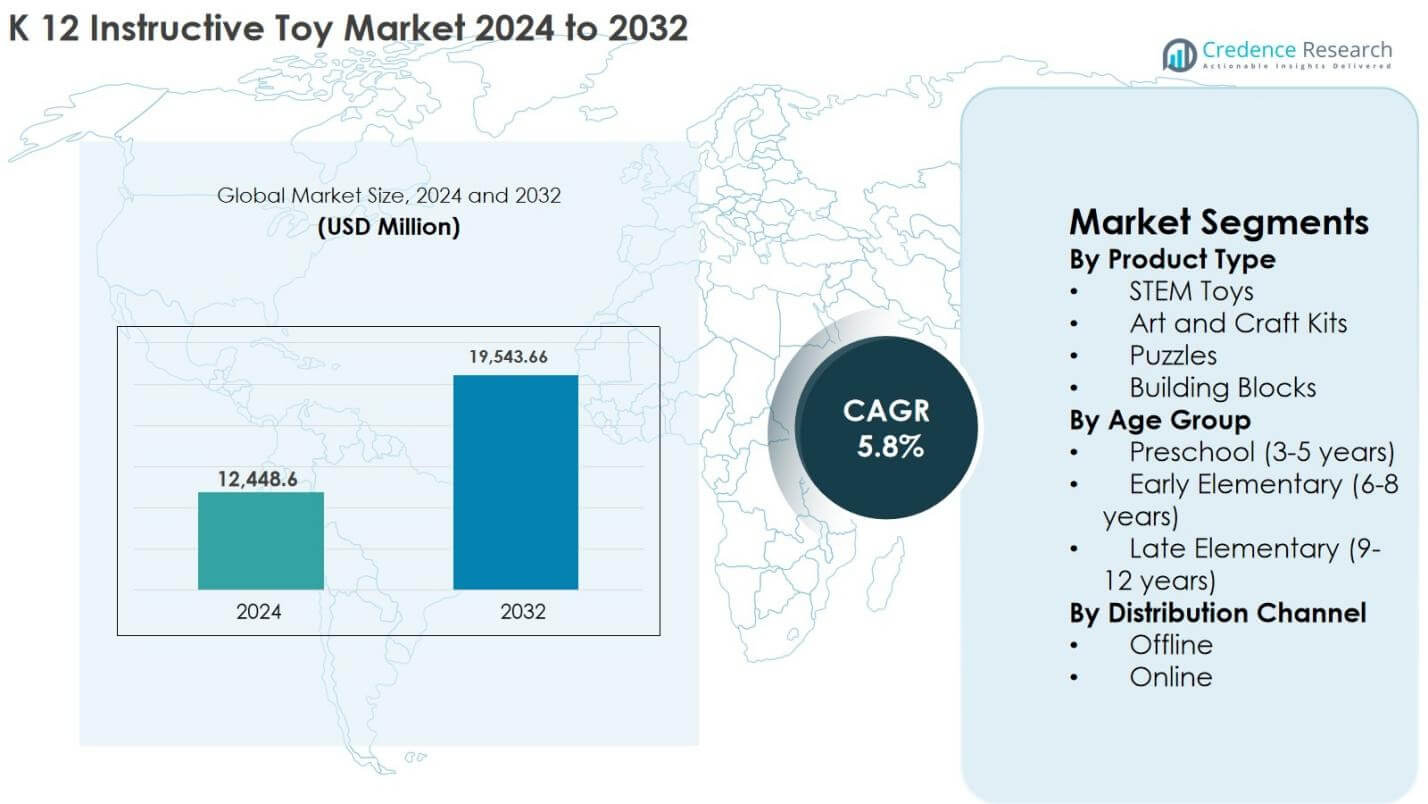
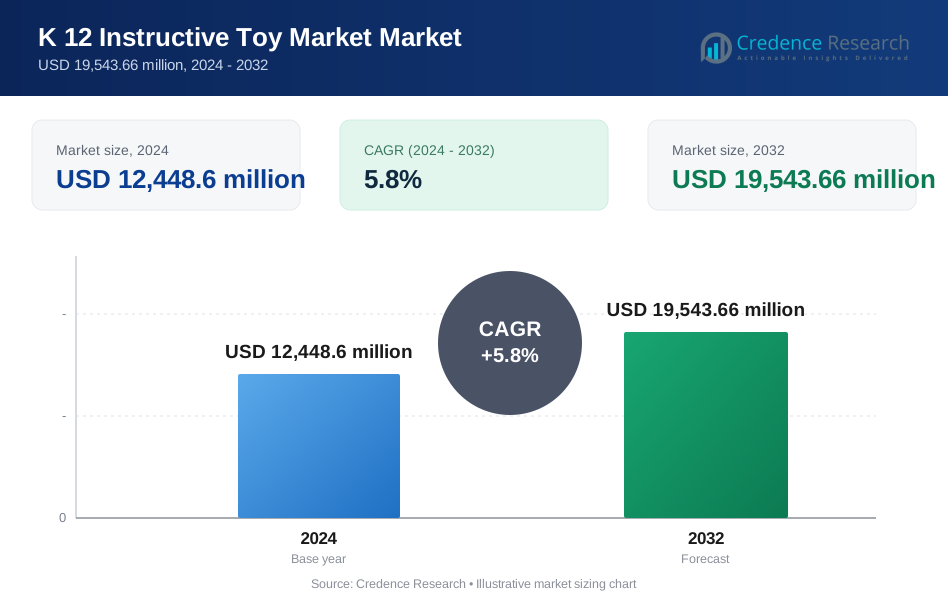
K-12 Instructive Toy Market size was valued at USD 12,448.6 million in 2024 and is anticipated to reach USD 19,543.66 million by 2032, growing at a CAGR of 5.8% during the forecast period.
| REPORT ATTRIBUTE | DETAILS |
|---|---|
| Historical Period | 2020-2023 |
| Base Year | 2024 |
| Forecast Period | 2025-2032 |
| K 12 Instructive Toy Market Size 2024 | USD 12,448.6 million |
| K 12 Instructive Toy Market, CAGR | 5.8% |
| K 12 Instructive Toy Market Size 2032 | USD 19,543.66 million |
K 12 Instructive Toy Market Insights
- Market growth is primarily driven by rising emphasis on STEM-based education, increasing parental spending on supplemental learning, and growing adoption of instructive toys in schools and homeschooling environments, with STEM toys emerging as the dominant product segment holding 38.6% share in 2024.
- Key market trends include integration of interactive and curriculum-aligned learning toys and growing penetration of online sales channels, while traditional offline retail continues to dominate with a 63.4% share due to consumer trust and physical product evaluation.
- The market remains moderately fragmented, with leading global brands focusing on innovation, age-specific learning outcomes, and strong distribution networks, while regional players compete through cost-effective and localized product offerings.
- Regionally, North America led with 34.8% share, followed by Asia Pacific at 28.4% driven by rapid urbanization and academic competitiveness, and Europe at 26.1% supported by holistic education frameworks and strong safety regulations.
K 12 Instructive Toy Market Segmentation Analysis:
By Product Type
The K-12 Instructive Toy market by product type is led by STEM toys, which accounted for 38.6% market share in 2024, driven by the rising emphasis on science, technology, engineering, and mathematics in early education curricula. STEM toys support hands-on learning, logical reasoning, and problem-solving skills, making them highly preferred by parents and educators. Art and craft kits continue to gain traction due to creativity development, while puzzles and building blocks remain integral for cognitive and motor-skill enhancement. Government initiatives promoting experiential learning and increased spending on educational toys further strengthen STEM toy dominance.
- For instance, LEGO Education’s SPIKE Prime set is used in classrooms to teach coding and engineering concepts through programmable bricks and sensors.
By Age Group
Based on age group, the early elementary segment (6–8 years) dominated the K-12 Instructive Toy market with a 41.2% share in 2024, supported by strong demand for curriculum-aligned learning tools during foundational schooling years. Children in this age group actively engage with STEM kits, puzzles, and logic-based games that reinforce classroom learning. Preschool toys benefit from early cognitive development trends, while late elementary toys focus on advanced problem-solving and critical thinking. The dominance of early elementary toys is driven by higher parental investment in structured learning and skill-building activities.
- For instance, Osmo’s Genius Starter Kit uses an iPad and physical game pieces to teach math, spelling, and problem-solving to children aged 6–10, blending play with core curriculum skills.
By Distribution Channel
The offline distribution channel held the dominant position with a 63.4% market share in 2024, supported by specialty toy stores, educational outlets, and large retail chains offering hands-on product demonstrations and trusted purchasing experiences. Parents prefer offline channels to assess product quality, age suitability, and educational value before purchase. However, online channels are expanding rapidly due to wider product availability and competitive pricing. The continued dominance of offline sales is driven by consumer trust, physical product evaluation, and strong retailer-educator partnerships in educational toy merchandising.
Key Growth Drivers
Rising Emphasis on STEM-Based and Experiential Learning
The growing global emphasis on STEM education is a primary growth driver for the K-12 instructive toy market, as schools and parents increasingly prioritize hands-on, experiential learning over rote memorization. STEM toys help children develop problem-solving, analytical thinking, coding literacy, and scientific reasoning from an early age, aligning closely with modern curriculum frameworks. Governments and educational institutions across developed and emerging economies are integrating STEM-focused activities into primary and middle-school education, which directly supports demand for instructive toys. Additionally, parents view these toys as long-term educational investments that complement classroom learning. The ability of STEM toys to combine learning with play enhances student engagement and knowledge retention, making them highly attractive. This shift toward outcome-based education continues to expand the addressable market for advanced learning toys across multiple age groups.
- For instance, Sphero’s SPRK+ robots are used in K-12 classrooms to teach coding, physics, and robotics through guided app-based activities that match grade-level standards.
Increasing Parental Spending on Early and Supplemental Education
Rising disposable incomes and heightened awareness of early childhood development have significantly increased parental spending on educational products, including K-12 instructive toys. Parents increasingly seek tools that strengthen foundational skills such as numeracy, literacy, creativity, and critical thinking outside formal classroom settings. Instructive toys are widely perceived as effective supplemental learning resources that support academic performance while reducing screen dependency. This trend is particularly strong in urban households, where competitive academic environments encourage early skill development. Additionally, dual-income families favor structured, self-guided learning toys that enable productive engagement at home. As education becomes a priority household expenditure, instructive toys benefit from consistent demand across preschool and elementary age groups, supporting sustained market growth.
- LeapFrog’s LeapStart interactive learning system offers activity books that teach reading and math skills through guided audio and a touch-and-talk stylus designed for preschool and early elementary children.
Integration of Learning Toys into Formal and Informal Education Systems
The growing integration of instructive toys into both formal school environments and informal learning spaces is another major driver of market expansion. Many schools now incorporate puzzles, building blocks, and STEM kits into classroom activities to promote interactive learning and collaborative problem-solving. Educational institutions increasingly partner with toy manufacturers to align products with curriculum objectives, enhancing classroom applicability. Beyond schools, after-school programs, tutoring centers, and homeschooling networks actively use instructive toys as teaching aids. This broadening adoption base expands usage beyond households, driving institutional demand. The alignment of instructive toys with educational outcomes strengthens their credibility, encouraging long-term adoption and repeat purchases across academic cycles.
Key Trends & Opportunities
Growing Adoption of Digital-Integrated and Smart Learning Toys
A key trend shaping the K-12 instructive toy market is the growing adoption of digital-integrated learning toys that blend physical play with interactive digital content. These toys enhance engagement through augmented learning experiences, progress tracking, and adaptive difficulty levels. Parents and educators increasingly favor toys that personalize learning and reinforce classroom instruction through guided activities. The opportunity lies in developing hybrid toys that maintain hands-on interaction while leveraging digital tools for feedback and assessment. As digital literacy becomes essential at younger ages, smart instructive toys offer scalable growth potential, particularly in tech-savvy urban markets and digitally connected households.
Expansion of E-Commerce and Direct-to-Consumer Channels
The rapid expansion of online retail and direct-to-consumer distribution presents a significant opportunity for the K-12 instructive toy market. E-commerce platforms enable manufacturers to reach a broader audience, offer detailed product information, and provide age- and curriculum-specific recommendations. Online channels also support customization, subscription-based learning kits, and bundled educational solutions. This shift improves accessibility in regions lacking specialized toy stores and allows brands to build direct relationships with consumers. As digital purchasing behavior becomes mainstream among parents, online platforms are expected to drive incremental growth, particularly for niche and premium instructive toy categories.
- For instance, KiwiCo ships subscription STEM and art crates directly to families each month, allowing parents to choose age-specific projects for toddlers through teens and manage plans entirely online
Key Challenges
High Price Sensitivity and Limited Penetration in Price-Conscious Markets
One of the key challenges facing the K-12 instructive toy market is high price sensitivity, particularly in developing and lower-income regions. Advanced STEM kits and curriculum-aligned toys often carry premium pricing, limiting affordability for a large segment of consumers. Parents in price-conscious markets may prioritize basic toys or low-cost alternatives over premium educational products. Additionally, schools with limited budgets may struggle to adopt instructive toys at scale. This pricing barrier restricts market penetration and slows adoption in emerging economies, compelling manufacturers to balance product innovation with cost optimization to expand reach.
Competition from Digital Learning Platforms and Screen-Based Content
The increasing availability of digital learning platforms, educational apps, and online content poses a significant challenge to the instructive toy market. Many parents and educators opt for low-cost or free digital solutions that offer instant access to learning resources. Screen-based tools often provide adaptive learning features and progress monitoring, competing directly with physical instructive toys. Excessive screen exposure concerns exist, but convenience and accessibility continue to drive digital adoption. To remain competitive, instructive toy manufacturers must clearly differentiate their products by emphasizing hands-on engagement, cognitive development benefits, and reduced screen dependency.
Regional Analysis
North America
North America dominated the K-12 instructive toy market with a 34.8% market share in 2024, driven by high parental spending on educational products and strong integration of learning toys into school curricula. The region benefits from widespread adoption of STEM-based education, well-established toy manufacturers, and advanced retail infrastructure. Parents actively invest in curriculum-aligned toys that enhance cognitive, analytical, and creative skills. Strong awareness of experiential learning and early childhood development further supports demand. Additionally, the presence of organized retail and growing penetration of online channels continue to reinforce North America’s leadership in the global market.
Europe
Europe accounted for 26.1% of the K-12 instructive toy market in 2024, supported by strong emphasis on holistic education and creativity-driven learning. Countries such as Germany, the UK, and France promote hands-on learning through puzzles, building blocks, and STEM kits integrated into early education systems. Sustainability-focused toy manufacturing and strict safety regulations enhance consumer trust across the region. Government-backed educational reforms and rising demand for skill-based learning tools drive steady adoption. The presence of established educational toy brands and specialty stores further strengthens Europe’s market position.
Asia Pacific
Asia Pacific held a 28.4% market share in 2024 and represents the fastest-growing region in the K-12 instructive toy market. Rapid urbanization, rising disposable incomes, and intense academic competition are key growth drivers across China, India, Japan, and South Korea. Parents increasingly invest in supplementary learning tools to enhance academic performance. Expanding middle-class populations and growing awareness of STEM education significantly boost demand. The rapid growth of e-commerce platforms improves product accessibility, while government initiatives supporting digital and experiential learning further accelerate market expansion across the region.
Latin America
Latin America captured 6.5% of the K-12 instructive toy market in 2024, supported by gradual improvements in education infrastructure and rising awareness of early learning benefits. Countries such as Brazil and Mexico show increasing adoption of affordable educational toys, particularly for preschool and early elementary age groups. Demand is driven by urban households seeking skill-development tools aligned with school curricula. However, price sensitivity remains a key factor influencing purchasing decisions. Expanding online retail penetration and localized product offerings are expected to support moderate growth across the region.
Middle East & Africa
The Middle East & Africa accounted for 4.2% of the K-12 instructive toy market in 2024, driven by increasing investments in education and rising enrollment in private schools. Gulf countries lead regional demand due to higher disposable incomes and strong focus on modern learning methods. Instructive toys are increasingly adopted to support early cognitive development and bilingual education. However, limited affordability and uneven access to organized retail restrict broader adoption. Ongoing education reforms and gradual expansion of e-commerce are expected to support steady market growth over the forecast period.
K 12 Instructive Toy Market Segmentations:
By Product Type
- STEM Toys
- Art and Craft Kits
- Puzzles
- Building Blocks
By Age Group
- Preschool (3-5 years)
- Early Elementary (6-8 years)
- Late Elementary (9-12 years)
By Distribution Channel
- Offline
- Online
By Geography
- North America
- U.S.
- Canada
- Mexico
- Europe
- Germany
- France
- U.K.
- Italy
- Spain
- Rest of Europe
- Asia Pacific
- China
- Japan
- India
- South Korea
- South-east Asia
- Rest of Asia Pacific
- Latin America
- Brazil
- Argentina
- Rest of Latin America
- Middle East & Africa
- GCC Countries
- South Africa
- Rest of the Middle East and Africa
Competitive Landscape
The competitive landscape of the K-12 instructive toy market is characterized by the presence of well-established global players and a growing number of specialized educational toy manufacturers competing on innovation, curriculum alignment, and brand trust. Companies such as Mattel, Hasbro, Bandai, TAKARA TOMY, Spin Master, MGA Entertainment, and Ravensburger leverage strong brand portfolios, wide distribution networks, and continuous product innovation to maintain their market positions. PLAYMOBIL, Melissa & Doug, LeapFrog, and VTech focus heavily on age-specific learning outcomes, STEM integration, and hands-on educational value, strengthening their appeal among parents and educators. Regional and niche players including Giochi Preziosi, MindWare, JAKKS Pacific, Goldlok Toys, Gigotoys, and Guangdong Loongon compete through localized offerings and cost-effective product lines. Overall, competition intensifies through new product launches, digital-learning integration, and partnerships with educational institutions to enhance learning relevance and market reach.
Key Player Analysis
- Ravensburger
- Hasbro
- MGA Entertainment
- Vtech
- PLAYMOBIL
- MindWare
- Leapfrog
- Bandai
- Melissa & Doug
- JAKKS Pacific
Recent Developments
- In December 2025, Funskool India Ltd announced its entry into the electronic toys category with the launch of a new range of interactive and learning-focused products under its Giggles brand including My First Learning Pad, My First Learning Laptop, Cargo Truck, Dump Truck, and My First Melody Book marking its strategic expansion into educational and electronic toy offerings this month
- In December 2025, Jazwares entered into a multi-year partnership with Spiralcute International, naming Jazwares as the master toy partner and global distributor (outside Asia) for popular character brands such as Chiikawa, Mofusand, and Koupen Chan, with new licensed toy lines set to launch globally (excluding Asia) beginning Fall 2026.
Report Coverage
The research report offers an in-depth analysis based on Product Type, Age Group, Distribution Channel and Geography. It details leading market players, providing an overview of their business, product offerings, investments, revenue streams, and key applications. Additionally, the report includes insights into the competitive environment, SWOT analysis, current market trends, as well as the primary drivers and constraints. Furthermore, it discusses various factors that have driven market expansion in recent years. The report also explores market dynamics, regulatory scenarios, and technological advancements that are shaping the industry. It assesses the impact of external factors and global economic changes on market growth. Lastly, it provides strategic recommendations for new entrants and established companies to navigate the complexities of the market.
Future Outlook
- The K-12 instructive toy market will continue to expand steadily, supported by increasing focus on experiential and skill-based learning across primary and middle education.
- STEM-oriented products will remain central to market growth as schools and parents prioritize problem-solving, coding, and analytical skills.
- Demand for age-specific and curriculum-aligned learning toys will strengthen, particularly in early and late elementary segments.
- Digital-integrated and smart learning toys will gain wider adoption as hybrid learning models become more common.
- Manufacturers will increasingly focus on product innovation that balances hands-on engagement with limited screen exposure.
- Online distribution channels will grow rapidly, improving accessibility and product variety for consumers.
- Offline retail will retain relevance through experiential purchasing, demonstrations, and educational consultations.
- Emerging economies will present significant growth opportunities due to rising education spending and urbanization.
- Partnerships between toy manufacturers and educational institutions will increase to enhance learning relevance.
- Competitive intensity will rise as global and regional players expand portfolios and strengthen brand differentiation.
Request a Free Sample
Fill in your details and we'll send you a free sample report.
- Sample data tables & charts
- Research methodology
Need a Custom Version of This Report?
Tailor the scope, geography, or segments to your exact requirements.
- Custom geography or segment scope
- Direct access to our analyst team
Frequently Asked Questions
What is the current market size for K 12 Instructive Toy market, and what is its projected size in 2032?
At what Compound Annual Growth Rate is the K 12 Instructive Toy market projected to grow between 2024 and 2032?
Which K 12 Instructive Toy market segment held the largest share in 2024?
What are the primary factors fueling the growth of the K 12 Instructive Toy market?
Who are the leading companies in the K 12 Instructive Toy market?
Which region commanded the largest share of the K 12 Instructive Toy market in 2024?
Table of Content
Chapter 1. Report Introduction
- 1.1 Report Description & Purpose
- 1.1.1 Report Title & Market Definition
- 1.1.2 Unique Selling Propositions (USP) & Key Differentiators
- 1.1.3 Value Proposition for Stakeholders
- 1.2 Research Objectives
- 1.2.1 Market Sizing Objectives (Volume & Revenue)
- 1.2.2 Segmentation Objectives
- 1.2.3 Competitive Intelligence Objectives
- 1.2.4 Forecast & Scenario Objectives
- 1.3 Report Scope
- 1.3.1 K 12 Instructive Toy Market Scope – Types & Subtypes Covered
- 1.3.2 Geographic Scope – Regions & Countries Covered
- 1.3.3 Historical Period, Base Year & Forecast Period (2024; forecast to 2032)
- 1.3.4 Inclusions & Exclusions
- 1.4 HS Code & Classification Framework
- 1.5 Currency, Units & Pricing Basis
- 1.6 Target Stakeholders
- 1.7 Limitations & Assumptions
Chapter 2. Executive Summary
- 2.1 Global K 12 Instructive Toy Market Market Snapshot
- 2.1.1 Market Size – Historical (2024) & Forecast (2024-2032) (2024: USD 12,448.6 million → 2032: USD 19,543.66 million)
- 2.1.2 Volume & Revenue – Global Totals
- 2.1.3 Key Market Highlights – Top Five Facts
- 2.2 K 12 Instructive Toy Market Market Segmentation Snapshot
- 2.2.1 Market Split by Region – 2024 vs. 2032
- 2.3 Competitive Snapshot
- 2.3.1 Top 10 Players by Revenue Share – 2024
- 2.3.2 Top 10 Players by Volume Share – 2024
- 2.3.3 Recent Strategic Developments (18-Month Summary)
- 2.4 Key Investment Highlights & Strategic Conclusions
Chapter 3. K 12 Instructive Toy Market Market Dynamics & Industry Analysis
- 3.1 Market Overview & Context
- 3.1.1 K 12 Instructive Toy Market Market Position in the Broader Automotive Value Chain
- 3.1.2 OEM vs. Replacement Market Dynamics
- 3.1.3 Market Maturity & Development Stage by Region
- 3.2 K 12 Instructive Toy Market Market Drivers
- 3.3 K 12 Instructive Toy Market Market Restraints & Challenges
- 3.4 K 12 Instructive Toy Market Market Opportunities
- 3.5 Porter's Five Forces Analysis
- 3.5.1 Threat of New Entrants
- 3.5.2 Bargaining Power of Suppliers
- 3.5.3 Bargaining Power of Buyers
- 3.5.4 Threat of Substitutes
- 3.5.5 Competitive Rivalry – Intensity Assessment
- 3.6 K 12 Instructive Toy Market Value Chain Analysis
- 3.6.1 Upstream – Raw Material/Input Suppliers
- 3.6.1.1 Raw Material/Input 1
- 3.6.1.2 Raw Material/Input 2
- 3.6.1.3 Raw Material/Input 3
- 3.6.2 Midstream – Production/Manufacturing/Service Delivery
- 3.6.2.1 Production/Process Overview
- 3.6.2.2 Key Facility Locations & Capacity by Manufacturer
- 3.6.3 Downstream – Distribution & End Consumer
- 3.6.3.1 Primary Channel – B2B/OEM
- 3.6.3.2 Secondary Channels – Dealer, Retail, Online, Direct
- 3.6.4 Value Chain Profitability Analysis
- 3.6.1 Upstream – Raw Material/Input Suppliers
- 3.7 PESTEL Analysis
- 3.7.1 Political Factors
- 3.7.2 Economic Factors
- 3.7.3 Social Factors
- 3.7.4 Technological Factors
- 3.7.5 Environmental Factors
- 3.7.6 Legal Factors
- 3.8 K 12 Instructive Toy Market Supply Chain Analysis
- 3.8.1 Raw Material/Input Supply Risk Assessment
- 3.8.2 Manufacturing Concentration Risk (Geographic Exposure)
- 3.8.3 Trade Disruption Impact Analysis
- 3.9 Regulatory & Policy Landscape
Note: The regulatory and policy landscape section covers regulations based on their applicability to the market, K 12 Instructive Toy Market category, geography, and scope of the study. Only regulatory frameworks with a material impact on operations, compliance, trade, sustainability, or market access are analyzed in detail.
Chapter 4. Key Investment Pockets & Opportunity Analysis
- 4.1 K 12 Instructive Toy Market Market Attractiveness Analysis
- 4.1.1 By Region – Investment Attractiveness Matrix (Volume × CAGR)
- 4.2 Absolute Revenue Growth Opportunity
- 4.2.1 By Region – Absolute USD Growth Through 2032
- 4.3 Incremental Volume Opportunity
- 4.3.1 By Region – Incremental Volume Through 2032
- 4.3.2 Segment – Incremental Volume
- 4.4 Emerging Submarket Opportunity Deep Dive (Subject to Applicability)
- 4.5 Emerging Market Opportunity Scorecards
- 4.5.1 United States
- 4.5.2 Europe
- 4.5.3 Asia
- 4.5.4 Middle East & Africa
Note: Emerging Market Opportunity Scorecards will be included based on relevance and strategic importance. Regions listed are indicative and may vary depending on data availability and market dynamics.
Chapter 5. K 12 Instructive Toy Market Import-Export Analysis & Trade Flows
- 5.1 Global Trade Overview
- 5.1.1 Global Export Value by Country (2024)
- 5.1.2 Global Export Volume by Country (2024)
- 5.1.3 Global Import Value by Country (2024)
- 5.1.4 Global Import Volume by Country (2024)
- 5.1.5 Net Trade Balance by Country (2024)
- 5.2 Export Analysis – Segment
- 5.2.1 Type 1 (HS Code)
- 5.2.2 Type 2 (HS Code)
- 5.2.3 Type 3 (HS Code)
- 5.2.4 Type 4 (HS Code)
- 5.2.5 Type 5 (HS Code)
- 5.3 Import Analysis – Segment
- 5.3.1 Type 1 (HS Code)
- 5.3.2 Type 2 (HS Code)
- 5.3.3 Type 3 (HS Code)
- 5.3.4 Type 4 (HS Code)
- 5.3.5 Type 5 (HS Code)
- 5.4 Average Unit Trade Prices
- 5.4.1 Average Export Price – Segment & Country
- 5.4.2 Average Import Price – Segment & Source Country
- 5.4.3 Price Trends (2024)
- 5.5 Key Trade Route Analysis
- 5.5.1 Trade Route 1
- 5.5.2 Trade Route 2
- 5.5.3 Trade Route 3
- 5.5.4 Trade Route 4
- 5.5.5 Trade Route 5
- 5.6 Trade Policy Impact Assessment
- 5.6.1 US Anti-Dumping & Section 301 Tariffs
- 5.6.2 EU Customs Union Impact
- 5.6.3 Major Free Trade Agreements
- 5.6.4 USMCA Rules of Origin
Note: Trade policy analysis will be included only where relevant to the K 12 Instructive Toy Market market.
Chapter 6. Competitive Landscape & Company Benchmarking
- 6.1 K 12 Instructive Toy Market Market Concentration & Structure
- 6.1.1 Herfindahl-Hirschman Index (HHI) – vs. 2024
- 6.1.2 Tier 1, Tier 2 & Tier 3 Market Structure
- 6.1.3 Global, Regional & Local Player Dynamics
- 6.2 K 12 Instructive Toy Market Market Share Analysis – 2024
- 6.2.1 Global Revenue Share by Company
- 6.2.2 Global Volume Share by Company
- 6.2.3 Regional Revenue Share
- 6.2.4 Market Share Evolution ( vs. 2024)
- 6.2.5 OEM Segment Share by Company
- 6.2.6 Replacement Segment Share by Company
- 6.3 Production/Delivery Capacity & Facility Analysis
- 6.3.1 Global Installed Capacity
- 6.3.2 Capacity Utilization Rates
- 6.3.3 Production/Output Volume
- 6.3.4 Facility Locations & Capacity Map
- 6.3.5 Planned Capacity Additions
- 6.4 K 12 Instructive Toy Market Competitive Benchmarking Matrix
- 6.4.1 Revenue, Volume, CAGR & Profitability Comparison
- 6.4.2 Channel Revenue Mix
- 6.4.3 Geographic Revenue Exposure
- 6.4.4 R&D Intensity
- 6.4.5 Sustainability Maturity
- 6.5 Strategic Developments in K 12 Instructive Toy Market (Last 24 Months)
- 6.5.1 Mergers, Acquisitions & Divestments
- 6.5.2 New K 12 Instructive Toy Market Launches
- 6.5.3 Facility Expansions
- 6.5.4 Strategic Alliances, Joint Ventures & Partnerships
- 6.5.5 Distribution Expansion & Market Entry
- 6.5.6 Sustainability & ESG Initiatives
- 6.6 Competitive Strategy Mapping
- 6.6.1 Leader, Challenger, Follower & Niche Classification
- 6.6.2 Pricing Strategy Comparison
- 6.6.3 Channel Strategy Matrix
Note: Strategic developments are included based on their materiality and the availability of reliable information.
Chapter 7. Global K 12 Instructive Toy Market Market – By Distribution Channel
- 7.1 Segment Overview
- 7.1.1 Volume & Revenue Split by Channel (2024 & 2032)
- 7.1.2 Channel Mix Evolution (2024-2032)
Chapter 8. Regional Market Analysis – Global Overview
- 8.1 Global Regional Overview
- 8.1.1 Regional Volume Share
- 8.1.2 Regional Revenue Share
- 8.1.3 Regional Volume by Region
- 8.1.4 Regional Revenue by Region
- 8.1.5 Regional Forecast Through 2032
- 8.2 Cross-Regional Segment Analysis
- 8.2.1 By Distribution Channel
- 8.2.2 By Brand/Price Tier
Chapter 9. North America K 12 Instructive Toy Market Market
- 9.1 United States
- 9.2 Canada
- 9.3 Mexico
Chapter 10. Europe K 12 Instructive Toy Market Market
- 10.1 Germany
- 10.2 France
- 10.3 Italy
- 10.4 United Kingdom
- 10.5 Spain
- 10.6 Poland
- 10.7 Russia
- 10.8 Netherlands
- 10.9 Belgium
- 10.10 Sweden
- 10.11 Denmark
- 10.12 Norway
- 10.13 Rest of Europe
Chapter 11. Asia Pacific K 12 Instructive Toy Market Market
- 11.1 China
- 11.2 India
- 11.3 Japan
- 11.4 South Korea
- 11.5 Thailand
- 11.6 Indonesia
- 11.7 Vietnam
- 11.8 Malaysia
- 11.9 Australia
- 11.10 Rest of Asia Pacific
Chapter 12. Latin America K 12 Instructive Toy Market Market
- 12.1 Brazil
- 12.2 Argentina
- 12.3 Colombia
- 12.4 Chile
- 12.5 Rest of Latin America
Chapter 13. Middle East K 12 Instructive Toy Market Market
- 13.1 Saudi Arabia
- 13.2 United Arab Emirates
- 13.3 Turkey
- 13.4 Israel
- 13.5 Iran
- 13.6 Rest of the Middle East
Chapter 14. Africa K 12 Instructive Toy Market Market
- 14.1 South Africa
- 14.2 Egypt
- 14.3 Nigeria
- 14.4 Morocco
- 14.5 Rest of Africa
Chapter 15. K 12 Instructive Toy Market Company Profiles
- 15.1 [Company 01]
- 15.1.1 Company Overview
- 15.1.2 Key Management Personnel
- 15.1.3 Products & Services Portfolio
- 15.1.4 Financial Performance
- 15.1.5 Key Market Focus & Geographic Presence
- 15.1.6 Recent Developments & Strategic Initiatives
Note: The company profile list is preliminary and may change based on research findings, market developments, data availability, and client requirements.
Chapter 16. Appendices
- Appendix A – List of Abbreviations & Acronyms
- Appendix B – Industry Classification Code Reference – Full Series
- Appendix C – Production & Capacity Data Tables
- Appendix D – End-Use & Demand Base Tables
- Appendix E – Consumption & Replacement Rate Assumptions
- Appendix F – ASP Reference Tables
- Appendix G – Manufacturing & Facility Database
- Appendix H – Import-Export Data Tables
- Appendix I – Regulatory Summary Tables
- Appendix J – Primary Research Participant List (Anonymized)
- Appendix K – Primary Research Questionnaire Framework
- Appendix L – Data Sources & Bibliography
- Appendix M – Market Size Divergence & Source Comparison
Chapter 17. Research Methodology
- 17.1 Research Framework & Philosophy
- 17.2 Secondary Research – Sources, Hierarchy & Data Extraction
- 17.3 Data Modeling – Bottom-Up & Top-Down Market Sizing
- 17.4 Primary Research – Stakeholder Framework, LOI & Sample Sizes
- 17.5 Forecast Methodology – Regression, Scenario & Sensitivity Analysis
- 17.6 Quality Control – Four-Layer Validation Framework
- 17.7 Limitations & Standard Assumptions
- 17.8 Disclaimer
