Market overview
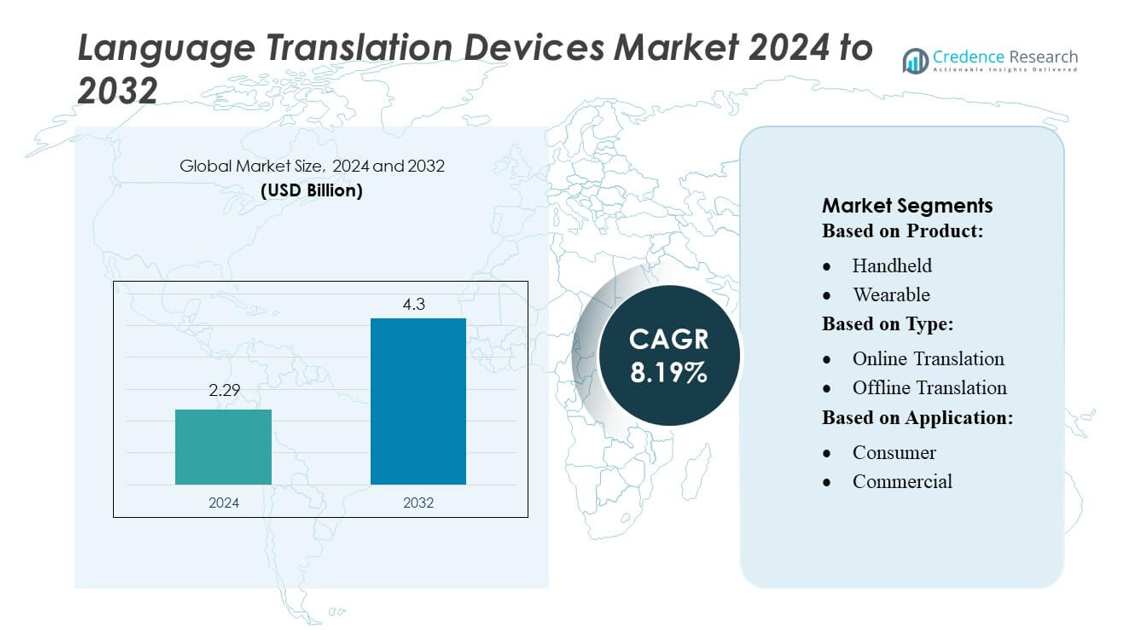
Language Translation Devices Market size was valued USD 2.29 billion in 2024 and is anticipated to reach USD 4.3 billion by 2032, at a CAGR of 8.19% during the forecast period.
| REPORT ATTRIBUTE |
DETAILS |
| Historical Period |
2020-2023 |
| Base Year |
2024 |
| Forecast Period |
2025-2032 |
| Language Translation Devices Market Size 2024 |
USD 2.29 billion |
| Language Translation Devices Market, CAGR |
8.19% |
| Language Translation Devices Market Size 2032 |
USD 4.3 billion |
The Language Translation Devices Market is shaped by a mix of global technology leaders and innovators that continue to advance AI-driven translation capabilities, real-time speech processing, and cross-device connectivity. Companies focus on improving contextual accuracy, expanding offline language packs, and integrating translation tools into wearables and smart ecosystems to strengthen competitiveness across consumer and commercial applications. Strategic investments in neural machine translation, noise reduction technologies, and multilingual software ecosystems support product differentiation in a rapidly evolving landscape. North America leads the market with approximately 34% share, supported by advanced digital infrastructure, strong consumer adoption, and widespread integration of translation technologies across travel, education, and enterprise sectors.
Market Insights
- The Language Translation Devices Market was valued at USD 2.29 billion in 2024 and is projected to reach USD 4.3 billion by 2032, advancing at a CAGR of 8.19%, driven by rising global travel demand and expanding multilingual communication needs.
- Growth accelerates as AI-driven translation engines, neural machine learning, and real-time speech processing enhance device accuracy, while offline capabilities support secure, fast communication across high-demand applications.
- Market trends emphasize integration with wearables, smartphones, and smart ecosystems, enabling seamless hands-free translation and expanding use cases across consumer, education, and enterprise sectors.
- Competitive intensity increases as technology players invest in noise reduction, multilingual software ecosystems, and domain-specific vocabulary, though accuracy gaps across dialects and high device costs restrain wider adoption.
- North America leads with 34% share, supported by strong digital infrastructure, while the consumer application segment holds the dominant share, driven by travel, retail, and cross-border communication requirements.
Access crucial information at unmatched prices!
Request your sample report today & start making informed decisions powered by Credence Research Inc.!
Download Sample
Market Segmentation Analysis:
By Product
Handheld devices dominate the Language Translation Devices Market with an estimated 58–60% share, driven by their wider functionality, longer battery life, and stronger processing capabilities preferred by travelers, enterprises, and education users. Their ability to support multi-language packs, noise-canceling microphones, and high-fidelity speakers reinforces adoption in diverse environments. Wearable devices continue to gain traction as compact, hands-free solutions suitable for real-time conversational translation, especially in tourism and logistics. Growth is supported by advancements in miniaturized chipsets and Bluetooth-enabled earbuds that enhance simultaneous interpretation efficiency.
- For instance, Caterpillar’s power breaker and power case type ATS units feature the ATC-800 or ATC-900 microprocessor-based controllers, which can achieve fast switching times.
By Type
Online translation holds the leading position with roughly 65% market share, supported by cloud-based neural machine translation engines that deliver higher accuracy, contextual learning, and continuous vocabulary updates. This segment benefits from expanding 5G connectivity, enabling low-latency performance for real-time speech and text conversion across multiple languages. Offline translation remains essential in regions with unstable connectivity and for users requiring secure, device-based processing. Increasing adoption of embedded AI accelerators and preloaded language databases strengthens offline capabilities, particularly for defense, aviation, and remote field applications.
- For instance, Generac’s TX series automatic transfer switches feature heavy-duty, contactor-based designs with a transfer time of less than 20 milliseconds in some models, and support load capacities up to 800 amperes and potentially beyond in industrial applications.
By Application
The consumer segment leads with about 55% share, driven by rising international travel, growing demand for multilingual communication tools, and increasing adoption of portable translators for personal and educational use. Consumers prefer intuitive devices with instant speech recognition, camera-based text translation, and multi-accent support. The commercial segment expands steadily in hospitality, retail, healthcare, and customer service, where real-time multilingual communication enhances operational efficiency and customer engagement. Enterprises adopt translation devices to reduce dependency on human interpreters and streamline multilingual interactions in cross-border operations.
Key Growth Drivers
Rising Global Tourism and Cross-Border Mobility
The Language Translation Devices Market grows strongly as international travel accelerates, with increasing tourist inflows, business trips, and student mobility heightening the need for real-time multilingual communication. Travelers prefer portable translation tools that deliver accurate, speech-to-speech conversion without delays, especially in regions with diverse linguistic ecosystems. Manufacturers integrate AI-driven neural machine translation (NMT), improved noise cancellation, and offline capabilities to enhance reliability in crowded or remote locations. This shift strengthens device penetration across hospitality, transportation, and retail environments seeking convenient multilingual support.
- For instance, AEG Power Solutions equips its Protect 8 series, a key industrial line, is known for a transfer time of under 5 milliseconds in static bypass mode, ensuring seamless power transfer for critical loads.
Expanding Use in Commercial and Enterprise Applications
Commercial adoption accelerates market growth as enterprises integrate translation devices to streamline multilingual engagement across customer service, logistics, field operations, and global sales interactions. Retailers, hotels, healthcare facilities, and transport operators deploy these devices to improve service accessibility for international customers and non-native speakers. Companies increasingly favor solutions with industry-specific vocabulary, cloud-synced translation memory, and secure data processing to maintain communication accuracy. This trend supports operational efficiency while reducing dependency on human interpreters in cost-sensitive and fast-paced business environments.
- For instance, Midwest Electric Products supplies closed transition transfer solutions integrated with standard Honeywell (e.g., Experion PKS) and Allen-Bradley (Micro800 or similar) PLC platforms, where individual switchgear units support continuous loads up to 5,000 Amps.
Technological Advancements in AI and Speech Recognition
Rapid innovation in AI-powered speech recognition, natural language processing (NLP), and neural translation models drives significant enhancement in translation speed, contextual accuracy, and accent adaptability. Modern devices incorporate edge-AI processing, enabling faster offline translations without relying solely on cloud connectivity. Enhanced chipsets, improved microphones, and on-device learning algorithms elevate the precision of dialogue interpretation across multiple dialects. These advancements increase device appeal in both personal and professional settings, reinforcing the market’s transition toward compact, high-performance translation solutions.
Key Trends & Opportunities
Growing Integration with Wearables and Smart Ecosystems
A key market trend emerges as translation capabilities extend into smart wearables—such as earbuds, AR glasses, and multifunctional portable devices—offering seamless hands-free communication. Manufacturers leverage Bluetooth connectivity, voice-activated controls, and multi-device pairing to support layered translation experiences. This shift creates opportunities for compact, unobtrusive solutions that appeal to travelers, commuters, and frontline workers. As smart ecosystems expand, translation devices increasingly interact with smartphones, navigation systems, and enterprise communication platforms to deliver unified multilingual support.
- For instance, Cummins’ PowerCommand® Cloud remote-monitoring system offers 24/7 visibility of multi-site power systems—enabling real-time notifications and remote control of generator sets, transfer switches and auxiliary assets.
Rising Demand for Offline and Secure Translation Solutions
Increasing awareness of data privacy drives strong demand for offline translation devices capable of secure, on-device processing without transmitting sensitive conversations to external servers. Governments, defense organizations, healthcare institutes, and corporates prefer solutions that reduce cybersecurity risks while maintaining high translation accuracy. This trend also benefits regions with limited internet connectivity, where offline translation becomes essential. Manufacturers capitalize on this opportunity by optimizing memory storage, embedded AI engines, and specialized language packs supporting domain-specific terminology.
- For instance, Eaton’s power-frame type automatic transfer switches support continuous current ratings up to 5,000 Amps (A).They are designed for system voltages up to 600 V AC. For time-based ratings, they offer withstand and close-on ratings of 100 kA in 0.05 seconds.
Expansion into Education and Language Learning Applications
The market sees new opportunities in academic institutions and language training environments where translation devices support interactive learning and improved comprehension. Students and educators adopt these tools for multilingual classrooms, international exchange programs, and cross-cultural collaboration projects. Devices equipped with two-way conversation modes, pronunciation guidance, and vocabulary building strengthen their relevance in education. This trend encourages developers to introduce customized learning modes and integration with digital learning platforms, widening adoption among schools, universities, and professional training centers.
Key Challenges
Accuracy Limitations Across Dialects and Contextual Nuances
Despite major advancements, translation accuracy varies significantly across dialects, slang, idiomatic expressions, and culturally embedded communication patterns. Devices sometimes misinterpret context-specific phrases, emotional tone, or industry-specific terminology, leading to communication gaps in critical scenarios. Such inaccuracies hinder adoption in professional environments like legal, medical, and business negotiations where precision is vital. Vendors must continuously refine linguistic datasets, expand regional language coverage, and improve contextual understanding to address this reliability concern.
High Cost of Advanced Translation Technologies
The cost of developing AI-powered translation devices with high-performance processors, advanced sensors, and multilingual neural engines remains relatively high, affecting broader affordability. Premium models with offline capabilities, noise reduction arrays, and real-time processing features often exceed the budget of cost-sensitive consumers and small businesses. This pricing challenge limits penetration in emerging markets where multilingual needs are strong but purchasing power remains uneven. Manufacturers must optimize production costs and explore modular or subscription-based models to broaden market accessibility.
Regional Analysis
North America
North America holds the largest share of around 34%, driven by strong adoption of AI-powered translation devices across travel, enterprise communication, and public service applications. The region benefits from advanced digital infrastructure, high consumer awareness, and rapid integration of real-time multilingual tools in hospitality, aviation, and healthcare. Major companies deploy translation solutions to support diverse immigrant populations and international business operations. Growth is further supported by the increasing use of wearable-based translation systems in corporate and educational settings, strengthening the region’s position as the leading market for premium, high-performance translation devices.
Europe
Europe accounts for approximately 29% of the market, supported by high tourism flows, multilingual workforces, and strong cross-border travel within the EU. Countries such as Germany, France, Spain, and Italy show significant adoption as businesses and public agencies prioritize efficient multilingual communication. The region’s hospitality, retail, and transportation sectors increasingly integrate AI translation devices to improve service accessibility. Continuous demand from international students and expatriates enhances device penetration across academic and commercial environments. Europe’s stringent data privacy regulations also accelerate adoption of secure, offline translation solutions, reinforcing sustained market expansion.
Asia-Pacific
Asia-Pacific captures about 27% of the market, fueled by booming tourism, expanding trade activities, and rising consumer preference for portable translation devices in countries with diverse linguistic landscapes. China, Japan, South Korea, and India show strong uptake as travelers and businesses seek efficient speech-to-speech translation for cross-border interactions. Government smart tourism initiatives and rapid technology adoption support wider deployment across airports, hotels, and retail hubs. The region also benefits from growing demand for educational translation tools among students and international professionals. Increasing availability of cost-effective, AI-enabled devices further accelerates APAC’s long-term growth momentum.
Latin America
Latin America holds around 6% of the market, driven by increasing tourism, expanding regional trade, and rising digitalization across service sectors. Countries like Brazil, Mexico, and Argentina adopt translation devices to support multilingual communication in hospitality, retail, and transportation environments. Growth is strengthened by the increasing arrival of international visitors and expanding cross-border business interactions within the region. Despite moderate price sensitivity, demand rises for affordable portable translators with accurate Spanish–English and Portuguese–English capabilities. Improvements in connectivity and rising smartphone penetration also encourage hybrid device usage across travel, education, and commercial operations.
Middle East & Africa
The Middle East & Africa region represents approximately 4% of the market, supported by expanding tourism ecosystems, large expatriate populations, and the growing need for multilingual service delivery across hospitality and aviation sectors. The UAE, Saudi Arabia, South Africa, and Egypt lead adoption as governments invest in smart travel infrastructure and international events. Businesses increasingly deploy translation devices to enhance communication with foreign workers and global visitors. While affordability challenges persist in parts of Africa, demand for compact offline translation tools continues to increase, particularly across education, healthcare, and customer service environments.
Market Segmentations:
By Product:
By Type:
- Online Translation
- Offline Translation
By Application:
By Geography
- North America
- Europe
- Germany
- France
- U.K.
- Italy
- Spain
- Rest of Europe
- Asia Pacific
- China
- Japan
- India
- South Korea
- South-east Asia
- Rest of Asia Pacific
- Latin America
- Brazil
- Argentina
- Rest of Latin America
- Middle East & Africa
- GCC Countries
- South Africa
- Rest of the Middle East and Africa
Competitive Landscape
The competitive landscape of the Language Translation Devices Market features a diverse mix of technology innovators and digital ecosystem leaders, including GE HealthCare, Garmin Ltd, Insulet Corporation, Dexcom, Inc., Abbott, Tandem Diabetes Care, Inc., OMRON Healthcare, Inc., Medtronic, Koninklijke Philips N.V., and Google. The Language Translation Devices Market remains highly competitive as companies prioritize advanced AI capabilities, real-time speech recognition, and improved contextual accuracy to strengthen their product portfolios. Manufacturers focus on developing compact, user-friendly devices with offline functionality, neural machine translation, and expanded language coverage to serve both consumer and enterprise users. Competition intensifies as wearable-based translators, smartphone-integrated tools, and standalone handheld devices all target overlapping user groups. Vendors differentiate through faster processing, noise reduction technologies, and domain-specific vocabulary support tailored for travel, education, retail, and commercial applications. Continuous innovation, strategic partnerships, and ecosystem integration shape the evolving competitive dynamics of the market.
Shape Your Report to Specific Countries or Regions & Enjoy 30% Off!
Key Player Analysis
- GE HealthCare
- Garmin Ltd
- Insulet Corporation
- Dexcom, Inc.
- Abbott
- Tandem Diabetes Care, Inc.
- OMRON Healthcare, Inc.
- Medtronic
- Koninklijke Philips N.V.
- Google
Recent Developments
- In July 2025, OMRON Healthcare has expanded its collaboration with Tricog Health, an AI-driven cardiac care company, to launch KeeboHealth- an advanced connected health platform designed to transform remote cardiac care and accelerate progress toward OMRON’s ‘Going for Zero’ vision, a world with zero cardiovascular events.
- In June 2025, Infineon Technologies announced a strategic partnership with The Healthcare Impact Alliance (HIA) to develop advanced connectivity solutions for the rapidly growing senior care market. This collaboration will leverage Infineon’s cutting-edge semiconductor technology to create a comprehensive ecosystem of connected healthcare devices.
- In April 2025, Stanford Medicin and Samsung announced a research partnership aimed at enhancing the Galaxy Watch’s sleep apnea detection capabilities and investigating AI-enabled solutions for continuous sleep health management.
- In April 2025, Somnology teamed up with Samsung to introduce a groundbreaking hybrid sleep care model. This innovative solution combines telehealth services with asynchronous support, delivering a personalized and accessible approach to managing sleep health
Report Coverage
The research report offers an in-depth analysis based on Product, Type, Application and Geography. It details leading market players, providing an overview of their business, product offerings, investments, revenue streams, and key applications. Additionally, the report includes insights into the competitive environment, SWOT analysis, current market trends, as well as the primary drivers and constraints. Furthermore, it discusses various factors that have driven market expansion in recent years. The report also explores market dynamics, regulatory scenarios, and technological advancements that are shaping the industry. It assesses the impact of external factors and global economic changes on market growth. Lastly, it provides strategic recommendations for new entrants and established companies to navigate the complexities of the market.
Future Outlook
- The market will adopt more AI-enhanced translation engines capable of improving contextual accuracy across diverse language pairs.
- Wearable-based translation devices will gain stronger adoption as consumers prefer hands-free, discreet communication tools.
- Offline translation capabilities will expand as users demand secure, fast, and reliable performance without internet dependency.
- Enterprise and commercial sectors will increasingly integrate translation devices to support multilingual customer engagement.
- Real-time translation in noisy environments will improve through advanced microphones and noise reduction algorithms.
- Education and training institutions will use translation tools to support multilingual classrooms and global collaboration.
- Integration with smartphones, AR glasses, and IoT ecosystems will create unified multilingual experiences.
- Devices will support more regional dialects and domain-specific vocabulary to expand accuracy across professions.
- Price-competitive offerings will rise to strengthen adoption in emerging markets.
- Continuous advancements in speech processing chips will enhance translation speed and device performance.



