
| REPORT ATTRIBUTE | DETAILS |
|---|---|
| Historical Period | 2019-2022 |
| Base Year | 2023 |
| Forecast Period | 2024-2032 |
| Mega Data Centers Market Size 2024 | USD 25,437.18 Million |
| Mega Data Centers Market, CAGR | 5.62% |
| Mega Data Centers Market Size 2032 | USD 41,934.52 Million |
Market Overview
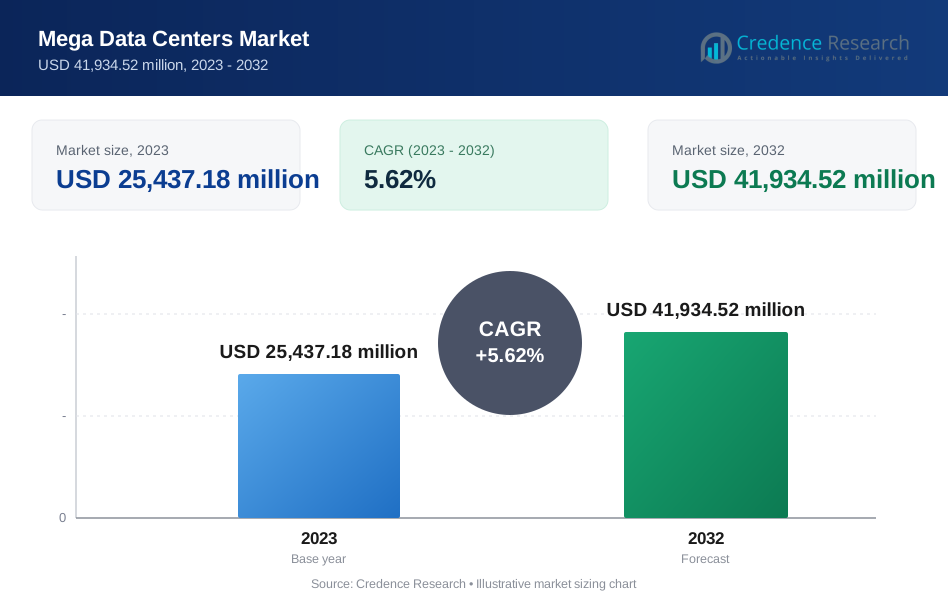
The Mega Data Centers Market is projected to grow from USD 25,437.18 million in 2023 to an estimated USD 41,934.52 million by 2032, with a compound annual growth rate (CAGR) of 5.62% from 2024 to 2032. This robust growth is driven by the exponential increase in data generation, the surge in cloud computing adoption, and the rising demand for high-performance computing solutions.
Key drivers propelling the Global Mega Data Centers Market include the relentless growth of big data analytics, the expansion of Internet of Things (IoT) devices, and the increasing reliance on artificial intelligence and machine learning applications. Additionally, trends such as the shift towards renewable energy sources for data center operations, advancements in cooling technologies, and the implementation of edge computing are shaping the market landscape. These factors collectively enhance the efficiency, scalability, and sustainability of mega data centers, making them indispensable in the modern digital economy.
Geographically, North America dominates the Global Mega Data Centers Market, owing to its advanced technological infrastructure and the presence of major cloud service providers. However, the Asia-Pacific region is expected to witness the highest growth rate, driven by rapid industrialization, increased internet penetration, and significant investments in data center facilities in countries like China and India. Key players in the market include industry giants such as Google, Amazon Web Services (AWS), Microsoft Azure, IBM, and Equinix. These companies are continuously expanding their data center footprints and investing in innovative technologies to maintain their competitive edge and meet the evolving demands of global businesses.
Market Drivers
Exponential Growth in Data Generation and Consumption
One of the foremost drivers propelling the Global Mega Data Centers Market is the exponential increase in data generation and consumption across various industries. The proliferation of digital technologies, including social media, streaming services, and e-commerce platforms, has led to an unprecedented surge in data creation. For instance, around 2.5 quintillion bytes of data are generated each day, with platforms like YouTube hosting over 720,000 hours of videos daily, equivalent to about 4.3 PB of data. Additionally, the advent of high-resolution media, such as 4K and 8K videos, and the growing adoption of immersive technologies like virtual reality (VR) and augmented reality (AR) contribute to the massive volumes of data that need to be stored, processed, and managed.As businesses and consumers generate more data, the necessity for robust and scalable data center solutions becomes critical. Mega data centers, with their extensive storage capabilities and advanced processing power, are uniquely positioned to handle these vast data streams efficiently. Furthermore, the integration of big data analytics and real-time data processing applications demands high-performance computing resources, which mega data centers are well-equipped to provide. This relentless data growth not only drives the demand for existing data center infrastructures but also stimulates investments in the development of new, state-of-the-art facilities to accommodate future data needs.
Accelerated Adoption of Cloud Computing and Digital Transformation
The accelerated adoption of cloud computing services is another pivotal driver for the Global Mega Data Centers Market. Organizations across diverse sectors are increasingly migrating their IT infrastructure to the cloud to leverage its flexibility, scalability, and cost-efficiency. For instance, data centers used between 240 to 340 terawatts of energy in 2022, with Google alone dedicating 10-15% of its total energy consumption to machine learning operations. Cloud service providers, such as Amazon Web Services (AWS), Microsoft Azure, and Google Cloud, require expansive and highly reliable data center facilities to support their global operations and deliver seamless services to customers.Digital transformation initiatives further amplify the demand for mega data centers. As businesses strive to enhance their digital capabilities, they rely heavily on cloud-based applications, software-as-a-service (SaaS) models, and other digital solutions that necessitate robust backend support. Mega data centers provide the essential infrastructure to host these applications, ensuring high availability, security, and performance. Additionally, the shift towards remote work and the increasing reliance on digital collaboration tools have heightened the need for dependable data center services, reinforcing the growth trajectory of the Global Mega Data Centers Market.
Advancements in Technology and Energy Efficiency
Technological advancements and a strong emphasis on energy efficiency are significant drivers influencing the expansion of mega data centers. Innovations in cooling technologies, such as liquid cooling and free-air cooling, have markedly improved the energy efficiency and operational sustainability of large-scale data centers. For instance, Google was able to reduce its data center cooling costs by 40% through the implementation of AI-controlled cooling infrastructure. These advancements not only reduce the overall energy consumption but also lower operational costs, making mega data centers more attractive to businesses seeking sustainable and cost-effective solutions.Moreover, the integration of artificial intelligence (AI) and machine learning (ML) into data center management systems enhances automation, predictive maintenance, and optimal resource allocation. These technologies enable data centers to operate more efficiently, minimizing downtime and maximizing performance. Additionally, the development of modular and scalable data center designs allows for greater flexibility in expansion and customization, catering to the evolving needs of businesses. As energy costs and environmental concerns continue to rise, the focus on energy-efficient technologies and sustainable practices becomes increasingly vital, driving further investments and innovations in the mega data centers sector.
Increasing Demand for High-Performance Computing (HPC) and Edge Computing
The rising demand for high-performance computing (HPC) and the expansion of edge computing are crucial drivers contributing to the growth of the Global Mega Data Centers Market. HPC applications, which are essential for complex simulations, scientific research, financial modeling, and artificial intelligence workloads, require immense computational power and advanced infrastructure. Mega data centers, equipped with high-capacity servers, advanced networking capabilities, and substantial storage solutions, are ideally suited to support these demanding applications.Simultaneously, the emergence of edge computing-where data processing occurs closer to the data source-complements the centralized power of mega data centers. While edge data centers handle real-time processing and reduce latency for localized applications, mega data centers provide the backbone for large-scale data aggregation, storage, and comprehensive analytics. This symbiotic relationship ensures that businesses can achieve both localized performance and centralized efficiency, driving the need for expansive and interconnected data center ecosystems. Furthermore, industries such as healthcare, automotive, and telecommunications are increasingly leveraging HPC and edge computing to innovate and enhance their services. For instance, in healthcare, HPC facilitates advanced medical research and personalized medicine, while edge computing supports real-time patient monitoring and telemedicine. In the automotive sector, these technologies enable the development of autonomous vehicles and smart transportation systems. The pervasive adoption of HPC and edge computing across these and other industries underscores the critical role of mega data centers in enabling technological advancements and sustaining economic growth.
Market Trends
Sustainable and Green Data Center Initiatives
Sustainability has become a paramount focus in the Global Mega Data Centers Market, driven by increasing environmental concerns and regulatory pressures. Data center operators are prioritizing the adoption of renewable energy sources such as solar, wind, and hydroelectric power to reduce their carbon footprint and achieve energy efficiency targets. For instance, storing just one terabyte of data in the cloud has an estimated carbon footprint of two tonnes annually, highlighting the critical need for sustainable solutions. This shift towards green energy not only aligns with global sustainability goals but also offers long-term cost benefits by mitigating the volatility of traditional energy prices. Additionally, companies are implementing advanced cooling technologies, such as liquid cooling and free-air cooling, which significantly lower energy consumption compared to traditional air conditioning systems. For instance, United Airline's Chicago site reduced energy consumption by 420 million kWh over 10 years through KyotoCooling® air-to-air heat transfer technology. The integration of energy-efficient hardware and the optimization of power usage effectiveness (PUE) metrics further enhance the sustainability of mega data centers. Furthermore, the concept of circular economy practices, including the recycling of electronic waste and the repurposing of cooling water, is gaining traction. For instance, LinkedIn's Hillsboro facility achieves free cooling using an advanced water side economizer, while Switch's technology helped save over 155 million gallons of water in three years. These sustainable initiatives not only improve the environmental performance of data centers but also enhance their reputation and compliance with international environmental standards, making sustainability a critical trend shaping the future of the Global Mega Data Centers Market.
Expansion of Edge Computing and Hybrid Data Center Architectures
The rapid growth of edge computing is significantly influencing the architecture and deployment strategies of mega data centers. As the demand for real-time data processing and low-latency applications increases, businesses are increasingly adopting hybrid data center models that integrate centralized mega data centers with localized edge data centers. For instance, Microsoft's Project Natick demonstrates innovative edge computing through their underwater data center that uses raw sea water for cooling. This hybrid approach enables organizations to balance the need for high-performance computing and large-scale data storage with the necessity for immediate data processing closer to the source. Edge data centers facilitate applications such as autonomous driving, smart cities, and Internet of Things (IoT) devices by providing rapid data analysis and reducing latency. For instance, Apple's Reno facility integrates edge computing with sustainability by powering operations through a 200 MW solar farm. Concurrently, mega data centers continue to serve as the backbone for extensive data aggregation, advanced analytics, and large-scale machine learning operations. The seamless integration of edge and central data centers through robust networking and interconnectivity solutions ensures efficient data flow and optimized performance across the entire infrastructure. Additionally, the adoption of software-defined networking (SDN) and network function virtualization (NFV) technologies enhances the flexibility and scalability of hybrid architectures. This trend towards hybrid and edge-integrated data center models not only meets the diverse and dynamic needs of modern businesses but also drives innovation and investment in both centralized and decentralized data center infrastructures, thereby shaping the evolution of the Global Mega Data Centers Market.
Market Restraints and Challenges
High Capital and Operational Expenditures
One of the primary restraints facing the Global Mega Data Centers Market is the substantial capital and operational expenditures required to establish and maintain large-scale data center facilities. Building a mega data center involves significant investments in land acquisition, construction, advanced infrastructure, and cutting-edge technology. Additionally, the cost of procuring and installing high-performance servers, networking equipment, and energy-efficient cooling systems can be prohibitively expensive. Operational costs, including energy consumption, maintenance, and staffing, further add to the financial burden. Energy costs, in particular, constitute a major portion of operational expenses, given the immense power requirements of mega data centers. These high costs can be a barrier to entry for smaller players and may limit the expansion capabilities of existing operators. Furthermore, the need for continuous upgrades and scalability to keep pace with evolving technological demands necessitates ongoing financial commitments. As a result, the high capital and operational expenditures associated with mega data centers can impede market growth and slow down the adoption rate, especially in regions with limited financial resources or stringent budget constraints.
Security and Data Privacy Concerns
Security and data privacy remain significant challenges within the Global Mega Data Centers Market. As mega data centers handle vast amounts of sensitive and critical information for diverse industries, they become prime targets for cyberattacks and data breaches. Ensuring robust cybersecurity measures to protect against threats such as hacking, malware, and ransomware is imperative but complex and costly. The increasing sophistication of cyber threats necessitates continuous investment in advanced security technologies, regular system updates, and comprehensive monitoring protocols. Additionally, data privacy regulations, such as the General Data Protection Regulation (GDPR) and the California Consumer Privacy Act (CCPA), impose stringent requirements on data handling, storage, and processing practices. Compliance with these regulations demands significant resources and expertise, and non-compliance can result in hefty fines and reputational damage. Furthermore, the geographical distribution of data centers introduces challenges related to varying regional data protection laws and cross-border data transfer restrictions. These security and privacy challenges not only increase operational complexities and costs but also impact the trust and confidence of clients and stakeholders. Addressing these concerns is crucial for data center operators to maintain compliance, protect sensitive data, and sustain market growth in an increasingly security-conscious global landscape.
Market Segmentation Analysis
By Component
The component segmentation of the Global Mega Data Centers Market includes both solutions and services. Solutions encompass essential elements such as IT infrastructure, support infrastructure, power, cooling, and other integrated systems required for the smooth operation of mega data centers. On the services side, offerings include system integration, monitoring services, and professional services, all of which are vital for ensuring efficient functionality, maintenance, and optimization of data center operations.
By solution Type
The Global Mega Data Centers Market, by solution type, includes several critical components that support efficient operations. IT infrastructure solutions encompass servers, storage systems, networking equipment, and virtualization technologies, forming the core of data processing and scalability. Support infrastructure solutions ensure operational continuity through uninterruptible power supplies (UPS), backup generators, and fire suppression systems, minimizing downtime and safeguarding data. Power solutions focus on energy management, renewable energy integration, and power distribution units (PDUs) to optimize consumption and enhance sustainability. Cooling solutions incorporate advanced technologies like liquid cooling, free-air cooling, and HVAC systems to maintain optimal temperatures and boost energy efficiency. The other category covers essential ancillary systems, including security, physical infrastructure, and software tools that contribute to overall functionality.
Segments
Based on Component
- Solutions
- Services
Based on Solution Type
- IT Infrastructure Solutions
- Support Infrastructure Solutions
- Power Solutions
- Cooling Solutions
- Others
Based on End User
- Cloud Providers
- Collocation Providers
- Enterprises
Based on Service Type
- System Integration
- Monitoring Services
- Professional Services
Based on Enterprise Size
- Small & Medium Enterprises (SMEs)
- Large Enterprises
Based on Industry Vertical
- Banking, Financial Services & Insurance (BFSI)
- Telecom & IT
- Media & Entertainment
- Government & Public Sector
- Others
Based on Region
- North America
- US
- Canada
- Mexico
- Europe
- Germany
- France
- UK
- Italy
- Spain
- Rest of Europe
- Asia Pacific
- China
- Japan
- India
- South Korea
- South-east Asia
- Rest of Asia Pacific
- Latin America
- Brazil
- Argentina
- Rest of Latin America
- Middle East & Africa
- GCC Countries
- South Africa
Regional Analysis
North America (37%)
North America holds the largest market share, accounting for approximately 37% of the Global Mega Data Centers Market. The region's dominance is primarily attributed to its advanced technological infrastructure, high adoption of cloud computing, and the presence of major cloud service providers such as Amazon Web Services (AWS), Google Cloud, and Microsoft Azure. The United States leads in terms of data center investments, with companies expanding their capacities to meet the increasing demand for cloud services, big data analytics, and artificial intelligence (AI) applications. The strong focus on sustainability and green data center initiatives in North America is also driving the deployment of energy-efficient solutions, further enhancing market growth. The region is expected to maintain its leadership position due to continued investments in next-generation technologies and infrastructure.
Europe (25%)
Europe holds approximately 25% of the market share and is the second-largest region in the Global Mega Data Centers Market. The region has a strong focus on sustainability and energy efficiency, with countries such as Germany, the Netherlands, and the UK leading the adoption of renewable energy solutions in data centers. Europe is also driven by stringent data privacy regulations, such as the General Data Protection Regulation (GDPR), which has prompted investments in secure and compliant data center infrastructure. The demand for cloud services, coupled with the growth of edge computing and digital transformation initiatives across industries, continues to fuel the expansion of mega data centers in the region.
Key players
- Cisco Systems Inc.
- Dell Software Inc.
- Fujitsu Ltd
- Hewlett-Packard Enterprise
- IBM Corporation
- Intel Corporation
- Juniper Networks Inc.
- Verizon Wireless
- Schneider Electric
- Vertiv Group Corp.
- NetApp
Competitive Analysis
The Global Mega Data Centers Market is characterized by intense competition among key players, each vying for technological leadership and market share. Companies like Cisco Systems Inc., IBM Corporation, and Hewlett-Packard Enterprise lead the market with comprehensive product portfolios and a strong focus on innovation. These companies are heavily investing in advanced networking, cloud solutions, and infrastructure management technologies to meet the increasing demand for scalable data centers. Intel Corporation and Dell Software Inc. are at the forefront of providing high-performance computing solutions, which are essential for large-scale data centers. Schneider Electric and Vertiv Group Corp. dominate the market for power and cooling solutions, contributing to the growing emphasis on energy efficiency and sustainability. Additionally, Juniper Networks Inc. and NetApp focus on networking and storage infrastructure, catering to the growing needs of cloud providers and enterprises. Together, these key players drive the market through technological advancements and strategic partnerships.
Recent Developments
- In March 2023, Cisco Systems Inc. investing in a new data center in Chennai to enhance cloudIndelivered security services and expand its footprint in India
- In May 2024, Dell Software Inc. introduced AI Factory with new technologies and services during its annual conference in Las Vegas, focusing on AI solutions from desktop to data center to cloud
- In October 2023, Fujitsu Ltd looking to auction off its data centers in Australia (Project Emerald), including six data centers offering colocation services
- In August 2024, HewlettInPackard Enterprise announced a new managed data center hosting service in UAE with direct liquid cooling for AI, partnering with Khazna Data Centers
- In June 2023, IBM Corporation announced plans to open its first EuropeInbased quantum data center in Ehningen, Germany, expected to be operational in 2024
- In January 2024, Intel Corporation investing $20 billion to create two advanced chip factories in Ohio, located next to hyperscale data centers
- In January 2024, Juniper Networks Inc. enhanced its data center solutions with AI technologies to improve network visibility, analysis, and automation
- In October 2023, Schneider Electric opened a new 105,000InsquareInfoot integration facility in Red Oak, Texas, for constructing prefabricated modular infrastructure
- In February 2023, Vertiv Group Corp. introduced new prefabricated modular data centre solutions In Vertiv MegaMod and Vertiv MegaMod Plus, designed for scalable deployment
- In October 2023, NetApp announced updates to its unified data storage solution, including new block storage products for enhanced savings and sustainability
Market Concentration and Characteristics
The Global Mega Data Centers Market is moderately concentrated, with a few dominant players like Cisco Systems Inc., IBM Corporation, HewlettInPackard Enterprise, and Intel Corporation holding significant market share. These companies leverage their established presence, vast product portfolios, and continuous investments in cuttingInedge technologies such as cloud computing, highInperformance computing, and energyInefficient infrastructure to maintain their competitive edge. The market is characterized by rapid technological advancements, with a focus on scalability, energy efficiency, and sustainability. While larger firms dominate, the market also includes niche players and regional firms that cater to specific aspects of data center solutions such as cooling, power management, and system integration. The competitive landscape is driven by ongoing innovations, partnerships, and mergers to capture emerging opportunities, especially in highIngrowth regions like AsiaInPacific.
Report Coverage
The research report offers an inIndepth analysis based on Component, Solution Type, End User, Service Type, Enterprise Size, Industry Vertical and Region. It details leading market players, providing an overview of their business, product offerings, investments, revenue streams, and key applications. Additionally, the report includes insights into the competitive environment, SWOT analysis, current market trends, as well as the primary drivers and constraints. Furthermore, it discusses various factors that have driven market expansion in recent years. The report also explores market dynamics, regulatory scenarios, and technological advancements that are shaping the industry. It assesses the impact of external factors and global economic changes on market growth. Lastly, it provides strategic recommendations for new entrants and established companies to navigate the complexities of the market.
Future Outlook
- The Global Mega Data Centers Market is projected to continue growing, driven by increasing demand for data storage, cloud services, and highInperformance computing across industries.
- Cloud adoption will remain a key growth driver, with more businesses migrating to cloud infrastructure for flexibility, scalability, and costInefficiency, increasing the need for mega data centers.
- There will be a heightened focus on sustainability, with mega data centers adopting renewable energy sources and advanced energyInefficient technologies to reduce carbon footprints and operational costs.
- As edge computing continues to grow, hybrid models integrating mega data centers with localized edge centers will emerge, offering realIntime data processing and improved performance for IoT and AI applications.
- Innovations in cooling technologies, such as liquid cooling and immersion cooling, will gain traction to improve energy efficiency and reduce the environmental impact of data center operations.
- The increasing use of artificial intelligence (AI), machine learning, and big data analytics will drive demand for highInperformance computing infrastructure, positioning mega data centers as critical enablers of these technologies.
- Emerging markets, particularly in the AsiaInPacific region, will see significant investment in mega data centers due to rapid industrialization, growing internet penetration, and expanding digital economies.
- As cyber threats become more sophisticated, mega data centers will invest heavily in advanced cybersecurity solutions and compliance with global data privacy regulations, ensuring the protection of sensitive information.
- Automation and AIIndriven management systems will play a larger role in optimizing data center operations, reducing downtime, and enhancing overall efficiency through predictive maintenance and realIntime monitoring.
- Mergers, acquisitions, and strategic partnerships will shape the market, as companies seek to expand their capabilities, improve infrastructure offerings, and compete in an increasingly dynamic global environment.
Request a Free Sample
Fill in your details and we'll send you a free sample report.
- Sample data tables & charts
- Research methodology
Need a Custom Version of This Report?
Tailor the scope, geography, or segments to your exact requirements.
- Custom geography or segment scope
- Direct access to our analyst team
Frequently Asked Questions
What is the market size of the Global Mega Data Centers Market in 2023 and 2032, and what is the expected CAGR?
What are the key drivers of growth in the Global Mega Data Centers Market?
Which region dominates the Global Mega Data Centers Market?
What role does sustainability play in the Global Mega Data Centers Market?
Who are the major players in this market?
Table of Content
Chapter 1. Report Introduction
- 1.1 Report Description & Purpose
- 1.1.1 Report Title & Market Definition
- 1.1.2 Unique Selling Propositions (USP) & Key Differentiators
- 1.1.3 Value Proposition for Stakeholders
- 1.2 Research Objectives
- 1.2.1 Market Sizing Objectives (Volume & Revenue)
- 1.2.2 Segmentation Objectives
- 1.2.3 Competitive Intelligence Objectives
- 1.2.4 Forecast & Scenario Objectives
- 1.3 Report Scope
- 1.3.1 Mega Data Centers Scope – Types & Subtypes Covered
- 1.3.2 Geographic Scope – Regions & Countries Covered
- 1.3.3 Historical Period, Base Year & Forecast Period (2023; forecast to 2032)
- 1.3.4 Inclusions & Exclusions
- 1.4 HS Code & Classification Framework
- 1.5 Currency, Units & Pricing Basis
- 1.6 Target Stakeholders
- 1.7 Limitations & Assumptions
Chapter 2. Executive Summary
- 2.1 Global Mega Data Centers Market Snapshot
- 2.1.1 Market Size – Historical (2023) & Forecast (2023-2032) (2023: USD 25,437.18 million → 2032: USD 41,934.52 million)
- 2.1.2 Volume & Revenue – Global Totals
- 2.1.3 Key Market Highlights – Top Five Facts
- 2.2 Mega Data Centers Market Segmentation Snapshot
- 2.2.1 Market Split by Region – 2023 vs. 2032
- 2.3 Competitive Snapshot
- 2.3.1 Top 10 Players by Revenue Share – 2023
- 2.3.2 Top 10 Players by Volume Share – 2023
- 2.3.3 Recent Strategic Developments (18-Month Summary)
- 2.4 Key Investment Highlights & Strategic Conclusions
Chapter 3. Mega Data Centers Market Dynamics & Industry Analysis
- 3.1 Market Overview & Context
- 3.1.1 Mega Data Centers Market Position in the Broader Automotive Value Chain
- 3.1.2 OEM vs. Replacement Market Dynamics
- 3.1.3 Market Maturity & Development Stage by Region
- 3.2 Mega Data Centers Market Drivers
- 3.3 Mega Data Centers Market Restraints & Challenges
- 3.4 Mega Data Centers Market Opportunities
- 3.5 Porter's Five Forces Analysis
- 3.5.1 Threat of New Entrants
- 3.5.2 Bargaining Power of Suppliers
- 3.5.3 Bargaining Power of Buyers
- 3.5.4 Threat of Substitutes
- 3.5.5 Competitive Rivalry – Intensity Assessment
- 3.6 Mega Data Centers Value Chain Analysis
- 3.6.1 Upstream – Raw Material/Input Suppliers
- 3.6.1.1 Raw Material/Input 1
- 3.6.1.2 Raw Material/Input 2
- 3.6.1.3 Raw Material/Input 3
- 3.6.2 Midstream – Production/Manufacturing/Service Delivery
- 3.6.2.1 Production/Process Overview
- 3.6.2.2 Key Facility Locations & Capacity by Manufacturer
- 3.6.3 Downstream – Distribution & End Consumer
- 3.6.3.1 Primary Channel – B2B/OEM
- 3.6.3.2 Secondary Channels – Dealer, Retail, Online, Direct
- 3.6.4 Value Chain Profitability Analysis
- 3.6.1 Upstream – Raw Material/Input Suppliers
- 3.7 PESTEL Analysis
- 3.7.1 Political Factors
- 3.7.2 Economic Factors
- 3.7.3 Social Factors
- 3.7.4 Technological Factors
- 3.7.5 Environmental Factors
- 3.7.6 Legal Factors
- 3.8 Mega Data Centers Supply Chain Analysis
- 3.8.1 Raw Material/Input Supply Risk Assessment
- 3.8.2 Manufacturing Concentration Risk (Geographic Exposure)
- 3.8.3 Trade Disruption Impact Analysis
- 3.9 Regulatory & Policy Landscape
Note: The regulatory and policy landscape section covers regulations based on their applicability to the market, Mega Data Centers category, geography, and scope of the study. Only regulatory frameworks with a material impact on operations, compliance, trade, sustainability, or market access are analyzed in detail.
Chapter 4. Key Investment Pockets & Opportunity Analysis
- 4.1 Mega Data Centers Market Attractiveness Analysis
- 4.1.1 By Region – Investment Attractiveness Matrix (Volume × CAGR)
- 4.2 Absolute Revenue Growth Opportunity
- 4.2.1 By Region – Absolute USD Growth Through 2032
- 4.3 Incremental Volume Opportunity
- 4.3.1 By Region – Incremental Volume Through 2032
- 4.3.2 Segment – Incremental Volume
- 4.4 Emerging Submarket Opportunity Deep Dive (Subject to Applicability)
- 4.5 Emerging Market Opportunity Scorecards
- 4.5.1 United States
- 4.5.2 Europe
- 4.5.3 Asia
- 4.5.4 Middle East & Africa
Note: Emerging Market Opportunity Scorecards will be included based on relevance and strategic importance. Regions listed are indicative and may vary depending on data availability and market dynamics.
Chapter 5. Mega Data Centers Import-Export Analysis & Trade Flows
- 5.1 Global Trade Overview
- 5.1.1 Global Export Value by Country (2023)
- 5.1.2 Global Export Volume by Country (2023)
- 5.1.3 Global Import Value by Country (2023)
- 5.1.4 Global Import Volume by Country (2023)
- 5.1.5 Net Trade Balance by Country (2023)
- 5.2 Export Analysis – Segment
- 5.2.1 Type 1 (HS Code)
- 5.2.2 Type 2 (HS Code)
- 5.2.3 Type 3 (HS Code)
- 5.2.4 Type 4 (HS Code)
- 5.2.5 Type 5 (HS Code)
- 5.3 Import Analysis – Segment
- 5.3.1 Type 1 (HS Code)
- 5.3.2 Type 2 (HS Code)
- 5.3.3 Type 3 (HS Code)
- 5.3.4 Type 4 (HS Code)
- 5.3.5 Type 5 (HS Code)
- 5.4 Average Unit Trade Prices
- 5.4.1 Average Export Price – Segment & Country
- 5.4.2 Average Import Price – Segment & Source Country
- 5.4.3 Price Trends (2023)
- 5.5 Key Trade Route Analysis
- 5.5.1 Trade Route 1
- 5.5.2 Trade Route 2
- 5.5.3 Trade Route 3
- 5.5.4 Trade Route 4
- 5.5.5 Trade Route 5
- 5.6 Trade Policy Impact Assessment
- 5.6.1 US Anti-Dumping & Section 301 Tariffs
- 5.6.2 EU Customs Union Impact
- 5.6.3 Major Free Trade Agreements
- 5.6.4 USMCA Rules of Origin
Note: Trade policy analysis will be included only where relevant to the Mega Data Centers market.
Chapter 6. Competitive Landscape & Company Benchmarking
- 6.1 Mega Data Centers Market Concentration & Structure
- 6.1.1 Herfindahl-Hirschman Index (HHI) – vs. 2023
- 6.1.2 Tier 1, Tier 2 & Tier 3 Market Structure
- 6.1.3 Global, Regional & Local Player Dynamics
- 6.2 Mega Data Centers Market Share Analysis – 2023
- 6.2.1 Global Revenue Share by Company
- 6.2.2 Global Volume Share by Company
- 6.2.3 Regional Revenue Share
- 6.2.4 Market Share Evolution ( vs. 2023)
- 6.2.5 OEM Segment Share by Company
- 6.2.6 Replacement Segment Share by Company
- 6.3 Production/Delivery Capacity & Facility Analysis
- 6.3.1 Global Installed Capacity
- 6.3.2 Capacity Utilization Rates
- 6.3.3 Production/Output Volume
- 6.3.4 Facility Locations & Capacity Map
- 6.3.5 Planned Capacity Additions
- 6.4 Mega Data Centers Competitive Benchmarking Matrix
- 6.4.1 Revenue, Volume, CAGR & Profitability Comparison
- 6.4.2 Channel Revenue Mix
- 6.4.3 Geographic Revenue Exposure
- 6.4.4 R&D Intensity
- 6.4.5 Sustainability Maturity
- 6.5 Strategic Developments in Mega Data Centers (Last 24 Months)
- 6.5.1 Mergers, Acquisitions & Divestments
- 6.5.2 New Mega Data Centers Launches
- 6.5.3 Facility Expansions
- 6.5.4 Strategic Alliances, Joint Ventures & Partnerships
- 6.5.5 Distribution Expansion & Market Entry
- 6.5.6 Sustainability & ESG Initiatives
- 6.6 Competitive Strategy Mapping
- 6.6.1 Leader, Challenger, Follower & Niche Classification
- 6.6.2 Pricing Strategy Comparison
- 6.6.3 Channel Strategy Matrix
Note: Strategic developments are included based on their materiality and the availability of reliable information.
Chapter 7. Global Mega Data Centers Market – By Distribution Channel
- 7.1 Segment Overview
- 7.1.1 Volume & Revenue Split by Channel (2023 & 2032)
- 7.1.2 Channel Mix Evolution (2023-2032)
Chapter 8. Regional Market Analysis – Global Overview
- 8.1 Global Regional Overview
- 8.1.1 Regional Volume Share
- 8.1.2 Regional Revenue Share
- 8.1.3 Regional Volume by Region
- 8.1.4 Regional Revenue by Region
- 8.1.5 Regional Forecast Through 2032
- 8.2 Cross-Regional Segment Analysis
- 8.2.1 By Distribution Channel
- 8.2.2 By Brand/Price Tier
Chapter 9. North America Mega Data Centers Market
- 9.1 United States
- 9.2 Canada
- 9.3 Mexico
Chapter 10. Europe Mega Data Centers Market
- 10.1 Germany
- 10.2 France
- 10.3 Italy
- 10.4 United Kingdom
- 10.5 Spain
- 10.6 Poland
- 10.7 Russia
- 10.8 Netherlands
- 10.9 Belgium
- 10.10 Sweden
- 10.11 Denmark
- 10.12 Norway
- 10.13 Rest of Europe
Chapter 11. Asia Pacific Mega Data Centers Market
- 11.1 China
- 11.2 India
- 11.3 Japan
- 11.4 South Korea
- 11.5 Thailand
- 11.6 Indonesia
- 11.7 Vietnam
- 11.8 Malaysia
- 11.9 Australia
- 11.10 Rest of Asia Pacific
Chapter 12. Latin America Mega Data Centers Market
- 12.1 Brazil
- 12.2 Argentina
- 12.3 Colombia
- 12.4 Chile
- 12.5 Rest of Latin America
Chapter 13. Middle East Mega Data Centers Market
- 13.1 Saudi Arabia
- 13.2 United Arab Emirates
- 13.3 Turkey
- 13.4 Israel
- 13.5 Iran
- 13.6 Rest of the Middle East
Chapter 14. Africa Mega Data Centers Market
- 14.1 South Africa
- 14.2 Egypt
- 14.3 Nigeria
- 14.4 Morocco
- 14.5 Rest of Africa
Chapter 15. Mega Data Centers Company Profiles
- 15.1 [Company 01]
- 15.1.1 Company Overview
- 15.1.2 Key Management Personnel
- 15.1.3 Products & Services Portfolio
- 15.1.4 Financial Performance
- 15.1.5 Key Market Focus & Geographic Presence
- 15.1.6 Recent Developments & Strategic Initiatives
Note: The company profile list is preliminary and may change based on research findings, market developments, data availability, and client requirements.
Chapter 16. Appendices
- Appendix A – List of Abbreviations & Acronyms
- Appendix B – Industry Classification Code Reference – Full Series
- Appendix C – Production & Capacity Data Tables
- Appendix D – End-Use & Demand Base Tables
- Appendix E – Consumption & Replacement Rate Assumptions
- Appendix F – ASP Reference Tables
- Appendix G – Manufacturing & Facility Database
- Appendix H – Import-Export Data Tables
- Appendix I – Regulatory Summary Tables
- Appendix J – Primary Research Participant List (Anonymized)
- Appendix K – Primary Research Questionnaire Framework
- Appendix L – Data Sources & Bibliography
- Appendix M – Market Size Divergence & Source Comparison
Chapter 17. Research Methodology
- 17.1 Research Framework & Philosophy
- 17.2 Secondary Research – Sources, Hierarchy & Data Extraction
- 17.3 Data Modeling – Bottom-Up & Top-Down Market Sizing
- 17.4 Primary Research – Stakeholder Framework, LOI & Sample Sizes
- 17.5 Forecast Methodology – Regression, Scenario & Sensitivity Analysis
- 17.6 Quality Control – Four-Layer Validation Framework
- 17.7 Limitations & Standard Assumptions
- 17.8 Disclaimer
