Market Overview:
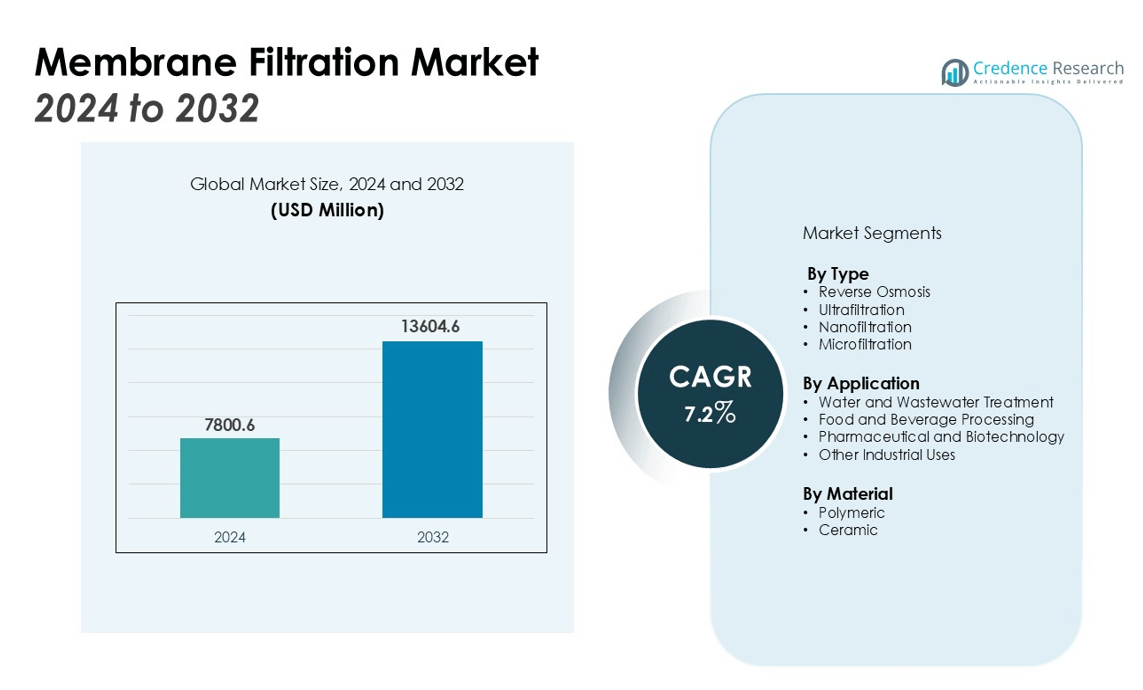
The Membrane Filtration Market size was valued at USD 7800.6 million in 2024 and is anticipated to reach USD 13604.6 million by 2032, at a CAGR of 7.2% during the forecast period (2024-2032).
| REPORT ATTRIBUTE | DETAILS |
|---|---|
| Historical Period | 2020-2023 |
| Base Year | 2024 |
| Forecast Period | 2025-2032 |
| Membrane Filtration Market Size 2024 | USD 7800.6 million |
| Membrane Filtration Market, CAGR | 7.2% |
| Membrane Filtration Market Size 2032 | USD 13604.6 million |
Key growth factors include the increasing need for clean water, stricter wastewater treatment regulations, and heightened awareness of water-borne diseases. Developments in membrane materials, such as ceramic and reverse osmosis membranes, are delivering better performance, durability, and cost efficiency. Industries such as pharmaceuticals, food and beverage, and dairy processing are adopting high-precision filtration systems to ensure product safety and meet rigorous quality standards. The pharmaceutical and biotechnology sectors, in particular, are driving demand for sterile and reliable filtration methods.
The Asia-Pacific region leads the market, supported by rapid industrial expansion, growing food processing industries, and strong emphasis on water quality. Europe holds a significant share, propelled by its well-established pharmaceutical and brewery sectors. North America continues to make steady contributions, supported by strict water treatment regulations and continuous innovation in filtration technologies, ensuring sustained demand and market development across diverse applications. Increasing collaborations between technology providers and end-use industries are further accelerating adoption and fostering innovation in membrane filtration solutions.
Market Insights:
- The Membrane Filtration Market was valued at USD 7800.6 million in 2024 and is projected to reach USD 13604.6 million by 2032, registering a CAGR of 7.2% during the forecast period.
- Rising demand for clean water, stricter wastewater treatment regulations, and greater awareness of water-borne diseases are fueling global adoption.
- Advances in ceramic, ultrafiltration, and reverse osmosis membranes are improving durability, efficiency, and cost-effectiveness across industries.
- High operational and maintenance costs, along with membrane fouling and performance limitations, remain key challenges for broader adoption.
- Asia-Pacific holds 41% of the market share, driven by industrial growth, food processing expansion, and significant municipal water infrastructure investments.
- Europe accounts for 28% of the market, supported by strong manufacturing standards, stringent food safety regulations, and a focus on sustainability.
- North America represents 22% of the market, benefiting from advanced technological integration, infrastructure modernization, and high-purity application demand.
Market Drivers:
Rising Global Demand for Clean and Safe Water
The Membrane Filtration Market is driven by the growing global need for clean, safe, and sustainable water sources. It addresses critical challenges in water purification by effectively removing contaminants, pathogens, and impurities. Stringent water safety regulations across industrial and municipal sectors are compelling the adoption of advanced membrane filtration systems. Growing awareness of water-borne diseases is further accelerating the demand for reliable purification technologies. This creates consistent opportunities for innovation and market expansion.
- For instance, DuPont's FilmTec™ Nanofiltration membranes, which won the 2024 Sustainable Technology of the Year award, are used in various applications, including lithium extraction and milk concentration.
Stringent Environmental and Wastewater Treatment Regulations
Government regulations mandating improved wastewater treatment standards are a major growth catalyst for the market. It enables industries to comply with strict discharge norms and achieve higher treatment efficiency. Wastewater recycling initiatives in manufacturing, power generation, and municipal applications are boosting the need for advanced membrane solutions. Rising industrialization in developing regions is creating a larger base of industries subject to environmental compliance. This regulatory push is ensuring steady market penetration.
- For instance, DuPont's award-winning FilmTec™ Fortilife™ membrane technologies are utilized in 112 countries, purifying over 50 million gallons of water per minute for various industrial and municipal applications.
Technological Advancements in Membrane Materials and Design
Continuous improvements in membrane materials, including ceramic, ultrafiltration, and reverse osmosis variants, are enhancing durability, energy efficiency, and filtration precision. The Membrane Filtration Market benefits from innovations that reduce operational costs while extending service life. It is witnessing the integration of automation and smart monitoring systems for process optimization. These advancements are expanding the application scope in pharmaceuticals, food and beverage, and dairy processing. High-performance membranes are also enabling more sustainable and efficient operations.
Growing Adoption in High-Purity and Sensitive Applications
Industries with high-purity requirements, such as pharmaceuticals, biotechnology, and electronics manufacturing, are increasingly adopting membrane filtration solutions. It provides sterile, contamination-free processing that meets stringent quality and safety standards. The market is benefiting from the rising demand for protein separation, enzyme recovery, and ultrapure water production. Expanding biopharmaceutical production capacity is further supporting adoption. This focus on precision and product integrity is reinforcing the market’s long-term growth trajectory.
Market Trends:
Advancements in High-Performance Membrane Technologies
The Membrane Filtration Market is experiencing a shift toward advanced membrane technologies that offer higher efficiency, longer lifespan, and reduced maintenance needs. Manufacturers are developing membranes with improved fouling resistance and enhanced permeability to optimize operational performance. It is also witnessing growing integration of energy-efficient designs that lower overall production costs while maintaining high-quality filtration output. The adoption of ceramic membranes and hybrid systems is expanding due to their durability and suitability for challenging industrial applications. Smart monitoring and automation tools are being incorporated to enable real-time performance tracking and predictive maintenance. These technological innovations are broadening the scope of applications in water treatment, food processing, pharmaceuticals, and biotechnology.
- For instance, Pall Corporation engineered a full-scale solution for a bioethanol facility using its Membralox ceramic membranes to process 250 cubic meters per hour of thin stillage, which improves the economics of production.
Rising Adoption Across Emerging and Niche Applications
The market is observing growing penetration in emerging sectors that require high-purity processing, such as electronics manufacturing, nutraceuticals, and specialty chemicals. It is also seeing increasing use in resource recovery applications, including the concentration of valuable by-products and the reuse of treated water. Demand is rising for modular and scalable membrane systems that can adapt to varying operational requirements in small and large-scale facilities. The Membrane Filtration Market is benefiting from the trend toward decentralized water treatment solutions, which improve accessibility in remote or underserved areas. Sustainability goals are driving interest in eco-friendly membrane materials and processes that reduce chemical usage and waste generation. The expansion of global food safety standards and pharmaceutical production is further supporting the steady adoption of advanced membrane filtration systems across industries.
- For instance, Asahi Kasei has introduced the Planova FG1, a next-generation virus removal filter for biopharmaceutical applications that offers up to 7 times higher flux than previous models.
Market Challenges Analysis:
High Operational and Maintenance Costs
The Membrane Filtration Market faces a significant challenge in managing the high operational and maintenance costs associated with advanced filtration systems. Frequent membrane replacement, energy consumption, and specialized cleaning processes increase the total cost of ownership. It requires skilled operators and consistent maintenance to ensure optimal performance, which can be a barrier for small and medium-sized enterprises. Variability in feedwater quality can further accelerate membrane fouling and damage, leading to unplanned downtime. These cost and maintenance constraints can slow adoption, especially in cost-sensitive industries and developing markets.
Performance Limitations and Technical Barriers
While membrane technologies offer high precision, they also face challenges related to performance limitations under extreme operating conditions. The Membrane Filtration Market must address issues such as reduced efficiency in handling high-solids content or aggressive chemical environments. It is also affected by membrane fouling, scaling, and biofilm formation, which impact system reliability and lifespan. Technical constraints in scaling up solutions for large industrial applications can limit market penetration. Meeting the demand for membranes that balance durability, efficiency, and cost-effectiveness remains a critical hurdle. These barriers underscore the need for ongoing innovation and material advancements to sustain market growth.
Market Opportunities:
Expanding Applications in Emerging Industries
The Membrane Filtration Market is positioned to benefit from expanding applications in sectors such as nutraceuticals, bio-based chemicals, and advanced electronics manufacturing. Growing demand for ultrapure water, precise ingredient separation, and contamination-free processing is creating new revenue streams. It is also finding opportunities in specialized uses like protein recovery, enzyme concentration, and resource reclamation from wastewater. The rise of personalized nutrition and biopharmaceuticals is boosting demand for highly specialized filtration solutions. Adoption in these high-value industries supports premium pricing and long-term market stability.
Growing Focus on Sustainable and Decentralized Solutions
Sustainability goals and water scarcity concerns are opening opportunities for eco-friendly membrane materials and low-energy filtration technologies. The Membrane Filtration Market can leverage innovations that reduce chemical usage, extend membrane lifespan, and improve recycling capabilities. It is also gaining traction in decentralized and modular treatment systems that serve remote or underserved areas, where conventional infrastructure is not feasible. Governments and industries are increasingly funding projects that integrate membrane filtration into circular water management systems. This shift toward sustainable, adaptable solutions positions the market for growth across both developed and developing economies.
Market Segmentation Analysis:
By Type
The Membrane Filtration Market is categorized into reverse osmosis, ultrafiltration, nanofiltration, and microfiltration. Reverse osmosis holds a leading position due to its high efficiency in removing dissolved solids and contaminants from water. Ultrafiltration is gaining traction in food, beverage, and dairy industries for its ability to retain essential nutrients while removing bacteria and other impurities. Nanofiltration is preferred for partial desalination and water softening applications, while microfiltration serves as an effective pre-treatment step in various industrial processes.
For instance, DuPont's FilmTec Fortilife XC120 reverse osmosis elements can achieve reject Total Dissolved Solids (TDS) levels greater than 120,000 ppm in industrial brine concentration applications.
By Application
The market serves water and wastewater treatment, food and beverage processing, pharmaceutical and biotechnology, and other industrial uses. It is witnessing strong growth in water and wastewater treatment, driven by regulatory requirements and rising water scarcity. The food and beverage sector relies on membrane filtration for product safety, consistency, and quality enhancement. Pharmaceutical and biotechnology applications demand sterile and contamination-free processes, making high-precision membranes essential for production.
- For instance, Nanostone's ceramic ultrafiltration membranes restored the water capacity to 3 million gallons per day at the Rapid Valley facility.
By Material
The market includes polymeric and ceramic membranes. Polymeric membranes dominate due to their cost-effectiveness, flexibility, and suitability for a wide range of applications. Ceramic membranes, while more expensive, offer superior durability, chemical resistance, and longer operational life, making them ideal for harsh industrial environments. The shift toward advanced membrane materials is shaping competitive strategies across the industry.
Segmentations:
By Type
- Reverse Osmosis
- Ultrafiltration
- Nanofiltration
- Microfiltration
By Application
- Water and Wastewater Treatment
- Food and Beverage Processing
- Pharmaceutical and Biotechnology
- Other Industrial Uses
By Material
- Polymeric
- Ceramic
By Region
- North America
- U.S.
- Canada
- Mexico
- Europe
- UK
- France
- Germany
- Italy
- Spain
- Russia
- Belgium
- Netherlands
- Austria
- Sweden
- Poland
- Denmark
- Switzerland
- Rest of Europe
- Asia Pacific
- China
- Japan
- South Korea
- India
- Australia
- Thailand
- Indonesia
- Vietnam
- Malaysia
- Philippines
- Taiwan
- Rest of Asia Pacific
- Latin America
- Brazil
- Argentina
- Peru
- Chile
- Colombia
- Rest of Latin America
- Middle East
- UAE
- KSA
- Israel
- Turkey
- Iran
- Rest of Middle East
- Africa
- Egypt
- Nigeria
- Algeria
- Morocco
- Rest of Africa
Regional Analysis:
Asia-Pacific Leading with Expanding Industrial and Municipal Demand
Asia-Pacific accounted for 41% of the Membrane Filtration Market in the latest assessment, reflecting its strong dominance in global demand. The region’s growth is driven by rapid industrialization, urbanization, and rising water treatment needs. Strong expansion in food processing, dairy, and beverage industries is fueling adoption of advanced filtration systems. It is also supported by significant investments in municipal water infrastructure to address increasing population and urban water scarcity. Government initiatives promoting sustainable water management are accelerating the installation of high-capacity membrane systems. Expanding pharmaceutical and biotechnology sectors further enhance the region’s demand for precision filtration technologies.
Europe Strengthening Through Advanced Manufacturing and Quality Standards
Europe held 28% of the Membrane Filtration Market in the latest evaluation, supported by its well-established pharmaceutical, brewery, and dairy processing industries. The market in this region benefits from stringent food safety and environmental regulations, encouraging continuous upgrades in filtration technology. It is characterized by high adoption of energy-efficient and long-lasting membrane solutions to meet sustainability targets. Research and development activities are fostering advancements in specialized membrane materials for niche industrial uses. The region’s focus on circular water systems and resource recovery also adds momentum to market growth.
North America Driving Growth with Technological Innovation
North America represented 22% of the Membrane Filtration Market in the latest statistics, reflecting its significant contribution to global demand. It is benefiting from extensive adoption in the pharmaceutical, biotechnology, and food sectors where high-purity standards are critical. Technological innovation, including automation and smart monitoring integration, is enhancing operational efficiency and reducing downtime. The region’s emphasis on replacing aging water treatment infrastructure is creating opportunities for advanced membrane installations. Rising investments in sustainable and decentralized treatment solutions are further driving market expansion.
Key Player Analysis:
- Veolia
- Alfa Laval India Pvt Ltd
- DuPont De Nemours Inc.
- Gesellschaft für Entstaubungsanlagen (GEA) Group Ag
- Minnesota Mining and Manufacturing Company (3M)
- Nitto Denko Corporation
- Koch Separation Systems
- Aqua Membranes
- Pall Corporation
- Synder Filtration
Competitive Analysis:
The Membrane Filtration Market features a competitive landscape with the presence of global and regional players focusing on innovation, product differentiation, and capacity expansion. Leading companies are investing in advanced membrane technologies that offer higher efficiency, longer lifespan, and reduced operational costs. It is characterized by strategic partnerships, mergers, and acquisitions aimed at expanding market reach and strengthening product portfolios. Key players are enhancing their presence in high-growth regions through targeted distribution networks and localized manufacturing. Competition is also intensifying in specialized applications such as pharmaceutical processing, high-purity water production, and sustainable wastewater treatment solutions. Continuous research and development efforts are enabling the introduction of membranes with improved fouling resistance, energy efficiency, and compatibility with diverse industrial environments. This competitive drive is positioning market leaders to address evolving customer needs while meeting stringent regulatory and quality standards across industries.
Recent Developments:
- In June 2025, Alfa Laval launched Clariot™, a next-generation, AI-based condition monitoring solution for hygienic process equipment.
- In January 2025, DuPont announced it was accelerating its plan to separate its Electronics business into a new, independent public company, targeting completion by November 1, 2025.
- In July 2025, Veolia and the Agence Française de Développement (AFD) established a three-year strategic partnership.
Market Concentration & Characteristics:
The Membrane Filtration Market exhibits a moderately concentrated structure, with a mix of established global leaders and emerging regional players competing for market share. It is characterized by high entry barriers due to significant capital investment, advanced technological requirements, and strict regulatory compliance. Leading companies maintain a competitive edge through innovation in membrane materials, process optimization, and specialized application development. The market demonstrates strong demand in industries requiring high-purity outputs, including pharmaceuticals, food and beverage, and water treatment. It is also defined by long-term contracts, customer-specific solutions, and a growing emphasis on sustainable and energy-efficient systems. Continuous R&D investment and strategic collaborations are shaping the competitive dynamics, enabling players to expand their global footprint and adapt to evolving industry standards.
Report Coverage:
The research report offers an in-depth analysis based on Type, Application, Material and Region. It details leading market players, providing an overview of their business, product offerings, investments, revenue streams, and key applications. Additionally, the report includes insights into the competitive environment, SWOT analysis, current market trends, as well as the primary drivers and constraints. Furthermore, it discusses various factors that have driven market expansion in recent years. The report also explores market dynamics, regulatory scenarios, and technological advancements that are shaping the industry. It assesses the impact of external factors and global economic changes on market growth. Lastly, it provides strategic recommendations for new entrants and established companies to navigate the complexities of the market.
Future Outlook:
- Demand for advanced membrane technologies will increase, driven by stricter global water quality and safety regulations.
- Adoption in pharmaceutical and biotechnology sectors will expand, supported by the need for sterile and contamination-free processes.
- Food and beverage applications will grow, with a focus on improving product consistency, safety, and shelf life.
- Development of membranes with enhanced fouling resistance and longer operational life will gain priority among manufacturers.
- Sustainability goals will drive the use of eco-friendly membrane materials and energy-efficient filtration systems.
- Integration of automation and smart monitoring will improve operational efficiency and predictive maintenance capabilities.
- Emerging economies will witness higher adoption due to industrial growth and government-led water treatment initiatives.
- Modular and decentralized membrane systems will see wider deployment in remote and resource-limited areas.
- Investments in R&D will lead to innovations in hybrid membrane systems for broader application versatility.
- Strategic partnerships and mergers will strengthen distribution networks and global market reach for leading players.

Request a Free Sample
Fill in your details and we'll send you a free sample report.
- Sample data tables & charts
- Research methodology
Market Dynamics
Stricter Water and Wastewater Treatment Regulations
Governments worldwide are enforcing more rigorous standards for water discharge and purification, compelling industries and municipalities to adopt advanced membrane filtration systems to comply with environmental and public health requirements.
Technological Advancements in Membrane Materials
Continuous innovation in membrane materials, such as ceramic and advanced polymeric membranes, is improving filtration efficiency, durability, and cost-effectiveness, making membrane filtration more attractive for a wider range of applications.
Expansion of High-Purity Applications in Pharmaceuticals and Biotechnology
The growing need for sterile, contamination-free processing in pharmaceutical and biotechnology manufacturing is driving demand for high-precision membrane filtration solutions that meet stringent quality and safety standards.
Growth in Food and Beverage Processing
Rising food safety regulations and the need for consistent product quality are leading food and beverage manufacturers to invest in membrane filtration systems for applications such as dairy processing, beverage clarification, and ingredient concentration.
Increasing Investments in Water Infrastructure in Emerging Markets
Rapid industrialization and urbanization in Asia-Pacific and other developing regions are resulting in significant investments in municipal and industrial water treatment infrastructure, boosting the adoption of membrane filtration technologies.
Need a Custom Version of This Report?
Tailor the scope, geography, or segments to your exact requirements.
- Custom geography or segment scope
- Direct access to our analyst team
Frequently Asked Questions
What is the current market size for Membrane Filtration, and what is its projected size in 2032?
At what Compound Annual Growth Rate is the Membrane Filtration market projected to grow between 2024 and 2032?
What are the primary factors fueling the growth of the Membrane Filtration market?
Which region commanded the largest share of the Membrane Filtration market in 2024?
Table of Content
Chapter 1 Market Segmentation
- 1.1 Segmentation Framework
- 1.1.1 Product and Service Classification
- 1.1.2 Application and End-Use Classification
- 1.1.3 Technology and Solution Classification
- 1.1.4 Customer and Distribution Channel Classification
- 1.1.5 Geographic Segmentation
- 1.1.6 Market Segment Definitions and Boundaries
- 1.2 By Type
- 1.2.1 Reverse Osmosis
- 1.2.2 Ultrafiltration
- 1.2.3 Nanofiltration
- 1.2.4 Microfiltration
- 1.3 By Material
- 1.3.1 Polymeric
- 1.3.2 Ceramic
- 1.4 By Application
- 1.4.1 Water and Wastewater Treatment
- 1.4.2 Food and Beverage Processing
- 1.4.3 Pharmaceutical and Biotechnology
- 1.4.4 Other Industrial Uses
Chapter 2 Introduction
- 2.1 Report Objectives and Scope
- 2.2 Product Definition and Industry Terminology
- 2.3 Market Inclusions and Exclusions
- 2.4 Research Process
- 2.4.1 Primary Research and Expert Interviews
- 2.4.2 Secondary Research and Source Review
- 2.4.3 Top-Down and Bottom-Up Estimation
- 2.4.4 Data Triangulation and Verification
- 2.5 Market Size Measurement Basis
- 2.5.1 2024: USD 7800.6 million → 2032: USD 13604.6 million
- 2.6 Historical and Forecast Reference Periods
- 2.6.1 Base Year: 2024
- 2.6.2 Forecast Period: 2024-2032
- 2.7 Research Assumptions and Limitations
Chapter 3 Executive Summary
- 3.1 Market Snapshot and Key Findings
- 3.2 Base-Year Market Size, 2024
- 3.3 Forecast Market Size, 2032
- 3.4 Revenue and Volume Growth Outlook
- 3.5 Key Demand and Supply Indicators
- 3.6 Leading Market Segments
- 3.7 Fastest-Growing Market Opportunities
- 3.8 Regional Performance Highlights
- 3.9 Technology and Industry Transformation
- 3.10 Competitive Landscape Summary
- 3.11 Analyst View and Strategic Implications
Chapter 4 Global Membrane Filtration Market Trends and Developments
- 4.1 Historical Industry Development
- 4.2 Recent Market Trends and Developments
- 4.3 Demand and Customer Behavior Trends
- 4.4 Technology and Product Innovation
- 4.5 Artificial Intelligence, Automation and Digitalization
- 4.6 Local Manufacturing and Supply Chain Realignment
- 4.7 Industry Partnerships, Mergers and Acquisitions
- 4.8 Sustainability and Circular Economy Developments
- 4.9 Government and Private Sector Investment Trends
- 4.10 Emerging Business Models and Commercialization
- 4.11 Industry Developments and Announcements
Chapter 5 Global Membrane Filtration Market Production, Supply and Demand Analysis
- 5.1 Demand Trend and Consumption Analysis
- 5.2 Demand Forecast, 2024-2032
- 5.3 Production and Output Trend
- 5.4 Production and Output Forecast, 2024-2032
- 5.5 Installed Capacity and Capacity Utilization
- 5.6 Company-Wise Production Plants and Statistics
- 5.6.1 Installed Production Capacity
- 5.6.2 Actual Production
- 5.6.3 Planned Capacity and Expansion Targets
- 5.7 Supply Chain Structure and Procurement Trends
- 5.8 Supply-Demand Gap and Bottlenecks
- 5.9 Import Dependence and Sourcing Structure
- 5.10 Contract Manufacturing and Outsourcing
- 5.11 Regional Supply and Demand Concentration
Chapter 6 Global Membrane Filtration Market Pricing Analysis
- 6.1 Pricing Structure and Measurement
- 6.2 Historical Pricing Trends
- 6.3 Pricing Outlook, 2024-2032
- 6.4 Average Selling Price and Unit Economics
- 6.5 Pricing by Product and Market Segment
- 6.6 Geographic Pricing Differences
- 6.7 Key Input, Energy, Labor and Logistics Costs
- 6.8 Contract Pricing and Purchasing Models
- 6.9 Pricing Sensitivity and Competitive Positioning
- 6.10 Price, Margin and Profitability Implications
Chapter 7 Global Membrane Filtration Market Dynamics
- 7.1 Market Growth Drivers
- 7.1.1 Demand-Side Drivers
- 7.1.2 Technology and Innovation Drivers
- 7.1.3 Infrastructure and Investment Drivers
- 7.1.4 Regulatory and Policy Drivers
- 7.2 Market Restraints
- 7.2.1 Cost and Affordability Constraints
- 7.2.2 Technology and Adoption Barriers
- 7.2.3 Supply Chain and Operational Constraints
- 7.3 Market Challenges
- 7.3.1 Competitive Pressure and Margin Erosion
- 7.3.2 Skills, Infrastructure and Implementation Gaps
- 7.4 Emerging Market Opportunities
- 7.5 Market Dynamics Impact and Time-Horizon Assessment
Chapter 8 Global Membrane Filtration Value Chain Analysis
- 8.1 Industry Value Chain Overview
- 8.2 Upstream Suppliers and Critical Inputs
- 8.3 Technology and Component Providers
- 8.4 Manufacturing or Service Delivery
- 8.5 Distribution, Channel Partners and Integrators
- 8.6 Downstream Applications and End Users
- 8.7 Value Addition and Profit Pools
- 8.8 Vertical Integration and Outsourcing
- 8.9 Supplier Concentration and Risk
- 8.10 Supply Chain Localization and Resilience
Chapter 9 Global Membrane Filtration Market Regulations and Policies
- 9.1 Relevant Laws, Standards and Compliance Frameworks
- 9.2 Product, Service, Safety and Quality Requirements
- 9.3 Government Policies, Incentives and Subsidies
- 9.4 Imports, Exports and Trade Barriers
- 9.5 Public Procurement and Local Content Requirements
- 9.6 Environmental and Sustainability Compliance
- 9.7 Upcoming Policy Changes and Market Implications
Chapter 10 Global Membrane Filtration Market Hotspots and Opportunities
- 10.1 Market Opportunity Mapping and Growth Hotspots
- 10.2 High-Growth Applications and Customer Groups
- 10.3 Underserved Markets and White-Space Opportunities
- 10.4 Emerging Technology and Product Opportunities
- 10.5 New Capacity and Investment Hotspots
- 10.6 Market Entry and Expansion Opportunities
- 10.7 Distribution and Partnership Opportunities
- 10.8 Near-Term and Long-Term Commercial Potential
- 10.9 Opportunity Attractiveness and Execution Risks
Chapter 11 Global Membrane Filtration Market Outlook, 2024-2032
- 11.1 Market Size and Analysis
- 11.1.1 Revenue (Market Measurement: 2024: USD 7800.6 million → 2032: USD 13604.6 million)
- 11.1.2 Market Volume and Quantity Sold
- 11.1.3 Historical Market Size
- 11.1.4 Base-Year Market Size, 2024
- 11.2 Market Forecast, 2024-2032
- 11.2.1 Revenue Forecast to 2032
- 11.2.2 Volume Forecast to 2032
- 11.2.3 CAGR and Year-on-Year Growth
- 11.2.4 Incremental Revenue Opportunity
- 11.3 Forecast Assumptions and Scenario Analysis
- 11.3.1 Base-Case Forecast
- 11.3.2 Optimistic and Conservative Scenarios
- 11.3.3 Technology, Pricing and Policy Sensitivities
- 11.4 Market Attractiveness and Growth Outlook
Chapter 12 Global Membrane Filtration Market Segmentation and Outlook
- 12.1 Segmentation Summary and Market Shares, 2024
- 12.2 Largest and Fastest-Growing Segments
- 12.3 By Type - Market Size and Forecast, 2024-2032
- 12.3.1 Segment Definition and Scope
- 12.3.2 Historical Market Size
- 12.3.3 Revenue Forecast, 2024-2032
- 12.3.4 Volume Forecast, 2024-2032
- 12.3.5 Base-Year Market Share, 2024
- 12.3.6 Segment CAGR and Growth Drivers
- 12.3.7 Subsegment Market Size and Forecast
- 12.3.7.1 Reverse Osmosis
- 12.3.7.2 Ultrafiltration
- 12.3.7.3 Nanofiltration
- 12.3.7.4 Microfiltration
- 12.3.8 Subsegment Pricing and Adoption Trends
- 12.3.9 Leading Suppliers and Competition
- 12.3.10 Regional Demand and Opportunities
- 12.4 By Material - Market Size and Forecast, 2024-2032
- 12.4.1 Segment Definition and Scope
- 12.4.2 Historical Market Size
- 12.4.3 Revenue Forecast, 2024-2032
- 12.4.4 Volume Forecast, 2024-2032
- 12.4.5 Base-Year Market Share, 2024
- 12.4.6 Segment CAGR and Growth Drivers
- 12.4.7 Subsegment Market Size and Forecast
- 12.4.7.1 Polymeric
- 12.4.7.2 Ceramic
- 12.4.8 Subsegment Pricing and Adoption Trends
- 12.4.9 Leading Suppliers and Competition
- 12.4.10 Regional Demand and Opportunities
- 12.5 By Application - Market Size and Forecast, 2024-2032
- 12.5.1 Segment Definition and Scope
- 12.5.2 Historical Market Size
- 12.5.3 Revenue Forecast, 2024-2032
- 12.5.4 Volume Forecast, 2024-2032
- 12.5.5 Base-Year Market Share, 2024
- 12.5.6 Segment CAGR and Growth Drivers
- 12.5.7 Subsegment Market Size and Forecast
- 12.5.7.1 Water and Wastewater Treatment
- 12.5.7.2 Food and Beverage Processing
- 12.5.7.3 Pharmaceutical and Biotechnology
- 12.5.7.4 Other Industrial Uses
- 12.5.8 Subsegment Pricing and Adoption Trends
- 12.5.9 Leading Suppliers and Competition
- 12.5.10 Regional Demand and Opportunities
- 12.6 Segment Growth Comparison
- 12.7 Segment Attractiveness and Priority Matrix
Chapter 13 Global Membrane Filtration End-Use and Application Market Outlook
- 13.1 End-Use Industry and Customer Demand Structure
- 13.2 Leading Applications and Customer Groups
- 13.3 End-Use Market Size, Share and Forecast
- 13.4 Major End-Use Industry Deep Dives
- 13.4.1 Customer Requirements and Use Cases
- 13.4.2 Demand and Replacement Cycles
- 13.4.3 Technical and Regulatory Considerations
- 13.4.4 Purchasing and Procurement Models
- 13.4.5 Leading Vendors and Distribution Channels
- 13.4.6 Forecast and Commercial Opportunities
- 13.5 Emerging Applications and Cross-Segment Demand
- 13.6 End-Use Industry Investment Priorities
Chapter 14 Global Membrane Filtration Geographic Market Outlook, 2024-2032
- 14.1 Regional Market Size and Share, 2024
- 14.2 Regional Market Forecast, 2024-2032
- 14.3 Regional Pricing, Production and Demand Differences
- 14.4 North America
- 14.4.1 United States
- 14.4.2 Canada
- 14.4.3 Mexico
- 14.5 Europe
- 14.5.1 Germany
- 14.5.2 France
- 14.5.3 Italy
- 14.5.4 United Kingdom
- 14.5.5 Spain
- 14.5.6 Poland
- 14.5.7 Russia
- 14.5.8 Netherlands
- 14.5.9 Belgium
- 14.5.10 Sweden
- 14.5.11 Denmark
- 14.5.12 Norway
- 14.5.13 Rest of Europe
- 14.6 Asia Pacific
- 14.6.1 China
- 14.6.2 India
- 14.6.3 Japan
- 14.6.4 South Korea
- 14.6.5 Thailand
- 14.6.6 Indonesia
- 14.6.7 Vietnam
- 14.6.8 Malaysia
- 14.6.9 Australia
- 14.6.10 Rest of Asia Pacific
- 14.7 Latin America
- 14.7.1 Brazil
- 14.7.2 Argentina
- 14.7.3 Colombia
- 14.7.4 Chile
- 14.7.5 Rest of Latin America
- 14.8 Middle East
- 14.8.1 Saudi Arabia
- 14.8.2 United Arab Emirates
- 14.8.3 Turkey
- 14.8.4 Israel
- 14.8.5 Iran
- 14.8.6 Rest of the Middle East
- 14.9 Africa
- 14.9.1 South Africa
- 14.9.2 Egypt
- 14.9.3 Nigeria
- 14.9.4 Morocco
- 14.9.5 Rest of Africa
- 14.10 Regional Investment, Policy and Supply Chain Differences
- 14.11 Regional Competitive Landscape
- 14.12 Geographic Growth Hotspots
Chapter 15 Global Membrane Filtration Technology, Innovation and Sustainability Outlook
- 15.1 Technology Landscape and Maturity
- 15.2 Product, Process and Service Innovation
- 15.3 AI, Automation and Digital Tools in the Industry
- 15.4 Technology Adoption and Performance Benchmarking
- 15.5 Innovation Pipeline and R&D Investment
- 15.6 Patent and Intellectual Property Trends
- 15.7 Energy Efficiency and Resource Management
- 15.8 Sustainability, Recycling and Circularity
- 15.9 Technology Roadmap, 2024-2032
- 15.10 Risks of Obsolescence and Technology Substitution
Chapter 16 Global Membrane Filtration Market Key Strategic Imperatives
- 16.1 Growth and Market Entry Priorities
- 16.2 High-Return Products and Segments
- 16.3 Pricing, Profitability and Cost Optimization
- 16.4 Technology Investment and Product Differentiation
- 16.5 Supply Chain Localization and Resilience
- 16.6 Distribution and Customer Acquisition
- 16.7 Partnership, Acquisition and Capacity Strategy
- 16.8 Regional Expansion Priorities
- 16.9 Short-, Medium- and Long-Term Actions
Chapter 17 Competition Outlook
- 17.1 Industry Competition Characteristics
- 17.2 Market Structure and Concentration
- 17.3 Market Share and Competitive Positioning, 2024
- 17.4 Company-Wise Revenue and Product Benchmarking
- 17.5 Production and Service Capacity Benchmarking
- 17.6 Technology, Pricing and Differentiation
- 17.7 Regional Footprint and Distribution Strength
- 17.8 Mergers, Acquisitions and Strategic Alliances
- 17.9 New Entrants and Competitive Threats
- 17.10 Porter's Five Forces and Industry Attractiveness
- 17.11 Competitive Outlook, 2024-2032
Chapter 18 Company Profiles
- 18.1 Company Coverage and Selection Criteria
- 18.2 Veolia
- 18.2.1 Business Description
- 18.2.2 Company Ownership and Geographic Presence
- 18.2.3 Product and Service Portfolio
- 18.2.4 Manufacturing and Operating Footprint
- 18.2.5 Production Capacity and Expansion Plans
- 18.2.6 Financial Performance and Investment
- 18.2.7 Market Share and Competitive Position
- 18.2.8 Technology and Innovation Capabilities
- 18.2.9 Strategic Alliances or Partnerships
- 18.2.10 Recent Developments
- 18.2.11 Growth Strategy and Outlook
- 18.3 Alfa Laval
- 18.4 DuPont De Nemours Inc.
- 18.5 GEA Group AG
- 18.6 3M
- 18.7 Nitto Denko Corporation
- 18.8 Koch Separation Systems
- 18.9 Aqua Membranes
- 18.10 Pall Corporation
- 18.11 Synder Filtration
- 18.12 Other Relevant Market Participants
Note: Every listed company is profiled on the structure shown under the first company. The company list is preliminary and may change based on research findings, market developments, data availability and client requirements.
Chapter 19 Disclaimer
- 19.1 Research and Forecast Disclaimer
- 19.2 Data Source and Estimation Limitations
Note: The depth of individual sections depends on data availability for this market. Volume, capacity, trade and other unit-based metrics are included where applicable.