
| REPORT ATTRIBUTE | DETAILS |
|---|---|
| Historical Period | 2019-2022 |
| Base Year | 2023 |
| Forecast Period | 2024-2032 |
| Mexico Data Center Storage Market Size 2023 | USD 1,392.35 million |
| Mexico Data Center Storage Market, CAGR | 6.60% |
| Mexico Data Center Storage Market Size 2032 | USD 2,411.02 million |
Market Overview
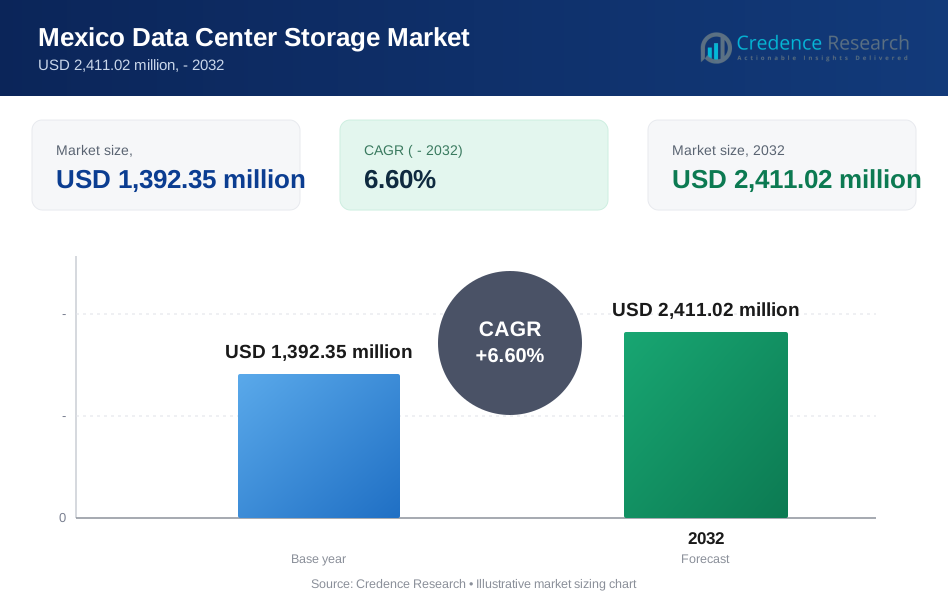
The Mexico Data Center Storage Market is anticipated to grow from USD 1,392.35 million in 2023 to USD 2,411.02 million by 2032, reflecting a compound annual growth rate (CAGR) of 6.60%.
The Mexico Data Center Storage Market is driven by the expanding digital transformation initiatives and increasing demand for cloud-based solutions. As businesses across Mexico adopt advanced technologies, the need for scalable and efficient storage solutions grows. The rise of big data analytics and edge computing further fuels this demand, while government investments in digital infrastructure bolster the market. Key trends include the adoption of hybrid cloud strategies, advancements in software-defined storage, and a focus on energy-efficient technologies to enhance operational performance and reduce costs. These factors collectively propel the market's robust growth trajectory.
The Mexico Data Center Storage Market is experiencing robust growth, with the country holding a significant share of the regional market. Mexico's data center infrastructure benefits from its strategic location, improved connectivity, and increasing digital transformation. Key players, including Dell Inc., Hewlett Packard Enterprise, and IBM Corporation, are expanding their presence to leverage the growing demand for data storage solutions. These companies are investing in advanced storage technologies and expanding their operations to support sectors like IT, telecommunications, and finance. Mexico’s favorable market conditions and strategic importance make it a key hub for data center storage in Latin America.
Market Drivers
Government Initiatives
Government initiatives are playing a crucial role in shaping the data center storage market in Mexico. Investments in the digitalization of public services aim to improve efficiency and transparency, thereby driving demand for advanced data center infrastructure. For instance, the Mexican government has launched a one-stop portal, gob.mx, which consolidates 34,000 databases from 250 government institutions and 5,400 public services. Moreover, stricter cybersecurity regulations are compelling organizations to invest in secure storage solutions to protect sensitive information from potential threats. These regulatory changes are pushing businesses to adopt more robust and compliant storage systems, thus contributing to the market’s growth.
Rapid Digital Transformation
The rapid digital transformation in Mexico is significantly impacting the data center storage market. The e-commerce boom, characterized by the widespread adoption of online shopping and digital payments, is driving an increased need for robust and scalable data storage infrastructure. For instance, the nearshoring effect, driven by Mexico’s strategic location and skilled workforce, has further accelerated the region’s digital transformation. Companies from the US and Europe are increasingly choosing Mexico as a nearshoring destination for software development, customer support, and other IT services. As businesses transition to cloud-based services, they require reliable and scalable storage solutions to support their operations. Additionally, the proliferation of IoT devices and the resultant generation of vast amounts of data necessitate advanced storage capabilities to manage and analyze this data efficiently. The convergence of these factors is fueling the demand for enhanced data center storage solutions.
Outsourcing and Colocation
Outsourcing and colocation services are becoming increasingly attractive due to their cost-effectiveness and scalability. Many businesses find outsourcing data center operations more economical compared to maintaining in-house facilities. Colocation facilities, in particular, offer flexible and scalable storage solutions that can adapt to growing data needs. This flexibility enables businesses to expand their storage capabilities without the significant upfront investments associated with building and managing their own data centers, further driving market demand.
Economic Growth and Industrialization
Economic growth and industrialization are key drivers of the data center storage market in Mexico. The expansion of various industries, including manufacturing, finance, and healthcare, is generating a higher demand for data storage solutions. Furthermore, increased foreign direct investment is contributing to the development of data center infrastructure across the country. This investment not only supports the growth of existing data centers but also facilitates the construction of new facilities, thereby bolstering the overall market for data storage.
Market Trends
Sustainability and Hybrid Cloud Strategies
Sustainability and hybrid cloud strategies are emerging as pivotal trends in the data center storage market. Data center operators are increasingly adopting green practices to minimize their environmental impact. For instance, AWS and Microsoft Azure are aiming to use 100% renewable energy by 2025 and to be water-positive by 2030. This includes the use of renewable energy sources, energy-efficient cooling systems, and overall optimization of power usage. The shift towards energy-efficient technologies reflects a broader commitment to reducing carbon footprints and aligning with global sustainability goals. Simultaneously, organizations are embracing hybrid cloud and multi-cloud strategies to maximize the benefits of both public and private cloud environments. These flexible storage solutions allow organizations to manage data across various platforms while ensuring data portability and interoperability. This hybrid approach not only enhances operational flexibility but also supports the efficient management of diverse storage needs. The integration of software-defined storage (SDS) further complements these trends by offering greater flexibility and scalability. SDS simplifies storage management tasks and reduces operational costs, making it an attractive option for businesses aiming to optimize their data storage infrastructure. Additionally, the incorporation of AI and machine learning into storage solutions is advancing intelligent data management. These technologies automate tasks, optimize performance, and enable predictive analytics to proactively address potential issues, driving further efficiencies in data center operations.
Hyper-Scale Data Centers and Edge Computing
The evolution of hyper-scale data centers and edge computing is driving transformative changes in the Mexico data center storage market. Major cloud providers and hyperscale data center operators are making substantial investments to meet the escalating demand for data storage capacity. These large-scale facilities are strategically located in regions with excellent network connectivity, ensuring low-latency access and high-speed data transfer. This focus on connectivity is crucial as businesses and consumers alike increasingly rely on rapid and reliable access to digital services. Concurrently, the rise of edge computing is reshaping the landscape by driving the deployment of smaller, distributed data centers closer to data generation points. This approach significantly reduces latency and enhances application performance, particularly for real-time data processing. By bringing storage closer to where data is created and used, businesses can achieve more responsive and efficient data handling, which is increasingly vital in a data-driven economy.
Market Challenges Analysis
Talent Shortages and Cost Pressures
Talent shortages and cost pressures further exacerbate the challenges faced by the data center storage market in Latin America. The scarcity of skilled professionals with expertise in data center operations, technology, and management poses a major hurdle. For instance, by 2025, Latin America will need 21,000 additional data center professionals, especially in markets such as Brazil, Chile, Colombia, and Mexico. Finding and retaining qualified personnel requires significant investments in training and development programs, which can strain resources and hinder growth. The skill gap in the industry necessitates a focused effort on workforce development to meet the growing demand for data center expertise. On the financial front, high construction and operational costs are pressing concerns. Building and maintaining data centers involve substantial expenses, including land acquisition, infrastructure development, and energy consumption. These high costs can impact profitability and force companies to adopt stringent cost-management strategies. Intense competition from both domestic and international players further exacerbates these pressures, driving down prices and profit margins. Companies must navigate these financial challenges while striving to remain competitive and deliver high-quality, cost-effective storage solutions.
Infrastructure Constraints and Regulatory Challenges
The Latin America data center storage market faces significant infrastructure constraints and regulatory challenges that impact its growth and efficiency. Limited power supply is a critical issue in some regions, with reliable and affordable power becoming increasingly difficult to secure, particularly during peak demand periods. This scarcity can hinder the operation and expansion of data centers, affecting their overall performance and reliability. Additionally, network connectivity remains a significant challenge, especially in remote or underdeveloped areas. Ensuring adequate and cost-effective network infrastructure in these locations is complex and costly, potentially impeding the deployment of data center solutions. Regulatory and policy frameworks add another layer of complexity to the market. Navigating the intricate landscape of data privacy and cybersecurity laws is both time-consuming and costly for businesses. Companies must comply with a variety of regulations that can vary significantly across different states, leading to a fragmented and inconsistent policy environment. This inconsistency creates operational difficulties for data center operators, who must adapt to diverse regulatory requirements while striving to maintain compliance across jurisdictions.
Market Segmentation Analysis:
By Storage Type:
The Mexico Data Center Storage Market is segmented by storage type into Traditional Storage, All-Flash Storage, and Hybrid Storage. Traditional Storage, encompassing disk-based systems, continues to hold a substantial market share due to its cost-effectiveness and established presence. It remains a reliable choice for businesses with extensive data storage needs. In contrast, All-Flash Storage is experiencing rapid growth owing to its superior performance attributes, such as faster data access and reduced latency, which are crucial for high-speed applications. This segment is particularly popular in industries requiring high-performance computing and real-time analytics. Hybrid Storage, which combines traditional and all-flash storage capabilities, is gaining traction as it offers a balanced approach, providing both performance and cost-efficiency. This flexibility makes Hybrid Storage an attractive option for enterprises seeking to optimize their storage infrastructure while managing costs.
By Application:
The application-based segmentation of the Mexico Data Center Storage Market includes IT and Telecommunications, BFSI, Government, Healthcare, and Others. The IT and Telecommunications sector is the largest contributor, driven by the increasing demand for cloud services and digital transformation. The BFSI sector also significantly drives demand due to the need for secure, scalable storage solutions to manage vast volumes of financial data. Government agencies are investing in data center storage to support digital services and comply with data localization regulations. The Healthcare sector is rapidly adopting storage solutions to handle electronic health records (EHRs) and telemedicine data securely. Additionally, the “Others” category, which includes industries like retail and education, is also contributing to market growth as these sectors increasingly adopt digital technologies and require robust data storage solutions. Each segment reflects specific needs and drives demand for tailored storage solutions in Mexico’s evolving data center landscape.
Segments:
Based on Storage Type:
- Traditional Storage
- All-Flash Storage
- Hybrid Storage
Based on Application:
- IT and Telecommunications
- BFSI
- Government
- Healthcare
- Others
Based on Deployment:
- Storage Area Network (SAN) System
- Network-attached storage (NAS) System
- Direct-Attached Storage (DAS) System
- Others
Based on the Geography:
- Northern region
- Southern region
- Pacific Coast region
- Gulf Coast region
- Yucatán Peninsula region
- Western region
- Eastern region
Regional Analysis
Northern region
The Northern region commands a substantial share of the Mexico data center storage market, holding approximately 30% of the total market. This dominance is largely attributed to its strategic location near the U.S. border, which facilitates cross-border data flows and attracts substantial investments from international tech companies. The region's well-established infrastructure, including robust power supply and network connectivity, supports a growing number of hyperscale and colocation data centers. Additionally, the strong industrial base in sectors such as automotive and manufacturing drives demand for advanced storage solutions to manage large volumes of data efficiently. The Northern region's favorable business environment and technological advancements continue to bolster its position as a key player in the data center storage market.
Pacific Coast region
The Pacific Coast region, capturing about 20% of the market, is emerging as a vital area for data center expansion due to its strategic advantages and growing tech sector. The region's access to international shipping routes through its major ports enhances connectivity and supports global data operations. Increasing investments in IT infrastructure and the rise of technology-driven industries are driving demand for both cloud and hybrid storage solutions. Furthermore, the Pacific Coast is focusing on sustainability by incorporating renewable energy sources into its data center operations, appealing to businesses seeking eco-friendly storage options. The combination of strategic location, growing industry presence, and environmental considerations positions the Pacific Coast region as a significant contributor to Mexico's data center storage market.
Key Player Analysis
- Dell Inc.
- Hewlett Packard Enterprise
- Huawei Technologies Co. Ltd
- Pure Storage Inc.
- Lenovo Group Limited
- Nutanix Inc.
- Oracle Corporation
- IBM Corporation
- SMART Modular Technologies Inc.
- Intel Corporation
Competitive Analysis
In the Mexico Data Center Storage Market, leading players such as Dell Inc., Hewlett Packard Enterprise, Huawei Technologies Co. Ltd, and IBM Corporation are pivotal in shaping the competitive landscape. These companies distinguish themselves through their advanced technology, strategic investments, and tailored offerings. The market is characterized by intense competition as firms focus on delivering high-performance storage systems that meet the growing demand for scalable and efficient solutions. Key competitive strategies include investing in regional infrastructure, enhancing data management capabilities, and adapting to local regulatory requirements. Companies also emphasize innovation in storage technologies and customer-centric solutions to maintain a competitive edge and address the evolving needs of Mexico's data center sector.
Recent Developments
- In May 2024, Dell Technologies expanded its Dell AI Factory with NVIDIA to include new server, edge, workstation, solutions, and services advancements that speed AI adoption and innovation.
- In March 2024, HPE debuted an end-to-end AI-native portfolio for Generative AI, including two solutions that encompass all the compute, storage, software, networking, and consulting services needed to accelerate AI projects.
- In May 2024, IBM announced several new updates to its watsonx platform during its annual THINK conference, focusing on making AI more open, cost-effective, and flexible for businesses.
Market Concentration & Characteristics
The Mexico Data Center Storage Market exhibits moderate to high market concentration, with several major players holding substantial shares. This concentration reflects the presence of both international giants and strong regional competitors investing in advanced storage technologies and infrastructure. The market is characterized by a diverse range of storage solutions, including traditional, all-flash, and hybrid systems, catering to varied business needs. Key characteristics include a high emphasis on scalability and performance driven by increasing data volumes and digital transformation. Additionally, innovation in storage technologies, such as hyper-converged infrastructure and software-defined storage, is a notable feature. Companies are also focusing on improving energy efficiency and data security to meet regulatory standards and operational demands. This competitive landscape drives continuous advancements and enhances the overall efficiency of storage solutions in Mexico's data center market.
Report Coverage
The research report offers an in-depth analysis based on Storage Type, Application, Deployment and Geography. It details leading market players, providing an overview of their business, product offerings, investments, revenue streams, and key applications. Additionally, the report includes insights into the competitive environment, SWOT analysis, current market trends, as well as the primary drivers and constraints. Furthermore, it discusses various factors that have driven market expansion in recent years. The report also explores market dynamics, regulatory scenarios, and technological advancements that are shaping the industry. It assesses the impact of external factors and global economic changes on market growth. Lastly, it provides strategic recommendations for new entrants and established companies to navigate the complexities of the market.
Future Outlook
- The market will continue to expand as digital transformation accelerates across industries in Mexico.
- Cloud storage solutions will see increased adoption due to their scalability and cost-effectiveness.
- Demand for all-flash and hybrid storage systems will grow due to their superior performance and efficiency.
- Edge computing will drive the need for distributed storage solutions closer to data sources.
- Investments in energy-efficient and sustainable technologies will rise to address environmental concerns.
- Data security will remain a top priority, leading to enhanced protection measures and compliance with regulations.
- Hybrid cloud and multi-cloud strategies will gain traction, offering greater flexibility and integration across platforms.
- Technological advancements, including AI and machine learning, will improve data management and analytics capabilities.
- Competitive pressures will encourage innovation and drive down costs, benefiting businesses with more affordable storage solutions.
- Continued government support for digital infrastructure will facilitate market growth and development in Mexico.
Request a Free Sample
Fill in your details and we'll send you a free sample report.
- Sample data tables & charts
- Research methodology
Need a Custom Version of This Report?
Tailor the scope, geography, or segments to your exact requirements.
- Custom geography or segment scope
- Direct access to our analyst team
Frequently Asked Questions
What is the current size of the Mexico Data Center Storage Market?
What factors are driving the growth of the Mexico Data Center Storage Market?
What are some challenges faced by the Mexico Data Center Storage Market?
Who are the major players in the Mexico Data Center Storage Market?
Table of Content
Chapter 1. Report Introduction
- 1.1 Report Description & Purpose
- 1.1.1 Report Title & Market Definition
- 1.1.2 Unique Selling Propositions (USP) & Key Differentiators
- 1.1.3 Value Proposition for Stakeholders
- 1.2 Research Objectives
- 1.2.1 Market Sizing Objectives (Volume & Revenue)
- 1.2.2 Segmentation Objectives
- 1.2.3 Competitive Intelligence Objectives
- 1.2.4 Forecast & Scenario Objectives
- 1.3 Report Scope
- 1.3.1 Mexico Data Center Storage Scope – Types & Subtypes Covered
- 1.3.2 Geographic Scope – Regions & Countries Covered
- 1.3.3 Historical Period, Base Year & Forecast Period (the historical period; forecast to 2032)
- 1.3.4 Inclusions & Exclusions
- 1.4 HS Code & Classification Framework
- 1.5 Currency, Units & Pricing Basis
- 1.6 Target Stakeholders
- 1.7 Limitations & Assumptions
Chapter 2. Executive Summary
- 2.1 Global Mexico Data Center Storage Market Snapshot
- 2.1.1 Market Size – Historical (the historical period) & Forecast (2032) (base year: USD 1,392.35 million → 2032: USD 2,411.02 million)
- 2.1.2 Volume & Revenue – Global Totals
- 2.1.3 Key Market Highlights – Top Five Facts
- 2.2 Mexico Data Center Storage Market Segmentation Snapshot
- 2.2.1 Market Split by Region – vs. 2032
- 2.3 Competitive Snapshot
- 2.3.1 Top 10 Players by Revenue Share –
- 2.3.2 Top 10 Players by Volume Share –
- 2.3.3 Recent Strategic Developments (18-Month Summary)
- 2.4 Key Investment Highlights & Strategic Conclusions
Chapter 3. Mexico Data Center Storage Market Dynamics & Industry Analysis
- 3.1 Market Overview & Context
- 3.1.1 Mexico Data Center Storage Market Position in the Broader Automotive Value Chain
- 3.1.2 OEM vs. Replacement Market Dynamics
- 3.1.3 Market Maturity & Development Stage by Region
- 3.2 Mexico Data Center Storage Market Drivers
- 3.3 Mexico Data Center Storage Market Restraints & Challenges
- 3.4 Mexico Data Center Storage Market Opportunities
- 3.5 Porter's Five Forces Analysis
- 3.5.1 Threat of New Entrants
- 3.5.2 Bargaining Power of Suppliers
- 3.5.3 Bargaining Power of Buyers
- 3.5.4 Threat of Substitutes
- 3.5.5 Competitive Rivalry – Intensity Assessment
- 3.6 Mexico Data Center Storage Value Chain Analysis
- 3.6.1 Upstream – Raw Material/Input Suppliers
- 3.6.1.1 Raw Material/Input 1
- 3.6.1.2 Raw Material/Input 2
- 3.6.1.3 Raw Material/Input 3
- 3.6.2 Midstream – Production/Manufacturing/Service Delivery
- 3.6.2.1 Production/Process Overview
- 3.6.2.2 Key Facility Locations & Capacity by Manufacturer
- 3.6.3 Downstream – Distribution & End Consumer
- 3.6.3.1 Primary Channel – B2B/OEM
- 3.6.3.2 Secondary Channels – Dealer, Retail, Online, Direct
- 3.6.4 Value Chain Profitability Analysis
- 3.6.1 Upstream – Raw Material/Input Suppliers
- 3.7 PESTEL Analysis
- 3.7.1 Political Factors
- 3.7.2 Economic Factors
- 3.7.3 Social Factors
- 3.7.4 Technological Factors
- 3.7.5 Environmental Factors
- 3.7.6 Legal Factors
- 3.8 Mexico Data Center Storage Supply Chain Analysis
- 3.8.1 Raw Material/Input Supply Risk Assessment
- 3.8.2 Manufacturing Concentration Risk (Geographic Exposure)
- 3.8.3 Trade Disruption Impact Analysis
- 3.9 Regulatory & Policy Landscape
Note: The regulatory and policy landscape section covers regulations based on their applicability to the market, Mexico Data Center Storage category, geography, and scope of the study. Only regulatory frameworks with a material impact on operations, compliance, trade, sustainability, or market access are analyzed in detail.
Chapter 4. Key Investment Pockets & Opportunity Analysis
- 4.1 Mexico Data Center Storage Market Attractiveness Analysis
- 4.1.1 By Region – Investment Attractiveness Matrix (Volume × CAGR)
- 4.2 Absolute Revenue Growth Opportunity
- 4.2.1 By Region – Absolute USD Growth Through 2032
- 4.3 Incremental Volume Opportunity
- 4.3.1 By Region – Incremental Volume Through 2032
- 4.3.2 Segment – Incremental Volume
- 4.4 Emerging Submarket Opportunity Deep Dive (Subject to Applicability)
- 4.5 Emerging Market Opportunity Scorecards
- 4.5.1 United States
- 4.5.2 Europe
- 4.5.3 Asia
- 4.5.4 Middle East & Africa
Note: Emerging Market Opportunity Scorecards will be included based on relevance and strategic importance. Regions listed are indicative and may vary depending on data availability and market dynamics.
Chapter 5. Mexico Data Center Storage Import-Export Analysis & Trade Flows
- 5.1 Global Trade Overview
- 5.1.1 Global Export Value by Country (the historical period)
- 5.1.2 Global Export Volume by Country (the historical period)
- 5.1.3 Global Import Value by Country (the historical period)
- 5.1.4 Global Import Volume by Country (the historical period)
- 5.1.5 Net Trade Balance by Country (the historical period)
- 5.2 Export Analysis – Segment
- 5.2.1 Type 1 (HS Code)
- 5.2.2 Type 2 (HS Code)
- 5.2.3 Type 3 (HS Code)
- 5.2.4 Type 4 (HS Code)
- 5.2.5 Type 5 (HS Code)
- 5.3 Import Analysis – Segment
- 5.3.1 Type 1 (HS Code)
- 5.3.2 Type 2 (HS Code)
- 5.3.3 Type 3 (HS Code)
- 5.3.4 Type 4 (HS Code)
- 5.3.5 Type 5 (HS Code)
- 5.4 Average Unit Trade Prices
- 5.4.1 Average Export Price – Segment & Country
- 5.4.2 Average Import Price – Segment & Source Country
- 5.4.3 Price Trends (the historical period)
- 5.5 Key Trade Route Analysis
- 5.5.1 Trade Route 1
- 5.5.2 Trade Route 2
- 5.5.3 Trade Route 3
- 5.5.4 Trade Route 4
- 5.5.5 Trade Route 5
- 5.6 Trade Policy Impact Assessment
- 5.6.1 US Anti-Dumping & Section 301 Tariffs
- 5.6.2 EU Customs Union Impact
- 5.6.3 Major Free Trade Agreements
- 5.6.4 USMCA Rules of Origin
Note: Trade policy analysis will be included only where relevant to the Mexico Data Center Storage market.
Chapter 6. Competitive Landscape & Company Benchmarking
- 6.1 Mexico Data Center Storage Market Concentration & Structure
- 6.1.1 Herfindahl-Hirschman Index (HHI) – vs.
- 6.1.2 Tier 1, Tier 2 & Tier 3 Market Structure
- 6.1.3 Global, Regional & Local Player Dynamics
- 6.2 Mexico Data Center Storage Market Share Analysis –
- 6.2.1 Global Revenue Share by Company
- 6.2.2 Global Volume Share by Company
- 6.2.3 Regional Revenue Share
- 6.2.4 Market Share Evolution ( vs. )
- 6.2.5 OEM Segment Share by Company
- 6.2.6 Replacement Segment Share by Company
- 6.3 Production/Delivery Capacity & Facility Analysis
- 6.3.1 Global Installed Capacity
- 6.3.2 Capacity Utilization Rates
- 6.3.3 Production/Output Volume
- 6.3.4 Facility Locations & Capacity Map
- 6.3.5 Planned Capacity Additions
- 6.4 Mexico Data Center Storage Competitive Benchmarking Matrix
- 6.4.1 Revenue, Volume, CAGR & Profitability Comparison
- 6.4.2 Channel Revenue Mix
- 6.4.3 Geographic Revenue Exposure
- 6.4.4 R&D Intensity
- 6.4.5 Sustainability Maturity
- 6.5 Strategic Developments in Mexico Data Center Storage (Last 24 Months)
- 6.5.1 Mergers, Acquisitions & Divestments
- 6.5.2 New Mexico Data Center Storage Launches
- 6.5.3 Facility Expansions
- 6.5.4 Strategic Alliances, Joint Ventures & Partnerships
- 6.5.5 Distribution Expansion & Market Entry
- 6.5.6 Sustainability & ESG Initiatives
- 6.6 Competitive Strategy Mapping
- 6.6.1 Leader, Challenger, Follower & Niche Classification
- 6.6.2 Pricing Strategy Comparison
- 6.6.3 Channel Strategy Matrix
Note: Strategic developments are included based on their materiality and the availability of reliable information.
Chapter 7. Global Mexico Data Center Storage Market – By Distribution Channel
- 7.1 Segment Overview
- 7.1.1 Volume & Revenue Split by Channel ( & 2032)
- 7.1.2 Channel Mix Evolution (2032)
Chapter 8. Regional Market Analysis – Global Overview
- 8.1 Global Regional Overview
- 8.1.1 Regional Volume Share
- 8.1.2 Regional Revenue Share
- 8.1.3 Regional Volume by Region
- 8.1.4 Regional Revenue by Region
- 8.1.5 Regional Forecast Through 2032
- 8.2 Cross-Regional Segment Analysis
- 8.2.1 By Distribution Channel
- 8.2.2 By Brand/Price Tier
Chapter 9. North America Mexico Data Center Storage Market
- 9.1 United States
- 9.2 Canada
- 9.3 Mexico
Chapter 10. Europe Mexico Data Center Storage Market
- 10.1 Germany
- 10.2 France
- 10.3 Italy
- 10.4 United Kingdom
- 10.5 Spain
- 10.6 Poland
- 10.7 Russia
- 10.8 Netherlands
- 10.9 Belgium
- 10.10 Sweden
- 10.11 Denmark
- 10.12 Norway
- 10.13 Rest of Europe
Chapter 11. Asia Pacific Mexico Data Center Storage Market
- 11.1 China
- 11.2 India
- 11.3 Japan
- 11.4 South Korea
- 11.5 Thailand
- 11.6 Indonesia
- 11.7 Vietnam
- 11.8 Malaysia
- 11.9 Australia
- 11.10 Rest of Asia Pacific
Chapter 12. Latin America Mexico Data Center Storage Market
- 12.1 Brazil
- 12.2 Argentina
- 12.3 Colombia
- 12.4 Chile
- 12.5 Rest of Latin America
Chapter 13. Middle East Mexico Data Center Storage Market
- 13.1 Saudi Arabia
- 13.2 United Arab Emirates
- 13.3 Turkey
- 13.4 Israel
- 13.5 Iran
- 13.6 Rest of the Middle East
Chapter 14. Africa Mexico Data Center Storage Market
- 14.1 South Africa
- 14.2 Egypt
- 14.3 Nigeria
- 14.4 Morocco
- 14.5 Rest of Africa
Chapter 15. Mexico Data Center Storage Company Profiles
- 15.1 [Company 01]
- 15.1.1 Company Overview
- 15.1.2 Key Management Personnel
- 15.1.3 Products & Services Portfolio
- 15.1.4 Financial Performance
- 15.1.5 Key Market Focus & Geographic Presence
- 15.1.6 Recent Developments & Strategic Initiatives
Note: The company profile list is preliminary and may change based on research findings, market developments, data availability, and client requirements.
Chapter 16. Appendices
- Appendix A – List of Abbreviations & Acronyms
- Appendix B – Industry Classification Code Reference – Full Series
- Appendix C – Production & Capacity Data Tables
- Appendix D – End-Use & Demand Base Tables
- Appendix E – Consumption & Replacement Rate Assumptions
- Appendix F – ASP Reference Tables
- Appendix G – Manufacturing & Facility Database
- Appendix H – Import-Export Data Tables
- Appendix I – Regulatory Summary Tables
- Appendix J – Primary Research Participant List (Anonymized)
- Appendix K – Primary Research Questionnaire Framework
- Appendix L – Data Sources & Bibliography
- Appendix M – Market Size Divergence & Source Comparison
Chapter 17. Research Methodology
- 17.1 Research Framework & Philosophy
- 17.2 Secondary Research – Sources, Hierarchy & Data Extraction
- 17.3 Data Modeling – Bottom-Up & Top-Down Market Sizing
- 17.4 Primary Research – Stakeholder Framework, LOI & Sample Sizes
- 17.5 Forecast Methodology – Regression, Scenario & Sensitivity Analysis
- 17.6 Quality Control – Four-Layer Validation Framework
- 17.7 Limitations & Standard Assumptions
- 17.8 Disclaimer
