
Market Overview
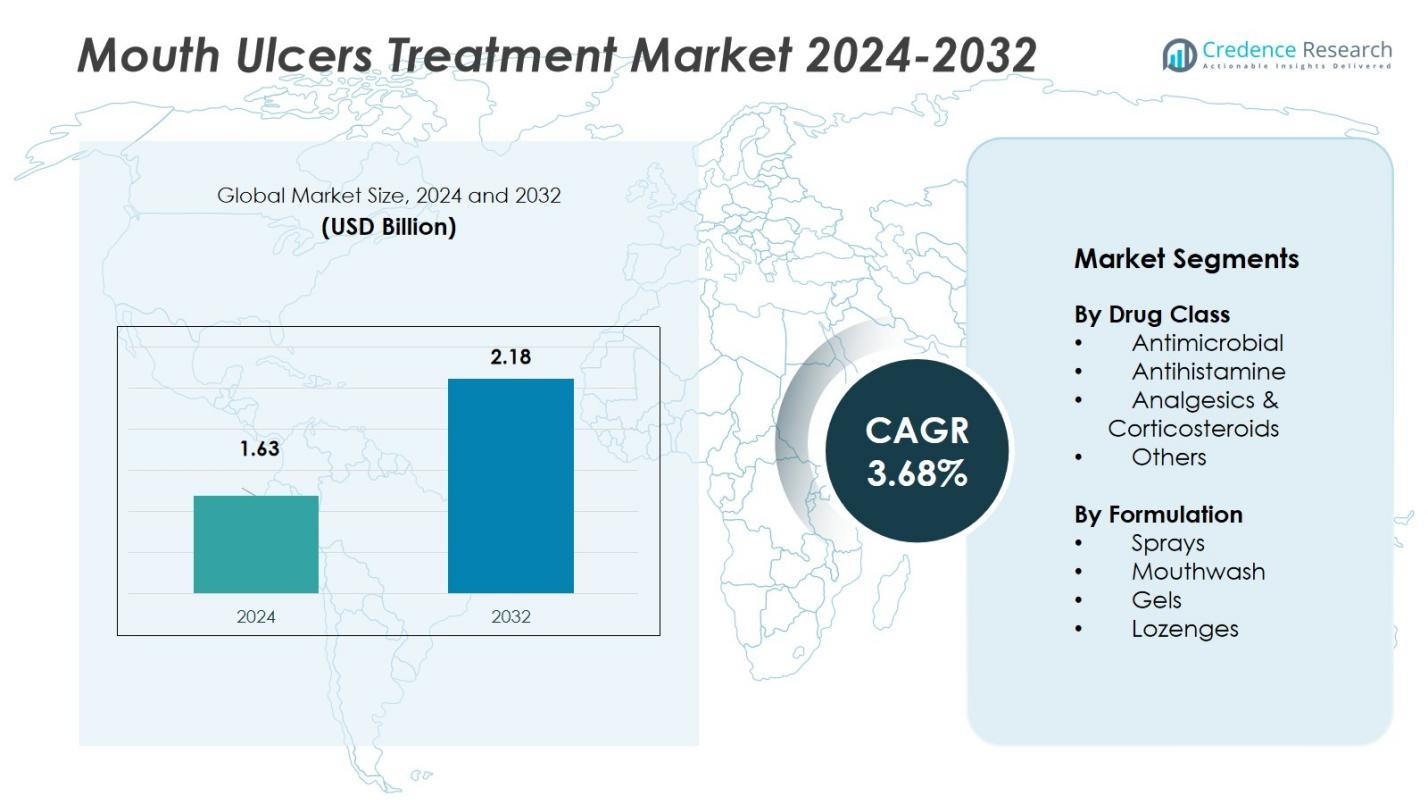
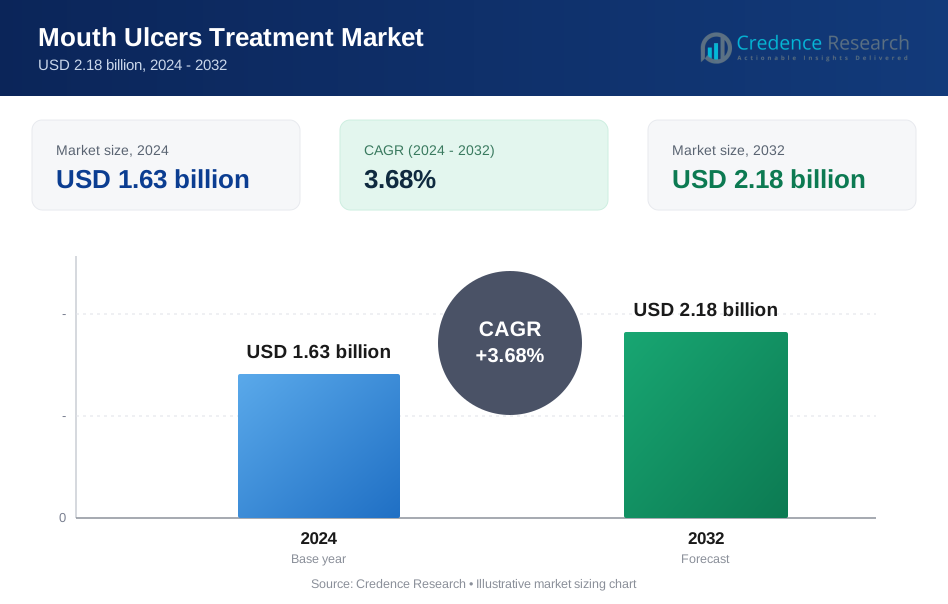
The Mouth Ulcers Treatment Market was valued at USD 1.63 billion in 2024 and is projected to reach USD 2.18 billion by 2032, growing at a CAGR of 3.68% during the forecast period.
| REPORT ATTRIBUTE | DETAILS |
|---|---|
| Historical Period | 2020-2023 |
| Base Year | 2024 |
| Forecast Period | 2025-2032 |
| Mouth Ulcers Treatment Market Size 2024 | USD 1.63 Billion |
| Mouth Ulcers Treatment Market, CAGR | 3.68% |
| Mouth Ulcers Treatment Market Size 2032 | USD 2.18 Billion |
The Mouth Ulcers Treatment Market features strong competition among global and regional pharmaceutical manufacturers. Major players such as Dr. Reddy's Laboratories Ltd, Pfizer Inc., GSK plc, Colgate-Palmolive Company, Blistex Inc., Church & Dwight Co. Inc., 3M Company, Bristol Myers Squibb Company, Patterson Dental Supply Inc., and Prince Care Pharma Private Limited dominate the landscape through extensive product portfolios, continuous R&D, and global distribution. These companies focus on developing advanced formulations like bioadhesive gels and herbal-based products to enhance healing and reduce recurrence. Strategic partnerships and digital marketing initiatives further strengthen brand positioning. Regionally, North America leads the market with 36% share, driven by high healthcare spending and OTC product availability. Europe follows with 28% share, supported by strong pharmaceutical infrastructure, while Asia-Pacific accounts for 24% share, emerging as the fastest-growing region due to rising oral health awareness and expanding access to affordable, locally produced ulcer treatments.
Market Insights
- The Mouth Ulcers Treatment Market was valued at USD 1.63 billion in 2024 and is projected to reach USD 2.18 billion by 2032, growing at a CAGR of 3.68%.
- Increasing cases of oral mucosal disorders, stress-induced ulcers, and rising use of tobacco products drive consistent market demand across all demographics.
- Growing consumer preference for herbal and corticosteroid-free products is shaping market trends, with companies focusing on bioadhesive and nanotechnology-based formulations for improved healing.
- Market competition remains strong among global players such as Dr. Reddy’s, Pfizer, GSK, Colgate-Palmolive, and Blistex, who emphasize innovation and OTC product expansion.
- Regionally, North America dominates with 36% share, followed by Europe at 28% and Asia-Pacific at 24%; among segments, antimicrobial drugs hold 38% share, and gels lead formulation preference with 41%, reflecting patient demand for fast-acting and easily applicable treatments.
Market Segmentation Analysis:
By Drug Class
Antimicrobial drugs dominate the mouth ulcers treatment market, holding 38% share in 2024. Their leadership stems from broad effectiveness in controlling bacterial infections that aggravate oral lesions. Increased prescription of chlorhexidine and tetracycline-based formulations enhances patient recovery and lowers recurrence rates. Antihistamines account for 27% share, favored for relieving allergic or inflammation-induced ulcers. Analgesics and corticosteroids collectively hold 25% share, driven by demand for rapid pain relief and inflammation reduction. The remaining 10% belongs to other agents, including vitamins and herbal formulations supporting mucosal healing and immunity enhancement.
- For instance, Aphthasol (amlexanox 5% oral paste) was tested in four multicenter, double-blind trials with 1,335 subjects and applied four times daily; FDA labeling notes statistically significant acceleration of healing versus vehicle and no treatment.
By Formulation
Gels lead the market with 41% share due to their targeted application, quick absorption, and soothing effect on lesions. Their growing use in over-the-counter treatments reflects patient preference for direct relief and minimal side effects. Mouthwash formulations follow with 30% share, supported by antibacterial properties and preventive use in daily oral care. Lozenges hold 18% share, gaining adoption for convenience and slow-release medication delivery. Sprays represent 11% share, primarily used for severe or recurrent ulcer cases where precise dosing and instant action are required.
- For instance, benzydamine 0.15% mouth spray is dosed 4–8 sprays every 1.5–3 hours; UK patient information leaflets document these administration frequencies for oral pain, including mouth ulcers.
Key Growth Drivers
Rising Prevalence of Oral Disorders
The growing incidence of mouth ulcers caused by stress, nutritional deficiency, and viral infections drives market demand. Increasing consumption of spicy food and tobacco products has also elevated oral lesion cases globally. The elderly population and patients with autoimmune diseases experience higher ulcer recurrence, prompting continuous treatment use. Expanding dental awareness campaigns further encourage early diagnosis and therapy adoption, supporting steady sales of antiseptic gels and antimicrobial mouthwashes.
- For instance, Haleon plc’s Biotène® OralBalance Moisturizing Gel, used for dry mouth and related ulceration, demonstrated relief lasting up to 4 hours in a 28-day clinical study.
Growing Demand for Over-the-Counter (OTC) Products
Consumer preference for self-medication and convenient treatment options fuels the adoption of OTC mouth ulcer products. Gels, lozenges, and sprays are increasingly available in pharmacies and e-commerce stores without prescriptions. Pharmaceutical companies invest in attractive packaging and natural ingredient-based formulations to expand reach. Widening retail distribution networks in emerging economies strengthen accessibility and affordability, boosting product penetration across demographics.
- For instance, Biotène® gel by Haleon is marketed as a “#1 dentist, pharmacist, and hygienist recommended brand for Dry Mouth management” in the U.S.
Technological and Formulation Advancements
Innovation in drug delivery systems and bioadhesive gels enhances treatment efficacy and duration of action. Manufacturers integrate anti-inflammatory and antimicrobial properties into single formulations for faster healing. Nanotechnology-based formulations improve local drug absorption and reduce recurrence risk. The introduction of herbal and corticosteroid-free products addresses safety concerns and appeals to health-conscious consumers, driving sustained growth across global markets.
Key Trends & Opportunities
Rising Preference for Herbal and Natural Formulations
The growing shift toward natural ingredients such as aloe vera, honey, and curcumin opens new market opportunities. Consumers prefer herbal-based gels and mouthwashes for their minimal side effects and soothing properties. Companies invest in clinical trials and certifications to enhance credibility and global acceptance. Expansion of organic product portfolios aligns with increasing demand for safe, long-term oral ulcer management solutions.
- For instance, the Indian firm's Smyle Mouth Ulcer Gelis an Ayurvedic, herbal product that advertises 'instant' or 'quick' pain relief and is marketed as being free from synthetic ingredients like Lidocaine and Choline Salicylate, found in other allopathic gels.
- Commerce Expansion and Digital Promotion Strategies The growing influence of digital marketing and online pharmacies boosts product visibility and consumer access. Companies leverage e-commerce platforms to reach wider audiences, especially in developing countries. Subscription models and tele-dentistry consultations encourage regular product use and brand loyalty. Online awareness campaigns and influencer partnerships drive sales growth, making digital channels a major opportunity area for future expansion.
- For instance, PharmEasy, a leading e-pharmacy in India, operates a comprehensive online platform offering prescription medicines, lab tests, and healthcare products with home delivery services. The platform has simplified healthcare access, particularly in remote areas, enhancing customer convenience.
 Key Challenges
Limited Awareness in Developing Regions
Despite product availability, low awareness about oral health and self-treatment options restricts adoption in developing economies. Many consumers perceive ulcers as minor and avoid medical consultation. Poor dental infrastructure and lack of education campaigns further limit market reach. Manufacturers face challenges in expanding their footprint without adequate awareness programs or healthcare collaborations.
Side Effects and Product Safety Concerns
Frequent use of corticosteroid-based and antimicrobial treatments raises concerns about mucosal thinning and resistance development. Some topical drugs cause irritation or allergic reactions, reducing long-term compliance. The regulatory scrutiny for synthetic ingredients and preservatives also restricts product approval timelines. Manufacturers must balance efficacy with safety by developing mild yet effective alternatives to maintain consumer trust.
Regional Analysis
North America
North America holds 36% share of the mouth ulcers treatment market in 2024, driven by high healthcare awareness and widespread use of OTC oral care products. The U.S. dominates regional revenue due to strong pharmaceutical R&D and the availability of advanced corticosteroid gels and antimicrobial mouthwashes. Rising prevalence of aphthous ulcers linked to stress, smoking, and dietary habits boosts demand. Favorable reimbursement structures and the expansion of e-commerce platforms for oral treatments further support regional growth. Canada contributes steadily with increasing adoption of herbal and natural formulations for ulcer relief.
Europe
Europe accounts for 28% share, supported by robust dental healthcare infrastructure and growing patient preference for prescription and non-prescription formulations. The U.K., Germany, and France lead with high demand for topical corticosteroids and herbal gels targeting oral lesions. The region’s focus on product safety and regulatory compliance encourages innovation in bioactive and natural ingredients. Manufacturers benefit from strong retail pharmacy distribution and consumer trust in clinical-grade products. The rising geriatric population and government-backed oral health campaigns also play a key role in expanding the European market.
Asia-Pacific
Asia-Pacific captures 24% share of the market and remains the fastest-growing region during the forecast period. Countries such as China, India, and Japan exhibit rising incidence of oral mucosal diseases linked to poor hygiene, spicy diets, and stress. Expanding access to affordable OTC medicines and increased awareness about oral care drive market growth. The presence of regional manufacturers offering low-cost herbal and traditional remedies enhances availability. Rapid urbanization, digital retail expansion, and healthcare modernization across Southeast Asia are expected to strengthen the region’s contribution further.
Latin America
Latin America holds 7% share, driven by growing adoption of OTC mouth ulcer products and expanding retail pharmacy networks. Brazil and Mexico lead the regional market, supported by increasing oral health awareness and government programs promoting hygiene education. Economic recovery and improving healthcare access boost the demand for cost-effective gels and mouthwashes. International brands are entering the region through partnerships with local distributors, enhancing availability. The rising middle-class population and preference for affordable, multi-symptom relief formulations further stimulate product demand.
Middle East & Africa
The Middle East & Africa region accounts for 5% share, reflecting growing awareness of oral care and increased adoption of modern treatment solutions. The Gulf Cooperation Council (GCC) countries lead, supported by high healthcare expenditure and expanding pharmacy chains. South Africa shows rising demand due to urbanization and higher prevalence of oral ulcers caused by nutritional deficiencies. Limited access to specialized dental care in some areas restricts faster growth. However, the introduction of herbal-based and cost-effective mouth ulcer treatments presents promising opportunities for market expansion.
Market Segmentations:
By Drug Class
- Antimicrobial
- Antihistamine
- Analgesics & Corticosteroids
- Others
By Formulation
- Sprays
- Mouthwash
- Gels
- Lozenges
By Region
- North America
- U.S.
- Canada
- Mexico
- Europe
- Germany
- France
- U.K.
- Italy
- Spain
- Rest of Europe
- Asia Pacific
- China
- Japan
- India
- South Korea
- South-east Asia
- Rest of Asia Pacific
- Latin America
- Brazil
- Argentina
- Rest of Latin America
- Middle East & Africa
- GCC Countries
- South Africa
- Rest of the Middle East and Africa
Competitive Landscape
The competitive landscape of the mouth ulcers treatment market includes major players such as Dr. Reddy's Laboratories Ltd, Pfizer Inc., Blistex Inc., Colgate-Palmolive Company, GSK plc, Bristol Myers Squibb Company, Church & Dwight Co. Inc., Patterson Dental Supply Inc., 3M Company, and Prince Care Pharma Private Limited. These companies compete through product innovation, brand reputation, and distribution strength. Market leaders emphasize expanding OTC product portfolios featuring fast-acting gels, herbal formulations, and pain-relief sprays to attract diverse consumer groups. Strategic collaborations, acquisitions, and regional partnerships enhance their market presence across developed and emerging economies. For instance, global pharmaceutical firms focus on bioadhesive technologies and anti-inflammatory compounds that improve healing efficacy and patient comfort. Continuous investment in R&D and digital marketing supports competitive differentiation, while local manufacturers strengthen their foothold through affordable, herbal-based treatments tailored to regional preferences.
Key Player Analysis
- Reddy's Laboratories Ltd
- Pfizer Inc.
- Blistex Inc.
- Colgate-Palmolive Company
- GSK plc
- Bristol Myers Squibb Company
- Church & Dwight Co. Inc.
- Patterson Dental Supply Inc.
- 3M Company
- Prince Care Pharma Private Limited
Recent Developments
- In October 2023, Mucocort AB received a European patent for its innovative intra-oral patch designed to treat aphthous mouth ulcers and expanded its collaboration with Aurena Laboratories AB to strengthen production and distribution capabilities.
- In 2024, Aston University (UK) and Quest Pharm announced a partnership to develop a tablet formulation for chemotherapy-induced mouth ulcers.
- In September 2022, Mucocort AB partnered with Aurena Laboratories AB to manufacture and commercialize a self-absorbing pain-relief patch aimed at managing recurrent mouth ulcers effectively.
Report Coverage
The research report offers an in-depth analysis based on Drug Class, Formulation and Region. It details leading market players, providing an overview of their business, product offerings, investments, revenue streams, and key applications. Additionally, the report includes insights into the competitive environment, SWOT analysis, current market trends, as well as the primary drivers and constraints. Furthermore, it discusses various factors that have driven market expansion in recent years. The report also explores market dynamics, regulatory scenarios, and technological advancements that are shaping the industry. It assesses the impact of external factors and global economic changes on market growth. Lastly, it provides strategic recommendations for new entrants and established companies to navigate the complexities of the market.
Future Outlook
- Rising awareness of oral hygiene will expand preventive and therapeutic product demand.
- Growth of herbal and natural formulations will attract health-conscious consumers globally.
- E-commerce channels will enhance accessibility and brand visibility in emerging regions.
- Continuous innovation in bioadhesive and nanotechnology-based gels will improve efficacy.
- OTC availability will boost consumer convenience and increase market penetration.
- Expanding geriatric population will drive demand for long-term mouth ulcer management.
- Strategic collaborations among pharma companies will accelerate new product development.
- Rising stress-related ulcer cases will sustain consistent demand across demographics.
- Regulatory focus on safety will encourage the development of mild, non-steroidal products.
- Emerging markets in Asia-Pacific and Latin America will offer major revenue growth opportunities.
Request a Free Sample
Fill in your details and we'll send you a free sample report.
- Sample data tables & charts
- Research methodology
Need a Custom Version of This Report?
Tailor the scope, geography, or segments to your exact requirements.
- Custom geography or segment scope
- Direct access to our analyst team
Frequently Asked Questions
What is the current market size for the Mouth Ulcers Treatment Market, and what is its projected size in 2032?
At what Compound Annual Growth Rate is the Mouth Ulcers Treatment Market projected to grow between 2025 and 2032?
Which Mouth Ulcers Treatment Market segment held the largest share in 2024?
What are the primary factors fueling the growth of the Mouth Ulcers Treatment Market?
Who are the leading companies in the Mouth Ulcers Treatment Market?
Which region commanded the largest share of the Mouth Ulcers Treatment Market in 2024?
Table of Content
Chapter 1. Report Introduction
- 1.1 Report Description & Purpose
- 1.1.1 Report Title & Market Definition
- 1.1.2 Unique Selling Propositions (USP) & Key Differentiators
- 1.1.3 Value Proposition for Stakeholders
- 1.2 Research Objectives
- 1.2.1 Market Sizing Objectives (Volume & Revenue)
- 1.2.2 Segmentation Objectives
- 1.2.3 Competitive Intelligence Objectives
- 1.2.4 Forecast & Scenario Objectives
- 1.3 Report Scope
- 1.3.1 Mouth Ulcers Treatment Scope – Types & Subtypes Covered
- 1.3.2 Geographic Scope – Regions & Countries Covered
- 1.3.3 Historical Period, Base Year & Forecast Period (2024; forecast to 2032)
- 1.3.4 Inclusions & Exclusions
- 1.4 HS Code & Classification Framework
- 1.5 Currency, Units & Pricing Basis
- 1.6 Target Stakeholders
- 1.7 Limitations & Assumptions
Chapter 2. Executive Summary
- 2.1 Global Mouth Ulcers Treatment Market Snapshot
- 2.1.1 Market Size – Historical (2024) & Forecast (2024-2032) (2024: USD 1.63 billion → 2032: USD 2.18 billion)
- 2.1.2 Volume & Revenue – Global Totals
- 2.1.3 Key Market Highlights – Top Five Facts
- 2.2 Mouth Ulcers Treatment Market Segmentation Snapshot
- 2.2.1 Market Split by Region – 2024 vs. 2032
- 2.3 Competitive Snapshot
- 2.3.1 Top 10 Players by Revenue Share – 2024
- 2.3.2 Top 10 Players by Volume Share – 2024
- 2.3.3 Recent Strategic Developments (18-Month Summary)
- 2.4 Key Investment Highlights & Strategic Conclusions
Chapter 3. Mouth Ulcers Treatment Market Dynamics & Industry Analysis
- 3.1 Market Overview & Context
- 3.1.1 Mouth Ulcers Treatment Market Position in the Broader Automotive Value Chain
- 3.1.2 OEM vs. Replacement Market Dynamics
- 3.1.3 Market Maturity & Development Stage by Region
- 3.2 Mouth Ulcers Treatment Market Drivers
- 3.3 Mouth Ulcers Treatment Market Restraints & Challenges
- 3.4 Mouth Ulcers Treatment Market Opportunities
- 3.5 Porter's Five Forces Analysis
- 3.5.1 Threat of New Entrants
- 3.5.2 Bargaining Power of Suppliers
- 3.5.3 Bargaining Power of Buyers
- 3.5.4 Threat of Substitutes
- 3.5.5 Competitive Rivalry – Intensity Assessment
- 3.6 Mouth Ulcers Treatment Value Chain Analysis
- 3.6.1 Upstream – Raw Material/Input Suppliers
- 3.6.1.1 Raw Material/Input 1
- 3.6.1.2 Raw Material/Input 2
- 3.6.1.3 Raw Material/Input 3
- 3.6.2 Midstream – Production/Manufacturing/Service Delivery
- 3.6.2.1 Production/Process Overview
- 3.6.2.2 Key Facility Locations & Capacity by Manufacturer
- 3.6.3 Downstream – Distribution & End Consumer
- 3.6.3.1 Primary Channel – B2B/OEM
- 3.6.3.2 Secondary Channels – Dealer, Retail, Online, Direct
- 3.6.4 Value Chain Profitability Analysis
- 3.6.1 Upstream – Raw Material/Input Suppliers
- 3.7 PESTEL Analysis
- 3.7.1 Political Factors
- 3.7.2 Economic Factors
- 3.7.3 Social Factors
- 3.7.4 Technological Factors
- 3.7.5 Environmental Factors
- 3.7.6 Legal Factors
- 3.8 Mouth Ulcers Treatment Supply Chain Analysis
- 3.8.1 Raw Material/Input Supply Risk Assessment
- 3.8.2 Manufacturing Concentration Risk (Geographic Exposure)
- 3.8.3 Trade Disruption Impact Analysis
- 3.9 Regulatory & Policy Landscape
Note: The regulatory and policy landscape section covers regulations based on their applicability to the market, Mouth Ulcers Treatment category, geography, and scope of the study. Only regulatory frameworks with a material impact on operations, compliance, trade, sustainability, or market access are analyzed in detail.
Chapter 4. Key Investment Pockets & Opportunity Analysis
- 4.1 Mouth Ulcers Treatment Market Attractiveness Analysis
- 4.1.1 By Region – Investment Attractiveness Matrix (Volume × CAGR)
- 4.2 Absolute Revenue Growth Opportunity
- 4.2.1 By Region – Absolute USD Growth Through 2032
- 4.3 Incremental Volume Opportunity
- 4.3.1 By Region – Incremental Volume Through 2032
- 4.3.2 Segment – Incremental Volume
- 4.4 Emerging Submarket Opportunity Deep Dive (Subject to Applicability)
- 4.5 Emerging Market Opportunity Scorecards
- 4.5.1 United States
- 4.5.2 Europe
- 4.5.3 Asia
- 4.5.4 Middle East & Africa
Note: Emerging Market Opportunity Scorecards will be included based on relevance and strategic importance. Regions listed are indicative and may vary depending on data availability and market dynamics.
Chapter 5. Mouth Ulcers Treatment Import-Export Analysis & Trade Flows
- 5.1 Global Trade Overview
- 5.1.1 Global Export Value by Country (2024)
- 5.1.2 Global Export Volume by Country (2024)
- 5.1.3 Global Import Value by Country (2024)
- 5.1.4 Global Import Volume by Country (2024)
- 5.1.5 Net Trade Balance by Country (2024)
- 5.2 Export Analysis – Segment
- 5.2.1 Type 1 (HS Code)
- 5.2.2 Type 2 (HS Code)
- 5.2.3 Type 3 (HS Code)
- 5.2.4 Type 4 (HS Code)
- 5.2.5 Type 5 (HS Code)
- 5.3 Import Analysis – Segment
- 5.3.1 Type 1 (HS Code)
- 5.3.2 Type 2 (HS Code)
- 5.3.3 Type 3 (HS Code)
- 5.3.4 Type 4 (HS Code)
- 5.3.5 Type 5 (HS Code)
- 5.4 Average Unit Trade Prices
- 5.4.1 Average Export Price – Segment & Country
- 5.4.2 Average Import Price – Segment & Source Country
- 5.4.3 Price Trends (2024)
- 5.5 Key Trade Route Analysis
- 5.5.1 Trade Route 1
- 5.5.2 Trade Route 2
- 5.5.3 Trade Route 3
- 5.5.4 Trade Route 4
- 5.5.5 Trade Route 5
- 5.6 Trade Policy Impact Assessment
- 5.6.1 US Anti-Dumping & Section 301 Tariffs
- 5.6.2 EU Customs Union Impact
- 5.6.3 Major Free Trade Agreements
- 5.6.4 USMCA Rules of Origin
Note: Trade policy analysis will be included only where relevant to the Mouth Ulcers Treatment market.
Chapter 6. Competitive Landscape & Company Benchmarking
- 6.1 Mouth Ulcers Treatment Market Concentration & Structure
- 6.1.1 Herfindahl-Hirschman Index (HHI) – vs. 2024
- 6.1.2 Tier 1, Tier 2 & Tier 3 Market Structure
- 6.1.3 Global, Regional & Local Player Dynamics
- 6.2 Mouth Ulcers Treatment Market Share Analysis – 2024
- 6.2.1 Global Revenue Share by Company
- 6.2.2 Global Volume Share by Company
- 6.2.3 Regional Revenue Share
- 6.2.4 Market Share Evolution ( vs. 2024)
- 6.2.5 OEM Segment Share by Company
- 6.2.6 Replacement Segment Share by Company
- 6.3 Production/Delivery Capacity & Facility Analysis
- 6.3.1 Global Installed Capacity
- 6.3.2 Capacity Utilization Rates
- 6.3.3 Production/Output Volume
- 6.3.4 Facility Locations & Capacity Map
- 6.3.5 Planned Capacity Additions
- 6.4 Mouth Ulcers Treatment Competitive Benchmarking Matrix
- 6.4.1 Revenue, Volume, CAGR & Profitability Comparison
- 6.4.2 Channel Revenue Mix
- 6.4.3 Geographic Revenue Exposure
- 6.4.4 R&D Intensity
- 6.4.5 Sustainability Maturity
- 6.5 Strategic Developments in Mouth Ulcers Treatment (Last 24 Months)
- 6.5.1 Mergers, Acquisitions & Divestments
- 6.5.2 New Mouth Ulcers Treatment Launches
- 6.5.3 Facility Expansions
- 6.5.4 Strategic Alliances, Joint Ventures & Partnerships
- 6.5.5 Distribution Expansion & Market Entry
- 6.5.6 Sustainability & ESG Initiatives
- 6.6 Competitive Strategy Mapping
- 6.6.1 Leader, Challenger, Follower & Niche Classification
- 6.6.2 Pricing Strategy Comparison
- 6.6.3 Channel Strategy Matrix
Note: Strategic developments are included based on their materiality and the availability of reliable information.
Chapter 7. Global Mouth Ulcers Treatment Market – By Distribution Channel
- 7.1 Segment Overview
- 7.1.1 Volume & Revenue Split by Channel (2024 & 2032)
- 7.1.2 Channel Mix Evolution (2024-2032)
Chapter 8. Regional Market Analysis – Global Overview
- 8.1 Global Regional Overview
- 8.1.1 Regional Volume Share
- 8.1.2 Regional Revenue Share
- 8.1.3 Regional Volume by Region
- 8.1.4 Regional Revenue by Region
- 8.1.5 Regional Forecast Through 2032
- 8.2 Cross-Regional Segment Analysis
- 8.2.1 By Distribution Channel
- 8.2.2 By Brand/Price Tier
Chapter 9. North America Mouth Ulcers Treatment Market
- 9.1 United States
- 9.2 Canada
- 9.3 Mexico
Chapter 10. Europe Mouth Ulcers Treatment Market
- 10.1 Germany
- 10.2 France
- 10.3 Italy
- 10.4 United Kingdom
- 10.5 Spain
- 10.6 Poland
- 10.7 Russia
- 10.8 Netherlands
- 10.9 Belgium
- 10.10 Sweden
- 10.11 Denmark
- 10.12 Norway
- 10.13 Rest of Europe
Chapter 11. Asia Pacific Mouth Ulcers Treatment Market
- 11.1 China
- 11.2 India
- 11.3 Japan
- 11.4 South Korea
- 11.5 Thailand
- 11.6 Indonesia
- 11.7 Vietnam
- 11.8 Malaysia
- 11.9 Australia
- 11.10 Rest of Asia Pacific
Chapter 12. Latin America Mouth Ulcers Treatment Market
- 12.1 Brazil
- 12.2 Argentina
- 12.3 Colombia
- 12.4 Chile
- 12.5 Rest of Latin America
Chapter 13. Middle East Mouth Ulcers Treatment Market
- 13.1 Saudi Arabia
- 13.2 United Arab Emirates
- 13.3 Turkey
- 13.4 Israel
- 13.5 Iran
- 13.6 Rest of the Middle East
Chapter 14. Africa Mouth Ulcers Treatment Market
- 14.1 South Africa
- 14.2 Egypt
- 14.3 Nigeria
- 14.4 Morocco
- 14.5 Rest of Africa
Chapter 15. Mouth Ulcers Treatment Company Profiles
- 15.1 [Company 01]
- 15.1.1 Company Overview
- 15.1.2 Key Management Personnel
- 15.1.3 Products & Services Portfolio
- 15.1.4 Financial Performance
- 15.1.5 Key Market Focus & Geographic Presence
- 15.1.6 Recent Developments & Strategic Initiatives
Note: The company profile list is preliminary and may change based on research findings, market developments, data availability, and client requirements.
Chapter 16. Appendices
- Appendix A – List of Abbreviations & Acronyms
- Appendix B – Industry Classification Code Reference – Full Series
- Appendix C – Production & Capacity Data Tables
- Appendix D – End-Use & Demand Base Tables
- Appendix E – Consumption & Replacement Rate Assumptions
- Appendix F – ASP Reference Tables
- Appendix G – Manufacturing & Facility Database
- Appendix H – Import-Export Data Tables
- Appendix I – Regulatory Summary Tables
- Appendix J – Primary Research Participant List (Anonymized)
- Appendix K – Primary Research Questionnaire Framework
- Appendix L – Data Sources & Bibliography
- Appendix M – Market Size Divergence & Source Comparison
Chapter 17. Research Methodology
- 17.1 Research Framework & Philosophy
- 17.2 Secondary Research – Sources, Hierarchy & Data Extraction
- 17.3 Data Modeling – Bottom-Up & Top-Down Market Sizing
- 17.4 Primary Research – Stakeholder Framework, LOI & Sample Sizes
- 17.5 Forecast Methodology – Regression, Scenario & Sensitivity Analysis
- 17.6 Quality Control – Four-Layer Validation Framework
- 17.7 Limitations & Standard Assumptions
- 17.8 Disclaimer
