
| REPORT ATTRIBUTE | DETAILS |
|---|---|
| Historical Period | 2020-2023 |
| Base Year | 2024 |
| Forecast Period | 2025-2032 |
| Nanotechnology Market Size 2024 | USD 6,838.11 million |
| Nanotechnology Market, CAGR | 34.7% |
| Nanotechnology Market Size 2032 | USD 74,110.01 million |
Market Overview:
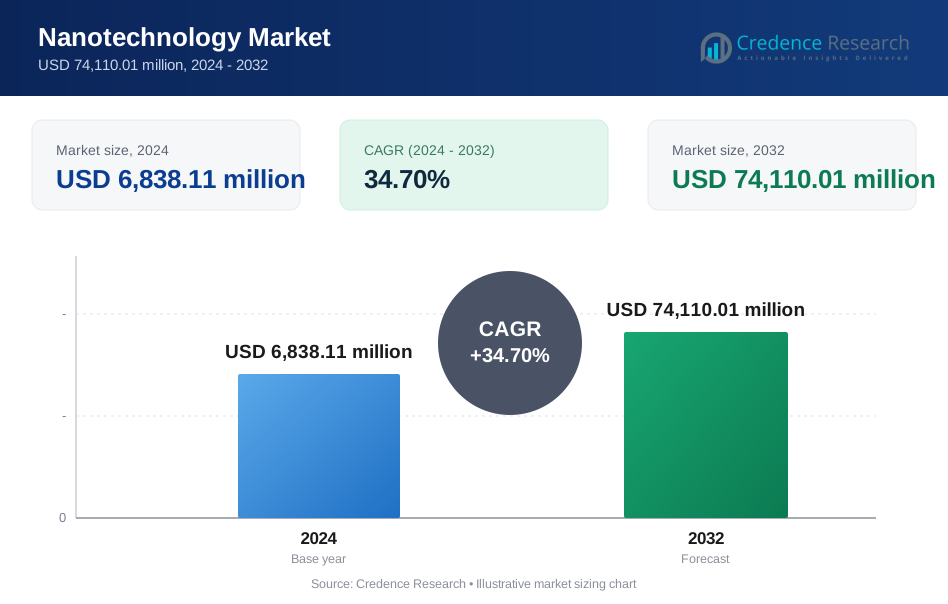
The Nanotechnology Market is projected to grow from USD 6,838.11 million in 2024 to USD 74,110.01 million by 2032, at a compound annual growth rate (CAGR) of 34.7%.
The Nanotechnology Market is driven by increasing demand for advanced materials and miniaturization across various industries, including electronics, healthcare, energy, and manufacturing. The growing application of nanomaterials in drug delivery systems, diagnostics, and electronics is fueling market growth. Additionally, innovations in nanomedicine, energy storage, and environmental sustainability are creating new opportunities. The rise of personalized medicine and precision treatments, alongside advancements in nanocomposites and coatings, is enhancing performance and efficiency in multiple sectors. Increasing investments in research and development, coupled with supportive government initiatives, are also contributing to market expansion. Furthermore, the trend toward cleaner and more efficient manufacturing processes, including the use of nanomaterials to improve energy efficiency, is gaining traction. As industries recognize the potential of nanotechnology to transform products and services, the market is poised for significant growth in the coming years.
The Nanotechnology Market is witnessing significant growth across various regions, with North America leading the market, holding a 35% share in 2024 due to its robust research and development infrastructure. Europe follows with a 27% share, driven by advancements in nanotechnology for healthcare, energy, and sustainable technologies. Asia-Pacific is expected to grow rapidly, capturing 20% of the market share in 2024, primarily due to increasing industrialization and investments in nanotechnology in countries like China, Japan, and India. The Rest of the World, including Latin America, the Middle East, and Africa, contributes to about 18% of the market share, with emerging applications in energy and healthcare. Key players such as Honeywell International Inc., DuPont, 3M, Sioen Industries NV, and ANSELL LTD are actively driving innovations in these regions, contributing to the market's dynamic growth.
Market Insights:
- The Nanotechnology Market is projected to grow from USD 6,838.11 million in 2024 to USD 74,110.01 million by 2032, at a CAGR of 34.7%.
- Increasing demand for advanced materials and miniaturization in industries such as electronics, healthcare, and energy is driving market growth.
- Nanotechnology applications in drug delivery, diagnostics, and electronics are significantly contributing to market expansion.
- Innovations in nanomedicine, energy storage, and environmental sustainability create new growth opportunities for the market.
- Growing investments in research and development, along with supportive government initiatives, are fueling market progress.
- The trend toward cleaner manufacturing processes, including nanomaterials for energy efficiency, is gaining momentum.
- North America leads the Nanotechnology Market with a 35% share in 2024, followed by Europe at 27%, Asia-Pacific at 20%, and the Rest of the World at 18%.
Market Drivers:
Increasing Demand for Advanced Materials:
One of the primary drivers of the Nanotechnology Market is the growing demand for advanced materials across a wide range of industries. Nanomaterials, due to their unique properties such as enhanced strength, conductivity, and flexibility, are increasingly being used in electronics, healthcare, automotive, and manufacturing. In the electronics sector, companies like Intel are leveraging nanomaterials to develop faster and more energy-efficient semiconductors. The ability to design materials at the nanoscale allows for superior performance, opening up new applications that were previously unattainable. Industries are particularly drawn to nanomaterials' ability to improve product efficiency, durability, and sustainability.
Advancements in Healthcare and Medicine:
Nanotechnology is revolutionizing the healthcare and medical industries, driving significant market growth. The application of nanomaterials in drug delivery systems, diagnostics, and treatment modalities, such as cancer therapies and regenerative medicine, is transforming healthcare solutions. For instance, nanomedicine platforms like Abraxane, which use nanoparticles for targeted cancer drug delivery, have demonstrated improved treatment efficacy with reduced side effects. The ability to manipulate materials at the molecular level enables highly targeted treatments with reduced side effects, driving the demand for nanotechnology in medical research. Innovations in nanomedicine are expected to continue fueling market expansion as healthcare providers adopt more effective and personalized treatments.
Environmental and Energy Applications:
Nanotechnology plays a crucial role in addressing global environmental and energy challenges. The development of nanomaterials for energy storage, solar cells, and environmental monitoring is creating sustainable solutions. For example, Tesla is exploring nanomaterials to enhance the performance and lifespan of their lithium-ion batteries. Nanotechnology is also enabling the development of more efficient energy storage systems, such as advanced batteries and supercapacitors, which are critical in reducing reliance on fossil fuels. Additionally, nanomaterials are used in water purification and pollution control, making them integral to environmental sustainability efforts.
Research and Development Investment:
Ongoing research and development in nanotechnology are essential drivers of market growth. Increased investment from both the private and public sectors is accelerating the development of new applications and the scaling up of nanotechnology-based solutions. For instance, governments like the U.S. and Japan have established nanotechnology-focused R&D programs to support innovation and commercialization in this field. Governments worldwide are supporting R&D initiatives aimed at enhancing the capabilities of nanotechnology, which fosters innovation and commercialization. As new breakthroughs emerge, industries are increasingly adopting nanotechnology to stay competitive and capitalize on its transformative potential.
Market Trends:
Growing Adoption in Electronics and Semiconductors:
One of the current trends in the Nanotechnology Market is the growing adoption of nanomaterials in electronics and semiconductors. As the demand for smaller, faster, and more efficient devices increases, nanotechnology provides the solution. Nanomaterials are being utilized to enhance the performance of semiconductors, enabling the development of smaller and more powerful electronic components. Companies like TSMC are leveraging nanotechnology to produce 3nm semiconductor chips, which offer higher performance and energy efficiency. This trend is particularly evident in the development of advanced transistors and memory devices, where nanotechnology allows for greater miniaturization without compromising functionality.
Nanomedicine Advancements:
In the healthcare sector, nanotechnology is making significant strides with the advancement of nanomedicine. Nanoparticles and nanomaterials are being used for drug delivery, imaging, and diagnostics, allowing for more precise treatments. BIND Therapeutics has developed nanoparticle-based drug delivery systems that target cancer cells while sparing healthy tissues, improving treatment outcomes. This trend is driven by the ability to target specific cells or tissues, reducing side effects and improving therapeutic outcomes. Additionally, nanotechnology is enhancing the effectiveness of vaccines and providing innovative solutions for the treatment of diseases such as cancer and neurological disorders, making it a rapidly growing area within the healthcare industry.
Sustainable and Green Nanotechnology:
There is a noticeable shift toward sustainable and green nanotechnology, particularly in environmental applications. Nanomaterials are increasingly being used in water purification, air filtration, and waste management systems. For instance, Nanostructured membranes developed by companies like DuPont are enabling more efficient water purification processes. This trend is driven by the growing need for environmentally friendly solutions that can address issues such as pollution and resource depletion. Nanotechnology's ability to provide efficient, low-energy solutions with minimal environmental impact is positioning it as a key technology in achieving global sustainability goals.
Nanotechnology in Energy Storage and Efficiency:
Another key trend in the Nanotechnology Market is the growing use of nanomaterials in energy storage and efficiency. Nanotechnology is being applied to improve batteries, supercapacitors, and fuel cells, making them more efficient and longer-lasting. For example, Nano One Materials Corp. is advancing nanotechnology for lithium-ion batteries, enhancing energy density and reducing production costs. This trend is critical as the world seeks cleaner energy solutions and more efficient ways to store and utilize energy, particularly in renewable energy systems such as solar and wind power. The continued advancement of nanotechnology in energy storage is essential to the widespread adoption of sustainable energy systems.
Market Challenges Analysis:
High Production Costs and Scalability Issues:
One of the primary challenges in the Nanotechnology Market is the high production costs and difficulties associated with scaling up nanomaterial manufacturing. While nanotechnology offers significant advantages in terms of performance and functionality, producing nanomaterials at an industrial scale can be expensive. For instance, the synthesis processes required to create high-quality nanomaterials often involve complex techniques, specialized equipment, and high-energy consumption, which can increase production costs. Additionally, maintaining consistency and quality across large-scale production remains a challenge, as even slight variations in the nanomaterial properties can impact the performance of the final product. These factors can limit the widespread adoption of nanotechnology, particularly for smaller companies or industries with limited budgets, hindering the market's overall growth potential. As demand for nanotechnology increases, companies must find ways to optimize production processes, reduce costs, and develop more cost-effective manufacturing methods to ensure market scalability and competitiveness.
Regulatory and Safety Concerns:
Another significant challenge facing the Nanotechnology Market is the regulatory uncertainty and safety concerns associated with the use of nanomaterials. Due to their unique properties, nanomaterials can behave differently than their bulk counterparts, raising concerns about potential health and environmental risks. Regulatory bodies have yet to establish comprehensive and universally accepted guidelines for the safe production, handling, and disposal of nanomaterials, which can slow the commercialization process. The lack of standardized testing methods and protocols further complicates efforts to assess the risks and benefits of nanotechnology across various applications. As public awareness of potential risks grows, manufacturers and researchers must address these concerns by developing safer nanomaterials and implementing robust safety measures to meet regulatory standards and gain consumer trust. These challenges must be overcome for the Nanotechnology Market to achieve its full potential, requiring greater collaboration between regulatory agencies, industry players, and researchers to ensure safe and responsible innovation.
Market Opportunities:
The Nanotechnology Market presents numerous opportunities, particularly in sectors such as healthcare, electronics, energy, and environmental sustainability. In healthcare, nanotechnology is driving innovations in drug delivery systems, diagnostics, and treatments. The ability to create more targeted therapies, such as nanoparticles that can deliver drugs directly to cancer cells, is revolutionizing medicine. Additionally, advancements in nanomedicine, including regenerative therapies and the development of more efficient medical devices, present significant growth potential. The rise of personalized medicine, where treatments are tailored to individual genetic profiles, is expected to expand further with the use of nanotechnology. The healthcare sector's increasing demand for more precise and effective treatments creates a substantial opportunity for nanotechnology to shape the future of medical science.
The growing need for sustainable solutions across industries also presents significant opportunities for nanotechnology. In the energy sector, nanomaterials are being applied to enhance the performance of batteries, supercapacitors, and solar cells, paving the way for more efficient energy storage and renewable energy systems. Nanotechnology is also making strides in environmental applications, such as water purification, air filtration, and pollution control. The potential for nanotechnology to provide more energy-efficient manufacturing processes and eco-friendly solutions is driving its integration into various industries. As global environmental concerns increase and the demand for cleaner energy grows, the use of nanotechnology to meet these needs will likely become more widespread, offering substantial opportunities for growth in both established and emerging markets.
Market Segmentation Analysis:
By Type:
The Nanotechnology Market is segmented by type into nanoparticles, nanocomposites, nanotubes, nanowires, and others. Nanoparticles dominate the market due to their widespread use in drug delivery systems, electronics, and coatings. Nanocomposites are gaining popularity for their enhanced mechanical properties, while nanotubes and nanowires are critical in electronics and energy applications.
By Application:
Nanotechnology applications span various industries, including healthcare, electronics, energy, and environmental management. In healthcare, nanomaterials are used in drug delivery, diagnostics, and tissue engineering. Electronics leverage nanomaterials for smaller, more efficient devices. Energy applications focus on improving batteries, fuel cells, and solar cells, while environmental applications address water treatment and pollution control.
By End User:
End users in the Nanotechnology Market include healthcare providers, electronics manufacturers, energy companies, and environmental agencies. Healthcare providers are adopting nanotechnology for precision medicine, while electronics manufacturers use it for advanced semiconductors. Energy companies focus on enhancing energy storage, and environmental agencies employ nanotechnology for sustainable waste management and pollution control.
Segments:
Based on Type:
- Nano Composites
- Nano Materials
- Nano Tools
- Nano Devices
- Others
Based on Application
- Healthcare
- Environment
- Energy
- Food and Agriculture
- Information and Technology
- Others
Based on End User
- Electronics
- Cosmetics
- Pharmaceutical
- Biotechnology
- Others
Based on the Geography:
- North America
- U.S.
- Canada
- Mexico
- Europe
- Germany
- France
- U.K.
- Italy
- Spain
- Rest of Europe
- Asia Pacific
- China
- Japan
- India
- South Korea
- South-east Asia
- Rest of Asia Pacific
- Latin America
- Brazil
- Argentina
- Rest of Latin America
- Middle East & Africa
- GCC Countries
- South Africa
- Rest of the Middle East and Africa
Regional Analysis:
North America:
North America is one of the leading regions in the Nanotechnology Market, accounting for a significant share in 2024. The market is primarily driven by the presence of major players in the United States and Canada, along with strong investments in research and development. The region's healthcare sector, especially in nanomedicine and drug delivery systems, is one of the largest adopters of nanotechnology. Additionally, advancements in nanomaterials for electronics and energy storage are driving growth in North America. In 2024, the North American Nanotechnology Market is projected to hold a market share of 35%, with continued growth fueled by government funding, innovation, and the region's robust manufacturing capabilities.
Europe:
Europe is another prominent player in the global Nanotechnology Market, with a market share of 27% in 2024. The region is home to several research institutions and nanotechnology firms focused on industrial applications. Countries like Germany, the United Kingdom, and France are leading the charge in integrating nanotechnology into healthcare, electronics, and energy sectors. Europe’s emphasis on sustainable technologies, including nanomaterials for clean energy and environmental applications, provides a strong foundation for market growth. Additionally, regulatory frameworks in Europe are favorable for the development of safe and efficient nanomaterials, encouraging further innovation and adoption.
Asia-Pacific:
Asia-Pacific is expected to witness the fastest growth in the Nanotechnology Market, with an estimated market share of 20% in 2024. This region is increasingly becoming a hub for nanotechnology research and manufacturing, driven by countries such as China, Japan, South Korea, and India. The market in Asia-Pacific is fueled by rapid industrialization, expanding healthcare needs, and the growing demand for nanotechnology-based solutions in electronics, energy, and environmental sectors. China, in particular, is heavily investing in nanotechnology as part of its national strategy to become a global leader in advanced manufacturing and technology.
Rest of the World:
The Rest of the World (RoW) includes regions such as Latin America, the Middle East, and Africa, which together contribute to a smaller portion of the global Nanotechnology Market. In 2024, RoW is projected to account for 18% of the market share. Though still emerging, regions like the Middle East and Latin America are starting to integrate nanotechnology into industries such as energy, healthcare, and environmental management. Growing investments in R&D and industrial applications in these regions are expected to contribute to steady market growth in the coming years.
Key Player Analysis:
- Agilent Technologies, Inc. (U.S.)
- Nanoscience Instruments (U.S.)
- Nanosurf (Switzerland)
- 3M (U.S.)
- AEB SE (U.S.)
- Eurofins Scientific (U.S.)
- Bruker (U.S.)
- DuPont (U.S.)
- ANSELL LTD (Australia)
- LAKELAND INC. (U.S.)
- Sioen Industries NV (Germany)
- Honeywell International Inc. (U.S.)
Competitive Analysis:
The Nanotechnology Market is highly competitive, with several prominent players driving innovation and growth across various sectors. Leading companies such as Honeywell International Inc., DuPont, 3M, Sioen Industries NV, ANSELL LTD, LAKELAND INC., AEB SE, Eurofins Scientific, Bruker, Agilent Technologies, Nanosurf, and Nanoscience Instruments are at the forefront, leveraging their expertise in research and development to introduce cutting-edge nanotechnology solutions. These companies focus on enhancing product performance, improving efficiency, and expanding their portfolios to meet the increasing demand for advanced materials in healthcare, electronics, energy, and environmental applications. To maintain a competitive edge, these players are investing in strategic partnerships, acquisitions, and collaborations to enhance their technological capabilities. DuPont has partnered with academic institutions to advance nanotechnology research and accelerate the commercialization of innovative solutions.Additionally, the emphasis on sustainability and safety, coupled with the integration of nanotechnology into diverse industries, strengthens their market position. As a result, they continue to shape the trajectory of the Nanotechnology Market by driving innovation and addressing emerging customer needs.
Recent Developments:
- In May 2023, Werfen formed a partnership with Thermo Fisher Scientific to globally distribute the TCAutomation laboratory automation system, designed for Hemostasis Diagnostics. This system ensures assay-specific pre-analytical quality management, sample integrity checks, accreditation tools for labs, and offers flexibility through front-loading and track sampling capabilities. The collaboration seeks to improve diagnostic processes and uphold high-quality standards in laboratory environments.
- In July 2023, Altair, an AI and computational science company, acquired OmniV to enhance its open model-based systems engineering across various domains such as simulation, testing, controls engineering, and product development. This acquisition aims to formalize the integration of models, facilitating better enterprise and program decision-making. Consumers will benefit from an open architecture, providing a traceable ecosystem for monitoring a product’s cost, performance, and mass throughout its lifecycle.
- In July 2023, Advanced Test Equipment Corporation expanded its product portfolio by adding the Bruker S1 Titan XRF Analyzer Series. This collaboration offers clients advanced analysis solutions, ensuring reliable results and exceptional versatility. By integrating this state-of-the-art technology, Advanced Test Equipment Corporation strengthens its ability to meet diverse client needs in measurement and testing.
- In September 2023, BASF, a leading producer of battery materials, partnered with Nanotech Energy to significantly reduce the carbon footprint of Nanotech's lithium-ion batteries intended for the North American market. This partnership allows Nanotech to produce cells made from recycled metals, enhancing sustainability. It also establishes a complete regional supply chain, ensuring more environmentally friendly battery production for North American customers.
Market Concentration & Characteristics:
The Nanotechnology Market exhibits moderate to high concentration, with a mix of established global players and emerging firms. Key players such as Honeywell International Inc., DuPont, and 3M dominate the market, leveraging their extensive resources and research capabilities to drive innovation and develop new applications across industries. The market is characterized by rapid technological advancements, with a strong emphasis on research and development to meet the increasing demand for advanced materials and solutions. Due to the diverse applications of nanotechnology in healthcare, electronics, energy, and environmental sectors, the market remains fragmented, with numerous niche players targeting specific areas of development. The competitive landscape is further shaped by strategic collaborations, mergers, and acquisitions, which enable companies to expand their portfolios and gain access to cutting-edge technologies. Regulatory challenges and the need for standardized safety protocols remain key factors influencing market dynamics and shaping the future of the industry.
Report Coverage:
The research report offers an in-depth analysis based on Type, Application, End-User and Geography. It details leading market players, providing an overview of their business, product offerings, investments, revenue streams, and key applications. Additionally, the report includes insights into the competitive environment, SWOT analysis, current market trends, as well as the primary drivers and constraints. Furthermore, it discusses various factors that have driven market expansion in recent years. The report also explores market dynamics, regulatory scenarios, and technological advancements that are shaping the industry. It assesses the impact of external factors and global economic changes on market growth. Lastly, it provides strategic recommendations for new entrants and established companies to navigate the complexities of the market.
Future Outlook:
- The Nanotechnology Market is expected to see continued growth across healthcare, electronics, energy, and manufacturing sectors.
- Increasing demand for nanomaterials in drug delivery systems and diagnostics will drive innovations in healthcare applications.
- Advancements in nanomedicine will enable more personalized and effective treatments, revolutionizing the healthcare landscape.
- Nanotechnology will play a key role in improving energy storage systems, including batteries and supercapacitors.
- Environmental sustainability efforts will benefit from nanotechnology, particularly in water purification and pollution control.
- The growing use of nanomaterials in electronics will lead to smaller, more efficient devices and components.
- Government investments and support for nanotechnology research will continue to accelerate market development.
- The integration of nanotechnology in manufacturing processes will enhance efficiency, sustainability, and cost-effectiveness.
- Regulatory frameworks will evolve to address safety concerns and establish guidelines for the safe use of nanomaterials.
- Increasing collaboration between industry players and research institutions will foster innovation and market expansion.
Request a Free Sample
Fill in your details and we'll send you a free sample report.
- Sample data tables & charts
- Research methodology
Need a Custom Version of This Report?
Tailor the scope, geography, or segments to your exact requirements.
- Custom geography or segment scope
- Direct access to our analyst team
Frequently Asked Questions
What is the current size of the Nanotechnology Market?
What factors are driving the growth of the Nanotechnology Market?
What are some challenges faced by the Nanotechnology Market?
Who are the major players in the Nanotechnology Market?
Table of Content
Chapter 1. Report Introduction
- 1.1 Report Description & Purpose
- 1.1.1 Report Title & Market Definition
- 1.1.2 Unique Selling Propositions (USP) & Key Differentiators
- 1.1.3 Value Proposition for Stakeholders
- 1.2 Research Objectives
- 1.2.1 Market Sizing Objectives (Volume & Revenue)
- 1.2.2 Segmentation Objectives
- 1.2.3 Competitive Intelligence Objectives
- 1.2.4 Forecast & Scenario Objectives
- 1.3 Report Scope
- 1.3.1 Nanotechnology Scope – Types & Subtypes Covered
- 1.3.2 Geographic Scope – Regions & Countries Covered
- 1.3.3 Historical Period, Base Year & Forecast Period (2024; forecast to 2032)
- 1.3.4 Inclusions & Exclusions
- 1.4 HS Code & Classification Framework
- 1.5 Currency, Units & Pricing Basis
- 1.6 Target Stakeholders
- 1.7 Limitations & Assumptions
Chapter 2. Executive Summary
- 2.1 Global Nanotechnology Market Snapshot
- 2.1.1 Market Size – Historical (2024) & Forecast (2024-2032) (2024: USD 6,838.11 million → 2032: USD 74,110.01 million)
- 2.1.2 Volume & Revenue – Global Totals
- 2.1.3 Key Market Highlights – Top Five Facts
- 2.2 Nanotechnology Market Segmentation Snapshot
- 2.2.1 Market Split by Region – 2024 vs. 2032
- 2.3 Competitive Snapshot
- 2.3.1 Top 10 Players by Revenue Share – 2024
- 2.3.2 Top 10 Players by Volume Share – 2024
- 2.3.3 Recent Strategic Developments (18-Month Summary)
- 2.4 Key Investment Highlights & Strategic Conclusions
Chapter 3. Nanotechnology Market Dynamics & Industry Analysis
- 3.1 Market Overview & Context
- 3.1.1 Nanotechnology Market Position in the Broader Automotive Value Chain
- 3.1.2 OEM vs. Replacement Market Dynamics
- 3.1.3 Market Maturity & Development Stage by Region
- 3.2 Nanotechnology Market Drivers
- 3.3 Nanotechnology Market Restraints & Challenges
- 3.4 Nanotechnology Market Opportunities
- 3.5 Porter's Five Forces Analysis
- 3.5.1 Threat of New Entrants
- 3.5.2 Bargaining Power of Suppliers
- 3.5.3 Bargaining Power of Buyers
- 3.5.4 Threat of Substitutes
- 3.5.5 Competitive Rivalry – Intensity Assessment
- 3.6 Nanotechnology Value Chain Analysis
- 3.6.1 Upstream – Raw Material/Input Suppliers
- 3.6.1.1 Raw Material/Input 1
- 3.6.1.2 Raw Material/Input 2
- 3.6.1.3 Raw Material/Input 3
- 3.6.2 Midstream – Production/Manufacturing/Service Delivery
- 3.6.2.1 Production/Process Overview
- 3.6.2.2 Key Facility Locations & Capacity by Manufacturer
- 3.6.3 Downstream – Distribution & End Consumer
- 3.6.3.1 Primary Channel – B2B/OEM
- 3.6.3.2 Secondary Channels – Dealer, Retail, Online, Direct
- 3.6.4 Value Chain Profitability Analysis
- 3.6.1 Upstream – Raw Material/Input Suppliers
- 3.7 PESTEL Analysis
- 3.7.1 Political Factors
- 3.7.2 Economic Factors
- 3.7.3 Social Factors
- 3.7.4 Technological Factors
- 3.7.5 Environmental Factors
- 3.7.6 Legal Factors
- 3.8 Nanotechnology Supply Chain Analysis
- 3.8.1 Raw Material/Input Supply Risk Assessment
- 3.8.2 Manufacturing Concentration Risk (Geographic Exposure)
- 3.8.3 Trade Disruption Impact Analysis
- 3.9 Regulatory & Policy Landscape
Note: The regulatory and policy landscape section covers regulations based on their applicability to the market, Nanotechnology category, geography, and scope of the study. Only regulatory frameworks with a material impact on operations, compliance, trade, sustainability, or market access are analyzed in detail.
Chapter 4. Key Investment Pockets & Opportunity Analysis
- 4.1 Nanotechnology Market Attractiveness Analysis
- 4.1.1 By Region – Investment Attractiveness Matrix (Volume × CAGR)
- 4.2 Absolute Revenue Growth Opportunity
- 4.2.1 By Region – Absolute USD Growth Through 2032
- 4.3 Incremental Volume Opportunity
- 4.3.1 By Region – Incremental Volume Through 2032
- 4.3.2 Segment – Incremental Volume
- 4.4 Emerging Submarket Opportunity Deep Dive (Subject to Applicability)
- 4.5 Emerging Market Opportunity Scorecards
- 4.5.1 United States
- 4.5.2 Europe
- 4.5.3 Asia
- 4.5.4 Middle East & Africa
Note: Emerging Market Opportunity Scorecards will be included based on relevance and strategic importance. Regions listed are indicative and may vary depending on data availability and market dynamics.
Chapter 5. Nanotechnology Import-Export Analysis & Trade Flows
- 5.1 Global Trade Overview
- 5.1.1 Global Export Value by Country (2024)
- 5.1.2 Global Export Volume by Country (2024)
- 5.1.3 Global Import Value by Country (2024)
- 5.1.4 Global Import Volume by Country (2024)
- 5.1.5 Net Trade Balance by Country (2024)
- 5.2 Export Analysis – Segment
- 5.2.1 Type 1 (HS Code)
- 5.2.2 Type 2 (HS Code)
- 5.2.3 Type 3 (HS Code)
- 5.2.4 Type 4 (HS Code)
- 5.2.5 Type 5 (HS Code)
- 5.3 Import Analysis – Segment
- 5.3.1 Type 1 (HS Code)
- 5.3.2 Type 2 (HS Code)
- 5.3.3 Type 3 (HS Code)
- 5.3.4 Type 4 (HS Code)
- 5.3.5 Type 5 (HS Code)
- 5.4 Average Unit Trade Prices
- 5.4.1 Average Export Price – Segment & Country
- 5.4.2 Average Import Price – Segment & Source Country
- 5.4.3 Price Trends (2024)
- 5.5 Key Trade Route Analysis
- 5.5.1 Trade Route 1
- 5.5.2 Trade Route 2
- 5.5.3 Trade Route 3
- 5.5.4 Trade Route 4
- 5.5.5 Trade Route 5
- 5.6 Trade Policy Impact Assessment
- 5.6.1 US Anti-Dumping & Section 301 Tariffs
- 5.6.2 EU Customs Union Impact
- 5.6.3 Major Free Trade Agreements
- 5.6.4 USMCA Rules of Origin
Note: Trade policy analysis will be included only where relevant to the Nanotechnology market.
Chapter 6. Competitive Landscape & Company Benchmarking
- 6.1 Nanotechnology Market Concentration & Structure
- 6.1.1 Herfindahl-Hirschman Index (HHI) – vs. 2024
- 6.1.2 Tier 1, Tier 2 & Tier 3 Market Structure
- 6.1.3 Global, Regional & Local Player Dynamics
- 6.2 Nanotechnology Market Share Analysis – 2024
- 6.2.1 Global Revenue Share by Company
- 6.2.2 Global Volume Share by Company
- 6.2.3 Regional Revenue Share
- 6.2.4 Market Share Evolution ( vs. 2024)
- 6.2.5 OEM Segment Share by Company
- 6.2.6 Replacement Segment Share by Company
- 6.3 Production/Delivery Capacity & Facility Analysis
- 6.3.1 Global Installed Capacity
- 6.3.2 Capacity Utilization Rates
- 6.3.3 Production/Output Volume
- 6.3.4 Facility Locations & Capacity Map
- 6.3.5 Planned Capacity Additions
- 6.4 Nanotechnology Competitive Benchmarking Matrix
- 6.4.1 Revenue, Volume, CAGR & Profitability Comparison
- 6.4.2 Channel Revenue Mix
- 6.4.3 Geographic Revenue Exposure
- 6.4.4 R&D Intensity
- 6.4.5 Sustainability Maturity
- 6.5 Strategic Developments in Nanotechnology (Last 24 Months)
- 6.5.1 Mergers, Acquisitions & Divestments
- 6.5.2 New Nanotechnology Launches
- 6.5.3 Facility Expansions
- 6.5.4 Strategic Alliances, Joint Ventures & Partnerships
- 6.5.5 Distribution Expansion & Market Entry
- 6.5.6 Sustainability & ESG Initiatives
- 6.6 Competitive Strategy Mapping
- 6.6.1 Leader, Challenger, Follower & Niche Classification
- 6.6.2 Pricing Strategy Comparison
- 6.6.3 Channel Strategy Matrix
Note: Strategic developments are included based on their materiality and the availability of reliable information.
Chapter 7. Global Nanotechnology Market – By Distribution Channel
- 7.1 Segment Overview
- 7.1.1 Volume & Revenue Split by Channel (2024 & 2032)
- 7.1.2 Channel Mix Evolution (2024-2032)
Chapter 8. Regional Market Analysis – Global Overview
- 8.1 Global Regional Overview
- 8.1.1 Regional Volume Share
- 8.1.2 Regional Revenue Share
- 8.1.3 Regional Volume by Region
- 8.1.4 Regional Revenue by Region
- 8.1.5 Regional Forecast Through 2032
- 8.2 Cross-Regional Segment Analysis
- 8.2.1 By Distribution Channel
- 8.2.2 By Brand/Price Tier
Chapter 9. North America Nanotechnology Market
- 9.1 United States
- 9.2 Canada
- 9.3 Mexico
Chapter 10. Europe Nanotechnology Market
- 10.1 Germany
- 10.2 France
- 10.3 Italy
- 10.4 United Kingdom
- 10.5 Spain
- 10.6 Poland
- 10.7 Russia
- 10.8 Netherlands
- 10.9 Belgium
- 10.10 Sweden
- 10.11 Denmark
- 10.12 Norway
- 10.13 Rest of Europe
Chapter 11. Asia Pacific Nanotechnology Market
- 11.1 China
- 11.2 India
- 11.3 Japan
- 11.4 South Korea
- 11.5 Thailand
- 11.6 Indonesia
- 11.7 Vietnam
- 11.8 Malaysia
- 11.9 Australia
- 11.10 Rest of Asia Pacific
Chapter 12. Latin America Nanotechnology Market
- 12.1 Brazil
- 12.2 Argentina
- 12.3 Colombia
- 12.4 Chile
- 12.5 Rest of Latin America
Chapter 13. Middle East Nanotechnology Market
- 13.1 Saudi Arabia
- 13.2 United Arab Emirates
- 13.3 Turkey
- 13.4 Israel
- 13.5 Iran
- 13.6 Rest of the Middle East
Chapter 14. Africa Nanotechnology Market
- 14.1 South Africa
- 14.2 Egypt
- 14.3 Nigeria
- 14.4 Morocco
- 14.5 Rest of Africa
Chapter 15. Nanotechnology Company Profiles
- 15.1 [Company 01]
- 15.1.1 Company Overview
- 15.1.2 Key Management Personnel
- 15.1.3 Products & Services Portfolio
- 15.1.4 Financial Performance
- 15.1.5 Key Market Focus & Geographic Presence
- 15.1.6 Recent Developments & Strategic Initiatives
Note: The company profile list is preliminary and may change based on research findings, market developments, data availability, and client requirements.
Chapter 16. Appendices
- Appendix A – List of Abbreviations & Acronyms
- Appendix B – Industry Classification Code Reference – Full Series
- Appendix C – Production & Capacity Data Tables
- Appendix D – End-Use & Demand Base Tables
- Appendix E – Consumption & Replacement Rate Assumptions
- Appendix F – ASP Reference Tables
- Appendix G – Manufacturing & Facility Database
- Appendix H – Import-Export Data Tables
- Appendix I – Regulatory Summary Tables
- Appendix J – Primary Research Participant List (Anonymized)
- Appendix K – Primary Research Questionnaire Framework
- Appendix L – Data Sources & Bibliography
- Appendix M – Market Size Divergence & Source Comparison
Chapter 17. Research Methodology
- 17.1 Research Framework & Philosophy
- 17.2 Secondary Research – Sources, Hierarchy & Data Extraction
- 17.3 Data Modeling – Bottom-Up & Top-Down Market Sizing
- 17.4 Primary Research – Stakeholder Framework, LOI & Sample Sizes
- 17.5 Forecast Methodology – Regression, Scenario & Sensitivity Analysis
- 17.6 Quality Control – Four-Layer Validation Framework
- 17.7 Limitations & Standard Assumptions
- 17.8 Disclaimer
