Market Overview:
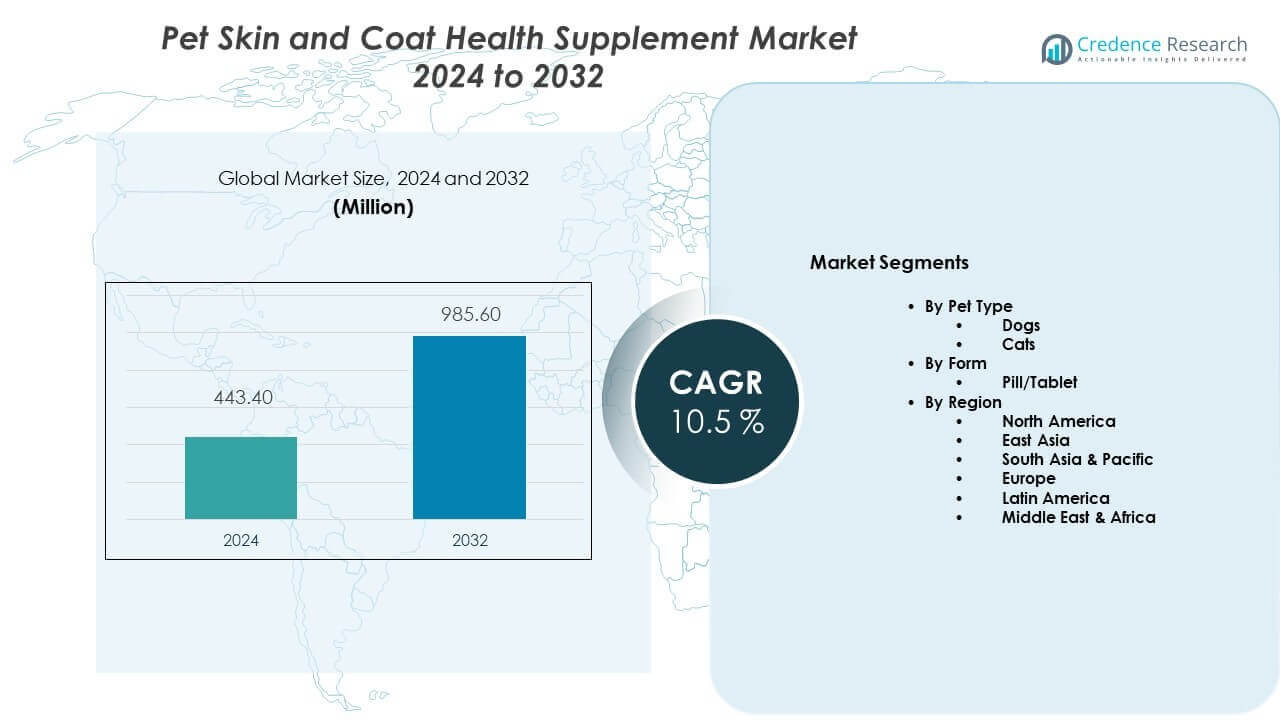
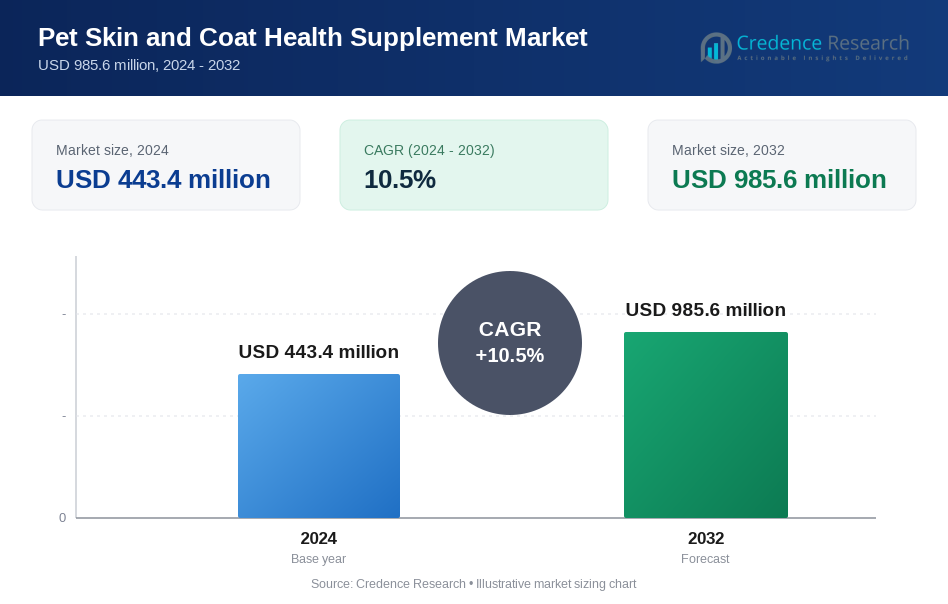
The Pet skin and coat health supplement market was valued at USD 443.4 million in 2024 and is projected to reach USD 985.6 million by 2032. The market is expected to grow at a CAGR of 10.5% from 2024 to 2032.
| REPORT ATTRIBUTE | DETAILS |
|---|---|
| Historical Period | 2020-2023 |
| Base Year | 2024 |
| Forecast Period | 2025-2032 |
| Pet Skin and Coat Health Supplement Market Size 2024 | USD 443.4 million |
| Pet Skin and Coat Health Supplement Market, CAGR | 10.5% |
| Pet Skin and Coat Health Supplement Market Size 2032 | USD 985.6 million |
Market growth is driven by rising pet humanization trends worldwide. Owners prioritize appearance, comfort, and long-term health of pets. Skin allergies and coat-related issues show higher incidence due to diet changes and environmental factors. Veterinarians recommend supplements for skin barrier support and coat quality. Omega fatty acids, vitamins, and minerals see strong demand. E-commerce platforms improve product access and awareness. Marketing through veterinarians and pet influencers supports trust. These factors collectively drive sustained market expansion.
North America leads the market due to high pet ownership and strong spending on pet wellness. The United States drives demand through premium supplement adoption and veterinary guidance. Europe follows with strong focus on animal nutrition standards and preventive care. Countries such as Germany and the UK show steady uptake. Asia Pacific emerges as a fast-growing region due to rising disposable income and urban pet adoption. China and India show growing awareness of pet supplements. Expanding retail networks support regional growth.
Market Insights:
- The Pet skin and coat health supplement market was valued at USD 443.4 million in 2024 and is projected to reach USD 985.6 million by 2032, growing at a CAGR of 10.5% during the forecast period.
- North America leads with about 55% share due to high pet ownership and premium wellness spending, followed by Europe at nearly 20% supported by preventive nutrition focus, and Asia Pacific at around 15% driven by urban pet adoption.
- Asia Pacific is the fastest-growing region with about 15% share, supported by rising disposable income, expanding pet care awareness, and growth of organized retail channels.
- By pet type, dogs account for around 68.5% share, reflecting higher ownership rates and greater spending on canine supplements.
- By form, pill and tablet supplements hold about 20.5% share due to accurate dosing, veterinary preference, and ease of daily administration.
Market Drivers:
Rising Pet Humanization And Preventive Health Focus Among Owners
The Pet skin and coat health supplement market benefits from strong pet humanization trends. Owners treat pets as family members and focus on daily wellness. Appearance and comfort gain high priority in pet care routines. Skin irritation and coat dullness raise owner concern. Supplements support visible health improvements. Veterinarians promote preventive nutrition approaches. Routine supplementation gains wider acceptance. This driver supports consistent demand growth.
- For instance, Nestlé Purina’s Pro Plan Veterinary Supplements Skin Care dog soft chews include omega-3 (EPA & DHA) and vitamin E per chew to support skin health and barrier function.
Increasing Incidence Of Skin Allergies And Coat-Related Conditions
Pet skin issues show higher occurrence across breeds and age groups. Environmental allergens affect pet skin sensitivity. Dietary gaps contribute to coat weakness and shedding. Supplements address nutritional deficiencies effectively. Omega fatty acids support skin barrier strength. Vitamins improve coat shine and texture. Owners seek non-prescription solutions first. These factors strengthen supplement adoption.
- For instance, Purina Pro Plan Veterinary Skin Care chews deliver 60 mg EPA & DHA per soft chew to help maintain protective skin barriers in dogs with sensitive skin.
Growing Influence Of Veterinary Guidance And Clinical Recommendations
Veterinary professionals guide supplement use for skin care. Clinics recommend supplements during routine checkups. Preventive advice improves owner confidence. Clinical endorsement increases product credibility. Supplement use aligns with long-term care plans. Trusted guidance supports repeat purchases. Pet owners follow professional advice closely. This influence drives market demand.
Expansion Of E-Commerce And Specialty Pet Retail Channels
Online platforms improve supplement accessibility. Digital channels offer product education and reviews. Subscription models encourage routine use. Specialty pet stores expand premium offerings. Wider availability improves consumer reach. Marketing campaigns increase product awareness. Easy access supports purchase frequency. Retail expansion fuels market growth.
Market Trends:
Shift Toward Natural And Clean Label Supplement Formulations
Consumers prefer supplements with natural ingredients. Clean label claims attract health-focused owners. Brands reduce artificial additives and fillers. Plant-based oils and extracts gain attention. Transparency in labeling improves trust. Natural positioning supports premium pricing. Ingredient sourcing gains higher scrutiny. This trend reshapes product development strategies.
- For instance, Purina Pro Plan Skin & Coat+ dog supplement uses salmon and linseed oils rich in omega fatty acids for coat support, without artificial colors or preservatives
Rising Popularity Of Breed-Specific And Life-Stage Products
Manufacturers develop targeted supplement formulas. Breed size and coat type influence formulation design. Puppies and senior pets receive tailored nutrition. Customization improves perceived effectiveness. Pet owners seek personalized solutions. Product differentiation supports brand loyalty. This trend expands portfolio diversity. Segmentation becomes more refined.
- For instance, Purina’s Pro Plan line includes skin-focused supplements across adult dogs of various sizes, helping manage sensitivity and coat condition.
Growth Of Functional Treat And Chewable Supplement Formats
Chewable supplements improve compliance rates. Treat-based formats simplify daily dosing. Pets accept flavored supplements easily. Owners prefer convenient administration methods. Functional treats combine nutrition with palatability. Product innovation focuses on taste and texture. This trend supports higher consumption rates. Format diversity improves market appeal.
Increased Use Of Digital Marketing And Influencer Advocacy
Brands invest in digital promotion strategies. Social media influences purchasing decisions. Pet influencers showcase visible results. Educational content supports informed buying. Online engagement builds brand recognition. Digital reviews impact trust levels. Direct-to-consumer models gain traction. This trend strengthens market visibility.
Market Challenges Analysis:
Lack Of Standardized Regulations And Product Quality Consistency
The Pet skin and coat health supplement market faces regulatory variation. Standards differ across regions and markets. Quality consistency varies among brands. Label claims create consumer confusion. Regulatory gaps affect product trust. Manufacturers manage compliance complexities. Certification processes raise costs. These challenges limit uniform market confidence.
Price Sensitivity And Competition From Alternative Pet Care Solutions
Premium supplements face price sensitivity issues. Cost-conscious owners limit repeat purchases. Grooming products compete for skin care budgets. Prescription treatments divert some demand. Brand differentiation remains challenging. Market entry barriers stay moderate. Price competition pressures margins. These factors constrain broader adoption.
Market Opportunities:
Expansion Potential In Emerging Pet Care Markets And Urban Regions
The Pet skin and coat health supplement market gains opportunity in emerging economies. Urban pet adoption rises steadily. Disposable income growth supports premium care spending. Awareness of pet nutrition improves gradually. Retail infrastructure expands in developing regions. Local brands enter untapped markets. Education campaigns boost adoption rates. These trends support long-term growth.
Product Innovation Through Advanced Nutrition And Functional Ingredients
Manufacturers invest in advanced ingredient research. Novel fatty acid blends enhance effectiveness. Functional nutrients improve absorption and results. Science-backed formulations attract informed consumers. Innovation supports premium product positioning. Collaboration with veterinarians strengthens development. Specialized products address unmet needs. This opportunity drives market differentiation.
Market Segmentation Analysis:
By Pet Type
The Pet skin and coat health supplement market shows clear dominance from the dog segment. Dogs experience higher exposure to outdoor allergens and skin conditions. Owners invest more in preventive care for dogs. Veterinary recommendations often focus on canine nutrition support. Dogs also show higher supplement compliance through treats and tablets. Cats form a growing segment due to rising indoor pet adoption. Feline skin sensitivity drives targeted supplement use. Product design increasingly addresses species-specific needs.
- For instance, Purina’s Pro Plan Veterinary Supplements Skin Care are formulated specifically for dogs with sensitive skin, highlighting canine focus.
By Form
Pill and tablet formats hold strong adoption across markets. These forms offer accurate dosing and longer shelf life. Pet owners prefer tablets for daily routine management. Veterinary clinics commonly recommend tablet-based supplements. Manufacturers improve palatability to increase acceptance. Blister and bottle packaging support convenience. Tablets align with prescription-style administration habits. This format supports consistent supplementation behavior.
- For instance, Purina’s skin care soft chews provide measured doses of omega-3 and zinc per day, improving compliance.
Segmentation:
By Pet Type- Dogs
- Cats
- Pill/Tablet
- North America
- U.S.
- Canada
- Mexico
- Europe
- Germany
- France
- U.K.
- Italy
- Spain
- Rest of Europe
- Asia Pacific
- China
- Japan
- India
- South Korea
- South-east Asia
- Rest of Asia Pacific
- Latin America
- Brazil
- Argentina
- Rest of Latin America
- Middle East & Africa
- GCC Countries
- South Africa
- Rest of the Middle East and Africa
Regional Analysis:
North America Dominates With High Pet Wellness Spending
The Pet skin and coat health supplement market is led by North America with about 55% revenue share. The United States drives regional demand due to high pet ownership and premium care spending. Veterinarian-backed supplement use remains common. Strong presence of established brands improves product trust. E-commerce and specialty pet retail channels support wide access. Preventive pet healthcare awareness stays high. These factors keep North America in a dominant position.
Europe Holds A Strong Position With Focus On Preventive Pet Nutrition
Europe accounts for nearly 20% of the global market share. Countries such as Germany, the UK, and France lead regional consumption. Pet owners show strong interest in balanced nutrition and supplement use. Regulatory oversight supports product quality and safety. Veterinary guidance influences purchasing decisions. Growing demand for natural formulations supports steady adoption. The region maintains consistent market performance.
Asia Pacific And Other Regions Show Emerging Growth Potential
Asia Pacific holds around 15% market share and shows rapid expansion. China, Japan, and India drive growth through rising urban pet adoption. Disposable income growth supports spending on pet supplements. Awareness of skin and coat health improves steadily. Latin America contributes nearly 5% share with gradual premiumization trends. The Middle East and Africa together account for about 5%, supported by niche urban demand. These regions present long-term growth opportunities.
Key Player Analysis:
- VetriScience Laboratories
- Zesty Paws
- Nutramax Laboratories
- PetNC Natural Care
- iHeartDogs
- Vet's Best
- Nestlé Purina
- Bayer Animal Health
Competitive Analysis:
The Pet skin and coat health supplement market shows a fragmented yet competitive structure. Established brands hold strong positions through veterinary trust and wide distribution. These players focus on formulation quality and ingredient transparency. Product differentiation centers on efficacy, palatability, and clean-label claims. Smaller brands compete through niche positioning and digital-first strategies. Retail presence across clinics, pet stores, and online channels shapes reach. Brand loyalty remains high due to repeat purchase behavior. It stays competitive through innovation and targeted marketing.
Recent Developments:
- In August 2024, VetriScience Laboratories announced a transformational rebranding initiative and launched innovative new products at the SUPERZOO Trade Show in Las Vegas. This marked the company's first major rebrand in 10 years, featuring a new logo and updated packaging designed to reflect current pet supplement market dynamics and evolving pet ownership trends. Accompanying the rebrand, VetriScience expanded its comprehensive range of mobility supplements with the launch of HMB Healthy Muscle & Strength granules, formulated with HMB, Type II Collagen with Hyaluronic Acid, and Curcumin from Turmeric. This shellfish-free alternative addresses a critical market need, offering a glucosamine alternative for pets with allergies or sensitivities to shellfish-based supplements commonly found in the market.
- Additionally, the company launched Immune Plus and Omega Plus supplements specifically targeting seasonal and environmental allergies, immune function, and skin and coat health in dogs. The Omega Plus supplement targets dry and itchy skin, dandruff, flaking, irregular shedding, and dull or dry coats, featuring a blend of fish oil, olive oil, safflower oil, vitamins, Omega fatty acids, and amino acids. All products carry the National Animal Supplement Council (NASC) quality seal and are manufactured in FDA-certified facilities in the United States. The company emphasized that its products remain formulated by experts with over 150 years of collective experience, maintaining its legacy of trust and innovation.
Report Coverage:
The research report offers an in-depth analysis based on Pet Type, Form, Distribution Channel, and Region. It details leading market players, providing an overview of their business, product offerings, investments, revenue streams, and key applications. Additionally, the report includes insights into the competitive environment, SWOT analysis, current market trends, as well as the primary drivers and constraints. Furthermore, it discusses various factors that have driven market expansion in recent years. The report also explores market dynamics, regulatory scenarios, and technological advancements that are shaping the industry. It assesses the impact of external factors and global economic changes on market growth. Lastly, it provides strategic recommendations for new entrants and established companies to navigate the complexities of the market.
Future Outlook:
- Preventive pet wellness gains higher adoption as owners focus on long-term skin health.
- Demand for natural ingredients strengthens product positioning across premium supplement lines.
- Veterinary influence continues to shape purchasing behavior through clinical recommendations.
- E-commerce platforms expand brand reach and support repeat purchasing patterns.
- Personalized nutrition gains attention through breed-specific and life-stage formulations.
- Premium supplements attract loyal customers seeking visible skin and coat improvements.
- Urban pet adoption supports steady demand growth in developing regions.
- Product innovation improves efficacy perception among informed pet owners.
- Emerging markets show rising awareness of preventive pet nutrition solutions.
- Brand trust remains a key success factor in sustaining competitive advantage.
Request a Free Sample
Fill in your details and we'll send you a free sample report.
- Sample data tables & charts
- Research methodology
Market Dynamics
Rising Pet Humanization and Preventive Health Focus
Pet owners increasingly treat pets as family members, prioritizing their appearance, comfort, and long-term health. This trend drives demand for supplements that visibly improve skin and coat quality, with preventive wellness routines becoming more common.
Increasing Incidence of Skin Allergies and Coat-Related Conditions
Environmental allergens and dietary changes have led to a higher prevalence of skin sensitivities and coat issues in pets. Owners seek non-prescription supplements, especially those with omega fatty acids and vitamins, to address these concerns and improve pet well-being.
Veterinary Guidance and Clinical Recommendations
Veterinarians play a key role in recommending skin and coat supplements during routine checkups, boosting owner confidence and repeat purchases. Clinical endorsements and integration into long-term care plans increase product credibility and market adoption.
Expansion of E-Commerce and Specialty Retail Channels
Online platforms and specialty pet stores have made supplements more accessible, offering education, reviews, and subscription models that encourage routine use. This expanded reach supports higher purchase frequency and market growth.
Shift Toward Natural and Clean Label Formulations
Consumers are increasingly seeking supplements with natural ingredients and transparent labeling, avoiding artificial additives. This preference supports premium pricing and drives innovation in product development, further fueling market expansion.
Need a Custom Version of This Report?
Tailor the scope, geography, or segments to your exact requirements.
- Custom geography or segment scope
- Direct access to our analyst team
Frequently Asked Questions
What is the current market size for Pet skin and coat health supplement market, and what is its projected size in 2032?
At what Compound Annual Growth Rate is the Pet skin and coat health supplement market projected to grow between 2025 and 2032?
Which Pet skin and coat health supplement market segment held the largest share in 2024?
What are the primary factors fueling the growth of the Pet skin and coat health supplement market?
Who are the leading companies in the Pet skin and coat health supplement market?
Which region commanded the largest share of the Pet skin and coat health supplement market in 2024?
Table of Content
Chapter 1 Market Segmentation
- 1.1 Segmentation Framework
- 1.1.1 Product and Service Classification
- 1.1.2 Application and End-Use Classification
- 1.1.3 Technology and Solution Classification
- 1.1.4 Customer and Distribution Channel Classification
- 1.1.5 Geographic Segmentation
- 1.1.6 Market Segment Definitions and Boundaries
- 1.2 By Form
- 1.2.1 Pill/Tablet
- 1.2.2 Soft Chew
- 1.2.3 Powder
- 1.2.4 Liquid
- 1.2.5 Topical
- 1.3 By Pet Type
- 1.3.1 Dogs
- 1.3.2 Cats
Chapter 2 Introduction
- 2.1 Report Objectives and Scope
- 2.2 Product Definition and Industry Terminology
- 2.3 Market Inclusions and Exclusions
- 2.4 Research Process
- 2.4.1 Primary Research and Expert Interviews
- 2.4.2 Secondary Research and Source Review
- 2.4.3 Top-Down and Bottom-Up Estimation
- 2.4.4 Data Triangulation and Verification
- 2.5 Market Size Measurement Basis
- 2.5.1 2024: USD 443.4 million → 2032: USD 985.6 million
- 2.6 Historical and Forecast Reference Periods
- 2.6.1 Base Year: 2024
- 2.6.2 Forecast Period: 2024-2032
- 2.7 Research Assumptions and Limitations
Chapter 3 Executive Summary
- 3.1 Market Snapshot and Key Findings
- 3.2 Base-Year Market Size, 2024
- 3.3 Forecast Market Size, 2032
- 3.4 Revenue and Volume Growth Outlook
- 3.5 Key Demand and Supply Indicators
- 3.6 Leading Market Segments
- 3.7 Fastest-Growing Market Opportunities
- 3.8 Regional Performance Highlights
- 3.9 Technology and Industry Transformation
- 3.10 Competitive Landscape Summary
- 3.11 Analyst View and Strategic Implications
Chapter 4 Global Pet Skin and Coat Health Supplement Market Trends and Developments
- 4.1 Historical Industry Development
- 4.2 Recent Market Trends and Developments
- 4.3 Demand and Customer Behavior Trends
- 4.4 Technology and Product Innovation
- 4.5 Artificial Intelligence, Automation and Digitalization
- 4.6 Local Manufacturing and Supply Chain Realignment
- 4.7 Industry Partnerships, Mergers and Acquisitions
- 4.8 Sustainability and Circular Economy Developments
- 4.9 Government and Private Sector Investment Trends
- 4.10 Emerging Business Models and Commercialization
- 4.11 Industry Developments and Announcements
Chapter 5 Global Pet Skin and Coat Health Supplement Market Production, Supply and Demand Analysis
- 5.1 Demand Trend and Consumption Analysis
- 5.2 Demand Forecast, 2024-2032
- 5.3 Production and Output Trend
- 5.4 Production and Output Forecast, 2024-2032
- 5.5 Installed Capacity and Capacity Utilization
- 5.6 Company-Wise Production Plants and Statistics
- 5.6.1 Installed Production Capacity
- 5.6.2 Actual Production
- 5.6.3 Planned Capacity and Expansion Targets
- 5.7 Supply Chain Structure and Procurement Trends
- 5.8 Supply-Demand Gap and Bottlenecks
- 5.9 Import Dependence and Sourcing Structure
- 5.10 Contract Manufacturing and Outsourcing
- 5.11 Regional Supply and Demand Concentration
Chapter 6 Global Pet Skin and Coat Health Supplement Market Pricing Analysis
- 6.1 Pricing Structure and Measurement
- 6.2 Historical Pricing Trends
- 6.3 Pricing Outlook, 2024-2032
- 6.4 Average Selling Price and Unit Economics
- 6.5 Pricing by Product and Market Segment
- 6.6 Geographic Pricing Differences
- 6.7 Key Input, Energy, Labor and Logistics Costs
- 6.8 Contract Pricing and Purchasing Models
- 6.9 Pricing Sensitivity and Competitive Positioning
- 6.10 Price, Margin and Profitability Implications
Chapter 7 Global Pet Skin and Coat Health Supplement Market Dynamics
- 7.1 Market Growth Drivers
- 7.1.1 Demand-Side Drivers
- 7.1.2 Technology and Innovation Drivers
- 7.1.3 Infrastructure and Investment Drivers
- 7.1.4 Regulatory and Policy Drivers
- 7.2 Market Restraints
- 7.2.1 Cost and Affordability Constraints
- 7.2.2 Technology and Adoption Barriers
- 7.2.3 Supply Chain and Operational Constraints
- 7.3 Market Challenges
- 7.3.1 Competitive Pressure and Margin Erosion
- 7.3.2 Skills, Infrastructure and Implementation Gaps
- 7.4 Emerging Market Opportunities
- 7.5 Market Dynamics Impact and Time-Horizon Assessment
Chapter 8 Global Pet Skin and Coat Health Supplement Value Chain Analysis
- 8.1 Industry Value Chain Overview
- 8.2 Upstream Suppliers and Critical Inputs
- 8.3 Technology and Component Providers
- 8.4 Manufacturing or Service Delivery
- 8.5 Distribution, Channel Partners and Integrators
- 8.6 Downstream Applications and End Users
- 8.7 Value Addition and Profit Pools
- 8.8 Vertical Integration and Outsourcing
- 8.9 Supplier Concentration and Risk
- 8.10 Supply Chain Localization and Resilience
Chapter 9 Global Pet Skin and Coat Health Supplement Market Regulations and Policies
- 9.1 Relevant Laws, Standards and Compliance Frameworks
- 9.2 Product, Service, Safety and Quality Requirements
- 9.3 Government Policies, Incentives and Subsidies
- 9.4 Imports, Exports and Trade Barriers
- 9.5 Public Procurement and Local Content Requirements
- 9.6 Environmental and Sustainability Compliance
- 9.7 Upcoming Policy Changes and Market Implications
Chapter 10 Global Pet Skin and Coat Health Supplement Market Hotspots and Opportunities
- 10.1 Market Opportunity Mapping and Growth Hotspots
- 10.2 High-Growth Applications and Customer Groups
- 10.3 Underserved Markets and White-Space Opportunities
- 10.4 Emerging Technology and Product Opportunities
- 10.5 New Capacity and Investment Hotspots
- 10.6 Market Entry and Expansion Opportunities
- 10.7 Distribution and Partnership Opportunities
- 10.8 Near-Term and Long-Term Commercial Potential
- 10.9 Opportunity Attractiveness and Execution Risks
Chapter 11 Global Pet Skin and Coat Health Supplement Market Outlook, 2024-2032
- 11.1 Market Size and Analysis
- 11.1.1 Revenue (Market Measurement: 2024: USD 443.4 million → 2032: USD 985.6 million)
- 11.1.2 Market Volume and Quantity Sold
- 11.1.3 Historical Market Size
- 11.1.4 Base-Year Market Size, 2024
- 11.2 Market Forecast, 2024-2032
- 11.2.1 Revenue Forecast to 2032
- 11.2.2 Volume Forecast to 2032
- 11.2.3 CAGR and Year-on-Year Growth
- 11.2.4 Incremental Revenue Opportunity
- 11.3 Forecast Assumptions and Scenario Analysis
- 11.3.1 Base-Case Forecast
- 11.3.2 Optimistic and Conservative Scenarios
- 11.3.3 Technology, Pricing and Policy Sensitivities
- 11.4 Market Attractiveness and Growth Outlook
Chapter 12 Global Pet Skin and Coat Health Supplement Market Segmentation and Outlook
- 12.1 Segmentation Summary and Market Shares, 2024
- 12.2 Largest and Fastest-Growing Segments
- 12.3 By Form - Market Size and Forecast, 2024-2032
- 12.3.1 Segment Definition and Scope
- 12.3.2 Historical Market Size
- 12.3.3 Revenue Forecast, 2024-2032
- 12.3.4 Volume Forecast, 2024-2032
- 12.3.5 Base-Year Market Share, 2024
- 12.3.6 Segment CAGR and Growth Drivers
- 12.3.7 Subsegment Market Size and Forecast
- 12.3.7.1 Pill/Tablet
- 12.3.7.2 Soft Chew
- 12.3.7.3 Powder
- 12.3.7.4 Liquid
- 12.3.7.5 Topical
- 12.3.8 Subsegment Pricing and Adoption Trends
- 12.3.9 Leading Suppliers and Competition
- 12.3.10 Regional Demand and Opportunities
- 12.4 By Pet Type - Market Size and Forecast, 2024-2032
- 12.4.1 Segment Definition and Scope
- 12.4.2 Historical Market Size
- 12.4.3 Revenue Forecast, 2024-2032
- 12.4.4 Volume Forecast, 2024-2032
- 12.4.5 Base-Year Market Share, 2024
- 12.4.6 Segment CAGR and Growth Drivers
- 12.4.7 Subsegment Market Size and Forecast
- 12.4.7.1 Dogs
- 12.4.7.2 Cats
- 12.4.8 Subsegment Pricing and Adoption Trends
- 12.4.9 Leading Suppliers and Competition
- 12.4.10 Regional Demand and Opportunities
- 12.5 Segment Growth Comparison
- 12.6 Segment Attractiveness and Priority Matrix
Chapter 13 Global Pet Skin and Coat Health Supplement Geographic Market Outlook, 2024-2032
- 13.1 Regional Market Size and Share, 2024
- 13.2 Regional Market Forecast, 2024-2032
- 13.3 Regional Pricing, Production and Demand Differences
- 13.4 North America
- 13.4.1 United States
- 13.4.2 Canada
- 13.4.3 Mexico
- 13.5 Europe
- 13.5.1 Germany
- 13.5.2 France
- 13.5.3 Italy
- 13.5.4 United Kingdom
- 13.5.5 Spain
- 13.5.6 Poland
- 13.5.7 Russia
- 13.5.8 Netherlands
- 13.5.9 Belgium
- 13.5.10 Sweden
- 13.5.11 Denmark
- 13.5.12 Norway
- 13.5.13 Rest of Europe
- 13.6 Asia Pacific
- 13.6.1 China
- 13.6.2 India
- 13.6.3 Japan
- 13.6.4 South Korea
- 13.6.5 Thailand
- 13.6.6 Indonesia
- 13.6.7 Vietnam
- 13.6.8 Malaysia
- 13.6.9 Australia
- 13.6.10 Rest of Asia Pacific
- 13.7 Latin America
- 13.7.1 Brazil
- 13.7.2 Argentina
- 13.7.3 Colombia
- 13.7.4 Chile
- 13.7.5 Rest of Latin America
- 13.8 Middle East
- 13.8.1 Saudi Arabia
- 13.8.2 United Arab Emirates
- 13.8.3 Turkey
- 13.8.4 Israel
- 13.8.5 Iran
- 13.8.6 Rest of the Middle East
- 13.9 Africa
- 13.9.1 South Africa
- 13.9.2 Egypt
- 13.9.3 Nigeria
- 13.9.4 Morocco
- 13.9.5 Rest of Africa
- 13.10 Regional Investment, Policy and Supply Chain Differences
- 13.11 Regional Competitive Landscape
- 13.12 Geographic Growth Hotspots
Chapter 14 Global Pet Skin and Coat Health Supplement Technology, Innovation and Sustainability Outlook
- 14.1 Technology Landscape and Maturity
- 14.2 Product, Process and Service Innovation
- 14.3 AI, Automation and Digital Tools in the Industry
- 14.4 Technology Adoption and Performance Benchmarking
- 14.5 Innovation Pipeline and R&D Investment
- 14.6 Patent and Intellectual Property Trends
- 14.7 Energy Efficiency and Resource Management
- 14.8 Sustainability, Recycling and Circularity
- 14.9 Technology Roadmap, 2024-2032
- 14.10 Risks of Obsolescence and Technology Substitution
Chapter 15 Global Pet Skin and Coat Health Supplement Market Key Strategic Imperatives
- 15.1 Growth and Market Entry Priorities
- 15.2 High-Return Products and Segments
- 15.3 Pricing, Profitability and Cost Optimization
- 15.4 Technology Investment and Product Differentiation
- 15.5 Supply Chain Localization and Resilience
- 15.6 Distribution and Customer Acquisition
- 15.7 Partnership, Acquisition and Capacity Strategy
- 15.8 Regional Expansion Priorities
- 15.9 Short-, Medium- and Long-Term Actions
Chapter 16 Competition Outlook
- 16.1 Industry Competition Characteristics
- 16.2 Market Structure and Concentration
- 16.3 Market Share and Competitive Positioning, 2024
- 16.4 Company-Wise Revenue and Product Benchmarking
- 16.5 Production and Service Capacity Benchmarking
- 16.6 Technology, Pricing and Differentiation
- 16.7 Regional Footprint and Distribution Strength
- 16.8 Mergers, Acquisitions and Strategic Alliances
- 16.9 New Entrants and Competitive Threats
- 16.10 Porter's Five Forces and Industry Attractiveness
- 16.11 Competitive Outlook, 2024-2032
Chapter 17 Company Profiles
- 17.1 Company Coverage and Selection Criteria
- 17.2 VetriScience Laboratories
- 17.2.1 Business Description
- 17.2.2 Company Ownership and Geographic Presence
- 17.2.3 Product and Service Portfolio
- 17.2.4 Manufacturing and Operating Footprint
- 17.2.5 Production Capacity and Expansion Plans
- 17.2.6 Financial Performance and Investment
- 17.2.7 Market Share and Competitive Position
- 17.2.8 Technology and Innovation Capabilities
- 17.2.9 Strategic Alliances or Partnerships
- 17.2.10 Recent Developments
- 17.2.11 Growth Strategy and Outlook
- 17.3 Zesty Paws
- 17.4 Nutramax Laboratories
- 17.5 PetNC Natural Care
- 17.6 iHeartDogs
- 17.7 Vet's Best
- 17.8 Nestlé Purina
- 17.9 Bayer Animal Health
- 17.10 Hill's Pet Nutrition
- 17.11 Mars Petcare
- 17.12 Other Relevant Market Participants
Note: Every listed company is profiled on the structure shown under the first company. The company list is preliminary and may change based on research findings, market developments, data availability and client requirements.
Chapter 18 Disclaimer
- 18.1 Research and Forecast Disclaimer
- 18.2 Data Source and Estimation Limitations
Note: The depth of individual sections depends on data availability for this market. Volume, capacity, trade and other unit-based metrics are included where applicable.