
Market Overview
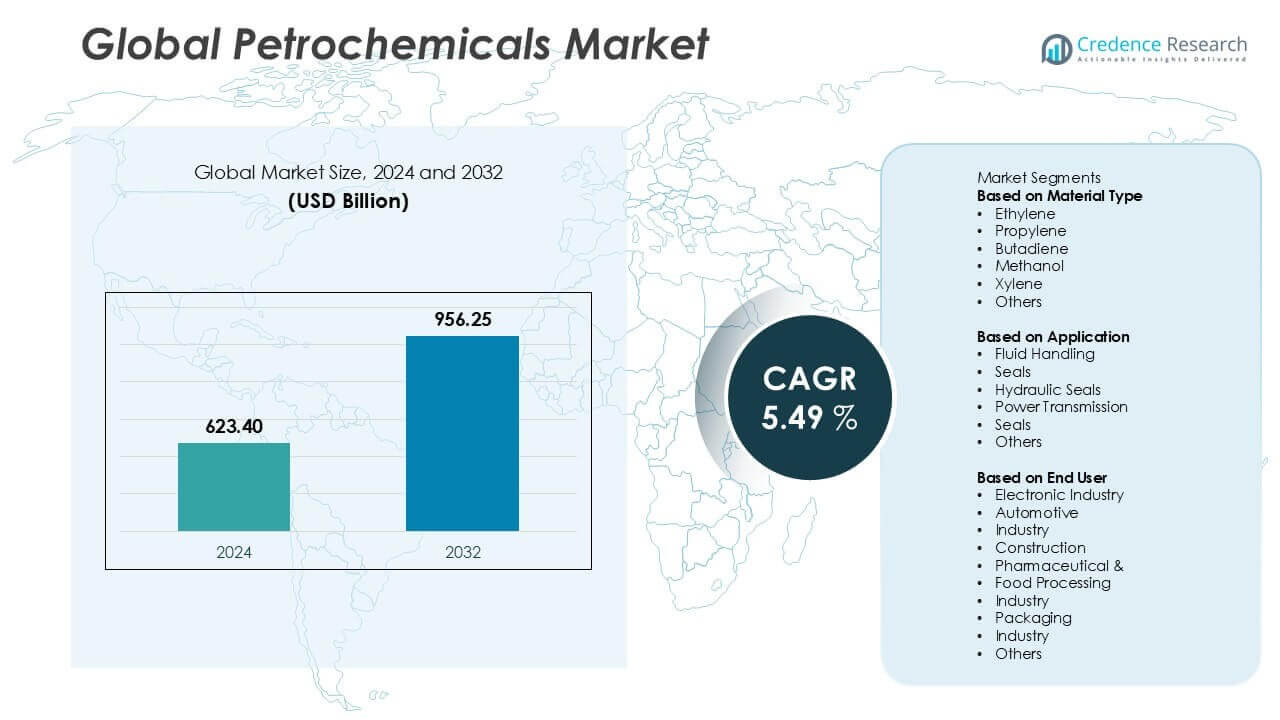
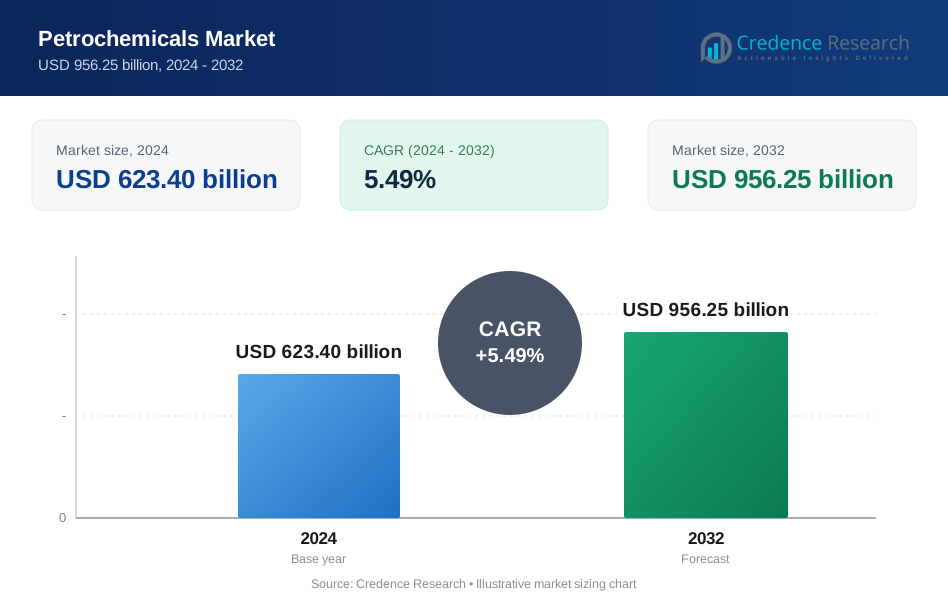
Petrochemicals market size was valued at USD 623.40 billion in 2024 and is anticipated to reach USD 956.25 billion by 2032, at a CAGR of 5.49% during the forecast period.
| REPORT ATTRIBUTE | DETAILS |
|---|---|
| Historical Period | 2020-2024 |
| Base Year | 2024 |
| Forecast Period | 2025-2032 |
| Petrochemicals Market Size 2024 | USD 623.40 Million |
| Petrochemicals Market , CAGR | 5.49% |
| Petrochemicals Market Size 2032 | USD 956.25 Million |
The petrochemicals market is led by prominent players such as BASF SE, Saudi Basic Industries Corp (SABIC), Sinopec Group, ExxonMobil, Dow Inc., Sumitomo Chemical Co. Ltd, and PetroChina Company Limited, each leveraging extensive production capacities, integrated operations, and global supply networks. These companies drive market growth through technological innovation, capacity expansions, and strategic partnerships. Asia-Pacific emerges as the dominant region, holding over 45% of the global market share, supported by strong manufacturing bases in China, India, Japan, and South Korea. The region’s cost-effective feedstocks, rising domestic consumption, and large-scale infrastructure projects consolidate its leadership in global petrochemical production and demand.
Market Insights
- The petrochemicals market was valued at USD 623.40 billion in 2024 and is projected to reach USD 956.25 billion by 2032, registering a CAGR of 5.49% during the forecast period.
- Growth is driven by rising demand from packaging, automotive, and construction industries, supported by expanding industrialization, increasing plastic consumption, and technological advancements in production efficiency.
- Key trends include the shift toward bio-based petrochemicals, integration of advanced process technologies, and increasing adoption of recyclable and sustainable materials to meet regulatory and consumer demands.
- The market is highly competitive, with leading players such as BASF SE, SABIC, Sinopec, ExxonMobil, and Dow Inc. focusing on capacity expansions, feedstock optimization, and strategic partnerships; however, crude oil price volatility and strict environmental regulations pose challenges.
- Asia-Pacific dominates with over 45% share, followed by North America (22%) and Europe (18%); ethylene leads the material type segment with more than 35% share globally.
Market Segmentation Analysis:
By Material Type
In the petrochemicals market, ethylene holds the dominant share of over 35%, driven by its extensive use in polyethylene production, which supports packaging, construction, and automotive industries. Its high demand is reinforced by rising consumption of lightweight, durable plastics and increasing applications in chemical intermediates like ethylene oxide and ethylene dichloride. The segment benefits from expanding manufacturing capacities in Asia-Pacific and technological advancements in steam cracking processes, which enhance yield efficiency and lower production costs. Growing investments in sustainable ethylene derived from bio-based feedstocks further strengthen its position in the market.
- For instance, SABIC operates an ethylene production facility in Saudi Arabia with a capacity exceeding 1.3 million metric tons annually, integrating advanced furnace technologies to improve thermal efficiency by 20% compared to conventional units.
By Application
Within applications, fluid handling emerges as the leading sub-segment, accounting for approximately 30% of market share, supported by its critical role in transferring petrochemical fluids across processing units and end-use industries. Demand growth is fueled by infrastructure expansions in refineries, petrochemical complexes, and chemical manufacturing plants. The segment is driven by advancements in corrosion-resistant materials and energy-efficient pump technologies, which improve operational reliability in aggressive chemical environments. Additionally, the need for precise flow control in both upstream and downstream operations sustains its dominance in the application spectrum.
- For instance, Flowserve supplied API 610 centrifugal pumps for ExxonMobil’s Baytown petrochemical complex, each capable of handling flow rates above 3,000 cubic meters per hour while meeting strict operational reliability standards.
By End User
The automotive industry leads among end users, representing around 28% of the petrochemicals market share, attributed to the sector’s extensive use of petrochemical derivatives in manufacturing plastics, synthetic rubbers, and composites. Lightweight materials derived from petrochemicals contribute to improved fuel efficiency and reduced emissions, aligning with global sustainability targets. The growing adoption of electric vehicles further drives demand for high-performance polymers and specialized coatings. Continuous R&D in advanced petrochemical-based materials enhances thermal resistance, durability, and design flexibility, ensuring the automotive segment maintains a strong growth trajectory in the forecast period.
Market Overview
Key Growth Drivers
Expanding Demand from Packaging Industry
The packaging industry remains a primary growth driver for the petrochemicals market, with high consumption of polyethylene, polypropylene, and PET for flexible and rigid packaging applications. Rising e-commerce activities, urbanization, and shifting consumer preferences toward convenient, lightweight packaging materials boost demand. Additionally, the growing use of barrier films for food preservation and pharmaceutical packaging supports steady market expansion. Emerging markets in Asia-Pacific, with their increasing manufacturing capacity and retail sector growth, further accelerate petrochemical consumption in packaging, reinforcing its role as a dominant demand generator.
- For instance, Dow Inc. developed its Elite™ polyethylene resins with a tensile strength exceeding 50 megapascals, enabling production of thinner yet more durable packaging films, reducing material use by up to 15% in large-scale applications.
Rising Automotive and Transportation Applications
The automotive sector’s shift toward lightweight materials to enhance fuel efficiency and reduce emissions is significantly driving petrochemical demand. Products such as polypropylene, ABS, and synthetic rubbers are extensively used in vehicle interiors, exteriors, and tire manufacturing. The rise of electric vehicles amplifies the need for advanced polymers with high thermal stability, lightweight composites, and durable coatings. Expanding vehicle production in emerging economies and continued innovation in high-performance petrochemical materials strengthen this segment’s contribution to overall market growth.
- For instance, BASF’s Ultramid® polyamide series delivers heat resistance up to 230°C, enabling its integration into under-the-hood automotive components in more than 6 million vehicles globally each year.
Expansion of Petrochemical Production Capacity in Asia-Pacific
Asia-Pacific’s rapid industrialization and infrastructure development have led to substantial investments in petrochemical plants, particularly in China, India, and Southeast Asia. The availability of cost-effective feedstocks, strategic integration with refining operations, and favorable government policies encourage capacity expansions. Global players are also forming joint ventures and investing in advanced process technologies to increase efficiency and reduce environmental impact. This regional production surge ensures a stable supply of petrochemicals to meet rising domestic and export demands, positioning Asia-Pacific as the global growth hub for the industry.
Key Trends & Opportunities
Shift Toward Bio-Based and Sustainable Petrochemicals
Growing environmental concerns and regulatory pressures are accelerating the adoption of bio-based petrochemicals. Manufacturers are investing in renewable feedstocks such as bio-ethanol, bio-propylene, and bio-based aromatics to reduce carbon footprints. This shift offers opportunities for companies to differentiate through eco-friendly product lines, attract sustainability-focused customers, and comply with evolving environmental standards. The trend also aligns with circular economy principles, supporting recycling initiatives and green chemistry innovations in the petrochemical sector.
- For instance, Braskem operates a bio-polyethylene plant in Brazil with an annual capacity of 200,000 metric tons, utilizing sugarcane-based ethanol to produce resins with a verified carbon footprint reduction of over 2.1 kilograms of CO₂ per kilogram of product compared to fossil-based equivalents.
Technological Advancements in Process Optimization
Integration of advanced technologies, such as AI-driven process control, catalytic process innovations, and energy-efficient cracking units, is transforming petrochemical manufacturing. These advancements enable higher yields, lower operational costs, and improved product quality. Companies leveraging predictive maintenance and real-time monitoring systems enhance plant reliability and reduce downtime, creating competitive advantages. The adoption of advanced process technologies also facilitates compliance with stricter emission regulations, positioning technologically advanced producers for long-term success.
Key Challenges
Volatility in Crude Oil Prices
Petrochemicals are heavily dependent on crude oil and natural gas as feedstocks, making the market vulnerable to price fluctuations. Sudden shifts in crude oil prices due to geopolitical tensions, supply chain disruptions, or production adjustments by OPEC directly impact production costs and profit margins. This volatility complicates long-term planning and investment decisions for manufacturers, prompting the need for flexible sourcing strategies and hedging mechanisms to manage financial risks.
Stringent Environmental Regulations
Increasingly strict environmental regulations targeting carbon emissions, plastic waste, and hazardous chemical usage present significant challenges for petrochemical producers. Compliance requires substantial investments in emission control systems, waste management, and the development of alternative materials. Failure to adapt may lead to fines, production restrictions, or loss of market share. The growing global push for sustainable materials further pressures companies to innovate while balancing cost efficiency and regulatory compliance.
Regional Analysis
North America
North America accounts for approximately 22% of the global petrochemicals market, supported by a well-established refining and chemical manufacturing infrastructure in the United States and Canada. The region benefits from abundant shale gas reserves, which provide cost-effective feedstocks like ethane for ethylene production. Strong demand from automotive, packaging, and construction industries sustains market growth, while technological advancements in process efficiency further enhance competitiveness. Strategic investments in capacity expansion and sustainability-focused projects strengthen regional supply capabilities. The presence of major multinational petrochemical companies ensures steady innovation, positioning North America as a key player in the global value chain.
- For instance, ExxonMobil’s Baytown complex in Texas expanded its ethane cracker to produce an additional 1.5 million metric tons of ethylene annually, making it one of the largest single-site ethylene producers worldwide.
Europe
Europe holds a market share of around 18%, driven by demand in automotive manufacturing, industrial production, and specialty chemicals. The region emphasizes sustainability, with strict regulations encouraging the adoption of bio-based and recyclable petrochemical products. Germany, France, and the Netherlands lead in production and innovation, supported by advanced process technologies and strong R&D capabilities. However, dependency on imported feedstocks increases cost sensitivity, prompting investment in alternative raw materials and energy-efficient production methods. Expansion of downstream applications, particularly in high-performance plastics and specialty polymers, sustains market relevance despite environmental and regulatory challenges.
- For instance, INEOS operates an ethylene oxide facility in Antwerp with a production capacity exceeding 420,000 metric tons annually, enabling supply to both industrial and specialty chemical sectors while integrating recycling technologies to reduce emissions.
Asia-Pacific
Asia-Pacific dominates the petrochemicals market with over 45% share, fueled by rapid industrialization, population growth, and strong manufacturing bases in China, India, Japan, and South Korea. The region benefits from integrated refinery-petrochemical complexes, cost-effective labor, and expanding domestic demand in packaging, automotive, construction, and electronics. Large-scale capacity additions and foreign investments, particularly in China and India, strengthen the supply network. Rising adoption of advanced technologies, along with government-backed infrastructure projects, further accelerates growth. Asia-Pacific’s competitive feedstock pricing and proximity to high-demand markets secure its position as the global hub for petrochemical production and consumption.
Latin America
Latin America represents about 8% of the global petrochemicals market, led by Brazil, Mexico, and Argentina. The region’s market is supported by growing industrialization, urbanization, and demand for petrochemical products in packaging, agriculture, and automotive sectors. Brazil’s strong ethanol industry offers opportunities for bio-based petrochemical production, aligning with sustainability trends. However, market growth is occasionally hindered by political instability and fluctuating economic conditions. Strategic investments in expanding refining and petrochemical capacities, coupled with trade partnerships, are expected to enhance regional supply capabilities and reduce dependency on imports from North America and Asia-Pacific.
Middle East & Africa
The Middle East & Africa collectively account for around 7% of the global petrochemicals market, benefiting from abundant crude oil and natural gas reserves, particularly in Saudi Arabia, UAE, and Qatar. The region’s low-cost feedstock advantage and large-scale petrochemical complexes enable competitive exports to Asia and Europe. Ongoing diversification efforts under national economic strategies are driving investments in downstream industries and specialty petrochemicals. Africa’s growing construction and packaging industries present emerging demand opportunities. However, geopolitical tensions and infrastructure gaps in certain areas pose challenges, requiring strategic collaborations and technology transfers to enhance regional production efficiency.
Market Segmentations:
By Material Type
- Ethylene
- Propylene
- Butadiene
- Methanol
- Xylene
- Others
By Application
- Fluid Handling
- Seals
- Hydraulic Seals
- Power Transmission
- Seals
- Others
By End User
- Electronic Industry
- Automotive
- Industry
- Construction
- Pharmaceutical &
- Food Processing
- Industry
- Packaging
- Industry
- Others
By Geography
- North America
- U.S.
- Canada
- Mexico
- Europe
- Germany
- France
- U.K.
- Italy
- Spain
- Rest of Europe
- Asia Pacific
- China
- Japan
- India
- South Korea
- South-east Asia
- Rest of Asia Pacific
- Latin America
- Brazil
- Argentina
- Rest of Latin America
- Middle East & Africa
- GCC Countries
- South Africa
- Rest of the Middle East and Africa
Competitive Landscape
The competitive landscape of the petrochemicals market is characterized by the presence of major multinational corporations and regionally dominant players competing on production capacity, feedstock access, and technological innovation. Leading companies such as BASF SE, Saudi Basic Industries Corp (SABIC), Sinopec Group, ExxonMobil, Dow Inc., Sumitomo Chemical Co. Ltd, and PetroChina Company Limited maintain strong market positions through integrated operations, extensive product portfolios, and global distribution networks. These players invest heavily in advanced manufacturing technologies, sustainability initiatives, and strategic capacity expansions to strengthen their competitive edge. Partnerships, mergers, and acquisitions are common strategies to access new markets and enhance value-added product offerings. Regional competitiveness is also influenced by feedstock availability and cost efficiency, with Middle Eastern producers benefiting from low-cost natural gas, while Asian companies leverage large-scale domestic demand. The shift toward bio-based and recyclable petrochemicals is prompting innovation and reshaping competitive dynamics, compelling market leaders to align growth strategies with sustainability goals.
- For instance, BASF invested over €1 billion in its Verbund site in Zhanjiang, China, aiming for an annual output of 1 million metric tons of ethylene and derivatives, supported by self-generated utilities to optimize energy efficiency.
Key Player Analysis
- BASF SE
- Saudi Basic Industries Corp (SABIC)
- Sinopec Group (China Petrochemical Corporation)
- Exxon Mobil Corporation (ExxonMobil)
- Dow Inc.
- Sumitomo Chemical Co. Ltd
- PetroChina Company Limited
- Others
Recent Developments
- In August 2025, ExxonMobil Guyana started production from the Yellowtail development in the Stabroek block, offshore Guyana. This project, with its One Guyana FPSO, is expected to produce 250,000 barrels of oil per day (bpd), contributing to a regional capacity of 900,000 bpd.
- In August 2025, Sinopec completed the mechanical expansion of its Zhenhai Refinery (Zhejiang Ningbo Petrochemical Base), now the largest in China at 50million tpy crude refining capacity. The new units will provide 8million tpy of petrochemical products, focusing on advanced polyolefins, specialty chemicals, and supporting supply chains for automotive, appliances, and textiles.
- In July 2025, ExxonMobil launched its wholly-owned chemical complex in Huizhou, Guangdong, China-the first US firm to wholly operate such a facility in China. The plant’s first phase includes a 1.6million tpy steam cracker plus high-performance polyethylene and polypropylene units, supporting China’s growing plastics and textiles industry.
- In April 2025, Sumitomo reduced stakes in loss-making petrochemical ventures, including Petro Rabigh (Saudi Arabia), and downsized operations in Japan and Singapore. The company is collaborating with local chemical firms to optimize Japan’s polyolefin base, possibly shutting one key plant.
Market Concentration & Characteristics
The Petrochemicals Market exhibits a moderately consolidated structure, with a mix of global leaders and regional producers competing across multiple product categories. It is characterized by high capital intensity, strong integration with refining operations, and significant reliance on cost-effective feedstocks such as natural gas and crude oil derivatives. Leading players maintain a competitive edge through technological innovation, extensive distribution networks, and diversified portfolios that cater to industries including packaging, automotive, construction, and electronics. The market demands continuous investment in process efficiency, environmental compliance, and product development to address evolving regulatory frameworks and sustainability goals. Regional concentration remains pronounced, with Asia-Pacific accounting for over 45% of global demand due to its large-scale manufacturing capacity and expanding domestic consumption. Competitive dynamics are shaped by economies of scale, access to raw materials, and the ability to meet high-volume, high-specification customer requirements. It continues to present growth opportunities for companies capable of balancing efficiency with sustainable practices.
Report Coverage
The research report offers an in-depth analysis based on Material Type, Application, End User and Geography. It details leading market players, providing an overview of their business, product offerings, investments, revenue streams, and key applications. Additionally, the report includes insights into the competitive environment, SWOT analysis, current market trends, as well as the primary drivers and constraints. Furthermore, it discusses various factors that have driven market expansion in recent years. The report also explores market dynamics, regulatory scenarios, and technological advancements that are shaping the industry. It assesses the impact of external factors and global economic changes on market growth. Lastly, it provides strategic recommendations for new entrants and established companies to navigate the complexities of the market.
Future Outlook
- Demand for petrochemicals will rise with increasing consumption in packaging, automotive, and construction sectors.
- Asia-Pacific will maintain its dominance due to strong manufacturing bases and expanding domestic demand.
- Bio-based and recyclable petrochemical products will gain wider adoption under sustainability regulations.
- Technological innovations in process efficiency will enhance production capacity and reduce costs.
- Capacity expansions in emerging economies will strengthen global supply chains.
- Strategic partnerships and mergers will increase market penetration and product diversification.
- Volatility in crude oil prices will continue to influence production economics and pricing strategies.
- Regulatory compliance will drive investments in cleaner and energy-efficient production facilities.
- Specialty petrochemicals will witness higher growth from electronics, healthcare, and renewable energy applications.
- Digital technologies and AI-driven operations will improve plant reliability and operational decision-making.
Request a Free Sample
Fill in your details and we'll send you a free sample report.
- Sample data tables & charts
- Research methodology
Need a Custom Version of This Report?
Tailor the scope, geography, or segments to your exact requirements.
- Custom geography or segment scope
- Direct access to our analyst team
Frequently Asked Questions
What is the current market size for Petrochemicals, and what is its projected size in 2032?
At what Compound Annual Growth Rate is the Petrochemicals market projected to grow between 2025 and 2032?
Which Petrochemicals market segment held the largest share in 2024?
What are the primary factors fueling the growth of the Petrochemicals market?
Who are the leading companies in the Petrochemicals market?
Which region commanded the largest share of the Petrochemicals market in 2024?
Table of Content
Chapter 1. Report Introduction
- 1.1 Report Description & Purpose
- 1.1.1 Report Title & Market Definition
- 1.1.2 Unique Selling Propositions (USP) & Key Differentiators
- 1.1.3 Value Proposition for Stakeholders
- 1.2 Research Objectives
- 1.2.1 Market Sizing Objectives (Volume & Revenue) (Volume Where Applicable)
- 1.2.2 Segmentation Objectives
- 1.2.3 Competitive Intelligence Objectives
- 1.2.4 Forecast & Scenario Objectives
- 1.3 Report Scope
- 1.3.1 Petrochemicals Scope – Segments & Subsegments Covered
- 1.3.2 Geographic Scope – Regions & Countries Covered
- 1.3.3 Historical Period, Base Year & Forecast Period (2024; forecast to 2032)
- 1.3.4 Inclusions & Exclusions
- 1.4 Industry Classification & Applicable Codes
- 1.5 Currency, Measurement Units & Valuation Basis
- 1.6 Target Stakeholders
- 1.7 Limitations & Assumptions
Chapter 2. Executive Summary
- 2.1 Global Petrochemicals Market Snapshot
- 2.1.1 Market Size – Historical (2024) & Forecast (2024-2032) (2024: USD 623.40 billion → 2032: USD 956.25 billion)
- 2.1.2 Volume & Revenue – Global Totals (Volume Where Applicable)
- 2.1.3 Key Market Highlights – Top Five Facts
- 2.2 Petrochemicals Market Segmentation Snapshot
- 2.2.1 Market Split by Region – 2024 vs. 2032
- 2.3 Competitive Snapshot
- 2.3.1 Top 10 Players by Revenue Share – 2024
- 2.3.2 Top 10 Players by Volume Share – 2024 (Volume Where Applicable)
- 2.3.3 Recent Strategic Developments (18-Month Summary)
- 2.4 Key Investment Highlights & Strategic Conclusions
Chapter 3. Petrochemicals Market Dynamics & Industry Analysis
- 3.1 Market Overview & Context
- 3.1.1 Petrochemicals Market Position in the Broader Industry Value Chain
- 3.1.2 Demand Structure & Purchasing Dynamics
- 3.1.3 Market Maturity & Development Stage by Region
- 3.2 Petrochemicals Market Drivers
- 3.3 Petrochemicals Market Restraints & Challenges
- 3.4 Petrochemicals Market Opportunities
- 3.5 Porter's Five Forces Analysis
- 3.5.1 Threat of New Entrants
- 3.5.2 Bargaining Power of Suppliers
- 3.5.3 Bargaining Power of Buyers
- 3.5.4 Threat of Substitutes
- 3.5.5 Competitive Rivalry – Intensity Assessment
- 3.6 Petrochemicals Value Chain Analysis
- 3.6.1 Upstream – Key Inputs, Resources & Suppliers
- 3.6.1.1 Key Input/Resource 1
- 3.6.1.2 Key Input/Resource 2
- 3.6.1.3 Key Input/Resource 3
- 3.6.2 Midstream – Core Operations & Value Creation
- 3.6.2.1 Operating Model & Process Overview
- 3.6.2.2 Key Operating Locations & Capabilities by Company
- 3.6.3 Downstream – Market Channels & End Users
- 3.6.3.1 Direct Sales & Customer Engagement Channels
- 3.6.3.2 Indirect Sales, Intermediaries & Partner Channels
- 3.6.4 Value Chain Profitability Analysis
- 3.6.1 Upstream – Key Inputs, Resources & Suppliers
- 3.7 PESTEL Analysis
- 3.7.1 Political Factors
- 3.7.2 Economic Factors
- 3.7.3 Social Factors
- 3.7.4 Technological Factors
- 3.7.5 Environmental Factors
- 3.7.6 Legal Factors
- 3.8 Petrochemicals Supply Chain Analysis
- 3.8.1 Critical Input & Resource Availability Risk Assessment
- 3.8.2 Supplier & Operational Concentration Risk (Geographic Exposure)
- 3.8.3 Supply & Service Disruption Impact Analysis
- 3.9 Regulatory & Policy Landscape
Note: The regulatory and policy landscape section covers regulations based on their applicability to the market, Petrochemicals category, geography, and scope of the study. Only regulatory frameworks with a material impact on operations, compliance, trade, sustainability, or market access are analyzed in detail.
Chapter 4. Key Investment Pockets & Opportunity Analysis
- 4.1 Petrochemicals Market Attractiveness Analysis
- 4.1.1 By Region – Investment Attractiveness Matrix (Market Size × CAGR)
- 4.2 Absolute Revenue Growth Opportunity
- 4.2.1 By Region – Absolute Revenue Growth Through 2032
- 4.3 Incremental Demand Opportunity
- 4.3.1 By Region – Incremental Demand Through 2032
- 4.3.2 Segment – Incremental Demand
- 4.4 Emerging Submarket Opportunity Deep Dive (Subject to Applicability)
- 4.5 Priority Market Opportunity Scorecards
- 4.5.1 United States
- 4.5.2 Europe
- 4.5.3 Asia
- 4.5.4 Middle East & Africa
Note: Priority market opportunity scorecards reflect the geographic scope and strategic relevance of the study. Listed markets are indicative and may be adapted to the industry.
Chapter 5. Petrochemicals Cross-Border Trade & Market Access Analysis
- 5.1 International Trade & Cross-Border Activity Overview
- 5.1.1 Global Export Value by Country (2024)
- 5.1.2 Global Export Volume by Country (2024) (Volume Where Applicable)
- 5.1.3 Global Import Value by Country (2024)
- 5.1.4 Global Import Volume by Country (2024) (Volume Where Applicable)
- 5.1.5 Net Trade Balance by Country (2024)
- 5.2 Export Analysis – Segment
- 5.2.1 Category 1 (Applicable Classification Code)
- 5.2.2 Category 2 (Applicable Classification Code)
- 5.2.3 Category 3 (Applicable Classification Code)
- 5.2.4 Category 4 (Applicable Classification Code)
- 5.2.5 Category 5 (Applicable Classification Code)
- 5.3 Import Analysis – Segment
- 5.3.1 Category 1 (Applicable Classification Code)
- 5.3.2 Category 2 (Applicable Classification Code)
- 5.3.3 Category 3 (Applicable Classification Code)
- 5.3.4 Category 4 (Applicable Classification Code)
- 5.3.5 Category 5 (Applicable Classification Code)
- 5.4 Cross-Border Pricing & Transaction Benchmarks
- 5.4.1 Export Pricing – Segment & Country
- 5.4.2 Import Pricing – Segment & Source Country
- 5.4.3 Price Trends (2024)
- 5.5 Key Cross-Border Trade & Delivery Routes
- 5.5.1 Cross-Border Trade/Delivery Route 1
- 5.5.2 Cross-Border Trade/Delivery Route 2
- 5.5.3 Cross-Border Trade/Delivery Route 3
- 5.5.4 Cross-Border Trade/Delivery Route 4
- 5.5.5 Cross-Border Trade/Delivery Route 5
- 5.6 Trade Policy & Market Access Impact Assessment
- 5.6.1 Tariff & Non-Tariff Barriers
- 5.6.2 Regional Trade & Economic Integration Frameworks
- 5.6.3 Bilateral & Multilateral Trade Agreements
- 5.6.4 Cross-Border Operating, Licensing & Localization Requirements
Note: This chapter applies where cross-border trade or delivery is relevant to Petrochemicals. Goods, services, and digital offerings are assessed using applicable classifications and transaction measures. Import-export volumes, trade balances, and route analyses are included only where meaningful to the market.
Chapter 6. Competitive Landscape & Company Benchmarking
- 6.1 Petrochemicals Market Concentration & Structure
- 6.1.1 Herfindahl-Hirschman Index (HHI) – vs. 2024
- 6.1.2 Leading, Mid-Sized & Emerging Player Structure
- 6.1.3 Global, Regional & Local Player Dynamics
- 6.2 Petrochemicals Market Share Analysis – 2024
- 6.2.1 Global Revenue Share by Company
- 6.2.2 Global Volume Share by Company (Volume Where Applicable)
- 6.2.3 Regional Revenue Share
- 6.2.4 Market Share Evolution ( vs. 2024)
- 6.2.5 Company Market Share by Key Segment
- 6.2.6 Company Market Share by Customer Group
- 6.3 Operating Scale, Capacity & Infrastructure Analysis
- 6.3.1 Global Operating Scale & Supply Capacity
- 6.3.2 Resource Utilization & Operating Efficiency
- 6.3.3 Output, Service Delivery & Activity Metrics
- 6.3.4 Operating Footprint & Infrastructure Map
- 6.3.5 Planned Operational & Capacity Expansion
- 6.4 Petrochemicals Competitive Benchmarking Matrix
- 6.4.1 Revenue, Growth, Profitability & Operating Metric Comparison
- 6.4.2 Channel Revenue Mix
- 6.4.3 Geographic Revenue Exposure
- 6.4.4 R&D Intensity
- 6.4.5 Sustainability Maturity
- 6.5 Strategic Developments in Petrochemicals (Last 24 Months)
- 6.5.1 Mergers, Acquisitions & Divestments
- 6.5.2 New Products, Services & Solutions in Petrochemicals
- 6.5.3 Operational & Infrastructure Expansions
- 6.5.4 Strategic Alliances, Joint Ventures & Partnerships
- 6.5.5 Distribution Expansion & Market Entry
- 6.5.6 Sustainability & ESG Initiatives
- 6.6 Competitive Strategy Mapping
- 6.6.1 Leader, Challenger, Follower & Niche Classification
- 6.6.2 Pricing Strategy Comparison
- 6.6.3 Channel Strategy Matrix
Note: Strategic developments are included based on their materiality and the availability of reliable information.
Chapter 7. Global Petrochemicals Market – By Sales & Delivery Channel
- 7.1 Segment Overview
- 7.1.1 Volume & Revenue Split by Channel (2024 & 2032) (Volume Where Applicable)
- 7.1.2 Channel Mix Evolution (2024-2032)
Chapter 8. Regional Market Analysis – Global Overview
- 8.1 Global Regional Overview
- 8.1.1 Regional Volume Share (Volume Where Applicable)
- 8.1.2 Regional Revenue Share
- 8.1.3 Regional Volume by Region (Volume Where Applicable)
- 8.1.4 Regional Revenue by Region
- 8.1.5 Regional Forecast Through 2032
- 8.2 Cross-Regional Segment Analysis
- 8.2.1 By Sales & Delivery Channel
- 8.2.2 By Competitive Positioning & Price Tier
Chapter 9. North America Petrochemicals Market
- 9.1 United States
- 9.2 Canada
- 9.3 Mexico
Chapter 10. Europe Petrochemicals Market
- 10.1 Germany
- 10.2 France
- 10.3 Italy
- 10.4 United Kingdom
- 10.5 Spain
- 10.6 Poland
- 10.7 Russia
- 10.8 Netherlands
- 10.9 Belgium
- 10.10 Sweden
- 10.11 Denmark
- 10.12 Norway
- 10.13 Rest of Europe
Chapter 11. Asia Pacific Petrochemicals Market
- 11.1 China
- 11.2 India
- 11.3 Japan
- 11.4 South Korea
- 11.5 Thailand
- 11.6 Indonesia
- 11.7 Vietnam
- 11.8 Malaysia
- 11.9 Australia
- 11.10 Rest of Asia Pacific
Chapter 12. Latin America Petrochemicals Market
- 12.1 Brazil
- 12.2 Argentina
- 12.3 Colombia
- 12.4 Chile
- 12.5 Rest of Latin America
Chapter 13. Middle East Petrochemicals Market
- 13.1 Saudi Arabia
- 13.2 United Arab Emirates
- 13.3 Turkey
- 13.4 Israel
- 13.5 Iran
- 13.6 Rest of the Middle East
Chapter 14. Africa Petrochemicals Market
- 14.1 South Africa
- 14.2 Egypt
- 14.3 Nigeria
- 14.4 Morocco
- 14.5 Rest of Africa
Chapter 15. Petrochemicals Company Profiles
- 15.1 [Company 01]
- 15.1.1 Company Overview
- 15.1.2 Key Management Personnel
- 15.1.3 Products & Services Portfolio
- 15.1.4 Financial Performance
- 15.1.5 Key Market Focus & Geographic Presence
- 15.1.6 Recent Developments & Strategic Initiatives
Note: The company profile list is preliminary and may change based on research findings, market developments, data availability, and client requirements.
Chapter 16. Appendices
- Appendix A – List of Abbreviations & Acronyms
- Appendix B – Industry Classification Code Reference – Full Series
- Appendix C – Supply, Output & Operating Capacity Data Tables
- Appendix D – End-Use & Demand Base Tables
- Appendix E – Demand, Adoption & Usage Assumptions
- Appendix F – Pricing & Revenue Metric Reference Tables
- Appendix G – Company Operations & Infrastructure Database
- Appendix H – Cross-Border Trade & Activity Data Tables (Where Applicable)
- Appendix I – Regulatory Summary Tables
- Appendix J – Primary Research Participant List (Anonymized)
- Appendix K – Primary Research Questionnaire Framework
- Appendix L – Data Sources & Bibliography
- Appendix M – Market Size Divergence & Source Comparison
Chapter 17. Research Methodology
- 17.1 Research Framework & Philosophy
- 17.2 Secondary Research – Sources, Hierarchy & Data Extraction
- 17.3 Data Modeling – Bottom-Up & Top-Down Market Sizing
- 17.4 Primary Research – Stakeholder Framework, LOI & Sample Sizes
- 17.5 Forecast Methodology – Regression, Scenario & Sensitivity Analysis
- 17.6 Quality Control – Four-Layer Validation Framework
- 17.7 Limitations & Standard Assumptions
- 17.8 Disclaimer
