
| REPORT ATTRIBUTE | DETAILS |
|---|---|
| Historical Period | 2020-2023 |
| Base Year | 2024 |
| Forecast Period | 2025-2032 |
| Residential VoIP Services Market Size 2024 | USD 22,114.1 Million |
| Residential VoIP Services Market, CAGR | 11.9% |
| Residential VoIP Services Market Size 2032 | USD 54,363.81 Million |
Market Overview:
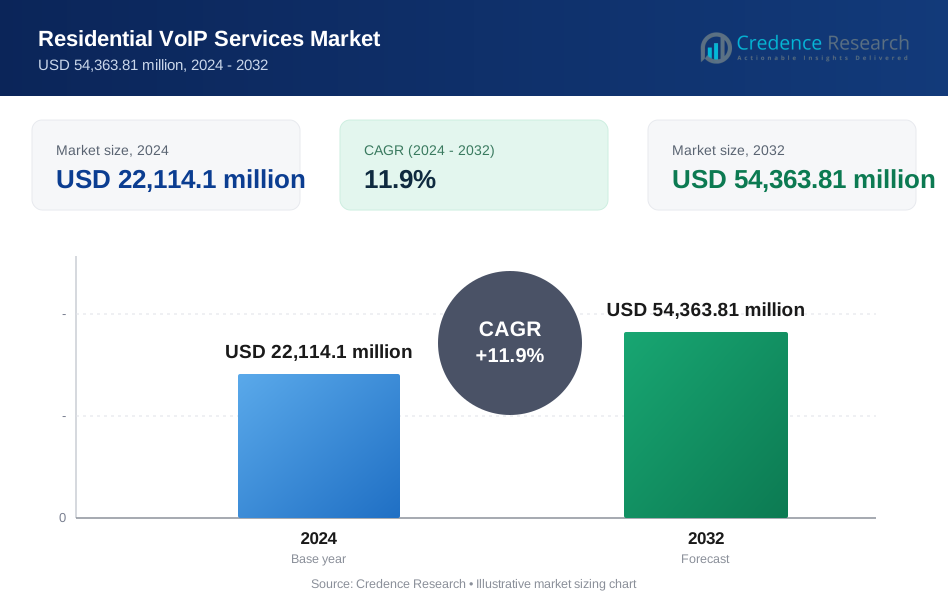
The Residential VoIP Services Market is expected to grow from USD 22,114.1 million in 2024 to USD 54,363.81 million by 2032, reflecting a compound annual growth rate (CAGR) of 11.9%.
The Residential VoIP Services Market is driven by increasing demand for cost-effective communication solutions and the growing adoption of internet-based services. As consumers seek affordable alternatives to traditional landline phones, VoIP offers significant savings and enhanced features like video calls, voicemail-to-email, and call forwarding. The proliferation of high-speed internet and the rise in remote work and digital connectivity also contribute to market growth. Moreover, the shift toward smart homes, integrated devices, and the Internet of Things (IoT) creates new opportunities for residential VoIP services, providing seamless integration with other home automation systems. As technology continues to advance, innovations in VoIP platforms, such as improved security features and enhanced voice quality, further fuel market demand. Additionally, the global trend towards digital transformation and the increased need for flexible communication solutions are key factors shaping the future trajectory of the Residential VoIP Services Market.
The Residential VoIP Services Market is experiencing growth across various regions, with North America holding the largest share at 35% in 2024, driven by advanced infrastructure and high adoption rates. Europe follows with a 28% share, led by countries like Germany, the UK, and France, where strong broadband infrastructure supports demand. The Asia Pacific region is poised for rapid growth, capturing 18% of the market, as countries like China, India, and Japan expand broadband access and VoIP adoption. The Rest of the World (RoW) region, comprising Latin America, the Middle East, and Africa, is gradually increasing in market share, with an estimated 19% in 2024. Leading players such as Verizon Communications, Zoom, DialPad, Vonage, and Nextiva are strategically expanding their presence across these regions to capture the growing demand for residential VoIP services.
Market Insights:
- The Residential VoIP Services Market is projected to grow from USD 22,114.1 million in 2024 to USD 54,363.81 million by 2032, at a CAGR of 11.9%.
- Increasing demand for cost-effective communication solutions and the shift from traditional landlines to VoIP services are key drivers of market growth.
- The rise in high-speed internet availability and the growing trend of remote work contribute to the adoption of residential VoIP services.
- The integration of VoIP services with smart home technologies and IoT devices offers new opportunities for service providers.
- Advancements in VoIP technology, such as enhanced voice quality and security features, are fueling market demand.
- North America leads the market with a 35% share in 2024, followed by Europe at 28%, Asia Pacific at 18%, and RoW at 19%.
- Key players like Verizon, Zoom, DialPad, and Vonage are expanding their market presence across these regions to meet the growing demand for residential VoIP services.
Market Drivers:
Cost-Effectiveness and Affordability:
One of the primary drivers of the Residential VoIP Services Market is the growing demand for cost-effective communication solutions. Traditional landline services can be expensive, particularly for long-distance calls. VoIP technology offers a more affordable alternative, providing users with low-cost or even free calling options, especially for international communication. The ability to replace conventional telephone services with VoIP systems leads to significant cost savings, making it a highly attractive option for residential users. For instance, Vonage offers VoIP plans that significantly reduce long-distance calling costs. With lower operating costs and minimal infrastructure requirements, VoIP service providers can pass on the savings to consumers, further accelerating market growth.
Increasing Internet Penetration and Speed:
As global internet penetration continues to rise and internet speeds improve, VoIP services are becoming increasingly viable for residential use. Faster and more reliable internet connections enable higher quality voice communication, making VoIP services more appealing to consumers. The widespread availability of broadband and fiber-optic internet has expanded the potential customer base for residential VoIP services, making it more accessible to users in both urban and rural areas. For instance, Comcast's Xfinity offers high-speed internet plans that support seamless VoIP communication. This growing internet accessibility is expected to fuel the continued adoption of VoIP technology, as it supports seamless, high-quality communication.
Advancements in VoIP Technology and Features:
Ongoing technological advancements in VoIP services play a crucial role in driving market growth. Modern VoIP systems now offer a wide array of additional features, such as video calling, call forwarding, voicemail-to-email, and smart home integrations. These enhanced capabilities not only improve the user experience but also differentiate VoIP services from traditional telephone systems. For example, Ooma Telo provides advanced features like smart home integration and voicemail-to-email transcription. As VoIP technology continues to evolve, users gain access to increasingly sophisticated and reliable communication solutions, further boosting demand in the residential market.
Growing Adoption of Remote Work and Digital Connectivity:
The rise in remote work, fueled by the global shift toward digital connectivity, has also contributed to the expansion of the Residential VoIP Services Market. With more individuals working from home, the need for efficient, flexible communication tools has increased. VoIP services, which allow for seamless communication across multiple devices, are ideal for supporting remote work environments. The ability to make and receive calls through internet-enabled devices-such as smartphones, laptops, and home assistants-has made VoIP an essential component of digital communication, especially in residential settings. For example, RingCentral offers VoIP solutions that support remote work by enabling seamless communication across various devices.
Market Trends:
Integration with Smart Home Devices:
A significant trend in the Residential VoIP Services Market is the integration of VoIP systems with smart home devices. As consumers increasingly adopt smart home technology, there is a growing demand for seamless communication between VoIP services and devices such as smart speakers, security systems, and home assistants. This integration allows users to make calls, receive messages, and control other aspects of their home environment through a single interface. Amazon Alexa can be integrated with VoIP services to enable voice-controlled calling. The convenience and efficiency of integrating VoIP services with home automation systems are driving consumer adoption and enhancing the overall user experience.
Cloud-Based VoIP Solutions:
Cloud-based VoIP services are rapidly gaining traction in the residential market due to their scalability, flexibility, and ease of deployment. Cloud platforms eliminate the need for complex infrastructure and allow users to access their VoIP services from virtually any device with an internet connection. This trend aligns with the broader digital transformation and the growing preference for cloud-based solutions in various sectors. For example, RingCentral offers cloud-based VoIP services that provide enhanced mobility, real-time updates, and seamless communication across multiple devices, making them a popular choice among residential customers.
Enhanced Security Features
With the increasing reliance on internet-based communication, security has become a key trend in the Residential VoIP Services Market. Providers are focusing on implementing advanced encryption techniques and other security protocols to protect users from potential cyber threats. This includes secure voice encryption, two-factor authentication, and secure access protocols. For instance, Ooma offers VoIP services with robust security features such as secure voice encryption and two-factor authentication. As consumer concerns regarding data privacy and online security continue to grow, VoIP service providers are responding by offering more robust security features to ensure safe and reliable communication.
Focus on User Experience and Customization:
Another notable trend is the growing emphasis on user experience and customization. VoIP service providers are focusing on creating more intuitive, user-friendly interfaces that make it easy for customers to manage their communication settings. Additionally, many providers are offering personalized options, such as call forwarding, voicemail management, and customizable ringtones. Vonage provides customizable ringtones and call forwarding options to enhance user experience. This focus on customization allows users to tailor their VoIP services to meet their specific needs, further enhancing satisfaction and loyalty within the residential market.
Market Challenges Analysis:
Network Dependency and Quality Concerns:
One of the primary challenges facing the Residential VoIP Services Market is its reliance on internet connectivity, which directly impacts the quality and reliability of communication. VoIP services are highly dependent on stable, high-speed internet connections, and any interruptions, latency, or bandwidth limitations can significantly degrade the voice quality and overall user experience. This dependency on internet infrastructure presents challenges in regions with poor or inconsistent broadband access, limiting the market’s potential in certain areas. Additionally, households with multiple connected devices may experience reduced performance if the available bandwidth is insufficient. For example, Plivo provides Call Insights, which allow service providers to track call quality metrics such as jitter, packet loss, and mean opinion scores (MOS), helping to identify and resolve issues related to network instability. For service providers, ensuring that their VoIP systems perform optimally across a wide range of internet conditions remains an ongoing challenge. This becomes particularly important in the face of rising demand for high-quality video calls, which place even greater strain on bandwidth and network resources.
Security and Privacy Risks:
As residential VoIP services rely on the internet, security and privacy risks remain a significant concern. VoIP systems are susceptible to cyber threats such as hacking, identity theft, and eavesdropping, especially in the absence of robust security measures. The potential for unauthorized access to personal and sensitive information through VoIP services can create significant privacy concerns for users. Additionally, because VoIP calls are transmitted over the internet rather than traditional phone lines, they are more vulnerable to cyberattacks such as denial-of-service (DoS) attacks or fraud. As a result, service providers must continuously enhance their security infrastructure to protect their customers and ensure trust in the service. The evolving nature of cyber threats means that providers need to stay ahead of potential risks and constantly update their security protocols to maintain consumer confidence and ensure compliance with data protection regulations. Failure to do so could lead to a loss of customer trust and market share.
Market Opportunities:
The Residential VoIP Services Market presents significant opportunities driven by the continued growth of internet infrastructure worldwide. As more households gain access to high-speed broadband, the market for VoIP services is expanding, particularly in regions that were previously underserved. This growth is fueled by the increasing adoption of internet-based communication platforms, offering consumers cost-effective and feature-rich alternatives to traditional phone lines. VoIP services can be further optimized by leveraging advancements in fiber-optic technology and 5G networks, which offer faster speeds and enhanced reliability. These improvements in connectivity create new possibilities for delivering high-quality voice, video, and integrated communication services, thus boosting the demand for VoIP systems in residential markets.
Additionally, the integration of VoIP services with other emerging technologies presents new growth opportunities. The rising popularity of smart homes and IoT devices has opened avenues for VoIP services to be embedded into home automation systems, allowing consumers to manage communication alongside other household functions. VoIP providers can tap into this trend by offering customized solutions that integrate voice services with security systems, voice-activated assistants, and entertainment platforms. This trend not only improves the user experience but also positions VoIP services as a key enabler of a connected and efficient home. Furthermore, as remote work continues to grow in popularity, residential VoIP solutions that facilitate communication across multiple devices and provide greater mobility are poised to capture an expanding consumer base seeking flexible and reliable solutions.
Market Segmentation Analysis:
By Pricing Models:
The Residential VoIP Services Market is segmented by pricing models, offering consumers various options such as subscription-based, pay-per-use, and freemium models. Subscription-based pricing remains the most popular due to its predictable monthly fees and added value through bundled services. Pay-per-use models cater to those seeking occasional use, while freemium offerings attract users with basic features and the option to upgrade.
By Target Audience:
Target audience segmentation includes residential consumers, small households, and larger family units. Residential users seeking affordable, reliable communication often prefer basic VoIP services, while larger households may require more advanced features, such as multiple lines or integration with home automation systems. Market providers tailor their services to meet the unique needs of these diverse groups.
By Service Features:
Residential VoIP services are segmented by the range of features offered, such as video calling, voicemail-to-email, call forwarding, and mobile apps for remote connectivity. Premium service packages tend to include enhanced features like high-definition voice quality, call blocking, and security options, catering to customers seeking more comprehensive and flexible communication solutions.
Segments:
Based on Pricing Models
- Subscription Based
- Pay As You Go
- Freemium Services
- volume Discounts
Based on Service Features
- Basic Voice Calling
- Video Calling
- Voicemail Services
- Advanced Call Management (Call Waiting, Call Forwarding, etc.)
- Integration with Other Communication Tools
Based on Target Customers
- Residential Consumers
- Small Households
- Larger Families
- Remote Workers
Based on the Geography:
- North America
- U.S.
- Canada
- Mexico
- Europe
- Germany
- France
- U.K.
- Italy
- Spain
- Rest of Europe
- Asia Pacific
- China
- Japan
- India
- South Korea
- South-east Asia
- Rest of Asia Pacific
- Latin America
- Brazil
- Argentina
- Rest of Latin America
- Middle East & Africa
- GCC Countries
- South Africa
- Rest of the Middle East and Africa
Regional Analysis:
North America
North America holds a significant share of the Residential VoIP Services Market, with an estimated market share of 35% in 2024. The region’s dominance is driven by advanced internet infrastructure, widespread adoption of high-speed broadband, and a mature telecommunications market. Residential consumers in North America are increasingly shifting towards VoIP services due to their cost-effectiveness and the integration of additional features like video calling, voicemail-to-email, and mobile app compatibility. The U.S. and Canada are key contributors, with a high rate of internet penetration and demand for flexible communication solutions. The presence of major VoIP service providers, along with the growing trend of remote work, further strengthens North America's market position. Additionally, increasing adoption of smart homes and IoT devices in the region supports the integration of VoIP services into home automation systems, creating further growth opportunities.
Europe:
Europe is expected to capture a market share of 28% in 2024, with strong growth prospects driven by technological advancements and the increasing reliance on internet-based communication. The region benefits from well-established broadband infrastructure, particularly in Western and Northern Europe, allowing seamless VoIP services to residential consumers. Countries like Germany, the UK, and France lead the market, as they have a high rate of VoIP adoption and strong consumer demand for both basic and premium services. The growing trend of digitalization and remote work across Europe further drives the demand for VoIP solutions. Additionally, the European market is witnessing rising interest in integrating VoIP with smart home devices, pushing service providers to offer more customizable and flexible solutions.
Asia Pacific
Asia Pacific is expected to experience rapid growth in the Residential VoIP Services Market, with a market share of 18% in 2024. The region's growth is fueled by the expansion of broadband infrastructure and increasing internet penetration, particularly in countries such as China, India, and Japan. In emerging markets, cost-effective VoIP services are becoming an attractive alternative to traditional landlines, driving adoption among price-sensitive consumers. The increasing adoption of smartphones and the digitalization of households are key factors propelling market growth. Furthermore, the rising trend of smart homes and IoT integration presents significant opportunities for VoIP service providers to cater to a more tech-savvy consumer base in Asia Pacific.
Rest of the World:
The Rest of the World (RoW) region, which includes Latin America, the Middle East, and Africa, is anticipated to capture a smaller portion of the market, with an estimated share of 19% in 2024. In Latin America, cost-conscious consumers are increasingly turning to VoIP services as a viable alternative to traditional phone lines. The Middle East and Africa are seeing gradual adoption, driven by improvements in internet connectivity and the increasing penetration of broadband services. However, the lack of widespread high-speed internet in certain parts of these regions presents challenges for broader market expansion. Nonetheless, as internet infrastructure improves, the demand for VoIP services is expected to rise, particularly in urban areas.
Key Player Analysis:
- Aircall
- Open Phone
- Ooma
- Vonage
- CallHippo
- Zoom
- CallTower
- Nextiva
- Grasshopper (Citrix)
- DialPad
- Verizon Communications
Competitive Analysis:
The Residential VoIP Services Market is highly competitive, with leading players such as Verizon Communications, Zoom, DialPad, Vonage, Ooma, Nextiva, Aircall, CallTower, Grasshopper (Citrix), CallHippo, and Open Phone. These companies differentiate themselves through a variety of service offerings, including cloud-based solutions, mobile compatibility, and integration with smart home devices. Verizon and Vonage leverage their strong brand recognition and extensive infrastructure, while newer entrants like Open Phone and CallHippo focus on providing flexible, user-friendly solutions with competitive pricing. Open Phone offers affordable VoIP services with features tailored for small businesses and residential users. Zoom and DialPad are capitalizing on the remote work trend, offering robust communication tools that extend beyond voice services, including video conferencing and team collaboration features. Ooma and Nextiva cater to residential customers with comprehensive packages, while Aircall and CallTower emphasize enterprise-grade services, targeting businesses and high-volume communication needs. These companies continually innovate to enhance user experience and maintain competitive advantage in the market.
Recent Developments:
- In July 2023, Ericsson completed the acquisition of Vonage Holdings Corp., strengthening its position as a technology leader. This acquisition enables Ericsson to expand its mobile network business and enter the enterprise sector, offering a full spectrum of communications solutions, including Communications Platform as a Service.
- In January 2023, Mega Corp Logistics collaborated with RingCentral, Inc. to utilize RingCentral's cloud communications capabilities, improving employee-customer communications across the company.
- In October 2023, Vodafone Idea revealed plans to increase its investment in India’s 5G infrastructure, contributing to the nation's existing network of 350,000 setups.
- In July 2024, Nokia partnered with Norlys, Denmark's largest integrated energy and telecommunications operator, to enhance its mobile core network and managed services, improving the performance and reliability of Norlys' 4G and 5G networks.
Market Concentration & Characteristics:
The Residential VoIP Services Market is moderately concentrated, with several key players dominating the industry while also leaving room for smaller, innovative companies. Large, established firms such as Verizon, Vonage, and Zoom hold significant market shares, benefiting from their extensive infrastructure, brand recognition, and broad customer base. These companies offer comprehensive service packages that include additional features like video calls, voicemail-to-email, and integration with mobile apps, which enhance their competitive edge. At the same time, newer players like Open Phone and CallHippo are gaining traction by providing flexible, cost-effective solutions tailored to specific consumer needs. The market is characterized by fierce competition, with companies constantly innovating to deliver superior voice quality, reliability, and advanced features to attract residential users. The increasing shift toward smart homes, the adoption of IoT, and the rise of remote work continue to shape the competitive landscape and drive growth within the sector.
Report Coverage:
The research report offers an in-depth analysis based on Pricing Model, Service Features, Target Customer and Geography. It details leading market players, providing an overview of their business, product offerings, investments, revenue streams, and key applications. Additionally, the report includes insights into the competitive environment, SWOT analysis, current market trends, as well as the primary drivers and constraints. Furthermore, it discusses various factors that have driven market expansion in recent years. The report also explores market dynamics, regulatory scenarios, and technological advancements that are shaping the industry. It assesses the impact of external factors and global economic changes on market growth. Lastly, it provides strategic recommendations for new entrants and established companies to navigate the complexities of the market.
Future Outlook:
- The Residential VoIP Services Market is expected to continue its strong growth trajectory, driven by increasing demand for cost-effective communication solutions.
- Advancements in broadband infrastructure and the rise of high-speed internet will enable wider VoIP adoption, especially in emerging markets.
- The integration of VoIP services with smart home devices and IoT platforms will present new growth opportunities for service providers.
- VoIP services will increasingly include advanced features like video calling, call forwarding, voicemail-to-email, and integration with home automation systems.
- Growing trends in remote work and digital communication will fuel demand for residential VoIP services across various regions.
- As the internet becomes more accessible, consumers in rural and underserved areas will become a key target market for VoIP providers.
- The need for enhanced security features and privacy measures will drive innovation in VoIP technology to protect users from cyber threats.
- The expansion of 5G networks will further enhance the quality and reliability of VoIP services, offering improved user experiences.
- The market will see a rise in subscription-based pricing models, as consumers prefer predictable, cost-efficient solutions for residential communication.
- Increased competition from both established and new players will lead to further service diversification and improved customer satisfaction in the VoIP market.
Request a Free Sample
Fill in your details and we'll send you a free sample report.
- Sample data tables & charts
- Research methodology
Market Dynamics
Cost-Effectiveness and Affordability
VoIP services offer significant cost savings over traditional landline telephony, especially for long-distance and international calls, making them highly attractive to residential users seeking affordable communication solutions.
Increasing Internet Penetration and Speed
The expansion of high-speed broadband and fiber-optic networks enables more households to access reliable VoIP services, supporting high-quality voice and video communication and expanding the addressable market.
Advancements in VoIP Technology and Features
Continuous innovation in VoIP platforms, such as enhanced voice quality, video calling, voicemail-to-email, and integration with smart home devices, increases the value proposition for residential customers and drives adoption.
Growth of Remote Work and Digital Connectivity
The rise in remote work and the need for flexible, device-agnostic communication tools have accelerated the shift from traditional phones to VoIP, as users require seamless connectivity across multiple devices at home.
Integration with Smart Home and IoT Devices
The growing adoption of smart home technologies and IoT devices creates new opportunities for VoIP services to be embedded into home automation systems, enhancing convenience and driving further market growth.
Need a Custom Version of This Report?
Tailor the scope, geography, or segments to your exact requirements.
- Custom geography or segment scope
- Direct access to our analyst team
Frequently Asked Questions
What is the current size of the Residential VoIP Services Market?
What factors are driving the growth of the Residential VoIP Services Market?
What are the key segments within the Residential VoIP Services Market?
What are some challenges faced by the Residential VoIP Services Market?
Who are the major players in the Residential VoIP Services Market?
Table of Content
Chapter 1 Market Segmentation
- 1.1 Segmentation Framework
- 1.1.1 Product and Service Classification
- 1.1.2 Application and End-Use Classification
- 1.1.3 Technology and Solution Classification
- 1.1.4 Customer and Distribution Channel Classification
- 1.1.5 Geographic Segmentation
- 1.1.6 Market Segment Definitions and Boundaries
- 1.2 By Pricing Model
- 1.2.1 Subscription Based
- 1.2.2 Pay As You Go
- 1.2.3 Freemium Services
- 1.2.4 Volume Discounts
- 1.3 By Service Features
- 1.3.1 Basic Voice Calling
- 1.3.2 Video Calling
- 1.3.3 Voicemail Services
- 1.3.4 Advanced Call Management
- 1.3.5 Integration with Other Communication Tools
- 1.4 By Target Customers
- 1.4.1 Residential Consumers
- 1.4.2 Small Households
- 1.4.3 Larger Families
- 1.4.4 Remote Workers
Chapter 2 Introduction
- 2.1 Report Objectives and Scope
- 2.2 Product Definition and Industry Terminology
- 2.3 Market Inclusions and Exclusions
- 2.4 Research Process
- 2.4.1 Primary Research and Expert Interviews
- 2.4.2 Secondary Research and Source Review
- 2.4.3 Top-Down and Bottom-Up Estimation
- 2.4.4 Data Triangulation and Verification
- 2.5 Market Size Measurement Basis
- 2.5.1 2024: USD 22,114.1 million → 2032: USD 54,363.81 million
- 2.6 Historical and Forecast Reference Periods
- 2.6.1 Base Year: 2024
- 2.6.2 Forecast Period: 2024-2032
- 2.7 Research Assumptions and Limitations
Chapter 3 Executive Summary
- 3.1 Market Snapshot and Key Findings
- 3.2 Base-Year Market Size, 2024
- 3.3 Forecast Market Size, 2032
- 3.4 Revenue and Volume Growth Outlook
- 3.5 Key Demand and Supply Indicators
- 3.6 Leading Market Segments
- 3.7 Fastest-Growing Market Opportunities
- 3.8 Regional Performance Highlights
- 3.9 Technology and Industry Transformation
- 3.10 Competitive Landscape Summary
- 3.11 Analyst View and Strategic Implications
Chapter 4 Global Residential VoIP Services Market Trends and Developments
- 4.1 Historical Industry Development
- 4.2 Recent Market Trends and Developments
- 4.3 Demand and Customer Behavior Trends
- 4.4 Technology and Product Innovation
- 4.5 Artificial Intelligence, Automation and Digitalization
- 4.6 Local Manufacturing and Supply Chain Realignment
- 4.7 Industry Partnerships, Mergers and Acquisitions
- 4.8 Sustainability and Circular Economy Developments
- 4.9 Government and Private Sector Investment Trends
- 4.10 Emerging Business Models and Commercialization
- 4.11 Industry Developments and Announcements
Chapter 5 Global Residential VoIP Services Market Supply and Demand Analysis
- 5.1 Demand Trend and Consumption Analysis
- 5.2 Demand Forecast, 2024-2032
- 5.3 Supply Chain Structure and Procurement Trends
- 5.4 Supply-Demand Gap and Bottlenecks
- 5.5 Import Dependence and Sourcing Structure
- 5.6 Regional Supply and Demand Concentration
Chapter 6 Global Residential VoIP Services Market Pricing Analysis
- 6.1 Pricing Structure and Measurement
- 6.2 Historical Pricing Trends
- 6.3 Pricing Outlook, 2024-2032
- 6.4 Pricing by Product and Market Segment
- 6.5 Geographic Pricing Differences
- 6.6 Key Input, Energy, Labor and Logistics Costs
- 6.7 Contract Pricing and Purchasing Models
- 6.8 Pricing Sensitivity and Competitive Positioning
- 6.9 Price, Margin and Profitability Implications
Chapter 7 Global Residential VoIP Services Market Dynamics
- 7.1 Market Growth Drivers
- 7.1.1 Demand-Side Drivers
- 7.1.2 Technology and Innovation Drivers
- 7.1.3 Infrastructure and Investment Drivers
- 7.1.4 Regulatory and Policy Drivers
- 7.2 Market Restraints
- 7.2.1 Cost and Affordability Constraints
- 7.2.2 Technology and Adoption Barriers
- 7.2.3 Supply Chain and Operational Constraints
- 7.3 Market Challenges
- 7.3.1 Competitive Pressure and Margin Erosion
- 7.3.2 Skills, Infrastructure and Implementation Gaps
- 7.4 Emerging Market Opportunities
- 7.5 Market Dynamics Impact and Time-Horizon Assessment
Chapter 8 Global Residential VoIP Services Value Chain Analysis
- 8.1 Industry Value Chain Overview
- 8.2 Upstream Suppliers and Critical Inputs
- 8.3 Technology and Component Providers
- 8.4 Manufacturing or Service Delivery
- 8.5 Distribution, Channel Partners and Integrators
- 8.6 Downstream Applications and End Users
- 8.7 Value Addition and Profit Pools
- 8.8 Vertical Integration and Outsourcing
- 8.9 Supplier Concentration and Risk
- 8.10 Supply Chain Localization and Resilience
Chapter 9 Global Residential VoIP Services Market Regulations and Policies
- 9.1 Relevant Laws, Standards and Compliance Frameworks
- 9.2 Product, Service, Safety and Quality Requirements
- 9.3 Government Policies, Incentives and Subsidies
- 9.4 Imports, Exports and Trade Barriers
- 9.5 Public Procurement and Local Content Requirements
- 9.6 Data Protection, AI and Cybersecurity Compliance
- 9.7 Upcoming Policy Changes and Market Implications
Chapter 10 Global Residential VoIP Services Market Hotspots and Opportunities
- 10.1 Market Opportunity Mapping and Growth Hotspots
- 10.2 High-Growth Applications and Customer Groups
- 10.3 Underserved Markets and White-Space Opportunities
- 10.4 Emerging Technology and Product Opportunities
- 10.5 New Capacity and Investment Hotspots
- 10.6 Market Entry and Expansion Opportunities
- 10.7 Distribution and Partnership Opportunities
- 10.8 Near-Term and Long-Term Commercial Potential
- 10.9 Opportunity Attractiveness and Execution Risks
Chapter 11 Global Residential VoIP Services Market Outlook, 2024-2032
- 11.1 Market Size and Analysis
- 11.1.1 Revenue (Market Measurement: 2024: USD 22,114.1 million → 2032: USD 54,363.81 million)
- 11.1.2 Historical Market Size
- 11.1.3 Base-Year Market Size, 2024
- 11.2 Market Forecast, 2024-2032
- 11.2.1 Revenue Forecast to 2032
- 11.2.2 CAGR and Year-on-Year Growth
- 11.2.3 Incremental Revenue Opportunity
- 11.3 Forecast Assumptions and Scenario Analysis
- 11.3.1 Base-Case Forecast
- 11.3.2 Optimistic and Conservative Scenarios
- 11.3.3 Technology, Pricing and Policy Sensitivities
- 11.4 Market Attractiveness and Growth Outlook
Chapter 12 Global Residential VoIP Services Market Segmentation and Outlook
- 12.1 Segmentation Summary and Market Shares, 2024
- 12.2 Largest and Fastest-Growing Segments
- 12.3 By Pricing Model - Market Size and Forecast, 2024-2032
- 12.3.1 Segment Definition and Scope
- 12.3.2 Historical Market Size
- 12.3.3 Revenue Forecast, 2024-2032
- 12.3.4 Base-Year Market Share, 2024
- 12.3.5 Segment CAGR and Growth Drivers
- 12.3.6 Subsegment Market Size and Forecast
- 12.3.6.1 Subscription Based
- 12.3.6.2 Pay As You Go
- 12.3.6.3 Freemium Services
- 12.3.6.4 Volume Discounts
- 12.3.7 Subsegment Pricing and Adoption Trends
- 12.3.8 Leading Suppliers and Competition
- 12.3.9 Regional Demand and Opportunities
- 12.4 By Service Features - Market Size and Forecast, 2024-2032
- 12.4.1 Segment Definition and Scope
- 12.4.2 Historical Market Size
- 12.4.3 Revenue Forecast, 2024-2032
- 12.4.4 Base-Year Market Share, 2024
- 12.4.5 Segment CAGR and Growth Drivers
- 12.4.6 Subsegment Market Size and Forecast
- 12.4.6.1 Basic Voice Calling
- 12.4.6.2 Video Calling
- 12.4.6.3 Voicemail Services
- 12.4.6.4 Advanced Call Management
- 12.4.6.5 Integration with Other Communication Tools
- 12.4.7 Subsegment Pricing and Adoption Trends
- 12.4.8 Leading Suppliers and Competition
- 12.4.9 Regional Demand and Opportunities
- 12.5 By Target Customers - Market Size and Forecast, 2024-2032
- 12.5.1 Segment Definition and Scope
- 12.5.2 Historical Market Size
- 12.5.3 Revenue Forecast, 2024-2032
- 12.5.4 Base-Year Market Share, 2024
- 12.5.5 Segment CAGR and Growth Drivers
- 12.5.6 Subsegment Market Size and Forecast
- 12.5.6.1 Residential Consumers
- 12.5.6.2 Small Households
- 12.5.6.3 Larger Families
- 12.5.6.4 Remote Workers
- 12.5.7 Subsegment Pricing and Adoption Trends
- 12.5.8 Leading Suppliers and Competition
- 12.5.9 Regional Demand and Opportunities
- 12.6 Segment Growth Comparison
- 12.7 Segment Attractiveness and Priority Matrix
Chapter 13 Global Residential VoIP Services End-Use and Application Market Outlook
- 13.1 End-Use Industry and Customer Demand Structure
- 13.2 Leading Applications and Customer Groups
- 13.3 End-Use Market Size, Share and Forecast
- 13.4 Major End-Use Industry Deep Dives
- 13.4.1 Customer Requirements and Use Cases
- 13.4.2 Demand and Replacement Cycles
- 13.4.3 Technical and Regulatory Considerations
- 13.4.4 Purchasing and Procurement Models
- 13.4.5 Leading Vendors and Distribution Channels
- 13.4.6 Forecast and Commercial Opportunities
- 13.5 Emerging Applications and Cross-Segment Demand
- 13.6 End-Use Industry Investment Priorities
Chapter 14 Global Residential VoIP Services Geographic Market Outlook, 2024-2032
- 14.1 Regional Market Size and Share, 2024
- 14.2 Regional Market Forecast, 2024-2032
- 14.3 Regional Pricing, Production and Demand Differences
- 14.4 North America
- 14.4.1 United States
- 14.4.2 Canada
- 14.4.3 Mexico
- 14.5 Europe
- 14.5.1 Germany
- 14.5.2 France
- 14.5.3 Italy
- 14.5.4 United Kingdom
- 14.5.5 Spain
- 14.5.6 Poland
- 14.5.7 Russia
- 14.5.8 Netherlands
- 14.5.9 Belgium
- 14.5.10 Sweden
- 14.5.11 Denmark
- 14.5.12 Norway
- 14.5.13 Rest of Europe
- 14.6 Asia Pacific
- 14.6.1 China
- 14.6.2 India
- 14.6.3 Japan
- 14.6.4 South Korea
- 14.6.5 Thailand
- 14.6.6 Indonesia
- 14.6.7 Vietnam
- 14.6.8 Malaysia
- 14.6.9 Australia
- 14.6.10 Rest of Asia Pacific
- 14.7 Latin America
- 14.7.1 Brazil
- 14.7.2 Argentina
- 14.7.3 Colombia
- 14.7.4 Chile
- 14.7.5 Rest of Latin America
- 14.8 Middle East
- 14.8.1 Saudi Arabia
- 14.8.2 United Arab Emirates
- 14.8.3 Turkey
- 14.8.4 Israel
- 14.8.5 Iran
- 14.8.6 Rest of the Middle East
- 14.9 Africa
- 14.9.1 South Africa
- 14.9.2 Egypt
- 14.9.3 Nigeria
- 14.9.4 Morocco
- 14.9.5 Rest of Africa
- 14.10 Regional Investment, Policy and Supply Chain Differences
- 14.11 Regional Competitive Landscape
- 14.12 Geographic Growth Hotspots
Chapter 15 Global Residential VoIP Services Technology, Innovation and Sustainability Outlook
- 15.1 Technology Landscape and Maturity
- 15.2 Product, Process and Service Innovation
- 15.3 AI, Automation and Digital Tools in the Industry
- 15.4 Technology Adoption and Performance Benchmarking
- 15.5 Innovation Pipeline and R&D Investment
- 15.6 Energy Efficiency and Resource Management
- 15.7 Sustainability, Recycling and Circularity
- 15.8 Technology Roadmap, 2024-2032
- 15.9 Risks of Obsolescence and Technology Substitution
Chapter 16 Global Residential VoIP Services Market Key Strategic Imperatives
- 16.1 Growth and Market Entry Priorities
- 16.2 High-Return Products and Segments
- 16.3 Pricing, Profitability and Cost Optimization
- 16.4 Technology Investment and Product Differentiation
- 16.5 Supply Chain Localization and Resilience
- 16.6 Distribution and Customer Acquisition
- 16.7 Partnership, Acquisition and Capacity Strategy
- 16.8 Regional Expansion Priorities
- 16.9 Short-, Medium- and Long-Term Actions
Chapter 17 Competition Outlook
- 17.1 Industry Competition Characteristics
- 17.2 Market Structure and Concentration
- 17.3 Market Share and Competitive Positioning, 2024
- 17.4 Company-Wise Revenue and Product Benchmarking
- 17.5 Production and Service Capacity Benchmarking
- 17.6 Technology, Pricing and Differentiation
- 17.7 Regional Footprint and Distribution Strength
- 17.8 Mergers, Acquisitions and Strategic Alliances
- 17.9 New Entrants and Competitive Threats
- 17.10 Porter's Five Forces and Industry Attractiveness
- 17.11 Competitive Outlook, 2024-2032
Chapter 18 Company Profiles
- 18.1 Company Coverage and Selection Criteria
- 18.2 Verizon Communications
- 18.2.1 Business Description
- 18.2.2 Company Ownership and Geographic Presence
- 18.2.3 Product and Service Portfolio
- 18.2.4 Manufacturing and Operating Footprint
- 18.2.5 Financial Performance and Investment
- 18.2.6 Market Share and Competitive Position
- 18.2.7 Technology and Innovation Capabilities
- 18.2.8 Strategic Alliances or Partnerships
- 18.2.9 Recent Developments
- 18.2.10 Growth Strategy and Outlook
- 18.3 Zoom
- 18.4 DialPad
- 18.5 Vonage
- 18.6 Ooma
- 18.7 Nextiva
- 18.8 Aircall
- 18.9 CallTower
- 18.10 Grasshopper (Citrix)
- 18.11 CallHippo
- 18.12 Other Relevant Market Participants
Note: Every listed company is profiled on the structure shown under the first company. The company list is preliminary and may change based on research findings, market developments, data availability and client requirements.
Chapter 19 Disclaimer
- 19.1 Research and Forecast Disclaimer
- 19.2 Data Source and Estimation Limitations
Note: The depth of individual sections depends on data availability for this market. Volume, capacity, trade and other unit-based metrics are included where applicable.

