
| REPORT ATTRIBUTE | DETAILS |
|---|---|
| Historical Period | 2020-2023 |
| Base Year | 2024 |
| Forecast Period | 2025-2032 |
| Sensitive Toothpaste Market Size 2024 | USD 1702.12 million i |
| Sensitive Toothpaste Market, CAGR | 5.74% |
| Sensitive Toothpaste Market Size 2032 | USD 2812.4 million |
Market Overview:
The Sensitive Toothpaste Market is projected to grow from USD 1702.12 million in 2023 to an estimated USD 2812.4 million by 2032, with a compound annual growth rate (CAGR) of 5.74% from 2023 to 2032.
Multiple factors drive the expansion of the Sensitive Toothpaste Market. Increasing awareness of oral health, driven by dentist recommendations and digital health campaigns, has made consumers more proactive in addressing tooth sensitivity. Urban consumers, in particular, seek premium, specialist products that combine convenience with effectiveness. Innovation in active ingredients like potassium nitrate, strontium chloride, and arginine has enhanced efficacy, improving consumer satisfaction and retention. Rising concerns about the side effects of traditional fluoride-based toothpaste have also prompted a shift toward natural and clinically tested formulations. Additionally, the rise of vegan and cruelty-free product preferences is influencing new product development. Growing online reviews and influencer marketing are boosting consumer confidence in switching to sensitivity-specific oral care products.
Regionally, Asia Pacific leads the Sensitive Toothpaste Market in terms of growth rate, driven by rising disposable incomes and a shift toward preventive healthcare. Markets like China and India are seeing robust demand, supported by a young population base and increasing urbanization. The presence of both international and local brands in retail and e-commerce channels has intensified competition while improving product availability. North America continues to hold a substantial portion of the market due to strong consumer awareness, regular dental checkups, and high per capita spending on oral care. European countries follow closely, with growing emphasis on sustainable packaging and eco-conscious oral care contributing to brand differentiation. Localized marketing strategies and the availability of tailored products have helped companies penetrate niche markets across all regions.
Market Insights:
- The Sensitive Toothpaste Market is set to grow at a CAGR of 5.74% from 2023 to 2032, driven by heightened oral health awareness and increasing consumer demand for specialist products.
- Dentin hypersensitivity is becoming more prevalent, prompting widespread use of desensitizing toothpaste recommended by both dental professionals and over-the-counter platforms.
- Consumers are shifting toward preventive care, favoring toothpaste that combines sensitivity relief with whitening, enamel strengthening, or cavity protection.
- Ingredient innovation, particularly in potassium nitrate, strontium chloride, and arginine, is enhancing product performance and trust among consumers seeking clinically effective solutions.
- Online retail and digital marketing channels are reshaping purchasing behavior, with subscription models and influencer campaigns expanding reach and brand engagement.
- Market saturation and similar product claims have intensified competition, pushing companies to invest in differentiation through branding, certifications, and packaging.
- Asia Pacific leads in growth rate due to rising disposable incomes and urbanization, while North America and Europe maintain strong shares through product innovation and sustainable practices.
Report Scope
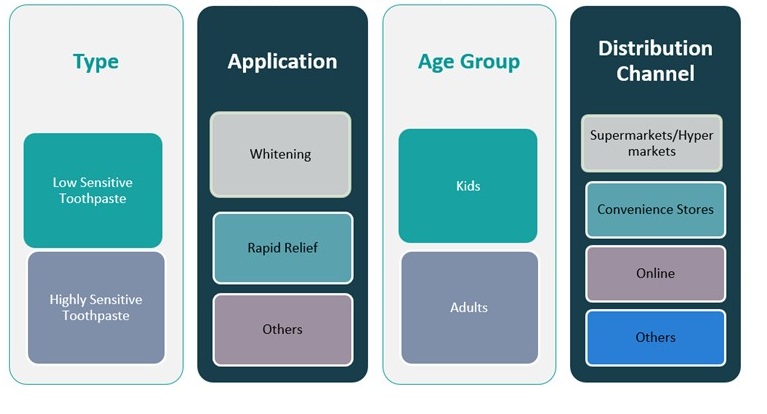
This report segments the Sensitive Toothpaste Market as follows:
Market Drivers:
Rising Prevalence of Dentin Hypersensitivity Accelerates Product Demand
The growing incidence of dentin hypersensitivity remains a primary driver of the Sensitive Toothpaste Market. Consumers across various age groups increasingly report sharp tooth pain triggered by hot, cold, or sweet stimuli. This condition often results from enamel erosion, gum recession, or aggressive brushing habits, creating long-term discomfort and the need for specialized care. It has prompted both dental professionals and over-the-counter retailers to recommend desensitizing toothpaste as a first line of defense. Awareness campaigns led by oral health organizations have strengthened recognition of tooth sensitivity as a treatable condition. It benefits from growing patient education efforts that emphasize the role of targeted oral care products in managing daily discomfort.
Consumer Shift Toward Preventive and Specialized Oral Care
The growing preference for preventive health practices directly influences demand for sensitivity-specific formulations. Consumers no longer rely solely on general-purpose toothpaste and seek targeted solutions for enamel protection and sensitivity relief. Rising health consciousness has led many to prioritize oral hygiene routines that prevent long-term dental conditions. The Sensitive Toothpaste Market aligns with this shift by offering products designed to strengthen tooth surfaces and block nerve pathways. It responds well to increasing demand for personalized oral care, especially among urban populations. Brands that offer dual-function products such as sensitivity relief combined with whitening or cavity protection-are witnessing stronger engagement and repeat purchases.
- For example, the "whitening" category within sensitive toothpaste has captured a substantial market share by offering dual benefits-addressing both tooth sensitivity and stain removal.
Product Innovation and Ingredient Advancements Boost Market Penetration
Ongoing research and development in dental care have introduced active ingredients that provide faster and longer-lasting relief. Companies are investing in advanced compounds such as potassium nitrate, stannous fluoride, and arginine, which reduce sensitivity by shielding nerve endings or blocking tubules in the dentin. These innovations have allowed manufacturers to launch differentiated products with clinically validated claims. The Sensitive Toothpaste Market benefits from this trend by attracting consumers who are increasingly skeptical of generic formulations. It also reflects growing interest in functional oral care that delivers measurable results. Consumer trust increases when products are backed by dental associations or carry visible certifications on packaging.
- For instance, Sensodyne has focused on rapid relief formulations and has leveraged digital tools like chatbots and Google Assistant to educate consumers about oral care.
E-Commerce Growth and Digital Influence Reshape Consumer Access
The expansion of online retail channels has significantly increased access to specialty toothpaste brands and variants. Consumers now rely on e-commerce platforms for both product information and convenient purchasing options. The Sensitive Toothpaste Market has adapted by enhancing its digital presence, offering subscription models, and promoting educational content on tooth sensitivity. Reviews, influencer endorsements, and targeted advertising influence buying decisions more than traditional in-store promotions. It benefits from the digital shift by reaching tech-savvy demographics who prioritize transparency and clinical effectiveness. Direct-to-consumer strategies have also helped smaller and emerging brands challenge legacy players in the sensitivity toothpaste segment.
Market Trends:
Growing Popularity of Natural and Clean-Label Formulations
The increasing demand for natural and clean-label oral care products is shaping the development of sensitive toothpaste. Consumers now scrutinize ingredients and prefer formulations free from artificial additives, parabens, and synthetic flavors. Brands are introducing sensitivity toothpaste lines enriched with plant-based compounds like aloe vera, chamomile, and green tea extracts. These formulations appeal to health-conscious buyers seeking gentle yet effective alternatives to conventional products. The Sensitive Toothpaste Market has responded with broader availability of eco-conscious and vegan-certified variants. It aligns with the consumer preference for transparency, sustainability, and ingredient traceability.
- For instance, Tom's of Maine launched a Sensitivity and Whitening Fluoride-Free Toothpaste in August 2023, which is formulated with naturally sourced ingredients and avoids artificial flavors, colors, and preservatives. This product uses an amino acid arginine and calcium carbonate complex to provide relief within 60 seconds and offers long-lasting protection with continuous use.
Rising Demand for Multi-Benefit Toothpaste Solutions
Consumers expect sensitive toothpaste to deliver more than just pain relief, leading to a surge in demand for multi-benefit products. Brands now combine desensitizing functions with whitening, tartar control, breath freshening, and enamel strengthening in a single formulation. This trend reflects a desire to simplify oral care routines without compromising on performance. The Sensitive Toothpaste Market is evolving to meet these preferences by developing all-in-one offerings that save time and enhance value. It encourages brand loyalty by addressing multiple concerns with fewer products. Premium and mid-range categories are witnessing higher conversion rates due to these advanced formulations.
- Sensodyne Extra Whitening Toothpaste, for example, is the #1 dentist-recommended brand for sensitive teeth and combines sensitivity relief with whitening, tartar build-up prevention, breath freshening, and cavity protection-all in an SLS-free formula.
Digital Health Trends and Personalization Influence Market Behavior
Digital tools and health apps are influencing how consumers approach oral hygiene and product selection. Tooth sensitivity diagnostics via smart toothbrushes, online consultations, and personalized recommendations are gaining traction. The Sensitive Toothpaste Market benefits from this integration of digital health and consumer behavior, allowing brands to tailor marketing efforts. It supports the development of subscription services and AI-powered product suggestions based on user feedback. The personalization trend enables better engagement and fosters trust through data-driven customization. Tech-savvy consumers expect consistent product performance validated through measurable outcomes.
Sustainable Packaging and Ethical Sourcing Gain Momentum
Environmental awareness is impacting purchasing decisions, especially among younger consumers. Brands that prioritize recyclable packaging, minimal plastic use, and ethically sourced ingredients are gaining competitive advantage. The Sensitive Toothpaste Market is incorporating these values into its production and branding strategies. It reflects the shift toward responsible consumption and long-term ecological impact. Companies are investing in biodegradable tubes, refillable containers, and carbon-neutral manufacturing processes. Sustainability-focused messaging is now an important component of brand identity and consumer retention.
Market Challenges Analysis:
High Competition and Brand Saturation Limit Differentiation
The Sensitive Toothpaste Market faces intense competition from both established oral care giants and emerging niche brands. A wide range of products with overlapping claims on sensitivity relief, whitening, and cavity protection creates brand saturation and consumer confusion. Companies struggle to differentiate offerings in a market where ingredient lists and benefits often appear similar. This saturation pressures pricing and limits the ability to command premiums, especially in price-sensitive regions. It forces brands to invest heavily in marketing, packaging, and endorsements to capture and retain consumer attention. The challenge of standing out in a crowded shelf environment affects both market entry and long-term scalability for newer players.
- For example, GlaxoSmithKline (GSK) and its Sensodyne brand illustrate the challenges of a crowded sensitive toothpaste market. In 2023, GSK reported that Sensodyne's global sales grew by 8%, a result driven by aggressive marketing and ongoing product innovation.
Consumer Skepticism and Limited Awareness in Emerging Economies
Despite rising oral health awareness, a significant portion of the global population remains unaware of effective treatments for tooth sensitivity. In many developing regions, consumers continue using regular toothpaste, either due to price constraints or lack of product education. The Sensitive Toothpaste Market encounters barriers where cultural attitudes, misinformation, or limited dental consultations prevent trial adoption. It also struggles with consumer skepticism regarding efficacy, especially when results are not immediate or clinically explained. Poor understanding of ingredients and benefits hampers trust and leads to low brand loyalty. Limited shelf presence in rural retail outlets and inadequate promotion further restrict product visibility and uptake.
Market Opportunities:
Large sections of rural populations in Asia, Africa, and Latin America remain underserved by specialty oral care products. These regions present untapped opportunities for expanding the Sensitive Toothpaste Market through affordable pricing, education, and improved distribution. Rising incomes and growing mobile access in these areas make digital awareness campaigns more feasible. It can benefit by partnering with local health authorities, dental associations, and retailers to build trust and visibility. First-mover advantage in these underserved markets could lead to long-term customer loyalty and high-volume sales. Customized formulations that address local dietary habits and preferences will further support regional adoption.
There is a strong opportunity to diversify offerings through advanced formulations, premium ingredients, and targeted solutions. The Sensitive Toothpaste Market can attract high-income consumers by introducing products with unique features such as enzymatic cleaning, herbal infusions, and probiotic blends. It can also grow by tapping into niche segments such as pediatric, senior, and post-dental procedure care. Brands that invest in R&D and communicate clear scientific backing can command higher margins and retain informed buyers. Expanding into adjacent oral care categories like mouth rinses and gels for sensitivity will strengthen brand ecosystems. Cross-category innovations and wellness-oriented branding will enhance long-term market value.
Market Segmentation Analysis:
The Sensitive Toothpaste Market features diverse segments catering to varying consumer needs and usage patterns.
By type, the market includes Low Sensitive Toothpaste, preferred by consumers with mild sensitivity, and Highly Sensitive Toothpaste, targeted at individuals with acute discomfort. The latter segment is growing faster due to increasing awareness and clinical validation.
By application, whitening dominates as consumers seek multi-functional products that address both sensitivity and aesthetic needs. Rapid Relief appeals to users requiring immediate symptom control, while the Others segment includes formulations for cavity protection or enamel repair.
By age group, Adults represent the dominant share due to greater sensitivity issues from aging, dental treatments, and lifestyle factors. Kids’ sensitive toothpaste is emerging, driven by parental concern for gentle and safe oral care.
By distribution channel. Supermarket/Hypermarkets lead with broad accessibility and competitive pricing, while Pharmacies benefit from professional trust and product recommendation. Online sales channels continue to grow rapidly due to convenience, product variety, and targeted promotions. Independent Retail Stores maintain relevance in localized markets with personalized service.
Segmentation:
By Type
- Low Sensitive Toothpaste
- Highly Sensitive Toothpaste
By Application
- Whitening
- Rapid Relief
- Others
By Age Group
- Kids
- Adults
By Distribution Channel
- Supermarket/Hypermarkets
- Independent Retail Stores
- Pharmacy
- Online Sales Channel
Regional Analysis:
North America Holds the Leading Position with Established Consumer Base North America accounts for 34% of the global Sensitive Toothpaste Market, supported by strong consumer awareness and a well-developed oral care infrastructure. High dental care costs encourage preventive health practices, driving demand for sensitivity-specific products. Consumers in the U.S. and Canada actively seek advanced formulations that combine pain relief with other benefits such as whitening and enamel protection. The presence of major market players, frequent dental consultations, and high per capita healthcare spending reinforce consistent product uptake. E-commerce platforms and pharmacy chains enhance accessibility and product visibility. It maintains its dominance through brand loyalty, innovation, and clinical endorsements that shape consumer trust.
Asia Pacific Emerges as the Fastest-Growing Regional Market Asia Pacific captures 28% of the Sensitive Toothpaste Market, driven by rapid urbanization, rising disposable incomes, and expanding awareness of oral health. China and India represent key growth centers, supported by large populations and an evolving preference for specialized personal care products. Retail penetration and e-commerce growth have significantly improved product accessibility across urban and semi-urban regions. International brands are investing in localized marketing and natural formulations to appeal to regional preferences. It benefits from increasing collaboration with dental professionals and product bundling strategies targeting first-time users. Growth in this region reflects both a shift in lifestyle and the influence of digital consumer engagement.
Europe Maintains a Stable Market Share through Premium Offerings Europe holds 22% of the Sensitive Toothpaste Market, sustained by mature consumer behavior, regulatory support, and a strong focus on premium, sustainable products. Countries such as Germany, the UK, and France drive demand through higher awareness of enamel erosion and dietary impact on dental sensitivity. European consumers prioritize ingredient safety, ethical sourcing, and eco-friendly packaging, influencing formulation trends. The market is also supported by frequent dental visits and pharmacy-based oral care consultations. It benefits from innovation in natural and fluoride-free variants that align with regulatory frameworks and consumer expectations. The region continues to serve as a benchmark for quality standards and clinical validation.
Key Player Analysis:
- Colgate-Palmolive Company
- Church and Dwight Co., Inc.
- GlaxoSmithKline plc
- Procter and Gamble
- Unilever
Competitive Analysis:
The Sensitive Toothpaste Market features intense competition with the presence of established global players and emerging niche brands. Key companies such as Colgate-Palmolive, GlaxoSmithKline (Sensodyne), Procter & Gamble (Oral-B), and Unilever (Signal) dominate shelf space through brand recognition, diversified portfolios, and strong retail distribution. These firms invest heavily in clinical research, product innovation, and advertising to maintain consumer trust and loyalty. It remains dynamic as new entrants and natural oral care brands challenge traditional formulas with herbal and clean-label alternatives. Private label offerings from pharmacy chains and supermarkets further increase pressure on pricing and differentiation. Companies focus on cross-category expansion, bundling with mouth rinses or dental kits to strengthen consumer retention. Competitive strategies include localized marketing, influencer partnerships, and digital commerce initiatives tailored to tech-savvy and health-conscious demographics.
Recent Developments:
- In May 2025, Church & Dwight Co., Inc. announced a definitive agreement to acquire the Touchland® brand for up to $880 million, including contingent payments based on 2025 net sales2. While Touchland is primarily known for hand sanitizers, the acquisition signals Church & Dwight’s continued expansion in the broader personal care category, which includes oral care brands like Arm & Hammer Sensitive Toothpaste. The deal is expected to close in the second quarter of 2025 and will strengthen Church & Dwight’s portfolio of leading consumer brands.
- In March 2024, Colgate-Palmolive launched its new Colgate Sensitive Pro-Relief Repair & Prevent toothpaste in the United States. This innovative product is designed to not only relieve sensitivity pain instantly but also to help repair and strengthen enamel over time. The launch is part of Colgate’s ongoing commitment to advancing oral health solutions for consumers with sensitive teeth, leveraging new Pro-Argin technology.
Market Concentration & Characteristics:
The Sensitive Toothpaste Market is moderately concentrated, with a few global players holding a significant share while regional and niche brands continue to expand their presence. It features a mix of mass-market and premium products that cater to varying consumer needs across income segments. Large multinational companies lead with strong distribution networks, clinical endorsements, and diversified product lines that include multi-benefit variants. The market reflects high brand loyalty, especially where consumers perceive proven relief from sensitivity symptoms. Product differentiation relies heavily on ingredients, packaging, and claims of efficacy. It continues to evolve with rising demand for natural, clean-label, and multifunctional toothpaste formulations that align with health and sustainability trends.
Report Coverage:
The research report offers an in-depth analysis based on Type, Application, Age Group and Distribution Channel. It details leading market players, providing an overview of their business, product offerings, investments, revenue streams, and key applications. Additionally, the report includes insights into the competitive environment, SWOT analysis, current market trends, as well as the primary drivers and constraints. Furthermore, it discusses various factors that have driven market expansion in recent years. The report also explores market dynamics, regulatory scenarios, and technological advancements that are shaping the industry. It assesses the impact of external factors and global economic changes on market growth. Lastly, it provides strategic recommendations for new entrants and established companies to navigate the complexities of the market.
Future Outlook:
- Consumer demand for personalized oral care solutions will drive the development of targeted sensitivity relief products.
- Natural and fluoride-free formulations are expected to gain wider adoption across health-conscious demographics.
- Premiumization will expand, with increased focus on multi-benefit toothpaste offering whitening, enamel repair, and breath freshness.
- Emerging markets in Asia and Latin America will see significant growth due to rising awareness and retail expansion.
- E-commerce and subscription models will streamline access and encourage brand loyalty among digital-first consumers.
- Innovation in desensitizing agents and faster-acting compounds will enhance product efficacy and differentiation.
- Collaborations with dental professionals will remain critical in building clinical credibility and consumer trust.
- Sustainable packaging and ethical sourcing will become essential for brand positioning and regulatory compliance.
- Cross-category bundling with mouth rinses and oral hygiene tools will expand product ecosystems.
- Increased competition from private labels and natural brands will push incumbents to refine pricing and innovation strategies.

Request a Free Sample
Fill in your details and we'll send you a free sample report.
- Sample data tables & charts
- Research methodology
Market Dynamics
Rising Prevalence of Dentin Hypersensitivity
Increasing cases of dentin hypersensitivity, often due to enamel erosion and gum recession, are prompting both dental professionals and consumers to seek specialized sensitive toothpaste for daily relief and prevention.
Consumer Shift Toward Preventive and Specialized Oral Care
Growing health consciousness and a focus on preventive dental care are driving consumers to choose toothpaste specifically formulated for sensitivity, often with added benefits like whitening or enamel strengthening.
Product Innovation and Ingredient Advancements
Ongoing R&D has led to the introduction of advanced ingredients such as potassium nitrate, stannous fluoride, and arginine, which provide faster and longer-lasting relief, enhancing consumer trust and market penetration.
E-Commerce Growth and Digital Influence
The expansion of online retail and digital marketing has made sensitive toothpaste more accessible, with influencer endorsements, subscription models, and targeted advertising accelerating consumer adoption, especially among tech-savvy demographics.
Demand for Natural and Clean-Label Formulations
Concerns about synthetic additives and a preference for natural, vegan, and eco-friendly products are driving brands to develop clean-label sensitive toothpaste, appealing to health-conscious and environmentally aware consumers.
Need a Custom Version of This Report?
Tailor the scope, geography, or segments to your exact requirements.
- Custom geography or segment scope
- Direct access to our analyst team
Frequently Asked Questions
What is the size Sensitive Toothpaste Market?
What factors are driving the growth of the market?
Which regions lead the market?
What are the key challenges faced by the market?
Who are the major players in the Sensitive Toothpaste Market?
Table of Content
Chapter 1 Market Segmentation
- 1.1 Segmentation Framework
- 1.1.1 Product and Service Classification
- 1.1.2 Application and End-Use Classification
- 1.1.3 Technology and Solution Classification
- 1.1.4 Customer and Distribution Channel Classification
- 1.1.5 Geographic Segmentation
- 1.1.6 Market Segment Definitions and Boundaries
- 1.2 By Type
- 1.2.1 Low Sensitive Toothpaste
- 1.2.2 Highly Sensitive Toothpaste
- 1.3 By Age Group
- 1.3.1 Kids
- 1.3.2 Adults
- 1.4 By Application
- 1.4.1 Whitening
- 1.4.2 Rapid Relief
- 1.4.3 Others
Chapter 2 Introduction
- 2.1 Report Objectives and Scope
- 2.2 Product Definition and Industry Terminology
- 2.3 Market Inclusions and Exclusions
- 2.4 Research Process
- 2.4.1 Primary Research and Expert Interviews
- 2.4.2 Secondary Research and Source Review
- 2.4.3 Top-Down and Bottom-Up Estimation
- 2.4.4 Data Triangulation and Verification
- 2.5 Market Size Measurement Basis
- 2.5.1 2024: USD 1702.12 million → 2032: USD 2812.4 million
- 2.6 Historical and Forecast Reference Periods
- 2.6.1 Base Year: 2024
- 2.6.2 Forecast Period: 2024-2032
- 2.7 Research Assumptions and Limitations
Chapter 3 Executive Summary
- 3.1 Market Snapshot and Key Findings
- 3.2 Base-Year Market Size, 2024
- 3.3 Forecast Market Size, 2032
- 3.4 Revenue and Volume Growth Outlook
- 3.5 Key Demand and Supply Indicators
- 3.6 Leading Market Segments
- 3.7 Fastest-Growing Market Opportunities
- 3.8 Regional Performance Highlights
- 3.9 Technology and Industry Transformation
- 3.10 Competitive Landscape Summary
- 3.11 Analyst View and Strategic Implications
Chapter 4 Global Sensitive Toothpaste Market Trends and Developments
- 4.1 Historical Industry Development
- 4.2 Recent Market Trends and Developments
- 4.3 Demand and Customer Behavior Trends
- 4.4 Technology and Product Innovation
- 4.5 Artificial Intelligence, Automation and Digitalization
- 4.6 Local Manufacturing and Supply Chain Realignment
- 4.7 Industry Partnerships, Mergers and Acquisitions
- 4.8 Sustainability and Circular Economy Developments
- 4.9 Government and Private Sector Investment Trends
- 4.10 Emerging Business Models and Commercialization
- 4.11 Industry Developments and Announcements
Chapter 5 Global Sensitive Toothpaste Market Production, Supply and Demand Analysis
- 5.1 Demand Trend and Consumption Analysis
- 5.2 Demand Forecast, 2024-2032
- 5.3 Production and Output Trend
- 5.4 Production and Output Forecast, 2024-2032
- 5.5 Installed Capacity and Capacity Utilization
- 5.6 Company-Wise Production Plants and Statistics
- 5.6.1 Installed Production Capacity
- 5.6.2 Actual Production
- 5.6.3 Planned Capacity and Expansion Targets
- 5.7 Supply Chain Structure and Procurement Trends
- 5.8 Supply-Demand Gap and Bottlenecks
- 5.9 Import Dependence and Sourcing Structure
- 5.10 Contract Manufacturing and Outsourcing
- 5.11 Regional Supply and Demand Concentration
Chapter 6 Global Sensitive Toothpaste Market Pricing Analysis
- 6.1 Pricing Structure and Measurement
- 6.2 Historical Pricing Trends
- 6.3 Pricing Outlook, 2024-2032
- 6.4 Average Selling Price and Unit Economics
- 6.5 Pricing by Product and Market Segment
- 6.6 Geographic Pricing Differences
- 6.7 Key Input, Energy, Labor and Logistics Costs
- 6.8 Contract Pricing and Purchasing Models
- 6.9 Pricing Sensitivity and Competitive Positioning
- 6.10 Price, Margin and Profitability Implications
Chapter 7 Global Sensitive Toothpaste Market Dynamics
- 7.1 Market Growth Drivers
- 7.1.1 Demand-Side Drivers
- 7.1.2 Technology and Innovation Drivers
- 7.1.3 Infrastructure and Investment Drivers
- 7.1.4 Regulatory and Policy Drivers
- 7.2 Market Restraints
- 7.2.1 Cost and Affordability Constraints
- 7.2.2 Technology and Adoption Barriers
- 7.2.3 Supply Chain and Operational Constraints
- 7.3 Market Challenges
- 7.3.1 Competitive Pressure and Margin Erosion
- 7.3.2 Skills, Infrastructure and Implementation Gaps
- 7.4 Emerging Market Opportunities
- 7.5 Market Dynamics Impact and Time-Horizon Assessment
Chapter 8 Global Sensitive Toothpaste Value Chain Analysis
- 8.1 Industry Value Chain Overview
- 8.2 Upstream Suppliers and Critical Inputs
- 8.3 Technology and Component Providers
- 8.4 Manufacturing or Service Delivery
- 8.5 Distribution, Channel Partners and Integrators
- 8.6 Downstream Applications and End Users
- 8.7 Value Addition and Profit Pools
- 8.8 Vertical Integration and Outsourcing
- 8.9 Supplier Concentration and Risk
- 8.10 Supply Chain Localization and Resilience
Chapter 9 Global Sensitive Toothpaste Market Regulations and Policies
- 9.1 Relevant Laws, Standards and Compliance Frameworks
- 9.2 Product, Service, Safety and Quality Requirements
- 9.3 Government Policies, Incentives and Subsidies
- 9.4 Imports, Exports and Trade Barriers
- 9.5 Public Procurement and Local Content Requirements
- 9.6 Environmental and Sustainability Compliance
- 9.7 Upcoming Policy Changes and Market Implications
Chapter 10 Global Sensitive Toothpaste Market Hotspots and Opportunities
- 10.1 Market Opportunity Mapping and Growth Hotspots
- 10.2 High-Growth Applications and Customer Groups
- 10.3 Underserved Markets and White-Space Opportunities
- 10.4 Emerging Technology and Product Opportunities
- 10.5 New Capacity and Investment Hotspots
- 10.6 Market Entry and Expansion Opportunities
- 10.7 Distribution and Partnership Opportunities
- 10.8 Near-Term and Long-Term Commercial Potential
- 10.9 Opportunity Attractiveness and Execution Risks
Chapter 11 Global Sensitive Toothpaste Market Outlook, 2024-2032
- 11.1 Market Size and Analysis
- 11.1.1 Revenue (Market Measurement: 2024: USD 1702.12 million → 2032: USD 2812.4 million)
- 11.1.2 Market Volume and Quantity Sold
- 11.1.3 Historical Market Size
- 11.1.4 Base-Year Market Size, 2024
- 11.2 Market Forecast, 2024-2032
- 11.2.1 Revenue Forecast to 2032
- 11.2.2 Volume Forecast to 2032
- 11.2.3 CAGR and Year-on-Year Growth
- 11.2.4 Incremental Revenue Opportunity
- 11.3 Forecast Assumptions and Scenario Analysis
- 11.3.1 Base-Case Forecast
- 11.3.2 Optimistic and Conservative Scenarios
- 11.3.3 Technology, Pricing and Policy Sensitivities
- 11.4 Market Attractiveness and Growth Outlook
Chapter 12 Global Sensitive Toothpaste Market Segmentation and Outlook
- 12.1 Segmentation Summary and Market Shares, 2024
- 12.2 Largest and Fastest-Growing Segments
- 12.3 By Type - Market Size and Forecast, 2024-2032
- 12.3.1 Segment Definition and Scope
- 12.3.2 Historical Market Size
- 12.3.3 Revenue Forecast, 2024-2032
- 12.3.4 Volume Forecast, 2024-2032
- 12.3.5 Base-Year Market Share, 2024
- 12.3.6 Segment CAGR and Growth Drivers
- 12.3.7 Subsegment Market Size and Forecast
- 12.3.7.1 Low Sensitive Toothpaste
- 12.3.7.2 Highly Sensitive Toothpaste
- 12.3.8 Subsegment Pricing and Adoption Trends
- 12.3.9 Leading Suppliers and Competition
- 12.3.10 Regional Demand and Opportunities
- 12.4 By Age Group - Market Size and Forecast, 2024-2032
- 12.4.1 Segment Definition and Scope
- 12.4.2 Historical Market Size
- 12.4.3 Revenue Forecast, 2024-2032
- 12.4.4 Volume Forecast, 2024-2032
- 12.4.5 Base-Year Market Share, 2024
- 12.4.6 Segment CAGR and Growth Drivers
- 12.4.7 Subsegment Market Size and Forecast
- 12.4.7.1 Kids
- 12.4.7.2 Adults
- 12.4.8 Subsegment Pricing and Adoption Trends
- 12.4.9 Leading Suppliers and Competition
- 12.4.10 Regional Demand and Opportunities
- 12.5 By Application - Market Size and Forecast, 2024-2032
- 12.5.1 Segment Definition and Scope
- 12.5.2 Historical Market Size
- 12.5.3 Revenue Forecast, 2024-2032
- 12.5.4 Volume Forecast, 2024-2032
- 12.5.5 Base-Year Market Share, 2024
- 12.5.6 Segment CAGR and Growth Drivers
- 12.5.7 Subsegment Market Size and Forecast
- 12.5.7.1 Whitening
- 12.5.7.2 Rapid Relief
- 12.5.7.3 Others
- 12.5.8 Subsegment Pricing and Adoption Trends
- 12.5.9 Leading Suppliers and Competition
- 12.5.10 Regional Demand and Opportunities
- 12.6 Segment Growth Comparison
- 12.7 Segment Attractiveness and Priority Matrix
Chapter 13 Global Sensitive Toothpaste End-Use and Application Market Outlook
- 13.1 End-Use Industry and Customer Demand Structure
- 13.2 Leading Applications and Customer Groups
- 13.3 End-Use Market Size, Share and Forecast
- 13.4 Major End-Use Industry Deep Dives
- 13.4.1 Customer Requirements and Use Cases
- 13.4.2 Demand and Replacement Cycles
- 13.4.3 Technical and Regulatory Considerations
- 13.4.4 Purchasing and Procurement Models
- 13.4.5 Leading Vendors and Distribution Channels
- 13.4.6 Forecast and Commercial Opportunities
- 13.5 Emerging Applications and Cross-Segment Demand
- 13.6 End-Use Industry Investment Priorities
Chapter 14 Global Sensitive Toothpaste Geographic Market Outlook, 2024-2032
- 14.1 Regional Market Size and Share, 2024
- 14.2 Regional Market Forecast, 2024-2032
- 14.3 Regional Pricing, Production and Demand Differences
- 14.4 North America
- 14.4.1 United States
- 14.4.2 Canada
- 14.4.3 Mexico
- 14.5 Europe
- 14.5.1 Germany
- 14.5.2 France
- 14.5.3 Italy
- 14.5.4 United Kingdom
- 14.5.5 Spain
- 14.5.6 Poland
- 14.5.7 Russia
- 14.5.8 Netherlands
- 14.5.9 Belgium
- 14.5.10 Sweden
- 14.5.11 Denmark
- 14.5.12 Norway
- 14.5.13 Rest of Europe
- 14.6 Asia Pacific
- 14.6.1 China
- 14.6.2 India
- 14.6.3 Japan
- 14.6.4 South Korea
- 14.6.5 Thailand
- 14.6.6 Indonesia
- 14.6.7 Vietnam
- 14.6.8 Malaysia
- 14.6.9 Australia
- 14.6.10 Rest of Asia Pacific
- 14.7 Latin America
- 14.7.1 Brazil
- 14.7.2 Argentina
- 14.7.3 Colombia
- 14.7.4 Chile
- 14.7.5 Rest of Latin America
- 14.8 Middle East
- 14.8.1 Saudi Arabia
- 14.8.2 United Arab Emirates
- 14.8.3 Turkey
- 14.8.4 Israel
- 14.8.5 Iran
- 14.8.6 Rest of the Middle East
- 14.9 Africa
- 14.9.1 South Africa
- 14.9.2 Egypt
- 14.9.3 Nigeria
- 14.9.4 Morocco
- 14.9.5 Rest of Africa
- 14.10 Regional Investment, Policy and Supply Chain Differences
- 14.11 Regional Competitive Landscape
- 14.12 Geographic Growth Hotspots
Chapter 15 Global Sensitive Toothpaste Technology, Innovation and Sustainability Outlook
- 15.1 Technology Landscape and Maturity
- 15.2 Product, Process and Service Innovation
- 15.3 AI, Automation and Digital Tools in the Industry
- 15.4 Technology Adoption and Performance Benchmarking
- 15.5 Innovation Pipeline and R&D Investment
- 15.6 Patent and Intellectual Property Trends
- 15.7 Energy Efficiency and Resource Management
- 15.8 Sustainability, Recycling and Circularity
- 15.9 Technology Roadmap, 2024-2032
- 15.10 Risks of Obsolescence and Technology Substitution
Chapter 16 Global Sensitive Toothpaste Market Key Strategic Imperatives
- 16.1 Growth and Market Entry Priorities
- 16.2 High-Return Products and Segments
- 16.3 Pricing, Profitability and Cost Optimization
- 16.4 Technology Investment and Product Differentiation
- 16.5 Supply Chain Localization and Resilience
- 16.6 Distribution and Customer Acquisition
- 16.7 Partnership, Acquisition and Capacity Strategy
- 16.8 Regional Expansion Priorities
- 16.9 Short-, Medium- and Long-Term Actions
Chapter 17 Competition Outlook
- 17.1 Industry Competition Characteristics
- 17.2 Market Structure and Concentration
- 17.3 Market Share and Competitive Positioning, 2024
- 17.4 Company-Wise Revenue and Product Benchmarking
- 17.5 Production and Service Capacity Benchmarking
- 17.6 Technology, Pricing and Differentiation
- 17.7 Regional Footprint and Distribution Strength
- 17.8 Mergers, Acquisitions and Strategic Alliances
- 17.9 New Entrants and Competitive Threats
- 17.10 Porter's Five Forces and Industry Attractiveness
- 17.11 Competitive Outlook, 2024-2032
Chapter 18 Company Profiles
- 18.1 Company Coverage and Selection Criteria
- 18.2 Colgate-Palmolive Company
- 18.2.1 Business Description
- 18.2.2 Company Ownership and Geographic Presence
- 18.2.3 Product and Service Portfolio
- 18.2.4 Manufacturing and Operating Footprint
- 18.2.5 Production Capacity and Expansion Plans
- 18.2.6 Financial Performance and Investment
- 18.2.7 Market Share and Competitive Position
- 18.2.8 Technology and Innovation Capabilities
- 18.2.9 Strategic Alliances or Partnerships
- 18.2.10 Recent Developments
- 18.2.11 Growth Strategy and Outlook
- 18.3 GlaxoSmithKline plc (Sensodyne)
- 18.4 Procter & Gamble (Oral-B)
- 18.5 Unilever (Signal)
- 18.6 Church & Dwight Co., Inc. (Arm & Hammer)
- 18.7 Lion Corporation
- 18.8 Henkel AG & Co. KGaA
- 18.9 Sunstar Group
- 18.10 Tom's of Maine
- 18.11 Dabur
- 18.12 Other Relevant Market Participants
Note: Every listed company is profiled on the structure shown under the first company. The company list is preliminary and may change based on research findings, market developments, data availability and client requirements.
Chapter 19 Disclaimer
- 19.1 Research and Forecast Disclaimer
- 19.2 Data Source and Estimation Limitations
Note: The depth of individual sections depends on data availability for this market. Volume, capacity, trade and other unit-based metrics are included where applicable.

