
Market Overview:
The Global Silicone Oil Market size was valued at USD 4,714.8 million in 2018 to USD 6,563.8 million in 2024 and is anticipated to reach USD 9,791.5 million by 2032, at a CAGR of 5.11% during the forecast period.
| REPORT ATTRIBUTE | DETAILS |
|---|---|
| Historical Period | 2020-2023 |
| Base Year | 2024 |
| Forecast Period | 2025-2032 |
| Silicone Oil Market Size 2024 | USD 6,563.8 Million |
| Silicone Oil Market, CAGR | 5.11% |
| Silicone Oil Market Size 2032 | USD 9,791.5 Million |
Growing demand from personal care, pharmaceutical, and industrial applications drives the Global Silicone Oil Market. Its excellent thermal stability, low surface tension, and lubricating properties enhance use in cosmetics, lubricants, and medical formulations. Rising use in construction coatings, automotive fluids, and healthcare products strengthens market expansion. Advancements in silicone chemistry and product diversification also support widespread adoption across multiple end-user industries.
Regionally, Asia-Pacific leads the market due to its strong industrial and manufacturing base, especially in China, Japan, and India. North America follows with growing applications in healthcare, automotive, and personal care industries. Europe maintains steady demand supported by advanced cosmetic and pharmaceutical sectors. Emerging markets in Latin America and the Middle East are witnessing growth driven by expanding industrialization and healthcare infrastructure.

Market Insights:
- The Global Silicone Oil Market was valued at USD 4,714.8 million in 2018, reached USD 6,563.8 million in 2024, and is projected to attain USD 9,791.5 million by 2032, growing at a CAGR of 5.11%.
- Asia-Pacific holds the largest regional share at 38.6%, driven by strong industrial output, rising consumer demand, and rapid infrastructure growth. Europe follows with 23%, supported by high-quality manufacturing and regulatory compliance, while North America holds 18.5%, led by advanced automotive and healthcare applications.
- The Middle East is the fastest-growing region with a 6.3% CAGR, supported by expanding construction, healthcare, and industrial diversification efforts.
- By end user, the automotive sector accounts for around 30% of total demand, supported by growing use in lubricants, heat transfer fluids, and brake systems.
- Personal Care & Cosmetics represents nearly 25% of the market, fueled by rising consumer awareness, product innovation, and expanding global beauty industries.
Market Drivers:
Rising Demand for Silicone Oil in Personal Care and Cosmetic Formulations
The Global Silicone Oil Market is driven by growing use in skincare, haircare, and cosmetic products. Silicone oil enhances smooth texture, spreadability, and long-lasting effects in lotions, conditioners, and foundations. Consumers prefer silicone-based products due to their non-greasy and moisture-locking properties. The rapid expansion of the beauty and personal care sector in developing regions supports higher consumption levels. Increasing disposable incomes and lifestyle changes further boost product demand. Manufacturers are introducing advanced formulations with higher purity and improved sensory effects. Expanding retail networks and e-commerce platforms enhance accessibility to silicone-based cosmetics. It strengthens the market’s growth outlook across the global beauty industry.
- For instance, Dow’s DOWSIL™ 790 Silicone Building Sealant offers outstanding unprimed adhesion to masonry, passing ASTM C920 requirements for Class 100/50 movement capability and maintaining flexibility and performance in building joints that experience up to +100% extension and -50% compression.
Expanding Use of Silicone Oil in Industrial and Automotive Applications
Industrial growth across automotive, manufacturing, and mechanical sectors contributes significantly to market expansion. Silicone oil is used in lubricants, dampers, and heat transfer fluids due to its excellent temperature resistance. The automotive sector benefits from its stability and low volatility under extreme conditions. Growing use in hydraulic systems, brake fluids, and shock absorbers increases industrial demand. The material’s resistance to oxidation and degradation ensures long equipment life. Rapid industrialization in Asia-Pacific drives the adoption of high-performance lubricants and fluids. Stringent maintenance standards in modern manufacturing increase its application frequency. The Global Silicone Oil Market benefits from technological innovations in lubricant formulation and system performance enhancement.
- For instance, Wacker’s ELASTOSIL R 531/60 silicone rubber, announced in August 2025, insulates busbars in high-voltage EV batteries designed for system voltages from 300 to 900 volts, retains insulation at continuous operating temperatures up to 205°C, and produces a ceramic protective layer at fire events between 800°C–1,000°C, ensuring high thermal and electrical safety and verified mechanical flexibility even below -40°C.
Rising Utilization in Healthcare and Pharmaceutical Sectors
The healthcare industry significantly boosts demand for silicone oil due to its biocompatibility and inert nature. It finds application in medical implants, drug delivery systems, and ophthalmic procedures. The growing prevalence of eye disorders like retinal detachment accelerates the use of silicone oil in ophthalmic surgeries. The pharmaceutical industry leverages silicone oil for drug coating, capsule lubrication, and anti-foaming applications. It enhances safety and reduces toxicity risks in critical medical uses. Expanding healthcare expenditure and access to advanced treatment procedures support steady demand. The ongoing innovation in biocompatible materials enhances product reliability. The Global Silicone Oil Market benefits from its increasing acceptance in regulated medical applications.
Increasing Demand from Construction and Coating Industries
The construction sector’s rapid expansion fuels demand for silicone oil-based coatings, sealants, and water repellents. These products enhance surface protection, UV resistance, and durability in modern infrastructure projects. Rising urbanization and industrial construction projects globally accelerate material adoption. The oil’s ability to improve flexibility and weatherproofing in coatings supports long-term application. Manufacturers develop environment-friendly and high-performance silicone-based additives for sustainable construction solutions. Growth in residential and commercial infrastructure in Asia and the Middle East drives significant market demand. Investments in renovation and smart building materials further strengthen product relevance. The Global Silicone Oil Market gains traction from strong adoption across high-performance architectural coatings.
Market Trends:
Growing Shift Toward Sustainable and Bio-Based Silicone Oils
The Global Silicone Oil Market is witnessing a strong move toward eco-friendly and bio-based product development. Manufacturers are investing in research to create sustainable silicone oils with reduced carbon footprints. Increasing regulatory pressures on petrochemical derivatives drive innovation in greener alternatives. Consumers prefer products with minimal environmental impact in personal and industrial applications. Companies focus on closed-loop production and recycling techniques to improve sustainability. Bio-based formulations also improve biodegradability while retaining key performance properties. Global initiatives promoting clean production practices accelerate this shift. It positions silicone oil manufacturers to meet future environmental compliance requirements effectively.
- For instance, Elkem’s Norwegian smelters have committed to cutting direct CO₂ emissions by 28% by 2031, with a goal for at least 40% of emissions to come from renewable sources such as biocarbon by 2030, as documented in their official climate strategy and supported by production achievements at Elkem’s Paraguay plant, which demonstrates 100% biocarbon usage.
Rising Integration of Silicone Oils in Advanced Electronics and Thermal Management
The electronics industry increasingly uses silicone oil for heat dissipation, insulation, and protection of sensitive components. Its dielectric stability and resistance to high temperatures make it suitable for semiconductors and LED systems. Growing demand for compact, high-performance electronics boosts the need for efficient cooling materials. Manufacturers integrate silicone oils into transformers, thermal pads, and dielectric fluids. Electric vehicles and renewable energy systems further expand usage for heat management. Continuous miniaturization of electronic devices enhances product demand in multiple applications. The Global Silicone Oil Market benefits from strong linkages between electronics manufacturing and advanced material innovation. It strengthens long-term adoption across energy-efficient systems.
- For instance, Wacker demonstrated at the Battery Show North America 2025 that its silicone-based adhesives used in EV battery applications maintain nearly constant mechanical performance after thermal aging and thermal shock, critical for safe, efficient thermal management in evolving cell-to-pack and cell-to-chassis battery designs for electric vehicles.
Technological Advancements Enhancing Functional and Chemical Performance
Ongoing research focuses on developing silicone oils with improved viscosity control, oxidation stability, and compatibility. Innovation in molecular modification enhances product durability under extreme conditions. Advancements in polymer blending and surface chemistry extend product application in new industries. High-performance formulations now serve aerospace, defense, and energy sectors with specialized needs. These developments improve operational safety and efficiency in complex environments. The Global Silicone Oil Market benefits from these innovations through wider material versatility. Industrial users increasingly adopt customized silicone oils for niche applications. It reinforces the role of research-driven product enhancement in long-term market growth.
Growing Application in Renewable Energy and Smart Manufacturing
Expanding renewable energy and automation industries drive new applications for silicone oil. It supports lubrication and insulation in wind turbines, solar modules, and precision machinery. High dielectric strength ensures safety and efficiency in renewable energy systems. Smart factories use silicone oils in sensors, actuators, and robotic systems for optimal performance. The transition toward electric mobility further broadens its industrial applications. Sustainability-focused manufacturing practices strengthen its demand in clean energy production. The Global Silicone Oil Market benefits from synergy between energy transition and industrial automation. It reflects the evolving importance of silicone oils in future-ready technologies.
Market Challenges Analysis:
Fluctuating Raw Material Prices and Supply Chain Constraints
The Global Silicone Oil Market faces price volatility due to dependence on silicon metal and chemical intermediates. Raw material shortages and trade restrictions often disrupt manufacturing schedules. Rising transportation and logistics costs further increase operational expenses for producers. Fluctuating crude oil prices influence energy-intensive silicone production processes. Limited availability of high-purity raw materials challenges consistent supply for premium grades. Manufacturers are adopting long-term contracts and backward integration to stabilize costs. However, small and medium enterprises struggle to manage pricing pressures effectively. It remains a critical challenge impacting profitability and competitiveness in the global market.
Stringent Environmental Regulations and Limited Biodegradability
The growing enforcement of environmental norms affects silicone oil production and waste disposal practices. Regulatory agencies monitor emissions and chemical waste management throughout the production cycle. Limited biodegradability of silicone oil raises concerns about long-term ecological impact. Companies must invest in sustainable production systems and compliance certifications to maintain market access. Meeting diverse international standards increases costs and operational complexity for producers. Public awareness regarding environmental effects of non-degradable materials influences purchasing preferences. The Global Silicone Oil Market is under pressure to innovate greener alternatives while retaining performance. It demands a balance between functionality, safety, and sustainability compliance.
Market Opportunities:
Expansion in Medical Devices and Pharmaceutical Formulations
Rising innovation in biocompatible silicone oils creates strong potential in healthcare applications. The oil’s inert nature and safety profile make it ideal for ophthalmic, implantable, and drug formulation uses. Growing investments in healthcare infrastructure and aging populations increase medical consumption. Pharmaceutical firms explore silicone oil for advanced drug delivery and sterile applications. The Global Silicone Oil Market benefits from expanding medical device manufacturing and R&D efforts. Increasing collaborations between chemical producers and healthcare companies foster material innovation. Regulatory approvals for medical-grade silicone oils open new revenue avenues. It strengthens the market’s footprint in global healthcare supply chains.
Emergence of Smart Manufacturing and Sustainable Industrial Processes
Rising adoption of automation and smart manufacturing systems drives silicone oil usage in precision equipment. Its thermal stability and insulation properties enhance performance in robotics and digital production setups. Industries transitioning toward sustainable operations favor silicone oils for efficiency and safety. Energy-saving lubricants and heat transfer solutions support industrial decarbonization goals. The Global Silicone Oil Market gains advantage from Industry 4.0 integration and green production strategies. Manufacturers focusing on eco-friendly, high-performance grades will capture emerging industrial segments. Rapid growth in clean energy and smart factories expands application scope. It reinforces silicone oil’s position as a critical enabler of next-generation industrial solutions.
Market Segmentation Analysis:
By Application
The Global Silicone Oil Market is segmented into lubricants, water repellents, working media, heat carrier, and others. Lubricants hold a dominant share due to their wide use in automotive, industrial, and mechanical systems. Silicone oil’s superior temperature resistance, low volatility, and oxidation stability make it ideal for precision lubrication. Water repellents show steady growth driven by demand from construction and textile applications. Working media and heat carriers are gaining traction in electronic and industrial thermal management. Other applications, including coatings and release agents, continue to expand with product innovations. It maintains strong performance across varied industrial and commercial applications.
- For instance, Dow’s DOWSIL™ 790 Silicone Building Sealant is specified for weather sealing joints in masonry, concrete, and natural stone, supporting market preference with extension and compression joint movement capability of +100%/-50% and proven resistance to sunlight, rain, snow, and temperature extremes in certified field applications.
By End User
The market is categorized into automotive, healthcare, personal care and cosmetics, aerospace, and others. The automotive segment leads due to growing use in lubricants, brake fluids, and dampers. Healthcare follows closely, supported by expanding use in medical devices, implants, and ophthalmic surgeries. The personal care and cosmetics sector records strong growth driven by rising consumer demand for high-quality formulations. The aerospace sector relies on silicone oils for heat transfer and hydraulic functions under extreme conditions. Other end users include electronics and industrial manufacturing sectors adopting silicone oils for performance and durability enhancement. It continues to benefit from diversified end-use expansion and product adaptability across industries.
- For instance, Elkem received NOK 33 million from Innovation Norway in August 2025 to develop recycled, low-emission silicone products for automotive and construction industries, supporting broader adoption in high-performance and sustainable applications among leading industrial end users.
Segmentation:
By Application
- Lubricants
- Water Repellents
- Working Media
- Heat Carrier
- Others
By End User
- Automotive
- Healthcare
- Personal Care & Cosmetics
- Aerospace
- Others
By Region
- North America
- U.S.
- Canada
- Mexico
- Europe
- Germany
- France
- U.K.
- Italy
- Spain
- Rest of Europe
- Asia Pacific
- China
- Japan
- India
- South Korea
- South-east Asia
- Rest of Asia Pacific
- Latin America
- Brazil
- Argentina
- Rest of Latin America
- Middle East & Africa
- GCC Countries
- South Africa
- Rest of the Middle East and Africa
Regional Analysis:
North America
The North America Global Silicone Oil Market size was valued at USD 890.63 million in 2018 to USD 1,214.87 million in 2024 and is anticipated to reach USD 1,762.47 million by 2032, at a CAGR of 4.7% during the forecast period. North America accounts for about 18.5% of the total market share. The region’s demand is led by robust adoption in the healthcare, automotive, and personal care sectors. The U.S. dominates regional consumption due to its strong manufacturing base and advanced R&D capabilities. Expanding use of silicone oil in medical implants, lubricants, and thermal management applications supports growth. Increasing innovation in high-performance materials enhances market value. Canada and Mexico are also witnessing rising industrial use of silicone oils in lubricants and coatings. It maintains steady momentum due to continuous technological integration and product diversification across industries.
Europe
The Europe Global Silicone Oil Market size was valued at USD 1,136.27 million in 2018 to USD 1,550.94 million in 2024 and is anticipated to reach USD 2,252.04 million by 2032, at a CAGR of 4.8% during the forecast period. Europe holds nearly 23% of the overall market share. The region’s growth is supported by high-quality standards and innovation in automotive and cosmetic applications. Germany, France, and the UK lead with strong demand from industrial lubricants and personal care formulations. The increasing shift toward sustainable silicone oils aligns with EU environmental directives. The pharmaceutical sector’s focus on advanced formulations adds steady revenue streams. Continuous development of eco-friendly silicone-based solutions enhances regional competitiveness. The Global Silicone Oil Market in Europe benefits from mature production infrastructure and strong R&D investment. It maintains consistent growth supported by energy-efficient technologies and regulatory alignment.
Asia Pacific
The Asia Pacific Global Silicone Oil Market size was valued at USD 1,818.03 million in 2018 to USD 2,534.10 million in 2024 and is anticipated to reach USD 3,786.37 million by 2032, at a CAGR of 5.1% during the forecast period. The region contributes nearly 38.6% of the global market share, making it the largest regional hub. China leads production and consumption, followed by Japan, India, and South Korea. Expanding industrialization and growing personal care markets drive substantial demand. The healthcare and electronics sectors contribute significantly through high-temperature-resistant and dielectric applications. Government initiatives supporting industrial modernization strengthen silicone oil adoption. Rising urbanization and consumer awareness boost product use across multiple sectors. It continues to outperform other regions due to cost-effective manufacturing and broad end-user diversity.
Latin America
The Latin America Global Silicone Oil Market size was valued at USD 480.91 million in 2018 to USD 717.05 million in 2024 and is anticipated to reach USD 1,164.21 million by 2032, at a CAGR of 6.2% during the forecast period. Latin America accounts for around 12% of the total market share. Brazil dominates the regional market due to strong automotive, construction, and healthcare industries. Expanding pharmaceutical and cosmetic sectors contribute to steady silicone oil demand. Increasing investments in industrial infrastructure and packaging technologies enhance regional penetration. Mexico and Argentina are emerging with rising adoption in lubricants and coatings. Local manufacturers are emphasizing cost-effective product innovations for diversified use. The Global Silicone Oil Market benefits from improving distribution networks and economic recovery across the region. It reflects growing opportunities tied to urban growth and healthcare advancements.
Middle East
The Middle East Global Silicone Oil Market size was valued at USD 204.62 million in 2018 to USD 306.25 million in 2024 and is anticipated to reach USD 499.37 million by 2032, at a CAGR of 6.3% during the forecast period. The region contributes about 5% of the total market share. GCC countries dominate the market with large-scale industrial and construction activities. Rising investments in infrastructure, healthcare, and cosmetics sectors drive steady demand. The oil’s heat resistance and chemical stability make it suitable for harsh climatic conditions. Saudi Arabia and the UAE are key growth centers emphasizing advanced manufacturing applications. Increasing focus on diversification away from oil-based economies supports industrial expansion. The Global Silicone Oil Market gains traction through partnerships and regional production capabilities. It maintains a strong outlook supported by innovation in high-performance silicone materials.
Africa
The Africa Global Silicone Oil Market size was valued at USD 184.35 million in 2018 to USD 240.61 million in 2024 and is anticipated to reach USD 327.04 million by 2032, at a CAGR of 3.9% during the forecast period. The region holds approximately 3% of the global market share. South Africa leads consumption due to its advanced automotive and healthcare sectors. Expanding construction and personal care industries are creating gradual demand growth. Limited local manufacturing capacity currently restricts higher market penetration. Import reliance remains high for specialized silicone oil products. Governments promoting industrialization and healthcare development present growth opportunities. Egypt and Nigeria are emerging markets with increasing consumption in cosmetics and lubricants. The Global Silicone Oil Market in Africa is expected to grow steadily through infrastructure development and rising urban demand. It reflects long-term potential supported by improving economic stability.
Key Player Analysis:
- Wacker Chemie AG
- BCD Chemie GmbH
- Clearco Products Co., Inc.
- CHI.MI.A. srl
- Silitex S.r.l.
- Elkem ASA
- LHCHEM
- Arihant Solvents and Chemicals
- SILIBASE SILICONE
Competitive Analysis:
The Global Silicone Oil Market is characterized by strong competition among multinational and regional manufacturers. Key players focus on expanding production capacities, improving formulations, and enhancing supply chain resilience. Leading companies emphasize R&D to develop eco-friendly and high-performance silicone oils for diversified end-use sectors. The market sees consistent investments in technological advancements and capacity optimization. Strategic collaborations and mergers strengthen the presence of global brands in emerging markets. Pricing remains competitive due to the growing number of local suppliers. It demonstrates a balanced market structure where innovation and quality differentiation determine leadership. The continuous focus on sustainability and application-specific performance is shaping the long-term competitive landscape.
Recent Developments:
- In October 2025, Wacker Chemie AG reinforced its role in the global silicone oil market by showcasing its next-generation thermally conductive adhesives for e-mobility at The Battery Show North America. These innovations focus on silicone and hybrid adhesive technologies that enhance performance for EV battery thermal management and advanced electronic applications, contributing to efficient heat transfer solutions in electric vehicles and energy storage systems.
- BCD Chemie GmbH made a noteworthy move in February 2025 by entering a new partnership with Biobase Sweden AB. Under this collaboration, BCD Chemie now distributes Biobase’s line of biobased and partially biodegradable industrial fluids in Germany, Austria, Switzerland, and Italy. This partnership expands BCD’s sustainable product offerings, including specialty functional fluids for lubricants and construction industries, strengthening their position in eco-friendly silicone oil alternatives.
Report Coverage:
The research report offers an in-depth analysis based on application and end-user segments. It details leading market players, providing an overview of their business, product offerings, investments, revenue streams, and key applications. Additionally, the report includes insights into the competitive environment, SWOT analysis, current market trends, as well as the primary drivers and constraints. Furthermore, it discusses various factors that have driven market expansion in recent years. The report also explores market dynamics, regulatory scenarios, and technological advancements that are shaping the industry. It assesses the impact of external factors and global economic changes on market growth. Lastly, it provides strategic recommendations for new entrants and established companies to navigate the complexities of the market.
Future Outlook:
- Growing adoption in medical and healthcare applications will drive long-term growth.
- Demand from the automotive industry will increase due to advanced lubrication needs.
- Sustainable and bio-based silicone oils will gain traction across global markets.
- Innovation in cosmetic-grade formulations will boost personal care applications.
- Asia-Pacific will remain the leading hub for production and consumption.
- Technological improvements will enhance thermal and chemical stability of products.
- Strategic mergers and acquisitions will shape competitive positioning.
- R&D investments will focus on environmental compliance and safety enhancement.
- Industrial automation and smart manufacturing will expand product usage.
- Market expansion into renewable energy and electronics sectors will strengthen future potential.
Request a Free Sample
Fill in your details and we'll send you a free sample report.
- Sample data tables & charts
- Research methodology
Need a Custom Version of This Report?
Tailor the scope, geography, or segments to your exact requirements.
- Custom geography or segment scope
- Direct access to our analyst team
Frequently Asked Questions
What is the current market size for Silicone Oil market, and what is its projected size in 2032?
At what Compound Annual Growth Rate is the Silicone Oil market projected to grow between 2025 and 2032?
What are the primary factors fueling the growth of the Silicone Oil market?
Who are the leading companies in the Global Silicone Oil Market?
Which region commanded the largest share of the Silicone Oil market in 2024?
Which region commanded the largest share of the Silicone Oil market in 2024?
Table of Content
Chapter 1. Report Introduction
- 1.1 Report Description & Purpose
- 1.1.1 Report Title & Market Definition
- 1.1.2 Unique Selling Propositions (USP) & Key Differentiators
- 1.1.3 Value Proposition for Stakeholders
- 1.2 Research Objectives
- 1.2.1 Market Sizing Objectives (Volume & Revenue)
- 1.2.2 Segmentation Objectives
- 1.2.3 Competitive Intelligence Objectives
- 1.2.4 Forecast & Scenario Objectives
- 1.3 Report Scope
- 1.3.1 Silicone Oil Scope – Types & Subtypes Covered
- 1.3.2 Geographic Scope – Regions & Countries Covered
- 1.3.3 Historical Period, Base Year & Forecast Period (2024; forecast to 2032)
- 1.3.4 Inclusions & Exclusions
- 1.4 HS Code & Classification Framework
- 1.5 Currency, Units & Pricing Basis
- 1.6 Target Stakeholders
- 1.7 Limitations & Assumptions
Chapter 2. Executive Summary
- 2.1 Global Silicone Oil Market Snapshot
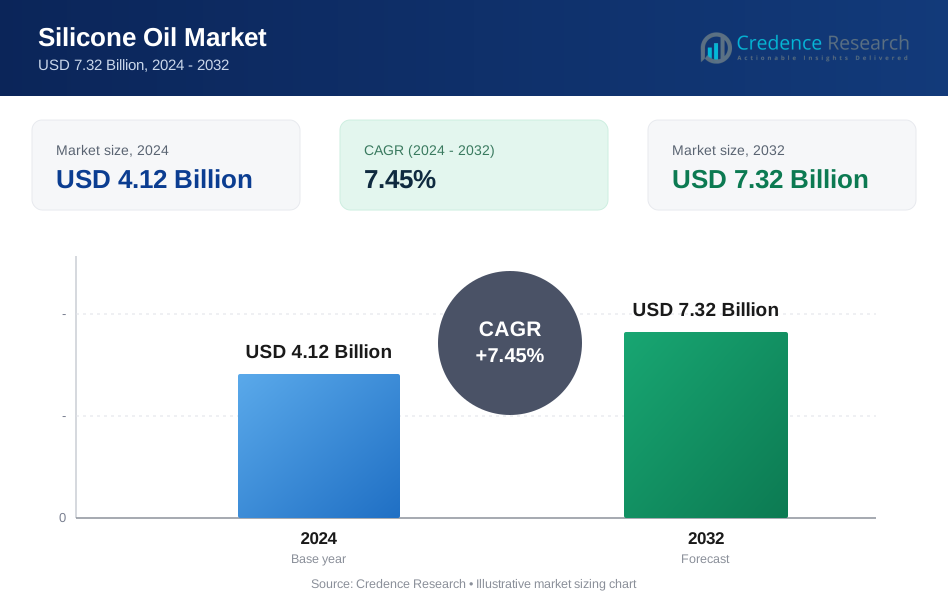
- 2.1.1 Market Size – Historical (2024) & Forecast (2024-2032) (2024: USD 4.12 Billion → 2032: USD 7.32 Billion)
- 2.1.2 Volume & Revenue – Global Totals
- 2.1.3 Key Market Highlights – Top Five Facts
- 2.2 Silicone Oil Market Segmentation Snapshot
- 2.2.1 Market Split by Region – 2024 vs. 2032
- 2.3 Competitive Snapshot
- 2.3.1 Top 10 Players by Revenue Share – 2024
- 2.3.2 Top 10 Players by Volume Share – 2024
- 2.3.3 Recent Strategic Developments (18-Month Summary)
- 2.4 Key Investment Highlights & Strategic Conclusions
Chapter 3. Silicone Oil Market Dynamics & Industry Analysis
- 3.1 Market Overview & Context
- 3.1.1 Silicone Oil Market Position in the Broader Automotive Value Chain
- 3.1.2 OEM vs. Replacement Market Dynamics
- 3.1.3 Market Maturity & Development Stage by Region
- 3.2 Silicone Oil Market Drivers
- 3.3 Silicone Oil Market Restraints & Challenges
- 3.4 Silicone Oil Market Opportunities
- 3.5 Porter's Five Forces Analysis
- 3.5.1 Threat of New Entrants
- 3.5.2 Bargaining Power of Suppliers
- 3.5.3 Bargaining Power of Buyers
- 3.5.4 Threat of Substitutes
- 3.5.5 Competitive Rivalry – Intensity Assessment
- 3.6 Silicone Oil Value Chain Analysis
- 3.6.1 Upstream – Raw Material/Input Suppliers
- 3.6.1.1 Raw Material/Input 1
- 3.6.1.2 Raw Material/Input 2
- 3.6.1.3 Raw Material/Input 3
- 3.6.2 Midstream – Production/Manufacturing/Service Delivery
- 3.6.2.1 Production/Process Overview
- 3.6.2.2 Key Facility Locations & Capacity by Manufacturer
- 3.6.3 Downstream – Distribution & End Consumer
- 3.6.3.1 Primary Channel – B2B/OEM
- 3.6.3.2 Secondary Channels – Dealer, Retail, Online, Direct
- 3.6.4 Value Chain Profitability Analysis
- 3.6.1 Upstream – Raw Material/Input Suppliers
- 3.7 PESTEL Analysis
- 3.7.1 Political Factors
- 3.7.2 Economic Factors
- 3.7.3 Social Factors
- 3.7.4 Technological Factors
- 3.7.5 Environmental Factors
- 3.7.6 Legal Factors
- 3.8 Silicone Oil Supply Chain Analysis
- 3.8.1 Raw Material/Input Supply Risk Assessment
- 3.8.2 Manufacturing Concentration Risk (Geographic Exposure)
- 3.8.3 Trade Disruption Impact Analysis
- 3.9 Regulatory & Policy Landscape
Note: The regulatory and policy landscape section covers regulations based on their applicability to the market, Silicone Oil category, geography, and scope of the study. Only regulatory frameworks with a material impact on operations, compliance, trade, sustainability, or market access are analyzed in detail.
Chapter 4. Key Investment Pockets & Opportunity Analysis
- 4.1 Silicone Oil Market Attractiveness Analysis
- 4.1.1 By Region – Investment Attractiveness Matrix (Volume × CAGR)
- 4.2 Absolute Revenue Growth Opportunity
- 4.2.1 By Region – Absolute USD Growth Through 2032
- 4.3 Incremental Volume Opportunity
- 4.3.1 By Region – Incremental Volume Through 2032
- 4.3.2 Segment – Incremental Volume
- 4.4 Emerging Submarket Opportunity Deep Dive (Subject to Applicability)
- 4.5 Emerging Market Opportunity Scorecards
- 4.5.1 United States
- 4.5.2 Europe
- 4.5.3 Asia
- 4.5.4 Middle East & Africa
Note: Emerging Market Opportunity Scorecards will be included based on relevance and strategic importance. Regions listed are indicative and may vary depending on data availability and market dynamics.
Chapter 5. Silicone Oil Import-Export Analysis & Trade Flows
- 5.1 Global Trade Overview
- 5.1.1 Global Export Value by Country (2024)
- 5.1.2 Global Export Volume by Country (2024)
- 5.1.3 Global Import Value by Country (2024)
- 5.1.4 Global Import Volume by Country (2024)
- 5.1.5 Net Trade Balance by Country (2024)
- 5.2 Export Analysis – Segment
- 5.2.1 Type 1 (HS Code)
- 5.2.2 Type 2 (HS Code)
- 5.2.3 Type 3 (HS Code)
- 5.2.4 Type 4 (HS Code)
- 5.2.5 Type 5 (HS Code)
- 5.3 Import Analysis – Segment
- 5.3.1 Type 1 (HS Code)
- 5.3.2 Type 2 (HS Code)
- 5.3.3 Type 3 (HS Code)
- 5.3.4 Type 4 (HS Code)
- 5.3.5 Type 5 (HS Code)
- 5.4 Average Unit Trade Prices
- 5.4.1 Average Export Price – Segment & Country
- 5.4.2 Average Import Price – Segment & Source Country
- 5.4.3 Price Trends (2024)
- 5.5 Key Trade Route Analysis
- 5.5.1 Trade Route 1
- 5.5.2 Trade Route 2
- 5.5.3 Trade Route 3
- 5.5.4 Trade Route 4
- 5.5.5 Trade Route 5
- 5.6 Trade Policy Impact Assessment
- 5.6.1 US Anti-Dumping & Section 301 Tariffs
- 5.6.2 EU Customs Union Impact
- 5.6.3 Major Free Trade Agreements
- 5.6.4 USMCA Rules of Origin
Note: Trade policy analysis will be included only where relevant to the Silicone Oil market.
Chapter 6. Competitive Landscape & Company Benchmarking
- 6.1 Silicone Oil Market Concentration & Structure
- 6.1.1 Herfindahl-Hirschman Index (HHI) – vs. 2024
- 6.1.2 Tier 1, Tier 2 & Tier 3 Market Structure
- 6.1.3 Global, Regional & Local Player Dynamics
- 6.2 Silicone Oil Market Share Analysis – 2024
- 6.2.1 Global Revenue Share by Company
- 6.2.2 Global Volume Share by Company
- 6.2.3 Regional Revenue Share
- 6.2.4 Market Share Evolution ( vs. 2024)
- 6.2.5 OEM Segment Share by Company
- 6.2.6 Replacement Segment Share by Company
- 6.3 Production/Delivery Capacity & Facility Analysis
- 6.3.1 Global Installed Capacity
- 6.3.2 Capacity Utilization Rates
- 6.3.3 Production/Output Volume
- 6.3.4 Facility Locations & Capacity Map
- 6.3.5 Planned Capacity Additions
- 6.4 Silicone Oil Competitive Benchmarking Matrix
- 6.4.1 Revenue, Volume, CAGR & Profitability Comparison
- 6.4.2 Channel Revenue Mix
- 6.4.3 Geographic Revenue Exposure
- 6.4.4 R&D Intensity
- 6.4.5 Sustainability Maturity
- 6.5 Strategic Developments in Silicone Oil (Last 24 Months)
- 6.5.1 Mergers, Acquisitions & Divestments
- 6.5.2 New Silicone Oil Launches
- 6.5.3 Facility Expansions
- 6.5.4 Strategic Alliances, Joint Ventures & Partnerships
- 6.5.5 Distribution Expansion & Market Entry
- 6.5.6 Sustainability & ESG Initiatives
- 6.6 Competitive Strategy Mapping
- 6.6.1 Leader, Challenger, Follower & Niche Classification
- 6.6.2 Pricing Strategy Comparison
- 6.6.3 Channel Strategy Matrix
Note: Strategic developments are included based on their materiality and the availability of reliable information.
Chapter 7. Global Silicone Oil Market – By Distribution Channel
- 7.1 Segment Overview
- 7.1.1 Volume & Revenue Split by Channel (2024 & 2032)
- 7.1.2 Channel Mix Evolution (2024-2032)
Chapter 8. Regional Market Analysis – Global Overview
- 8.1 Global Regional Overview
- 8.1.1 Regional Volume Share
- 8.1.2 Regional Revenue Share
- 8.1.3 Regional Volume by Region
- 8.1.4 Regional Revenue by Region
- 8.1.5 Regional Forecast Through 2032
- 8.2 Cross-Regional Segment Analysis
- 8.2.1 By Distribution Channel
- 8.2.2 By Brand/Price Tier
Chapter 9. North America Silicone Oil Market
- 9.1 United States
- 9.2 Canada
- 9.3 Mexico
Chapter 10. Europe Silicone Oil Market
- 10.1 Germany
- 10.2 France
- 10.3 Italy
- 10.4 United Kingdom
- 10.5 Spain
- 10.6 Poland
- 10.7 Russia
- 10.8 Netherlands
- 10.9 Belgium
- 10.10 Sweden
- 10.11 Denmark
- 10.12 Norway
- 10.13 Rest of Europe
Chapter 11. Asia Pacific Silicone Oil Market
- 11.1 China
- 11.2 India
- 11.3 Japan
- 11.4 South Korea
- 11.5 Thailand
- 11.6 Indonesia
- 11.7 Vietnam
- 11.8 Malaysia
- 11.9 Australia
- 11.10 Rest of Asia Pacific
Chapter 12. Latin America Silicone Oil Market
- 12.1 Brazil
- 12.2 Argentina
- 12.3 Colombia
- 12.4 Chile
- 12.5 Rest of Latin America
Chapter 13. Middle East Silicone Oil Market
- 13.1 Saudi Arabia
- 13.2 United Arab Emirates
- 13.3 Turkey
- 13.4 Israel
- 13.5 Iran
- 13.6 Rest of the Middle East
Chapter 14. Africa Silicone Oil Market
- 14.1 South Africa
- 14.2 Egypt
- 14.3 Nigeria
- 14.4 Morocco
- 14.5 Rest of Africa
Chapter 15. Silicone Oil Company Profiles
- 15.1 [Company 01]
- 15.1.1 Company Overview
- 15.1.2 Key Management Personnel
- 15.1.3 Products & Services Portfolio
- 15.1.4 Financial Performance
- 15.1.5 Key Market Focus & Geographic Presence
- 15.1.6 Recent Developments & Strategic Initiatives
Note: The company profile list is preliminary and may change based on research findings, market developments, data availability, and client requirements.
Chapter 16. Appendices
- Appendix A – List of Abbreviations & Acronyms
- Appendix B – Industry Classification Code Reference – Full Series
- Appendix C – Production & Capacity Data Tables
- Appendix D – End-Use & Demand Base Tables
- Appendix E – Consumption & Replacement Rate Assumptions
- Appendix F – ASP Reference Tables
- Appendix G – Manufacturing & Facility Database
- Appendix H – Import-Export Data Tables
- Appendix I – Regulatory Summary Tables
- Appendix J – Primary Research Participant List (Anonymized)
- Appendix K – Primary Research Questionnaire Framework
- Appendix L – Data Sources & Bibliography
- Appendix M – Market Size Divergence & Source Comparison
Chapter 17. Research Methodology
- 17.1 Research Framework & Philosophy
- 17.2 Secondary Research – Sources, Hierarchy & Data Extraction
- 17.3 Data Modeling – Bottom-Up & Top-Down Market Sizing
- 17.4 Primary Research – Stakeholder Framework, LOI & Sample Sizes
- 17.5 Forecast Methodology – Regression, Scenario & Sensitivity Analysis
- 17.6 Quality Control – Four-Layer Validation Framework
- 17.7 Limitations & Standard Assumptions
- 17.8 Disclaimer
