
| REPORT ATTRIBUTE | DETAILS |
|---|---|
| Historical Period | 2019-2022 |
| Base Year | 2023 |
| Forecast Period | 2024-2032 |
| Saudi Arabia Plastic Products Market Size 2023 | USD 8559.13 Million |
| Saudi Arabia Plastic Products Market, CAGR | 2.53% |
| Saudi Arabia Plastic Products Market Size 2032 | USD 10869.82 Million |
Market Overview
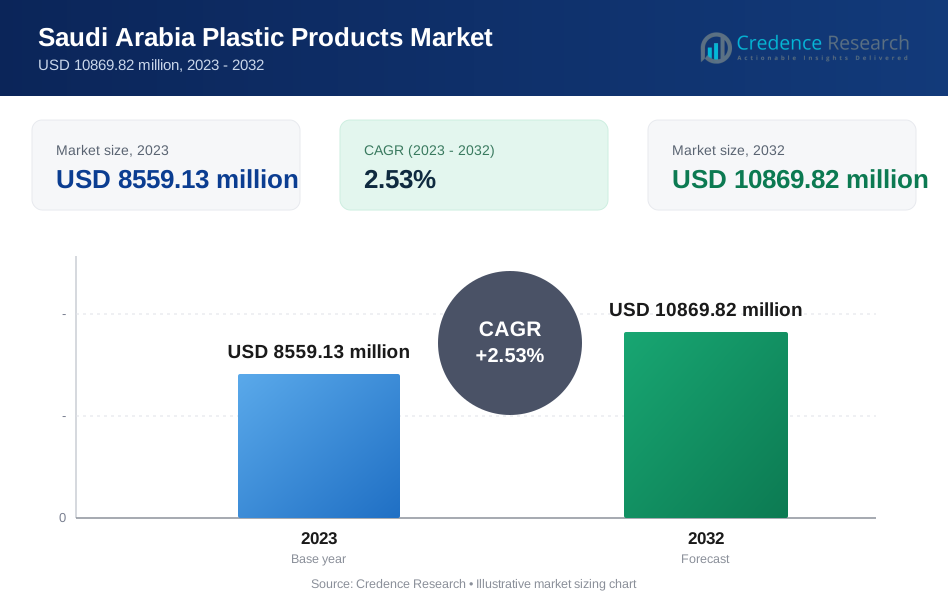
The Saudi Arabia Plastic Products Market is projected to grow from USD 8559.13 million in 2023 to USD 10869.82 million by 2032, reflecting a compound annual growth rate (CAGR) of 2.53%. The Saudi Arabia Plastic Products Market is an integral part of the country's industrial ecosystem, reflecting its robust economic growth and diverse industrial sectors. Plastic products play a pivotal role across various industries, including construction, packaging, automotive, healthcare, and consumer goods, contributing significantly to the nation's industrial output. Over recent years, the market has witnessed substantial expansion, driven by various factors such as infrastructure development, population growth, urbanization, and technological advancements.
Ambitious infrastructure projects spearheaded by Saudi Arabia, as part of its Vision 2030 plan to diversify the economy and reduce dependence on oil, serve as primary drivers fueling the growth of the Plastic Products Market. These projects, spanning sectors like transportation, utilities, housing, and commercial construction, generate substantial demand for plastic products used in pipes, fittings, insulation materials, and other construction components. With the construction sector continuing to thrive, the demand for plastic products is poised to remain robust, further propelling market growth.
Additionally, the packaging industry represents a significant segment of the Saudi Arabia Plastic Products Market, driven by the rise of e-commerce, retail, and the food and beverage sectors. There is a growing demand for innovative and sustainable packaging solutions, with plastic packaging materials offering versatility, durability, and cost-effectiveness. The adoption of recyclable and biodegradable plastics is increasing due to growing environmental awareness, further driving innovation in the packaging sector. Furthermore, the automotive industry serves as another key driver, with plastic components playing a crucial role in modern automotive design, offering benefits such as weight reduction, fuel efficiency, and design flexibility. As the automotive sector continues to grow, supported by investments and favorable government policies, the demand for plastic products in various applications within the industry is expected to witness a corresponding increase.
Moreover, the healthcare sector presents significant opportunities for the Saudi Arabia Plastic Products Market, driven by the expansion of healthcare infrastructure and increased healthcare spending. Plastic products such as medical devices, equipment, and packaging materials are in high demand, offering safety, sterility, and cost-effectiveness in modern healthcare delivery. Despite promising growth prospects, the market faces challenges related to environmental sustainability, including concerns about plastic waste and pollution. Industry players are increasingly focusing on recycling, circular economy initiatives, and the development of biodegradable plastics to address these challenges and align with global sustainability goals. Additionally, fluctuations in raw material prices, supply chain disruptions, and geopolitical uncertainties pose operational challenges for plastic product manufacturers, necessitating strategic sourcing, supply chain management, and investment in technologies for enhanced productivity and cost competitiveness.
Segmentation Analysis
By Product Type:
The Saudi Arabia Plastic Products Market exhibits a diverse range of product types catering to various industries and consumer needs. Among the key product categories are Sheets, Film, and Plates, Tubes, Containers, Household Articles, Floor Cover and Wall Cover, Textile Fabrics, and Other Products. Sheets, Film, and Plates constitute a significant portion of the market, offering versatile solutions for packaging, construction, and industrial applications. Tubes and containers are widely used for packaging in the food and beverage, pharmaceutical, and personal care industries. Household articles encompass a broad range of plastic products, including kitchenware, storage containers, and utensils. Floor cover and wall cover materials find extensive use in the construction and interior design sectors, providing durable and aesthetically pleasing solutions. Textile fabrics made from plastic fibers serve diverse applications in apparel, home furnishings, and industrial settings.
By End-User Industry:
The Saudi Arabia Plastic Products Market serves a wide range of end-user industries, each with distinct requirements and applications. The Building and Construction sector stands as a significant consumer of plastic products, utilizing materials such as pipes, fittings, insulation, and cladding for various construction projects. Plastic products play a vital role in enhancing durability, efficiency, and sustainability in building applications. Consumer Goods represent another key segment, encompassing a myriad of plastic products used in daily life, including household items, appliances, toys, and packaging materials. The Life Sciences industry relies on plastic products for medical devices, laboratory equipment, and pharmaceutical packaging, where safety, sterility, and precision are paramount. Aerospace applications demand specialized plastic components known for their lightweight, durability, and resistance to extreme conditions, contributing to aircraft design and performance. The Food and Beverage sector utilizes plastic packaging materials to ensure product safety, freshness, and convenience for consumers.
Segments:
By Product Type:
- Sheets
- Film and Plates
- Tubes
- Containers
- Household Articles
- Floor Cover and Wall Cover
- Textile Fabrics
- Other Products
By End-User Industry:
- Building and Construction
- Consumer Goods
- Life Sciences
- Aerospace
- Food and Beverage
- Other Applications
By Region:
- Riyadh
- Eastern
- Western
- Southern
- Northern
Market Drivers
Thriving Economy and Rising Consumer Spending:
Saudi Arabia's robust economy, buoyed by both oil and non-oil sectors, contributes significantly to the demand for plastic products. The nation's strong economic foundation translates into higher standards of living and increased disposable income among consumers. This surge in spending drives demand across various sectors, including food packaging, consumer goods, and construction materials. As consumers have more purchasing power, the demand for plastic products for both essential and discretionary purposes continues to grow, further fueling the expansion of the market.
Government Initiatives:
Vision 2030, a strategic development plan initiated by the Saudi government, serves as a pivotal driver for the plastic products market. This ambitious plan encompasses mega infrastructure projects aimed at diversifying the economy and reducing dependence on oil revenue. For instance, the Saudi government has invested heavily in infrastructure development, which is driving the demand for plastic pipes. Projects such as the construction of new seaports, railways, and manufacturing facilities require a substantial amount of plastic materials, including pipes, fittings, and insulation solutions. The government’s commitment to these initiatives creates a conducive environment for the growth of the plastic products market, with increased demand anticipated across various sectors involved in infrastructure development.
High Demand from Various Industries:
The Saudi plastic products market benefits from robust demand emanating from diverse industries. The packaging industry represents another significant segment, catering to the needs of the food & beverage, pharmaceutical, and consumer goods sectors. Additionally, plastics play a crucial role in the automotive and transportation sectors, where lightweight components, interior parts, and wire insulation contribute to vehicle design and performance. The Saudi Arabian automotive market is the largest in the Middle East and consists almost entirely of imported vehicles. The automotive sector accounts for more than half of the value share in the Saudi plastic and rubber product market. This indicates the significant role of plastics in the automotive and transportation sectors in Saudi Arabia.
Growing Population and Urbanization:
Saudi Arabia experiences rapid population growth coupled with urbanization, which significantly impacts the demand for plastic products. As the population expands and urban areas develop, there is a heightened need for housing, infrastructure, and consumer goods, all of which rely on plastic products to varying degrees. Urbanization is also progressing at a fast pace. For instance, the urban population in Saudi Arabia was around 84.73% in 2022, and it’s expected to continue growing. This urban expansion is driving the demand for various plastic products. The construction industry, in particular, benefits from this trend, with increased demand for plastic materials for residential and commercial developments. As urbanization continues unabated, the demand for plastic products is expected to remain strong, driving market growth in the coming years.
Innovation in Plastic Technologies:
The Saudi Arabia Plastic Products Market is characterized by continuous innovation in plastic technologies, fostering the development of new types of plastics with enhanced properties. Manufacturers are investing in research and development to create plastics with improved biodegradability, heat resistance, and flame retardancy, among other desirable traits. These innovations not only expand the application areas of plastics but also create new market opportunities in sectors such as healthcare, aerospace, and electronics. By staying at the forefront of plastic technology advancements, the market remains dynamic and adaptable to evolving consumer and industry demands, driving sustained growth and competitiveness.
Market Trends
Shift towards Sustainable Plastics:
Environmental concerns are steering the Saudi Arabia Plastic Products Market towards sustainable solutions. Biodegradable plastics, derived from renewable resources like corn starch or sugarcane, are gaining traction due to their ability to decompose naturally, thus reducing plastic waste. Additionally, there is a growing emphasis on utilizing recycled plastic content in new products, helping conserve virgin plastic resources and mitigate plastic pollution. Furthermore, manufacturers are increasingly focusing on developing lightweight plastic solutions that require less material, thereby reducing their environmental footprint and promoting sustainability.
Focus on Functionality and Performance:
The market is witnessing a notable shift towards plastic products with enhanced functionalities to meet evolving consumer and industry demands. Barrier plastics, offering superior protection against moisture, oxygen, and other environmental factors, are becoming increasingly prevalent, extending the shelf life of packaged goods and ensuring product quality. In the construction industry, safety regulations are stringent, and in the transportation industry, there are comprehensive safety and logistics standards. These standards necessitate the use of flame-retardant plastics, contributing to their increased demand. These advancements in functionality and performance contribute to the overall value proposition of plastic products in the market.
E-commerce Growth:
The rise of e-commerce is significantly influencing the demand for plastic packaging solutions in Saudi Arabia. As online retail continues to gain momentum, durable and lightweight plastics are crucial for protecting products during transportation and delivery. Manufacturers are thus innovating in packaging design and material selection to meet the unique requirements of e-commerce logistics, ensuring that products arrive intact and undamaged to the end consumer. This trend underscores the pivotal role of plastics in facilitating the efficiency and reliability of the e-commerce supply chain.
Rise of 3D Printing:
The growing adoption of 3D printing technologies is driving the emergence of a new market for specialized plastic filaments used in creating 3D printed products. This trend opens up opportunities for plastic manufacturers to diversify their product offerings and cater to niche applications in industries such as healthcare, aerospace, and automotive. As 3D printing technology continues to advance and become more accessible, the demand for high-quality, customizable plastic filaments is expected to grow. The 3D printing filament market in Saudi Arabia is on the rise, driven by the growing adoption of additive manufacturing across multiple industries. This further stimulates market expansion and innovation.
Focus on Cost Optimization:
Plastic manufacturers in Saudi Arabia are proactively focusing on optimizing production processes and reducing material costs to maintain competitiveness in the market. For instance, National Plastic Factory, one of the leading plastic products manufacturers in Saudi Arabia since 1976, follows the protocol of quality testing, engineering changes, and product evaluation during the production process at the site. They have more than 300 molds and 80 machines, serving different industrial sectors.
By embracing innovative manufacturing techniques and leveraging technological advancements, manufacturers can streamline operations and enhance cost efficiency without compromising product quality or performance. For example, Saudi Arabia is actively investing in additive manufacturing research and development to enhance local capabilities and accelerate technological advancements.
Market Restraints and Challenges
Environmental Concerns and Regulations:
A significant challenge facing the Saudi Arabia Plastic Products Market is the escalating public awareness of plastic pollution and its adverse environmental effects. This heightened awareness has prompted governments to impose stricter regulations on plastic production, usage, and disposal. For example, there might be bans on single-use plastics or limitations on plastic content in packaging. Compliance with these regulations not only increases production costs for manufacturers but also necessitates the adoption of sustainable practices throughout the supply chain to mitigate environmental impact.
Fluctuations in Oil Prices:
The Saudi plastic industry heavily relies on oil derivatives as raw materials for plastic production. Consequently, fluctuations in global oil prices pose a considerable challenge to the industry, impacting production costs and overall profitability for plastic manufacturers. Volatility in oil prices can lead to unpredictable fluctuations in raw material costs, thereby affecting the competitiveness of plastic products in the market and requiring manufacturers to adapt their pricing strategies accordingly.
Limited Recycling Infrastructure:
Despite growing interest in recycling, Saudi Arabia faces challenges due to its limited plastic waste management and recycling infrastructure. The lack of a robust recycling ecosystem hampers effective collection, sorting, and reprocessing of plastic waste into new products. As a result, a significant amount of plastic waste ends up in landfills or incineration facilities, exacerbating environmental concerns and limiting the potential for circularity in the plastic value chain. Addressing these infrastructure limitations will be crucial to improving plastic waste management practices and promoting a more sustainable approach to plastic usage in Saudi Arabia.
Competition from Alternative Materials:
The Saudi Arabia Plastic Products Market faces stiff competition from alternative materials perceived as more environmentally friendly, such as paper, glass, and metal packaging. These alternative materials are gaining traction in certain sectors due to their recyclability, biodegradability, or perceived lower environmental impact. As a result, plastic manufacturers are under pressure to innovate and differentiate their products to maintain market share and competitiveness. Building brand awareness for sustainable plastic solutions and educating consumers about their benefits will be essential strategies for navigating this competitive landscape and retaining consumer trust and loyalty.
Key Players
- Arabian Plastics Industrial Company Limited
- Zamil Plastic
- Rowad National Plastic Company Ltd
- Takween Advanced Industries
- Tamam Plastic Factory
Regional Analysis
Riyadh
The Riyadh region, being the capital and the economic hub of Saudi Arabia, accounts for the largest share of the country's plastic products market, capturing around 35% of the total market. The region's thriving industrial sector, which includes petrochemical, manufacturing, and packaging industries, has been the primary driver of the plastic products market. The presence of major industrial zones, such as the King Abdullah Economic City and the Riyadh Second Industrial City, has fostered the growth of plastic processing and manufacturing facilities in the region. Additionally, the region's well-developed infrastructure and its strategic location have made it a hub for the distribution and logistics of plastic products, further enhancing the market's expansion.
Eastern
The Eastern region of Saudi Arabia holds a significant share of the plastic products market, accounting for approximately 25% of the total market. The region's dominance is largely attributed to the presence of the country's petrochemical hub, centered around the city of Jubail. The availability of feedstock, combined with the region's well-established industrial infrastructure, has enabled the growth of a robust plastic processing industry. The region's petrochemical companies, along with the presence of plastic converters and manufacturers, have contributed to the region's stronghold in the Saudi Arabian plastic products market.
Western
The Western region, encompassing cities like Jeddah and Makkah, holds around 20% of the Saudi Arabia plastic products market share. The region's thriving commercial and logistical activities, coupled with its status as a major import and export hub, have driven the demand for plastic products in sectors such as packaging, construction, and consumer goods. The presence of large-scale plastic converting and manufacturing facilities in the region, as well as the availability of skilled labor, have further contributed to the market's expansion in the Western region.
Southern
The Southern region of Saudi Arabia holds a modest share of the country's plastic products market, estimated at around 10%. The region's economy is primarily driven by agriculture, mining, and tourism, which have relatively lower demand for plastic products compared to the industrialized regions. However, the region's ongoing efforts to diversify its economic base and invest in infrastructure development projects have created opportunities for the growth of the plastic products market, particularly in the packaging and construction sectors.
Northern
The Northern region of Saudi Arabia accounts for the smallest share of the plastic products market, capturing approximately 10% of the total market. This region is known for its relatively less developed industrial base and higher dependence on traditional economic activities. However, the government's initiatives to promote industrial diversification and invest in infrastructure projects have started to create opportunities for the plastic processing industry in the Northern region. The region's proximity to export markets and the availability of raw materials may contribute to the future growth of the plastic products market in this area.
Future Outlook
- Continuous Growth: The Saudi Arabia Plastic Products Market is expected to witness sustained growth in the coming years, driven by increasing demand from various industries.
- Infrastructure Development: Ongoing infrastructure projects in Saudi Arabia will contribute to the demand for plastic products, particularly in construction and infrastructure development.
- Technological Advancements: Innovations in plastic manufacturing technologies will lead to the development of advanced and more efficient plastic products, catering to evolving market needs.
- Economic Diversification: Saudi Arabia's efforts to diversify its economy will create new opportunities for the plastic products market, especially in sectors such as healthcare, automotive, and packaging.
- Sustainability Focus: There will be a growing emphasis on sustainable plastic solutions, leading to the adoption of eco-friendly materials and recycling initiatives to minimize environmental impact.
- Regulatory Compliance: Compliance with stringent regulations regarding plastic usage and waste management will shape the market landscape, influencing product development and manufacturing practices.
- Market Diversification: The market will witness diversification in product offerings, catering to a wide range of applications across industries such as construction, healthcare, packaging, and consumer goods.
- Export Opportunities: Saudi Arabia's strategic location and robust infrastructure will position the country as a key exporter of plastic products to regional and international markets.
- Investment in R&D: Increased investment in research and development activities will drive innovation in the plastic products market, leading to the introduction of novel materials and technologies.
- Market Consolidation: The market may undergo consolidation as larger players acquire smaller manufacturers to expand their product portfolios and market reach, fostering competition and innovation in the industry.
Request a Free Sample
Fill in your details and we'll send you a free sample report.
- Sample data tables & charts
- Research methodology
Need a Custom Version of This Report?
Tailor the scope, geography, or segments to your exact requirements.
- Custom geography or segment scope
- Direct access to our analyst team
Frequently Asked Questions
What is the projected growth of the Saudi Arabia Plastic Products Market between 2023 and 2032?
What factors are driving the growth of the Saudi Arabia Plastic Products Market?
Who are the major players in the Saudi Arabia Plastic Products Market?
How is the availability of Saudi Arabia Plastic Products Market expanding, and through what channels?
Table of Content
Chapter 1. Report Introduction
- 1.1 Report Description & Purpose
- 1.1.1 Report Title & Market Definition
- 1.1.2 Unique Selling Propositions (USP) & Key Differentiators
- 1.1.3 Value Proposition for Stakeholders
- 1.2 Research Objectives
- 1.2.1 Market Sizing Objectives (Volume & Revenue)
- 1.2.2 Segmentation Objectives
- 1.2.3 Competitive Intelligence Objectives
- 1.2.4 Forecast & Scenario Objectives
- 1.3 Report Scope
- 1.3.1 Saudi Arabia Plastic Products Scope – Types & Subtypes Covered
- 1.3.2 Geographic Scope – Regions & Countries Covered
- 1.3.3 Historical Period, Base Year & Forecast Period (2023; forecast to 2032)
- 1.3.4 Inclusions & Exclusions
- 1.4 HS Code & Classification Framework
- 1.5 Currency, Units & Pricing Basis
- 1.6 Target Stakeholders
- 1.7 Limitations & Assumptions
Chapter 2. Executive Summary
- 2.1 Global Saudi Arabia Plastic Products Market Snapshot
- 2.1.1 Market Size – Historical (2023) & Forecast (2023-2032) (2023: USD 8559.13 million → 2032: USD 10869.82 million)
- 2.1.2 Volume & Revenue – Global Totals
- 2.1.3 Key Market Highlights – Top Five Facts
- 2.2 Saudi Arabia Plastic Products Market Segmentation Snapshot
- 2.2.1 Market Split by Region – 2023 vs. 2032
- 2.3 Competitive Snapshot
- 2.3.1 Top 10 Players by Revenue Share – 2023
- 2.3.2 Top 10 Players by Volume Share – 2023
- 2.3.3 Recent Strategic Developments (18-Month Summary)
- 2.4 Key Investment Highlights & Strategic Conclusions
Chapter 3. Saudi Arabia Plastic Products Market Dynamics & Industry Analysis
- 3.1 Market Overview & Context
- 3.1.1 Saudi Arabia Plastic Products Market Position in the Broader Automotive Value Chain
- 3.1.2 OEM vs. Replacement Market Dynamics
- 3.1.3 Market Maturity & Development Stage by Region
- 3.2 Saudi Arabia Plastic Products Market Drivers
- 3.3 Saudi Arabia Plastic Products Market Restraints & Challenges
- 3.4 Saudi Arabia Plastic Products Market Opportunities
- 3.5 Porter's Five Forces Analysis
- 3.5.1 Threat of New Entrants
- 3.5.2 Bargaining Power of Suppliers
- 3.5.3 Bargaining Power of Buyers
- 3.5.4 Threat of Substitutes
- 3.5.5 Competitive Rivalry – Intensity Assessment
- 3.6 Saudi Arabia Plastic Products Value Chain Analysis
- 3.6.1 Upstream – Raw Material/Input Suppliers
- 3.6.1.1 Raw Material/Input 1
- 3.6.1.2 Raw Material/Input 2
- 3.6.1.3 Raw Material/Input 3
- 3.6.2 Midstream – Production/Manufacturing/Service Delivery
- 3.6.2.1 Production/Process Overview
- 3.6.2.2 Key Facility Locations & Capacity by Manufacturer
- 3.6.3 Downstream – Distribution & End Consumer
- 3.6.3.1 Primary Channel – B2B/OEM
- 3.6.3.2 Secondary Channels – Dealer, Retail, Online, Direct
- 3.6.4 Value Chain Profitability Analysis
- 3.6.1 Upstream – Raw Material/Input Suppliers
- 3.7 PESTEL Analysis
- 3.7.1 Political Factors
- 3.7.2 Economic Factors
- 3.7.3 Social Factors
- 3.7.4 Technological Factors
- 3.7.5 Environmental Factors
- 3.7.6 Legal Factors
- 3.8 Saudi Arabia Plastic Products Supply Chain Analysis
- 3.8.1 Raw Material/Input Supply Risk Assessment
- 3.8.2 Manufacturing Concentration Risk (Geographic Exposure)
- 3.8.3 Trade Disruption Impact Analysis
- 3.9 Regulatory & Policy Landscape
Note: The regulatory and policy landscape section covers regulations based on their applicability to the market, Saudi Arabia Plastic Products category, geography, and scope of the study. Only regulatory frameworks with a material impact on operations, compliance, trade, sustainability, or market access are analyzed in detail.
Chapter 4. Key Investment Pockets & Opportunity Analysis
- 4.1 Saudi Arabia Plastic Products Market Attractiveness Analysis
- 4.1.1 By Region – Investment Attractiveness Matrix (Volume × CAGR)
- 4.2 Absolute Revenue Growth Opportunity
- 4.2.1 By Region – Absolute USD Growth Through 2032
- 4.3 Incremental Volume Opportunity
- 4.3.1 By Region – Incremental Volume Through 2032
- 4.3.2 Segment – Incremental Volume
- 4.4 Emerging Submarket Opportunity Deep Dive (Subject to Applicability)
- 4.5 Emerging Market Opportunity Scorecards
- 4.5.1 United States
- 4.5.2 Europe
- 4.5.3 Asia
- 4.5.4 Middle East & Africa
Note: Emerging Market Opportunity Scorecards will be included based on relevance and strategic importance. Regions listed are indicative and may vary depending on data availability and market dynamics.
Chapter 5. Saudi Arabia Plastic Products Import-Export Analysis & Trade Flows
- 5.1 Global Trade Overview
- 5.1.1 Global Export Value by Country (2023)
- 5.1.2 Global Export Volume by Country (2023)
- 5.1.3 Global Import Value by Country (2023)
- 5.1.4 Global Import Volume by Country (2023)
- 5.1.5 Net Trade Balance by Country (2023)
- 5.2 Export Analysis – Segment
- 5.2.1 Type 1 (HS Code)
- 5.2.2 Type 2 (HS Code)
- 5.2.3 Type 3 (HS Code)
- 5.2.4 Type 4 (HS Code)
- 5.2.5 Type 5 (HS Code)
- 5.3 Import Analysis – Segment
- 5.3.1 Type 1 (HS Code)
- 5.3.2 Type 2 (HS Code)
- 5.3.3 Type 3 (HS Code)
- 5.3.4 Type 4 (HS Code)
- 5.3.5 Type 5 (HS Code)
- 5.4 Average Unit Trade Prices
- 5.4.1 Average Export Price – Segment & Country
- 5.4.2 Average Import Price – Segment & Source Country
- 5.4.3 Price Trends (2023)
- 5.5 Key Trade Route Analysis
- 5.5.1 Trade Route 1
- 5.5.2 Trade Route 2
- 5.5.3 Trade Route 3
- 5.5.4 Trade Route 4
- 5.5.5 Trade Route 5
- 5.6 Trade Policy Impact Assessment
- 5.6.1 US Anti-Dumping & Section 301 Tariffs
- 5.6.2 EU Customs Union Impact
- 5.6.3 Major Free Trade Agreements
- 5.6.4 USMCA Rules of Origin
Note: Trade policy analysis will be included only where relevant to the Saudi Arabia Plastic Products market.
Chapter 6. Competitive Landscape & Company Benchmarking
- 6.1 Saudi Arabia Plastic Products Market Concentration & Structure
- 6.1.1 Herfindahl-Hirschman Index (HHI) – vs. 2023
- 6.1.2 Tier 1, Tier 2 & Tier 3 Market Structure
- 6.1.3 Global, Regional & Local Player Dynamics
- 6.2 Saudi Arabia Plastic Products Market Share Analysis – 2023
- 6.2.1 Global Revenue Share by Company
- 6.2.2 Global Volume Share by Company
- 6.2.3 Regional Revenue Share
- 6.2.4 Market Share Evolution ( vs. 2023)
- 6.2.5 OEM Segment Share by Company
- 6.2.6 Replacement Segment Share by Company
- 6.3 Production/Delivery Capacity & Facility Analysis
- 6.3.1 Global Installed Capacity
- 6.3.2 Capacity Utilization Rates
- 6.3.3 Production/Output Volume
- 6.3.4 Facility Locations & Capacity Map
- 6.3.5 Planned Capacity Additions
- 6.4 Saudi Arabia Plastic Products Competitive Benchmarking Matrix
- 6.4.1 Revenue, Volume, CAGR & Profitability Comparison
- 6.4.2 Channel Revenue Mix
- 6.4.3 Geographic Revenue Exposure
- 6.4.4 R&D Intensity
- 6.4.5 Sustainability Maturity
- 6.5 Strategic Developments in Saudi Arabia Plastic Products (Last 24 Months)
- 6.5.1 Mergers, Acquisitions & Divestments
- 6.5.2 New Saudi Arabia Plastic Products Launches
- 6.5.3 Facility Expansions
- 6.5.4 Strategic Alliances, Joint Ventures & Partnerships
- 6.5.5 Distribution Expansion & Market Entry
- 6.5.6 Sustainability & ESG Initiatives
- 6.6 Competitive Strategy Mapping
- 6.6.1 Leader, Challenger, Follower & Niche Classification
- 6.6.2 Pricing Strategy Comparison
- 6.6.3 Channel Strategy Matrix
Note: Strategic developments are included based on their materiality and the availability of reliable information.
Chapter 7. Global Saudi Arabia Plastic Products Market – By Distribution Channel
- 7.1 Segment Overview
- 7.1.1 Volume & Revenue Split by Channel (2023 & 2032)
- 7.1.2 Channel Mix Evolution (2023-2032)
Chapter 8. Regional Market Analysis – Global Overview
- 8.1 Global Regional Overview
- 8.1.1 Regional Volume Share
- 8.1.2 Regional Revenue Share
- 8.1.3 Regional Volume by Region
- 8.1.4 Regional Revenue by Region
- 8.1.5 Regional Forecast Through 2032
- 8.2 Cross-Regional Segment Analysis
- 8.2.1 By Distribution Channel
- 8.2.2 By Brand/Price Tier
Chapter 9. North America Saudi Arabia Plastic Products Market
- 9.1 United States
- 9.2 Canada
- 9.3 Mexico
Chapter 10. Europe Saudi Arabia Plastic Products Market
- 10.1 Germany
- 10.2 France
- 10.3 Italy
- 10.4 United Kingdom
- 10.5 Spain
- 10.6 Poland
- 10.7 Russia
- 10.8 Netherlands
- 10.9 Belgium
- 10.10 Sweden
- 10.11 Denmark
- 10.12 Norway
- 10.13 Rest of Europe
Chapter 11. Asia Pacific Saudi Arabia Plastic Products Market
- 11.1 China
- 11.2 India
- 11.3 Japan
- 11.4 South Korea
- 11.5 Thailand
- 11.6 Indonesia
- 11.7 Vietnam
- 11.8 Malaysia
- 11.9 Australia
- 11.10 Rest of Asia Pacific
Chapter 12. Latin America Saudi Arabia Plastic Products Market
- 12.1 Brazil
- 12.2 Argentina
- 12.3 Colombia
- 12.4 Chile
- 12.5 Rest of Latin America
Chapter 13. Middle East Saudi Arabia Plastic Products Market
- 13.1 Saudi Arabia
- 13.2 United Arab Emirates
- 13.3 Turkey
- 13.4 Israel
- 13.5 Iran
- 13.6 Rest of the Middle East
Chapter 14. Africa Saudi Arabia Plastic Products Market
- 14.1 South Africa
- 14.2 Egypt
- 14.3 Nigeria
- 14.4 Morocco
- 14.5 Rest of Africa
Chapter 15. Saudi Arabia Plastic Products Company Profiles
- 15.1 [Company 01]
- 15.1.1 Company Overview
- 15.1.2 Key Management Personnel
- 15.1.3 Products & Services Portfolio
- 15.1.4 Financial Performance
- 15.1.5 Key Market Focus & Geographic Presence
- 15.1.6 Recent Developments & Strategic Initiatives
Note: The company profile list is preliminary and may change based on research findings, market developments, data availability, and client requirements.
Chapter 16. Appendices
- Appendix A – List of Abbreviations & Acronyms
- Appendix B – Industry Classification Code Reference – Full Series
- Appendix C – Production & Capacity Data Tables
- Appendix D – End-Use & Demand Base Tables
- Appendix E – Consumption & Replacement Rate Assumptions
- Appendix F – ASP Reference Tables
- Appendix G – Manufacturing & Facility Database
- Appendix H – Import-Export Data Tables
- Appendix I – Regulatory Summary Tables
- Appendix J – Primary Research Participant List (Anonymized)
- Appendix K – Primary Research Questionnaire Framework
- Appendix L – Data Sources & Bibliography
- Appendix M – Market Size Divergence & Source Comparison
Chapter 17. Research Methodology
- 17.1 Research Framework & Philosophy
- 17.2 Secondary Research – Sources, Hierarchy & Data Extraction
- 17.3 Data Modeling – Bottom-Up & Top-Down Market Sizing
- 17.4 Primary Research – Stakeholder Framework, LOI & Sample Sizes
- 17.5 Forecast Methodology – Regression, Scenario & Sensitivity Analysis
- 17.6 Quality Control – Four-Layer Validation Framework
- 17.7 Limitations & Standard Assumptions
- 17.8 Disclaimer
