
| REPORT ATTRIBUTE | DETAILS |
|---|---|
| Historical Period | 2019-2022 |
| Base Year | 2023 |
| Forecast Period | 2024-2032 |
| Graphite Market Size 2024 | USD 7815.2 Million |
| Graphite Market, CAGR | 7.30% |
| Graphite Market Size 2032 | USD 14734.57 Million |
Market Insights
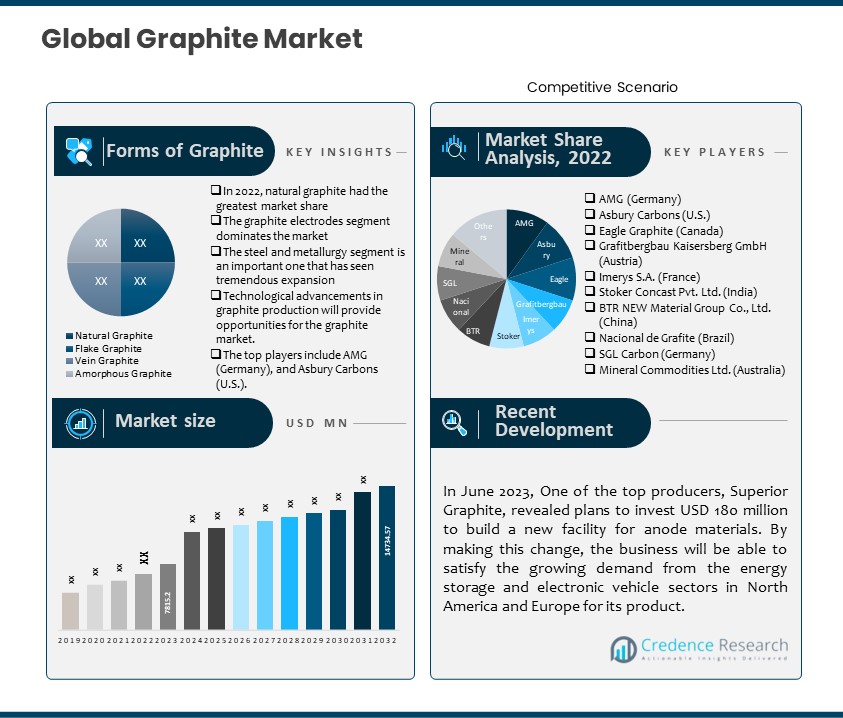
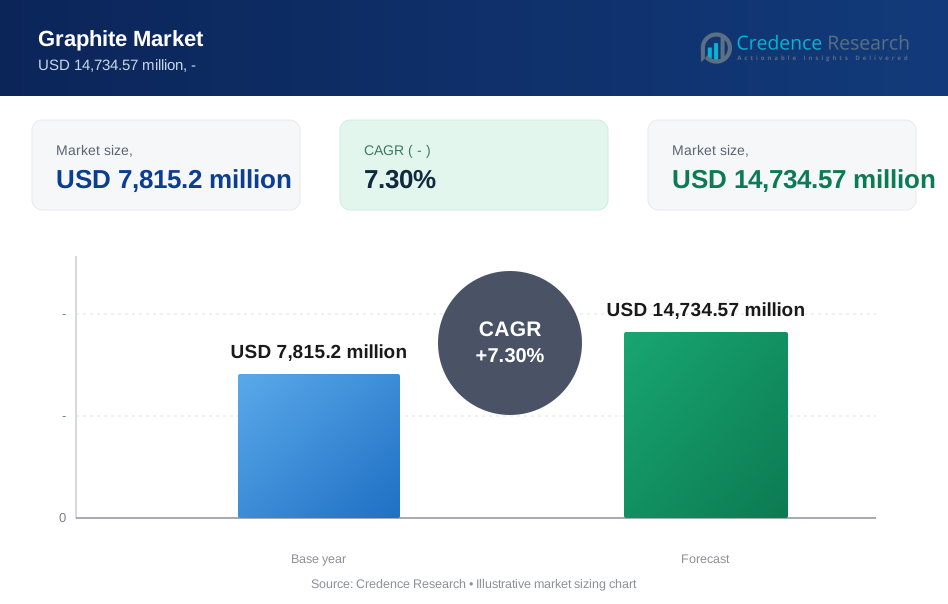
- The global market for graphite is expected to develop at a compound annual growth rate (CAGR) of 7.30% between 2024 and 2032, from its estimated USD 7815.2 million in 2023 to USD 14734.57 million in 2032.
- The largest category is natural graphite. Flake graphite, on the other hand, is expected to grow at a strong CAGR.
- The graphite electrodes category will expand at a rapid rate of growth.
- The CAGR for steel and metallurgy is expected to be the highest during the projection period.
- The electrodes and contacts will have the highest CAGR throughout the prediction period.
- Asia Pacific dominated the graphite market.
- Regarding the market share of graphite, Europe is expected to come second.
- In the graphite market, North America is anticipated to grow fastest.
- Due to its widespread use in the manufacturing of consumer electronics such as tablets, laptops, and smartphones, graphite demand is directly influenced by the growth of this industry.
- The demand for lithium-ion batteries, of which graphite is an essential component, is being driven by the growing global adoption of electric vehicles (EVs), offering a substantial growth opportunity for the graphite market.
Executive Summary
Market Definition
The production, processing, and distribution of graphite, a naturally occurring form of crystalline carbon, are all part of the global industry known as the graphite market. Due to its special qualities, which include high electrical conductivity, lubricity, chemical inertness, and thermal conductivity, graphite is an essential material for a wide range of industrial applications. The market includes synthetic graphite made by methods such as chemical vapor deposition or graphitization of carbon materials, as well as natural graphite extracted from mines.
Market Overview
The graphite sector is estimated to develop at a 7.30% compound annual growth rate (CAGR) between 2024 and 2032, maintaining its current upward trend. The market will continue to develop, rising from its estimated USD 7815.2 million in 2023 to USD 14734.57 million in 2032.
Synthetic graphite is mainly utilized in the production of graphite electrodes, which can withstand incredibly high electrical currents. Synthetic graphite is immediately formed into these electrodes by shaping it after it is produced. When making steel in an electric arc furnace (EAF), graphite electrodes are essential. They act as conductive materials, carrying electrical energy to the EAF, where it is melted into raw materials and steel scrap by high-temperature arcs. During this process, graphite electrodes have to endure high temperatures and mechanical strain. Spoons and other vessels used in the steelmaking process are lined with graphite. Its superior thermal resistance makes it possible to move molten steel from the furnace to the casting location.
The linings of furnaces, kilns, incinerators, and reactors are examples of high-temperature environments where graphite additives are used to create refractory materials. After electrodes, refractories represent the graphite market's second-largest share. Graphite is used to improve the final refractory product's effectiveness by raising its thermal conductivity, lowering the thermal gradient between its hot and cold faces, which reduces expansion, repelling molten slag, extending its working life, strengthening its resistance to corrosion and thermal shocks, enhancing its performance at higher temperatures, and lowering its wettability to molten metals so that they do not affect the final product. These factors are anticipated to boost the growth of the graphite market.
Segmentation by Forms of Graphite
- Natural graphite is the market leader in graphite forms. It is an essential component in lithium-ion batteries, which are widely used in electronic devices like laptops, smartphones, and electric vehicles (EVs). The industry's need for natural graphite has increased dramatically due to the electric vehicle market's explosive growth and the growing uptake of renewable energy storage technologies.
- The flake graphite category will exhibit a sizable CAGR during the projected period. Individual graphene layers are layered on top of one another to form the layered structure of flake graphite. Because these layers are easily separated, flake graphite is a versatile material with many uses.
- Other forms of graphite, including vein graphite and amorphous graphite, also support the need for graphite.
Segmentation by Synthetic Graphite
- Graphite electrodes are considered the best synthetic graphite category. Graphite is an excellent electrical conductor and is used to make graphite electrodes. An electric arc is created between the electrode tip and the metallic charge in the furnace when electricity flows through these electrodes.
- The isotropic graphite category will likely register a significant CAGR during forecasting. Because isotropic graphite is uniform, its mechanical strength, electrical conductivity, and thermal conductivity are constant in all directions. Because of this, it is useful in applications where consistency and predictability are essential.
- Other synthetic graphites, such as graphite powders and particles and graphite blocks and shapes, also contribute to the demand for graphite.
Segmentation by End-Use Industries
- The steel and metallurgy category is projected to grow faster over the projection period. Graphite electrodes are vital parts of electric arc furnaces (EAFs), which are frequently used in the production of steel. EAFs create new steel by melting raw materials and scrap steel. Graphite electrodes, which act as conductive materials, produce the high temperatures required to melt the steel scrap.
- Other end-use industries influence the need for graphite, including the automotive and transportation, electronics and semiconductors, energy storage and batteries, chemicals and process industries, foundry and casting, construction and infrastructure, consumer goods and sporting goods, and aerospace and defense industries.
Segmentation by Product Applications
- The electrodes and contacts will likely have the highest CAGR during the projection period. Graphite electrodes are utilized in the electric arc furnace and ladle furnace processes to produce steel and other non-ferrous metals. It is a consumable that is required for melting and alloying procedures in order to conduct high currents at low voltage.
- Other product applications, such as refractories and heat management, lubricants and coatings, carbon fiber reinforcements, cathodic protection, and thermal management solutions, also contribute to the demand for graphite.
Segmentation by Region
- The Asia Pacific leads the graphite industry. Resources for graphite are plentiful throughout the Asia-Pacific region. China, India, and Indonesia are a few of the nations with significant graphite reserves.
- Europe is estimated to rank second in market size for graphite.
- The graphite industry is predicted to flourish rapidly in North America.
- The remaining need for graphite is met by regions including Africa, the Middle East, and Latin America.
Due to its extraordinary electrical conductivity and adaptability, graphite is an essential component of consumer electronics. Its important application in the steel and refractories sectors is one of the aspects that is expected to propel market expansion.
Based on projections, the graphite market is anticipated to be dominated by Asia Pacific. The growth of the graphite industry in Asia Pacific is primarily driven by increasing consumer appetite for services based on graphite, especially in the region's emerging economies. This increasing demand is a result of rapidly developing infrastructure, industrialization, and urbanization. Significant graphite deposits can be found in nations like China, India, and Indonesia, and the Asia Pacific region is rich in graphite resources overall. The region's graphite industry is well-founded due to the abundance of available resources. Graphite and its products are exported in large quantities from nations like China to a variety of industries across the globe. Asia Pacific's leadership in the graphite industry is further reinforced by the existence of effective supply chains and trade networks.
The graphite market in North America is anticipated to expand fastest throughout the forecast. North America frequently leads innovations in technology. Graphite is a necessary ingredient in lithium-ion batteries, which are utilized in electronics, energy storage devices, and electric vehicles (EVs). The market for graphite in North America may be expanding due to the growing emphasis on sustainability and clean energy, as well as the need for EVs and renewable energy technologies. Graphite is a multipurpose material that finds use in electrodes, batteries, lubricants, and refractories, among other applications. Market growth for graphite may be supported by an increase in the number of industries that need these products.
Key Highlights of the Report
The global graphite market is segmented by forms of graphite, synthetic graphite, end-use industries, product applications, and region. Natural graphite is the leading type of graphite available in the market. Graphite electrodes are the top category. The steel and metallurgy category is anticipated to increase at the highest CAGR throughout the projection period. Throughout the projection period, the electrodes and contacts will have the greatest CAGR. The graphite market is expanding mostly in the Asia Pacific.
The graphite market is expanding due to the expansion of chemical industries. The demand for graphite is still growing since the global chemical industry is a US$ 4 trillion business that affects almost every area of the economy. This is due to the fact that chemistry directly affects more than 95% of manufactured goods, and graphite is an essential component of many chemical processes and applications. The chemical industry uses graphite extensively because of its special qualities. It has outstanding thermal conductivity, is immune to corrosion and high temperatures, and is chemically inert. Because of these qualities, graphite is a perfect material to use in the construction of heat exchangers, vessels, and chemical reactors. It can handle a variety of chemical processes because of its exceptional thermal stability and resistance to corrosive chemicals.
Asia Pacific is expected to account for the largest graphite market globally. Infrastructure for the mining, processing, and manufacturing of graphite is heavily invested in the Asia Pacific area. By boosting their competitiveness in the international arena, this investment helps the growth and modernization of industries related to graphite. The North American region is also assumed to have the market's sharpest growth. Sturdy research and development efforts in North America aimed at improving graphite's qualities and uses could propel market expansion. This might lead to the development of novel applications or enhanced production techniques, increasing the appeal of graphite to businesses.
Which Key Factors Are Driving The Global Graphite Market?
Rising demand for lithium-ion batteries, the global uptake of electric vehicles, and technological advancements in graphite production are some of the factors driving the graphite market's expansion.
What are The Main Challenges Confronting The Graphite Market Globally?
The lack of high-grade graphite reserves, the ecological issues associated with graphite mining, and the slow acceptance of electric vehicles in some regions. These challenges are confronting the graphite market.
What Market Opportunities Exist For Graphite Globally?
The market potential for graphite includes the rapid development of graphene-based technology and the growing acceptance of graphite in industrial applications.
Market Drivers
Multiple factors propel the graphite industry across the globe. The primary factors propelling the global graphite market are as follows:
Superior Electrical Conductivity and Adaptability of Graphite
Graphite is becoming an increasingly important element in many aspects of the functionality and design of electronic devices. Because of its extraordinary qualities, graphite has made it possible for sophisticated technologies to be seamlessly incorporated into people's daily lives. Examples of these technologies include batteries for laptops and smartphones, thermal management systems, and touchscreens, where graphite is a key component. Lithium-ion batteries, which are widely used in laptops, smartphones, and other portable electronic devices, use graphite as an anode material. An effective means of storing and releasing electrical energy is the graphite anode. In order to ensure that electronic components run at ideal temperatures, they are also utilized in thermal management solutions like thermal interface materials (TIMs) and graphite heat sinks. Graphite is used in conductive inks and as a lubricant in electronic devices, particularly those with touchscreens and keyboards, to enable dependable and seamless touch or keypress interactions.
Market Restraints
There are several obstacles that the global graphite market must overcome to continue growing. Among them are the following:
Concerns with Graphite's Availability and Costs
The main source of graphite is naturally occurring mineral deposits. High-grade graphite reserves are not concentrated geographically; the major reserves are located in China, Brazil, and a few other chosen regions. Concerns regarding supply chain vulnerabilities and geopolitical risks arise when graphite is solely supplied by a small number of nations. Finding new graphite deposits and removing graphite from mines that already exist can be expensive and technically difficult. Extensive exploration efforts may be necessary for many potential graphite deposits, and complicated mining procedures may be needed to extract graphite from them, which would further affect availability and costs. There are a number of reasons why graphite prices can fluctuate, including disruptions in the supply chain, shifts in the dynamics of demand, and speculation in commodity markets. For businesses that depend on graphite, this volatility presents difficulties since it can skew production schedules, raise overhead expenses, and have an impact on profit margins. Increased capital and infrastructure investments are needed to develop effective processing facilities and increase the capacity of graphite production. Insufficient investment in the infrastructure needed for graphite mining and processing could limit supply growth, escalating availability concerns and raising prices.
Opportunities
There are plenty of potential prospects in the global graphite industry. Among these are the following:
Introduction of Additive Manufacturing
Graphite is a material that has found application across numerous industries because of its distinctive characteristics, which include powerful electrical and thermal conductivity. Technological advancements in 3D printing have made it possible to print parts with complex geometry and intricate structures that were previously impossible or difficult to make using conventional methods. The demand in industries like aerospace, health care, and automotive for stronger, lighter, and more cost-effective components has led to the use of 3D printing. Graphite is a suitable material for 3D printing applications in these industries due to its exceptional length-to-weight ratio. Because of its thermal and electrical conductivity qualities, it is also suitable for heat exchangers, electronic components, and batteries. The demand for 3D printing applications is increasing, along with the need for specific graphite materials. Manufacturers are always developing new materials based on graphite to satisfy the specific requirements of different industries. As a result, the graphite industry gets new opportunities with the advent of additive manufacturing.
Competitive Landscape
Key Players
Several major competitors exist in the fiercely competitive global graphite market. The following are a few of the leading market participants and their market shares:
- AMG (Germany)
- Asbury Carbons (U.S.)
- Eagle Graphite (Canada)
- Grafitbergbau Kaisersberg GmbH (Austria)
- Imerys S.A. (France)
- Stoker Concast Pvt. Ltd. (India)
- BTR NEW Material Group Co., Ltd. (China)
- Nacional de Grafite (Brazil)
- SGL Carbon (Germany)
- Mineral Commodities Ltd. (Australia)
- Superior Graphite (U.S.)
- Tirupati Carbons & Chemicals Pvt. Ltd. (India)
- Others
These companies prioritize product innovation, distribution channel expansion, mergers, and acquisitions to remain competitive.
The largest suppliers in the global graphite market continuously work to stay one step ahead of the competition by developing innovative concepts and products.
In January 2023, POSCO Chemical started building its second synthetic graphite anode material manufacturing facility, which can produce ten kilotons per year.
In October 2022, South Korea's LG Energy Solution Ltd. was informed by Syrah Resources Ltd. that it will get a crucial lithium-ion battery component. As per the terms of the deal, the business was to supply LG Energy Solution Ltd. with active anode material (AAM) at a rate of two kilotons per year starting in 2025, and to boost the rate to a minimum of 10 ktpa once its manufacturing capacity at its Vidalia site in Louisiana was reached.
In October 2022, At its Beauvoir location in the French department of Allier, Imerys Graphite & Carbon declared the beginning of a historic lithium exploitation operation known as "the EMILI Project." At its production sites in Willebroek, Belgium, and Bodio, Switzerland, the project aimed to complete Imerys' product line, which includes synthetic graphite and carbon black, and to further establish Imerys as a global leader and expert in Li-ion battery components.
In March 2022, EagleGraphite declared that it will collaborate with British Columbia to create silicon-modified battery anodes using the company's high-performance graphite. USD 290,000 was provided by the company for the project.
Summary of Key Findings
- The growth of this industry has led to the usage of graphite in the manufacturing process of numerous consumer goods, including lubricants, coatings, and sporting goods.
- The market is segmented by forms of graphite, synthetic graphite, end-use industries, product applications, and regions.
- In the market, natural graphite is the most widely used form of graphite.
- Graphite electrodes are the notable category.
- The steel and metallurgy end-use industry is expected to grow fastest in terms of CAGR during the forecast period.
- The electrodes and contacts will likely see the highest CAGR during the anticipated time frame.
- The Asia Pacific is leading market development; the market is highly competitive with key players including AMG (Germany), Asbury Carbons (U.S.), Eagle Graphite (Canada), Grafitbergbau Kaisersberg GmbH (Austria), Imerys S.A. (France), Stoker Concast Pvt. Ltd. (India), BTR NEW Material Group Co., Ltd. (China), Nacional de Grafite (Brazil), SGL Carbon (Germany), Mineral Commodities Ltd. (Australia), Superior Graphite (U.S.), Tirupati Carbons & Chemicals Pvt. Ltd. (India), and Others.
Future Outlook
- The graphite industry is expected to increase significantly in Asia Pacific, and its outlook is positive worldwide.
- The advancement of technologies for mining, processing, and purification of graphite is anticipated to aid the market's expansion.
- Rising export charges imposed by various nations, trade disputes between the world's largest economies, and steps taken to protect domestic supplies are predicted to hamper the growth of the graphite industry.
- To stay ahead of the competition, key enterprises must develop new products, expand their market reach, and keep their prices competitive.
How CXOs Can Benefit from the Credence Research Graphite Market Report
CXOs may get a detailed picture of the market in the Credence Research Graphite Market Report, which includes:
- Market size and growth forecast: The report provides detailed estimates of the global graphite market size, segmented by forms of graphite, synthetic graphite, end-use industries, product applications, and region. It also includes forecasts for the market through 2032 based on key trends and drivers.
- Market segmentation: The research report breaks down the graphite market into segments based on forms of graphite, synthetic graphite, end-use industries, product applications, and regions. This segmentation provides CXOs with a granular understanding of the market and the opportunities in each segment.
- Competitive landscape: The research report offers a detailed analysis of the major companies in the graphite industry, including information on their business plans, product lines, and earnings. CXOs can use this information to evaluate and identify their competitors.
- Key trends and drivers: The research report identifies and evaluates the main trends and factors influencing the graphite market. CXOs can use this information to make well-informed choices regarding their plans and investments.
CXOs can use the insights from the Credence Research Graphite Market Report to:
- Identify growth opportunities: This analysis may help CXOs identify new growth opportunities in the graphite sector. For example, the report identifies the growing demand for graphite from the electronics and semiconductors industry as a key opportunity.
- Make informed investment decisions: The report helps CXOs choose graphite wisely. For example, the research study provides information on the critical factors to consider when selecting graphite solutions and evaluating suppliers.
- Develop competitive strategies: CXOs can use the research report to develop competitive strategies for their graphite businesses. For example, the research paper outlines the main strategies that graphite suppliers utilize to differentiate themselves from competitors.
- Track market developments: This research report may help CXOs stay ahead of the curve by tracking market developments. For instance, it offers insights into the most recent developments and trends in the graphite market.
CXOs seeking to expand their industry knowledge and spot growth prospects will find the Credence Research Graphite Market Report useful.
Segmentation
- By Forms of Graphite
- Natural Graphite
- Flake Graphite
- Vein Graphite
- Amorphous Graphite
- By Synthetic Graphite
- Graphite Electrodes
- Isotropic Graphite
- Graphite Powders and Particles
- Graphite Blocks and Shapes
- By End-Use Industries
- Steel and Metallurgy
- Automotive and Transportation
- Electronics and Semiconductors
- Energy Storage and Batteries
- Chemicals and Process Industries
- Foundry and Casting
- Construction and Infrastructure
- Consumer Goods and Sporting Goods
- Aerospace and Defense
- By Product Applications
- Electrodes and Contacts
- Refractories and Heat Management
- Lubricants and Coatings
- Carbon Fiber Reinforcements
- Cathodic Protection
- Thermal Management Solutions
- By Region
- North America
- The U.S.
- Canada
- Mexico
- Europe
- Germany
- France
- The U.K.
- Italy
- Spain
- Rest of Europe
- Asia Pacific
- China
- Japan
- India
- South Korea
- South-east Asia
- Rest of Asia Pacific
- Latin America
- Brazil
- Argentina
- Rest of Latin America
- Middle East & Africa
- GCC Countries
- South Africa
- The Rest of the Middle East and Africa
- North America
Request a Free Sample
Fill in your details and we'll send you a free sample report.
- Sample data tables & charts
- Research methodology
Need a Custom Version of This Report?
Tailor the scope, geography, or segments to your exact requirements.
- Custom geography or segment scope
- Direct access to our analyst team
Frequently Asked Questions
How much does the global market currently hold for graphite?
What is the graphite market's projected growth rate between 2024 and 2032?
In terms of forms of graphite, which market category is leading?
Which product application segment is estimated to have the highest CAGR throughout the forecast period?
Who are the main players in the graphite industry globally?
Table of Content
Chapter 1. Report Introduction
- 1.1 Report Description & Purpose
- 1.1.1 Report Title & Market Definition
- 1.1.2 Unique Selling Propositions (USP) & Key Differentiators
- 1.1.3 Value Proposition for Stakeholders
- 1.2 Research Objectives
- 1.2.1 Market Sizing Objectives (Volume & Revenue)
- 1.2.2 Segmentation Objectives
- 1.2.3 Competitive Intelligence Objectives
- 1.2.4 Forecast & Scenario Objectives
- 1.3 Report Scope
- 1.3.1 Graphite Scope – Types & Subtypes Covered
- 1.3.2 Geographic Scope – Regions & Countries Covered
- 1.3.3 Historical Period, Base Year & Forecast Period (the historical period; forecast to the forecast period)
- 1.3.4 Inclusions & Exclusions
- 1.4 HS Code & Classification Framework
- 1.5 Currency, Units & Pricing Basis
- 1.6 Target Stakeholders
- 1.7 Limitations & Assumptions
Chapter 2. Executive Summary
- 2.1 Global Graphite Market Snapshot
- 2.1.1 Market Size – Historical (the historical period) & Forecast (the forecast period) (base year: USD 7,815.2 million → forecast year: USD 14,734.57 million)
- 2.1.2 Volume & Revenue – Global Totals
- 2.1.3 Key Market Highlights – Top Five Facts
- 2.2 Graphite Market Segmentation Snapshot
- 2.2.1 Market Split by Region – vs.
- 2.3 Competitive Snapshot
- 2.3.1 Top 10 Players by Revenue Share –
- 2.3.2 Top 10 Players by Volume Share –
- 2.3.3 Recent Strategic Developments (18-Month Summary)
- 2.4 Key Investment Highlights & Strategic Conclusions
Chapter 3. Graphite Market Dynamics & Industry Analysis
- 3.1 Market Overview & Context
- 3.1.1 Graphite Market Position in the Broader Automotive Value Chain
- 3.1.2 OEM vs. Replacement Market Dynamics
- 3.1.3 Market Maturity & Development Stage by Region
- 3.2 Graphite Market Drivers
- 3.3 Graphite Market Restraints & Challenges
- 3.4 Graphite Market Opportunities
- 3.5 Porter's Five Forces Analysis
- 3.5.1 Threat of New Entrants
- 3.5.2 Bargaining Power of Suppliers
- 3.5.3 Bargaining Power of Buyers
- 3.5.4 Threat of Substitutes
- 3.5.5 Competitive Rivalry – Intensity Assessment
- 3.6 Graphite Value Chain Analysis
- 3.6.1 Upstream – Raw Material/Input Suppliers
- 3.6.1.1 Raw Material/Input 1
- 3.6.1.2 Raw Material/Input 2
- 3.6.1.3 Raw Material/Input 3
- 3.6.2 Midstream – Production/Manufacturing/Service Delivery
- 3.6.2.1 Production/Process Overview
- 3.6.2.2 Key Facility Locations & Capacity by Manufacturer
- 3.6.3 Downstream – Distribution & End Consumer
- 3.6.3.1 Primary Channel – B2B/OEM
- 3.6.3.2 Secondary Channels – Dealer, Retail, Online, Direct
- 3.6.4 Value Chain Profitability Analysis
- 3.6.1 Upstream – Raw Material/Input Suppliers
- 3.7 PESTEL Analysis
- 3.7.1 Political Factors
- 3.7.2 Economic Factors
- 3.7.3 Social Factors
- 3.7.4 Technological Factors
- 3.7.5 Environmental Factors
- 3.7.6 Legal Factors
- 3.8 Graphite Supply Chain Analysis
- 3.8.1 Raw Material/Input Supply Risk Assessment
- 3.8.2 Manufacturing Concentration Risk (Geographic Exposure)
- 3.8.3 Trade Disruption Impact Analysis
- 3.9 Regulatory & Policy Landscape
Note: The regulatory and policy landscape section covers regulations based on their applicability to the market, Graphite category, geography, and scope of the study. Only regulatory frameworks with a material impact on operations, compliance, trade, sustainability, or market access are analyzed in detail.
Chapter 4. Key Investment Pockets & Opportunity Analysis
- 4.1 Graphite Market Attractiveness Analysis
- 4.1.1 By Region – Investment Attractiveness Matrix (Volume × CAGR)
- 4.2 Absolute Revenue Growth Opportunity
- 4.2.1 By Region – Absolute USD Growth Through the forecast period
- 4.3 Incremental Volume Opportunity
- 4.3.1 By Region – Incremental Volume Through the forecast period
- 4.3.2 Segment – Incremental Volume
- 4.4 Emerging Submarket Opportunity Deep Dive (Subject to Applicability)
- 4.5 Emerging Market Opportunity Scorecards
- 4.5.1 United States
- 4.5.2 Europe
- 4.5.3 Asia
- 4.5.4 Middle East & Africa
Note: Emerging Market Opportunity Scorecards will be included based on relevance and strategic importance. Regions listed are indicative and may vary depending on data availability and market dynamics.
Chapter 5. Graphite Import-Export Analysis & Trade Flows
- 5.1 Global Trade Overview
- 5.1.1 Global Export Value by Country (the historical period)
- 5.1.2 Global Export Volume by Country (the historical period)
- 5.1.3 Global Import Value by Country (the historical period)
- 5.1.4 Global Import Volume by Country (the historical period)
- 5.1.5 Net Trade Balance by Country (the historical period)
- 5.2 Export Analysis – Segment
- 5.2.1 Type 1 (HS Code)
- 5.2.2 Type 2 (HS Code)
- 5.2.3 Type 3 (HS Code)
- 5.2.4 Type 4 (HS Code)
- 5.2.5 Type 5 (HS Code)
- 5.3 Import Analysis – Segment
- 5.3.1 Type 1 (HS Code)
- 5.3.2 Type 2 (HS Code)
- 5.3.3 Type 3 (HS Code)
- 5.3.4 Type 4 (HS Code)
- 5.3.5 Type 5 (HS Code)
- 5.4 Average Unit Trade Prices
- 5.4.1 Average Export Price – Segment & Country
- 5.4.2 Average Import Price – Segment & Source Country
- 5.4.3 Price Trends (the historical period)
- 5.5 Key Trade Route Analysis
- 5.5.1 Trade Route 1
- 5.5.2 Trade Route 2
- 5.5.3 Trade Route 3
- 5.5.4 Trade Route 4
- 5.5.5 Trade Route 5
- 5.6 Trade Policy Impact Assessment
- 5.6.1 US Anti-Dumping & Section 301 Tariffs
- 5.6.2 EU Customs Union Impact
- 5.6.3 Major Free Trade Agreements
- 5.6.4 USMCA Rules of Origin
Note: Trade policy analysis will be included only where relevant to the Graphite market.
Chapter 6. Competitive Landscape & Company Benchmarking
- 6.1 Graphite Market Concentration & Structure
- 6.1.1 Herfindahl-Hirschman Index (HHI) – vs.
- 6.1.2 Tier 1, Tier 2 & Tier 3 Market Structure
- 6.1.3 Global, Regional & Local Player Dynamics
- 6.2 Graphite Market Share Analysis –
- 6.2.1 Global Revenue Share by Company
- 6.2.2 Global Volume Share by Company
- 6.2.3 Regional Revenue Share
- 6.2.4 Market Share Evolution ( vs. )
- 6.2.5 OEM Segment Share by Company
- 6.2.6 Replacement Segment Share by Company
- 6.3 Production/Delivery Capacity & Facility Analysis
- 6.3.1 Global Installed Capacity
- 6.3.2 Capacity Utilization Rates
- 6.3.3 Production/Output Volume
- 6.3.4 Facility Locations & Capacity Map
- 6.3.5 Planned Capacity Additions
- 6.4 Graphite Competitive Benchmarking Matrix
- 6.4.1 Revenue, Volume, CAGR & Profitability Comparison
- 6.4.2 Channel Revenue Mix
- 6.4.3 Geographic Revenue Exposure
- 6.4.4 R&D Intensity
- 6.4.5 Sustainability Maturity
- 6.5 Strategic Developments in Graphite (Last 24 Months)
- 6.5.1 Mergers, Acquisitions & Divestments
- 6.5.2 New Graphite Launches
- 6.5.3 Facility Expansions
- 6.5.4 Strategic Alliances, Joint Ventures & Partnerships
- 6.5.5 Distribution Expansion & Market Entry
- 6.5.6 Sustainability & ESG Initiatives
- 6.6 Competitive Strategy Mapping
- 6.6.1 Leader, Challenger, Follower & Niche Classification
- 6.6.2 Pricing Strategy Comparison
- 6.6.3 Channel Strategy Matrix
Note: Strategic developments are included based on their materiality and the availability of reliable information.
Chapter 7. Global Graphite Market – By Distribution Channel
- 7.1 Segment Overview
- 7.1.1 Volume & Revenue Split by Channel ( & )
- 7.1.2 Channel Mix Evolution (the forecast period)
Chapter 8. Regional Market Analysis – Global Overview
- 8.1 Global Regional Overview
- 8.1.1 Regional Volume Share
- 8.1.2 Regional Revenue Share
- 8.1.3 Regional Volume by Region
- 8.1.4 Regional Revenue by Region
- 8.1.5 Regional Forecast Through the forecast period
- 8.2 Cross-Regional Segment Analysis
- 8.2.1 By Distribution Channel
- 8.2.2 By Brand/Price Tier
Chapter 9. North America Graphite Market
- 9.1 United States
- 9.2 Canada
- 9.3 Mexico
Chapter 10. Europe Graphite Market
- 10.1 Germany
- 10.2 France
- 10.3 Italy
- 10.4 United Kingdom
- 10.5 Spain
- 10.6 Poland
- 10.7 Russia
- 10.8 Netherlands
- 10.9 Belgium
- 10.10 Sweden
- 10.11 Denmark
- 10.12 Norway
- 10.13 Rest of Europe
Chapter 11. Asia Pacific Graphite Market
- 11.1 China
- 11.2 India
- 11.3 Japan
- 11.4 South Korea
- 11.5 Thailand
- 11.6 Indonesia
- 11.7 Vietnam
- 11.8 Malaysia
- 11.9 Australia
- 11.10 Rest of Asia Pacific
Chapter 12. Latin America Graphite Market
- 12.1 Brazil
- 12.2 Argentina
- 12.3 Colombia
- 12.4 Chile
- 12.5 Rest of Latin America
Chapter 13. Middle East Graphite Market
- 13.1 Saudi Arabia
- 13.2 United Arab Emirates
- 13.3 Turkey
- 13.4 Israel
- 13.5 Iran
- 13.6 Rest of the Middle East
Chapter 14. Africa Graphite Market
- 14.1 South Africa
- 14.2 Egypt
- 14.3 Nigeria
- 14.4 Morocco
- 14.5 Rest of Africa
Chapter 15. Graphite Company Profiles
- 15.1 [Company 01]
- 15.1.1 Company Overview
- 15.1.2 Key Management Personnel
- 15.1.3 Products & Services Portfolio
- 15.1.4 Financial Performance
- 15.1.5 Key Market Focus & Geographic Presence
- 15.1.6 Recent Developments & Strategic Initiatives
Note: The company profile list is preliminary and may change based on research findings, market developments, data availability, and client requirements.
Chapter 16. Appendices
- Appendix A – List of Abbreviations & Acronyms
- Appendix B – Industry Classification Code Reference – Full Series
- Appendix C – Production & Capacity Data Tables
- Appendix D – End-Use & Demand Base Tables
- Appendix E – Consumption & Replacement Rate Assumptions
- Appendix F – ASP Reference Tables
- Appendix G – Manufacturing & Facility Database
- Appendix H – Import-Export Data Tables
- Appendix I – Regulatory Summary Tables
- Appendix J – Primary Research Participant List (Anonymized)
- Appendix K – Primary Research Questionnaire Framework
- Appendix L – Data Sources & Bibliography
- Appendix M – Market Size Divergence & Source Comparison
Chapter 17. Research Methodology
- 17.1 Research Framework & Philosophy
- 17.2 Secondary Research – Sources, Hierarchy & Data Extraction
- 17.3 Data Modeling – Bottom-Up & Top-Down Market Sizing
- 17.4 Primary Research – Stakeholder Framework, LOI & Sample Sizes
- 17.5 Forecast Methodology – Regression, Scenario & Sensitivity Analysis
- 17.6 Quality Control – Four-Layer Validation Framework
- 17.7 Limitations & Standard Assumptions
- 17.8 Disclaimer
