
Market overview
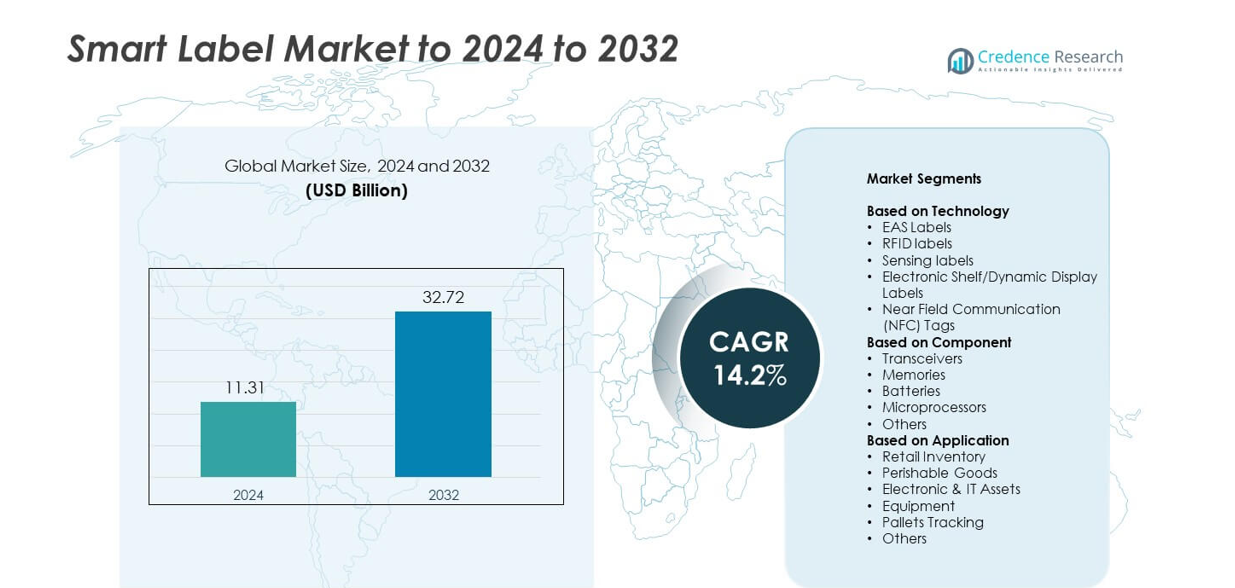
Smart Label Market size was valued USD 11.31 Billion in 2024 and is anticipated to reach USD 32.72 Billion by 2032, at a CAGR of 14.2% during the forecast period.
| REPORT ATTRIBUTE | DETAILS |
|---|---|
| Historical Period | 2020-2023 |
| Base Year | 2024 |
| Forecast Period | 2025-2032 |
| Smart Label Market Size 2024 | USD 11.31 Billion |
| Smart Label Market, CAGR | 14.2% |
| Smart Label Market Size 2032 | USD 32.72 Billion |
The SMART LABEL Market features key players such as Checkpoint Systems, Inc., Avery Dennison Corporation, Invengo Information Technology Co., Ltd., MPI Labels, NXP Semiconductors, Zebra Technologies Corporation, Murata Manufacturing Co., Ltd., CCL Industries, Impinj, Inc., and Alien Technology, LLC. These companies strengthen market growth through advanced RFID platforms, sensing technologies, and integrated label solutions that support real-time tracking and automation. Their focus on accuracy, supply-chain transparency, and embedded intelligence drives adoption across retail, logistics, and perishable goods. North America led the SMART LABEL Market in 2024 with an estimated 38% share, supported by high digital adoption, strong retail automation, and early RFID uptake. Europe followed with rising smart packaging investments, while Asia Pacific recorded fast expansion driven by manufacturing scale and rapid IoT integration.
Market Insights
- The Smart Label Market reached USD 11.31 Billion in 2024 and is projected to hit USD 32.72 Billion by 2032, advancing at a CAGR of 14.2%.
- Market growth is driven by high adoption of RFID labels, which held the largest share in 2024 due to rising demand for real-time tracking, automated inventory cycles, and enhanced supply-chain visibility.
- Key trends include wider use of electronic shelf labels in retail, expansion of sensing labels in cold-chain logistics, and increasing NFC tag deployment for consumer engagement across packaged goods.
- Competitive activity remains strong as players expand portfolios with IoT-enabled labels, integrated software platforms, and advanced semiconductor components, while pricing pressure and integration complexity restrain rapid adoption for small retailers.
- North America led the market with about 38% share, followed by Europe at around 32%, Asia Pacific close to 24%, and the rest of the world accounting for smaller contributions, reflecting strong retail digitization and industrial automation.
Market Segmentation Analysis:
By Technology
RFID labels dominated the smart label market in 2024 with about 46% share. RFID gained strong traction because retailers, logistics firms, and manufacturers used these tags for fast scanning, real-time tracking, and improved accuracy across large inventories. Adoption rose as companies shifted to automated workflows and omnichannel fulfilment. Sensing labels advanced in food and pharma due to rising demand for freshness and condition monitoring. Electronic shelf labels expanded in supermarkets as dynamic pricing improved margin control, while NFC tags grew in consumer goods for product authentication.
- For instance, the entire RAIN RFID industry shipped approximately 44.8 billion tag chips in 2023, confirming large-scale RFID adoption across retail and logistics.
By Component
Transceivers led the market in 2024 with nearly 38% share. Their leadership came from rising installations of RFID systems across retail, warehouses, and transport hubs. Transceivers enabled fast data exchange between tags and readers, which improved supply-chain visibility. Memories grew due to expanding data-rich labels used for compliance and traceability. Microprocessors advanced in high-value assets where advanced processing was needed. Batteries saw adoption in active smart labels used for long-range tracking and temperature-logging tasks.
- For instance, Infineon disclosed that it has shipped over 10 billion security controllers using its Integrity Guard architecture, which are widely embedded as core chips in secure RFID and smart label solutions.
By Application
Retail inventory held the largest share in 2024 with around 41% of the global market. Growth came from strong demand for accurate stock tracking, loss prevention, and automated checkout systems. Retailers adopted item-level tagging to reduce shrinkage and improve replenishment cycles across stores and warehouses. Perishable goods gained attention due to rising need for freshness monitoring. Electronic and IT assets grew as firms tracked expensive equipment, while pallet tracking expanded in logistics networks focused on reducing manual scanning and improving shipment visibility.
Key Growth Drivers
Rising demand for real-time inventory visibility
Rising demand for real-time inventory visibility remains a key growth driver in the smart label market. Retailers, logistics firms, and warehouses adopted smart labels to achieve faster cycle counts and improve stock accuracy across large networks. Real-time tracking reduced stockouts, strengthened demand planning, and enhanced fulfillment speed for high-volume operations. RFID-based systems also minimized manual labor and improved order precision, which encouraged broader installation across supermarkets, e-commerce hubs, and distribution centers that rely on automated workflows.
- For instance, Myer in Australia cut its daily inventory counting time for Apple products from 2.5 hours to just 15 minutes at RFID-enabled pilot stores after deploying item-level RFID across selected categories. For an entire apparel department, a full stocktake that previously took 24 labor hours was reduced to just 30 minutes with one person.
Expansion of omnichannel retail operations
Expansion of omnichannel retail operations continues to drive strong adoption of smart labels. Retailers require unified inventory data across online and offline channels to support click-and-collect services, same-day delivery, and multi-location order routing. Smart labels enable synchronized item visibility, faster restocking, and improved customer service during peak demand periods. As brands scale digital commerce, streamlined inventory coordination becomes essential, which increases smart label usage across global retail chains and strengthens long-term demand.
- For instance, Fabletics has rolled out its RFID-driven gStore inventory application in 74 stores and is adding about 20 locations each month, targeting coverage of more than 100 outlets to support real-time stock visibility for omnichannel fulfillment.
Growth in smart packaging and product authentication
Growth in smart packaging and authentication supports rising market demand as brands seek stronger protection and consumer engagement. Smart labels verify product integrity, detect tampering, and prevent counterfeiting in categories such as pharmaceuticals, premium beverages, and electronics. Sensing labels enhance freshness monitoring for food and cold-chain goods, improving safety and shelf-life control. The combined benefits strengthen brand trust, enable regulatory compliance, and expand adoption in sectors that require high security and product transparency.
Key Trend & Opportunity
Rapid shift toward electronic shelf labels and dynamic pricing
Rapid adoption of electronic shelf labels creates a major trend and opportunity as retailers push toward automated pricing systems. Dynamic displays allow stores to adjust prices instantly based on demand, inventory levels, or seasonal changes, reducing manual labor and printing waste. These labels improve price accuracy, enhance customer transparency, and support real-time promotions. Large hypermarkets and convenience chains accelerated deployments to boost margins and streamline store operations, opening strong opportunities for display-integrated smart label solutions.
- For instance, Pricer reports having sold more than 350 million electronic shelf labels to over 28,000 stores in more than 70 countries, underlining the rapid global shift to digital price labeling.
Growing adoption of IoT-enabled sensing labels
Growing adoption of IoT-enabled sensing labels creates significant opportunities across cold-chain logistics, pharmaceuticals, and industrial assets. These labels monitor temperature, humidity, vibration, and product condition with higher precision, supporting safer handling and regulatory compliance. IoT connectivity enhances decision-making during storage and transport, reducing spoilage and improving quality control. Expanding use in perishable foods, vaccines, biologics, and high-value equipment strengthens demand for intelligent monitoring labels with cloud-enabled analytics.
- For instance, Identiv received an initial order to manufacture 25 million IoT Pixel tags for a major ambient IoT platform, supporting item-level sensing and real-time monitoring across large supply chains.
Rising use of NFC tags for consumer engagement
Rising use of NFC tags offers strong opportunities for direct brand-to-consumer interaction. NFC-enabled packaging allows buyers to access product details, loyalty programs, authenticity checks, and promotional content with a simple smartphone tap. This enhances user experience and strengthens customer engagement during purchase and post-purchase stages. Growing interest in interactive packaging and digital marketing pushes brands to integrate NFC tags across cosmetics, apparel, beverages, and premium goods.
Key Challenge
High deployment and integration costs
High deployment and integration costs remain a major challenge, especially for small and medium retailers. RFID systems, electronic shelf labels, and sensing technologies require investment in hardware, software platforms, network infrastructure, and continuous maintenance. Staff training and system integration further raise expenses, slowing adoption in cost-sensitive markets. Many businesses delay full-scale deployment due to budget limits, which restricts fast expansion in emerging regions and reduces speed of digital transformation.
Concerns about data security and privacy
Concerns about data security and privacy hinder adoption as smart labels generate large volumes of tracking and product-level information. Unauthorized access, data leaks, and misuse pose risks for retailers, logistics companies, and consumers. Firms must secure communication channels, encrypt data, and meet regional privacy regulations, which raises deployment complexity and operating costs. These concerns force organizations to invest in advanced cybersecurity measures and slow adoption among users wary of data vulnerabilities.
Regional Analysis
North America
North America held the highest share of the smart label market in 2024 with about 38%. Strong adoption came from large retailers, logistics providers, and e-commerce fulfillment centers seeking accurate and real-time inventory tracking. RFID expansion across hypermarkets, electronics chains, and warehouse automation systems boosted demand. Electronic shelf labels gained traction as brands focused on dynamic pricing and reduced labor costs. Widespread use of sensing labels in cold-chain food, pharmaceuticals, and healthcare supported consistent growth. The region continued to advance due to mature digital infrastructure, strong IoT integration, and rapid investment in automated retail technologies.
Europe
Europe accounted for nearly 30% of the smart label market in 2024. High regulatory focus on product transparency, traceability, and sustainability supported adoption across food, pharmaceuticals, and consumer goods. Retailers embraced electronic shelf labels to manage dynamic pricing, especially in France, Germany, and the Nordics. RFID deployment expanded as brands strengthened anti-counterfeit protection and logistics efficiency. Growth accelerated through rising use of NFC-enabled packaging for customer engagement. Strong digital transformation across supply chains helped increase deployment in supermarkets, fashion chains, and industrial inventory systems across major European economies.
Asia Pacific
Asia Pacific captured around 22% share of the smart label market in 2024. Rapid expansion in retail, e-commerce, and manufacturing created strong demand for RFID and sensing labels. China, Japan, and South Korea led adoption due to large-scale automation, strict quality control needs, and growth in omnichannel retail. Rising logistics activity and cold-chain modernization supported wider use of condition-monitoring labels. NFC-enabled packaging gained momentum in consumer electronics and premium goods. Faster digitalization, rising disposable incomes, and strong government support for smart supply-chain technologies continued to boost market penetration across the region.
Latin America
Latin America held close to 6% of the smart label market in 2024. Adoption grew steadily as retail chains and logistics operators modernized inventory tracking systems. Brazil, Mexico, and Chile led regional demand due to expanding supermarkets, rising e-commerce penetration, and stronger focus on product authentication. RFID-based systems helped reduce shrinkage and improve stock accuracy. Growth in cold-chain distribution encouraged use of sensing labels for perishables. Despite cost barriers, improving digital infrastructure supported gradual adoption of electronic shelf labels across urban retail markets.
Middle East & Africa
Middle East & Africa accounted for about 4% share of the smart label market in 2024. Demand increased in retail, food distribution, and pharmaceuticals as businesses strengthened tracking accuracy and supply-chain visibility. The UAE, Saudi Arabia, and South Africa led adoption due to rising smart retail investments and expansion of automated warehouses. RFID labels supported asset tracking in logistics hubs, while sensing labels gained interest in temperature-sensitive goods. Although penetration remained lower than other regions, ongoing digital transformation and growth in organized retail contributed to steady market expansion.
Market Segmentations:
By Technology
- EAS Labels
- RFID labels
- Sensing labels
- Electronic Shelf/Dynamic Display Labels
- Near Field Communication (NFC) Tags
By Component
- Transceivers
- Memories
- Batteries
- Microprocessors
- Others
By Application
- Retail Inventory
- Perishable Goods
- Electronic & IT Assets
- Equipment
- Pallets Tracking
- Others
By Geography
- North America
- U.S.
- Canada
- Mexico
- Europe
- Germany
- France
- U.K.
- Italy
- Spain
- Rest of Europe
- Asia Pacific
- China
- Japan
- India
- South Korea
- South-east Asia
- Rest of Asia Pacific
- Latin America
- Brazil
- Argentina
- Rest of Latin America
- Middle East & Africa
- GCC Countries
- South Africa
- Rest of the Middle East and Africa
Competitive Landscape
The SMART LABEL Market features leading players such as Checkpoint Systems, Inc., AVERY DENNISON CORPORATION, Invengo Information Technology Co., Ltd., MPI Labels, NXP Semiconductors, Zebra Technologies Corporation, Murata Manufacturing Co., Ltd., CCL Industries, Impinj, Inc., and Alien Technology, LLC. Market competition intensified as companies focused on expanding RFID, NFC, and sensing label portfolios to meet rising demand across retail, logistics, healthcare, and manufacturing. Vendors invested in integrated software platforms that linked label data with enterprise systems to improve automation and traceability. Partnerships with retailers, packaging converters, and supply-chain providers supported wider deployment across warehouses and stores. Firms accelerated innovation in low-power chips, thinner label structures, and eco-friendly materials to address sustainability priorities. Global expansion strategies, including new production units and regional distribution partnerships, helped strengthen access to growing markets in Asia Pacific, Europe, and North America.
Key Player Analysis
- Checkpoint Systems, Inc.
- AVERY DENNISON CORPORATION
- Invengo Information Technology Co., Ltd.
- MPI Labels
- NXP Semiconductors
- Zebra Technologies Corporation
- Murata Manufacturing Co., Ltd.
- CCL Industries
- Impinj, Inc.
- Alien Technology, LLC.
Recent Developments
- In 2025, Avery Dennison showcased its latest smart labeling and digital identification solutions at the Retail Leadership Summit 2025 in Mumbai, India.
- In 2025, Zebra Technologies introduced Aurora Velocity scan tunnel solutions aimed at enhancing automation and accuracy in smart label reading applications for warehouses and supply chains.
- In 2025, NXP partnered with Linxens IoT Solutions and UnaBiz to launch a smart label program aimed at transforming logistics, supply chain sustainability, and real-time item-level tracking with IoT connectivity integration.
Report Coverage
The research report offers an in-depth analysis based on Technology, Component, Application and Geography. It details leading market players, providing an overview of their business, product offerings, investments, revenue streams, and key applications. Additionally, the report includes insights into the competitive environment, SWOT analysis, current market trends, as well as the primary drivers and constraints. Furthermore, it discusses various factors that have driven market expansion in recent years. The report also explores market dynamics, regulatory scenarios, and technological advancements that are shaping the industry. It assesses the impact of external factors and global economic changes on market growth. Lastly, it provides strategic recommendations for new entrants and established companies to navigate the complexities of the market.
Future Outlook
- The smart label market will expand as retailers adopt automated tracking systems.
- RFID labels will gain wider use due to rising need for faster stock verification.
- Electronic shelf labels will grow as stores shift toward digital pricing models.
- NFC-enabled labels will see higher demand as brands focus on consumer engagement.
- IoT-linked sensing labels will increase adoption in cold-chain and pharma logistics.
- Supply-chain operators will enhance real-time visibility by integrating cloud-based smart label platforms.
- Growth will accelerate in e-commerce due to multi-location inventory needs.
- Manufacturers will deploy smart labels to strengthen product authentication and reduce counterfeiting.
- Adoption will rise in developing regions as hardware costs gradually fall.
- Sustainability goals will push companies to adopt energy-efficient and recyclable smart label designs.

Request a Free Sample
Fill in your details and we'll send you a free sample report.
- Sample data tables & charts
- Research methodology
Market Dynamics
Real-time inventory visibility
Retailers, logistics firms, and warehouses are adopting smart labels to enable faster cycle counts and improve stock accuracy across large networks. Real-time tracking reduces stockouts, strengthens demand planning, and enhances fulfillment speed, making smart labels essential for automated workflows.
Expansion of omnichannel retail operations
The growth of omnichannel retail requires unified inventory data across online and offline channels. Smart labels enable synchronized item visibility, faster restocking, and improved customer service, supporting click-and-collect, same-day delivery, and multi-location order routing.
Growth in smart packaging and product authentication
Brands are increasingly using smart labels to verify product integrity, detect tampering, and prevent counterfeiting, especially in pharmaceuticals, premium beverages, and electronics. Sensing labels also enhance freshness monitoring for food and cold-chain goods, supporting regulatory compliance and brand trust.
Rapid adoption of electronic shelf labels and dynamic pricing
Retailers are deploying electronic shelf labels to automate pricing, reduce manual labor, and improve price accuracy. Dynamic pricing capabilities allow stores to respond instantly to demand and inventory changes, driving adoption in supermarkets and large retail chains.
IoT-enabled sensing labels for cold-chain and pharma logistics
The need for precise monitoring of temperature, humidity, and product condition in cold-chain logistics and pharmaceuticals is driving the adoption of IoT-enabled sensing labels. These labels support regulatory compliance, reduce spoilage, and improve quality control across supply chains.
Need a Custom Version of This Report?
Tailor the scope, geography, or segments to your exact requirements.
- Custom geography or segment scope
- Direct access to our analyst team
Frequently Asked Questions
What is the current market size for Smart Label Market, and what is its projected size in 2032?
At what Compound Annual Growth Rate is the Smart Label Market projected to grow between 2025 and 2032?
What are the key drivers for the growth of the smart label market?
Which is the major segment in the smart label market by Labelling Technology?
Who are the leading companies in the Smart Label Market?
Table of Content
Chapter 1 Market Segmentation
- 1.1 Segmentation Framework
- 1.1.1 Product and Service Classification
- 1.1.2 Application and End-Use Classification
- 1.1.3 Technology and Solution Classification
- 1.1.4 Customer and Distribution Channel Classification
- 1.1.5 Geographic Segmentation
- 1.1.6 Market Segment Definitions and Boundaries
- 1.2 By Component
- 1.2.1 Transceivers
- 1.2.2 Memories
- 1.2.3 Batteries
- 1.2.4 Microprocessors
- 1.2.5 Others
- 1.3 By Technology
- 1.3.1 EAS Labels
- 1.3.2 RFID labels
- 1.3.3 Sensing labels
- 1.3.4 Electronic Shelf/Dynamic Display Labels
- 1.3.5 Near Field Communication (NFC) Tags
- 1.4 By Application
- 1.4.1 Retail Inventory
- 1.4.2 Perishable Goods
- 1.4.3 Electronic & IT Assets
- 1.4.4 Equipment
- 1.4.5 Pallets Tracking
- 1.4.6 Others
Chapter 2 Introduction
- 2.1 Report Objectives and Scope
- 2.2 Product Definition and Industry Terminology
- 2.3 Market Inclusions and Exclusions
- 2.4 Research Process
- 2.4.1 Primary Research and Expert Interviews
- 2.4.2 Secondary Research and Source Review
- 2.4.3 Top-Down and Bottom-Up Estimation
- 2.4.4 Data Triangulation and Verification
- 2.5 Market Size Measurement Basis
- 2.5.1 2024: USD 11.31 Billion → 2032: USD 32.72 Billion
- 2.6 Historical and Forecast Reference Periods
- 2.6.1 Base Year: 2024
- 2.6.2 Forecast Period: 2024-2032
- 2.7 Research Assumptions and Limitations
Chapter 3 Executive Summary
- 3.1 Market Snapshot and Key Findings
- 3.2 Base-Year Market Size, 2024
- 3.3 Forecast Market Size, 2032
- 3.4 Revenue and Volume Growth Outlook
- 3.5 Key Demand and Supply Indicators
- 3.6 Leading Market Segments
- 3.7 Fastest-Growing Market Opportunities
- 3.8 Regional Performance Highlights
- 3.9 Technology and Industry Transformation
- 3.10 Competitive Landscape Summary
- 3.11 Analyst View and Strategic Implications
Chapter 4 Global Smart Label Market Trends and Developments
- 4.1 Historical Industry Development
- 4.2 Recent Market Trends and Developments
- 4.3 Demand and Customer Behavior Trends
- 4.4 Technology and Product Innovation
- 4.5 Artificial Intelligence, Automation and Digitalization
- 4.6 Local Manufacturing and Supply Chain Realignment
- 4.7 Industry Partnerships, Mergers and Acquisitions
- 4.8 Sustainability and Circular Economy Developments
- 4.9 Government and Private Sector Investment Trends
- 4.10 Emerging Business Models and Commercialization
- 4.11 Industry Developments and Announcements
Chapter 5 Global Smart Label Market Production, Supply and Demand Analysis
- 5.1 Demand Trend and Consumption Analysis
- 5.2 Demand Forecast, 2024-2032
- 5.3 Production and Output Trend
- 5.4 Production and Output Forecast, 2024-2032
- 5.5 Installed Capacity and Capacity Utilization
- 5.6 Company-Wise Production Plants and Statistics
- 5.6.1 Installed Production Capacity
- 5.6.2 Actual Production
- 5.6.3 Planned Capacity and Expansion Targets
- 5.7 Supply Chain Structure and Procurement Trends
- 5.8 Supply-Demand Gap and Bottlenecks
- 5.9 Import Dependence and Sourcing Structure
- 5.10 Contract Manufacturing and Outsourcing
- 5.11 Regional Supply and Demand Concentration
Chapter 6 Global Smart Label Market Pricing Analysis
- 6.1 Pricing Structure and Measurement
- 6.2 Historical Pricing Trends
- 6.3 Pricing Outlook, 2024-2032
- 6.4 Average Selling Price and Unit Economics
- 6.5 Pricing by Product and Market Segment
- 6.6 Geographic Pricing Differences
- 6.7 Key Input, Energy, Labor and Logistics Costs
- 6.8 Contract Pricing and Purchasing Models
- 6.9 Pricing Sensitivity and Competitive Positioning
- 6.10 Price, Margin and Profitability Implications
Chapter 7 Global Smart Label Market Dynamics
- 7.1 Market Growth Drivers
- 7.1.1 Demand-Side Drivers
- 7.1.2 Technology and Innovation Drivers
- 7.1.3 Infrastructure and Investment Drivers
- 7.1.4 Regulatory and Policy Drivers
- 7.2 Market Restraints
- 7.2.1 Cost and Affordability Constraints
- 7.2.2 Technology and Adoption Barriers
- 7.2.3 Supply Chain and Operational Constraints
- 7.3 Market Challenges
- 7.3.1 Competitive Pressure and Margin Erosion
- 7.3.2 Skills, Infrastructure and Implementation Gaps
- 7.4 Emerging Market Opportunities
- 7.5 Market Dynamics Impact and Time-Horizon Assessment
Chapter 8 Global Smart Label Value Chain Analysis
- 8.1 Industry Value Chain Overview
- 8.2 Upstream Suppliers and Critical Inputs
- 8.3 Technology and Component Providers
- 8.4 Manufacturing or Service Delivery
- 8.5 Distribution, Channel Partners and Integrators
- 8.6 Downstream Applications and End Users
- 8.7 Value Addition and Profit Pools
- 8.8 Vertical Integration and Outsourcing
- 8.9 Supplier Concentration and Risk
- 8.10 Supply Chain Localization and Resilience
Chapter 9 Global Smart Label Market Regulations and Policies
- 9.1 Relevant Laws, Standards and Compliance Frameworks
- 9.2 Product, Service, Safety and Quality Requirements
- 9.3 Government Policies, Incentives and Subsidies
- 9.4 Imports, Exports and Trade Barriers
- 9.5 Public Procurement and Local Content Requirements
- 9.6 Environmental and Sustainability Compliance
- 9.7 Data Protection, AI and Cybersecurity Compliance
- 9.8 Upcoming Policy Changes and Market Implications
Chapter 10 Global Smart Label Market Hotspots and Opportunities
- 10.1 Market Opportunity Mapping and Growth Hotspots
- 10.2 High-Growth Applications and Customer Groups
- 10.3 Underserved Markets and White-Space Opportunities
- 10.4 Emerging Technology and Product Opportunities
- 10.5 New Capacity and Investment Hotspots
- 10.6 Market Entry and Expansion Opportunities
- 10.7 Distribution and Partnership Opportunities
- 10.8 Near-Term and Long-Term Commercial Potential
- 10.9 Opportunity Attractiveness and Execution Risks
Chapter 11 Global Smart Label Market Outlook, 2024-2032
- 11.1 Market Size and Analysis
- 11.1.1 Revenue (Market Measurement: 2024: USD 11.31 Billion → 2032: USD 32.72 Billion)
- 11.1.2 Market Volume and Quantity Sold
- 11.1.3 Historical Market Size
- 11.1.4 Base-Year Market Size, 2024
- 11.2 Market Forecast, 2024-2032
- 11.2.1 Revenue Forecast to 2032
- 11.2.2 Volume Forecast to 2032
- 11.2.3 CAGR and Year-on-Year Growth
- 11.2.4 Incremental Revenue Opportunity
- 11.3 Forecast Assumptions and Scenario Analysis
- 11.3.1 Base-Case Forecast
- 11.3.2 Optimistic and Conservative Scenarios
- 11.3.3 Technology, Pricing and Policy Sensitivities
- 11.4 Market Attractiveness and Growth Outlook
Chapter 12 Global Smart Label Market Segmentation and Outlook
- 12.1 Segmentation Summary and Market Shares, 2024
- 12.2 Largest and Fastest-Growing Segments
- 12.3 By Component - Market Size and Forecast, 2024-2032
- 12.3.1 Segment Definition and Scope
- 12.3.2 Historical Market Size
- 12.3.3 Revenue Forecast, 2024-2032
- 12.3.4 Volume Forecast, 2024-2032
- 12.3.5 Base-Year Market Share, 2024
- 12.3.6 Segment CAGR and Growth Drivers
- 12.3.7 Subsegment Market Size and Forecast
- 12.3.7.1 Transceivers
- 12.3.7.2 Memories
- 12.3.7.3 Batteries
- 12.3.7.4 Microprocessors
- 12.3.7.5 Others
- 12.3.8 Subsegment Pricing and Adoption Trends
- 12.3.9 Leading Suppliers and Competition
- 12.3.10 Regional Demand and Opportunities
- 12.4 By Technology - Market Size and Forecast, 2024-2032
- 12.4.1 Segment Definition and Scope
- 12.4.2 Historical Market Size
- 12.4.3 Revenue Forecast, 2024-2032
- 12.4.4 Volume Forecast, 2024-2032
- 12.4.5 Base-Year Market Share, 2024
- 12.4.6 Segment CAGR and Growth Drivers
- 12.4.7 Subsegment Market Size and Forecast
- 12.4.7.1 EAS Labels
- 12.4.7.2 RFID labels
- 12.4.7.3 Sensing labels
- 12.4.7.4 Electronic Shelf/Dynamic Display Labels
- 12.4.7.5 Near Field Communication (NFC) Tags
- 12.4.8 Subsegment Pricing and Adoption Trends
- 12.4.9 Leading Suppliers and Competition
- 12.4.10 Regional Demand and Opportunities
- 12.5 By Application - Market Size and Forecast, 2024-2032
- 12.5.1 Segment Definition and Scope
- 12.5.2 Historical Market Size
- 12.5.3 Revenue Forecast, 2024-2032
- 12.5.4 Volume Forecast, 2024-2032
- 12.5.5 Base-Year Market Share, 2024
- 12.5.6 Segment CAGR and Growth Drivers
- 12.5.7 Subsegment Market Size and Forecast
- 12.5.7.1 Retail Inventory
- 12.5.7.2 Perishable Goods
- 12.5.7.3 Electronic & IT Assets
- 12.5.7.4 Equipment
- 12.5.7.5 Pallets Tracking
- 12.5.7.6 Others
- 12.5.8 Subsegment Pricing and Adoption Trends
- 12.5.9 Leading Suppliers and Competition
- 12.5.10 Regional Demand and Opportunities
- 12.6 Segment Growth Comparison
- 12.7 Segment Attractiveness and Priority Matrix
Chapter 13 Global Smart Label End-Use and Application Market Outlook
- 13.1 End-Use Industry and Customer Demand Structure
- 13.2 Leading Applications and Customer Groups
- 13.3 End-Use Market Size, Share and Forecast
- 13.4 Major End-Use Industry Deep Dives
- 13.4.1 Customer Requirements and Use Cases
- 13.4.2 Demand and Replacement Cycles
- 13.4.3 Technical and Regulatory Considerations
- 13.4.4 Purchasing and Procurement Models
- 13.4.5 Leading Vendors and Distribution Channels
- 13.4.6 Forecast and Commercial Opportunities
- 13.5 Emerging Applications and Cross-Segment Demand
- 13.6 End-Use Industry Investment Priorities
Chapter 14 Global Smart Label Geographic Market Outlook, 2024-2032
- 14.1 Regional Market Size and Share, 2024
- 14.2 Regional Market Forecast, 2024-2032
- 14.3 Regional Pricing, Production and Demand Differences
- 14.4 North America
- 14.4.1 United States
- 14.4.2 Canada
- 14.4.3 Mexico
- 14.5 Europe
- 14.5.1 Germany
- 14.5.2 France
- 14.5.3 Italy
- 14.5.4 United Kingdom
- 14.5.5 Spain
- 14.5.6 Poland
- 14.5.7 Russia
- 14.5.8 Netherlands
- 14.5.9 Belgium
- 14.5.10 Sweden
- 14.5.11 Denmark
- 14.5.12 Norway
- 14.5.13 Rest of Europe
- 14.6 Asia Pacific
- 14.6.1 China
- 14.6.2 India
- 14.6.3 Japan
- 14.6.4 South Korea
- 14.6.5 Thailand
- 14.6.6 Indonesia
- 14.6.7 Vietnam
- 14.6.8 Malaysia
- 14.6.9 Australia
- 14.6.10 Rest of Asia Pacific
- 14.7 Latin America
- 14.7.1 Brazil
- 14.7.2 Argentina
- 14.7.3 Colombia
- 14.7.4 Chile
- 14.7.5 Rest of Latin America
- 14.8 Middle East
- 14.8.1 Saudi Arabia
- 14.8.2 United Arab Emirates
- 14.8.3 Turkey
- 14.8.4 Israel
- 14.8.5 Iran
- 14.8.6 Rest of the Middle East
- 14.9 Africa
- 14.9.1 South Africa
- 14.9.2 Egypt
- 14.9.3 Nigeria
- 14.9.4 Morocco
- 14.9.5 Rest of Africa
- 14.10 Regional Investment, Policy and Supply Chain Differences
- 14.11 Regional Competitive Landscape
- 14.12 Geographic Growth Hotspots
Chapter 15 Global Smart Label Technology, Innovation and Sustainability Outlook
- 15.1 Technology Landscape and Maturity
- 15.2 Product, Process and Service Innovation
- 15.3 AI, Automation and Digital Tools in the Industry
- 15.4 Technology Adoption and Performance Benchmarking
- 15.5 Innovation Pipeline and R&D Investment
- 15.6 Patent and Intellectual Property Trends
- 15.7 Energy Efficiency and Resource Management
- 15.8 Sustainability, Recycling and Circularity
- 15.9 Technology Roadmap, 2024-2032
- 15.10 Risks of Obsolescence and Technology Substitution
Chapter 16 Global Smart Label Market Key Strategic Imperatives
- 16.1 Growth and Market Entry Priorities
- 16.2 High-Return Products and Segments
- 16.3 Pricing, Profitability and Cost Optimization
- 16.4 Technology Investment and Product Differentiation
- 16.5 Supply Chain Localization and Resilience
- 16.6 Distribution and Customer Acquisition
- 16.7 Partnership, Acquisition and Capacity Strategy
- 16.8 Regional Expansion Priorities
- 16.9 Short-, Medium- and Long-Term Actions
Chapter 17 Competition Outlook
- 17.1 Industry Competition Characteristics
- 17.2 Market Structure and Concentration
- 17.3 Market Share and Competitive Positioning, 2024
- 17.4 Company-Wise Revenue and Product Benchmarking
- 17.5 Production and Service Capacity Benchmarking
- 17.6 Technology, Pricing and Differentiation
- 17.7 Regional Footprint and Distribution Strength
- 17.8 Mergers, Acquisitions and Strategic Alliances
- 17.9 New Entrants and Competitive Threats
- 17.10 Porter's Five Forces and Industry Attractiveness
- 17.11 Competitive Outlook, 2024-2032
Chapter 18 Company Profiles
- 18.1 Company Coverage and Selection Criteria
- 18.2 Checkpoint Systems, Inc.
- 18.2.1 Business Description
- 18.2.2 Company Ownership and Geographic Presence
- 18.2.3 Product and Service Portfolio
- 18.2.4 Manufacturing and Operating Footprint
- 18.2.5 Production Capacity and Expansion Plans
- 18.2.6 Financial Performance and Investment
- 18.2.7 Market Share and Competitive Position
- 18.2.8 Technology and Innovation Capabilities
- 18.2.9 Strategic Alliances or Partnerships
- 18.2.10 Recent Developments
- 18.2.11 Growth Strategy and Outlook
- 18.3 Avery Dennison Corporation
- 18.4 Invengo Information Technology Co., Ltd.
- 18.5 MPI Labels
- 18.6 NXP Semiconductors
- 18.7 Zebra Technologies Corporation
- 18.8 Murata Manufacturing Co., Ltd.
- 18.9 CCL Industries
- 18.10 Impinj, Inc.
- 18.11 Alien Technology, LLC.
- 18.12 Other Relevant Market Participants
Note: Every listed company is profiled on the structure shown under the first company. The company list is preliminary and may change based on research findings, market developments, data availability and client requirements.
Chapter 19 Disclaimer
- 19.1 Research and Forecast Disclaimer
- 19.2 Data Source and Estimation Limitations
Note: The depth of individual sections depends on data availability for this market. Volume, capacity, trade and other unit-based metrics are included where applicable.

