
Market Overview
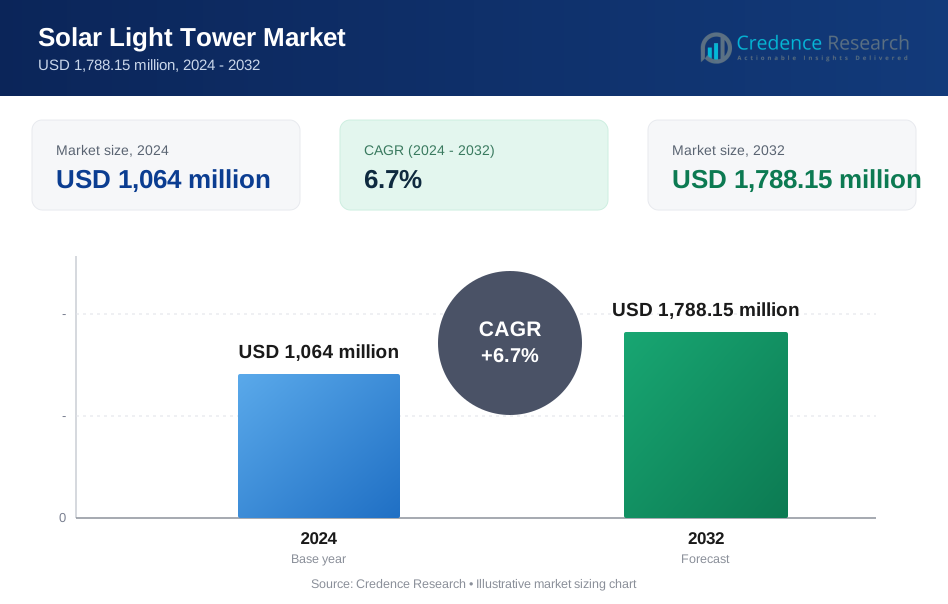
The Solar Light Tower Market size was valued at USD 1,064 million in 2024 and is anticipated to reach USD 1,788.15 million by 2032, growing at a CAGR of 6.7% during the forecast period.
| REPORT ATTRIBUTE | DETAILS |
|---|---|
| Historical Period | 2020-2023 |
| Base Year | 2024 |
| Forecast Period | 2025-2032 |
| Solar Light Tower Market Size 2024 | USD 1,064 million |
| Solar Light Tower Market, CAGR | 6.7% |
| Solar Light Tower Market Size 2032 | USD 1,788.15 million |
Solar Light Tower Market is supported by the strong presence of established manufacturers and rental solution providers focused on energy-efficient and mobile lighting systems. Key players such as Atlas Copco, Generac Mobile Products, Caterpillar, Larson Electronics, CleanLight, Biglux Innovation, National Signal, and GREENSKY Mobile Power & Light continue to strengthen their portfolios through advanced LED integration, hybrid designs, and expanded rental fleets to address construction, infrastructure, and emergency response demand. Regionally, North America leads the Solar Light Tower Market with a 34.8% market share in 2024, driven by strict emission regulations, high rental penetration, and large-scale infrastructure projects. Europe follows with 27.6% market share, supported by decarbonization mandates, while Asia Pacific holds 22.9% market share, fueled by rapid infrastructure expansion and growing adoption of off-grid lighting solutions.
Market Insights
- Solar Light Tower Market was valued at USD 1,064 million in 2024 and is projected to reach USD 1,788.15 million by 2032, registering a CAGR of 6.7% during the forecast period.
- Market growth is driven by rising infrastructure and construction activities, increasing adoption of low-emission lighting solutions, and strong demand from rental companies for fuel-free and low-maintenance equipment.
- Key trends include rapid adoption of LED lighting holding 9% segment share in 2024, growing preference for mobile units with 72.4% share, and increasing integration of hybrid and smart energy management systems.
- Market players focus on fleet expansion, advanced LED and battery technologies, and rental-based deployment strategies to strengthen presence across construction, mining, and emergency response applications.
- Regionally, North America led with 8% market share in 2024, followed by Europe at 27.6%, Asia Pacific at 22.9%, Latin America at 8.1%, and Middle East & Africa at 6.6%, reflecting broad global adoption.
Market Segmentation Analysis:
By Channel:
The Solar Light Tower Market, by channel, is led by the rental segment, which accounted for 58.6% market share in 2024, surpassing direct sales. Rental dominance is driven by high upfront equipment costs, short-term project requirements, and the preference of construction, mining, and event management companies for flexible, asset-light solutions. Rental models reduce capital expenditure while ensuring access to advanced LED-based solar towers with lower operating costs. Additionally, rental providers frequently upgrade fleets with hybrid and fully solar units, further strengthening rental adoption across infrastructure, oil & gas, and emergency response applications.
- For instance, Dayim Equipment Rental in Saudi Arabia added 75 Atlas Copco HiLight S2+ solar LED towers to its fleet, featuring protected solar panels that deploy from the canopy for easy transport and setup in harsh conditions.
By Product:
Based on product type, the Solar Light Tower Market is dominated by mobile solar light towers, which captured 72.4% market share in 2024. Strong demand stems from their portability, rapid deployment capability, and suitability for remote and off-grid sites. Mobile units are widely used in road construction, mining operations, disaster relief, and outdoor events where grid access is limited. Their integrated trailers, adjustable masts, and hybrid charging options enhance operational flexibility. In contrast, stationary towers serve niche, long-term installations, while mobility remains the key driver supporting higher adoption and sustained demand growth.
- For instance, Greenshine New Energy's mobile solar light towers, equipped with 4 x 100W floodlights and 150Ah GEL batteries, provide silent, portable illumination for construction sites without grid connections.
By Lighting:
By lighting type, LED lighting held the dominant position in the Solar Light Tower Market with a 65.9% market share in 2024. LED dominance is supported by higher luminous efficiency, longer lifespan, and significantly lower energy consumption compared to metal halide and electric alternatives. LEDs maximize solar energy utilization, extend operating hours, and minimize maintenance requirements, making them ideal for continuous outdoor operations. Increasing regulatory focus on energy efficiency and carbon reduction further accelerates LED adoption, while declining LED component costs continue to reinforce its leadership across construction, mining, and municipal applications.
Key Growth Drivers
Expansion of Infrastructure and Construction Activities
The Solar Light Tower Market is strongly supported by increasing infrastructure and construction activities across roads, railways, mining sites, and urban development projects. Governments and private contractors require reliable temporary lighting for night operations, safety compliance, and productivity enhancement. Solar light towers meet these needs by offering rapid deployment, mobility, and off-grid functionality without fuel dependence. Rising investments in large-scale infrastructure projects in emerging economies, combined with ongoing maintenance and redevelopment in developed regions, continue to drive consistent demand for solar-powered lighting solutions.
- For instance, solar light towers supported the FIFA World Cup 2022 in Qatar by providing emission-free illumination in parking areas and fan zones. This deployment ensured safety and productivity for large-scale event infrastructure without relying on fuel-powered alternatives.
Rising Focus on Sustainable and Low-Emission Solutions
Sustainability initiatives and stricter emission regulations are major drivers of the Solar Light Tower Market. Construction and mining operators are actively reducing diesel usage to comply with environmental norms and corporate sustainability targets. Solar light towers provide zero-emission operation, lower noise levels, and reduced operating costs, making them attractive alternatives to conventional diesel units. Increasing adoption of green procurement policies by public authorities and private enterprises further accelerates the shift toward solar-powered lighting systems across temporary and remote applications.
- For instance, Atlas Copco's HiLight MS 4 and MS 5 solar light towers reduce CO2 emissions by up to 8 tonnes per year per unit versus diesel models. These towers provide up to 85 hours of autonomy with lithium batteries and solar recharging in as little as 4-5 hours.
Growth of Rental Equipment and Temporary Power Services
The expansion of rental equipment services significantly boosts the Solar Light Tower Market. Rental companies prefer solar light towers due to reduced fuel expenses, lower maintenance requirements, and longer operational life. End users benefit from cost-effective access without capital investment, particularly for short-term and seasonal projects. Growing demand from construction, events, and emergency services encourages rental providers to expand solar and hybrid fleets, strengthening market penetration and supporting long-term growth.
Key Trends & Opportunities
Technological Advancements in Solar and LED Integration
Technological progress in photovoltaic efficiency, battery storage, and LED lighting creates strong growth opportunities in the Solar Light Tower Market. High-performance solar panels and advanced batteries extend operating hours and improve reliability in diverse environments. Integrated energy management systems enable optimized power usage and remote monitoring. These advancements enhance performance, reduce downtime, and increase user confidence, driving wider adoption across construction, infrastructure, and industrial applications.
- For instance, Trina Solar's n-type HJT modules achieve 25.44% conversion efficiency, certified by Fraunhofer ISE, supporting compact, high-output designs for light towers in space-limited sites.
Increasing Demand from Emergency and Disaster Management
Rising demand from emergency response and disaster management agencies presents a key opportunity for the Solar Light Tower Market. Solar light towers provide immediate, off-grid illumination for rescue operations, temporary shelters, and infrastructure recovery efforts. Their quiet operation, portability, and independence from fuel supply chains make them ideal for crisis situations. Governments increasingly deploy mobile solar lighting units for preparedness and rapid response, expanding the market beyond traditional construction applications.
- For instance, in 2022, the USDA Forest Service deployed 20 solar light towers from Emergency Command Support on the Six Rivers Fire in California. These units achieved 100% fuel reduction, supporting nighttime operations without diesel generators.
Key Challenges
High Initial Equipment Cost Compared to Conventional Towers
High upfront costs remain a significant challenge for the Solar Light Tower Market. Advanced solar panels, batteries, and LED components increase manufacturing and purchase expenses compared to diesel-powered light towers. Price sensitivity among small contractors and developing regions limits direct ownership adoption. Although lifecycle and operating costs are lower, the initial investment barrier slows widespread penetration, keeping demand concentrated within rental channels.
Performance Limitations in Low Sunlight Conditions
Performance variability in regions with limited sunlight poses another challenge for the Solar Light Tower Market. Extended cloudy periods or seasonal variations can reduce charging efficiency and operating duration. While hybrid models help mitigate this issue, fully solar systems may face reliability concerns in certain geographies. End users requiring uninterrupted lighting may remain cautious, emphasizing the need for continued innovation in battery capacity and energy optimization technologies.
Regional Analysis
North America
The Solar Light Tower Market in North America accounted for 34.8% market share in 2024, supported by strong adoption across construction, infrastructure maintenance, and emergency response applications. The United States leads regional demand due to strict emission regulations, high labor safety standards, and widespread use of rental equipment. Contractors increasingly replace diesel-powered towers with solar and hybrid alternatives to reduce fuel costs and comply with sustainability mandates. Strong presence of established rental companies and continuous investment in highway, utility, and renewable infrastructure projects further reinforce market growth across the region.
Europe
Europe represented 27.6% market share in 2024 in the Solar Light Tower Market, driven by stringent environmental regulations and aggressive decarbonization targets. Countries such as Germany, France, and the United Kingdom actively promote low-emission construction practices, accelerating solar light tower adoption. Government-led infrastructure upgrades, rail modernization, and urban redevelopment projects create steady demand for temporary lighting solutions. High awareness of noise reduction and fuel efficiency benefits further supports market penetration. The growing preference for rental-based solar equipment strengthens adoption across public works and private construction activities.
Asia Pacific
The Asia Pacific Solar Light Tower Market captured 22.9% market share in 2024, supported by rapid infrastructure development and expanding construction activity across China, India, and Southeast Asia. Large-scale investments in highways, smart cities, mining operations, and renewable energy projects generate strong demand for mobile and off-grid lighting solutions. Increasing government focus on reducing diesel dependency and improving site safety further boosts adoption. Although cost sensitivity remains a factor, rising rental penetration and improving awareness of long-term operating savings continue to drive steady regional market expansion.
Latin America
Latin America accounted for 8.1% market share in 2024 within the Solar Light Tower Market, driven by infrastructure expansion and mining activities across Brazil, Chile, and Mexico. Remote project locations and limited grid access increase reliance on mobile lighting solutions. Solar light towers gain traction due to rising fuel costs and growing interest in sustainable construction practices. Government-led road and energy projects, combined with expanding rental equipment networks, support market growth. Adoption remains concentrated in large projects, while gradual cost reduction improves accessibility across smaller contractors.
Middle East & Africa
The Middle East & Africa Solar Light Tower Market held 6.6% market share in 2024, supported by infrastructure development, oil & gas operations, and large-scale construction projects. Harsh operating environments and remote project sites create strong demand for reliable off-grid lighting. Solar light towers benefit from abundant sunlight, reducing fuel logistics and operational costs. Increasing adoption in temporary camps, events, and emergency response further supports growth. Expanding rental services and rising sustainability awareness contribute to gradual but consistent market penetration across the region.
Market Segmentations:
By Channel
- Sales
- Rental
By Product
- Stationary
- Mobile
By Lighting
- Metal Halide
- LED
- Electric
- Others
By Technology
- Manual lifting system
- Hydraulic lifting system
By Application
- Construction
- Infrastructure development
- Oil & Gas
- Mining
- Military & defense
By Geography
- North America
- U.S.
- Canada
- Mexico
- Europe
- Germany
- France
- U.K.
- Italy
- Spain
- Rest of Europe
- Asia Pacific
- China
- Japan
- India
- South Korea
- South-east Asia
- Rest of Asia Pacific
- Latin America
- Brazil
- Argentina
- Rest of Latin America
- Middle East & Africa
- GCC Countries
- South Africa
- Rest of the Middle East and Africa
Competitive Landscape
Competitive Landscape Analysis: The Solar Light Tower Market is characterized by the presence of key players such as Atlas Copco, Generac Mobile Products, Caterpillar, Larson Electronics, CleanLight, Biglux Innovation, Colorado Standby, National Signal, and GREENSKY Mobile Power & Light, competing through product innovation, fleet expansion, and strategic partnerships. Market participants focus on developing high-efficiency solar towers integrated with advanced LED lighting, improved battery storage, and hybrid capabilities to enhance operating hours and reliability. Rental-focused strategies dominate, with companies expanding solar fleets to meet growing demand from construction, infrastructure, and emergency response sectors. Players also emphasize geographic expansion through distributor networks and localized service support to strengthen customer reach. Continuous investment in lightweight designs, intelligent energy management systems, and remote monitoring features differentiates offerings in a competitive environment. Compliance with environmental regulations and alignment with sustainability goals further shape competitive positioning, driving long-term growth and technological advancement across the market.
Key Player Analysis
- Larson Electronics
- CleanLight
- Caterpillar
- GREENSKY MOBILE POWER & LIGHT
- Atlas Copco
- National Signal
- Biglux Innovation
- Herc Rentals
- Generac Mobile Products
- Colorado Standby
Recent Developments
- In December 2024, Terex Corporation introduced an advanced hybrid solar light tower that combines solar and battery power to improve efficiency on construction sites.
- In November 2024, Generac Power Systems launched a new line of pure solar light towers designed for eco-friendly outdoor lighting solutions.
- In March 2025, Atlas Copco launched the second generation of solar powered light towers, the HiLight MS 4 and HiLight MS 5, featuring enhanced LED performance and extended autonomy for construction, mining, and events applications
Report Coverage
The research report offers an in-depth analysis based on Channel, Product, Lighting, Technology, Application and Geography. It details leading market players, providing an overview of their business, product offerings, investments, revenue streams, and key applications. Additionally, the report includes insights into the competitive environment, SWOT analysis, current market trends, as well as the primary drivers and constraints. Furthermore, it discusses various factors that have driven market expansion in recent years. The report also explores market dynamics, regulatory scenarios, and technological advancements that are shaping the industry. It assesses the impact of external factors and global economic changes on market growth. Lastly, it provides strategic recommendations for new entrants and established companies to navigate the complexities of the market.
Future Outlook
- The Solar Light Tower Market will experience steady growth driven by expanding infrastructure and construction activities worldwide.
- Increasing preference for low-emission and fuel-free lighting solutions will accelerate adoption across temporary lighting applications.
- Rental-based deployment models will continue to dominate as end users seek cost flexibility and reduced capital investment.
- Technological advancements in solar panels, batteries, and LED systems will improve efficiency and operating reliability.
- Hybrid solar light towers will gain traction to address performance needs in low-sunlight and high-demand environments.
- Demand from emergency response, disaster management, and public safety operations will increase significantly.
- Growing government regulations on emissions and noise levels will support replacement of diesel-powered light towers.
- Expansion of rental and distribution networks will enhance market penetration in developing regions.
- Declining component costs will improve affordability and broaden adoption among small and mid-sized contractors.
- Integration of smart monitoring and energy management features will enhance operational control and fleet utilization.
Request a Free Sample
Fill in your details and we'll send you a free sample report.
- Sample data tables & charts
- Research methodology
Need a Custom Version of This Report?
Tailor the scope, geography, or segments to your exact requirements.
- Custom geography or segment scope
- Direct access to our analyst team
Frequently Asked Questions
What is the current market size for the Solar Light Tower Market, and what is its projected size in 2032?
At what Compound Annual Growth Rate is the Solar Light Tower Market projected to grow between 2024 and 2032?
How do solar light towers compare to traditional diesel-powered alternatives in terms of cost?
What regions are expected to experience significant growth in the solar light tower market?
What role does technology play in enhancing the efficiency of solar light towers?
Who are the leading companies in the Solar Light Tower Market?
Table of Content
Chapter 1. Report Introduction
- 1.1 Report Description & Purpose
- 1.1.1 Report Title & Market Definition
- 1.1.2 Unique Selling Propositions (USP) & Key Differentiators
- 1.1.3 Value Proposition for Stakeholders
- 1.2 Research Objectives
- 1.2.1 Market Sizing Objectives (Volume & Revenue)
- 1.2.2 Segmentation Objectives
- 1.2.3 Competitive Intelligence Objectives
- 1.2.4 Forecast & Scenario Objectives
- 1.3 Report Scope
- 1.3.1 Solar Light Tower Scope – Types & Subtypes Covered
- 1.3.2 Geographic Scope – Regions & Countries Covered
- 1.3.3 Historical Period, Base Year & Forecast Period (2024; forecast to 2032)
- 1.3.4 Inclusions & Exclusions
- 1.4 HS Code & Classification Framework
- 1.5 Currency, Units & Pricing Basis
- 1.6 Target Stakeholders
- 1.7 Limitations & Assumptions
Chapter 2. Executive Summary
- 2.1 Global Solar Light Tower Market Snapshot
- 2.1.1 Market Size – Historical (2024) & Forecast (2024-2032) (2024: USD 1,064 million → 2032: USD 1,788.15 million)
- 2.1.2 Volume & Revenue – Global Totals
- 2.1.3 Key Market Highlights – Top Five Facts
- 2.2 Solar Light Tower Market Segmentation Snapshot
- 2.2.1 Market Split by Region – 2024 vs. 2032
- 2.3 Competitive Snapshot
- 2.3.1 Top 10 Players by Revenue Share – 2024
- 2.3.2 Top 10 Players by Volume Share – 2024
- 2.3.3 Recent Strategic Developments (18-Month Summary)
- 2.4 Key Investment Highlights & Strategic Conclusions
Chapter 3. Solar Light Tower Market Dynamics & Industry Analysis
- 3.1 Market Overview & Context
- 3.1.1 Solar Light Tower Market Position in the Broader Automotive Value Chain
- 3.1.2 OEM vs. Replacement Market Dynamics
- 3.1.3 Market Maturity & Development Stage by Region
- 3.2 Solar Light Tower Market Drivers
- 3.3 Solar Light Tower Market Restraints & Challenges
- 3.4 Solar Light Tower Market Opportunities
- 3.5 Porter's Five Forces Analysis
- 3.5.1 Threat of New Entrants
- 3.5.2 Bargaining Power of Suppliers
- 3.5.3 Bargaining Power of Buyers
- 3.5.4 Threat of Substitutes
- 3.5.5 Competitive Rivalry – Intensity Assessment
- 3.6 Solar Light Tower Value Chain Analysis
- 3.6.1 Upstream – Raw Material/Input Suppliers
- 3.6.1.1 Raw Material/Input 1
- 3.6.1.2 Raw Material/Input 2
- 3.6.1.3 Raw Material/Input 3
- 3.6.2 Midstream – Production/Manufacturing/Service Delivery
- 3.6.2.1 Production/Process Overview
- 3.6.2.2 Key Facility Locations & Capacity by Manufacturer
- 3.6.3 Downstream – Distribution & End Consumer
- 3.6.3.1 Primary Channel – B2B/OEM
- 3.6.3.2 Secondary Channels – Dealer, Retail, Online, Direct
- 3.6.4 Value Chain Profitability Analysis
- 3.6.1 Upstream – Raw Material/Input Suppliers
- 3.7 PESTEL Analysis
- 3.7.1 Political Factors
- 3.7.2 Economic Factors
- 3.7.3 Social Factors
- 3.7.4 Technological Factors
- 3.7.5 Environmental Factors
- 3.7.6 Legal Factors
- 3.8 Solar Light Tower Supply Chain Analysis
- 3.8.1 Raw Material/Input Supply Risk Assessment
- 3.8.2 Manufacturing Concentration Risk (Geographic Exposure)
- 3.8.3 Trade Disruption Impact Analysis
- 3.9 Regulatory & Policy Landscape
Note: The regulatory and policy landscape section covers regulations based on their applicability to the market, Solar Light Tower category, geography, and scope of the study. Only regulatory frameworks with a material impact on operations, compliance, trade, sustainability, or market access are analyzed in detail.
Chapter 4. Key Investment Pockets & Opportunity Analysis
- 4.1 Solar Light Tower Market Attractiveness Analysis
- 4.1.1 By Region – Investment Attractiveness Matrix (Volume × CAGR)
- 4.2 Absolute Revenue Growth Opportunity
- 4.2.1 By Region – Absolute USD Growth Through 2032
- 4.3 Incremental Volume Opportunity
- 4.3.1 By Region – Incremental Volume Through 2032
- 4.3.2 Segment – Incremental Volume
- 4.4 Emerging Submarket Opportunity Deep Dive (Subject to Applicability)
- 4.5 Emerging Market Opportunity Scorecards
- 4.5.1 United States
- 4.5.2 Europe
- 4.5.3 Asia
- 4.5.4 Middle East & Africa
Note: Emerging Market Opportunity Scorecards will be included based on relevance and strategic importance. Regions listed are indicative and may vary depending on data availability and market dynamics.
Chapter 5. Solar Light Tower Import-Export Analysis & Trade Flows
- 5.1 Global Trade Overview
- 5.1.1 Global Export Value by Country (2024)
- 5.1.2 Global Export Volume by Country (2024)
- 5.1.3 Global Import Value by Country (2024)
- 5.1.4 Global Import Volume by Country (2024)
- 5.1.5 Net Trade Balance by Country (2024)
- 5.2 Export Analysis – Segment
- 5.2.1 Type 1 (HS Code)
- 5.2.2 Type 2 (HS Code)
- 5.2.3 Type 3 (HS Code)
- 5.2.4 Type 4 (HS Code)
- 5.2.5 Type 5 (HS Code)
- 5.3 Import Analysis – Segment
- 5.3.1 Type 1 (HS Code)
- 5.3.2 Type 2 (HS Code)
- 5.3.3 Type 3 (HS Code)
- 5.3.4 Type 4 (HS Code)
- 5.3.5 Type 5 (HS Code)
- 5.4 Average Unit Trade Prices
- 5.4.1 Average Export Price – Segment & Country
- 5.4.2 Average Import Price – Segment & Source Country
- 5.4.3 Price Trends (2024)
- 5.5 Key Trade Route Analysis
- 5.5.1 Trade Route 1
- 5.5.2 Trade Route 2
- 5.5.3 Trade Route 3
- 5.5.4 Trade Route 4
- 5.5.5 Trade Route 5
- 5.6 Trade Policy Impact Assessment
- 5.6.1 US Anti-Dumping & Section 301 Tariffs
- 5.6.2 EU Customs Union Impact
- 5.6.3 Major Free Trade Agreements
- 5.6.4 USMCA Rules of Origin
Note: Trade policy analysis will be included only where relevant to the Solar Light Tower market.
Chapter 6. Competitive Landscape & Company Benchmarking
- 6.1 Solar Light Tower Market Concentration & Structure
- 6.1.1 Herfindahl-Hirschman Index (HHI) – vs. 2024
- 6.1.2 Tier 1, Tier 2 & Tier 3 Market Structure
- 6.1.3 Global, Regional & Local Player Dynamics
- 6.2 Solar Light Tower Market Share Analysis – 2024
- 6.2.1 Global Revenue Share by Company
- 6.2.2 Global Volume Share by Company
- 6.2.3 Regional Revenue Share
- 6.2.4 Market Share Evolution ( vs. 2024)
- 6.2.5 OEM Segment Share by Company
- 6.2.6 Replacement Segment Share by Company
- 6.3 Production/Delivery Capacity & Facility Analysis
- 6.3.1 Global Installed Capacity
- 6.3.2 Capacity Utilization Rates
- 6.3.3 Production/Output Volume
- 6.3.4 Facility Locations & Capacity Map
- 6.3.5 Planned Capacity Additions
- 6.4 Solar Light Tower Competitive Benchmarking Matrix
- 6.4.1 Revenue, Volume, CAGR & Profitability Comparison
- 6.4.2 Channel Revenue Mix
- 6.4.3 Geographic Revenue Exposure
- 6.4.4 R&D Intensity
- 6.4.5 Sustainability Maturity
- 6.5 Strategic Developments in Solar Light Tower (Last 24 Months)
- 6.5.1 Mergers, Acquisitions & Divestments
- 6.5.2 New Solar Light Tower Launches
- 6.5.3 Facility Expansions
- 6.5.4 Strategic Alliances, Joint Ventures & Partnerships
- 6.5.5 Distribution Expansion & Market Entry
- 6.5.6 Sustainability & ESG Initiatives
- 6.6 Competitive Strategy Mapping
- 6.6.1 Leader, Challenger, Follower & Niche Classification
- 6.6.2 Pricing Strategy Comparison
- 6.6.3 Channel Strategy Matrix
Note: Strategic developments are included based on their materiality and the availability of reliable information.
Chapter 7. Global Solar Light Tower Market – By Distribution Channel
- 7.1 Segment Overview
- 7.1.1 Volume & Revenue Split by Channel (2024 & 2032)
- 7.1.2 Channel Mix Evolution (2024-2032)
Chapter 8. Regional Market Analysis – Global Overview
- 8.1 Global Regional Overview
- 8.1.1 Regional Volume Share
- 8.1.2 Regional Revenue Share
- 8.1.3 Regional Volume by Region
- 8.1.4 Regional Revenue by Region
- 8.1.5 Regional Forecast Through 2032
- 8.2 Cross-Regional Segment Analysis
- 8.2.1 By Distribution Channel
- 8.2.2 By Brand/Price Tier
Chapter 9. North America Solar Light Tower Market
- 9.1 United States
- 9.2 Canada
- 9.3 Mexico
Chapter 10. Europe Solar Light Tower Market
- 10.1 Germany
- 10.2 France
- 10.3 Italy
- 10.4 United Kingdom
- 10.5 Spain
- 10.6 Poland
- 10.7 Russia
- 10.8 Netherlands
- 10.9 Belgium
- 10.10 Sweden
- 10.11 Denmark
- 10.12 Norway
- 10.13 Rest of Europe
Chapter 11. Asia Pacific Solar Light Tower Market
- 11.1 China
- 11.2 India
- 11.3 Japan
- 11.4 South Korea
- 11.5 Thailand
- 11.6 Indonesia
- 11.7 Vietnam
- 11.8 Malaysia
- 11.9 Australia
- 11.10 Rest of Asia Pacific
Chapter 12. Latin America Solar Light Tower Market
- 12.1 Brazil
- 12.2 Argentina
- 12.3 Colombia
- 12.4 Chile
- 12.5 Rest of Latin America
Chapter 13. Middle East Solar Light Tower Market
- 13.1 Saudi Arabia
- 13.2 United Arab Emirates
- 13.3 Turkey
- 13.4 Israel
- 13.5 Iran
- 13.6 Rest of the Middle East
Chapter 14. Africa Solar Light Tower Market
- 14.1 South Africa
- 14.2 Egypt
- 14.3 Nigeria
- 14.4 Morocco
- 14.5 Rest of Africa
Chapter 15. Solar Light Tower Company Profiles
- 15.1 [Company 01]
- 15.1.1 Company Overview
- 15.1.2 Key Management Personnel
- 15.1.3 Products & Services Portfolio
- 15.1.4 Financial Performance
- 15.1.5 Key Market Focus & Geographic Presence
- 15.1.6 Recent Developments & Strategic Initiatives
Note: The company profile list is preliminary and may change based on research findings, market developments, data availability, and client requirements.
Chapter 16. Appendices
- Appendix A – List of Abbreviations & Acronyms
- Appendix B – Industry Classification Code Reference – Full Series
- Appendix C – Production & Capacity Data Tables
- Appendix D – End-Use & Demand Base Tables
- Appendix E – Consumption & Replacement Rate Assumptions
- Appendix F – ASP Reference Tables
- Appendix G – Manufacturing & Facility Database
- Appendix H – Import-Export Data Tables
- Appendix I – Regulatory Summary Tables
- Appendix J – Primary Research Participant List (Anonymized)
- Appendix K – Primary Research Questionnaire Framework
- Appendix L – Data Sources & Bibliography
- Appendix M – Market Size Divergence & Source Comparison
Chapter 17. Research Methodology
- 17.1 Research Framework & Philosophy
- 17.2 Secondary Research – Sources, Hierarchy & Data Extraction
- 17.3 Data Modeling – Bottom-Up & Top-Down Market Sizing
- 17.4 Primary Research – Stakeholder Framework, LOI & Sample Sizes
- 17.5 Forecast Methodology – Regression, Scenario & Sensitivity Analysis
- 17.6 Quality Control – Four-Layer Validation Framework
- 17.7 Limitations & Standard Assumptions
- 17.8 Disclaimer
