
Market Overview:
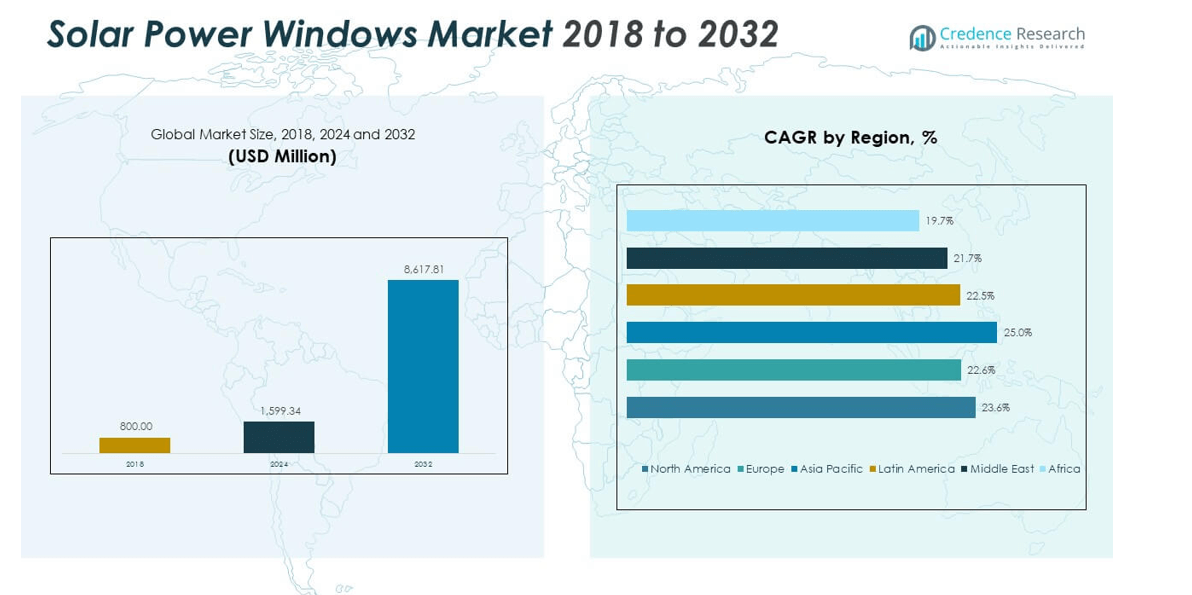
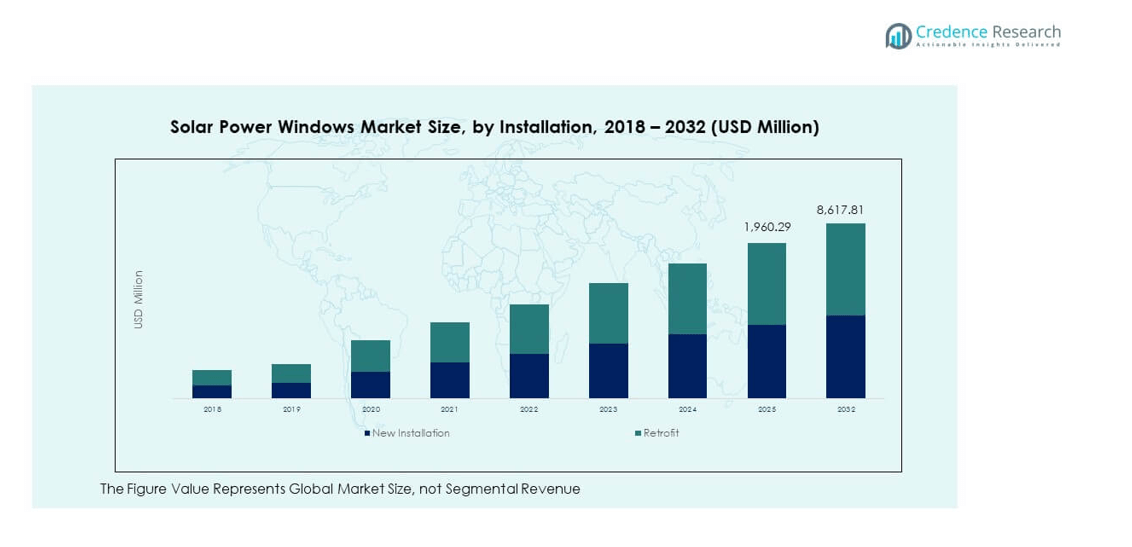
The Solar Power Windows Market size was valued at USD 800.00 million in 2018 to USD 1,599.34 million in 2024 and is anticipated to reach USD 8,617.81 million by 2032, at a CAGR of 23.56% during the forecast period.
| REPORT ATTRIBUTE | DETAILS |
|---|---|
| Historical Period | 2020-2023 |
| Base Year | 2024 |
| Forecast Period | 2025-2032 |
| Solar Power Windows Market Size 2024 | USD 1,599.34 million |
| Solar Power Windows Market, CAGR | 23.56% |
| Solar Power Windows Market Size 2032 | USD 8,617.81 million |
The growing emphasis on renewable energy integration in modern architecture drives market growth. Increasing adoption of building-integrated photovoltaics (BIPV) and transparent solar glass fuels demand across commercial, residential, and institutional sectors. The Solar Power Windows Market benefits from rising sustainability goals, energy cost reduction initiatives, and government incentives for eco-friendly construction. Advancements in nanotechnology and thin-film coatings further enhance light absorption and energy conversion efficiency, making solar windows a viable energy solution for smart buildings.
North America leads the market due to strong regulatory support for green buildings and high investment in solar technologies. Europe follows with active implementation of renewable energy directives and advanced architectural innovation. Asia Pacific is emerging rapidly, supported by urban development and government-led energy transition programs in China, Japan, and India. Latin America and the Middle East are witnessing early adoption in commercial infrastructure, while Africa presents long-term potential through renewable-focused development projects.
Market Insights:
- The Solar Power Windows Market size was valued at USD 800.00 million in 2018, reached USD 1,599.34 million in 2024, and is projected to attain USD 8,617.81 million by 2032, registering a CAGR of 23.56%.
- North America leads with a 39.2% share, supported by strong renewable energy mandates, green construction policies, and advanced R&D in solar glass.
- Europe follows with a 22.5% share, driven by strict EU energy-efficiency regulations and large-scale solar integration in urban architecture.
- Asia Pacific holds 26.3% of the market and is the fastest-growing region, propelled by rapid urbanization, smart city projects, and government-led renewable energy initiatives.
- Based on installation, new installations account for roughly 60% of total revenue, while retrofit installations contribute around 40%, reflecting strong adoption in both new and existing infrastructure.
Market Drivers
Growing Adoption of Building-Integrated Photovoltaics in Sustainable Architecture
The integration of solar windows into building façades supports the shift toward net-zero energy infrastructure. Architects and developers prefer transparent photovoltaic glass to generate power without compromising design aesthetics. It aligns with sustainability goals, lowering energy costs in high-rise and commercial buildings. Government incentives for green construction accelerate installation across developed regions. The Solar Power Windows Market benefits from these initiatives as more cities adopt eco-friendly building codes. Advancements in solar coatings enhance light transmission while maintaining energy efficiency. The demand for energy-independent buildings fuels this adoption trend. It continues to attract investments from real estate developers focused on smart urban infrastructure.
- For instance, Ubiquitous Energy demonstrated the world’s first 1.5-meter-wide pane of transparent solar glass for architectural use in April 2022, with this UE Power technology expected to deliver floor-to-ceiling glass panels (1.5 by 3 meters) that generate up to 1 kilowatt-hour of electricity per day as it scales to commercial production in 2024.
Technological Advancements in Transparent Photovoltaic Materials and Nanocoatings
Continuous innovation in materials science supports performance improvements in solar windows. Manufacturers are developing advanced thin-film and organic photovoltaic layers that increase efficiency and transparency. These innovations help convert both visible and infrared light into electricity. Enhanced nanocoatings protect glass from UV degradation and improve self-cleaning capabilities. It leads to better durability and lower maintenance costs for end users. The Solar Power Windows Market gains momentum from research partnerships between universities and tech firms. Scalable production processes now allow mass manufacturing at competitive costs. Such developments expand adoption in residential, automotive, and commercial applications.
Supportive Government Policies and Renewable Energy Incentives Driving Deployment
Global initiatives promoting renewable energy adoption are driving large-scale investments in solar integration. Governments provide tax credits, subsidies, and low-interest loans to encourage building-level solar installations. Public infrastructure projects incorporate transparent solar panels to meet energy efficiency mandates. The Solar Power Windows Market grows due to strict emission regulations across Europe and North America. It benefits from the inclusion of solar glazing in smart city and urban renewal programs. Local authorities in Asia-Pacific promote domestic solar manufacturing through policy support. Public-private partnerships accelerate commercialization and create new opportunities for manufacturers. The policy landscape continues to strengthen the market’s expansion potential.
- For instance, Onyx Solar participated in Fuorisalone Design Week 2024 in Milan, showcasing its photovoltaic glass technology for building-integrated photovoltaic (BIPV) applications. The company has delivered similar solar glass solutions for public and commercial projects worldwide, emphasizing architectural design and energy efficiency.
Rising Urbanization and Energy Demand Accelerating Adoption of Smart Glass Solutions
The growing urban population increases demand for energy-efficient construction materials. Smart solar glass provides dual functionality by generating power and improving thermal insulation. It reduces reliance on conventional electricity and supports urban sustainability targets. The Solar Power Windows Market gains traction in high-density regions with limited rooftop space. It offers a scalable energy solution suitable for commercial towers and metro stations. Integration with energy management systems enhances building performance and operational savings. The preference for clean energy technologies drives procurement in government-led projects. Expanding urban infrastructure across Asia and the Middle East reinforces long-term growth prospects.
Market Trends
Integration of Solar Windows in Smart Cities and Energy-Efficient Urban Planning
Urban planners increasingly adopt solar glazing as part of smart infrastructure projects. Integration with IoT-based energy systems enables real-time monitoring and optimized power usage. The Solar Power Windows Market benefits from city-level mandates promoting renewable integration in public spaces. Transparent panels installed in commercial centers and transit hubs improve sustainability metrics. It enhances energy independence while reducing peak load pressure on grids. Architects incorporate solar glass into façades, bus shelters, and noise barriers for efficiency. Design versatility supports widespread adoption in both new and retrofitted structures. Growing urban electrification drives this trend toward multi-functional construction materials.
Expansion of Research on Perovskite and Organic Solar Cell Technologies
Technological innovation continues to reshape the landscape of solar window manufacturing. Perovskite and organic photovoltaic cells achieve high conversion efficiency while maintaining flexibility. These technologies enable curved and tinted glass applications for various architectures. The Solar Power Windows Market evolves with increased investments in pilot production facilities. It gains from research programs focusing on long-term stability and large-area fabrication. Collaboration among materials companies and academic institutions supports rapid prototyping. Continuous testing improves lifespan and optical quality, attracting commercial interest. These advancements open doors for lightweight, transparent, and aesthetically pleasing solar solutions.
Rising Collaboration Between Construction and Energy Firms for Integrated Solutions
Strategic alliances between glass producers and renewable energy companies accelerate innovation. Partnerships focus on developing integrated solar façades that combine design, safety, and power generation. The Solar Power Windows Market experiences growth from such cross-industry collaborations. It supports faster market entry and wider distribution across commercial real estate projects. Energy companies now offer bundled installation and maintenance services for solar glazing. Construction firms integrate these systems into modular prefabricated designs. The trend increases affordability and promotes mass-scale adoption of solar windows. Enhanced ecosystem partnerships strengthen value chains and ensure consistent technological improvement.
- For instance, AGC Glass Europe’s SunEwat building-integrated photovoltaic (BIPV) glass was adopted in November 2023 for “The Greenhouse” at Dulwich College Singapore, covering skylights and facades and generating the equivalent of about 40% of total campus energy consumption, as officially reported by AGC and Dulwich College in sustainability press releases.
Adoption of Smart Control Systems and AI-Based Energy Optimization Tools
Manufacturers integrate smart control systems to enhance solar energy performance. Artificial intelligence enables automatic adjustment of window transparency and power output. The Solar Power Windows Market benefits from integration with energy management platforms. It allows predictive analytics to optimize generation based on weather data. Smart systems adjust lighting and shading, improving building comfort and reducing HVAC costs. The convergence of AI and renewable technologies enhances operational efficiency. Energy data analytics further supports grid stability and load balancing. Automation of solar performance monitoring becomes a standard trend in modern infrastructure.
- For instance, Polysolar partnered with the London Borough of Harrow in 2023 for Project-A.I.R, an AI-guided retrofit shelter integrating a three-kilowatt glass array, which in concept presentations was shown to potentially reduce energy bills for participating social housing tenants by up to 45%, corroborated by the council’s Grand Designs Live case study and Polysolar’s technology press materials.
Market Challenges Analysis
High Manufacturing Costs and Complex Production Processes Limiting Scalability
The production of transparent photovoltaic glass requires advanced deposition and coating technologies. High material costs, such as rare conductive oxides and encapsulation layers, increase unit prices. It restricts large-scale deployment, especially in price-sensitive regions. The Solar Power Windows Market faces difficulty achieving economies of scale due to intricate fabrication. Equipment calibration, precision coating, and defect-free lamination demand skilled labor. Manufacturers struggle with balancing transparency and energy conversion efficiency. Supply chain constraints of raw materials further add cost pressures. The challenge persists until new cost-efficient materials and automated systems become mainstream.
Low Awareness and Regulatory Uncertainty Affecting Market Penetration
Limited consumer knowledge about energy-generating windows hinders adoption in residential sectors. Developers often prioritize traditional materials due to cost familiarity and performance reliability. The Solar Power Windows Market is impacted by inconsistent standards for building-integrated photovoltaics. It creates uncertainty in certification and approval processes across regions. The absence of uniform testing guidelines delays product commercialization. Market participants face challenges in gaining long-term investor confidence. Educational campaigns and pilot projects remain necessary to raise awareness. Broader policy alignment will be vital to improve product visibility and user trust.
Market Opportunities
Rising Demand for Net-Zero Energy Buildings in Urban Construction Projects
The global shift toward carbon neutrality drives investments in energy-efficient infrastructure. Governments and developers focus on integrating solar glazing into large commercial complexes. The Solar Power Windows Market benefits from new sustainability targets in green building standards. It supports decentralized energy generation and reduces grid dependency in cities. Growing construction in emerging economies creates fresh opportunities for localized production. Real estate firms explore solar façades for design flexibility and environmental compliance. Partnerships with energy service companies expand adoption across urban clusters. Continuous innovation in transparent PV technology strengthens long-term growth potential.
Growing Application Scope Across Automotive and Consumer Electronics Industries
Automotive manufacturers explore solar windows to enhance vehicle energy efficiency and reduce battery load. Integration into sunroofs and side panels supports auxiliary power generation. The Solar Power Windows Market expands into transportation and smart devices segments. It benefits from research in lightweight, bendable solar materials suited for compact designs. Consumer electronics companies adopt solar glass for portable power solutions. Cross-sector diversification enhances business resilience and broadens product demand. It creates new revenue streams beyond the construction industry. These developments shape a promising outlook for technology adoption across multiple domains.
Market Segmentation Analysis:
By Product Type:
Photovoltaic solar windows hold a dominant position, driven by high energy conversion efficiency and design versatility. These windows integrate thin-film cells into glass panels, enabling power generation without obstructing visibility. Transparent solar windows are gaining traction due to aesthetic appeal and wider use in commercial buildings. They balance light transmission and power output effectively. The remaining segment includes hybrid products designed for customized applications across research and specialty structures. The Solar Power Windows Market benefits from innovations that enhance transparency and output stability in these products.
- For instance, NEXT Energy Technologies installed 22 transparent photovoltaic windows at Patagonia’s Ventura, California headquarters (January 2023), offsetting an estimated 10–40% of the building’s energy load while maintaining normal transparency and functionality, as documented in direct company news and affiliated press coverage.
By Application:
The commercial segment leads the market due to rising adoption in office towers, retail centers, and smart infrastructure projects. It reduces energy costs while improving building sustainability ratings. Residential use is expanding with increased awareness of green construction. Industrial applications are growing in manufacturing facilities aiming to achieve energy efficiency targets. Others include educational and public infrastructure sectors adopting solar glass for eco-friendly upgrades.
- For instance, ClearVue Technologies’ solar glass greenhouse at Murdoch University, Perth (2021–2024), used three generations of transparent photovoltaic glazing to offset nearly 40% of facility energy consumption over two years, with continuous data-logging and peer-reviewed reporting by university researchers and ClearVue Technologies.
By Technology:
Thin-film technology dominates due to flexibility, lightweight structure, and compatibility with curved designs. Crystalline silicon remains essential for projects requiring high power density. Other technologies include organic and perovskite-based innovations under testing for commercial readiness.
By Installation:
New installations account for the largest share, supported by large-scale construction and smart city projects. Retrofit installations are increasing in heritage and existing buildings due to ease of integration and minimal disruption. It ensures broader market penetration across urban modernization programs.
Segmentation:
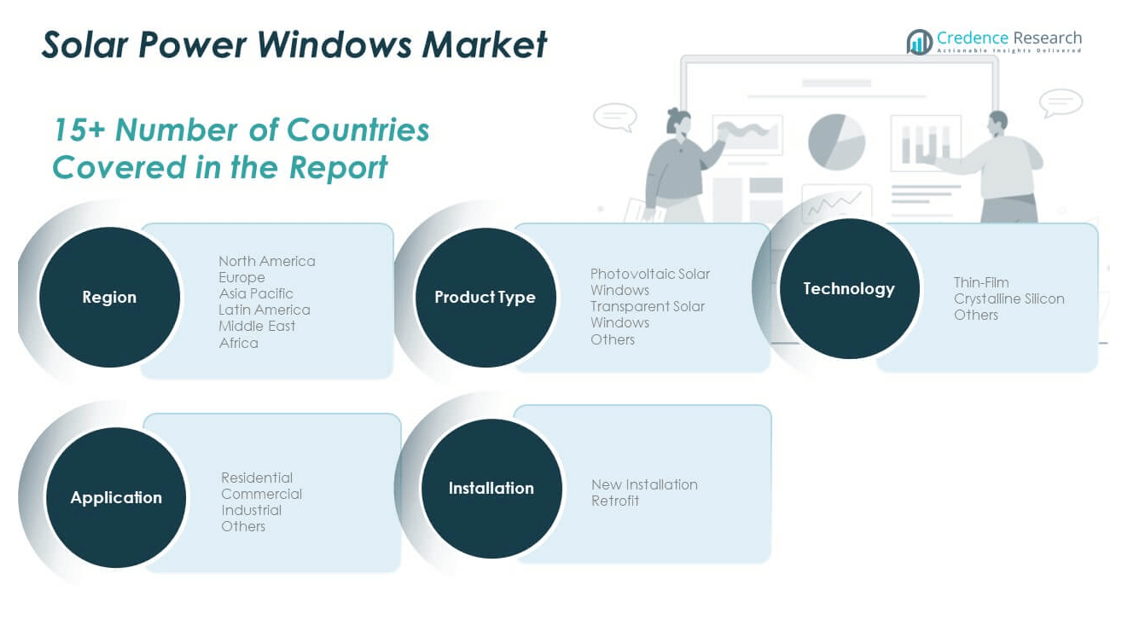
By Product Type
- Photovoltaic Solar Windows
- Transparent Solar Windows
- Others
By Application
- Residential
- Commercial
- Industrial
- Others
By Technology
- Thin-Film
- Crystalline Silicon
- Others
By Installation
- New Installation
- Retrofit
By Region
- North America
- U.S.
- Canada
- Europe
- Germany
- France
- U.K.
- Italy
- Spain
- Rest of Europe
- Asia Pacific
- China
- Japan
- India
- South Korea
- South-east Asia
- Rest of Asia Pacific
- Latin America
- Brazil
- Mexico
- Rest of Latin America
- Middle East & Africa
- GCC Countries
- South Africa
- Rest of Middle East and Africa
Regional Analysis:
North America
The North America Solar Power Windows Market size was valued at USD 317.60 million in 2018 to USD 627.89 million in 2024 and is anticipated to reach USD 3,379.06 million by 2032, at a CAGR of 23.6% during the forecast period. North America holds a 39.2% market share, driven by strong renewable energy policies and green building standards. The region leads adoption through rapid integration of solar glazing in commercial and government infrastructure. The Solar Power Windows Market benefits from U.S. initiatives promoting energy-efficient building materials. It gains momentum through partnerships between tech developers and architectural firms. High R&D investment in transparent photovoltaic technologies supports long-term growth. The presence of companies such as SolarWindow Technologies and Onyx Renewables strengthens regional innovation. Expansion in smart city projects and retrofitting of public infrastructure will further enhance demand across the U.S. and Canada.
Europe
The Europe Solar Power Windows Market size was valued at USD 188.32 million in 2018 to USD 360.13 million in 2024 and is anticipated to reach USD 1,819.67 million by 2032, at a CAGR of 22.6% during the forecast period. Europe commands a 22.5% market share, supported by sustainability mandates and high environmental awareness. The Solar Power Windows Market in the region is driven by stringent EU energy-efficiency regulations. It benefits from large-scale implementation of solar-integrated façades in Germany, France, and the UK. Governments encourage green construction through incentives and carbon-neutral goals. The rise in retrofitting projects across historic urban centers promotes product adoption. Companies like Polysolar Ltd. and Heliatek GmbH lead technological advancements in flexible solar glass. Strong public-private collaborations reinforce Europe’s leadership in sustainable architectural innovation.
Asia Pacific
The Asia Pacific Solar Power Windows Market size was valued at USD 202.56 million in 2018 to USD 422.30 million in 2024 and is anticipated to reach USD 2,503.48 million by 2032, at a CAGR of 25.0% during the forecast period. Asia Pacific holds a 26.3% market share, led by rapid urbanization and industrial expansion. It benefits from government initiatives promoting renewable energy integration in construction. China, Japan, and South Korea dominate production through strong manufacturing capacity and technological innovation. The Solar Power Windows Market grows as smart city projects and green infrastructure increase. India and Australia also contribute with growing adoption in residential and institutional buildings. Regional players collaborate with global firms to enhance photovoltaic efficiency. Expanding construction activity and favorable investment climates ensure sustained growth in the coming years.
Latin America
The Latin America Solar Power Windows Market size was valued at USD 54.40 million in 2018 to USD 107.78 million in 2024 and is anticipated to reach USD 541.80 million by 2032, at a CAGR of 22.5% during the forecast period. Latin America represents a 6.7% market share, supported by emerging solar projects in Brazil and Mexico. The region focuses on improving energy infrastructure and reducing grid dependency. The Solar Power Windows Market gains traction with the expansion of renewable policies and green construction practices. It benefits from increasing investments in commercial real estate and public infrastructure. Partnerships between local and international firms accelerate technology transfer. Rising awareness about sustainable architecture stimulates residential adoption. Gradual economic recovery across key nations supports consistent demand for solar-integrated building materials.
Middle East
The Middle East Solar Power Windows Market size was valued at USD 25.60 million in 2018 to USD 47.33 million in 2024 and is anticipated to reach USD 224.97 million by 2032, at a CAGR of 21.7% during the forecast period. The Middle East holds a 4.1% market share, with growth driven by diversification from fossil fuels to renewable energy sources. The Solar Power Windows Market benefits from large-scale investments in smart cities such as NEOM and Masdar. It gains strength from government-backed programs promoting sustainable construction. The UAE and Saudi Arabia lead installation projects integrating solar glass into commercial towers. Architectural innovation and abundant sunlight provide favorable conditions for development. International firms collaborate with local developers to enhance solar efficiency. Continuous expansion of eco-friendly infrastructure boosts market visibility and adoption rates.
Africa
The Africa Solar Power Windows Market size was valued at USD 11.52 million in 2018 to USD 33.91 million in 2024 and is anticipated to reach USD 148.82 million by 2032, at a CAGR of 19.7% during the forecast period. Africa accounts for a 1.2% market share, with potential concentrated in South Africa, Egypt, and Kenya. The Solar Power Windows Market grows with urban development and rising interest in renewable integration. It benefits from government efforts to reduce electricity shortages through decentralized energy systems. Local construction companies begin adopting solar glass for sustainability compliance. International collaborations introduce pilot projects to demonstrate commercial feasibility. Growing foreign investment in smart urban planning fosters awareness and demand. Africa remains a developing frontier for solar window technology, supported by regional infrastructure modernization efforts.
Key Player Analysis:
- SolarWindow Technologies, Inc.
- Onyx Solar Group LLC
- Ubiquitous Energy, Inc.
- Polysolar Ltd.
- Solaria Corporation
- Heliatek GmbH
- Brite Solar
- Physee Group
- Sunpartner Technologies
- SolarGaps
- Glass to Power S.p.A.
- ClearVue Technologies Limited
- Next Energy Technologies, Inc.
- Sharp Corporation
- Kyocera Corporation
Competitive Analysis:
The Solar Power Windows Market features strong competition among innovators in building-integrated photovoltaics and transparent solar technologies. Leading companies such as SolarWindow Technologies, Onyx Solar Group, Ubiquitous Energy, Polysolar Ltd., Solaria Corporation, and Heliatek GmbH focus on enhancing transparency, efficiency, and durability in photovoltaic glass solutions. It emphasizes scalable production and partnerships with construction and energy firms to accelerate deployment. Firms like NEXT Energy Technologies and ClearVue Technologies invest in organic and perovskite-based materials to expand design flexibility. Strategic mergers, funding rounds, and pilot installations strengthen their market positions. The industry’s competitive edge relies on technological innovation, cost efficiency, and intellectual property portfolios supporting differentiation in global markets.
Recent Developments:
- In August 2025, Onyx Renewables, a key player in building-integrated photovoltaics, completed two ground-mount solar projects totaling 13 MW at the U.S. Army's Fort Polk military installation, through a joint venture with Corvias. Earlier, in June 2025, Onyx secured a $260 million credit facility, supporting deployment of distributed energy projects for commercial and industrial clients nationwide.
- In July 2025, NEXT Energy Technologies introduced its innovative photovoltaic window technology, marking a pivotal moment for organic solar windows in commercial buildings. At its Santa Barbara headquarters, NEXT installed the first set of photovoltaic windows, showcasing a tangible demonstration of solar-absorbing glass that generates energy and supports sustainability objectives.
- In June 2025, SolarWindow Technologies completed a $3.9 million capital raise through self-directed domestic and offshore offerings, aiming to accelerate development of its transparent electricity-generating coatings for architectural glass and plastics.
Report Coverage:
The research report offers an in-depth analysis based on Product Type, Application, Technology and Installation. It details leading market players, providing an overview of their business, product offerings, investments, revenue streams, and key applications. Additionally, the report includes insights into the competitive environment, SWOT analysis, current market trends, as well as the primary drivers and constraints. Furthermore, it discusses various factors that have driven market expansion in recent years. The report also explores market dynamics, regulatory scenarios, and technological advancements that are shaping the industry. It assesses the impact of external factors and global economic changes on market growth. Lastly, it provides strategic recommendations for new entrants and established companies to navigate the complexities of the market.
Future Outlook:
- Growing adoption of solar-integrated architecture will make building façades a major renewable energy source.
- Continued innovation in transparent and flexible photovoltaic materials will expand product versatility.
- Increasing construction of net-zero energy buildings will create sustained demand across commercial sectors.
- Rising government incentives and sustainability mandates will drive investment in solar glazing technologies.
- Integration with smart energy management systems will optimize performance and reduce operational costs.
- Expansion of perovskite-based technologies will improve energy conversion efficiency and aesthetic quality.
- Collaboration between construction and renewable energy companies will accelerate large-scale deployment.
- Rapid urbanization in Asia-Pacific will boost new installations across smart city projects.
- Manufacturers will focus on cost-efficient production methods to improve scalability and affordability.
- Strategic R&D in lightweight solar glass will enable broader use in transportation and consumer devices.

Request a Free Sample
Fill in your details and we'll send you a free sample report.
- Sample data tables & charts
- Research methodology
Market Dynamics
Growing Adoption of Building-Integrated Photovoltaics in Sustainable Architecture
The integration of solar windows into building façades is accelerating as architects and developers seek to meet net-zero energy goals without compromising design aesthetics. This trend is supported by government incentives and sustainability mandates, driving installations in both new and retrofitted commercial and residential buildings.
Technological Advancements in Transparent Photovoltaic Materials and Nanocoatings
Continuous innovation in thin-film, organic, and nanocoating technologies is improving the efficiency, transparency, and durability of solar windows. These advancements enable higher energy conversion rates and lower maintenance costs, making solar windows more attractive for widespread adoption.
Supportive Government Policies and Renewable Energy Incentives
Global and regional policies promoting renewable energy, such as tax credits, subsidies, and green building standards, are encouraging the deployment of solar power windows. These incentives lower the financial barriers for developers and accelerate market growth, especially in North America, Europe, and Asia Pacific.
Rising Urbanization and Energy Demand Accelerating Adoption of Smart Glass Solutions
Rapid urbanization and the need for energy-efficient construction materials are driving demand for solar power windows, particularly in high-density urban areas with limited rooftop space. Smart solar glass offers dual benefits of power generation and improved thermal insulation, supporting sustainability targets in modern infrastructure projects.
Need a Custom Version of This Report?
Tailor the scope, geography, or segments to your exact requirements.
- Custom geography or segment scope
- Direct access to our analyst team
Frequently Asked Questions
What is the current market size for the Solar Power Windows Market, and what is its projected size in 2032?
At what Compound Annual Growth Rate is the Solar Power Windows Market projected to grow between 2024 and 2032?
What are the primary factors fueling the growth of the Solar Power Windows Market?
Who are the leading companies in the Solar Power Windows Market?
Which region commanded the largest share of the Solar Power Windows Market in 2024?
Table of Content
Chapter 1 Market Segmentation
- 1.1 Segmentation Framework
- 1.1.1 Product and Service Classification
- 1.1.2 Application and End-Use Classification
- 1.1.3 Technology and Solution Classification
- 1.1.4 Customer and Distribution Channel Classification
- 1.1.5 Geographic Segmentation
- 1.1.6 Market Segment Definitions and Boundaries
- 1.2 By Technology
- 1.2.1 Thin-Film
- 1.2.2 Crystalline Silicon
- 1.2.3 Others
- 1.3 By Application
- 1.3.1 Residential
- 1.3.2 Commercial
- 1.3.3 Industrial
- 1.3.4 Others
- 1.4 By Installation
- 1.4.1 New Installation
- 1.4.2 Retrofit
- 1.5 By Product Type
- 1.5.1 Photovoltaic Solar Windows
- 1.5.2 Transparent Solar Windows
- 1.5.3 Others
Chapter 2 Introduction
- 2.1 Report Objectives and Scope
- 2.2 Product Definition and Industry Terminology
- 2.3 Market Inclusions and Exclusions
- 2.4 Research Process
- 2.4.1 Primary Research and Expert Interviews
- 2.4.2 Secondary Research and Source Review
- 2.4.3 Top-Down and Bottom-Up Estimation
- 2.4.4 Data Triangulation and Verification
- 2.5 Market Size Measurement Basis
- 2.5.1 2024: USD 1,599.34 million → 2032: USD 8,617.81 million
- 2.6 Historical and Forecast Reference Periods
- 2.6.1 Base Year: 2024
- 2.6.2 Forecast Period: 2024-2032
- 2.7 Research Assumptions and Limitations
Chapter 3 Executive Summary
- 3.1 Market Snapshot and Key Findings
- 3.2 Base-Year Market Size, 2024
- 3.3 Forecast Market Size, 2032
- 3.4 Revenue and Volume Growth Outlook
- 3.5 Key Demand and Supply Indicators
- 3.6 Leading Market Segments
- 3.7 Fastest-Growing Market Opportunities
- 3.8 Regional Performance Highlights
- 3.9 Technology and Industry Transformation
- 3.10 Competitive Landscape Summary
- 3.11 Analyst View and Strategic Implications
Chapter 4 Global Solar Power Windows Market Trends and Developments
- 4.1 Historical Industry Development
- 4.2 Recent Market Trends and Developments
- 4.3 Demand and Customer Behavior Trends
- 4.4 Technology and Product Innovation
- 4.5 Artificial Intelligence, Automation and Digitalization
- 4.6 Local Manufacturing and Supply Chain Realignment
- 4.7 Industry Partnerships, Mergers and Acquisitions
- 4.8 Sustainability and Circular Economy Developments
- 4.9 Government and Private Sector Investment Trends
- 4.10 Emerging Business Models and Commercialization
- 4.11 Industry Developments and Announcements
Chapter 5 Global Solar Power Windows Market Production, Supply and Demand Analysis
- 5.1 Demand Trend and Consumption Analysis
- 5.2 Demand Forecast, 2024-2032
- 5.3 Production and Output Trend
- 5.4 Production and Output Forecast, 2024-2032
- 5.5 Installed Capacity and Capacity Utilization
- 5.6 Company-Wise Production Plants and Statistics
- 5.6.1 Installed Production Capacity
- 5.6.2 Actual Production
- 5.6.3 Planned Capacity and Expansion Targets
- 5.7 Supply Chain Structure and Procurement Trends
- 5.8 Supply-Demand Gap and Bottlenecks
- 5.9 Import Dependence and Sourcing Structure
- 5.10 Contract Manufacturing and Outsourcing
- 5.11 Regional Supply and Demand Concentration
Chapter 6 Global Solar Power Windows Market Pricing Analysis
- 6.1 Pricing Structure and Measurement
- 6.2 Historical Pricing Trends
- 6.3 Pricing Outlook, 2024-2032
- 6.4 Average Selling Price and Unit Economics
- 6.5 Pricing by Product and Market Segment
- 6.6 Geographic Pricing Differences
- 6.7 Key Input, Energy, Labor and Logistics Costs
- 6.8 Contract Pricing and Purchasing Models
- 6.9 Pricing Sensitivity and Competitive Positioning
- 6.10 Price, Margin and Profitability Implications
Chapter 7 Global Solar Power Windows Market Dynamics
- 7.1 Market Growth Drivers
- 7.1.1 Demand-Side Drivers
- 7.1.2 Technology and Innovation Drivers
- 7.1.3 Infrastructure and Investment Drivers
- 7.1.4 Regulatory and Policy Drivers
- 7.2 Market Restraints
- 7.2.1 Cost and Affordability Constraints
- 7.2.2 Technology and Adoption Barriers
- 7.2.3 Supply Chain and Operational Constraints
- 7.3 Market Challenges
- 7.3.1 Competitive Pressure and Margin Erosion
- 7.3.2 Skills, Infrastructure and Implementation Gaps
- 7.4 Emerging Market Opportunities
- 7.5 Market Dynamics Impact and Time-Horizon Assessment
Chapter 8 Global Solar Power Windows Value Chain Analysis
- 8.1 Industry Value Chain Overview
- 8.2 Upstream Suppliers and Critical Inputs
- 8.3 Technology and Component Providers
- 8.4 Manufacturing or Service Delivery
- 8.5 Distribution, Channel Partners and Integrators
- 8.6 Downstream Applications and End Users
- 8.7 Value Addition and Profit Pools
- 8.8 Vertical Integration and Outsourcing
- 8.9 Supplier Concentration and Risk
- 8.10 Supply Chain Localization and Resilience
Chapter 9 Global Solar Power Windows Market Regulations and Policies
- 9.1 Relevant Laws, Standards and Compliance Frameworks
- 9.2 Product, Service, Safety and Quality Requirements
- 9.3 Government Policies, Incentives and Subsidies
- 9.4 Imports, Exports and Trade Barriers
- 9.5 Public Procurement and Local Content Requirements
- 9.6 Environmental and Sustainability Compliance
- 9.7 Upcoming Policy Changes and Market Implications
Chapter 10 Global Solar Power Windows Market Hotspots and Opportunities
- 10.1 Market Opportunity Mapping and Growth Hotspots
- 10.2 High-Growth Applications and Customer Groups
- 10.3 Underserved Markets and White-Space Opportunities
- 10.4 Emerging Technology and Product Opportunities
- 10.5 New Capacity and Investment Hotspots
- 10.6 Market Entry and Expansion Opportunities
- 10.7 Distribution and Partnership Opportunities
- 10.8 Near-Term and Long-Term Commercial Potential
- 10.9 Opportunity Attractiveness and Execution Risks
Chapter 11 Global Solar Power Windows Market Outlook, 2024-2032
- 11.1 Market Size and Analysis
- 11.1.1 Revenue (Market Measurement: 2024: USD 1,599.34 million → 2032: USD 8,617.81 million)
- 11.1.2 Market Volume and Quantity Sold
- 11.1.3 Historical Market Size
- 11.1.4 Base-Year Market Size, 2024
- 11.2 Market Forecast, 2024-2032
- 11.2.1 Revenue Forecast to 2032
- 11.2.2 Volume Forecast to 2032
- 11.2.3 CAGR and Year-on-Year Growth
- 11.2.4 Incremental Revenue Opportunity
- 11.3 Forecast Assumptions and Scenario Analysis
- 11.3.1 Base-Case Forecast
- 11.3.2 Optimistic and Conservative Scenarios
- 11.3.3 Technology, Pricing and Policy Sensitivities
- 11.4 Market Attractiveness and Growth Outlook
Chapter 12 Global Solar Power Windows Market Segmentation and Outlook
- 12.1 Segmentation Summary and Market Shares, 2024
- 12.2 Largest and Fastest-Growing Segments
- 12.3 By Technology - Market Size and Forecast, 2024-2032
- 12.3.1 Segment Definition and Scope
- 12.3.2 Historical Market Size
- 12.3.3 Revenue Forecast, 2024-2032
- 12.3.4 Volume Forecast, 2024-2032
- 12.3.5 Base-Year Market Share, 2024
- 12.3.6 Segment CAGR and Growth Drivers
- 12.3.7 Subsegment Market Size and Forecast
- 12.3.7.1 Thin-Film
- 12.3.7.2 Crystalline Silicon
- 12.3.7.3 Others
- 12.3.8 Subsegment Pricing and Adoption Trends
- 12.3.9 Leading Suppliers and Competition
- 12.3.10 Regional Demand and Opportunities
- 12.4 By Application - Market Size and Forecast, 2024-2032
- 12.4.1 Segment Definition and Scope
- 12.4.2 Historical Market Size
- 12.4.3 Revenue Forecast, 2024-2032
- 12.4.4 Volume Forecast, 2024-2032
- 12.4.5 Base-Year Market Share, 2024
- 12.4.6 Segment CAGR and Growth Drivers
- 12.4.7 Subsegment Market Size and Forecast
- 12.4.7.1 Residential
- 12.4.7.2 Commercial
- 12.4.7.3 Industrial
- 12.4.7.4 Others
- 12.4.8 Subsegment Pricing and Adoption Trends
- 12.4.9 Leading Suppliers and Competition
- 12.4.10 Regional Demand and Opportunities
- 12.5 By Installation - Market Size and Forecast, 2024-2032
- 12.5.1 Segment Definition and Scope
- 12.5.2 Historical Market Size
- 12.5.3 Revenue Forecast, 2024-2032
- 12.5.4 Volume Forecast, 2024-2032
- 12.5.5 Base-Year Market Share, 2024
- 12.5.6 Segment CAGR and Growth Drivers
- 12.5.7 Subsegment Market Size and Forecast
- 12.5.7.1 New Installation
- 12.5.7.2 Retrofit
- 12.5.8 Subsegment Pricing and Adoption Trends
- 12.5.9 Leading Suppliers and Competition
- 12.5.10 Regional Demand and Opportunities
- 12.6 By Product Type - Market Size and Forecast, 2024-2032
- 12.6.1 Segment Definition and Scope
- 12.6.2 Historical Market Size
- 12.6.3 Revenue Forecast, 2024-2032
- 12.6.4 Volume Forecast, 2024-2032
- 12.6.5 Base-Year Market Share, 2024
- 12.6.6 Segment CAGR and Growth Drivers
- 12.6.7 Subsegment Market Size and Forecast
- 12.6.7.1 Photovoltaic Solar Windows
- 12.6.7.2 Transparent Solar Windows
- 12.6.7.3 Others
- 12.6.8 Subsegment Pricing and Adoption Trends
- 12.6.9 Leading Suppliers and Competition
- 12.6.10 Regional Demand and Opportunities
- 12.7 Segment Growth Comparison
- 12.8 Segment Attractiveness and Priority Matrix
Chapter 13 Global Solar Power Windows End-Use and Application Market Outlook
- 13.1 End-Use Industry and Customer Demand Structure
- 13.2 Leading Applications and Customer Groups
- 13.3 End-Use Market Size, Share and Forecast
- 13.4 Major End-Use Industry Deep Dives
- 13.4.1 Customer Requirements and Use Cases
- 13.4.2 Demand and Replacement Cycles
- 13.4.3 Technical and Regulatory Considerations
- 13.4.4 Purchasing and Procurement Models
- 13.4.5 Leading Vendors and Distribution Channels
- 13.4.6 Forecast and Commercial Opportunities
- 13.5 Emerging Applications and Cross-Segment Demand
- 13.6 End-Use Industry Investment Priorities
Chapter 14 Global Solar Power Windows Geographic Market Outlook, 2024-2032
- 14.1 Regional Market Size and Share, 2024
- 14.2 Regional Market Forecast, 2024-2032
- 14.3 Regional Pricing, Production and Demand Differences
- 14.4 North America
- 14.4.1 United States
- 14.4.2 Canada
- 14.4.3 Mexico
- 14.5 Europe
- 14.5.1 Germany
- 14.5.2 France
- 14.5.3 Italy
- 14.5.4 United Kingdom
- 14.5.5 Spain
- 14.5.6 Poland
- 14.5.7 Russia
- 14.5.8 Netherlands
- 14.5.9 Belgium
- 14.5.10 Sweden
- 14.5.11 Denmark
- 14.5.12 Norway
- 14.5.13 Rest of Europe
- 14.6 Asia Pacific
- 14.6.1 China
- 14.6.2 India
- 14.6.3 Japan
- 14.6.4 South Korea
- 14.6.5 Thailand
- 14.6.6 Indonesia
- 14.6.7 Vietnam
- 14.6.8 Malaysia
- 14.6.9 Australia
- 14.6.10 Rest of Asia Pacific
- 14.7 Latin America
- 14.7.1 Brazil
- 14.7.2 Argentina
- 14.7.3 Colombia
- 14.7.4 Chile
- 14.7.5 Rest of Latin America
- 14.8 Middle East
- 14.8.1 Saudi Arabia
- 14.8.2 United Arab Emirates
- 14.8.3 Turkey
- 14.8.4 Israel
- 14.8.5 Iran
- 14.8.6 Rest of the Middle East
- 14.9 Africa
- 14.9.1 South Africa
- 14.9.2 Egypt
- 14.9.3 Nigeria
- 14.9.4 Morocco
- 14.9.5 Rest of Africa
- 14.10 Regional Investment, Policy and Supply Chain Differences
- 14.11 Regional Competitive Landscape
- 14.12 Geographic Growth Hotspots
Chapter 15 Global Solar Power Windows Technology, Innovation and Sustainability Outlook
- 15.1 Technology Landscape and Maturity
- 15.2 Product, Process and Service Innovation
- 15.3 AI, Automation and Digital Tools in the Industry
- 15.4 Technology Adoption and Performance Benchmarking
- 15.5 Innovation Pipeline and R&D Investment
- 15.6 Patent and Intellectual Property Trends
- 15.7 Energy Efficiency and Resource Management
- 15.8 Sustainability, Recycling and Circularity
- 15.9 Technology Roadmap, 2024-2032
- 15.10 Risks of Obsolescence and Technology Substitution
Chapter 16 Global Solar Power Windows Market Key Strategic Imperatives
- 16.1 Growth and Market Entry Priorities
- 16.2 High-Return Products and Segments
- 16.3 Pricing, Profitability and Cost Optimization
- 16.4 Technology Investment and Product Differentiation
- 16.5 Supply Chain Localization and Resilience
- 16.6 Distribution and Customer Acquisition
- 16.7 Partnership, Acquisition and Capacity Strategy
- 16.8 Regional Expansion Priorities
- 16.9 Short-, Medium- and Long-Term Actions
Chapter 17 Competition Outlook
- 17.1 Industry Competition Characteristics
- 17.2 Market Structure and Concentration
- 17.3 Market Share and Competitive Positioning, 2024
- 17.4 Company-Wise Revenue and Product Benchmarking
- 17.5 Production and Service Capacity Benchmarking
- 17.6 Technology, Pricing and Differentiation
- 17.7 Regional Footprint and Distribution Strength
- 17.8 Mergers, Acquisitions and Strategic Alliances
- 17.9 New Entrants and Competitive Threats
- 17.10 Porter's Five Forces and Industry Attractiveness
- 17.11 Competitive Outlook, 2024-2032
Chapter 18 Company Profiles
- 18.1 Company Coverage and Selection Criteria
- 18.2 SolarWindow Technologies, Inc.
- 18.2.1 Business Description
- 18.2.2 Company Ownership and Geographic Presence
- 18.2.3 Product and Service Portfolio
- 18.2.4 Manufacturing and Operating Footprint
- 18.2.5 Production Capacity and Expansion Plans
- 18.2.6 Financial Performance and Investment
- 18.2.7 Market Share and Competitive Position
- 18.2.8 Technology and Innovation Capabilities
- 18.2.9 Strategic Alliances or Partnerships
- 18.2.10 Recent Developments
- 18.2.11 Growth Strategy and Outlook
- 18.3 Onyx Solar Group LLC
- 18.4 Ubiquitous Energy, Inc.
- 18.5 Polysolar Ltd.
- 18.6 Solaria Corporation
- 18.7 Heliatek GmbH
- 18.8 ClearVue Technologies Limited
- 18.9 Next Energy Technologies, Inc.
- 18.10 Sharp Corporation
- 18.11 Kyocera Corporation
- 18.12 Other Relevant Market Participants
Note: Every listed company is profiled on the structure shown under the first company. The company list is preliminary and may change based on research findings, market developments, data availability and client requirements.
Chapter 19 Disclaimer
- 19.1 Research and Forecast Disclaimer
- 19.2 Data Source and Estimation Limitations
Note: The depth of individual sections depends on data availability for this market. Volume, capacity, trade and other unit-based metrics are included where applicable.

