South Korea Tire Market Overview:
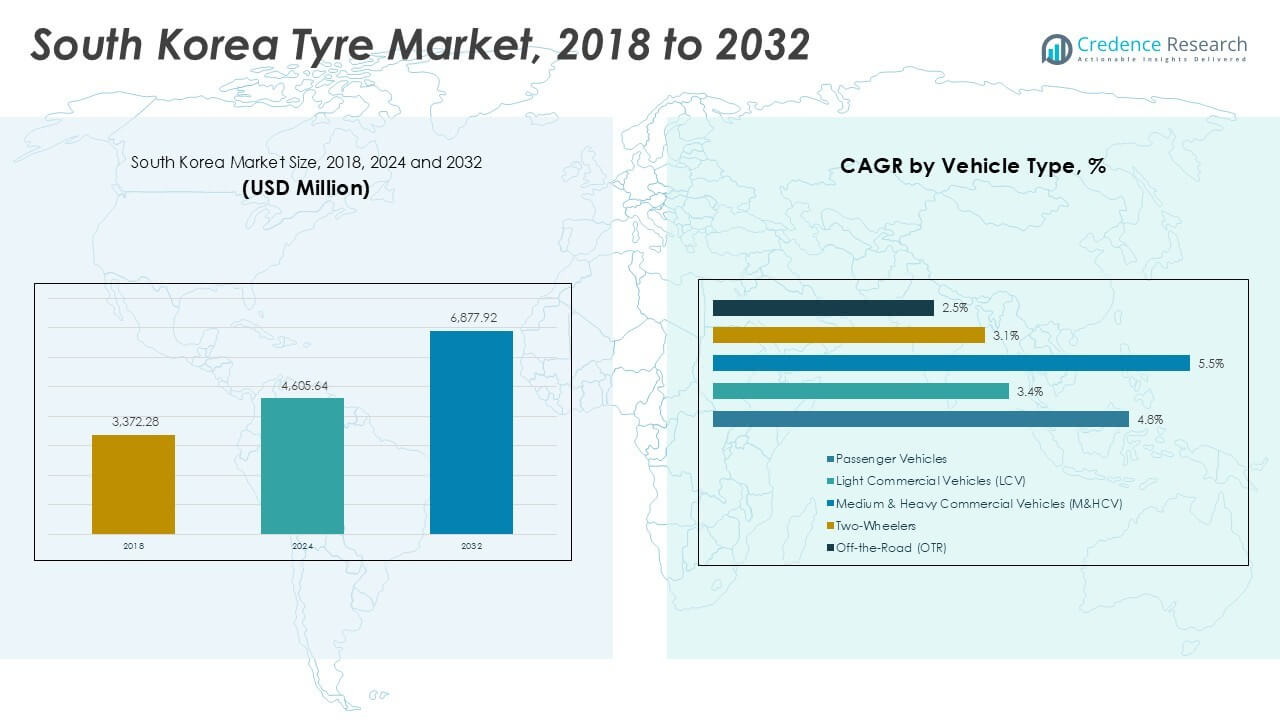
South Korea tyre market size was valued at USD 3,372.28 million in 2018, reached USD 4,605.64 million in 2024, and is anticipated to reach USD 6,877.92 million by 2032, at a CAGR of 4.79% during the forecast period.
| REPORT ATTRIBUTE | DETAILS |
|---|---|
| Historical Period | 2020-2023 |
| Base Year | 2024 |
| Forecast Period | 2025-2032 |
| South Korea Tire Market Size 2024 | USD 4,605.64 Million |
| South Korea Tire Market, CAGR | 4.79% |
| South Korea Tire Market Size 2032 | USD 6,877.92 Million |
The South Korea tyre market is led by Hankook Tire & Technology, Kumho Tire, and Nexen Tire, which collectively hold a dominant share due to strong domestic manufacturing, OEM partnerships, and export capabilities. Among global players, Michelin Korea and Bridgestone Korea maintain competitive positions, particularly in premium and performance segments. Hankook leads the market with its wide distribution, innovation in EV tyres, and strong brand reputation. The Seoul Capital Area emerges as the leading region, accounting for over 40% of the total market share in 2024, supported by high vehicle density, replacement demand, and concentration of premium vehicle users. This regional dominance aligns with the strong aftermarket presence and retail infrastructure established by major players.
South Korea Tire Market Insights
- The South Korea tyre market was valued at USD 4,605.64 million in 2024 and is projected to reach USD 6,877.92 million by 2032, growing at a CAGR of 4.79%.
- Rising vehicle ownership, frequent tyre replacements, and EV tyre demand drive market expansion, especially in urban regions.
- All-season tyres dominate the product category with nearly 60% share, while radial tyres lead in tyre type with over 70% market share.
- Hankook Tire & Technology, Kumho Tire, and Nexen Tire hold strong positions, while Michelin Korea and Bridgestone Korea remain competitive in premium segments.
- The Seoul Capital Area contributes more than 40% of total market share, followed by Gyeonggi and Incheon at nearly 20%, supported by high vehicle density, logistics activity, and OEM presence.
Market Segmentation Analysis:
By Vehicle Type
Passenger vehicles dominate South Korea’s tyre market by vehicle type, accounting for over 55% of the total market in 2024. High car ownership rates, urban commuting, and consumer preference for mid-size and premium cars drive consistent tyre demand. Two-wheelers and LCVs contribute steadily, supported by e-commerce growth and last-mile delivery. Medium and heavy commercial vehicles (M&HCVs) gain traction from logistics and industrial movements. Off-the-road (OTR) tyres serve construction, mining, and agriculture, but represent a smaller share due to limited large-scale deployment.
- For instance, Hankook Tire supplies original equipment tyres for Hyundai and Kia passenger vehicles produced in South Korea, delivering several million OE tyres annually from its Geumsan and Daejeon plants.
By Tire Type
Radial tyres lead the tyre type segment with more than 70% share in 2024, driven by superior fuel efficiency, enhanced traction, and longer life. Widespread adoption in passenger cars and commercial fleets underpins growth. Regulatory support for vehicle safety and road performance standards reinforces radial tyre penetration. Bias tyres continue to serve niche roles in agricultural and OTR applications due to their strength and cost-effectiveness, but their market share continues to decline year-over-year in favor of radial alternatives.
- For instance, Kumho Tire manufactures high-performance radial tyres using steel-belted constructions tested for speeds above 300 kilometers per hour at its Gwangju R&D center.
By Product Category
All-season tyres dominate the product category, holding nearly 60% share in 2024. Consumers prefer them due to year-round usability, lower replacement frequency, and balanced performance across climates. Winter tyres gain seasonal traction in northern regions, supported by safety norms and snowfall-related regulations. Summer tyres are popular in performance segments but remain limited in scope. EV-specific and low rolling resistance tyres see rising adoption as the country’s electric vehicle fleet expands, with OEMs focusing on energy-efficient, lightweight tyre solutions tailored for EV drivetrains.
South Korea Tire Market Key Growth Drivers
Strong Replacement Demand Driven by Vehicle Ownership
South Korea’s high vehicle ownership rate, especially in urban centers like Seoul and Busan, drives significant replacement tyre demand. Ageing vehicle fleets and regulatory inspections mandate regular tyre checks and replacements, sustaining aftermarket consumption. Consumers prioritize safety and performance, prompting more frequent tyre replacements compared to global averages. With around 60–65% of the tyre market revenue stemming from replacement demand, this segment remains a consistent growth anchor. Expanding e-commerce and direct-to-consumer platforms further simplify access, encouraging timely replacements and fostering brand-switching behavior among consumers.
- For instance, Hankook Tire operates over 500 branded T'Station retail outlets across South Korea, supplying replacement tyres for passenger vehicles with premium touring models designed for an average tread life of approximately 80,000 kilometers.
Expansion of Electric Vehicle (EV) Adoption
Rapid EV adoption in South Korea is creating new demand for specialized low rolling resistance and EV-specific tyres. Government incentives and automaker investments boost EV sales, particularly among domestic brands like Hyundai and Kia. EVs require tyres with better load distribution, noise reduction, and improved durability factors prompting innovation among tyre manufacturers. Major players focus on designing tyres optimized for battery range and performance. This trend creates a new premium sub-segment within the broader market, with EV tyre demand forecast to outpace other categories in annual growth over the next decade.
- For instance, Kumho Tire developed EV-specific tyres tested for noise levels below 70 decibels and load capacities exceeding 800 kilograms per tyre to support electric sedans and SUVs.
Growth in Logistics and E-Commerce Delivery Fleets
The rise in e-commerce has directly fueled the expansion of commercial delivery fleets, especially light commercial vehicles (LCVs) and two-wheelers. These fleets require frequent tyre replacements due to high daily usage, variable road conditions, and time-sensitive delivery schedules. Companies operating large fleets prefer durable, high-performance tyres to reduce downtime and improve fuel efficiency. Demand for LCV tyres has grown rapidly post-2020, as last-mile delivery services proliferate in urban and suburban regions. This structural growth in logistics strengthens demand across both OEM and aftermarket segments for commercial vehicle tyres.
South Korea Tire Market Key Trends & Opportunities
Rise in Digital and Direct-to-Consumer Sales Channels
Digital transformation in tyre retail is reshaping how consumers purchase replacement tyres. Online platforms, mobile apps, and direct-to-consumer websites offer competitive pricing, transparent product comparisons, and convenient booking for installations. South Korean consumers, especially in urban areas, are increasingly comfortable buying tyres online, bypassing traditional dealers. This shift opens up new branding and upselling opportunities for manufacturers. Subscription models and tyre-as-a-service offerings are also emerging, targeting fleet operators with predictable maintenance needs. This trend enhances aftermarket accessibility and drives innovation in customer engagement strategies.
- For instance, Hankook Tire operates its official online platform, T-Station.com, in South Korea, integrating product selection with offline fitting across a network of more than 460 retail locations nationwide.
Focus on Sustainable and Smart Tyre Solutions
Sustainability and smart mobility trends are influencing tyre product development. Manufacturers invest in recyclable materials, fuel-efficient compounds, and low-emission production techniques. Smart tyres embedded with sensors to monitor pressure, wear, and temperature are gaining interest from fleet operators and tech-integrated car models. South Korea’s push toward carbon neutrality and smart city infrastructure supports adoption of these solutions. Government partnerships and R&D grants encourage domestic players to develop eco-friendly and connected tyre technologies, offering long-term growth potential and competitive differentiation.
South Korea Tire Market Key Challenges
Pricing Pressure from Imported and Budget Brands
The domestic tyre industry faces stiff competition from low-cost imports, particularly from China and Southeast Asia. These brands often offer competitive performance at significantly lower prices, appealing to budget-conscious consumers and small fleet operators. This trend puts downward pressure on margins for local and global premium players operating in South Korea. Even with strong brand loyalty, the value-for-money segment is expanding, forcing incumbents to either lower prices or introduce mid-tier product lines, potentially diluting brand positioning and profitability in the long term.
Sluggish OEM Tyre Demand Due to Limited Auto Production Growth
South Korea’s automotive production has shown slower growth in recent years due to global chip shortages, export uncertainties, and evolving demand patterns. OEM tyre demand directly depends on new vehicle manufacturing and sales, which have not kept pace with replacement segment growth. While electric vehicle production is increasing, it is not yet large enough to fully offset the stagnation in conventional car output. This limits growth opportunities for tyre suppliers heavily reliant on OEM tie-ups, requiring strategic diversification into aftermarket channels or international markets.
South Korea Tire Market Regional Analysis
Seoul Capital Area
The Seoul Capital Area dominates the South Korea tyre market, accounting for over 40% of total market share in 2024. High vehicle density, extensive urban road networks, and strong demand for premium and replacement tyres drive market concentration. The region benefits from a well-developed distribution system and strong OEM presence. Consumers in Seoul prefer all-season and EV-specific tyres due to high awareness and adoption of electric vehicles. Frequent vehicle use and regulatory inspections contribute to short tyre replacement cycles, maintaining consistent aftermarket growth.
Gyeonggi and Incheon
Gyeonggi Province, combined with Incheon, captures nearly 20% of the tyre market share. As a suburban and industrial belt surrounding Seoul, this region supports growing demand for light commercial vehicle (LCV) and industrial tyres. Rising population, delivery fleets, and logistics parks contribute to high tyre turnover. OEM tie-ups and service centers in Incheon’s port area enhance accessibility. This region also shows higher demand for radial and high-durability tyres, especially for commercial and intercity use. Steady infrastructure development supports growth in off-the-road (OTR) tyre applications.
Gyeongsang Region (Busan, Daegu, Ulsan)
The Gyeongsang region, led by industrial hubs such as Busan and Ulsan, holds about 15% market share. Strong automotive manufacturing activity and busy port logistics contribute to robust OEM and replacement tyre demand. Busan’s port facilitates tyre imports and exports, aiding distribution. Ulsan, a key base for Hyundai and other automakers, supports OEM demand for passenger and commercial vehicles. Consumers here demand both summer and all-season tyres, with a preference for high-performance options. Industrial applications drive growth in bias tyres and specialty categories.
Jeolla and Chungcheong Regions
Jeolla and Chungcheong collectively account for nearly 15% of the tyre market, supported by agricultural, mining, and industrial operations. These regions show rising demand for off-the-road (OTR) tyres used in tractors, construction vehicles, and mining equipment. Bias tyres remain more prominent in rural areas, but radial adoption is growing due to government-led safety initiatives. Chungcheong also benefits from national expressway networks that require frequent tyre maintenance in commercial fleets. Aftermarket growth is supported by expanding dealer networks and mobile tyre services across smaller cities.
Gangwon and Jeju Regions
Gangwon and Jeju Island represent a smaller but strategic portion of the tyre market, accounting for around 8–10% of total share. Gangwon’s mountainous terrain and snowfall drive demand for winter tyres and durable treads. Tourism and seasonal vehicle rentals also fuel short-term tyre demand. Jeju, with its electric vehicle–friendly policies and green transportation goals, sees rising demand for EV-specific and low rolling resistance tyres. Although these regions are less industrial, targeted subsidies and infrastructure development sustain modest but steady growth in the tyre market.
South Korea Tire Market Segmentations:
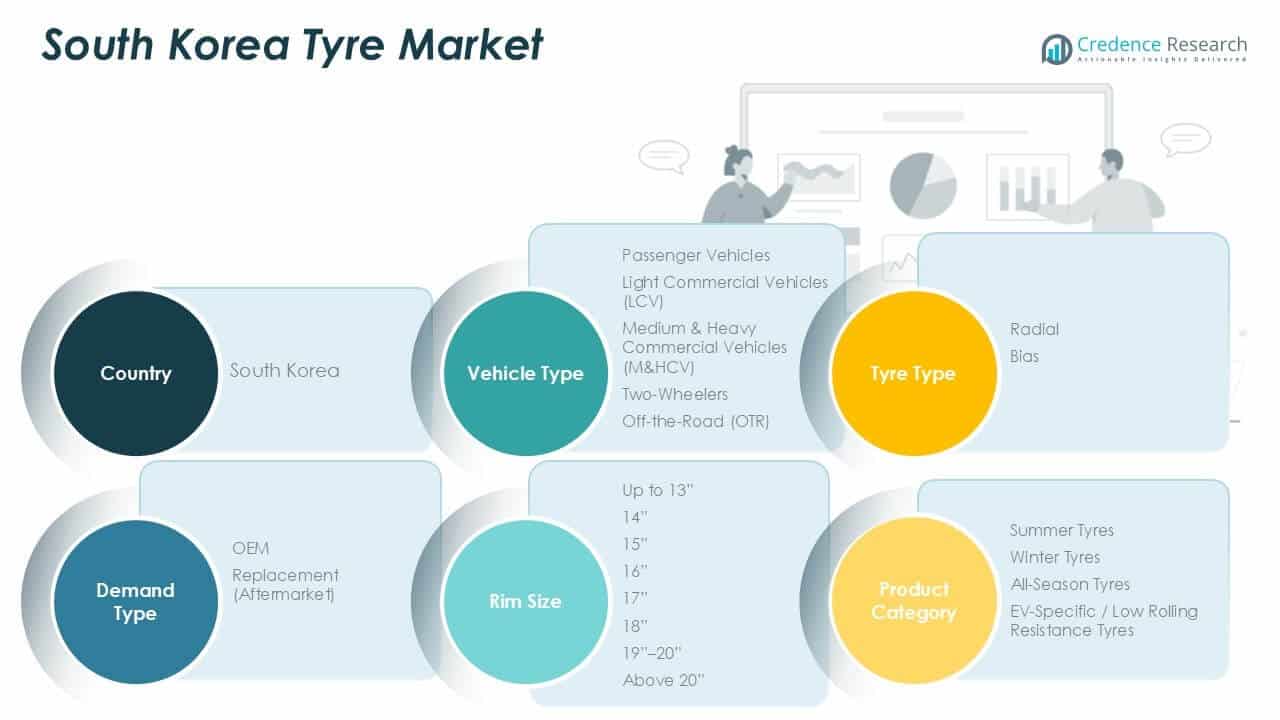
By Vehicle Type
- Passenger Vehicles
- Light Commercial Vehicles (LCV)
- Medium & Heavy Commercial Vehicles (M&HCV)
- Two-Wheelers
- Off-the-Road (OTR)
By Tire Type
- Radial
- Bias
By Product Category
- Summer Tyres
- Winter Tyres
- All-Season Tyres
- EV-Specific / Low Rolling Resistance Tyres
By Demand Type
- OEM
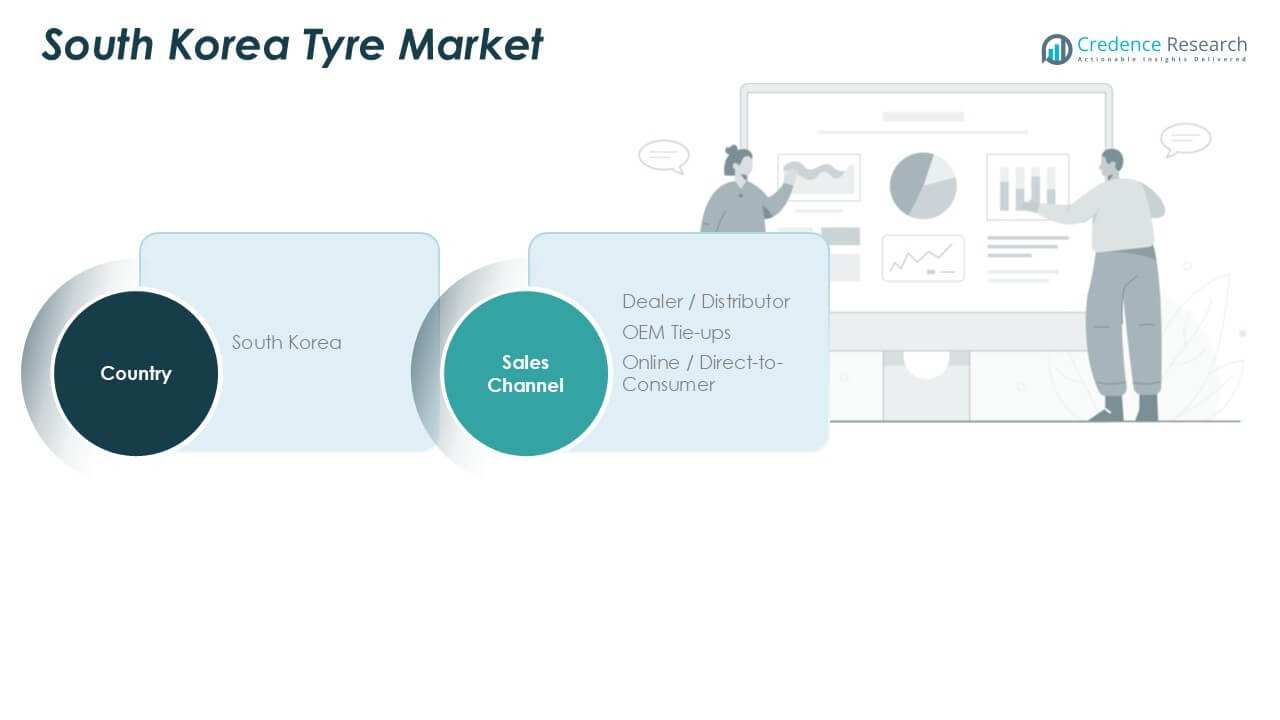
- Replacement (Aftermarket)
By Rim Size
- Up to 13"
- 14"
- 15"
- 16"
- 17"
- 18"
- 19"–20"
- Above 20"
By Sales Channel
- Dealer / Distributor
- OEM Tie-ups
- Online / Direct-to-Consumer
By Geography
- Seoul Capital Area
- Gyeonggi and Incheon
- Gyeongsang Region (Busan, Daegu, Ulsan)
- Jeolla and Chungcheong Regions
- Gangwon and Jeju Regions
Competitive Landscape
The South Korea tyre market is highly competitive, with strong presence from both domestic and international players. Leading local manufacturers Hankook Tire & Technology, Kumho Tire, and Nexen Tire together command a major share of the market, leveraging advanced R&D, brand equity, and OEM partnerships. Hankook maintains a leadership position through its premium offerings and global export strength. Foreign subsidiaries like Michelin Korea and Bridgestone Korea contribute significantly in the replacement and performance tyre segments. The competition intensifies in the mid-tier and budget segments, where imported tyres from China and Southeast Asia gain ground. Companies invest in EV-optimized tyres, smart manufacturing, and digital retail to stay ahead. Product innovation, sustainability initiatives, and distribution expansion remain core strategies among key players. Mergers, OE tie-ups, and expansion into smart tyres and eco-friendly materials define the evolving market dynamics. The landscape favors firms with robust local networks and adaptive product portfolios aligned with mobility trends.
Key Player Analysis
- Hankook Tire & Technology
- Kumho Tire
- Nexen Tire
- Michelin Korea
- Bridgestone Korea
Recent Developments
- In March 2025, Michelin was named one of the world’s 100 most innovative companies by Clarivate, recognizing its strong R&D capabilities. The company also launched the MICHELIN City Touring tire for bicycles, emphasizing safety and sustainability.
- In March 2025, Bridgestone announced its 2025 motorsports plan, continuing support for professional and grassroots motorsports globally. The company is emphasizing sustainable motorsport as a “mobile laboratory” to refine technologies for commercial tire development. Bridgestone remains the exclusive tire supplier for major race series, including Japan’s SUPER GT and North America’s NTT INDYCAR® SERIES.
- In February 2025, Goodyear announced a capacity expansion at its Lawton, Oklahoma facility, targeting production of 10 million additional premium tires annually, especially larger rim sizes and higher-margin segments.
Report Coverage
The research report offers an in-depth analysis based on Vehicle Type, Tire Type, Product, Demand Type, Rim Size, Sales Channel and Geography and Geography. It details leading market players, providing an overview of their business, product offerings, investments, revenue streams, and key applications. Additionally, the report includes insights into the competitive environment, SWOT analysis, current market trends, as well as the primary drivers and constraints. Furthermore, it discusses various factors that have driven market expansion in recent years. The report also explores market dynamics, regulatory scenarios, and technological advancements that are shaping the industry. It assesses the impact of external factors and global economic changes on market growth. Lastly, it provides strategic recommendations for new entrants and established companies to navigate the complexities of the market.
Future Outlook
- The market will benefit from steady growth in vehicle ownership across urban regions.
- Replacement tyres will remain the primary revenue source due to regular inspection cycles.
- Electric vehicle adoption will accelerate demand for EV-specific and low rolling resistance tyres.
- Radial tyres will continue to dominate due to performance and fuel efficiency advantages.
- All-season tyres will gain wider acceptance for year-round usability.
- Digital tyre sales and online booking platforms will expand customer reach.
- Fleet demand from logistics and delivery services will support commercial tyre sales.
- Sustainability will shape product design through recyclable materials and low-emission processes.
- Competition will intensify as imported mid-range brands expand presence.
- Innovation and strong distribution networks will define long-term competitive success.

Request a Free Sample
Fill in your details and we'll send you a free sample report.
- Sample data tables & charts
- Research methodology
Market Dynamics
Strong Replacement Demand Driven by Vehicle Ownership
South Korea’s high vehicle ownership rates, especially in urban centers like Seoul and Busan, lead to frequent tyre replacements due to regulatory inspections and consumer safety preferences. This results in a robust aftermarket segment, accounting for the majority of tyre market revenue.
Expansion of Electric Vehicle (EV) Adoption
Rapid growth in EV sales, supported by government incentives and domestic automaker investments, is driving demand for specialized EV-specific and low rolling resistance tyres. Tyre manufacturers are innovating to meet the unique requirements of EVs, such as noise reduction and improved durability.
Growth in Logistics and E-Commerce Delivery Fleets
The surge in e-commerce has expanded commercial delivery fleets, particularly LCVs and two-wheelers, which require frequent tyre replacements due to intensive usage. This trend is fueling demand for durable, high-performance tyres in both OEM and aftermarket channels.
Digital and Direct-to-Consumer Sales Channels
Increasing consumer comfort with online tyre purchases and the rise of direct-to-consumer platforms are reshaping the retail landscape. This digital transformation enhances accessibility, encourages brand switching, and opens new opportunities for manufacturers to engage customers.
Focus on Sustainable and Smart Tyre Solutions
Growing emphasis on sustainability and smart mobility is prompting manufacturers to invest in eco-friendly materials, fuel-efficient compounds, and smart tyres with embedded sensors. These innovations align with South Korea’s carbon neutrality goals and evolving consumer preferences.
Need a Custom Version of This Report?
Tailor the scope, geography, or segments to your exact requirements.
- Custom geography or segment scope
- Direct access to our analyst team
Frequently Asked Questions
What is the current market size for the South Korea Tyre market, and what is its projected size in 2032?
At what Compound Annual Growth Rate is the South Korea Tyre market projected to grow between 2024 and 2032?
Which South Korea Tyre market segment held the largest share in 2024?
What are the primary factors fueling the growth of the South Korea Tyre market?
Who are the leading companies in the South Korea Tyre market?
Which region commanded the largest share of the South Korea Tyre market in 2024?
Table of Content
Chapter 1 Market Segmentation
- 1.1 Segmentation Framework
- 1.1.1 Product and Service Classification
- 1.1.2 Application and End-Use Classification
- 1.1.3 Technology and Solution Classification
- 1.1.4 Customer and Distribution Channel Classification
- 1.1.5 Geographic Segmentation
- 1.1.6 Market Segment Definitions and Boundaries
- 1.2 By Tire Type
- 1.2.1 Radial
- 1.2.2 Bias
- 1.3 By Vehicle Type
- 1.3.1 Passenger Vehicles
- 1.3.2 Light Commercial Vehicles (LCV)
- 1.3.3 Medium & Heavy Commercial Vehicles (M&HCV)
- 1.3.4 Two-Wheelers
- 1.3.5 Off-the-Road (OTR)
- 1.4 By Sales Channel
- 1.4.1 Dealer / Distributor
- 1.4.2 OEM Tie-ups
- 1.4.3 Online / Direct-to-Consumer
- 1.5 By Product Category
- 1.5.1 All-Season Tyres
- 1.5.2 Winter Tyres
- 1.5.3 Summer Tyres
- 1.5.4 EV-Specific / Low Rolling Resistance Tyres
Chapter 2 Introduction
- 2.1 Report Objectives and Scope
- 2.2 Product Definition and Industry Terminology
- 2.3 Market Inclusions and Exclusions
- 2.4 Research Process
- 2.4.1 Primary Research and Expert Interviews
- 2.4.2 Secondary Research and Source Review
- 2.4.3 Top-Down and Bottom-Up Estimation
- 2.4.4 Data Triangulation and Verification
- 2.5 Market Size Measurement Basis
- 2.5.1 2024: USD 4,605.64 million → 2032: USD 6,877.92 million
- 2.6 Historical and Forecast Reference Periods
- 2.6.1 Base Year: 2024
- 2.6.2 Forecast Period: 2024-2032
- 2.7 Research Assumptions and Limitations
Chapter 3 Executive Summary
- 3.1 Market Snapshot and Key Findings
- 3.2 Base-Year Market Size, 2024
- 3.3 Forecast Market Size, 2032
- 3.4 Revenue and Volume Growth Outlook
- 3.5 Key Demand and Supply Indicators
- 3.6 Leading Market Segments
- 3.7 Fastest-Growing Market Opportunities
- 3.8 Regional Performance Highlights
- 3.9 Technology and Industry Transformation
- 3.10 Competitive Landscape Summary
- 3.11 Analyst View and Strategic Implications
Chapter 4 South Korea Tyre Market Trends and Developments
- 4.1 Historical Industry Development
- 4.2 Recent Market Trends and Developments
- 4.3 Demand and Customer Behavior Trends
- 4.4 Technology and Product Innovation
- 4.5 Artificial Intelligence, Automation and Digitalization
- 4.6 Local Manufacturing and Supply Chain Realignment
- 4.7 Industry Partnerships, Mergers and Acquisitions
- 4.8 Sustainability and Circular Economy Developments
- 4.9 Government and Private Sector Investment Trends
- 4.10 Emerging Business Models and Commercialization
- 4.11 Industry Developments and Announcements
Chapter 5 South Korea Tyre Market Production, Supply and Demand Analysis
- 5.1 Demand Trend and Consumption Analysis
- 5.2 Demand Forecast, 2024-2032
- 5.3 Production and Output Trend
- 5.4 Production and Output Forecast, 2024-2032
- 5.5 Installed Capacity and Capacity Utilization
- 5.6 Company-Wise Production Plants and Statistics
- 5.6.1 Installed Production Capacity
- 5.6.2 Actual Production
- 5.6.3 Planned Capacity and Expansion Targets
- 5.7 Supply Chain Structure and Procurement Trends
- 5.8 Supply-Demand Gap and Bottlenecks
- 5.9 Import Dependence and Sourcing Structure
- 5.10 Contract Manufacturing and Outsourcing
- 5.11 Regional Supply and Demand Concentration
Chapter 6 South Korea Tyre Market Pricing Analysis
- 6.1 Pricing Structure and Measurement
- 6.2 Historical Pricing Trends
- 6.3 Pricing Outlook, 2024-2032
- 6.4 Average Selling Price and Unit Economics
- 6.5 Pricing by Product and Market Segment
- 6.6 Geographic Pricing Differences
- 6.7 Key Input, Energy, Labor and Logistics Costs
- 6.8 Contract Pricing and Purchasing Models
- 6.9 Pricing Sensitivity and Competitive Positioning
- 6.10 Price, Margin and Profitability Implications
Chapter 7 South Korea Tyre Market Dynamics
- 7.1 Market Growth Drivers
- 7.1.1 Demand-Side Drivers
- 7.1.2 Technology and Innovation Drivers
- 7.1.3 Infrastructure and Investment Drivers
- 7.1.4 Regulatory and Policy Drivers
- 7.2 Market Restraints
- 7.2.1 Cost and Affordability Constraints
- 7.2.2 Technology and Adoption Barriers
- 7.2.3 Supply Chain and Operational Constraints
- 7.3 Market Challenges
- 7.3.1 Competitive Pressure and Margin Erosion
- 7.3.2 Skills, Infrastructure and Implementation Gaps
- 7.4 Emerging Market Opportunities
- 7.5 Market Dynamics Impact and Time-Horizon Assessment
Chapter 8 South Korea Tyre Value Chain Analysis
- 8.1 Industry Value Chain Overview
- 8.2 Upstream Suppliers and Critical Inputs
- 8.3 Technology and Component Providers
- 8.4 Manufacturing or Service Delivery
- 8.5 Distribution, Channel Partners and Integrators
- 8.6 Downstream Applications and End Users
- 8.7 Value Addition and Profit Pools
- 8.8 Vertical Integration and Outsourcing
- 8.9 Supplier Concentration and Risk
- 8.10 Supply Chain Localization and Resilience
Chapter 9 South Korea Tyre Market Regulations and Policies
- 9.1 Relevant Laws, Standards and Compliance Frameworks
- 9.2 Product, Service, Safety and Quality Requirements
- 9.3 Government Policies, Incentives and Subsidies
- 9.4 Imports, Exports and Trade Barriers
- 9.5 Public Procurement and Local Content Requirements
- 9.6 Environmental and Sustainability Compliance
- 9.7 Upcoming Policy Changes and Market Implications
Chapter 10 South Korea Tyre Market Hotspots and Opportunities
- 10.1 Market Opportunity Mapping and Growth Hotspots
- 10.2 High-Growth Applications and Customer Groups
- 10.3 Underserved Markets and White-Space Opportunities
- 10.4 Emerging Technology and Product Opportunities
- 10.5 New Capacity and Investment Hotspots
- 10.6 Market Entry and Expansion Opportunities
- 10.7 Distribution and Partnership Opportunities
- 10.8 Near-Term and Long-Term Commercial Potential
- 10.9 Opportunity Attractiveness and Execution Risks
Chapter 11 South Korea Tyre Market Outlook, 2024-2032
- 11.1 Market Size and Analysis
- 11.1.1 Revenue (Market Measurement: 2024: USD 4,605.64 million → 2032: USD 6,877.92 million)
- 11.1.2 Market Volume and Quantity Sold
- 11.1.3 Historical Market Size
- 11.1.4 Base-Year Market Size, 2024
- 11.2 Market Forecast, 2024-2032
- 11.2.1 Revenue Forecast to 2032
- 11.2.2 Volume Forecast to 2032
- 11.2.3 CAGR and Year-on-Year Growth
- 11.2.4 Incremental Revenue Opportunity
- 11.3 Forecast Assumptions and Scenario Analysis
- 11.3.1 Base-Case Forecast
- 11.3.2 Optimistic and Conservative Scenarios
- 11.3.3 Technology, Pricing and Policy Sensitivities
- 11.4 Market Attractiveness and Growth Outlook
Chapter 12 South Korea Tyre Market Segmentation and Outlook
- 12.1 Segmentation Summary and Market Shares, 2024
- 12.2 Largest and Fastest-Growing Segments
- 12.3 By Tire Type - Market Size and Forecast, 2024-2032
- 12.3.1 Segment Definition and Scope
- 12.3.2 Historical Market Size
- 12.3.3 Revenue Forecast, 2024-2032
- 12.3.4 Volume Forecast, 2024-2032
- 12.3.5 Base-Year Market Share, 2024
- 12.3.6 Segment CAGR and Growth Drivers
- 12.3.7 Subsegment Market Size and Forecast
- 12.3.7.1 Radial
- 12.3.7.2 Bias
- 12.3.8 Subsegment Pricing and Adoption Trends
- 12.3.9 Leading Suppliers and Competition
- 12.3.10 Regional Demand and Opportunities
- 12.4 By Vehicle Type - Market Size and Forecast, 2024-2032
- 12.4.1 Segment Definition and Scope
- 12.4.2 Historical Market Size
- 12.4.3 Revenue Forecast, 2024-2032
- 12.4.4 Volume Forecast, 2024-2032
- 12.4.5 Base-Year Market Share, 2024
- 12.4.6 Segment CAGR and Growth Drivers
- 12.4.7 Subsegment Market Size and Forecast
- 12.4.7.1 Passenger Vehicles
- 12.4.7.2 Light Commercial Vehicles (LCV)
- 12.4.7.3 Medium & Heavy Commercial Vehicles (M&HCV)
- 12.4.7.4 Two-Wheelers
- 12.4.7.5 Off-the-Road (OTR)
- 12.4.8 Subsegment Pricing and Adoption Trends
- 12.4.9 Leading Suppliers and Competition
- 12.4.10 Regional Demand and Opportunities
- 12.5 By Sales Channel - Market Size and Forecast, 2024-2032
- 12.5.1 Segment Definition and Scope
- 12.5.2 Historical Market Size
- 12.5.3 Revenue Forecast, 2024-2032
- 12.5.4 Volume Forecast, 2024-2032
- 12.5.5 Base-Year Market Share, 2024
- 12.5.6 Segment CAGR and Growth Drivers
- 12.5.7 Subsegment Market Size and Forecast
- 12.5.7.1 Dealer / Distributor
- 12.5.7.2 OEM Tie-ups
- 12.5.7.3 Online / Direct-to-Consumer
- 12.5.8 Subsegment Pricing and Adoption Trends
- 12.5.9 Leading Suppliers and Competition
- 12.5.10 Regional Demand and Opportunities
- 12.6 By Product Category - Market Size and Forecast, 2024-2032
- 12.6.1 Segment Definition and Scope
- 12.6.2 Historical Market Size
- 12.6.3 Revenue Forecast, 2024-2032
- 12.6.4 Volume Forecast, 2024-2032
- 12.6.5 Base-Year Market Share, 2024
- 12.6.6 Segment CAGR and Growth Drivers
- 12.6.7 Subsegment Market Size and Forecast
- 12.6.7.1 All-Season Tyres
- 12.6.7.2 Winter Tyres
- 12.6.7.3 Summer Tyres
- 12.6.7.4 EV-Specific / Low Rolling Resistance Tyres
- 12.6.8 Subsegment Pricing and Adoption Trends
- 12.6.9 Leading Suppliers and Competition
- 12.6.10 Regional Demand and Opportunities
- 12.7 Segment Growth Comparison
- 12.8 Segment Attractiveness and Priority Matrix
Chapter 13 South Korea Tyre Geographic Market Outlook, 2024-2032
- 13.1 Domestic Market Distribution and Demand Clusters
- 13.2 State- or Province-Wise Market Size and Forecast, 2024-2032
- 13.3 City and Metropolitan Market Outlook
- 13.4 Industrial, Manufacturing and Commercial Clusters
- 13.5 Geographic Concentration of Key End Users
- 13.6 Local Pricing and Purchasing Differences
- 13.7 Domestic Production Facilities and Capacity Map
- 13.8 Local Infrastructure and Project Pipeline
- 13.9 State-Level Policy and Incentive Differences
- 13.10 Subnational Investment Hotspots and Opportunities
- 13.11 Distribution and Logistics Networks
- 13.12 Domestic Competitive Footprint
Chapter 14 South Korea Tyre Technology, Innovation and Sustainability Outlook
- 14.1 Technology Landscape and Maturity
- 14.2 Product, Process and Service Innovation
- 14.3 AI, Automation and Digital Tools in the Industry
- 14.4 Technology Adoption and Performance Benchmarking
- 14.5 Innovation Pipeline and R&D Investment
- 14.6 Patent and Intellectual Property Trends
- 14.7 Energy Efficiency and Resource Management
- 14.8 Sustainability, Recycling and Circularity
- 14.9 Technology Roadmap, 2024-2032
- 14.10 Risks of Obsolescence and Technology Substitution
Chapter 15 South Korea Tyre Market Key Strategic Imperatives
- 15.1 Growth and Market Entry Priorities
- 15.2 High-Return Products and Segments
- 15.3 Pricing, Profitability and Cost Optimization
- 15.4 Technology Investment and Product Differentiation
- 15.5 Supply Chain Localization and Resilience
- 15.6 Distribution and Customer Acquisition
- 15.7 Partnership, Acquisition and Capacity Strategy
- 15.8 Regional Expansion Priorities
- 15.9 Short-, Medium- and Long-Term Actions
Chapter 16 Competition Outlook
- 16.1 Industry Competition Characteristics
- 16.2 Market Structure and Concentration
- 16.3 Market Share and Competitive Positioning, 2024
- 16.4 Company-Wise Revenue and Product Benchmarking
- 16.5 Production and Service Capacity Benchmarking
- 16.6 Technology, Pricing and Differentiation
- 16.7 Regional Footprint and Distribution Strength
- 16.8 Mergers, Acquisitions and Strategic Alliances
- 16.9 New Entrants and Competitive Threats
- 16.10 Porter's Five Forces and Industry Attractiveness
- 16.11 Competitive Outlook, 2024-2032
Chapter 17 Company Profiles
- 17.1 Company Coverage and Selection Criteria
- 17.2 Hankook Tire & Technology
- 17.2.1 Business Description
- 17.2.2 Company Ownership and Geographic Presence
- 17.2.3 Product and Service Portfolio
- 17.2.4 Manufacturing and Operating Footprint
- 17.2.5 Production Capacity and Expansion Plans
- 17.2.6 Financial Performance and Investment
- 17.2.7 Market Share and Competitive Position
- 17.2.8 Technology and Innovation Capabilities
- 17.2.9 Strategic Alliances or Partnerships
- 17.2.10 Recent Developments
- 17.2.11 Growth Strategy and Outlook
- 17.3 Kumho Tire
- 17.4 Nexen Tire
- 17.5 Michelin Korea
- 17.6 Bridgestone Korea
- 17.7 Goodyear
- 17.8 Continental
- 17.9 Pirelli
- 17.10 Yokohama Rubber
- 17.11 Toyo Tire
- 17.12 Other Relevant Market Participants
Note: Every listed company is profiled on the structure shown under the first company. The company list is preliminary and may change based on research findings, market developments, data availability and client requirements.
Chapter 18 Disclaimer
- 18.1 Research and Forecast Disclaimer
- 18.2 Data Source and Estimation Limitations
Note: The depth of individual sections depends on data availability for this market. Volume, capacity, trade and other unit-based metrics are included where applicable.