
Market Overview:
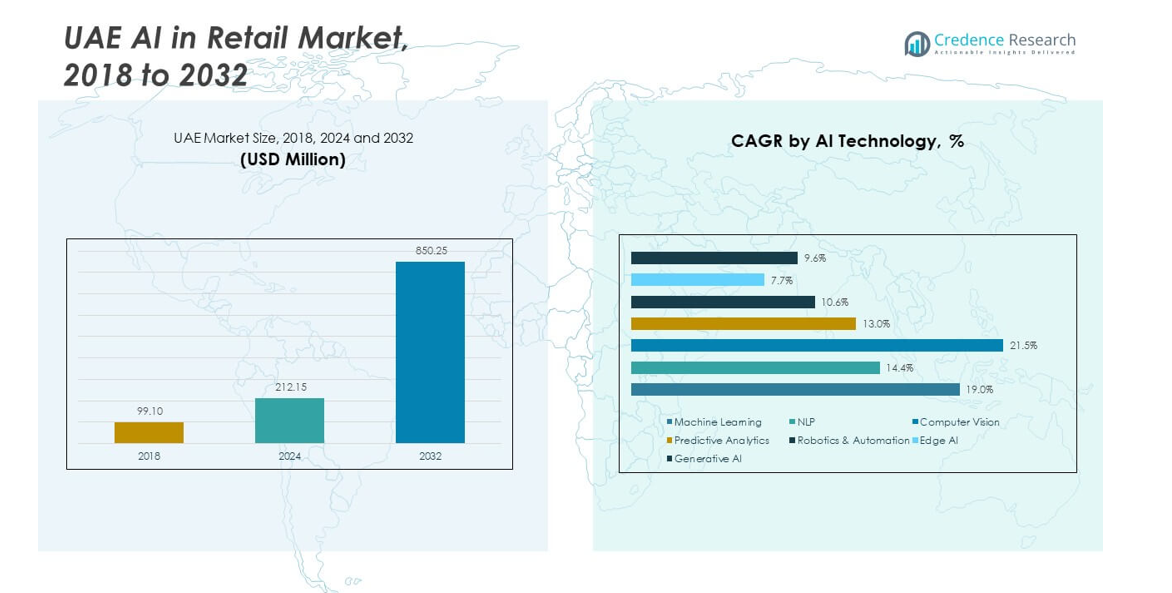
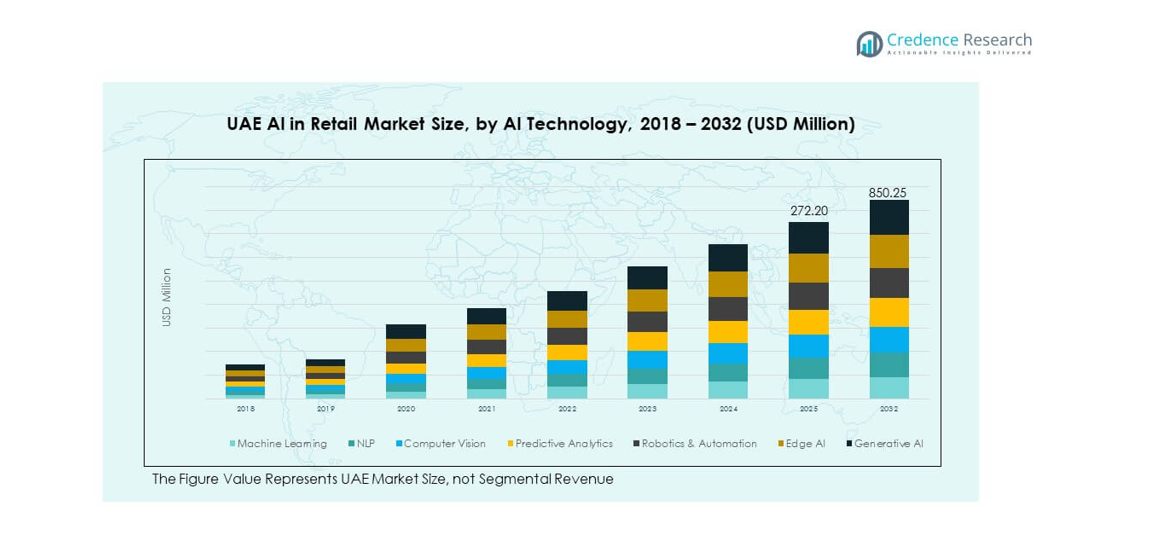
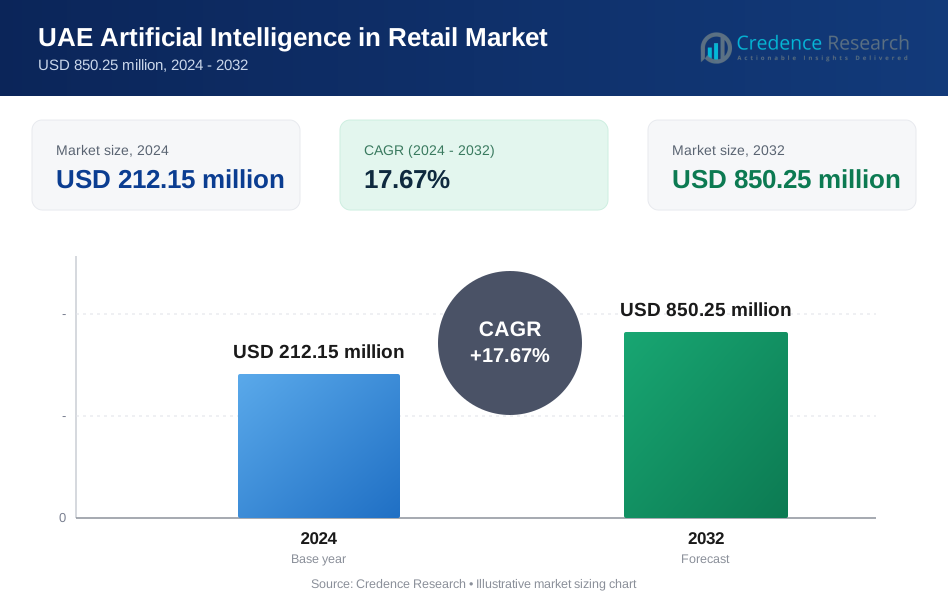
The UAE AI in Retail Market size was valued at USD 99.10 million in 2018 to USD 212.15 million in 2024. The market is anticipated to reach USD 850.25 million by 2032. The forecast period reflects a CAGR of 17.67%.
| REPORT ATTRIBUTE | DETAILS |
|---|---|
| Historical Period | 2020-2023 |
| Base Year | 2024 |
| Forecast Period | 2025-2032 |
| UAE AI in Retail Market Size 2024 | USD 212.15 million |
| UAE AI in Retail Market, CAGR | 17.67% |
| UAE AI in Retail Market Size 2032 | USD 850.25 million |
Retailers adopt AI to improve customer experience and operational speed. Smart analytics helps predict demand and reduce stock gaps. Computer vision supports cashier-less stores and faster checkouts. Personalization engines raise conversion through tailored offers. AI chatbots handle service queries with faster response times. Pricing tools adjust rates in real time. Fraud detection improves payment security. Cloud access lowers deployment costs. Government digital programs support adoption. Strong smartphone use boosts data-driven retail. Omnichannel strategies rely on unified AI platforms.
Dubai leads adoption due to large malls and global brands. Abu Dhabi follows with smart city retail programs. Sharjah shows steady uptake among mid-sized chains. Northern emirates are emerging with value-focused deployments. Urban areas lead due to data access and scale. Tourist hubs adopt AI to manage peak demand. Free zones attract retail technology pilots. Cross-border retailers test models locally. Regional leadership links to infrastructure readiness. Emerging areas grow through franchising expansion.
Market Insights:
- The UAE AI in Retail Market stood at USD 99.10 million in 2018, reached USD 212.15 million in 2024, and is projected to hit USD 850.25 million by 2032, growing at a 17.67% CAGR, driven by rapid digital retail adoption and AI-led automation.
- Dubai (~50%), Abu Dhabi (~30%), and Sharjah & Northern Emirates (~20%) lead regional shares due to mall density, smart city programs, strong cloud infrastructure, and high enterprise retail concentration.
- Sharjah & Northern Emirates represent the fastest-growing region with around 20% share, supported by franchise expansion, cloud-based AI adoption, and rising penetration among mid-sized retailers.
- By AI technology, Machine Learning accounts for ~32% of segment share, driven by demand forecasting, personalization, and customer analytics, while Computer Vision holds ~24% due to checkout automation and store analytics use.
- Predictive Analytics (~18%) and NLP including chatbots (~16%) form the mid-tier share, while other AI technologies including generative and edge AI contribute ~10%, reflecting early-stage but rising adoption.
Market Drivers:
Strong Government Push Toward Digital Retail Transformation And AI Adoption
The UAE AI in Retail Market gains momentum from national digital strategies. Federal and emirate programs promote AI use across commerce. Retailers align operations with smart economy goals. Policy support reduces uncertainty for long-term investments. Public entities encourage data-driven retail systems. Regulatory clarity supports enterprise-scale deployment. Innovation hubs connect retailers with AI vendors.
- For instance, Dubai’s Smart Dubai initiative enabled AI pilots across retail services, where government-backed platforms processed millions of anonymized consumer interactions annually to support data-driven retail planning.
Rising Demand For Hyper-Personalized Customer Shopping Experiences
Retailers seek deeper customer engagement across physical and digital channels. AI enables tailored product recommendations at scale. Loyalty programs use predictive insights for targeted rewards. Customer data helps refine assortments by location. Brands improve basket size through personalization engines. Experience-led retail strengthens repeat visits. Competition pushes rapid adoption across formats.
- For instance, Majid Al Futtaim reported that AI-driven personalization across its Carrefour UAE digital channels analyzed millions of customer transactions yearly to optimize offers and improve repeat purchase frequency.
Need For Operational Efficiency And Real-Time Decision Support
Retail margins face pressure from rising operating costs. AI tools support demand forecasting and inventory accuracy. Retailers reduce stockouts through predictive analytics. Automated pricing improves response to demand shifts. Workforce planning improves through traffic prediction. Decision speed improves across store networks. Cost control remains a core priority.
Growth Of Omnichannel Retail Models And Data Integration Needs
Retailers unify online and offline operations through AI platforms. Data integration supports seamless customer journeys. Unified dashboards improve supply chain visibility. AI supports click-and-collect models. Retailers track behavior across touchpoints. Omnichannel execution raises service consistency. Platform scalability drives investment decisions.
Market Trends:
Expansion Of Computer Vision Systems Across Physical Retail Stores
Retailers deploy vision systems for store analytics. Footfall tracking improves layout decisions. Shelf monitoring reduces manual audits. Theft detection improves store security. Checkout automation gains traction in urban stores. Vision data supports staffing plans. Adoption grows across large retail chains.
- For instance, Majid Al Futtaim reported that AI-driven personalization across its Carrefour UAE digital channels analyzed millions of customer transactions yearly to optimize offers and improve repeat purchase frequency.
Growing Use Of Conversational AI And Virtual Shopping Assistants
Retailers adopt AI assistants for customer interaction. Chatbots handle queries across apps and websites. Voice assistants support product discovery. Response quality improves customer satisfaction. AI reduces load on service teams. Multilingual support fits the local market. Deployment scales across sectors.
- For instance, Microsoft Azure AI-powered chatbots used by UAE retailers support Arabic and English queries and handle tens of thousands of customer conversations per month without human escalation.
Shift Toward Cloud-Based AI Platforms And SaaS Models
Retailers favor cloud delivery for faster deployment. SaaS models reduce upfront costs. Updates roll out without system disruption. Cloud access supports multi-store operations. Data storage scales with demand growth. Vendors offer modular AI services. Flexibility drives platform preference.
Rising Focus On Ethical AI And Data Governance Practices
Retailers prioritize responsible AI use. Data privacy rules shape system design. Transparency builds customer trust. Retailers audit algorithms for bias. Secure data handling gains importance. Governance frameworks guide AI deployment. Compliance influences vendor selection.
Market Challenges Analysis:
High Implementation Costs And Integration Complexity Across Legacy Systems
The UAE AI in Retail Market faces cost-related barriers. AI deployment requires skilled teams and system upgrades. Legacy POS systems limit integration speed. Customization raises project timelines. Small retailers face budget constraints. Integration risks disrupt store operations. Vendor coordination adds complexity. ROI visibility remains uneven during early stages.
Data Privacy Concerns And Shortage Of AI-Skilled Retail Workforce
Retailers manage sensitive consumer data at scale. Compliance requirements increase operational oversight. Data breaches raise reputational risk. Talent shortages slow advanced AI adoption. Retailers depend on external consultants. Training programs need time to mature. Skill gaps affect model accuracy. Workforce readiness remains uneven.
Market Opportunities:
AI Adoption Across Mid-Sized Retailers And Franchise Networks
The UAE AI in Retail Market offers growth among mid-tier retailers. Scalable AI tools suit franchise operations. Cloud platforms reduce entry barriers. Regional chains seek analytics for expansion. Standardized tools improve rollout speed. Vendors target affordable AI solutions. Market penetration can widen rapidly.
Integration Of AI With Smart City And Tourism-Focused Retail Ecosystems
Retail aligns with smart city initiatives. Tourist-heavy zones adopt AI for demand spikes. Language-aware systems serve global visitors. AI supports dynamic merchandising in malls. Event-driven retail gains accuracy. Partnerships with city platforms create new use cases. Long-term ecosystem growth supports innovation.
Market Segmentation Analysis:
By AI Technology
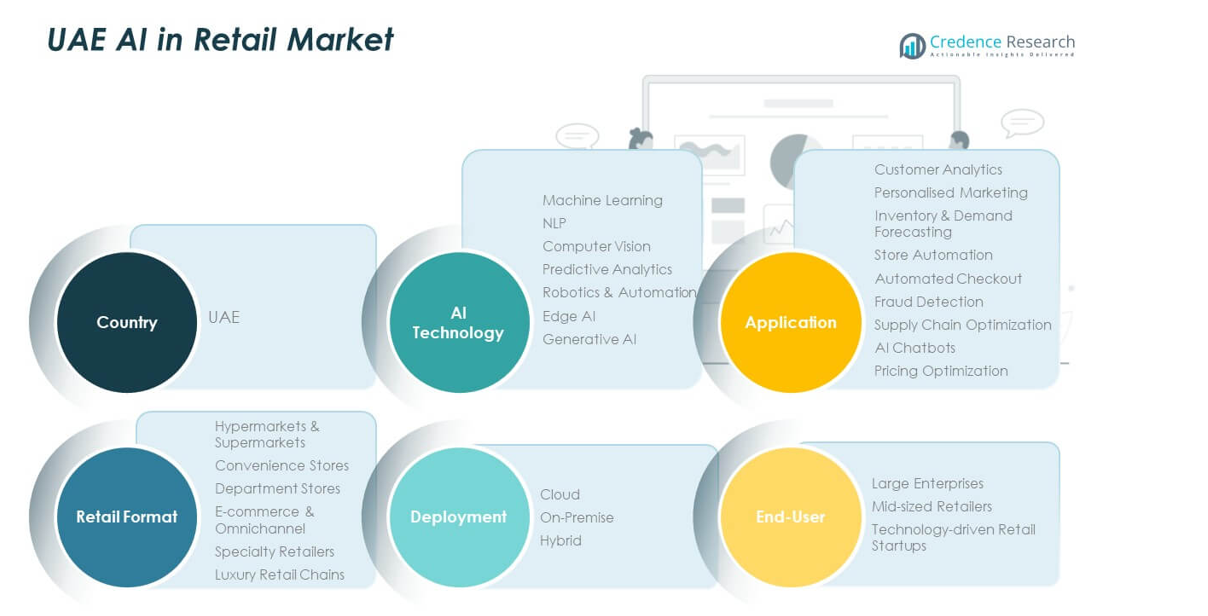
Machine Learning leads adoption through demand forecasting and customer behavior modeling. Computer Vision supports store analytics, loss prevention, and checkout automation. Natural Language Processing enables chatbots and voice-based search. Predictive Analytics improves planning accuracy across supply chains. Others include recommendation engines and anomaly detection tools that support niche retail use cases. Technology choice depends on data maturity and retail scale.
- For instance, SAP MENA’s AI-enabled retail planning tools process millions of historical sales records to generate demand forecasts with automated daily refresh cycles.
By Application
Customer Analytics drives personalization and loyalty management. Virtual Assistants handle service queries and product discovery across channels. Inventory Management uses AI to reduce stock gaps and overstock risks. Pricing Optimization supports dynamic pricing based on demand signals. Fraud Detection protects digital payments and reduces chargebacks. Application focus varies by retail format and digital presence.
- For instance, Oracle Retail AI solutions deployed in the UAE analyze transaction-level data across thousands of daily purchases to flag anomalous payment behavior and reduce digital fraud incidents.
By Retail Format
Supermarkets and hypermarkets deploy AI for volume-driven efficiency. Specialty stores use AI to refine assortments and customer targeting. Convenience stores adopt lightweight AI tools for demand planning. Online retail relies heavily on AI for personalization and automation. Format size shapes deployment depth.
By Deployment
Cloud-based deployment dominates due to scalability and lower upfront costs. It supports multi-store operations and rapid updates. On-premise deployment serves retailers with strict data control needs. Deployment choice reflects security priorities and IT capacity.
By End-User
Large retail chains lead adoption due to scale and data access. Mid-sized retailers adopt modular AI tools to support expansion. Small retailers use limited AI features through SaaS platforms. The UAE AI in Retail Market reflects varied adoption maturity across user groups.
Segmentation:
- By AI Technology
- Machine Learning
- Computer Vision
- Natural Language Processing
- Predictive Analytics
- Others
- By Application
- Customer Analytics
- Virtual Assistants
- Inventory Management
- Pricing Optimization
- Fraud Detection
- By Retail Format
- Supermarkets & Hypermarkets
- Specialty Stores
- Convenience Stores
- Online Retail
- By Deployment
- Cloud-Based
- On-Premise
- By End-User
- Large Retail Chains
- Mid-Sized Retailers
- Small Retailers
- By Region
- Dubai
- Abu Dhabi
- Sharjah
- Northern Emirates
Regional Analysis:
Dubai
Dubai holds the largest share of the UAE AI in Retail Market at about 50%. The emirate leads due to high mall density and global retail brands. Retailers deploy AI for personalization and store analytics. Smart retail aligns with Dubai’s digital economy agenda. Tourist-driven demand supports advanced customer insights. Large retailers test AI innovations at scale. Strong cloud infrastructure accelerates adoption.
Abu Dhabi
Abu Dhabi represents roughly 30% of the market share. Government-backed digital programs support AI adoption. Retailers focus on secure data platforms and compliance. Mall operators adopt AI for demand planning and pricing control. Smart city initiatives encourage automation. Enterprise retailers lead technology investments. Adoption expands steadily across formats.
Sharjah And Northern Emirates
Sharjah and the Northern Emirates together account for around 20% of the market share. Cost-focused retailers adopt modular AI tools. Franchise expansion supports analytics demand. Cloud platforms lower entry barriers for smaller chains. Retailers prioritize inventory accuracy and pricing tools. Urban centers lead adoption. Growth potential remains strong.
Key Player Analysis:
- IBM Middle East
- Microsoft Azure AI
- SAP MENA
- Oracle Middle East
- Majid Al Futtaim
Competitive Analysis:
The UAE AI in Retail Market shows moderate to high competition among global technology firms and regional retail leaders. Large vendors compete on cloud scale, analytics depth, and security features. Retail groups gain advantage through proprietary data and pilot programs. Partnerships shape deployment speed and customization. Cloud platforms reduce switching barriers for retailers. Innovation cycles remain short due to rapid AI upgrades. Competitive strength depends on ecosystem support and integration capability.
Recent Developments:
- In November 2025, Microsoft and G42 announced a major 200-megawatt datacenter expansion through Khazna Data Centers, a G42 subsidiary, as part of Microsoft's $15.2 billion investment announcement in the UAE. This expansion is expected to come online before the end of 2026 and will provide additional world-class AI and cloud infrastructure, strengthening Microsoft Azure's secure and scalable services for the nation's digital economy. The partnership is grounded in the highest standards of cybersecurity, data protection, and ethical AI, with the Responsible AI Future Foundation serving as a global model for responsible AI development and governance.
- Most recently, in November 2025, Oracle announced a major expansion of the Oracle Cloud Abu Dhabi Region with the deployment of the first Oracle Cloud Infrastructure (OCI) Supercluster powered by NVIDIA Blackwell GPUs in the Middle East. Powered by more than 4,000 NVIDIA Blackwell GPUs, this supercluster supports sovereign AI initiatives and helps customers across smart government, energy, financial services, healthcare, logistics, and retail accelerate AI adoption while meeting data sovereignty requirements.
- In October 2025, Oracle expanded its presence in Dubai Internet City with the opening of a state-of-the-art Customer Experience Centre. On October 6, 2025, the center was inaugurated with the introduction of a reimagined Zayed Innovation Hub, one of the first AI-dedicated hubs launched in the UAE. This hub showcases Oracle's enterprise-ready AI solutions through immersive demonstrations and real-world use cases, featuring over 200 Oracle Cloud Infrastructure (OCI) and industry-focused Oracle Fusion Cloud Applications infused with AI and Generative AI capabilities.
- In October 2025, IBM Middle East announced a significant collaboration with Deloitte Middle East at GITEX 2025. On October 14, 2025, Saad Toma, General Manager of IBM Middle East and Africa, and Muhannad Tayem, Technology & Transformation Chief Operating Officer at Deloitte Middle East, signed an agreement to advance generative AI adoption across Gulf Cooperation Council (GCC) organizations. This partnership aims to deliver AI-led and technology-driven services across multiple sectors including banking and finance, government, oil and gas, and energy and utilities, enabling organizations to unlock new opportunities for innovation and growth while maintaining responsible AI practices at scale.
- Additionally, in October 2025, eSolutions, a subsidiary of MDS System Integration Group, hosted successful events in Abu Dhabi and Dubai showcasing "Driving Asset Lifecycle with IBM AI Infused Technology." These two-day sessions brought together industry leaders and enterprise decision-makers to explore how AI, automation, and data-driven insights are transforming asset management and operational efficiency across Middle Eastern industries.
Report Coverage:
The research report offers an in-depth analysis based on AI technology, application, retail format, deployment, end-user, and region. It details leading market players, providing an overview of their business, product offerings, investments, revenue streams, and key applications. Additionally, the report includes insights into the competitive environment, SWOT analysis, current market trends, as well as the primary drivers and constraints. Furthermore, it discusses various factors that have driven market expansion in recent years. The report also explores market dynamics, regulatory scenarios, and technological advancements that are shaping the industry. It assesses the impact of external factors and global economic changes on market growth. Lastly, it provides strategic recommendations for new entrants and established companies to navigate the complexities of the market.
Future Outlook:
- Retailers expand AI-led personalization across physical and digital channels.
- Cloud-based AI platforms gain wider adoption among mid-sized retailers.
- Computer vision use increases in checkout and store analytics.
- Data governance becomes a core deployment criterion.
- Omnichannel AI integration strengthens customer engagement.
- Smart city programs support retail automation initiatives.
- Franchise networks adopt scalable AI tools.
- AI-driven pricing tools gain wider acceptance.
- Workforce upskilling improves AI utilization.
- Partnerships accelerate innovation and deployment speed.
Request a Free Sample
Fill in your details and we'll send you a free sample report.
- Sample data tables & charts
- Research methodology
Market Dynamics
Strong Government Push Toward Digital Retail Transformation and AI Adoption
Federal and emirate-level digital strategies, such as Dubai’s Smart Dubai initiative, actively promote AI integration in retail, reducing regulatory uncertainty and encouraging long-term investments in data-driven retail systems.
Rising Demand for Hyper-Personalized Customer Shopping Experiences
Retailers are leveraging AI to deliver tailored product recommendations, targeted loyalty rewards, and location-specific assortments, which enhances customer engagement and increases repeat purchases across both physical and digital channels.
Need for Operational Efficiency and Real-Time Decision Support
AI-powered tools for demand forecasting, inventory management, and automated pricing help retailers optimize operations, reduce stockouts, and improve decision speed, addressing the pressure of rising operating costs and tight retail margins.
Growth of Omnichannel Retail Models and Data Integration Needs
The shift toward unified online and offline retail experiences is driving adoption of AI platforms that enable seamless customer journeys, integrated dashboards, and scalable supply chain visibility, supporting the UAE’s rapidly evolving omnichannel landscape.
Expansion of Cloud-Based AI Platforms and SaaS Models
Cloud-based AI solutions lower entry barriers for mid-sized and smaller retailers, enabling rapid deployment, scalability, and cost-effective access to advanced analytics and automation, which accelerates market penetration and innovation cycles.
Need a Custom Version of This Report?
Tailor the scope, geography, or segments to your exact requirements.
- Custom geography or segment scope
- Direct access to our analyst team
Frequently Asked Questions
What is the current market size for UAE AI in Retail Market, and what is its projected size in 2032?
At what Compound Annual Growth Rate is the UAE AI in Retail Market projected to grow between 2024 and 2032
Which UAE AI in Retail Market segment held the largest share in 2024?
What are the primary factors fueling the growth of the UAE AI in Retail Market?
Who are the leading companies in the UAE AI in Retail Market?
Which region commanded the largest share of the UAE AI in Retail Market in 2024?
Table of Content
Chapter 1 Market Segmentation
- 1.1 Segmentation Framework
- 1.1.1 Product and Service Classification
- 1.1.2 Application and End-Use Classification
- 1.1.3 Technology and Solution Classification
- 1.1.4 Customer and Distribution Channel Classification
- 1.1.5 Geographic Segmentation
- 1.1.6 Market Segment Definitions and Boundaries
- 1.2 By Deployment
- 1.2.1 Cloud-Based
- 1.2.2 On-Premise
- 1.3 By Application
- 1.3.1 Customer Analytics
- 1.3.2 Virtual Assistants
- 1.3.3 Inventory Management
- 1.3.4 Pricing Optimization
- 1.3.5 Fraud Detection
- 1.4 By AI Technology
- 1.4.1 Machine Learning
- 1.4.2 Computer Vision
- 1.4.3 Natural Language Processing
- 1.4.4 Predictive Analytics
- 1.4.5 Others
- 1.5 By Retail Format
- 1.5.1 Supermarkets & Hypermarkets
- 1.5.2 Specialty Stores
- 1.5.3 Convenience Stores
- 1.5.4 Online Retail
Chapter 2 Introduction
- 2.1 Report Objectives and Scope
- 2.2 Product Definition and Industry Terminology
- 2.3 Market Inclusions and Exclusions
- 2.4 Research Process
- 2.4.1 Primary Research and Expert Interviews
- 2.4.2 Secondary Research and Source Review
- 2.4.3 Top-Down and Bottom-Up Estimation
- 2.4.4 Data Triangulation and Verification
- 2.5 Market Size Measurement Basis
- 2.5.1 2024: USD 212.15 million → 2032: USD 850.25 million
- 2.6 Historical and Forecast Reference Periods
- 2.6.1 Base Year: 2024
- 2.6.2 Forecast Period: 2024-2032
- 2.7 Research Assumptions and Limitations
Chapter 3 Executive Summary
- 3.1 Market Snapshot and Key Findings
- 3.2 Base-Year Market Size, 2024
- 3.3 Forecast Market Size, 2032
- 3.4 Revenue and Volume Growth Outlook
- 3.5 Key Demand and Supply Indicators
- 3.6 Leading Market Segments
- 3.7 Fastest-Growing Market Opportunities
- 3.8 Regional Performance Highlights
- 3.9 Technology and Industry Transformation
- 3.10 Competitive Landscape Summary
- 3.11 Analyst View and Strategic Implications
Chapter 4 UAE Artificial Intelligence in Retail Market Trends and Developments
- 4.1 Historical Industry Development
- 4.2 Recent Market Trends and Developments
- 4.3 Demand and Customer Behavior Trends
- 4.4 Technology and Product Innovation
- 4.5 Artificial Intelligence, Automation and Digitalization
- 4.6 Local Manufacturing and Supply Chain Realignment
- 4.7 Industry Partnerships, Mergers and Acquisitions
- 4.8 Sustainability and Circular Economy Developments
- 4.9 Government and Private Sector Investment Trends
- 4.10 Emerging Business Models and Commercialization
- 4.11 Industry Developments and Announcements
Chapter 5 UAE Artificial Intelligence in Retail Market Production, Supply and Demand Analysis
- 5.1 Demand Trend and Consumption Analysis
- 5.2 Demand Forecast, 2024-2032
- 5.3 Production and Output Trend
- 5.4 Production and Output Forecast, 2024-2032
- 5.5 Installed Capacity and Capacity Utilization
- 5.6 Company-Wise Production Plants and Statistics
- 5.6.1 Installed Production Capacity
- 5.6.2 Actual Production
- 5.6.3 Planned Capacity and Expansion Targets
- 5.7 Supply Chain Structure and Procurement Trends
- 5.8 Supply-Demand Gap and Bottlenecks
- 5.9 Import Dependence and Sourcing Structure
- 5.10 Contract Manufacturing and Outsourcing
- 5.11 Regional Supply and Demand Concentration
Chapter 6 UAE Artificial Intelligence in Retail Market Pricing Analysis
- 6.1 Pricing Structure and Measurement
- 6.2 Historical Pricing Trends
- 6.3 Pricing Outlook, 2024-2032
- 6.4 Average Selling Price and Unit Economics
- 6.5 Pricing by Product and Market Segment
- 6.6 Geographic Pricing Differences
- 6.7 Key Input, Energy, Labor and Logistics Costs
- 6.8 Contract Pricing and Purchasing Models
- 6.9 Pricing Sensitivity and Competitive Positioning
- 6.10 Price, Margin and Profitability Implications
Chapter 7 UAE Artificial Intelligence in Retail Market Dynamics
- 7.1 Market Growth Drivers
- 7.1.1 Demand-Side Drivers
- 7.1.2 Technology and Innovation Drivers
- 7.1.3 Infrastructure and Investment Drivers
- 7.1.4 Regulatory and Policy Drivers
- 7.2 Market Restraints
- 7.2.1 Cost and Affordability Constraints
- 7.2.2 Technology and Adoption Barriers
- 7.2.3 Supply Chain and Operational Constraints
- 7.3 Market Challenges
- 7.3.1 Competitive Pressure and Margin Erosion
- 7.3.2 Skills, Infrastructure and Implementation Gaps
- 7.4 Emerging Market Opportunities
- 7.5 Market Dynamics Impact and Time-Horizon Assessment
Chapter 8 UAE Artificial Intelligence in Retail Value Chain Analysis
- 8.1 Industry Value Chain Overview
- 8.2 Upstream Suppliers and Critical Inputs
- 8.3 Technology and Component Providers
- 8.4 Manufacturing or Service Delivery
- 8.5 Distribution, Channel Partners and Integrators
- 8.6 Downstream Applications and End Users
- 8.7 Value Addition and Profit Pools
- 8.8 Vertical Integration and Outsourcing
- 8.9 Supplier Concentration and Risk
- 8.10 Supply Chain Localization and Resilience
Chapter 9 UAE Artificial Intelligence in Retail Market Regulations and Policies
- 9.1 Relevant Laws, Standards and Compliance Frameworks
- 9.2 Product, Service, Safety and Quality Requirements
- 9.3 Government Policies, Incentives and Subsidies
- 9.4 Imports, Exports and Trade Barriers
- 9.5 Public Procurement and Local Content Requirements
- 9.6 Environmental and Sustainability Compliance
- 9.7 Data Protection, AI and Cybersecurity Compliance
- 9.8 Upcoming Policy Changes and Market Implications
Chapter 10 UAE Artificial Intelligence in Retail Market Hotspots and Opportunities
- 10.1 Market Opportunity Mapping and Growth Hotspots
- 10.2 High-Growth Applications and Customer Groups
- 10.3 Underserved Markets and White-Space Opportunities
- 10.4 Emerging Technology and Product Opportunities
- 10.5 New Capacity and Investment Hotspots
- 10.6 Market Entry and Expansion Opportunities
- 10.7 Distribution and Partnership Opportunities
- 10.8 Near-Term and Long-Term Commercial Potential
- 10.9 Opportunity Attractiveness and Execution Risks
Chapter 11 UAE Artificial Intelligence in Retail Market Outlook, 2024-2032
- 11.1 Market Size and Analysis
- 11.1.1 Revenue (Market Measurement: 2024: USD 212.15 million → 2032: USD 850.25 million)
- 11.1.2 Market Volume and Quantity Sold
- 11.1.3 Historical Market Size
- 11.1.4 Base-Year Market Size, 2024
- 11.2 Market Forecast, 2024-2032
- 11.2.1 Revenue Forecast to 2032
- 11.2.2 Volume Forecast to 2032
- 11.2.3 CAGR and Year-on-Year Growth
- 11.2.4 Incremental Revenue Opportunity
- 11.3 Forecast Assumptions and Scenario Analysis
- 11.3.1 Base-Case Forecast
- 11.3.2 Optimistic and Conservative Scenarios
- 11.3.3 Technology, Pricing and Policy Sensitivities
- 11.4 Market Attractiveness and Growth Outlook
Chapter 12 UAE Artificial Intelligence in Retail Market Segmentation and Outlook
- 12.1 Segmentation Summary and Market Shares, 2024
- 12.2 Largest and Fastest-Growing Segments
- 12.3 By Deployment - Market Size and Forecast, 2024-2032
- 12.3.1 Segment Definition and Scope
- 12.3.2 Historical Market Size
- 12.3.3 Revenue Forecast, 2024-2032
- 12.3.4 Volume Forecast, 2024-2032
- 12.3.5 Base-Year Market Share, 2024
- 12.3.6 Segment CAGR and Growth Drivers
- 12.3.7 Subsegment Market Size and Forecast
- 12.3.7.1 Cloud-Based
- 12.3.7.2 On-Premise
- 12.3.8 Subsegment Pricing and Adoption Trends
- 12.3.9 Leading Suppliers and Competition
- 12.3.10 Regional Demand and Opportunities
- 12.4 By Application - Market Size and Forecast, 2024-2032
- 12.4.1 Segment Definition and Scope
- 12.4.2 Historical Market Size
- 12.4.3 Revenue Forecast, 2024-2032
- 12.4.4 Volume Forecast, 2024-2032
- 12.4.5 Base-Year Market Share, 2024
- 12.4.6 Segment CAGR and Growth Drivers
- 12.4.7 Subsegment Market Size and Forecast
- 12.4.7.1 Customer Analytics
- 12.4.7.2 Virtual Assistants
- 12.4.7.3 Inventory Management
- 12.4.7.4 Pricing Optimization
- 12.4.7.5 Fraud Detection
- 12.4.8 Subsegment Pricing and Adoption Trends
- 12.4.9 Leading Suppliers and Competition
- 12.4.10 Regional Demand and Opportunities
- 12.5 By AI Technology - Market Size and Forecast, 2024-2032
- 12.5.1 Segment Definition and Scope
- 12.5.2 Historical Market Size
- 12.5.3 Revenue Forecast, 2024-2032
- 12.5.4 Volume Forecast, 2024-2032
- 12.5.5 Base-Year Market Share, 2024
- 12.5.6 Segment CAGR and Growth Drivers
- 12.5.7 Subsegment Market Size and Forecast
- 12.5.7.1 Machine Learning
- 12.5.7.2 Computer Vision
- 12.5.7.3 Natural Language Processing
- 12.5.7.4 Predictive Analytics
- 12.5.7.5 Others
- 12.5.8 Subsegment Pricing and Adoption Trends
- 12.5.9 Leading Suppliers and Competition
- 12.5.10 Regional Demand and Opportunities
- 12.6 By Retail Format - Market Size and Forecast, 2024-2032
- 12.6.1 Segment Definition and Scope
- 12.6.2 Historical Market Size
- 12.6.3 Revenue Forecast, 2024-2032
- 12.6.4 Volume Forecast, 2024-2032
- 12.6.5 Base-Year Market Share, 2024
- 12.6.6 Segment CAGR and Growth Drivers
- 12.6.7 Subsegment Market Size and Forecast
- 12.6.7.1 Supermarkets & Hypermarkets
- 12.6.7.2 Specialty Stores
- 12.6.7.3 Convenience Stores
- 12.6.7.4 Online Retail
- 12.6.8 Subsegment Pricing and Adoption Trends
- 12.6.9 Leading Suppliers and Competition
- 12.6.10 Regional Demand and Opportunities
- 12.7 Segment Growth Comparison
- 12.8 Segment Attractiveness and Priority Matrix
Chapter 13 UAE Artificial Intelligence in Retail End-Use and Application Market Outlook
- 13.1 End-Use Industry and Customer Demand Structure
- 13.2 Leading Applications and Customer Groups
- 13.3 End-Use Market Size, Share and Forecast
- 13.4 Major End-Use Industry Deep Dives
- 13.4.1 Customer Requirements and Use Cases
- 13.4.2 Demand and Replacement Cycles
- 13.4.3 Technical and Regulatory Considerations
- 13.4.4 Purchasing and Procurement Models
- 13.4.5 Leading Vendors and Distribution Channels
- 13.4.6 Forecast and Commercial Opportunities
- 13.5 Emerging Applications and Cross-Segment Demand
- 13.6 End-Use Industry Investment Priorities
Chapter 14 UAE Artificial Intelligence in Retail Geographic Market Outlook, 2024-2032
- 14.1 Domestic Market Distribution and Demand Clusters
- 14.2 State- or Province-Wise Market Size and Forecast, 2024-2032
- 14.3 City and Metropolitan Market Outlook
- 14.4 Industrial, Manufacturing and Commercial Clusters
- 14.5 Geographic Concentration of Key End Users
- 14.6 Local Pricing and Purchasing Differences
- 14.7 Domestic Production Facilities and Capacity Map
- 14.8 Local Infrastructure and Project Pipeline
- 14.9 State-Level Policy and Incentive Differences
- 14.10 Subnational Investment Hotspots and Opportunities
- 14.11 Distribution and Logistics Networks
- 14.12 Domestic Competitive Footprint
Chapter 15 UAE Artificial Intelligence in Retail Technology, Innovation and Sustainability Outlook
- 15.1 Technology Landscape and Maturity
- 15.2 Product, Process and Service Innovation
- 15.3 AI, Automation and Digital Tools in the Industry
- 15.4 Technology Adoption and Performance Benchmarking
- 15.5 Innovation Pipeline and R&D Investment
- 15.6 Patent and Intellectual Property Trends
- 15.7 Energy Efficiency and Resource Management
- 15.8 Sustainability, Recycling and Circularity
- 15.9 Technology Roadmap, 2024-2032
- 15.10 Risks of Obsolescence and Technology Substitution
Chapter 16 UAE Artificial Intelligence in Retail Market Key Strategic Imperatives
- 16.1 Growth and Market Entry Priorities
- 16.2 High-Return Products and Segments
- 16.3 Pricing, Profitability and Cost Optimization
- 16.4 Technology Investment and Product Differentiation
- 16.5 Supply Chain Localization and Resilience
- 16.6 Distribution and Customer Acquisition
- 16.7 Partnership, Acquisition and Capacity Strategy
- 16.8 Regional Expansion Priorities
- 16.9 Short-, Medium- and Long-Term Actions
Chapter 17 Competition Outlook
- 17.1 Industry Competition Characteristics
- 17.2 Market Structure and Concentration
- 17.3 Market Share and Competitive Positioning, 2024
- 17.4 Company-Wise Revenue and Product Benchmarking
- 17.5 Production and Service Capacity Benchmarking
- 17.6 Technology, Pricing and Differentiation
- 17.7 Regional Footprint and Distribution Strength
- 17.8 Mergers, Acquisitions and Strategic Alliances
- 17.9 New Entrants and Competitive Threats
- 17.10 Porter's Five Forces and Industry Attractiveness
- 17.11 Competitive Outlook, 2024-2032
Chapter 18 Company Profiles
- 18.1 Company Coverage and Selection Criteria
- 18.2 IBM Middle East
- 18.2.1 Business Description
- 18.2.2 Company Ownership and Geographic Presence
- 18.2.3 Product and Service Portfolio
- 18.2.4 Manufacturing and Operating Footprint
- 18.2.5 Production Capacity and Expansion Plans
- 18.2.6 Financial Performance and Investment
- 18.2.7 Market Share and Competitive Position
- 18.2.8 Technology and Innovation Capabilities
- 18.2.9 Strategic Alliances or Partnerships
- 18.2.10 Recent Developments
- 18.2.11 Growth Strategy and Outlook
- 18.3 Microsoft Azure AI
- 18.4 SAP MENA
- 18.5 Oracle Middle East
- 18.6 Majid Al Futtaim
- 18.7 Google Cloud
- 18.8 Amazon Web Services (AWS)
- 18.9 eSolutions (MDS System Integration Group)
- 18.10 Deloitte Middle East
- 18.11 NVIDIA
- 18.12 Other Relevant Market Participants
Note: Every listed company is profiled on the structure shown under the first company. The company list is preliminary and may change based on research findings, market developments, data availability and client requirements.
Chapter 19 Disclaimer
- 19.1 Research and Forecast Disclaimer
- 19.2 Data Source and Estimation Limitations
Note: The depth of individual sections depends on data availability for this market. Volume, capacity, trade and other unit-based metrics are included where applicable.

